
Slate Coasters from Jiujiang: Natural Stone Coasters, Custom Finishes & Wholesale Sourcing
Pick it up. Natural slate coasters combine the distinctive texture of real stone with practical tabletop protection. Sourced from Jiujiang, China, they can be produced in a range of sizes, surface finishes and edge styles, with optional sealing, logo engraving and custom packaging for retail, hospitality and corporate gifts. This guide follows one coaster through the examination a careful buyer puts it through — the object, the face, the edge, the section, the mark, the box — and then through the commercial layer behind it: wholesale sourcing, engraving programmes, private-label supply, and what the Jiujiang origin actually contributes.
Slate coasters from Jiujiang open the Crafts & Giftware section of the Jiujiang Slate Guide: the same regional stone as the roofing and billiard families, read at table scale instead of slab scale. The readers differ from those pages. For buyers and gift shoppers evaluating natural slate coasters from China, the questions run at two levels. A retail shopper or gift buyer wants to know how the piece looks, feels and survives a dinner party. An importer, a promotional-goods agency or a private-label brand wants to know about dimensional consistency, engraving quality, packaging survival and repeat batches. Both are covered in the sections below.
One clarification first, because it frames everything below. There is no roofing-style test certificate behind the phrase "tested slate coaster". The EN and ASTM regimes that govern roofing slate describe roofing slate; they do not follow the stone into tabletop products. Small-format coasters are specified the way small-format stone has always been specified — written specification, approved sample, inspection criteria — and this article is organised around exactly those documents.
| LOOK AT | WHAT IT SETTLES | WHAT YOU SPECIFY |
|---|---|---|
| The face | Cleft or honed; sealed or left as-cut | Finish, treatment and the wet-glass test on the sample |
| The edge | Hand-feel, perceived quality, chipping risk | Edge profile and the defect criteria in QC |
| The section | Format, shape and thickness | Dimensions with tolerances, confirmed per order |
| The mark | Engraving contrast and branding | Artwork, size, position, approval on a sample |
| The box | Retail value and transit survival | Packaging spec and carton markings before production |
Quick answer: the quality of a natural slate coaster depends on its material, dimensions, surface finish, edge treatment, marking and packaging. The face, the edge, the section, the mark and the box each carry a decision of their own, and each one is settled on a sample — not on a catalogue photograph. The sections below settle them in order, working from one rule: a regional name identifies a source of stone, never a finished product.
The Object in Your Hand — What a Slate Coaster Is, and Does
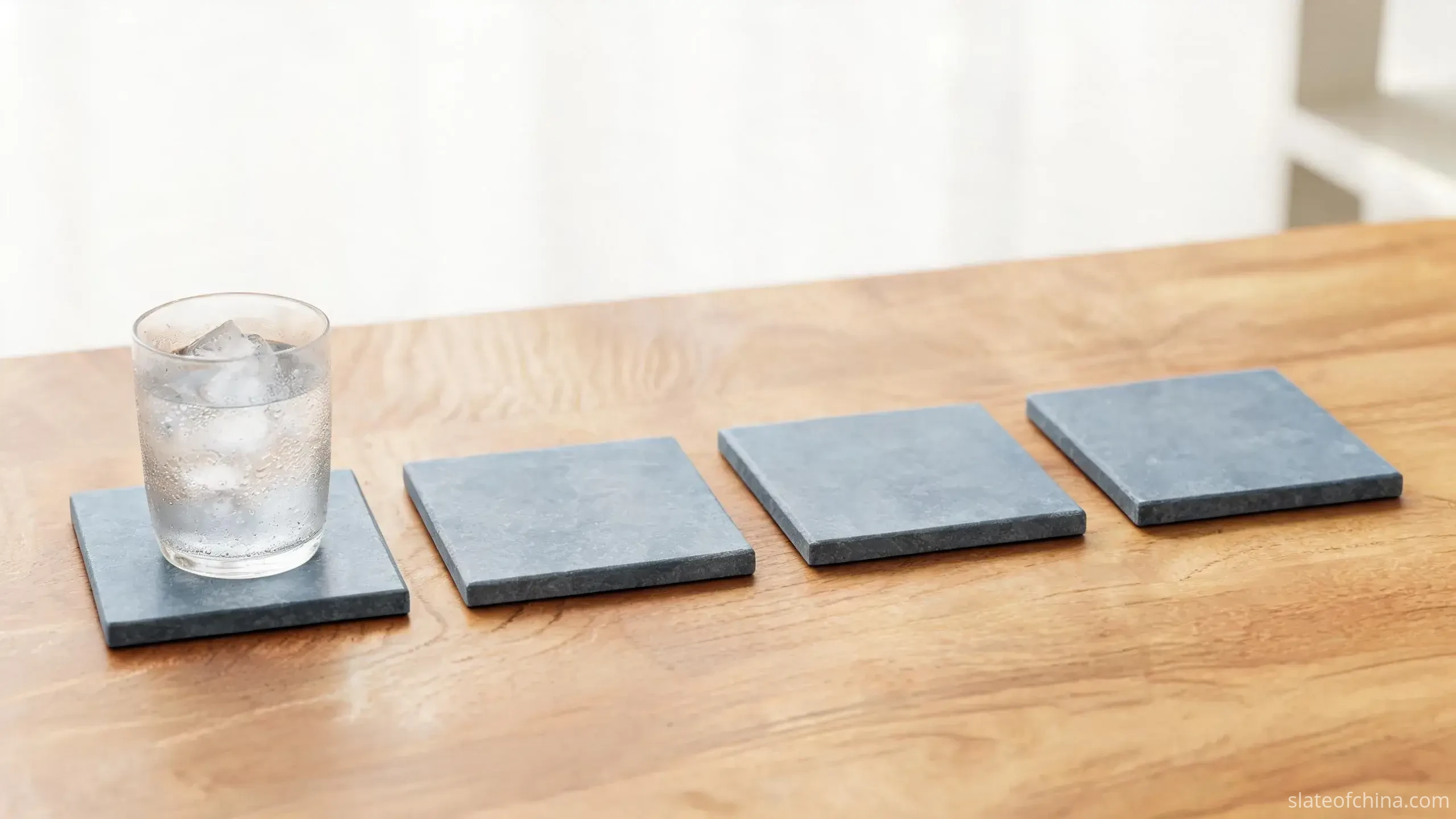
Set a cold glass on it. The job list is short: a coaster has to interrupt condensation rings, heat marks and the daily scuff of cups and glasses. Slate brings three qualities to that short list. Mass — a stone coaster does not wander around the table the way a light one does. Face — a surface that reads as material rather than print, with the faint mottling and the cool blue-grey tone of the family described in What Is Jiujiang Slate. And a markable surface — slate accepts engraving, which is why the same object serves dinner tables and brand campaigns at once.
The limitations, read at the same time: slate is not flexible, it does not bounce, and it can chip if it lands edge-first on a hard floor. A broken corner on a dropped coaster is an impact, not a manufacturing defect. The sections on edges and packaging exist because that risk is managed through design — edge treatment first, transit protection second. What separates a good slate coaster from a poor one is not the stone's identity but the specification discipline around it.
Physically, the product is a thin piece of stone split or sawn from larger stock, cut to a format, then finished on its face and edges. Two face philosophies run through everything: the natural cleft face — the split surface the stone offers along its bedding — and processed faces, honed or smoothed to a calmer, more uniform appearance. Neither is superior; they are different products, priced and QC-checked differently.
Natural variation comes with the material. Colour tone, mottling intensity and edge character differ from piece to piece, and that difference is part of what buyers of natural stone are paying for. Brands that need a tighter appearance do not fight the geology; they define the accepted variation range against a retained reference sample before mass production. The most under-specified sentence in gift-product sourcing is the one describing acceptable variation.
Who buys this product: households and lifestyle retail; hotels, restaurants and bars running coordinated tabletop accessories; corporate-gift programmes and wedding favours; promotional merchandise for campaigns and events; boxed gift collections for homeware stores; and private-label lines built to a retailer's own spec. The same belt supplies the big formats — roofing slate and billiard slate — and this article is the specification layer all of those markets share when the format shrinks.
The Face and the Edge — Finishes, Sealing and Three Edge Styles
Turn it under the light. The face changes first. A cleft face carries the split character of the stone — subtle relief, a faint sheen of mineral, a surface that photographs as craft. A honed face is ground smooth: quieter, more contemporary, and easier to keep visually consistent across a retail run. The same stone can look a different grey by the time it is honed — which is why finishes are approved on physical samples, under the lighting the product will actually live in, rather than compared from two screen images.
To seal or not to seal. Sealing is an option, not a default, and sealed slate coasters deserve a closer question than the name suggests. A suitable penetrating or surface treatment can slow liquid absorption and staining; it does not make the piece waterproof or stain-proof, and it can change colour, sheen, surface feel and the aftercare instructions that should travel with the product. Before specifying a treatment, a buyer should be able to answer five questions:
- What treatment product and application method will be used, and what does the supplier document about it?
- Does the treated surface change the original colour or texture — and does that change match the retail look intended?
- How does the treated sample respond to water, coffee, tea and red wine — the four liquids a coaster actually meets?
- Is the treatment appropriate for a tabletop accessory, and what happens on renewal — is it a once-only or maintenance regime?
- What care instructions ship with the product, and in what languages?
If the intended use involves direct food contact or a market with material-safety requirements, the suitability and documentation of any coating should be verified against that use. A coaster standing under a glass is usually not a food-contact surface — but the intended use should still be declared, and the paperwork should follow it.
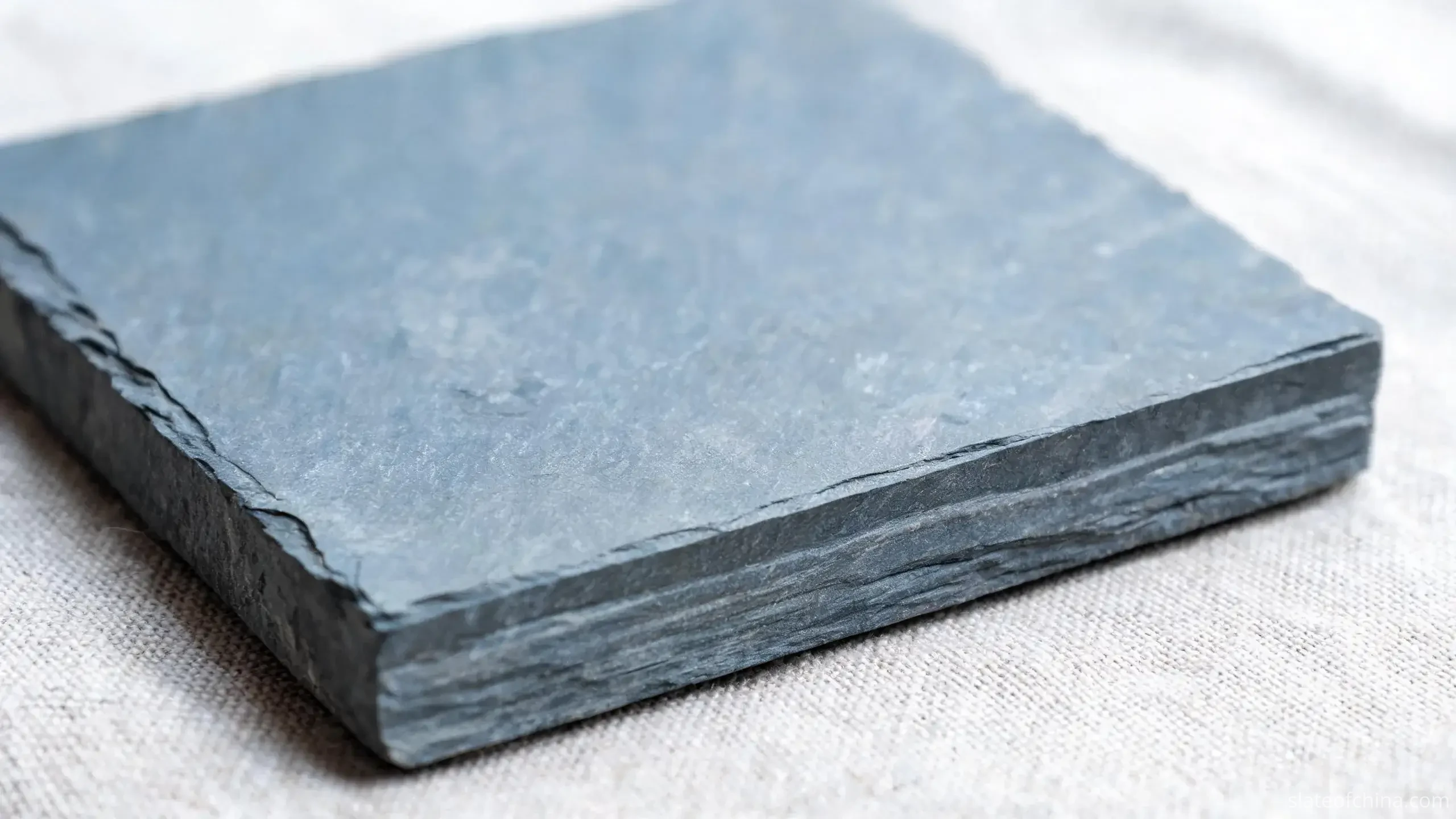
Run a thumb around the edge. The edge is where a coaster stops being a picture and becomes an object. Three styles cover the market:
- Straight-cut edges — clean, geometric, and the natural companion to a honed face.
- Beveled (chamfered) edges — a small relieved profile that softens the perimeter in the eye and in the hand; the standard choice for gift retail.
- Natural-style edges — the split outline kept, irregular and characterful; the look most engraved gift coasters on the market actually carry.
A machine edge points to the workshop behind it; a natural edge points to the stone itself. Neither is cosmetic: edge quality is the QC checkpoint where chipping, sharp arrises and loose flakes are caught. Repeatability is further evidence of process — an identical chamfer across two thousand pieces depends on machine finishing, on the same cutting and finishing equipment the region built for its larger formats.
Looking for custom slate coasters?
Natural slate coasters can be specified for retail collections, corporate gifts and private-label projects:
- Custom dimensions, finishes and edge styles
- Logo engraving, confirmed on a sample before production
- Individual, set or gift-box packaging
- Wholesale supply for importers and distributors
Send your target size, quantity, logo requirements and packaging preferences through the enquiry form — the reply states which options current samples support.
The Section — Sizes, Shapes and Thickness
Stack four of them. The cheapest inspection instrument in this trade is the stack: four finished pieces set one on another show thickness variation as rocking and unevenness, without a caliper. In a matched retail set, uniform thickness is part of the product — a set that stacks badly reads as carelessness on the shelf.
The table below collects the practical starting points buyers develop around. These are development reference points, not a stock list: every figure is confirmed against the supplier's raw material, equipment and quality requirements, per order.
| DESIGN ITEM | PRACTICAL STARTING POINTS | WHAT IT DECIDES |
|---|---|---|
| Square | 90 × 90 mm; 100 × 100 mm | The familiar format for mugs and glasses; easiest to pack in sets |
| Round | 90–100 mm diameter | Softer look; pairs naturally with round glassware |
| Rectangular | Custom length and width | Suits elongated glasses and coordinated table sets |
| Thickness | Roughly 4–10 mm, subject to material and processing | Visual weight, handling feel, freight cost, set stacking |
| Edge | Straight-cut; beveled; natural-style | Style, hand safety, added processing work |
| Face | Natural cleft; honed; treatment where agreed | Texture, apparent colour, maintenance story |
Thickness is the main pricing lever. Thinner slate drink coasters read lighter and more understated, but their viability depends on the stone's integrity, the format, the edge treatment and how the pieces are packed; thicker coasters read more substantial while adding material consumption, shipping weight and packaging bulk. There is no best thickness without the brief — the right number comes from handling samples at the shortlisted options and from what the production line can hold consistently across a run.
On shape: a square is the clean set-builder, a round softens a gift collection, and a custom outline makes a product instantly recognisable on a shelf. Custom shapes are available where tooling, cutting time and edge work support them — and every one of those adds cost. The commercial question is whether the distinctiveness earns its tooling back; that is a market call, not a machining call.
And because weight is what stone people always check first: a 100 × 100 × 8 mm piece is 80 cm³ of stone, and at the family's typical density of 2.7–2.8 g/cm³ that is roughly 215–225 g per piece — an indicative estimate, the standard density-times-volume arithmetic, not a weighed production figure. A boxed set of four lands near a kilogram before sleeves and gift box are added. The freight arithmetic belongs in the pricing from the start, and it is covered in its own section below. One worked example shows how the lines in this section come together on an enquiry — the figures below are illustrative, and every row marked "to be confirmed" is exactly what the supplier and the buyer settle together before a firm quotation:
| SPECIFICATION LINE | ONE FILLED-IN EXAMPLE |
|---|---|
| Product | Natural slate drink coaster |
| Shape | Square |
| Size | 100 × 100 mm — illustrative option |
| Thickness | To be confirmed against sample |
| Surface | Natural cleft or processed, subject to availability |
| Edge | To be confirmed |
| Logo | Subject to artwork and process approval |
| Packaging | Bulk or gift-set packaging, subject to confirmation |
The Mark — Engraving, Logos and Personalization
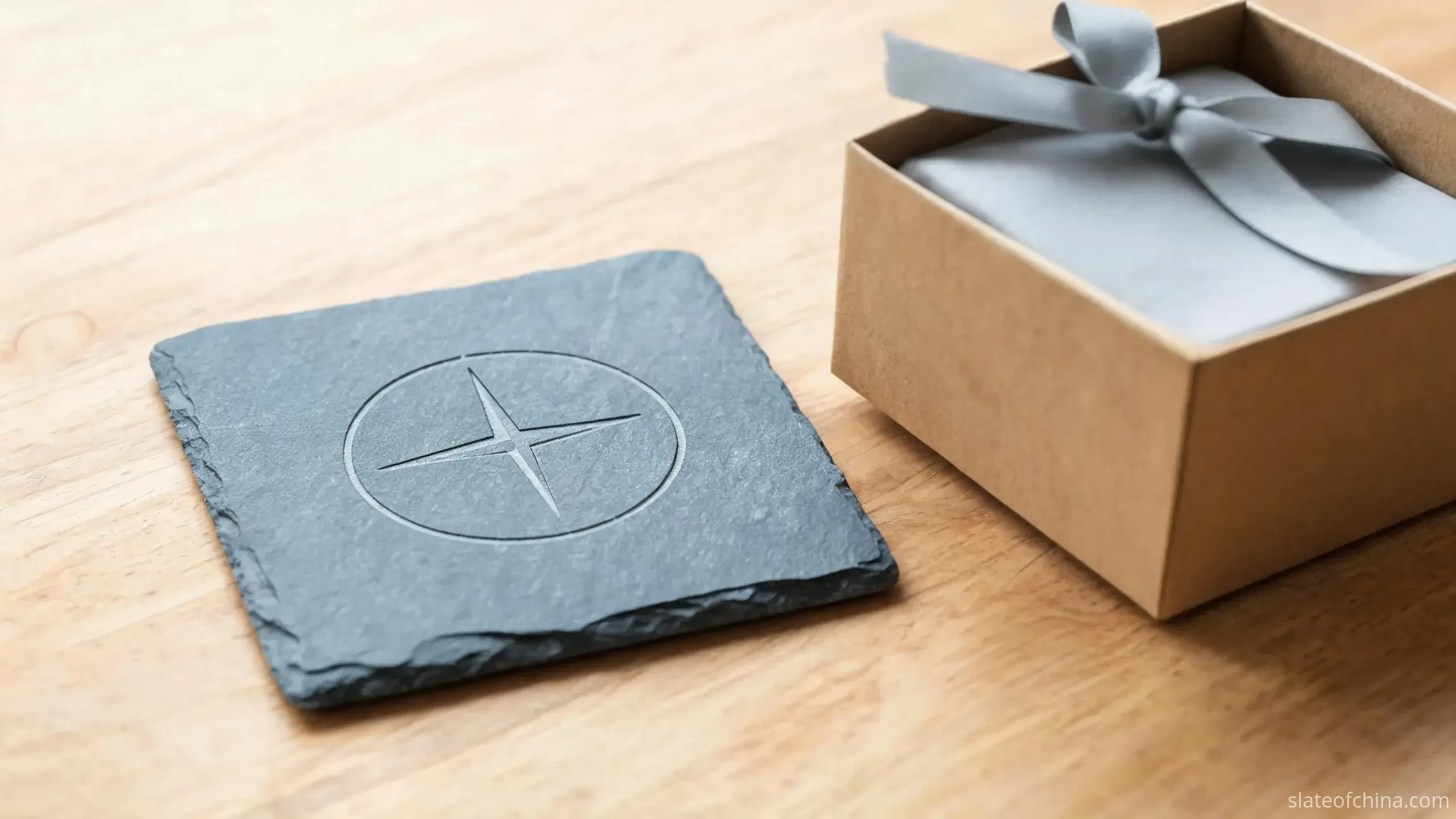
Tilt it toward the window. In raking light, an engraved mark reads as part of the surface, not as a print on top of it. Laser engraving is the common route for slate because it renders fine graphics and text without inks, plates or films; mechanical engraving cuts deeper and suits bolder marks. On most slate the engraving reads lighter than the surrounding face — the mark is where the dark outer face is removed — and the exact contrast depends on the stone's surface, the machine settings and the batch. That variability, not the absence of capability, is why branded orders approve a pre-production sample rather than a design file.
Custom slate coasters carry more than company logos: names and initials for weddings, event dates for favours, decorative patterns for retail collections, retailer branding for private-label programs, and coordinated sets mixing several personalisations in one carton. The process choice follows the artwork — fine linework and small text need the marking method that holds them, and very small type may not reproduce consistently on every piece of a natural surface. A clear customization brief carries six lines:
- Artwork file and the approved version — vector where the logo exists in vector
- Logo size and position on the piece
- The required appearance — contrast, depth, single or repeated face
- Personalisation split, if any: how many unique pieces in the order
- Packaging and label requirements attached to the marked product
- The approval step: sample engraved and signed off before the run
That last line is load-bearing. For corporate gifts and private-label programs, consistency matters as much as the stone itself, and the sample-approval ritual that protects it is described in Samples and Sample Approval. Engraved slate coasters succeed as products when the mark survives the run; they succeed as brand assets when the mark survives the run identically.
From Block to Gift Box — The Eight Stops of Production
None of it shows in the listing photograph. A finished coaster is small; the chain that produces it reliably is not. Eight stops, in order:
- Raw selection — material sorted for colour, texture, thickness band and structural integrity, against the target product's appearance.
- Cutting to size — the format is cut from stock; cutting accuracy decides dimensional consistency and the amount of edge work that follows.
- Edge finishing — cut, beveled or natural-style, to the approved profile; chipping and sharp arrises are caught here.
- Surface finishing — honing or smoothing where the specification calls for a processed face.
- Cleaning and drying — stone dust and cutting residue removed; pieces fully dried before any treatment or packing.
- Sealing or treatment — where agreed, applied to product specification with its documented method and curing time.
- Marking — engraving or other branding, checked against the approved artwork piece by piece.
- Inspection and packing — dimensions, thickness, appearance, flatness and edge quality confirmed against the order specification; then retail or bulk packing as agreed.
Not every product runs all eight. A natural cleft face with a natural edge skips stops four and six; a plain bulk-packed promotional run may skip six and seven. The final process belongs to the finish, the customization and the price point — and the processing culture behind the chain, from block handling to finished formats, is described for the region in How Jiujiang Slate Is Made. Whether a specific workshop runs coaster lines full-time or as campaign jobs is a supplier-level question — the right one to ask early.
The Same Job, Five Materials
A coaster's job is fixed; the material is a choice. Natural slate is one of five common answers, and the comparison should run in both directions — the porcelain coaster industry has good reasons for its market share, and so does cork.
| MATERIAL | WHAT IT BRINGS | WHERE IT RUNS OUT |
|---|---|---|
| Natural slate | Real stone mass and feel; natural blue-grey character; a face that takes engraving; a material story for retail | Chips on impact; variation by nature; heavier to ship than any of the others |
| Ceramic | Colour range, printed patterns, glaze finishes, production consistency | Breaks and chips when dropped; appearance stands or falls with the glaze |
| Cork | Light, soft, quiet on glass, low cost | Absorbs liquids; stains and compresses over time |
| Silicone | Flexible, effectively unbreakable, easy to clean, cheap to tool | Reads as plastic; no material story; branding limited to moulded or printed marks |
| Wood | Warm natural tone, easy custom shaping, light | Moisture response and maintenance depend on species and coating |
Slate earns its place when the brief asks for genuine stone character, a markable face and a tactile weight that photographs as quality. It is the wrong answer when the brief needs featherweight fulfilment, impact-proofing around pools and bars, or the perfect uniformity of a moulded product — a brief those other materials answer better.
For an importer, the comparison belongs on one line of landed cost, not on a piece price: packaging, expected breakage, retail positioning and the customer's expectations belong in the same column as the factory unit price. Two quotes are only comparable when they price the same specification — a rule that holds across every format the region ships.
The Commercial Layer — Wholesale, OEM and Private Label
Scale the order up and the sample desk matters more, not less. Wholesale slate coasters are evaluated on the same evidence as any stone product: material, dimensions, finishing, documentation — with the added twist that a small gift product is also a retail object, so appearance consistency and packaging carry commercial weight a paving shipment never carries.
What the importer checks, briefly: photographs and physical samples of the actual material, with the permitted variation range agreed in writing; finished dimensions and thickness, with it stated clearly whether dimensions are taken before or after edge finishing; edge and surface quality against explicit defect criteria rather than a general "no visible defects"; sealing verified on the sample — never assumed from the word "slate"; branding scope fixed (which faces marked, how many personalisations); packaging specified before production, not chosen at the quotation stage; and quality managed through a written specification plus a retained reference sample, which is also how repeat orders keep their consistency across batches. The wider diligence conversation is a page in its own right — Questions to Ask Before You Buy — and currently offered natural-stone lines are collected in the natural stone products category as the commercial entry point.
A private-label coaster program involves more than adding a logo. It carries a coordinated product design, fixed dimensions and finishes, controlled material appearance, repeatable inspection criteria, branded packaging and a documented sample-approval loop — the same list a private-label buyer would bring to any product category, which is why a stone supplier who already runs architectural specifications can work comfortably in this one. Those parameters — dimensions and tolerances, appearance range, finishes, artwork, packaging, approval procedure, quantities and lead times, defect handling — are the ten quotation lines at the end of this article, locked at order stage rather than filled in at enquiry stage.
On minimums, one rule keeps expectations honest: MOQ belongs to the supplier and the project, never to the material. Standard formats in bulk packing order differently from custom shapes, engraved pieces or printed gift boxes, because each added step is a setup someone has to pay for. A bulk slate coasters quotation is requested on the actual specification — size, finish, edge, marking, packaging, quantity — and a sample or trial order is the low-risk first step for a new line with an untested market.
Packaged for the Journey — Sleeves, Boxes and Export Cartons
Put it back in the box. A coaster is a small product with a long journey ahead of it — from workbench to gift box to courier van to a foreign retail shelf. Gift packaging has to do two jobs at once: present the product for retail, and protect it on the way.
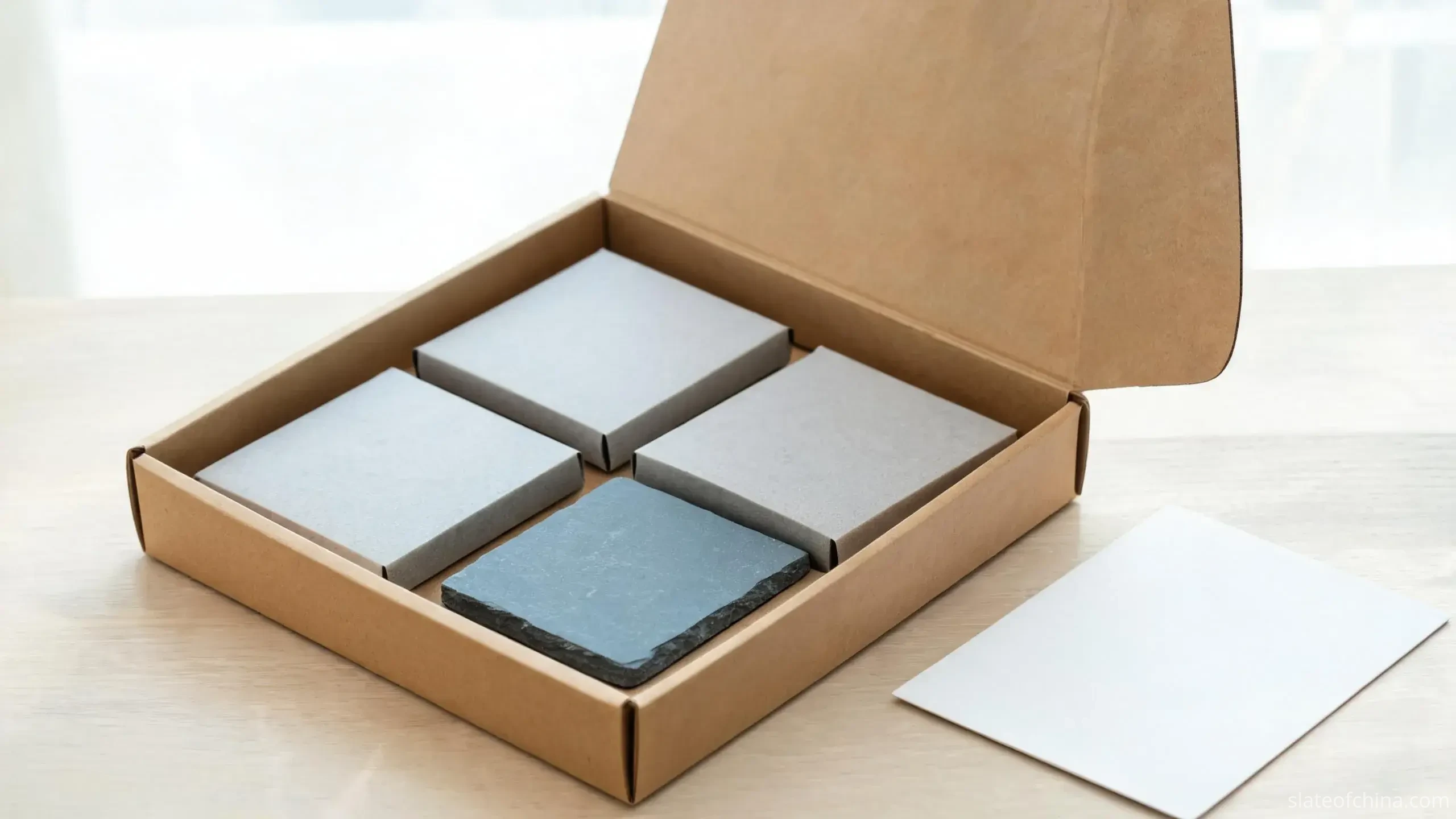
The layers, inside out: individual sleeves or separators so finished pieces cannot rub against one another; set boxes — a four-piece set is one common retail format, though the market decides the final count; printed gift boxes and branded inserts for collections that retail on presentation; care instructions folded in where the finish or treatment requires aftercare; and export cartons whose inner packing is designed to stop movement, because movement is what breaks corners on a rigid stone long before impact does. Custom slate coaster packaging is specified before mass production — sleeve material, whether boxes are printed, carton markings, and how many sets a master carton carries.
Two pieces of arithmetic belong to the importer. First, packaged dimensions and gross weight decide the freight, not the coaster's dimensions — packaging adds both cost and cube, and it changes how many units fit a shipping carton. Second, and less intuitive: full-format slate containers reach their weight ceiling long before they are full; coaster cartons do the opposite, filling their volume long before they approach their weight limit. For coaster shipments, packaging efficiency is therefore a real pricing lever rather than an afterthought. The freight mechanics behind both patterns are laid out in How Jiujiang Slate Is Packed and Shipped and Containers, Freight and Delivery from Jiujiang.
What the Origin Tells You — and What It Never Will
Jiujiang slate coasters start from a real advantage: a dense, long-established production ecosystem. The Lushan–Xingzi belt gives the region's processors a common starting material and the shared cool blue-grey colour family described in The Geology of Jiujiang Slate; the cutting and finishing lines were built for architectural formats and scaled down for small work; and a short road haul connects the Lushan-area pits to the Yangtze-side port that ships full containers of roofing and billiard slate — the same freight corridor a coaster carton rides. Slate coasters from China sourced through this corridor inherit an industry, not just a quarry.
What the origin never tells you is whether a particular order passed inspection. A region with heavy equipment can still ship a chipped edge; origin answers supply-side questions, not order-level ones. And unlike roofing slate, coaster work sits outside the EN 12326 and ASTM C406 world entirely — a roofing-slate test report is not evidence for a small-format gift product, and no document should be allowed to imply otherwise. What genuine product evidence looks like for stone lines is described in How to Read a Slate Test Report; what a coaster order actually needs is the written specification and approved sample this article has been assembling section by section.
Between origin and shipment stands the supplier, and coaster orders use the region's standard diligence tools: distinguishing a processing factory from a trading intermediary matters as much for small products as for slabs (Factory vs Trading Company); direct sourcing shortens the chain (How to Source Jiujiang Slate Directly); and a supplier should be verified on evidence — production capability, available material colours and finishes, sample quality, edge and customization capability, treatment options, packaging and export experience, inspection process, and clarity of communication — the checklist in How to Verify a Jiujiang Slate Supplier, worked through before a bulk order is placed.
Asking for a Quotation — Ten Lines That Make One
Then write it all down. Everything this article has examined becomes the quotation request. Ten lines, in the order a supplier reads them:
- Size and shape — the format: 100 × 100 mm square, a round, or a drawn outline
- Thickness — required finished thickness and the tolerance band accepted
- Face — natural cleft, honed, or another agreed finish
- Edge — straight-cut, beveled or natural-style
- Treatment — sealed or unsealed, subject to sample approval
- Marking — artwork, engraving position and total quantity of marked pieces
- Quantity — total pieces, and the set configuration they pack into
- Packaging — bulk packing, individual packaging or branded gift boxes
- Destination — country and port or delivery address
- Terms — preferred Incoterm, if already known
Where the specification is still open, a first enquiry can begin smaller: a reference image, a target size, an estimated quantity and the intended use. The supplier's job at that stage is to say which lines must be settled before a firm quotation — and a clear answer at this stage is a useful first signal of how the order will be handled. A sample or trial order then converts the written specification into physical evidence before any market is committed to it. When you are ready, send the ten lines to us with your target retail context — the request form reaches the same desk that handles the architectural slate in this guide.
Frequently Asked Questions
Do natural slate coasters absorb water?
Slate is a dense stone, but no coaster made of it should be sold as waterproof. Untreated surfaces can show temporary darkening where a wet glass stands; sealed surfaces shed liquids differently, and no treatment makes the product stain-proof. If liquid behaviour matters to your line, run the spill test on the approved sample — water, coffee and red wine, each left to stand and wiped off — and agree the result you will accept before mass production.
Can slate coasters be engraved with a company logo?
Yes, where the supplier runs the marking process. Laser engraving is the common route for slate because it produces fine, durable graphics without inks or plates; mechanically engraved marks run deeper. The mark usually reads lighter than the surrounding face, and contrast varies with the stone and the machine settings — which is why branded orders are approved on a pre-production sample rather than a design file alone. Supply vector artwork where possible, and fix logo size, position and the number of marked faces in writing.
What is the best thickness for slate coasters?
There is no single best thickness. Usable pieces commonly fall somewhere in a range of roughly four to ten millimetres, and the right figure depends on the stone, the format, the edge treatment and the packaging. Thinner pieces read lighter; thicker pieces read more substantial while adding weight, material cost and freight. Handle samples at the shortlisted thicknesses before locking the specification, and confirm what the supplier can hold consistently across a run.
Can I order custom shapes and sizes?
Custom formats are usually possible where the raw material and tooling support them — subject to material availability, cutting method, edge work and order quantity. Complexity has a price: an outline that needs extra cutting time or special edge finishing costs more than a square, before packaging is adapted to fit it. Confirm finished dimensions and tolerances with the supplier at enquiry stage, not at inspection.
Are slate coasters good for corporate gifts?
They are a strong candidate — a real-stone feel, a markable face and a boxed format that photographs well. The conditions: approve the engraved logo on a pre-production sample, specify protective packaging for couriered or air-freighted gifts, and plan a schedule buffer for personalisation, since individual names or event dates take longer than a single repeated logo. Branded programs succeed on consistency, which is a supplier-selection question before it is a design question.
How are slate coasters packed for export?
Typically in layers: individual sleeves or separators so pieces cannot rub, then sets in paperboard or gift boxes, then inner protection inside export cartons engineered to stop movement. What to agree in writing: sleeve material, whether boxes are printed, carton markings, and how many sets each master carton carries.
What is the minimum order quantity for wholesale slate coasters?
There is no material-level minimum: the figure is set by the supplier and the project. Standard formats in bulk packing usually order differently from custom shapes, engraved programs or printed gift boxes, because each added production step carries its own setup. Request the quotation on your actual specification, and treat a sample or trial order as the low-risk first step for a new line.
How do I clean and care for natural slate coasters?
Ordinary care is a soft cloth, mild detergent and prompt drying. Avoid abrasive pads and aggressive cleaners unless the finish and any treatment are known to tolerate them, and test unfamiliar products on a spare piece first. Sealed and unsealed faces age differently, so follow the care instructions for the actual finish — and expect a factory-applied treatment to need renewal over time. Care information belongs in the gift box, not worked out by the recipient afterwards.
Related Reading
Building a natural slate coaster line?
Slate of China develops small-format slate products on the same Jiujiang cutting and finishing base behind the architectural slate in this guide. Send the format, finish, edge style, engraving artwork, set configuration and packaging concept you have in mind, with estimated quantity and destination — the reply confirms which options current samples support, and the specification a first order should lock.