
Jiujiang Slate Buyer Checklist: Ten Lines Between a Quote and a Deposit
"Can you send your bank details? I'd like to pay the deposit today."
"Not yet. Give the order one hour first."
That exchange, or a version of it, reaches the order desk here in Jiujiang most months. The price is agreed, the quantity is roughly settled, the buyer is ready to move — and nothing discussed so far exists in a form either side could hold the other to. The gap between an accepted quotation and a wired deposit is where orders quietly go wrong. Usually not through bad faith: through vagueness that was comfortable to leave in place while everything was still friendly.
I type order confirmations at this factory for a living — the page that stands between those two messages. Fifteen years at the desk, a few thousand sheets, and a reputation for saying not yet more often than anyone else in the building. Not to slow business down. Every line missing from that page is a problem that comes back later, when it costs more: at the packing bench, at customs, on a roof two winters in.
This page is that hour, written out — the Jiujiang slate buyer checklist for anyone buying slate from China: specifications, test data, samples, packing, payment and delivery terms, arranged as the ten lines our own desk fills before we will accept a deposit. Use it in both directions. As your checklist before ordering. And as a quiet test of whoever is quoting you: a supplier who produces these lines unprompted is one kind of partner; one who resists putting them on paper has answered a question you had not asked yet.
Quick Answer — the ten lines to settle before any deposit:
| Line | What you confirm | Where it must be settled |
|---|---|---|
| 01 | Product specification — application, format, thickness band, finish, colour, quantity | Specification lines of the order sheet |
| 02 | Tolerances and the natural variation you accept | Tolerance clauses and sample annex |
| 03 | Test reports that match this material and your market's standard | Technical annex |
| 04 | An approved sample, referenced by both sides | Sample annex |
| 05 | Who quarries, processes and answers for the slate | Supplier file |
| 06 | Packing, marks and loading — described and priced | Packing clause |
| 07 | One comparison basis: Incoterm, currency, unit, quantity | Price lines |
| 08 | Payment schedule and a verified beneficiary | Payment clause |
| 09 | Lead time back-calculated; shipping documents listed | Schedule and document list |
| 10 | A signed order confirmation holding all ten | The page itself |
Each line is one sentence on one page. Together they are the difference between ordering slate and wishing for it. The sections below explain what each line protects you from — and point to where the subject already has a deeper page in this guide, because most of these lines deserve, and have, an article of their own.
Line 01: The Stone You Are Actually Buying
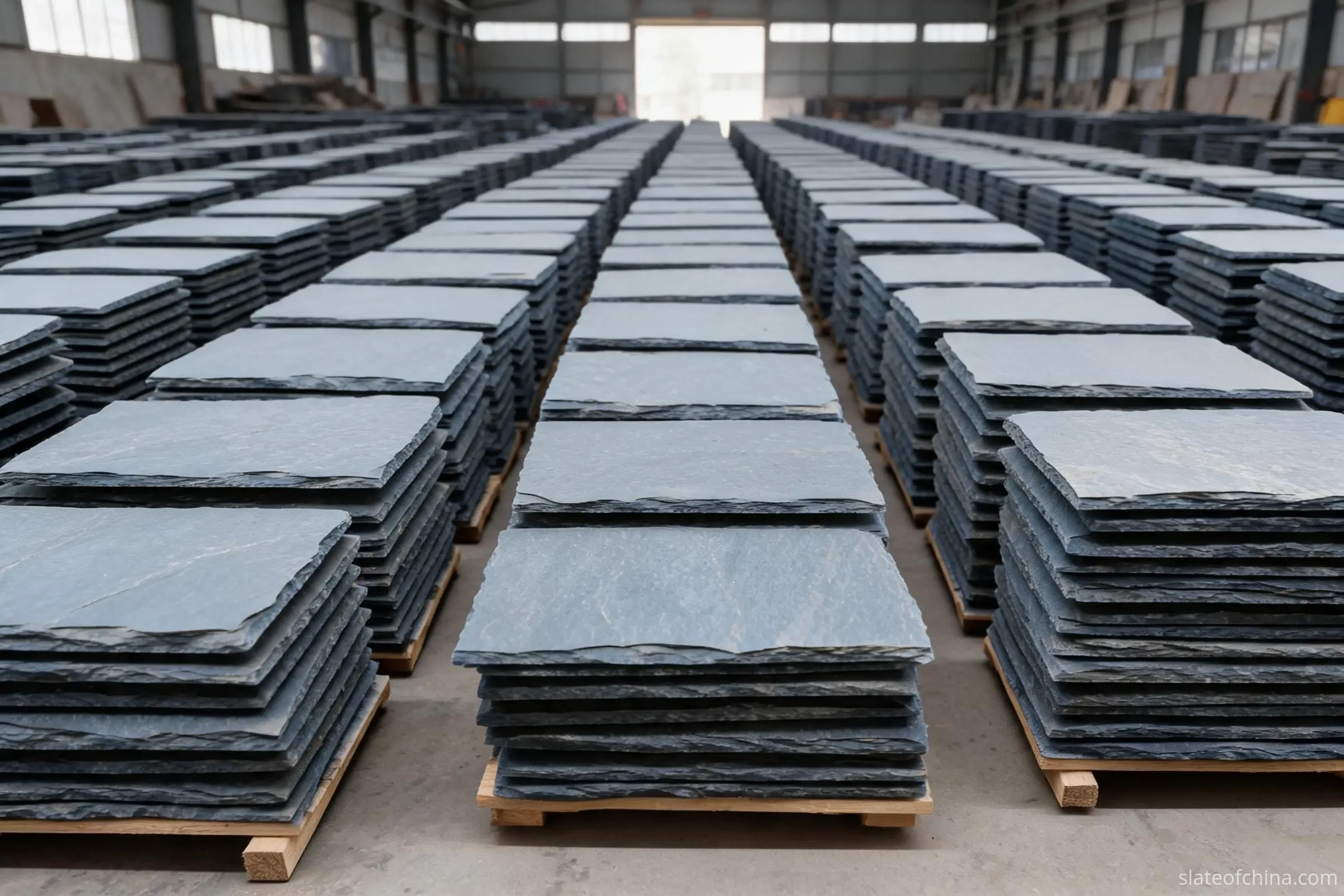
A quotation that begins "natural slate, good quality" has not begun. The first line of the file describes the product the way the production floor will meet it: application, format, thickness band, finish, colour family, quantity in the unit your project actually thinks in.
For roofing, that reads like: 500×250 mm, 6–8 mm, natural cleft face, rived edge, blue-black to dark grey range, 1,400 m², tonally sorted. For a billiard order it reads like: 9 ft three-piece set, 45 mm, hole layout per attached drawing, 12 sets. Neither sentence is poetry — both are copy-paste, which is the point.
Two habits make this line worth its ink. Sizes are nominal: the format is the target, and the permitted variation around it is a separate agreement — the word "nominal" earns its own entry in our glossary. And thickness is a band, not a number: slate is split along a natural plane, and "6–8 mm" is an honest splitter's output. A quote that says only "6 mm slate" is promising something no one can keep — and quietly scheduling the conversation nobody wants to have at unloading.
Send a spec sheet, a drawing or a marked-up photo instead of adjectives. The size guide and thickness guide on the roofing side, and the drawing-confirmation page for billiard orders, exist so that this line can be copied rather than composed.
Line 02: The Variation You Have Agreed to Live With
Natural slate is a geological product. Within one batch the tone drifts a shade, the surface ripples a little, the thickness moves inside its band. None of it is a defect; all of it is foreseeable — which is why it belongs in writing rather than in optimism.
The second line records what variation you have agreed to live with: the tonal range (a sorted lot, or an approved range against the sample), the thickness band treated as a band, how flatness is specified and measured, and what happens to a piece that falls outside the agreement — replaced, credited or discounted. Decided while everyone is still friends, it costs a sentence. Decided after the container arrives, it costs a claim.
The failure this line prevents has a standard shape. The buyer approves the lightest tile in the sample set; production delivers the honest mid-tone; both sides spend a fortnight arguing about what "similar" meant. The mechanics live on their own pages — sorting and mixing, flatness and dimensional stability, sample approval — the point here is only that the agreement travels with the order, not in an email thread.
Put the usable yield on the same line. Roofs are laid from delivered quantity minus cuts, breakage and sorting, and the trade plans for it — the breakage allowance page explains the arithmetic. What the file needs is one sentence: is the quoted quantity supplied or usable — because the difference is a few percent and an argument.
Line 03: Reports That Belong to This Order
Slate has testable properties — water absorption, flexural strength, freeze–thaw behaviour — and most buyers know the names. The third line is narrower: which reports will stand behind this order, and what makes a report evidence rather than decoration.
Which material? A report describes the specimens it tested. The version that matters is tied to the product being quoted — ideally by batch number, at minimum by material source and grade. Our desk attaches reports where batch numbers can be matched to the shipping marks — and where a report covers representative material rather than a specific batch, the file should say so; how to read that linkage, line by line, is a page of its own.
Which standard? EN 12326 for European destinations, ASTM C406 for North American ones — and both have scopes worth knowing: EN 12326 covers slate and stone for discontinuous roofing and cladding, and ASTM C406 is written for roofing slate, so neither is a blanket specification for every natural slate product. The two systems are not interchangeable — different methods, different classifications, different marking — so name one in your specification, with the parts and edition your project references, and hold every document to it. What is ultimately required is set by the product, the project requirements and the current regulations of the destination market. The comparison sits in our EN-and-ASTM page.
Report or certificate? A test report is results from a tested sample; a conformity certificate is a claim about a product family. Both are legitimate; they answer different questions. Worth deciding which one your project actually needs before the file is assembled.
One caution stays on the desk: a laboratory result is evidence about a material, not a promise about a project. Reports support conformity; they do not replace whatever your destination market requires. What to ask for — and our published results — cover the rest of that ground.
Line 04: The Sample You Both Signed
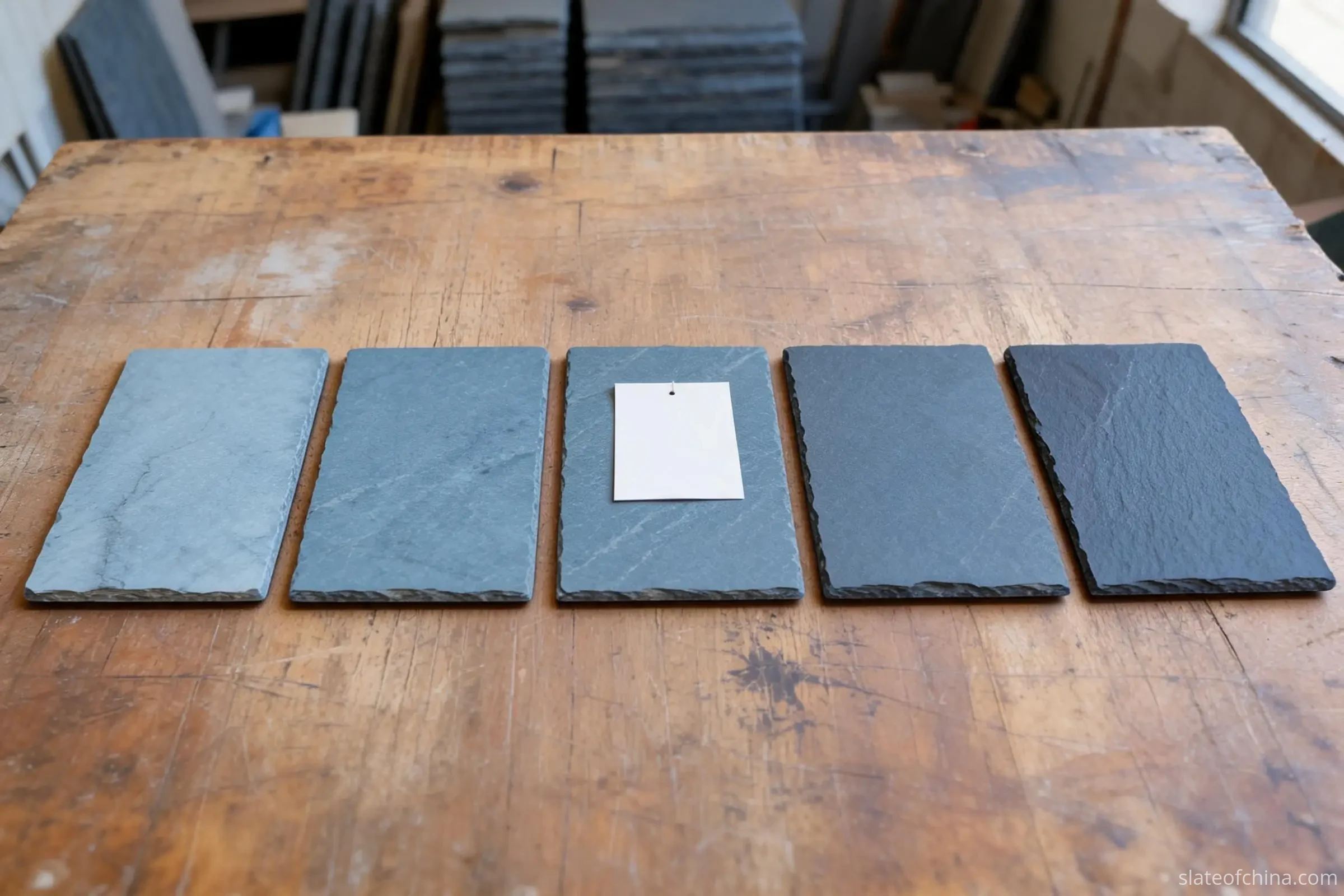
Photographs get you to a shortlist. A physical sample gets you to production. The fourth line records the reference the whole order will be judged against: what was approved, by whom, when — and how the shipment will be compared to it.
Our desk sends roofing buyers a five-piece set spanning the tonal range, with the mid-tone tile marked as the reference — a roof is laid from the whole range, not from its best tile. Billiard buyers get a machined sample, or first-article photographs from the actual production run on repeat orders. Either way, the approval that matters is written: approved against enclosed set, mid-tone reference travels with the order. Looks good, please proceed over one bright photograph does not.
Time the line honestly. Courier to Europe typically runs three to seven working days, so the sample loop costs days, not weeks — the cheapest insurance on this page. What a sample can and cannot prove, and how the approval should be worded, is unpacked in our sample-approval page; the roofing guide's process walkthrough covers the buyer-side steps.
Line 05: The Maker Behind the Email
By the time you are filling this checklist you have, presumably, a shortlisted supplier. This line is not the audit — that is a separate walk. It records the two facts the order file itself needs: who will actually process the slate, and who answers for it if someone else does.
The trade around Jiujiang, like most stone regions, mixes factories, trading companies and hybrids, and all three can serve an order well — the factory-versus-trading page sets out how to tell them apart and when each earns its keep. What the file wants is plain: if the company quoting you does not run the saws, the confirmation should say who does, and the responsibility language should not dissolve at that boundary.
If the deeper verification is still on your list, run it before the deposit, not after the first problem. Choosing the route comes first; this line is where the choice gets written down.
Line 06: The Packing You Are Paying For
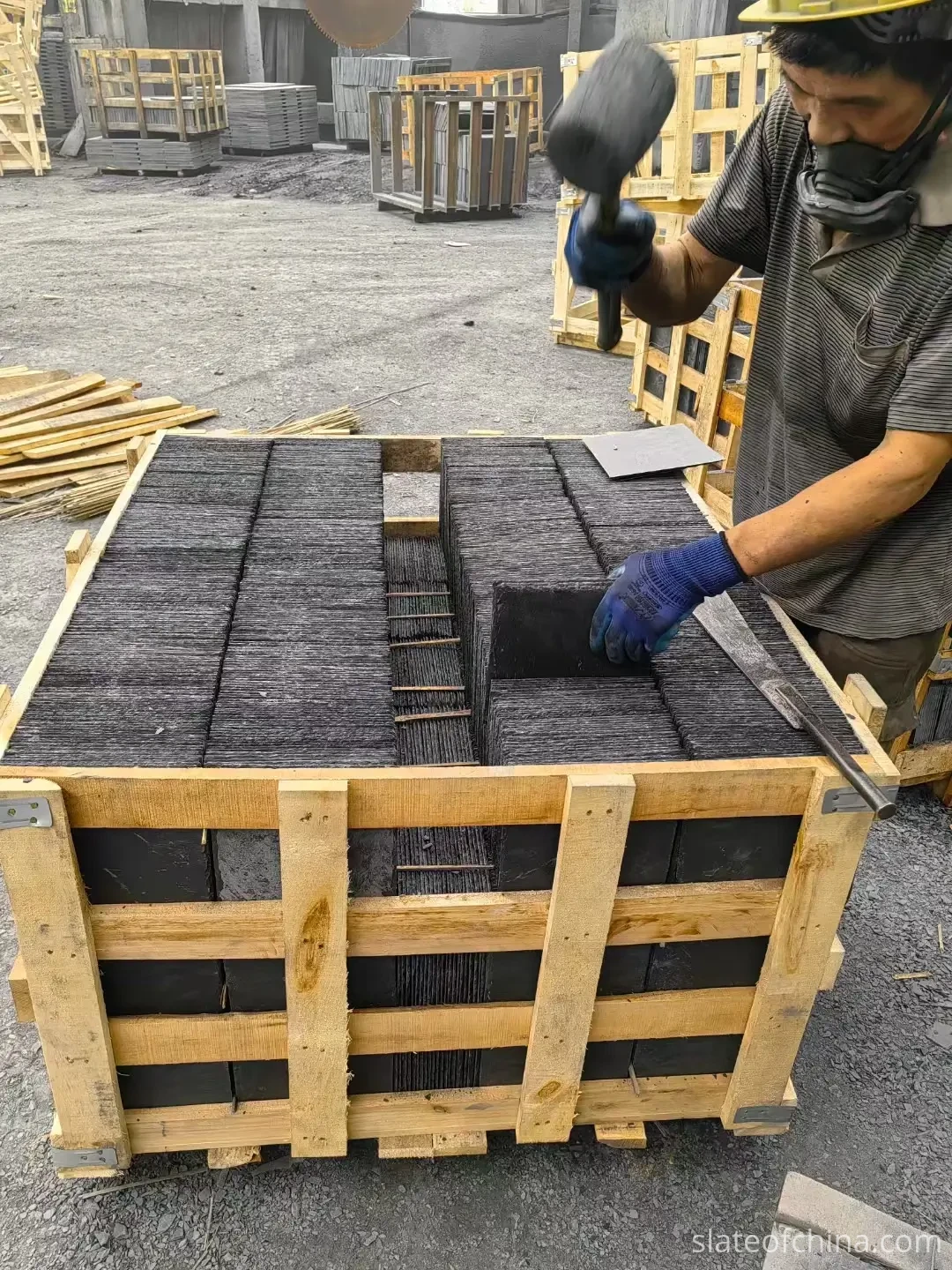
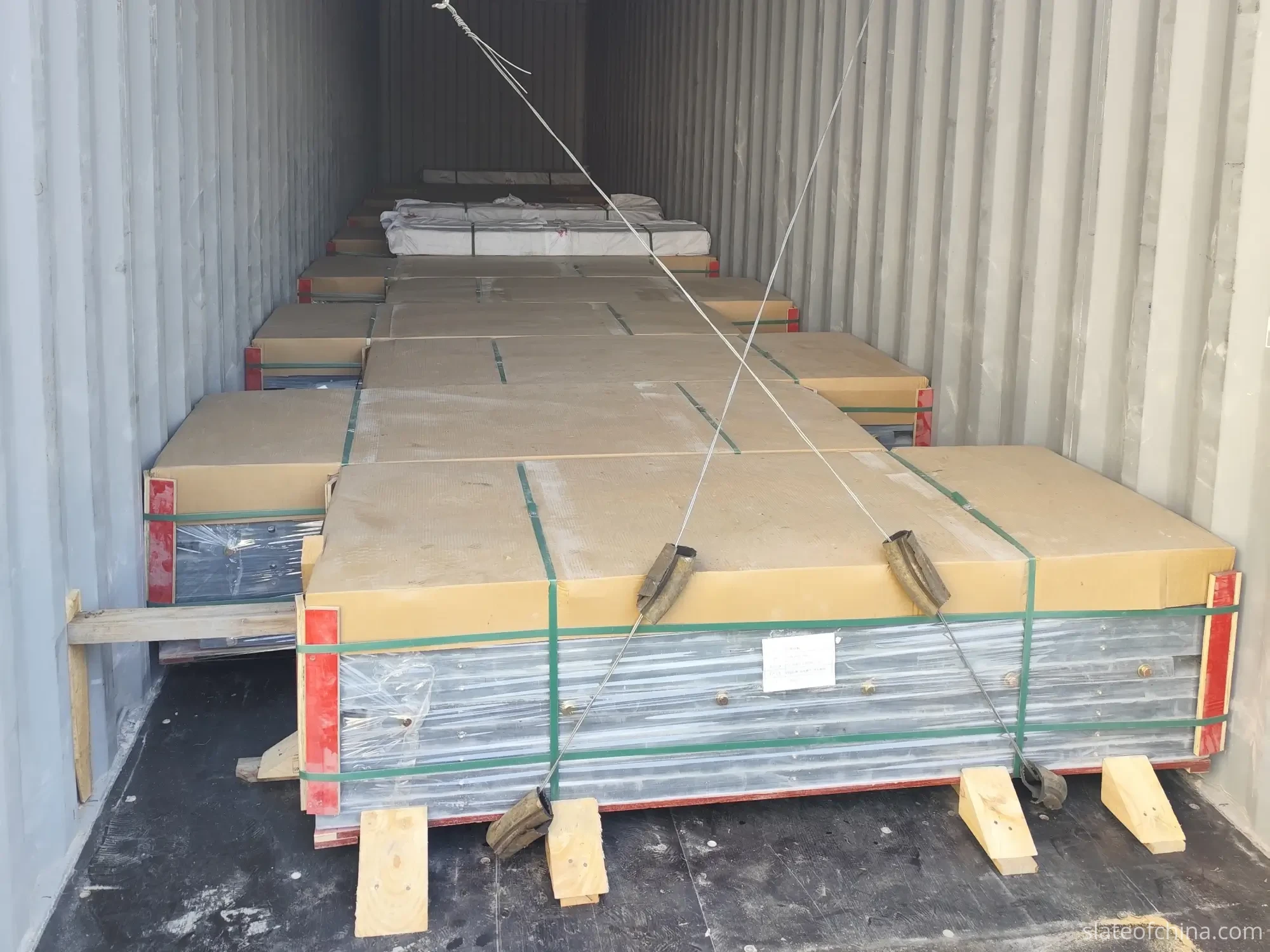
"Packing included" is the most overworked phrase in slate quotations. Included at what standard? The sixth line replaces it with a description: crate construction, separators between layers, strapping, corner protection, moisture care, marks and quantity labels per crate, the loading method — and, explicitly, whether packing and container loading sit inside the quoted price or beside it.
Packing should match the slate product, the shipment size and the transport conditions — there is no single export rule. Roofing slate leaving this region normally travels in wooden crates rather than open pallets; less-than-container-load shipments and products needing fuller enclosure justify stronger crates; and large-format panels may call for purpose-designed supports or A-frames. Whatever the method, the timber should be heat-treated and ISPM 15 stamped, as international shipping expects. Billiard orders add a rule worth writing down whole: a matched three-piece bed should be kept together and identified as one set, because a bed split across two crates makes receiving, inspection and assembly harder.
Why crates here, how a container is braced, and what a loading day actually looks like — that is a full walkthrough elsewhere in this guide, and the billiard side has its own crate standard page. The checklist needs only the description and the price line to agree.
Line 07: The Quote You Are Actually Comparing
Two quotations for "the same slate" that differ by eight percent are usually not the same quotation. Before the comparison means anything, the file fixes the basis: one Incoterm with a named port, one currency, one unit — and one honest divisor.
The Incoterm first: FOB Shanghai and CIF Rotterdam are not two prices for the same thing; they answer different questions. Put the rule, the port and the version on the sheet, and make every supplier quote the same one. The trade words themselves are defined in the glossary's fourth drawer.
Then the divisor, which deserves a number — treated as a product-specific estimate, never as a loading standard. In our shipments, a 20 ft container of 7–9 mm roofing slate has typically landed around 1,130–1,450 m², but the real figure varies with thickness distribution, packing method, the weight of the packaging itself and the container's permitted payload. Ask for an estimated loading plan with net and gross weights for your specific product before comparing freight costs. The same freight divided by 1,150 instead of 1,400 square metres moves your cost per metre more than most negotiations do. Compare landed cost, not the factory line — the freight and delivery page in this guide walks that arithmetic end to end, and the roofing guide's quotation-comparison page covers the discipline from the buyer's chair.
Line 08: The Account That Receives Your Money
The trade's common structure is a deposit with the order and the balance before shipment or against copy shipping documents — the shape we use on most container orders, and the shape that keeps both sides partly exposed, which is the point of it. It is a common shape, not a rule: custom work, repeat orders, stock material and small consolidated shipments each negotiate their own arrangements, and the right split is whatever both sides agree properly reflects the order's risk.
The line records the schedule: amounts, currency, what triggers the balance — production complete, inspection passed, documents issued — and who carries the bank charges. Then the part worth slowing down for: the beneficiary.
The account name should match the company that signed the order. When it does not, the file should say why — an export agent, a group account — and the contract should say it too, before the money moves rather than after.
And the security rule that never changes: if bank details change mid-order — a new account, a new email format, sudden urgency — confirm through a channel that existed before this conversation. A phone number that answered last month is worth more than the most official-looking email today. Payment fraud in this trade rarely attacks the stone; it attacks the wire.
What a deposit should buy is a documented order. A discount for paying everything early buys a documented discount. Only one of them is worth the money.
Line 09: The Dates You Can Defend
"Thirty days" is not a delivery term. The ninth line works backwards from the date the slate has to be ready to work with — the roof programme, the shop floor, the handover — and writes dates, not durations.
The arithmetic from this end: production for container quantities typically runs two to four weeks after deposit, sample approval and drawing confirmation; the ocean leg to Europe runs four to six weeks; and before all that, the container comes to the factory — loaded at our bay, and at the Yangtze river port the same day, some forty minutes down the road. Those are typical ranges, not promises — the confirmed schedule belongs in the quotation and in the order file. Add customs and the inland legs on your side, and "in time for spring" turns into a date you can actually hold.
The same line lists the documents you will need, as drafts before the vessel sails: commercial invoice, packing list, bill of lading, certificate of origin where your market wants one, and the test report travelling with the goods. The export-desk page unpacks each file and the consistency checks between them — the numbers that must agree across documents, because a wrong digit discovered at sea costs more than one caught at the desk.
Billiard shipments have their own Incoterms and insurance notes in the billiard shipping guide. And if your order includes an inspection — ours or a third party's — its date belongs on this line too, before the balance rather than after it (what a pre-shipment inspection checks).
Line 10: The Page Everything Lives On
Everything above lands on one document. The trade calls it a proforma invoice, a purchase order or an order confirmation — several names, one object: buyer and seller legal names; the product description in full, with the thickness band and the tolerance language; quantity and unit; sample and report references by number; the packing description; unit price, total, currency, Incoterm with named port; the payment schedule with beneficiary; lead time and the key dates; the document list. Plus a short clause for the day something does not match — reported within how many days, evidenced how, settled how.
Then both sides sign it. In this trade, a countersigned PDF and an explicit confirmed, please proceed from the buyer's named contact are both treated as commitments. The form matters less than the fact that the words exist somewhere other than a chat history.
Changes after this page are change orders, not favours — priced, written, re-confirmed. The most expensive sentence in stone is "just make it 600×300 instead", spoken softly at a moment when nobody is writing anything down.
Our desk will not take a deposit against a file that skips these lines, and after fifteen years I can report the discipline has saved more arguments than it has cost orders. The pages that follow this one in the guide — the FAQ, the glossary — exist for everything you meet after the ten lines are filled. This page exists so there is something in between.
The Sheet, Assembled: What a Deposit-Ready File Looks Like
Here is the whole checklist as it looks on our desk, in the order it gets typed. Copy the structure; fill it with your project. The right-hand column points to where the deeper guidance lives.
| Line | The sentence it holds | Deeper guidance |
|---|---|---|
| 01 | 500×250 mm · 6–8 mm · natural cleft, rived edge · blue-black–dark grey · 1,400 m² | sizes · thickness |
| 02 | tonal range per approved set · thickness within band · non-conforming pieces replaced or credited | flatness · breakage |
| 03 | EN 12326 test report, batch-linked to this order, annexed | read a report · EN vs ASTM |
| 04 | approved five-piece set, reference number and date, mid-tone marked | sample approval |
| 05 | processed by [factory]; responsibility clause as agreed | verify a supplier |
| 06 | wooden export crates, ISPM 15, strapping, marks; loading at factory included | packing & shipping |
| 07 | FOB Shanghai · USD · per m² · on ~1,400 m² per 20 ft | freight · compare quotes |
| 08 | deposit with order · balance against B/L copy · beneficiary as contracted | sourcing routes |
| 09 | deposit → production 2–4 weeks → ocean 4–6 weeks → ETA [date] · documents as listed | documents · PSI |
| 10 | signed or written-confirmed by both parties · changes in writing | FAQ · glossary |
When line ten carries both signatures, the deposit stops being an act of faith and becomes a step in a documented process. The container that leaves Jiujiang some weeks later is one both sides recognise: same format, same band, same crates, same numbers on the invoice as on the packing list.
That is all a buyer checklist is for. Not paperwork for its own sake — the shortest route we know to the boring outcome, where the slate arrives and it is the slate you ordered.
Questions Buyers Ask at the Deposit Stage
How much is a normal deposit for a slate order from China?
In this trade the common structure is a deposit of roughly 30% with the order and the balance before shipment or against copy shipping documents — the split we use on most container orders. Staged or higher splits appear on first orders and complex projects. What matters more than the percentage is what the deposit buys: a written order file and a production slot. A discount offered for paying everything in advance is rarely worth the exposure it moves from the seller to you.
A supplier is asking for 100% payment in advance. Should I be worried?
Treat it as a signal rather than a verdict. Full advance payment has legitimate niches — small sample shipments, consolidated less-than-container-load cargo, material already cut to size — but for production orders the deposit-plus-balance structure exists precisely so both sides share the risk. If a supplier will only proceed against full advance, ask why, and weigh the answer against a proper verification of the company before the money moves.
Should the deposit come before or after sample approval?
Usually after — the sample is part of what the deposit buys. The sequence our desk runs is: specification agreed, sample couriered and approved in writing, order confirmation issued, then deposit. When timing makes a physical sample impossible, a first-article photo or video approval can stand in, recorded the same way — as a written reference attached to the order. Timing pressure, custom machining, repeat orders and small consolidated shipments can each justify a different sequence; what should not vary is that an approved reference exists in writing before production starts.
Can I change the specification after paying the deposit?
Often, but never silently. Before cutting starts, a change is cheap: a revised sheet and a re-confirmed price. After material is split or machined, a change means re-doing work, and the cost follows. The discipline is the change order — the same one-page habit as the original file, priced and confirmed by both sides. The change to avoid is the verbal one.
Is a proforma invoice a contract?
It is the document most orders in this trade actually run on, and in practice a confirmed proforma invoice is treated as the order. What it is not is a substitute for precision: a PI with vague product lines and no tolerance, sample or report references imports all of those gaps into the deal. Write the PI as if it were the contract — because on the day something goes wrong, it will be.
What happens to my deposit if the project schedule changes?
It depends where production stands. Before material is allocated, a schedule shift is mostly a re-booking of the production slot. Once splitting and machining have started, the stone is being cut to your lines, and capacity and material have been consumed — cancellation then has a real cost, which the file should have addressed in advance. That is why the lead-time line is worth back-calculating before you pay, not after.
Related Reading
Bring this checklist to our desk.
Planning a roofing slate project, or sourcing billiard table slate from China? You do not have to arrive with ten lines filled in — assembling the file is our job too, and the reply comes back looking like Lines 01–10: a written order you can hold us to. Send us the details for your side of the trade:
- Roofing — tile format and thickness range, colour reference, quantity in m², destination port, target date.
- Billiard — table type, your drawing or hole layout, slate thickness, number of sets, destination port.
Start from the published test results, browse the roofing slate range, or send the enquiry directly.