
Billiard Slate Shipping Guide: Incoterms, Ports, Breakage & Insurance

The phone call that starts every shipping conversation is never about the stone. It is about who was holding the risk when it broke.
I coordinate billiard slate exports from our factory in Jiujiang. In twelve years of shipping billiard slate from China, I have sent containers to thirty-plus countries — and the calls I remember are not the ones where everything went right. They are the ones where a buyer opened a container, found a chipped joint edge or a cracked panel, and the first question I had to ask was: under what Incoterm?
That question decides who pays, who files the claim, and whether the loss falls on the stone, the packing, the carrier, or the insurance policy. It is a question that should be answered before the container leaves — not after damage is found.
This guide walks through the practical shipping decisions behind an international billiard slate order from China: what determines the shipping cost, which Incoterm fits the order, and what happens when slate arrives damaged.
Shipping billiard slate internationally comes down to four decisions:
1. Incoterms
Who carries the cost and risk at each stage — from the factory gate to your warehouse floor.
2. Port & Route
Where your cost chain starts and how it branches — the nearest port is not always the right one.
3. Breakage Allowance
What counts as damage for machined billiard slate — and who decides before the container is sealed.
4. Cargo Insurance
What a policy actually covers — and what it quietly excludes when you need it most.
Why Billiard Slate Shipping Is Not Like Shipping Ordinary Stone
A container of roofing slate arrives with a few broken tiles, the buyer sets them aside, and the roof goes up. A container of billiard slate arrives with one cracked panel, and the entire table set may be unusable.
That difference shapes everything about how billiard slate should be shipped. Three characteristics separate it from ordinary stone cargo:
It is heavy for its size. Billiard slate has a density of about 2.7 tonnes per cubic metre. A nine-foot three-piece set at 25 mm weighs roughly 250–270 kg. A twelve-foot snooker set at 45 mm can approach 800 kg. Weight fills a container long before volume does.
It is thin relative to its footprint. A playing surface panel may be 2.5 metres long and only 25–45 mm thick. That ratio makes the long edges and corners vulnerable to impact and uneven support — not because the stone is weak, but because the geometry gives a breaking force more leverage.
It is already machined. The panels in a shipment are not raw slabs. They may already have finished thickness, ground surfaces, squared joint edges, pocket openings, bolt holes and dowel holes — all cut to the buyer's table specification. A shipment can technically arrive intact — no visible break — and still be unusable because a joint edge was chipped, a pocket opening was damaged, or a mounting hole was deformed during transit.
This is why intact does not mean usable, and why shipping decisions for billiard slate should be made with the same care as the machining decisions that preceded them.
A note on scope before we go further. This page is about the shipping decisions — who carries the risk, where the costs divide, what counts as breakage and what the insurance does. How the slate is physically protected inside the box is covered separately in our export packing guide and our container loading guide.
From Our Yard in Jiujiang to Your Warehouse
Most billiard slate shipping from China goes by sea. The logistics chain looks straightforward on paper:
Factory → Truck → Jiujiang Port → Yangtze River Feeder → Shanghai (or Ningbo) → Ocean Vessel → Destination Port → Customs Clearance → Local Delivery → Buyer's Warehouse
In practice, two parts of that chain deserve more attention than buyers usually give them.
The first is the inland leg. Our factory sits about forty minutes from Jiujiang port on the Yangtze River. An empty container is trucked to our yard, loaded at the factory, and sent back to the port the same day — which means the loading plan has to be settled before the container arrives at the gate. There is no second chance at a port warehouse.
From Jiujiang, the container travels roughly 800 km down the Yangtze to Shanghai, where it boards an ocean vessel. Some shipments route through Ningbo instead, depending on sailing schedules and destination. The feeder leg adds a few days, but it is a well-established route and the through bill of lading covers the entire journey.
The second part is port selection — and the best port is not necessarily the closest one. A supplier may choose a port based on shipping-line schedules, destination routes, freight rates, container availability and port congestion. For a buyer comparing quotations from different Chinese suppliers, the named port of loading should always be confirmed, because it affects the inland transport cost that may or may not be included in the price.
A better question than "Which port do you use?" is: Which port and shipping route gives the best overall combination of inland transport, ocean freight, transit time and reliability for my destination?

FCL or LCL: The First Decision That Shapes Everything Else
In billiard slate container shipping, the choice between Full Container Load and Less than Container Load is not just about quantity. It is about how many times the cargo changes hands before it reaches you — and how much control you keep over each handover.
FCL means one shipment uses an entire container. The container is loaded at our factory, sealed, and not opened until it arrives at the destination. For regular commercial orders — several table sets or more — FCL is almost always the better choice. Fewer handovers mean fewer opportunities for impact, mis-stacking, or rough handling by third parties. FCL is also more economical when the quantity is large enough to fill or nearly fill a container, which for billiard slate happens sooner than many buyers expect because of the weight.
LCL means the cargo shares container space with other shipments. It may be the right choice for samples, trial orders of one or two table sets, or buyers testing a new supplier. But LCL cargo passes through additional consolidation and deconsolidation points — it is loaded, unloaded, sorted and reloaded at least twice before reaching the destination port. For heavy, machined stone with vulnerable edges, every additional handling event is a risk event.
Because billiard slate is heavy, the container's weight limit usually becomes the binding constraint before the physical volume is reached. A 20 ft container that could physically hold a large volume of lightweight goods may reach its payload limit with only a portion of that volume in slate. This is why asking "How many sets fit in a container?" is a weight question before it is a space question — and why the answer depends on the slate thickness and table size in the order.
Incoterms: What Each Term Actually Puts on Your Desk
One of the most common sources of confusion in international stone purchasing is comparing quotations under different Incoterms. The same billiard slate can look very different in price depending on whether the quotation is EXW, FOB, CFR, CIF or DAP — because each term draws the line between the seller's responsibilities and the buyer's at a different point.
The four terms a billiard slate buyer is most likely to meet:
| Term | Seller Usually Arranges | Buyer Usually Handles | Risk Transfers |
|---|---|---|---|
| EXW | Goods made ready at the factory | Pickup, export clearance, freight, insurance, import, delivery | When the buyer collects the goods at the seller's premises |
| FOB | Export clearance + loading on the vessel at the named port | Ocean freight, insurance, destination charges, customs, local delivery | When goods are loaded on board the vessel at the port of loading |
| CFR | Export clearance + ocean freight to the destination port | Insurance, destination charges, customs, local delivery | When goods are loaded on board the vessel at the port of loading |
| CIF | Export clearance + ocean freight + required insurance to the destination port | Destination charges, customs, local delivery, any additional insurance | When goods are loaded on board the vessel at the port of loading |
Whatever term is used, always confirm the exact Incoterm version and the named place or port in the quotation. "FOB" without a named port is not a complete term — and two "FOB" quotations with different named ports may not be comparable prices.
One point that catches buyers off guard: under both CFR and CIF, risk transfers when the goods are loaded on board the vessel at the port of loading — not when they arrive at the destination port. The seller pays the freight to your port under CIF, but the buyer carries the risk during the ocean voyage. That is why cargo insurance matters even when the seller has arranged the freight.
Another common misunderstanding: a CIF quotation does not mean "all transportation costs to my warehouse are included." Destination port charges, customs clearance, import duties and local delivery are typically still the buyer's responsibility under CIF. The price line falls at the destination port — not at the warehouse door.
For a buyer with an established freight forwarder, a billiard slate FOB China quotation is often the most straightforward basis for comparison. The buyer's forwarder handles the ocean leg, the buyer controls the insurance, and every supplier's FOB price can be compared on the same ground. For buyers who prefer a simpler purchasing process, CIF can be convenient — but the buyer should still check what the insurance covers, what the insured value is, and what the deductible is.

Why the Cheapest Slate Quote Is Rarely the Cheapest Shipment
Suppose Supplier A offers a nine-foot slate set at US$X FOB Shanghai, and Supplier B offers the same set at US$Y CIF Felixstowe. At first glance, one number is lower. But which supplier is actually cheaper?
You cannot answer that question until both quotations sit on the same basis. The real billiard slate shipping cost is a chain, and a meaningful comparison should account for every link:
Product price + machining + packing + inland transport + export charges + ocean freight + insurance + destination port charges + customs duty + local delivery.
For billiard slate, the comparison should also include what is in the product price. Is surface grinding included? Are joint edges machined? Are pocket openings cut? Are mounting holes drilled? Is CNC work included? Is the packing — pallets or crates — included in the price, or added as a separate line? Is the quotation per piece, per set, per table, or per square metre?
A cheap slate quotation can become an expensive one if important processing or logistics costs show up as separate charges later. The question is not "What is the price?" but "What is included in the price, and what will I pay separately before the slate reaches my warehouse?"
The detailed method for normalising quotations — same Incoterm, same currency, same unit, same quantity — is covered in our billiard slate buying guide. The short version: two quotations for "25 mm billiard slate" that do not state tolerance, inspection level and packing are not yet comparable prices.
Billiard Slate Shipping Cost: What Determines the Number
Buyers often ask for the shipping cost in their first email. The honest answer is that a billiard slate freight cost is not one number — it is a chain of numbers assembled by different parties along the route:
On the cargo side: slate weight, number of sets and packing weight — together they form the gross shipment weight that freight is actually quoted against.
On the route side: FCL or LCL, the origin port, the destination port, the ocean freight on that route, and the inland trucking at both ends.
On the destination side: destination port charges, customs duty and tax, and the final delivery distance to your warehouse.
On the protection side: the insurance premium — small relative to the cargo value, but part of the chain.
For heavy stone products, shipping cost should be calculated from the gross shipment weight and the actual shipping route — not from the slate price alone. Two shipments of the same slate value, one landing at a major port and one delivered two hundred kilometres inland, are simply not the same shipping cost.
The factor that surprises buyers most is weight — for billiard slate, it fills the container long before the space does. The next section explains what that means for your container.
Weight: The Constraint That Silently Decides Your Shipping Cost
Unlike many manufactured products, billiard slate reaches several tonnes per container without trying. The final shipping weight depends on table size, slate thickness, number of pieces, number of table sets, and the weight of pallets, crates and protective materials.
As a typical example, a nine-foot three-piece set at 25 mm weighs about 250–270 kg. A twelve-foot snooker set at 45 mm can approach 800 kg. Load several sets with their packing, and the gross weight climbs quickly.
For container loading, there are at least three constraints — and the third one is often overlooked:
| Constraint | What It Asks | Who Checks It |
|---|---|---|
| Physical volume | Can the products physically fit inside the container? | Usually not the binding constraint for slate |
| Container payload | Is the total cargo weight within the container's permitted payload? | Shipping line + factory loading plan |
| Road weight limits | Can the loaded container legally travel from the port to the destination? | Buyer's local transport regulations — often overlooked |
A shipment may be perfectly acceptable inside the container but create problems during inland transport if the gross vehicle weight exceeds local road regulations at the destination. This is why a professional quotation should consider the complete logistics chain — and why buyers should ask for the gross weight of the complete shipment (slate + packaging + pallets or crates), not just the net weight of the stone.
When Slate Arrives Damaged: What Counts, What Doesn't
Natural slate is strong, but strength is not the same as immunity. Billiard slate shipping damage may occur because of dropping, forklift impact, inadequate support, uneven loading, excessive vibration, transshipment handling or improper lifting. The most vulnerable areas on a billiard slate panel are the corners, the long edges, the thin sections, the machined openings, the areas around bolt holes, and the joint faces where two or three panels meet.
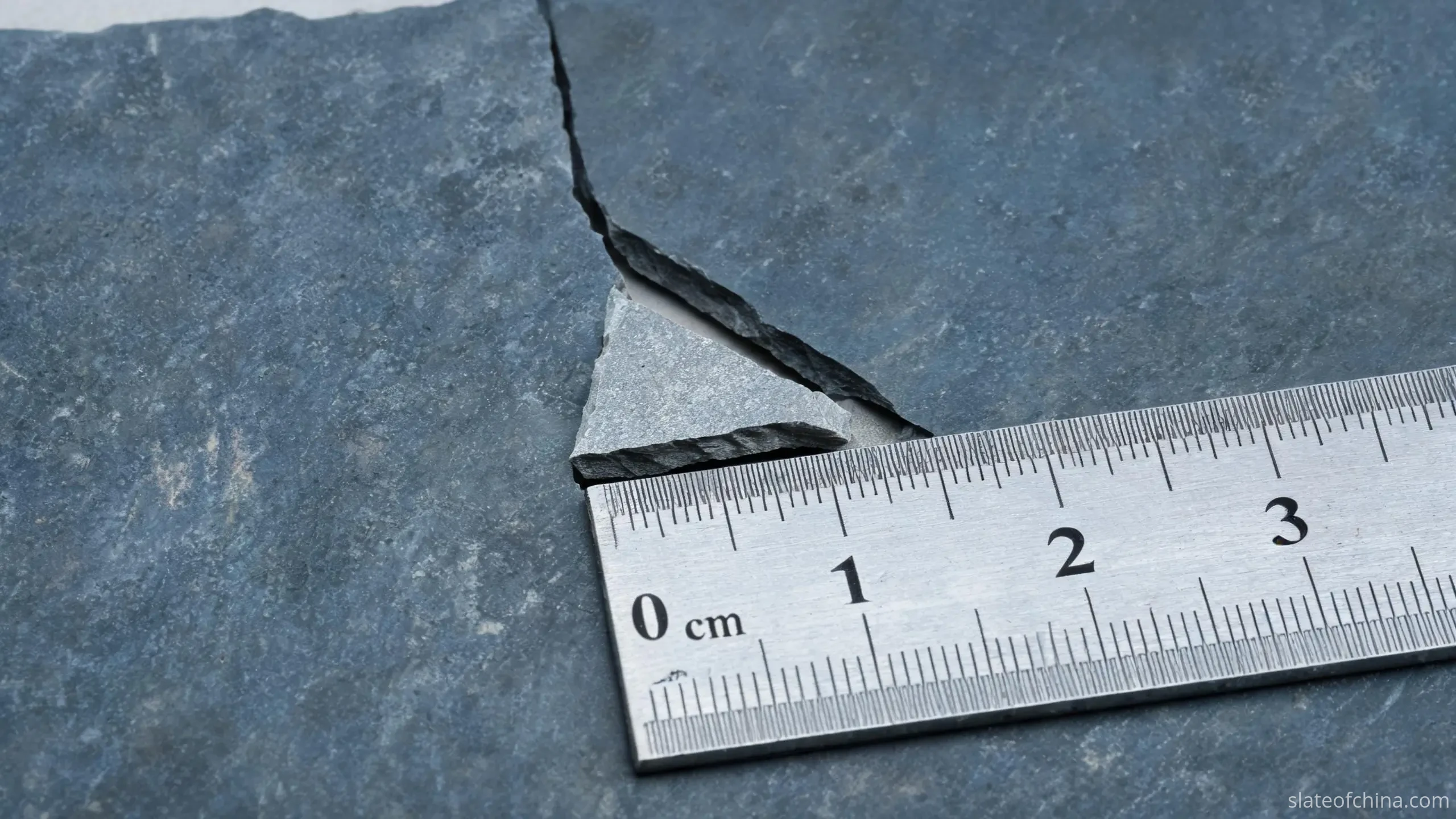
Here is the point that other shipping guides often get wrong: there is no universal international percentage that defines acceptable billiard slate breakage.
A buyer should not simply assume "a 2% breakage allowance is always acceptable." For roofing slate, breakage can be counted by the piece — a few broken tiles out of several thousand may be tolerable. For billiard slate, one damaged piece may be far more significant than the percentage suggests, because the panels are machined to a specific table specification and a single broken panel can hold up the entire set.
What matters is not the percentage but the type of damage:
A broken raw slate panel and a damaged CNC-machined panel are not necessarily the same commercial loss. A raw panel can sometimes be re-cut. A finished panel with a damaged pocket opening, a chipped joint edge or a deformed mounting hole may not be usable on the table it was machined for — and replacing it means a new cutting, a new machining cycle and a second shipment.
A small non-functional edge chip on a cut side may be repairable or may fall outside the critical assembly zone. A broken corner on a joint edge may mean the panel cannot be assembled properly. A crack through a machined pocket opening may make the piece unusable. A crack across a joint face may require a replacement — and a replacement means waiting for a new panel to be cut, machined and shipped.
This is why acceptable damage should be defined in the purchase contract or order confirmation — before the container is sealed, not negotiated after damage is found. A practical agreement should define three things:
What counts as damage. Complete breakage, major cracks, structural cracks, large corner breaks, serious edge damage, damage to machined joints, damage affecting installation — these are damage. Minor edge chips outside functional zones, small natural surface marks and non-functional cosmetic imperfections may or may not count, depending on the agreed quality standard.
What does not necessarily count as unacceptable damage. This depends on the agreed standard between buyer and seller — but the exact definitions should be written down before the order is confirmed.
What happens if damage occurs. Replacement piece, replacement set, credit, partial refund, or repair where technically appropriate — the best solution depends on the type and severity of damage, and it should be agreed before the container is sealed, not argued about after it is opened.
For a deeper look at how we identify and classify surface defects before packing, see our guide to common billiard slate defects.
Cargo Insurance: What It Covers and What It Quietly Doesn't
For commercial shipments, billiard slate cargo insurance deserves serious consideration. The value of a machined slate set — especially a custom order with specific pocket layouts, hole patterns and joint geometry — can be substantial, while the cost of marine insurance is relatively small compared to the potential loss from a serious shipping incident.
But having a policy — whether arranged by the seller under CIF or purchased separately by the buyer under FOB — is not the same as having the right cover. Before relying on it, confirm the following six points:
| Insurance Point | What the Buyer Should Confirm |
|---|---|
| Coverage | What risks are covered — all risks or named perils? Is impact damage during transshipment included, or only total loss? |
| Insured value | How is the insured amount calculated — invoice value, CIF value, or a higher figure that covers the cost of a replacement order? |
| Deductible | Is there an excess, and how high is it? A high deductible can make small claims impractical — and one damaged panel can hold up a table set. |
| Exclusions | What is specifically excluded — inherent vice, insufficient packing, delay, loss of market? |
| Claim deadline | How quickly must damage be reported after delivery? Most policies require notice within a specific window — often 3 to 7 days. |
| Evidence | What photos, documents and survey reports are required to support a claim? |
Two points deserve special attention. First, CIF does not mean that every possible type of cargo damage is automatically covered. CIF includes only the insurance the term requires — the buyer should check whether the coverage, the insured amount and the deductible are adequate for the full value of the shipment, or arrange additional cover separately.
Second, if damage is attributed to insufficient packing rather than a shipping event, the claim may be denied — which is another reason why proper export packing matters. Packing and insurance are two halves of the same protection: the packing prevents the damage, the policy pays for what the packing could not prevent.
Container Arrives: The First Hour Decides Your Claim

When a container of billiard slate arrives at your warehouse, the instinct is to open the doors and start unloading. Resist that instinct — the first hour after arrival decides whether a damage claim succeeds or fails. Work through the sequence in order:
1. Photograph the seal before the doors open. The seal number must match the bill of lading. If it does not — or if the seal has been tampered with — the chain of custody is broken, and the claim path changes. Note it before anything else happens.
2. Photograph the container and the packing before unloading. Container exterior (impact marks, dents, damage to walls, doors or roof), interior condition (water ingress, moisture, oil contamination, unusual odour), cargo arrangement (has anything shifted?), and packing condition (crushed, broken or opened crates). A photograph taken before unloading establishes that the damage occurred during transit, not during unloading.
3. Unload carefully — and keep the damaged packing. Do not throw away broken pallets, splintered crates or crushed foam. Together with the broken stone, they are the evidence of how the cargo was secured and where the force came from.
4. Identify and photograph each damaged piece. Photograph each damaged panel before and after it is removed from its packing, with the crate or pallet label visible where possible.
5. Notify the forwarder, the supplier and the insurer promptly. Most cargo insurance policies require notice within a specific window — often 3 to 7 days from delivery — and a formal survey report for serious claims. Missing the window can invalidate the claim.
6. Keep the documents that followed the shipment. Commercial invoice, packing list, bill of lading, insurance certificate, delivery receipt, and any inspection report. Good documentation is what makes the difference between damage attributable to the carrier, the shipping line, the packing, or the handling at the destination — and that attribution determines who pays.
7. Determine the outcome. Replacement piece, replacement set, credit, partial refund or repair — the route depends on the type of damage and on what was agreed before the container was sealed. If there is obvious serious damage, the insurer's surveyor decides the attribution; do not dispose of damaged packing or broken slate until the survey is complete.
What to Ask Before You Place the Order
The questions below are more useful than asking "How much is the shipping?" — because the answer to "How much is the shipping?" depends on the answers to all of them.
Product: What is the table size, slate dimensions, number of pieces, slate thickness, net weight and gross weight? What machining is included — grinding, joint edges, pocket openings, mounting holes? (See our technical specifications for a full spec sheet.)
Packing: Pallets or wooden crates? What are the package dimensions? What is the gross weight per package? How many packages? Is forklift access available from all sides? What lifting equipment is needed at the destination?
Shipping: What is the port of loading? FCL or LCL? How many sets per container? What is the estimated transit time? What Incoterm is being quoted? What is the destination port? (The full process — from order confirmation through customs clearance — is covered in our guide on how to import billiard slate from China.)
Risk and insurance: Is cargo insurance included in the price (under CIF)? What coverage does it provide? What is the insured value? What is the deductible? Who handles the claim if damage occurs? What evidence is required? What is the agreed procedure for shipping damage?
These questions — asked before the order is placed — can prevent most of the shipping problems I have spent twelve years untangling.
Shipping Is Part of the Product
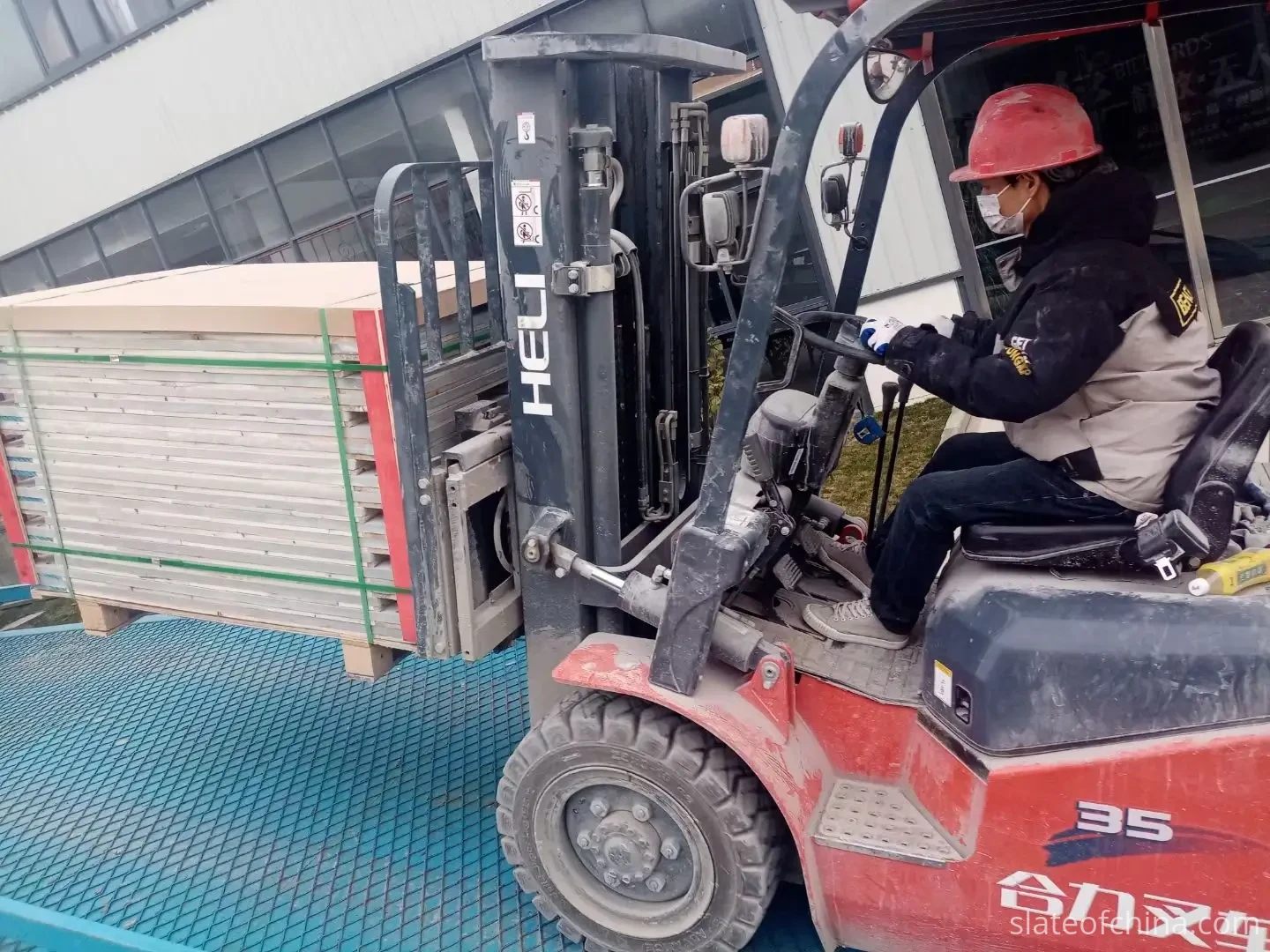
For billiard slate, transportation should not be treated as an afterthought. A supplier may produce excellent slate, machine it to the buyer's exact specification, and inspect every panel — but if the shipment is poorly packed, poorly secured, or poorly insured, the buyer may still receive damaged material that cannot be assembled.
The complete supply chain — stone selection, cutting, grinding, CNC machining, inspection, packing, loading, ocean transport, unloading and final inspection — is a single chain. Each link affects the next. For OEM table manufacturers, this is particularly important because the slate has already been machined to the manufacturer's exact table specification. Replacing one damaged custom-machined panel involves far more than the raw stone value — it means a new cutting, a new machining cycle, and a new shipment.
The practical implication is simple: buy the complete shipping solution, not just the slate. Evaluate the whole package — slate quality, machining, packing, shipping terms, insurance, documentation and after-sales support — before the order is confirmed. Discuss these points with the supplier before production begins, not after the container has sailed.
If you are sourcing snooker slate, pool table slate, Chinese 8-ball slate, Russian pyramid slate or custom billiard slate from China, send us your table dimensions, slate thickness, quantity, destination port and machining requirements. We can then work from the actual specification and provide a quotation that includes the shipping terms — rather than a generic slate price that leaves the logistics for you to figure out.
Frequently Asked Questions
Which Incoterm is best for importing billiard slate from China?
FOB is the most common choice for buyers with their own freight forwarder — it gives the buyer control over the ocean leg and insurance, and makes supplier prices easy to compare. CIF can be convenient for buyers who prefer the supplier to arrange freight and minimum insurance, but the buyer should still check the coverage, insured value and deductible. There is no universally "best" Incoterm — the right one depends on your logistics experience and how much control you want over the shipping process.
How much billiard slate breakage is normal during shipping?
There is no universal breakage percentage that applies to billiard slate. Unlike roofing slate, where breakage can be counted by the piece against a large quantity, one damaged billiard slate panel can hold up an entire table set — because the panels are machined to a specific table specification. What matters more than a percentage is defining what counts as damage, what does not, and what happens if damage occurs — all agreed before shipment, not negotiated after.
Does CIF mean the supplier covers all shipping costs and insurance?
No. Under CIF, the seller pays the ocean freight and arranges minimum cargo insurance to the named destination port. But risk transfers when the goods are loaded on board the vessel at the port of loading — not when they arrive at the destination. Destination port charges, customs clearance, import duties and local delivery are typically still the buyer's responsibility. CIF also includes only minimum insurance — the buyer should check whether additional coverage is needed for the full value of the shipment.
Should I buy cargo insurance even when buying FOB?
Yes, for commercial billiard slate orders. Under FOB, the buyer arranges the ocean freight and carries the risk from the moment the goods are loaded on board. Cargo insurance is relatively inexpensive compared to the potential loss from a serious shipping incident — and for custom-machined billiard slate, the replacement cost (new cutting, new machining, new shipment) may exceed the original invoice value. Check the policy type, covered risks, insured value, deductible and exclusions before relying on it.
What should I do if my billiard slate arrives damaged?
Do not unload immediately. First photograph the container exterior, the seal number, the interior condition and the packing before moving anything. If the seal does not match the bill of lading, note it. Photograph each damaged pallet or crate before and after opening. Keep all shipping documents — commercial invoice, packing list, bill of lading, insurance certificate and delivery receipt. Notify the carrier, forwarder and insurer promptly — most policies require notice within a specific window, often 3 to 7 days. Do not dispose of damaged packing or broken slate until the survey is complete.
Is FCL or LCL better for billiard slate shipments?
FCL is almost always preferred for regular commercial orders. The container is loaded at the factory, sealed, and not opened until it arrives — fewer handovers mean fewer opportunities for damage. LCL may be appropriate for samples, trial orders or one or two table sets, but LCL cargo passes through additional consolidation points where it is loaded, unloaded and reloaded. For heavy, machined stone with vulnerable edges, every additional handling event increases the risk. The choice also depends on quantity — and for billiard slate, the container's weight limit usually becomes the binding constraint before volume.
What shipping documents do I need for importing billiard slate from China?
The core document set typically includes the commercial invoice (declares the sale), packing list (describes the cargo), bill of lading (transport and title document), certificate of origin (when required by the destination country), and insurance certificate (when applicable). If wooden packing is used, the crates or pallets should carry ISPM 15 compliance marks. For billiard slate, test reports or quality documentation may also be useful at customs. The exact set depends on your country and the Incoterm — confirm requirements with your customs broker before the shipment sails.
Need a billiard slate shipping quote?
Send us:
- Table type and finished slate dimensions
- Slate thickness and number of sets
- Required machining
- Destination port or city
- Preferred Incoterm, if applicable
We can help estimate the packing, container loading and shipping arrangement for your order — with the shipping terms spelled out, not left open.