
Information Required for Custom Production: The 6 Fields Behind Every Custom Billiard Slate Order
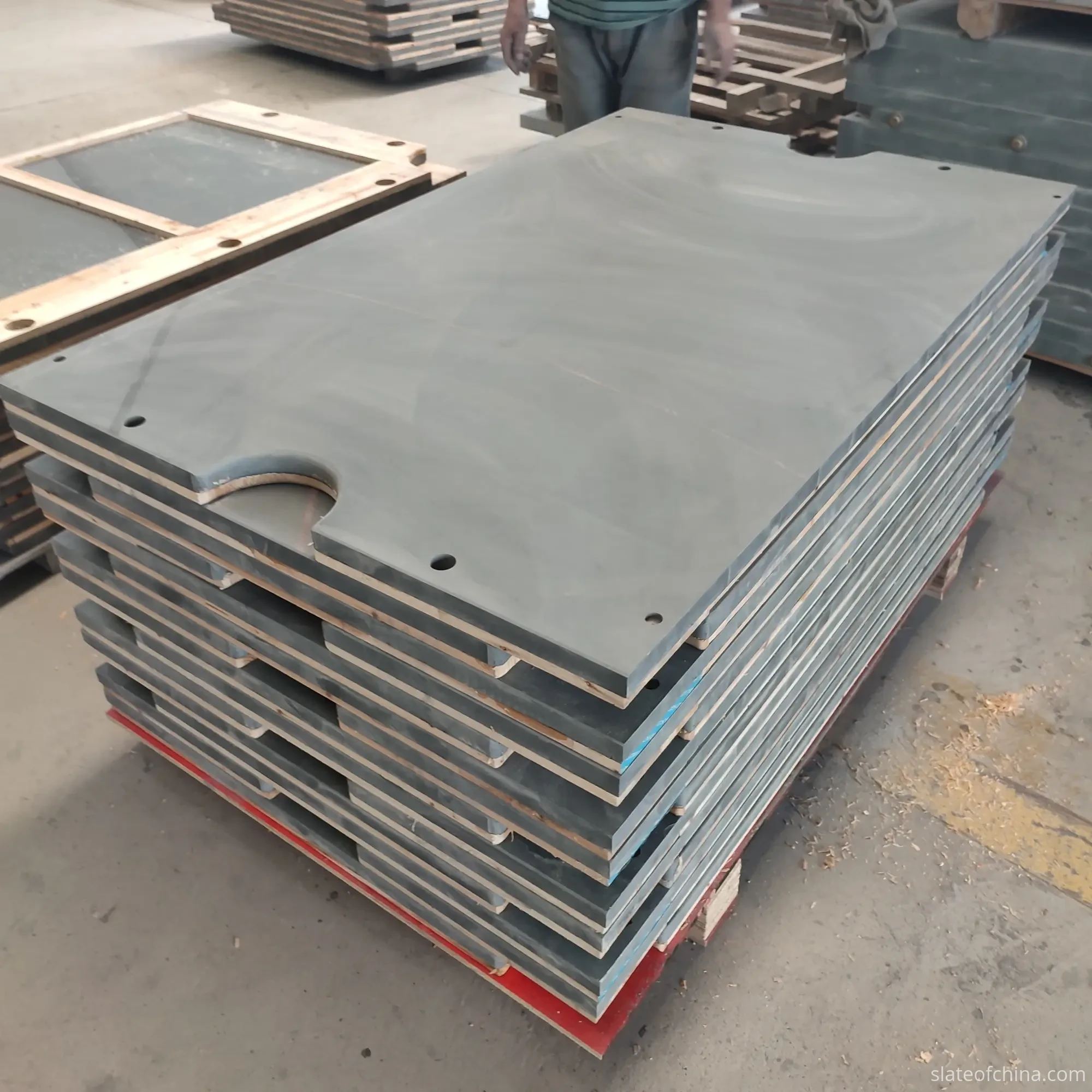
A 12 ft snooker bed is around 800 kilograms of slate, usually in five pieces at 45 mm. A 9 ft pool bed is roughly 250 to 270 kilograms across three pieces at 25 mm. Both sentences are true, and neither one can be machined. They describe weight classes, not products: nothing in either sentence tells a factory where a single mounting hole belongs.
The distance between a sentence like that and a confirmed production order is a short form. Six fields: the table type, the slate dimensions, the thickness, the piece count, the drawing, the quantity. Individually each field is a line of text; together they decide whether a custom order runs quietly through the workshop or spends its first fortnight as a chain of clarification emails. This page walks the form field by field — what each one decides, what a complete entry looks like, and what its absence tends to cost.
It is written for the people who fill that form in practice: table manufacturers building OEM beds, private-label brands, distributors specifying non-standard formats, and buyers replacing a slate set for a table nobody makes drawings for anymore. If you are earlier in the journey and only need a price, the five details that produce a fast, accurate quotation have their own page — start with How to Request a Billiard Slate Quotation and come back here when the numbers turn into an order.
The custom slate production form, in six lines:
| Field | What it decides | A complete entry reads like |
|---|---|---|
| Table type and model | Which geometry family the bed belongs to | "12 ft snooker, five-piece, OEM production for [brand]" |
| Slate dimensions | The outline the saw actually cuts | Overall length × width per section, in millimetres |
| Thickness | Raw block, machining time, freight weight | "45 mm, every section, per drawing" |
| Pieces and joints | How the bed is built, shipped and installed | "Five pieces, joint positions per drawing Rev. B" |
| Technical drawing | Every machined feature the bed carries | DWG or dimensioned PDF: pockets, holes, edges, tolerances |
| Quantity | Batch economics, scheduling, packing plan | "20 complete sets now, about 30 sets per month later" |
Six completed fields are a production conversation. Six blank ones are a guess with a purchase order attached.
Preparing a Custom Billiard Slate Order?
Have your table type, finished slate dimensions, thickness, piece count, drawing and required quantity ready. If some details are still undecided, tell us what you know and we can identify the information needed for a production quotation.
Six Fields, Two Thresholds
There are two thresholds in a custom slate order, and they are not the same height. The first is the information needed to quote. The second is the information needed to produce. A quotation can carry an assumption openly — one thickness priced, another noted as an option, a packing plan described as typical. The moment the same inquiry becomes a work order, every one of those assumptions stops being an estimate and starts being geometry: a block gets selected, a saw follows a line, a drill finds a position. A custom order is where the factory commits stone to your information — which is why the six fields above stay the same whether the order is one replacement bed or a recurring OEM programme of hundreds of sets.
The scale changes; the fields do not. A single replacement set cares mostly about dimensions, pieces and holes. A recurring programme adds the long-term questions — batch consistency, revision control, annual demand — covered in OEM billiard slate for table manufacturers, and the full route from an approved drawing to volume production is mapped in custom billiard slate manufacturing. The sourcing journey around all of it — samples, inspection, import documents — is assembled in the billiard slate buying guide. What follows is the form itself, line by line.
| What buyers send | What the factory still cannot know | The same order, production-ready |
|---|---|---|
| "8 ft pool slate, please quote" | Thickness, piece count, hole layout | "8 ft American pool, 25 mm, three-piece, hole layout per attached drawing Rev. C" |
| "snooker slate, best quality" | Outline, pieces, acceptance criteria | "12 ft snooker, 45 mm, five-piece, joint positions per drawing; flatness per our spec sheet" |
| "same as my old table" | Nothing has been measured yet | "Replacement for [model]; old set measured — panel length, width, thickness and hole positions recorded, photos attached" |
| "OEM standard, you know the specs" | Whose standard, which revision | "Per approved sample and drawing Rev. B; acceptance per agreed inspection plan" |
| "about fifty, maybe more" | Sets or pieces? This order or a year? | "20 complete sets now; roughly 30 sets per month expected from next quarter" |
None of the left-hand entries is careless — each is a real inquiry, trimmed only for space. But each leaves the factory guessing, and a factory that has to guess will either ask, which is correct but slow, or assume, which is fast and worse. The right-hand entries are the same products, said in the six fields. The gap between the two columns is not effort; it is knowing what the machine needs.
Table Type and Model: The Line That Sets the Geometry
The table-type line does the most work on the form, because it decides which geometry family the bed belongs to. Snooker, American pool, Chinese 8-ball, Russian pyramid, carom — each discipline carries its own playing-area conventions, pocket culture and thickness habits, and two tables with the same outside footprint can belong to completely different families. The field guide to those families is in the types of billiard slate, and the material consequences of the snooker/pool split are compared in pool slate vs snooker slate.
A complete entry names three things: the discipline, the model or brand, and the job the slate is for. A Chinese 8-ball bed for a commercial table maker tells the factory which spec culture it is entering — a discipline with conventions of its own, covered in Chinese 8-ball table slate. A Russian pyramid order points at another set of playing-area habits entirely, mapped in Russian pyramid table slate, while a carom bed, with no pockets at all, is a third conversation, described in Korean carom table slate. The application line matters just as much: OEM production, private label, distribution or replacement each come with their own confirmation habits downstream.
One caution belongs here rather than later: table-size naming is not standardized across makers. A 9 ft from one brand is not guaranteed to match a 9 ft from another, and nothing about the label tells the factory the outline of the stone. Say the discipline first and the size second — never the size alone. A size class is a nickname; a dimension is a decision.
Slate Dimensions: Send Numbers, Not Names
The dimensions field is where the nominal table size, the playing area and the slate outline get confused with each other, because all three get called the size in casual speech. They are three different numbers, and only one of them can be cut. The full warning — how the trio differs, and where it bites hardest — is mapped in the American pool table slate buying guide, and it applies to every table family, not just American pool.
For a multi-piece bed, the outline alone is still not enough. A production-ready dimensions entry carries the overall length and width of the complete bed, the length and width of each section, and the positions of the joints. Where holes are dimensioned from the playing-area boundary rather than the slate edge, say so — the two references give different numbers, and the CNC program follows whichever one the drawing declares.
Replacement orders add a step: measure the old set before writing anything. The panels on the table are the only drawing some tables still have, and the measuring routine — what to record, in what order, with what photographs — is laid out in replacement slate for existing billiard tables. For the established formats, collected reference figures live in the billiard slate technical specifications — treat them as orientation for a new design, and confirm every number against your own drawing before ordering. The saw follows the drawing, not the brochure.
Thickness: One Number, Three Costs
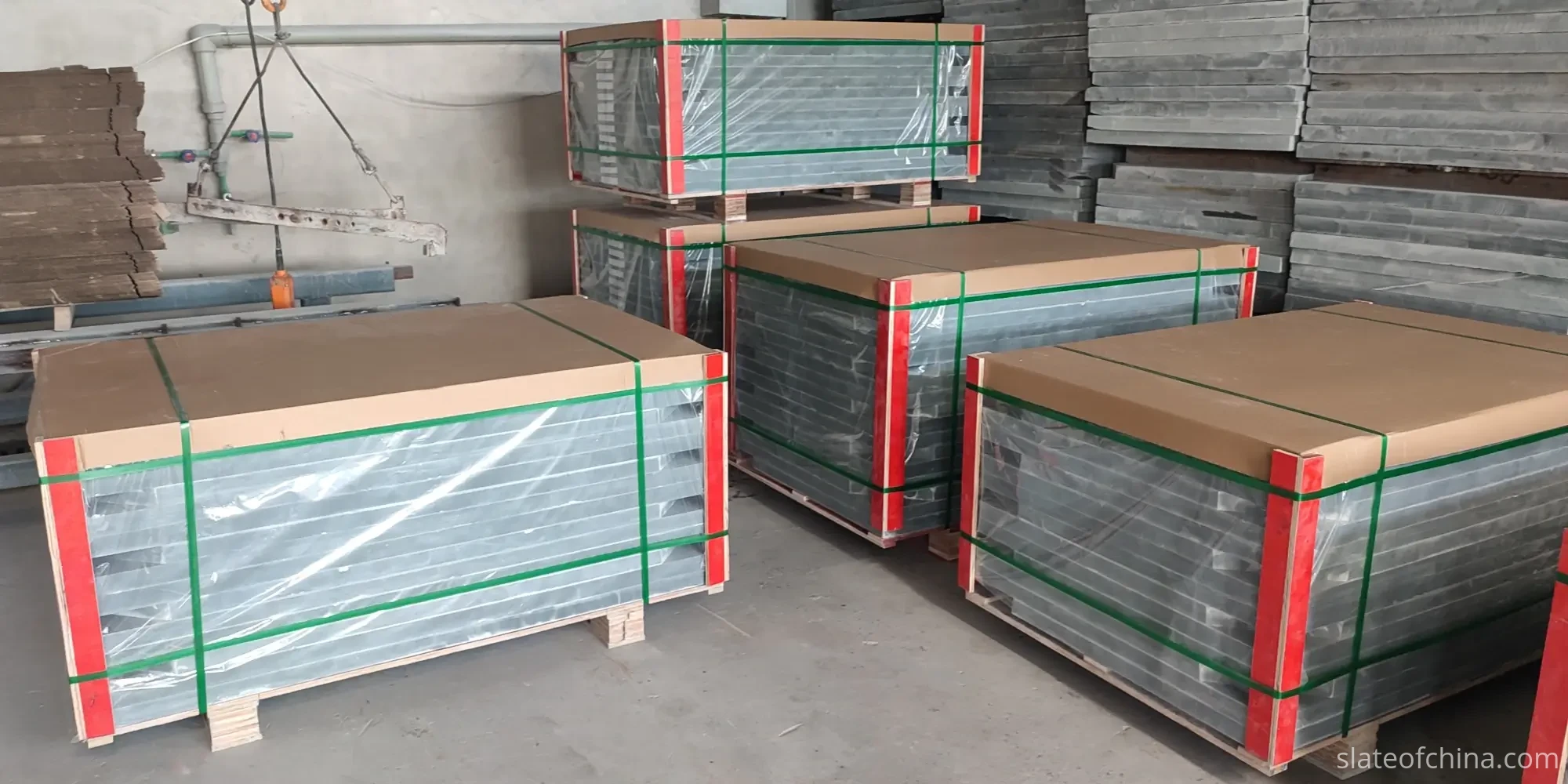
Thickness is the field buyers most often leave to the supplier, and the one the supplier can least afford to guess. The millimetre figure attaches three costs at once: the raw block a bed needs, the hours of grinding and handling a thicker section takes, and the freight weight — slate runs at roughly 2.7 tonnes per cubic metre, so every added millimetre is a running cost all the way to the port. What thick enough means is answered by the table design, not by a supplier's stock list; what each step from 19 to 45 mm does to a table is covered in how slate thickness affects table performance, with the pool, snooker and Chinese 8-ball bands compared in pool vs snooker vs Chinese 8-ball slate thickness.
Common practice, as designs actually specify it: pool beds are commonly built in the 19–25 mm band, snooker beds in the 38–45 mm band, Chinese 8-ball tables typically towards the thicker end of that range. These are conventions, not standards — the confirmed drawing is the only authority. As indicative estimates for budgeting: a 7 ft pool bed at 19 mm runs about 130–140 kg per set, a 9 ft pool bed at 25 mm about 250–270 kg, and a 12 ft snooker bed at 45 mm around 800 kg — with the actual weight always following the confirmed dimensions, piece layout and machining.
Three details make a thickness entry production-ready. First, whether the figure applies to every section, because some designs vary it. Second, whether the edge is profiled — a stepped edge, a rebate or a chamfer means the bed is not one uniform thickness, and the drawing has to show where the profile starts. Third, the tolerance, if your engineering sets one; if it does not, ask the factory to state its standard in writing and attach that document to the order, rather than leaving the word standard to mean whatever is convenient later.
Pieces and Joints: The Bed's Hidden Layout
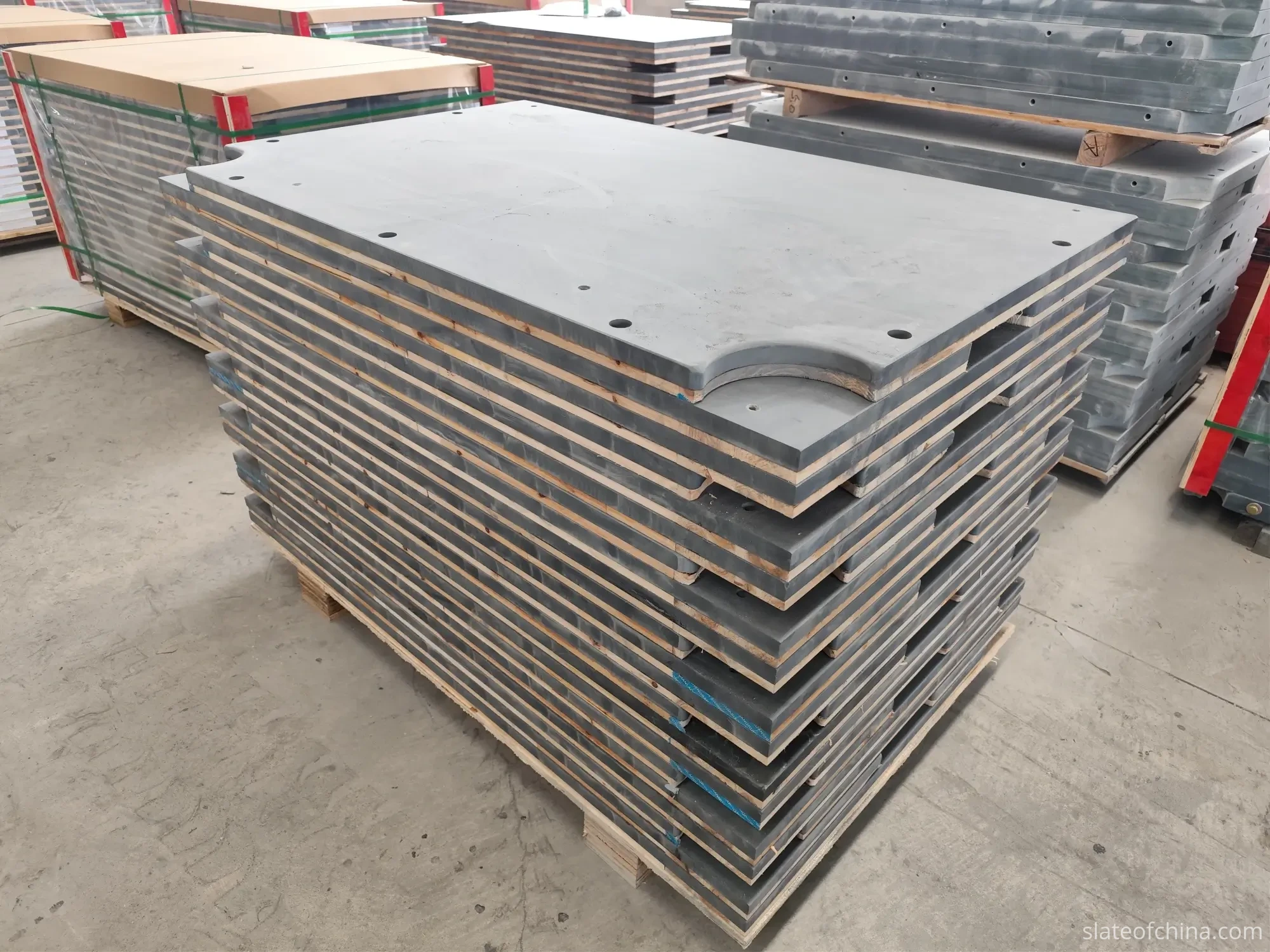
The piece count is not a preference; it is part of the bed's engineering. One-piece, three-piece and five-piece configurations trade flatness continuity against transport, handling and installation realities, and the trade-off belongs to the table designer before it belongs to anyone else — the cost ledger behind the choice is walked in one-piece vs three-piece slate for manufacturers. Most pool beds travel in three sections, large snooker beds commonly in five, and the drawing carries the exact layout: joint positions, per-section dimensions, and the edge profiles the sections present to each other, machined as covered in slate edge and joint machining.
The arithmetic that hides in this field deserves its own sentence. An order for 100 five-piece sets is not an order for 100 pieces of slate — it is an order for 500 pieces that have to match each other in groups of five, batch after batch. The matching work is what separates a one-off from an OEM programme, and it is the subject of OEM billiard slate for table manufacturers. On the form itself, the field reads simply: five pieces per set, joint positions per drawing Rev. B.
The Drawing: The Field That Carries the Others
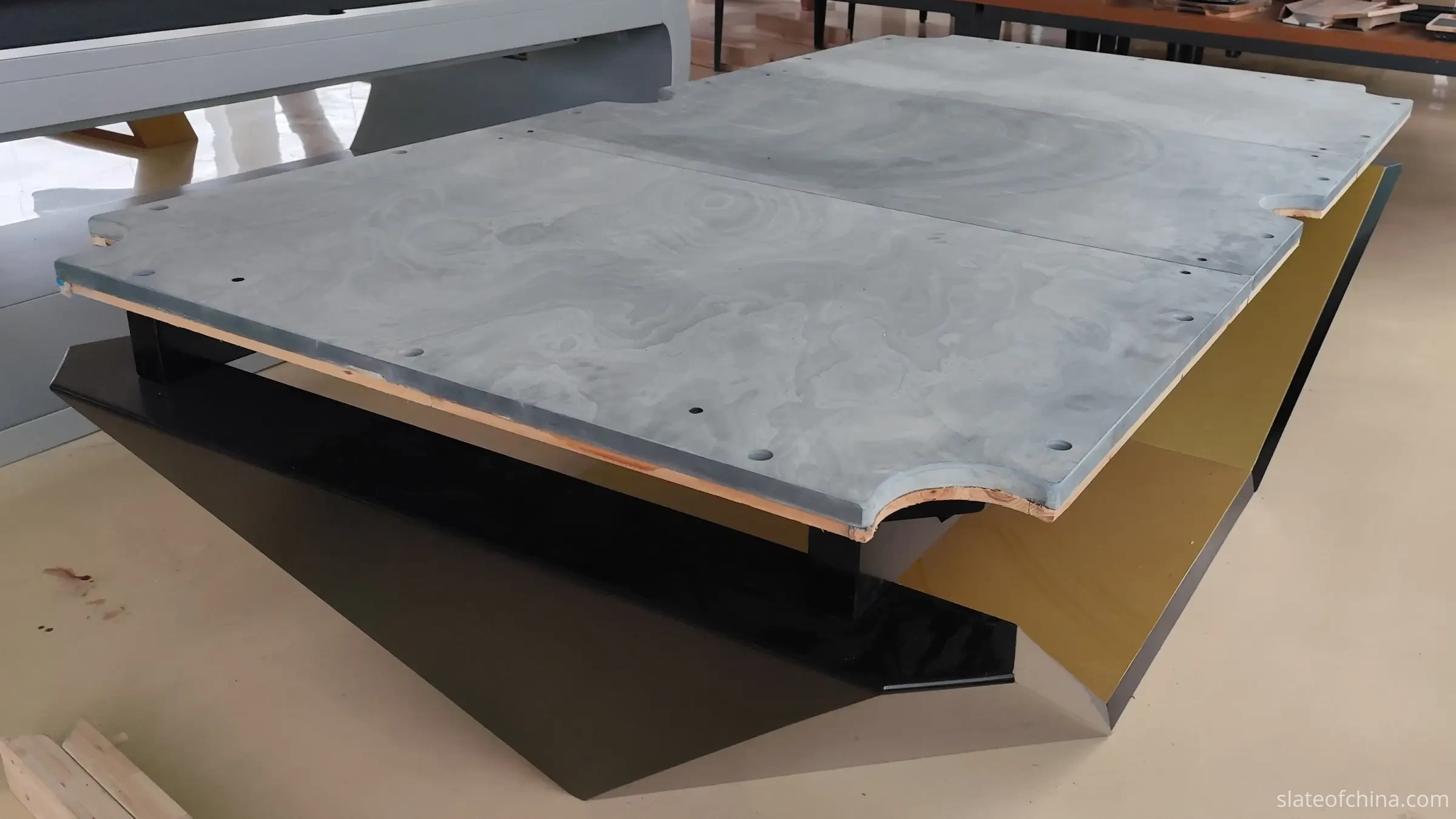
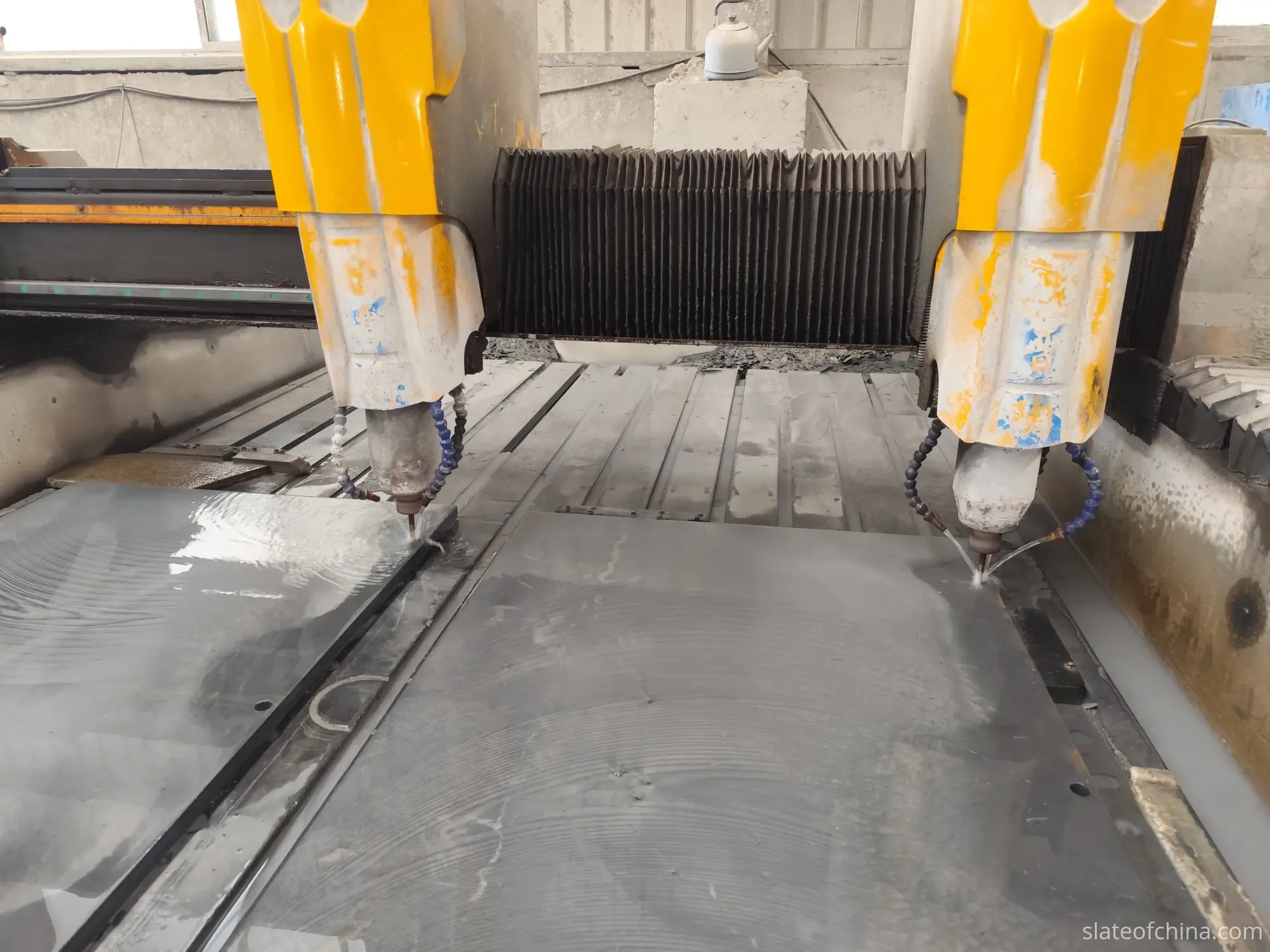
Everything above can be written in one line of text. The drawing is where the remaining geometry lives, which is why it is the field that carries all the others. Two beds with the same outline and different drawings are two different products on the CNC bed — different pockets, different holes, different edge work — and only one of them is the one your frame expects. That is also why a factory asks for CAD before cutting a single pocket; its side of that exchange is described in CNC pocket cuts and drawing confirmation.
At minimum, a billiard slate technical drawing carries:
- the overall dimensions and the dimensions of each section;
- pocket openings with their radii, where the table has pockets;
- hole positions, diameters and any countersinks — the drilling vocabulary is detailed in CNC drilling and mounting holes;
- cutouts, rebates and stepped edges;
- the joint design and the edge profiles;
- the playing-area reference the dimensions are taken from;
- tolerances on the features your assembly depends on;
- the units, the drawing number and the revision.
The revision line is the one buyers regret skipping. Rev. A becomes Rev. B the moment a single hole moves — and a factory machines the revision it was sent, not the one you meant. When a drawing changes, send the new revision and get it acknowledged before the calendar moves on.
On formats: DWG or DXF when CAD geometry exists, because the factory can work directly from it; a dimensioned PDF when the design is final and every critical number is printed legibly; photographs and sketches for the conversation stage — useful, honest, and never a production document. An existing sample or an old bed plus careful measurements works the same way: it starts the order, and production follows the approved drawing that comes out of it, not the object it came from.
If no drawing exists yet, say so on the form in those words. A first price can be built from the table type, approximate dimensions and photographs; a production order cannot. Many factories, ours included, will help convert a sample or a sketch into a draft for approval — what that help must not do is quietly substitute the factory's assumptions for your geometry. The drawing you approve is the geometry you receive.
Quantity: Sets, Not Slabs
The quantity field looks the simplest and causes the most expensive misunderstandings, because slate is ordered in two currencies: complete sets and individual sections. A line like we need 100 means nothing until the unit is named. A hundred five-piece sets is five hundred sections; a hundred sections is twenty sets and a pile of spares. Write the unit, and check that the quotation prints the same one back.
Beyond the unit, tell the factory what kind of order this is: a sample or trial set, a production batch, or the first drop of a recurring programme with annual demand behind it. The distinction changes how blocks are selected and how the schedule is built — a factory plans a sample with different hands than it plans a year. And if several specifications are involved, one email listing all of them beats three emails with one each: the factory can sequence them together instead of discovering them one at a time.
One habit protects the number itself: quantity scales a specification; it never replaces one. A larger order earns better batch economics — block selection, setup, inspection and packing all divide across more sets — but it does not convert a vague specification into a correct one. The fifty-first set of a confirmed drawing is a triumph of planning; the fifty-first set of a guess is just more slate in the wrong shape.
Acceptance Criteria: What Good Means on Paper
The form has six printed fields, and a seventh that serious buyers attach: the acceptance criteria. Words like premium, high precision and top quality cannot be machined against, inspected or argued about. What can, is a sentence that names a feature, a limit and a method. The craft is to separate the dimensions your assembly depends on from the ones it merely notices: hole positions and joint faces decide whether the bed fits the frame and whether the sections meet as one surface — assembly-critical; a small chip outside the playing zone or a variation in tone is cosmetic. An acceptance rule that says which is which protects both sides from arguing about the wrong thing later.
Where the numbers live: on the drawing, feature by feature, rather than in a blanket slogan — and there is more than one legitimate way to put them there. Your company can write its own tolerances. It can attach an existing quality-control standard and ask the factory to confirm in writing what it can achieve and how it inspects. Or it can ask the factory to state its own standard, review it, and agree the figures together before machining. A workshop without an engineering team loses nothing by choosing the second or third route — what matters is not who writes the tolerance, but that both sides confirm the same written figures before machining starts. What a slate factory actually measures, and the figures its own beds carry, is documented in the billiard slate quality and test data and in thickness and dimensional inspection; your half of the contract — what to verify when the shipment lands — is laid out in how to check billiard slate flatness on incoming inspection.
Destination and Packing: The Fields the Drawing Doesn't Carry
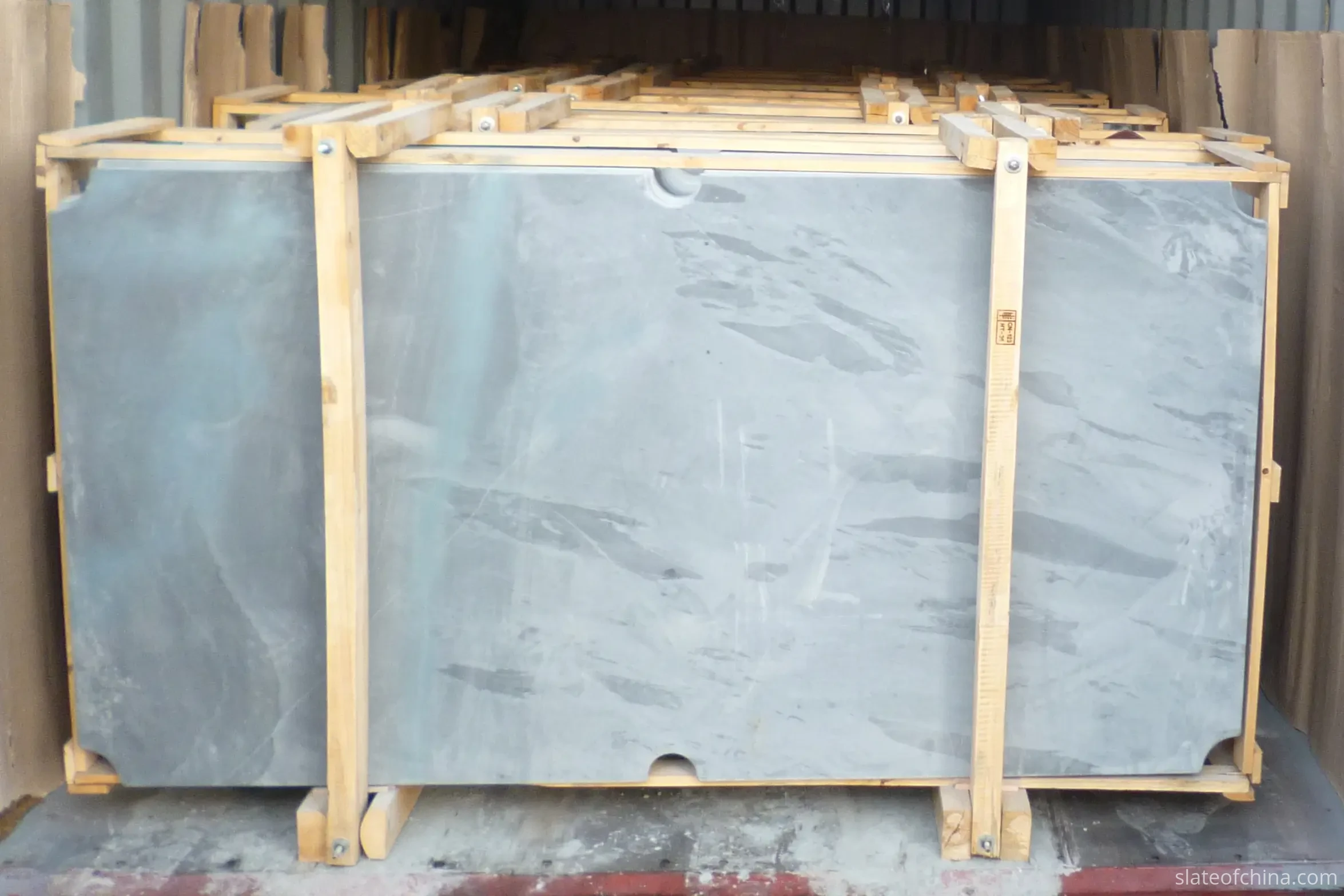
Two lines that look like logistics belong on the production form, because packing is a manufacturing decision, not an afterthought. A bed of non-standard dimensions does not travel like a catalogue size: the packing is designed around the confirmed panels, which means the destination and the shipment type have to be on the form early enough to matter. Oversized panels change the plan entirely — in our practice they usually travel on A-frames, while full containers of finished sets usually travel flat-stacked on pallets and less-than-container shipments in strengthened crates, always confirmed with the packing plan for the order rather than assumed from a habit.
The destination also prices the order. Freight, packing materials and handling differ between a container to one port and a crated set to an inland address, and slate is dense stone — every dimension and every millimetre of thickness on the form becomes kilograms on a bill of lading. What an export packing standard should include is detailed in export wooden crate packing, and the vocabulary of terms, ports and insurance is collected in the billiard slate shipping guide.
When Half the Fields Are Still Empty
Custom orders rarely start complete, and they do not need to. A new table model has a frame design still moving; a replacement buyer has a brand nobody documents anymore. What separates a smooth project from a stalled one is not completeness — it is knowing which state each field is in and saying so.
| Where the information stands | A typical example | What to do with it |
|---|---|---|
| Confirmed | Thickness and piece count are fixed by your table design | Send them as-is in the first email |
| Available but unverified | Dimensions copied from an old sample or another maker's page | Label them unverified and ask the factory to review them before production |
| Under development | The pocket layout is still moving with the frame design | Request a preliminary price on the fixed fields and name the open ones |
| Not yet decided | Final quantity, packing, destination | State the plan you do have and the timing you expect |
A declared gap is a managed risk; a silent one is a rework order. A factory can price two declared options side by side — 38 mm and 45 mm, pallets and crates — but it cannot price an absence, and it should never have to guess one quietly. Preliminary drawings deserve the same courtesy: mark a draft as a draft, and the quotation that comes back will say what it is provisional about, instead of pretending to be a production commitment.
The Spec Block You Can Copy and Send
The email wrapper around your inquiry has its own template on the quotation page. This block is the production half — the specification that travels inside it. Copy it, delete what does not apply, fill the brackets, and leave an honest to be confirmed where a field is still open.
CUSTOM BILLIARD SLATE — PRODUCTION SPECIFICATION

1. Table type and model:
   [snooker / pool / Chinese 8-ball / pyramid / carom] + [model or brand, market]

2. Application:
   [OEM production / private label / distribution / replacement / new design]

3. Slate dimensions:
   Overall [length x width mm]; per-section dimensions and joint
   positions: [per attached drawing]

4. Thickness: [mm] — [all sections / exceptions per drawing]

5. Pieces per set: [one / three / five / other]

6. Machining (pockets, holes, edges, cutouts):
   [per drawing Rev. __ / to be confirmed]

7. Acceptance criteria:
   [our spec attached / please state your standard in writing]

8. Quantity:
   [__ complete sets now; __ sets per month/year expected]

9. Destination and terms:
   [country + port], Incoterm [__], [FCL / LCL / to advise],
   packing expectation [__]

10. Target delivery: [date or window]

Drawing attached: [DWG / DXF / dimensioned PDF / photos only / none yet]
Fields still open: [list anything undecided]
Fields marked to be confirmed are normal; fields guessed are not. The block takes five minutes to fill properly, and it buys back the week the emails would have spent establishing it.
Frequently Asked Questions About Custom Billiard Slate Production
What information is required for custom billiard slate production?
Six fields make up the form: the table type and model; the actual slate dimensions, per section; the thickness in millimetres; the piece count with its joint layout; the technical drawing; and the quantity expressed in complete sets. A production-ready order adds acceptance criteria and the destination with its packing expectations. Anything still undecided is better declared than guessed.
Can I order custom billiard slate without a technical drawing?
Yes, for an initial price. Send the table type, approximate dimensions or measurements taken from the old set, the thickness if it is known, and clear photographs; a factory can quote against that and can often help prepare a draft drawing for approval. Production itself follows an approved drawing, because the geometry that reaches the CNC bed has to come from somewhere more reliable than memory.
What should a billiard slate technical drawing include?
The overall dimensions and each section's dimensions; pocket openings and radii; hole positions, diameters and countersinks; cutouts, rebates and stepped edges; the joint design and edge profiles; the playing-area reference the dimensions are taken from; tolerances on the features your assembly depends on; and the units, drawing number and revision. When anything moves, the revision moves with it — the factory machines the revision it is sent.
Should custom pool table slate be one piece or three?
The configuration follows the table design and its transport realities rather than a universal rule. Three sections are common for pool beds, five for large snooker beds, and one-piece beds appear where size and handling allow. Whatever your frame expects, state it explicitly with the joint positions — a correctly sized set with the wrong piece count is still the wrong set.
Do I have to specify tolerances myself?
Not necessarily. One route is to specify tolerances yourself for the features your assembly depends on — hole positions, joint faces, thickness. Another is to attach your existing quality-control standard and ask the factory to confirm in writing what it can achieve and how it inspects. A third is to ask for the factory's own written standard, review it, and agree the figures together before ordering. Any of the three routes gives the order a written acceptance basis — which is exactly what vague quality words never provide.
Is ordering 100 slate pieces the same as ordering 100 sets?
No, and on a five-piece bed the difference is fivefold: 100 sets is 500 sections that must match each other in groups of five. Slate is also ordered as individual sections for spares and repairs. Name the unit on the form and confirm that the quotation prints the same one back.
Does custom billiard slate require a larger minimum order than standard sizes?
It depends on the specification and the factory's setup rather than on the word custom alone. Many projects start with a sample or a trial set so both sides can verify geometry and quality before a batch, and where a custom design enters repeat production, a realistic first quantity and an honest annual estimate help the factory plan blocks, scheduling and inspection properly.
Ready to Send a Custom Slate Specification?
Send the six fields — table type and model, actual dimensions, thickness, piece count, drawing and quantity — with anything still open marked as to be confirmed. As a custom billiard slate manufacturer shipping to 30+ countries, we review every custom inquiry against what the CNC bed actually needs, flag the missing pieces before machining starts, and reply with the few questions that matter instead of a long list of them.