
Slate Edge and Joint Machining: Why Three-Piece Billiard Slate Lines Up — or Doesn't
In our inspection area, there is a test that never appears on any drawing. The overhead lamp goes off, a technician holds a small flashlight behind the joint where two slate panels meet, and looks for light.
If the beam leaks through, the panels measured correctly and the edge did not. Length, width and thickness can all check out on the caliper, and yet the joint does not close. A line of light traces a gap that should not exist — sometimes hairline-thin, sometimes visible at one end and invisible at the other.
The gap is not in the dimensions. The gap is in the geometry.
Quick Answer
The symptom: a visible gap or step where two slate panels meet, even when length, width and thickness all check out.
Layer 1 — straightness: if the joint face is not straight, the gap varies along the seam.
Layer 2 — squareness: if the edge is not square to the playing surface, one panel sits higher than the other.
Layer 3 — panel matching: three panels machined at different times, on different setups, will not mate as a set.
The root cause: the drawing said "3-piece, 25 mm" but never said which edges are joint faces, what geometry they need, or how the three panels should be matched. Edge and joint machining is the process that controls all three layers — and it starts with the drawing, not the caliper.
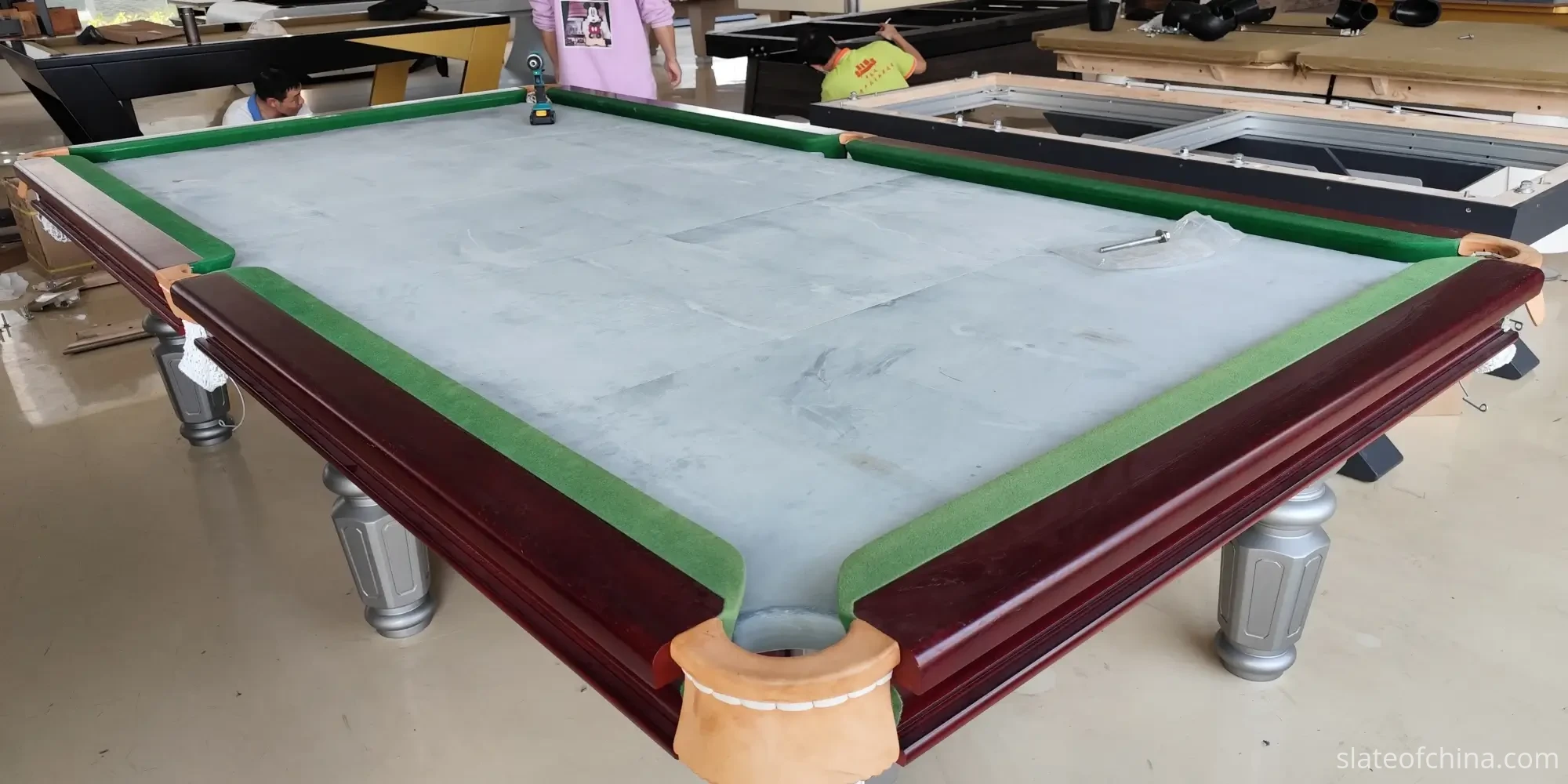
What the Caliper Cannot Tell You
A tape measure reads length. A caliper reads thickness. A square reads one corner at a time. These instruments answer a narrow question: did the panel reach its nominal dimensions? They do not answer the question that matters on the assembly floor: will three panels come together as one continuous surface?
The difference sounds subtle until you have stood over a joint that refuses to close.
Imagine three panels — call them A, B and C — and every dimension on every panel matches the drawing. Panel A is the correct length. Panel B is the correct width. Panel C is the correct thickness. By the standard measurement sheet, all three pass. Now push them together. The left joint closes at the top but opens at the bottom. The right joint closes at the far end but shows a hairline gap near the centre. A step of a fraction of a millimetre runs along one seam — invisible to a tape measure, obvious to a straightedge, and potentially significant when leveling the finished playing surface.
Correct dimensions tell you the panel was cut to size. They do not tell you the edge was cut to geometry.
This is the distinction that separates a slate supplier who cuts stone from one who machines it. Cutting to size is a question of length and width. Machining to geometry is a question of straightness, squareness, and the relationship between adjacent edges — the properties that only matter when two panels have to meet.
A Joint Face Is a Working Surface, Not a Finish
Not every edge of a billiard slate panel has the same job, and this is where a lot of misunderstanding starts.
A visible outside edge — the long side of a panel that runs along the table rail — has one set of requirements. It needs to look clean, it needs to meet the overall dimension, and it may need a specific edge treatment: a chamfer, a slight bevel, or a square edge that sits flush against the frame. After the cloth goes on and the rails go up, this edge is partly visible and partly hidden. It matters, but it is primarily a dimensional and cosmetic concern.
A joint face is different. It is the surface where two slate panels meet at the centre of the table. After assembly, it is completely invisible — buried under cloth, filler, and the weight of the frame pressing down. No customer will ever see it. No one will run a finger along it. And yet it is one of the most functionally important surfaces on the entire panel, because it determines whether the three pieces form one plane or three slightly different planes.
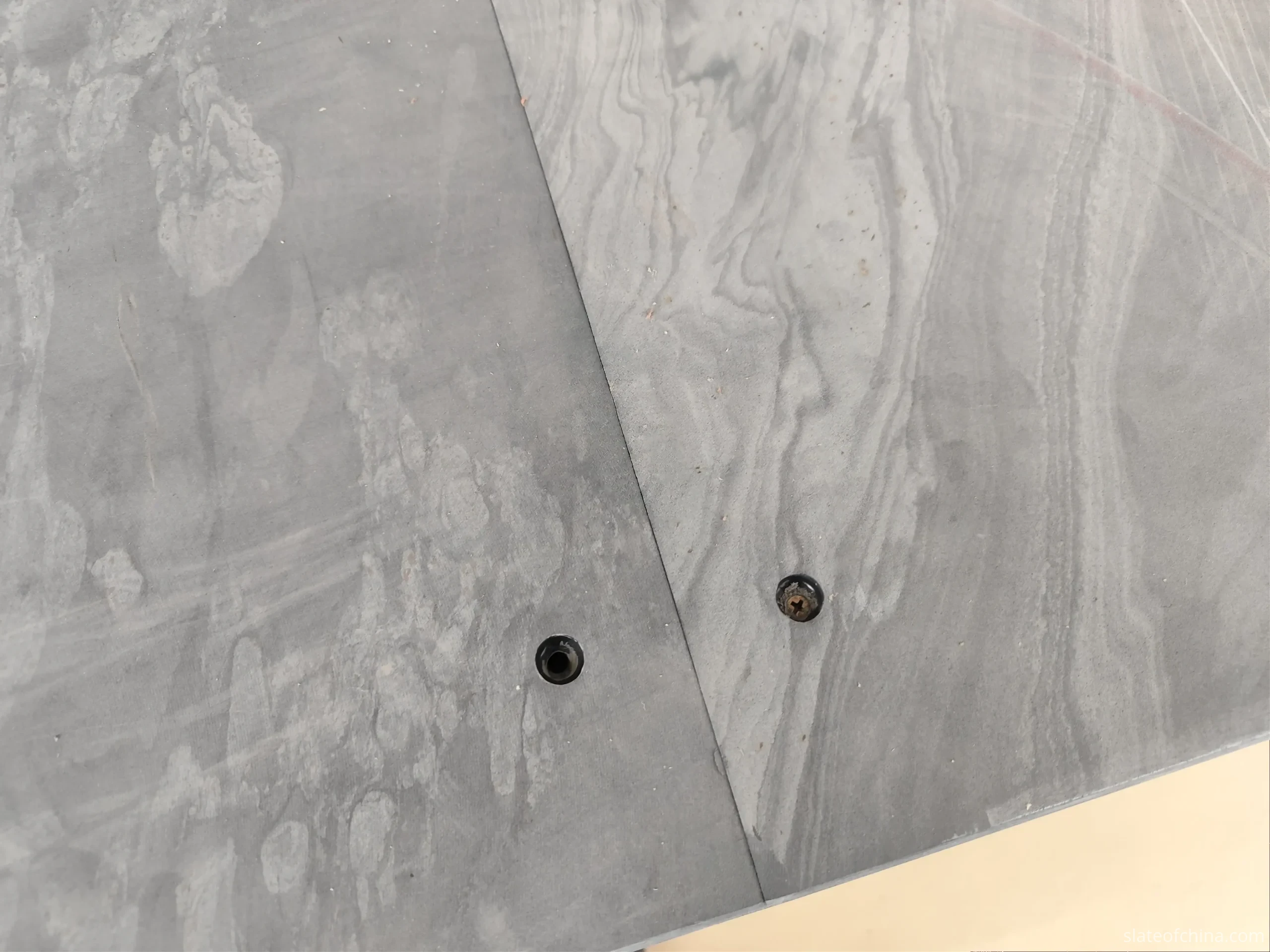
The machining requirement for a joint face is therefore different from the requirement for an outside edge. A joint face needs straightness along its full length. It needs squareness to the playing surface. It needs consistent contact — no high spots that hold the panels apart, no low spots that let them rock. And it needs dimensional repeatability: the joint face on Panel A has to match the joint face on Panel B, because the two will be pressed against each other.
This is why a supplier saying "the slate is CNC machined" tells you less than it sounds like it does. The relevant question is not whether a machine was involved. The question is which edges and surfaces were actually machined, what geometry was controlled, and how the three panels in a set were matched to each other. A panel can be cut on a CNC bridge saw and still have joint faces that were never squared — because the saw cut the outline but never came back to machine the mating surfaces.
Straightness: Where the Gap Starts
Straightness is the first geometry that fails, and it is the easiest to miss.
A joint face that is not straight does not produce a uniform gap. It produces a gap that changes along the length of the seam. At one end the panels might touch. In the middle they might separate. At the other end they might touch again — or they might rock, because the high spot in the centre is holding the edges apart at both ends. The installer sees a joint that is "mostly closed" with a suspicious opening somewhere in the middle, and the natural response is to add more filler. Filler hides the gap; it does not correct the geometry.
For controlled OEM production, edge straightness should be established during the edge-squaring stage — the step where the rough-cut perimeter is machined to a controlled, straight reference surface. This is not the same as cutting the panel to length. Cutting to length answers how long is it? Squaring the edge answers how straight is it? A panel can be exactly 914 mm long and have an edge that bows by a fraction of a millimetre in the middle. The length is right; the straightness is not.
The reason this matters for a three-piece set is simple: the joint gap follows the edge. If one joint face bows inward by 0.3 mm at the centre, the gap at the centre is 0.3 mm wider than at the ends. The panel measured correctly. The edge did not.
Squareness: Where the Step Hides
If straightness controls the gap, squareness controls the step.
Squareness means the joint face is perpendicular to the playing surface. When two panels meet at a joint, their playing surfaces need to be in the same plane. If the joint face on one panel leans — if it is not square to the top surface — the panel will sit slightly higher or lower than its neighbour. The difference may be a fraction of a millimetre, but a ball rolling across the joint will feel it. So will a straightedge laid across the seam.
I have seen installers spend an hour shimming a joint that looked perfect in the dimensions but produced a visible step under the straightedge. The problem was not the installer. The problem was an edge that was cut to length but not squared to the surface. On a 25 mm slate, a lean of a fraction of a degree across the edge width translates into a measurable step at the playing surface. On a 45 mm or 50 mm snooker slate, the same lean produces an even larger step, because there is more edge width for the angle to act over.
This is one reason edge machining cannot be treated as a simple "cut to size" operation. The relationship between the edge and the playing surface has to be controlled, not just the relationship between the edge and the nominal dimension. For controlled OEM production, the playing surface should be established first — through surface grinding — and the edges then machined with reference to that surface, not independently of it.
Accurate joint machining creates the right starting geometry, but it does not replace final table installation and leveling. The table frame, support points, mounting method and final slate leveling still affect the finished playing surface. A well-machined set gives the installer a head start; it does not eliminate the need for careful assembly.
Three Panels Cut as One Set
Here is a problem that catches even experienced buyers: each panel can be individually correct and the set can still fail.
Suppose Panel A is machined on Monday morning, Panel B on Tuesday afternoon, and Panel C on Wednesday. Each panel was set up, machined, and inspected individually. Each one passed its dimensional check. But the three panels were never machined as a set — they were never on the same fixture, referenced from the same datum, or checked against each other.
The result is cumulative mismatch. Panel A's joint face might be a fraction of a degree off from Panel B's, because the setups were different. Panel B might be a fraction of a millimetre shorter than Panel C, because the reference edge was established differently. Each deviation is within tolerance individually. Together, they add up to a set that does not close cleanly.
For controlled OEM production, the three panels in a set should be machined using consistent references and a controlled sequence — so that the joint face on Panel A is matched to the joint face on Panel B by method, not by luck. This is what we mean when we say the set is the unit, not the panel. Individual dimensions are necessary; panel-to-panel consistency is what makes the set work. The joint alignment page covers what happens at the moment of assembly. This page is about the machining that makes that moment predictable.
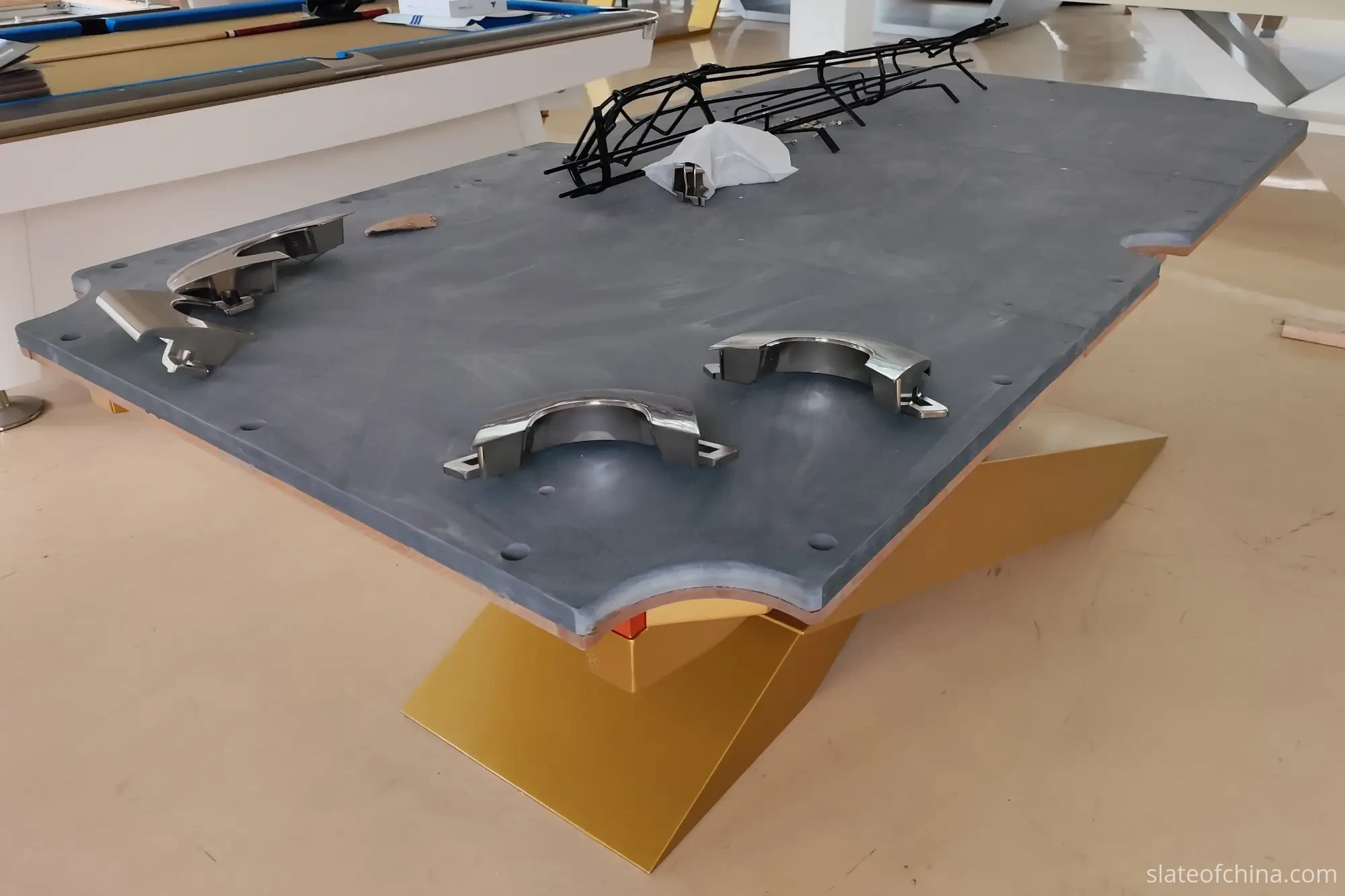
How the Edge Is Machined
Edge and joint machining is not a single operation. For controlled OEM production, it runs through several stages, and the order matters.
Initial cutting. The raw slate is first cut approximately to the required dimensions. At this stage, the panel still has machining allowance — it is a workable blank, not a finished part. The purpose is to produce a panel of roughly the right size, not to achieve final joint geometry.
Edge squaring. The major edges are then machined to establish straight, controlled reference surfaces. This step matters more than it sounds, because every subsequent machining and inspection operation can use these squared edges as a reference. If the first edge is not straight, every edge measured from it inherits the error. For controlled OEM production, the machining sequence should stay consistent from panel to panel within a set — the same edge squared first, the same edge used as the reference, and the same order followed on Panel A, B and C.

Joint face machining. The mating surfaces between adjacent panels are then machined according to the table drawing. The objective is not simply to make the edge look straight — it is to hold the specified geometry: straightness along the full length, squareness to the playing surface, and consistency with the corresponding joint face on the neighbouring panel. For a three-piece set, this is where "machined to size" becomes "machined to mate."
Dimensional inspection. After machining, the panels are checked against the approved drawing. Depending on the order, inspection may cover length, width, thickness, diagonal dimensions, edge straightness, joint face condition, hole locations, pocket locations and surface flatness. The exact inspection points follow the buyer's technical drawing — not a generic checklist. The thickness and dimensional inspection page covers how individual dimensions are measured and reconciled. Here, the focus is on the edges and joints: are the joint faces straight? Are they square? Do the three panels mate?
The Drawing Decides Which Edge Matters
One of the most important principles in OEM billiard slate production is this: the table drawing should define the geometry, and the slate supplier should manufacture to that geometry.
Different billiard table manufacturers use different joint configurations. The same nominal table size — say, a 9 ft pool table — can have different panel divisions, different joint positions, different mounting-hole patterns, different pocket layouts and different edge treatments. A supplier who assumes that every three-piece set uses the same joint configuration is guessing, and guessing is expensive when the panels arrive at the assembly floor and do not fit.
This is why "standard three-piece slate" is not always a sufficient technical specification. The drawing should specify: which edges are joint faces and which are outside edges, where the joints are located, what edge treatments are required, and what tolerances apply. Without this information, the supplier has to interpret — and interpretation is where alignment problems are born.
For a manufacturer producing replacement slate for a known table, the relevant production data may already exist. For an OEM customer developing a new table, the approved engineering drawing is the reference document. The drawing confirmation process is covered separately; here, the point is that the drawing is what tells each edge what it needs to be.
Thickness Changes the Edge Equation
Edge machining has to be considered together with slate thickness, and the relationship is not symmetric.
Buyers commonly specify different thicknesses depending on the table design and market — 19 mm, 22 mm, 25 mm, 30 mm, 35 mm, 38 mm, 45 mm and 50 mm all appear in production. A given angular deviation in the joint face can produce a more noticeable offset across a thicker edge. A joint face that leans by the same fraction of a degree may produce a more visible step on a 50 mm snooker slate than on a 25 mm pool slate, because the thicker edge gives the angle more distance to project across — though the final offset depends on the combined effect of the angular error, the geometric relationship, and the actual reference surface, not on thickness alone.
This means that a panel should not only meet its nominal thickness specification. The manufacturer should also consider how the top playing surface, the bottom surface and the machined edges relate to each other. On a thicker panel, this relationship deserves closer attention — not because the edge is harder to machine, but because a given geometry deviation can have a more visible consequence.
This is particularly important when mounting holes, pockets and other CNC features share the same panel. A hole position is defined relative to the table drawing; a joint face is defined relative to the playing surface. Both have to be right on the same piece of stone. The technical specifications page collects standard sizes and thicknesses in one reference table.
| Slate Thickness | Edge-Geometry Concern | Why It Matters for Alignment |
|---|---|---|
| 19–25 mm (pool) | Less edge width for angular deviation to project across | A given angular deviation generally produces a smaller edge offset |
| 30–38 mm (pool / carom) | More edge width — squareness deviations become more noticeable | The same angular deviation can produce a larger offset than on thinner slate |
| 45–50 mm (snooker) | Greater edge width — geometry becomes more sensitive | The edge-to-surface relationship requires careful control; final offset depends on the combined geometry, not thickness alone |
Not an Isolated Cut
Edge machining should not be viewed as an isolated operation, and this is where the value of CNC becomes clear.
A finished slate panel may include several different machining operations, and they need to work together: raw slate → cutting → edge machining → joint machining → pocket machining → hole drilling → surface finishing → inspection. The accuracy of each operation depends on the one before it. If the edge is not straight, the pocket cut that references the edge inherits the error. If the joint face is not square, the panel that sits next to it inherits a step.
This is why CNC billiard slate machining is valuable for OEM production: the machining process can be based on defined coordinates rather than relying entirely on manual marking. The CNC programme does not just cut — it holds the relationship between edges, holes, pockets and joint faces in a single coordinate system. When the same programme runs on Panel A, B and C, the three panels share a geometric reference by construction, not by coincidence.
The CNC machining guide covers the machine side. Here, the point is that edge and joint machining is one link in a chain, and a chain is only as strong as the relationships between its links.
Edge Problems: What to Look For
The table below collects the most common edge and joint problems, the symptom each one produces at installation, and the check that catches it before the container leaves the factory. It is a quick reference, not a substitute for the approved drawing — but it covers the geometry issues that dimensional inspection alone will miss.
| Machining issue | Typical symptom | What to check |
|---|---|---|
| Joint face not straight | Uneven gap along the joint — closes at ends, opens in the middle | Straightedge along the joint face; look for light underneath |
| Joint face not square | Step between panels — one panel sits higher than the other | Engineer's square against the joint face and the playing surface |
| Panel mismatch | Joints do not close consistently — one seam fine, the other off | Dry assembly of the full three-piece set on a flat bench |
| Damaged joint face | Local gap or instability at one point along the seam | Visual inspection of the contact surface for chips and cracks |
| Incorrect reference | Multiple dimensions drift — the panel looks right but nothing lines up | Compare the machining datum against the approved drawing |
What "3-Piece, 25 mm" Leaves Unsaid
When purchasing three-piece billiard slate, the single most common RFQ description is something like: "3-piece slate, 25 mm thick." This is enough to start a conversation. It is not enough to prevent alignment problems.
A better RFQ or technical drawing can specify the following — and the more of these that are defined, the less room there is for interpretation between buyer and manufacturer:
- Basic dimensions: overall table size, individual panel dimensions, slate thickness, playing area
- Joint information: number of slate pieces, joint positions, joint-face geometry requirements
- Required edge treatment: chamfer, bevel, square edge — and on which edges
- Relevant tolerances: critical dimensions, measurement method, acceptable ranges
- CNC features: pocket dimensions, pocket positions, mounting holes, countersinks, threaded holes if required
- Inspection: critical dimensions to inspect, measurement method, acceptable tolerances, sample approval requirements
None of this is exotic. But each item that is left unspecified becomes a decision the supplier makes on the buyer's behalf — and the supplier may not know which edges are joint faces, what the table frame expects, or how the installer will handle a gap. The manufacturer selection page covers how to evaluate whether a supplier can work to this level of detail. Here, the practical message is: the drawing is the cheapest alignment tool you have.
Inspecting Edges and Joints Before the Container Leaves
For larger B2B orders, buyers do not necessarily need to inspect every dimension themselves. A more practical approach is to establish a simple inspection procedure with the supplier — one that checks the things that dimensions alone miss.
Visual inspection. Look for chipped joint faces, cracked corners, damaged edges and poorly machined surfaces. A chipped joint face is not always a rejection — it depends on whether the chip is on the contact surface or a non-contact area — but it should be flagged and assessed, not hidden.
Dimensional inspection. Measure critical dimensions against the approved drawing: length, width, thickness, diagonals. This is the standard check and it catches gross errors. It does not catch geometry errors.
Joint-face inspection. This is the check that the standard inspection sheet often omits. Run a straightedge along each joint face. Look for light under the straightedge — the same flashlight principle. Check whether the edge is square to the playing surface with an engineer's square. These two checks take minutes per panel and catch the geometry problems that dimensional inspection cannot.
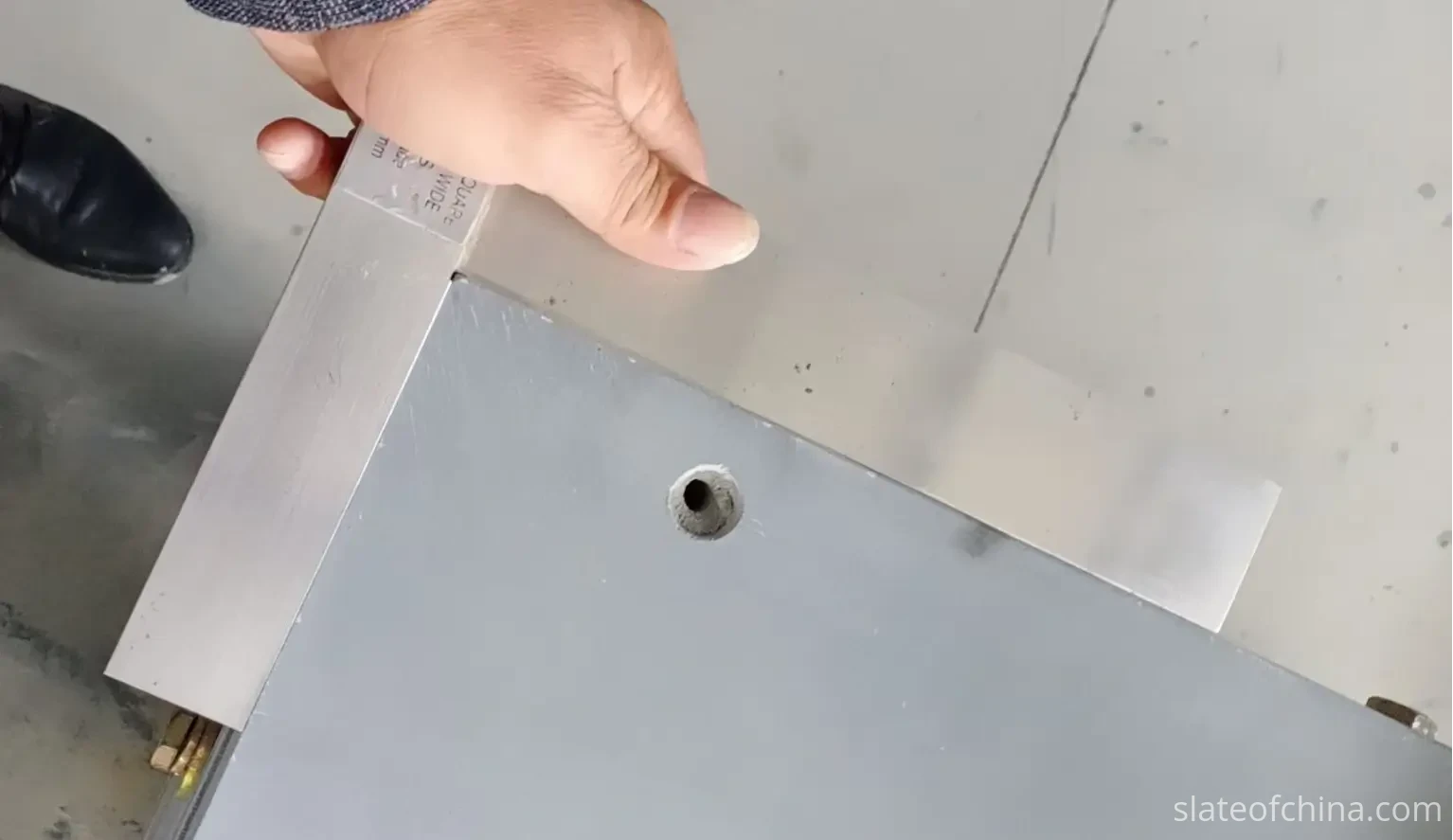
Sample assembly. For an important OEM project — especially a new table design or a new supplier — assembling a representative three-piece set before mass production can reveal problems that individual measurements will not show. This is the dry assembly test: push the three panels together on a flat bench, check the joints with a straightedge and a flashlight, and confirm the set closes before the rest of the production runs. The quality control checklist covers the full inspection framework. Here, the focus is on the edges and joints: the checks that prevent the gap from travelling to the assembly floor.
Six Questions for Your Supplier
Before placing an OEM order, these questions help distinguish a manufacturer that understands billiard slate from one who simply cuts stone:
- Are the slate joint faces CNC machined or manually finished? — The answer tells you whether the geometry is controlled by programme or by hand.
- How are the three panels matched during production? — The answer should describe a consistent sequence, not three independent setups.
- What dimensions are inspected after edge machining? — The answer should include edge straightness and joint-face condition, not just length and width.
- Can the factory manufacture according to our CAD drawing? — The answer tells you whether the supplier works to your geometry or to their own assumptions.
- Can you provide dimensional inspection records for critical features? — The answer tells you whether inspection is documented or verbal.
- Can a sample three-piece set be produced for approval before mass production? — The answer tells you whether the supplier can prove the set closes before committing to a full run.
These are not trick questions. A supplier who can answer them clearly is one who has already thought about what happens to the slate after it reaches the table factory. A supplier who cannot is one who may deliver correct dimensions and incorrect geometry — and leave the gap for the installer to discover.
Joint Machining Does Not Replace Final Table Installation
Accurate joint machining creates the right starting geometry. It does not guarantee a perfect playing surface on its own.
After the three panels leave the factory, the final playing surface depends on factors the slate supplier does not control: the table frame, the support points, the leveling process, the slate mounting, the joint filler, the installer's technique, and the final surface leveling. A well-machined set makes all of these easier; it does not eliminate them.
This is why edge and joint machining should be understood as one stage in a chain, not as a standalone guarantee. The machining controls the starting geometry — straightness, squareness and panel-to-panel matching. The installation controls what happens to that geometry once the panels are placed on the frame, bolted down, leveled and joined. A set that is machined well but installed poorly will still have problems; a set that is machined poorly cannot be rescued by installation skill alone.
The practical takeaway for buyers is simple: specify the machining geometry in the drawing, inspect it before shipment, and then make sure the installation process is designed to preserve it. Accurate joint machining gives the installer a set that is ready to close; the installer still has to close it.
The Edge You Will Never See
After the table is assembled, the edges are gone. The cloth covers the surface, the rails cover the perimeter, the filler covers the joints, and the player sees a single unbroken plane. No one will ever run a finger along a joint face. No one will ever hold a flashlight behind a seam.
But the edges were there first. They decided whether the three panels became one surface or three surfaces pretending to be one. They decided whether the installer spent twenty minutes or two hours on the joints. They decided whether the filler was a whisper or a layer. And they decided whether the table played true — or whether a ball crossing the seam felt a bump that no amount of cloth could hide.
That is what edge and joint machining is for. Not to make the slate look finished — but to make the three pieces fit together so well that no one ever thinks about the joint again.
FAQ: Slate Edge and Joint Machining
Can three slate panels have correct dimensions but still not align properly?
Yes. Length, width and thickness can all meet the drawing while the joint still has a gap or step. Straightness, squareness and panel-to-panel matching also have to be controlled.
What is the difference between edge machining and joint face machining?
Edge machining covers all perimeter edges of a panel. Joint face machining is the specific part that machines the mating surfaces where two panels meet. An outside edge is partly visible after assembly; a joint face is normally hidden but functionally critical — its straightness and squareness decide whether the three pieces form one continuous plane.
Do all three-piece billiard slate sets use the same joint configuration?
No. Different table manufacturers use different panel divisions, joint positions, pocket layouts, hole patterns and edge treatments — even for the same nominal table size. The approved drawing should define the joint configuration for each specific table design.
How are billiard slate joint faces machined?
In a sequence: the raw slate is cut to a rough blank, the major edges are squared to establish straight reference surfaces, and the joint faces are then machined to the geometry in the table drawing — straight, square to the playing surface, and consistent with the neighbouring panel. For a three-piece set, the panels should be machined in a consistent sequence so the joint faces are matched by method.
What should I specify when ordering three-piece billiard slate?
Beyond "3-piece, 25 mm," specify: overall table size, individual panel dimensions, slate thickness, playing area, number of pieces, joint positions, joint-face geometry requirements, required edge treatment, relevant tolerances, CNC features (pockets, holes, countersinks), and inspection requirements. The more that is defined in the drawing, the less room there is for interpretation.
Can a sample three-piece set be produced before mass production?
Yes, and for OEM projects it is one of the most effective ways to catch alignment problems early. The sample set can be assembled on a flat bench and the joints checked with a straightedge before the production run begins. This tests the relationship between panels, not just the panels themselves.
Does slate thickness affect edge machining requirements?
Yes. Thicker slate has more edge width, so a given angular deviation in the joint face can produce a more noticeable offset at the playing surface. The relationship between the playing surface and the machined edges deserves closer attention on thicker panels — not because the edge is harder to machine, but because a given geometry deviation can have a more visible consequence.
Related Reading
Have a three-piece slate drawing? Send it to us for review.
The drawing decides which edges are joint faces and what geometry they need. Send us your drawing and table specifications, and we can discuss the required slate dimensions, edge machining, joint machining and CNC features before production — so the three panels arrive at your assembly floor ready to close, not ready to be reworked.
Send Us Your Slate Drawing → Request an OEM Quote
Or browse our billiard slate product range for standard and custom options.