
Jiujiang Slate: From Local Industry to Global Market
Every export order that leaves this region starts as a sheet of paper on a desk — a proforma invoice, six or eight lines from the buyer's name down to the destination port. Read it in the direction it was written, and it tells you what is being shipped. Read it backwards, from the last line to the first, and it tells you something else: how much a place has to learn before that sheet of paper can exist at all. Destination port — somebody had to learn to move thirty tonnes of stone across an ocean without breaking the edges. Packing terms — somebody had to learn what a cargo handler does to a crate on a bad afternoon. Tolerances and test reports — somebody had to learn to measure, document, and hold a number still across ten repeat orders. Material specification — somebody had to learn which blocks are worth sawing and which are only worth splitting. And material itself — the first line — is the oldest knowledge of all, older than any factory on this stretch of the Yangtze.
That is what this page is about. Not the catalogue of what the Jiujiang slate industry makes — the structure of that is drawn elsewhere in this guide — but the story of how the capabilities stacked up, era by era, until a local stone industry in northern Jiangxi could hold its own in global markets for both roofing slate and billiard table slate. It is worth an overseas buyer's reading time for a practical reason: the fastest way to judge a supplier is to know which era's capabilities you are actually buying.
Quick Answer — five eras, one order sheet:
| Era | What the region learned | What a buyer inherits |
|---|---|---|
| 1. Before the containers | The stone itself — how it splits, weathers, behaves | Material knowledge built roof by roof, over generations |
| 2. The hand-skills era | Trades organise around the material — splitters, hauliers, workshops | A cluster, not a lone quarry: depth of skills within one region |
| 3. The machine era | Saws, grinders, machining — geometry held to a drawing | Two product worlds, one stone: split tiles and machined beds |
| 4. The evidence era | Specs, samples, reports — answering to distant desks | A quotation that means the same thing in March and October |
| 5. The market era | Freight rhythm, repeat orders, markets as the final judge | Suppliers who learned the hard way — at somebody's pallet |
Each era below answers who learned it, why the market forced it, and what it hands to the next buyer. The five stack; no era replaces the one before it — the hand splitter and the gantry grinder still work in the same industry.
Before the Containers
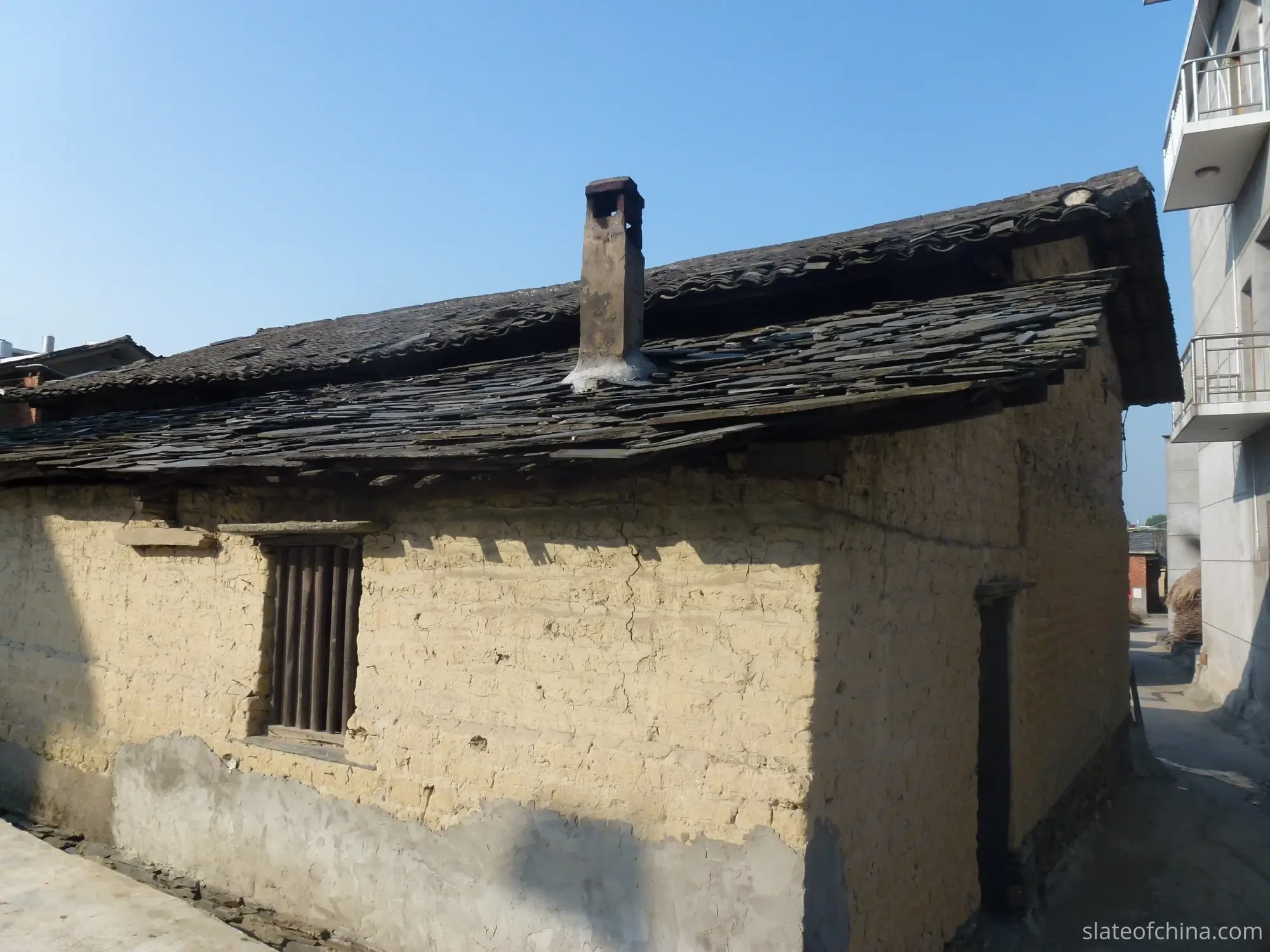
Long before export licences or container schedules, the hills south of the Yangtze in northern Jiangxi already had a working relationship with their slate. Villages roofed with it; workshops carved and ground it into objects that needed a fine, stable, workable face. None of that commerce crossed a border, and none of it needed to. What accumulated instead was something less visible and more durable: knowledge of the material itself. Which beds split clean and which fight the chisel. How the stone weathers on a south-facing roof versus a north one. What a frost year does to a poor piece and what it does to a good one. None of it was written down; all of it was remembered, because the roofs were the test and the roofs did not negotiate.
That inheritance matters more to a modern buyer than it sounds. The village roof was a slow, unpaid testing programme that ran for generations — a laboratory nobody funded and nobody could fake. The history pages of this guide tell that story in detail, from inkstones to tombstones to the roofs still standing today. What the export trade inherited from it was not just confidence in the stone but a population of hands that already knew it — the quiet head start that every later era built on.
The Skills That Predate the Machines
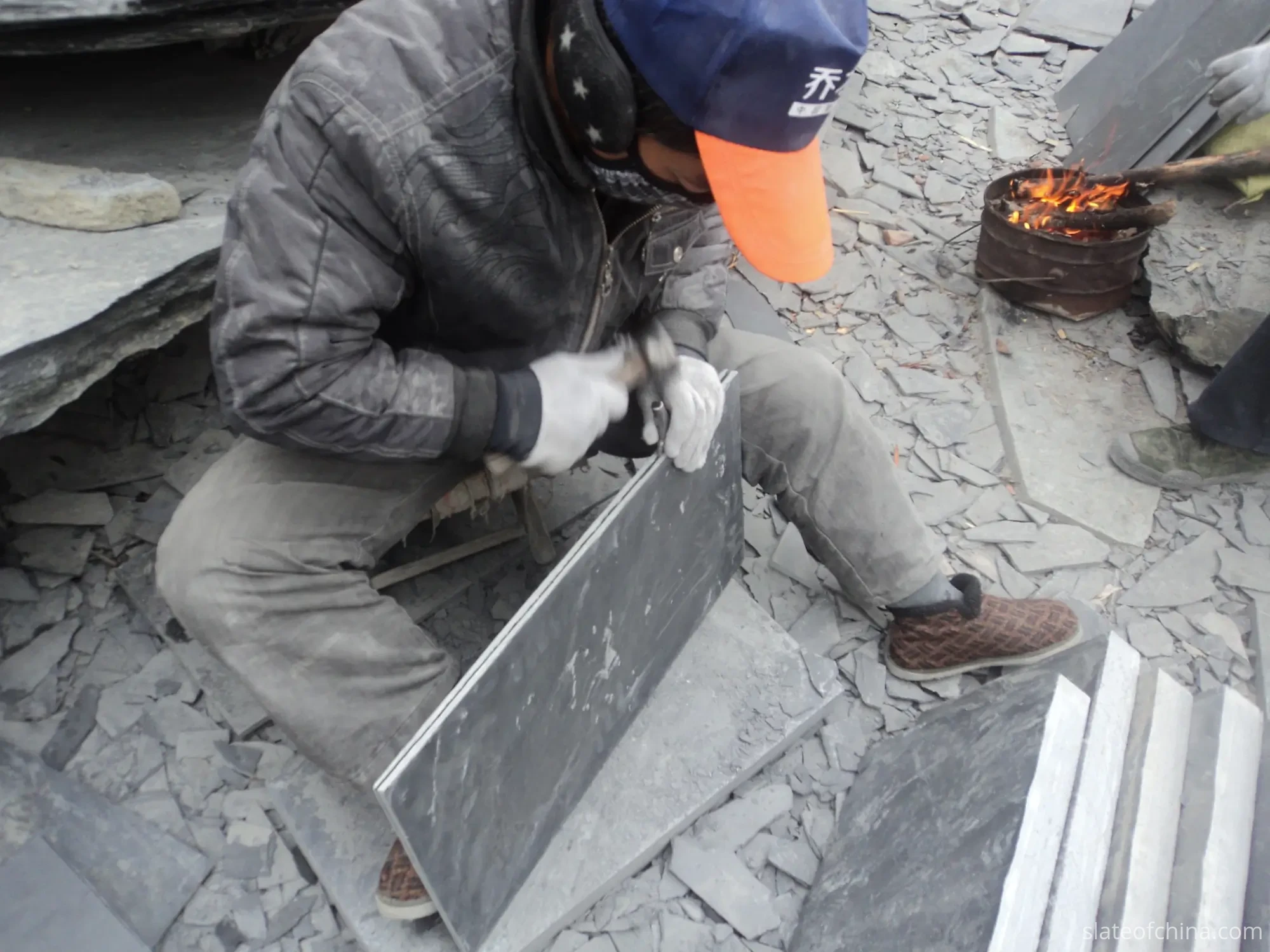
A geological deposit does not become an industry until people organise around it. In the pre-machine generations, the slate industry in Jiangxi province took its shape: quarry men who knew the benches, hand splitters who could read grain and strike a true face, dressing and sorting skills, the hauliers and boatmen who moved heavy stone down to the river. Around them gathered the supporting cast every stone region grows — tool sharpeners, crate makers, the workshops that turned a rough split into a product. It was a trade before it was an industry: skills passed down, specialities divided, and a working economy of small players who each did one part of the job well.
Two things about that era still shape the region today, and a buyer should know both. The first is that the trade organised by capability, not by company — no single business did everything, and cooperation was the only way a block became a roof. That habit of specialisation is why the modern supply chain here has layers rather than one factory, a structure the industry page maps out link by link. The second is that the hand skills themselves survived the machines — they were never replaced, only upgraded. The splitter's judgement about where a stone wants to break has no machine equivalent; what changed later is what his striking earned.
This is also the era to retire a comfortable myth: that export-grade quality is something a region simply discovers on the morning the first foreign buyer arrives. Local use built knowledge, but knowledge is not a specification. A roof tile that satisfied a village for eighty winters is not automatically a tile that satisfies a written dimensional tolerance, a colour range agreed in advance, and a claim for breakage filed from another continent. Between the two stands everything in the rest of this page.
What the Machines Change
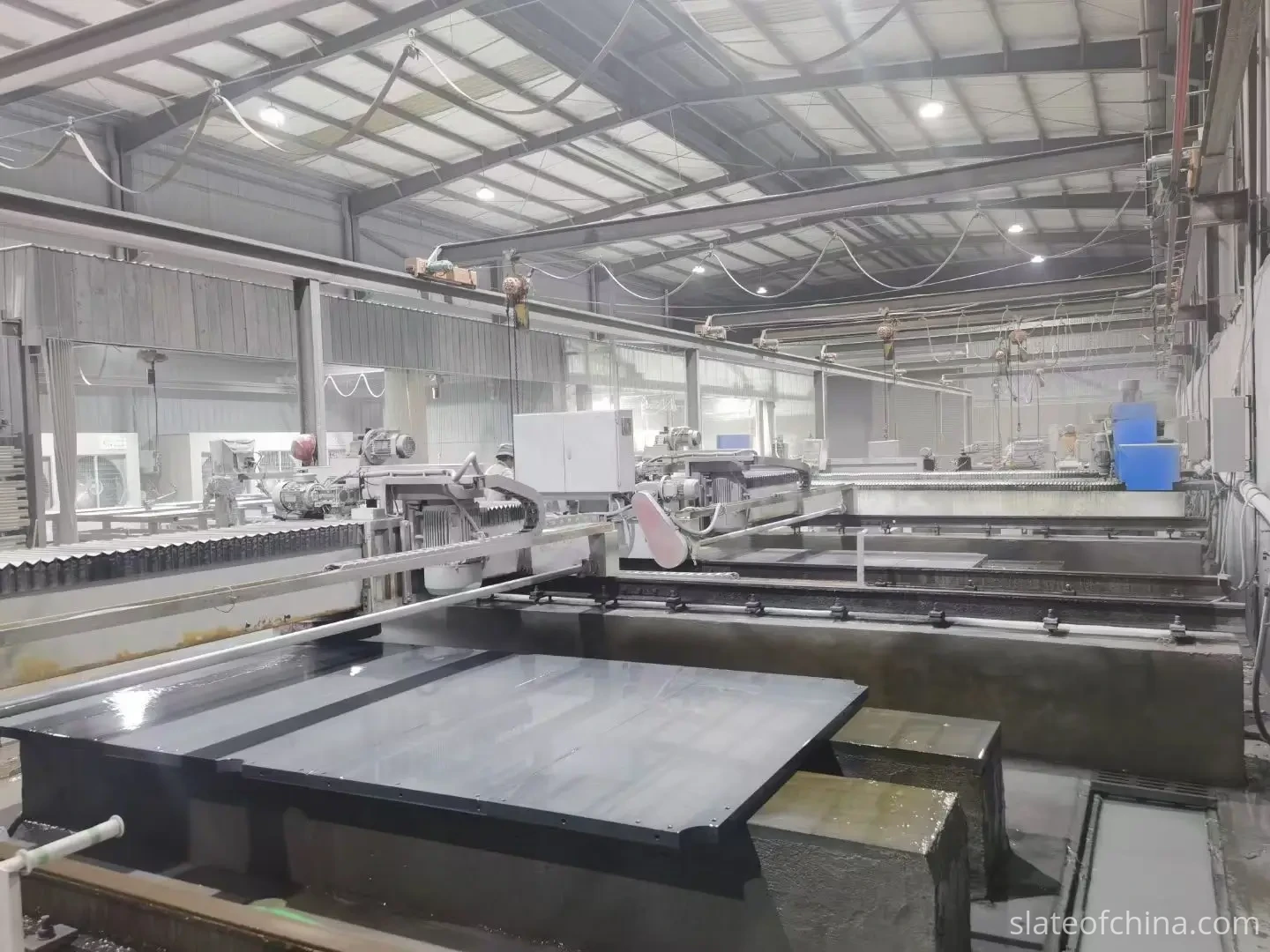
When the saws, the grinders and the machining centres finally arrived in this region, they did not arrive as a single event — but looking back, they mark the sharpest turn the trade ever took. Their contribution is easiest to see as three separate gifts.
Volume. A hand splitter earning a living in the pre-machine era produced what a pair of hands could produce. Saws changed the arithmetic of scale: same stone, same hills, suddenly a roof's worth of tiles in a fraction of the time. Output is not a virtue on its own — but no export trade exists without it, because no distant buyer can build a season's programme on a workshop that splits one crate a week.
Geometry. The deeper change was not speed but shape. A hand-split tile is true to the grain; a machined bed is true to a drawing. With saws and grinders, the region could for the first time hold a rectangle, a thickness, a flat plane to a number somebody else had written down — the capability that an export billiard table slate supplier is built on, and one that roofing production absorbed too in its own way: trimmed edges, sorted dimensions, a crate of tiles that behave like a batch rather than a family of individuals. What the machines created, in short, was the possibility of a specification. The two journeys are told apart in detail elsewhere: the split-and-dress route that makes a roof tile and the saw-grind-machine route that makes a table bed.
Two product worlds from one resource. Once geometry could be held, the same stone could serve two entirely different conceptions of value. Roofing slate is the stone asked to do what it does naturally — cleave into weatherproof planes — and to be graded, counted and packed as such. Billiard slate is the stone asked to stop acting like stone and act like a machined component: sawn flat, ground true, drilled where a frame expects bolts, its playing behaviour governed by flatness figures whose measurement basis and limits are set out on the flatness page of this guide. Table beds run between nineteen and thirty-eight millimetres thick depending on the table; roof tiles run a fraction of that. Same resource; different physics of value.
One consequence deserves a buyer's attention because it contradicts the brochure logic of "one rock, everything": capability is route-specific. A workshop whose whole life is hand-splitting tiles can be superb at roofing and useless at holding a machining tolerance; a machine hall full of grinders does not automatically grade and blend a weathering tile well. The era of machines gave the region the possibility of two product worlds — it did not give every workshop both. Which one a given supplier actually commands is a question of evidence, not geography: the three production routes are mapped on the industry page, and the buyer's version of that question is answered on the verification pages.
What the Buyers Teach
Machines made export possible. What made it real was the education that only distant desks can give. A local buyer can walk the yard, touch the tile, argue in person and be back next week. An overseas buyer places trust months ahead of arrival, across a border, in a language the workshop did not grow up speaking. Serving that kind of customer rewired the trade — not the machines, the habits. Five lessons, roughly in the order the market delivered them:
- A specification is a conversation, not a formality. Dimensions, thickness bands, colour ranges, what counts as acceptable variation — none of it survives contact with two factories unless it is written before production and agreed by both sides. Nodding at a photograph is not agreeing.
- Evidence beats adjectives. "Good quality" convinced nobody at distance. Test reports for the material line the destination market speaks — European-worded or American-worded standards being close cousins that cannot substitute for each other, as the standards page explains — plus photographs, batch records, and sealed reference samples that turn "trust me" into "check me". The sample-approval discipline earned its own page in this guide.
- Consistency is the product. The first order proves a supplier can make it. The tenth proves they can make it again — same colour reference, same dimensional band, same sound when tapped. Repeat business in this trade is a memory test, and the desks that pass it are the ones that wrote things down.
- Communication is a production step. Drawings confirmed in writing, questions asked before the blade touches stone, an honest "no" when a tolerance cannot be held. Most export disasters begin as a polite silence two weeks before loading.
- Heavy stone is a logistics problem pretending to be a product. Slate breaks at edges, corners and machined faces, and a cargo handler on a bad afternoon does not read the packing list. Packing, bracing and container loading became engineering in their own right — the shipping pages of this guide show what that discipline looks like in practice, from crate design to the forty-minute run from gate to river quay.
Notice what all five have in common: none of them is about the stone. By this era the region's material was already proven — generations of roofs had seen to that. What the buyers taught was everything around the stone, and the trade that absorbed these lessons stopped being a quarry with a price list and became something closer to a slate manufacturer in China that had earned its paperwork — a phrase no geologist would recognise and every purchasing manager will.

The Market as Final Judge
Strip the story to its bones and the plot is a series of classrooms. The village roof taught the stone. The hand-trade taught the skills. The machines taught geometry. The buyers taught evidence. And then the last teacher walks in — the market itself, whose examination never ends: the container that has to arrive, not just ship; the reorder that either happens or does not; the pallet opened in another country and judged there, with no appeal. This is the era the region lives in now, and its verdicts are the only ones that compound.
What passes the examination is unglamorous and consistent. Freight that runs like a rhythm rather than an adventure. A 500 × 250 mm tile order that means the same thing to the same buyer twice in one year. A drawing confirmed, a bed machined to it, every panel that ships crossing a bench first. Behaviour in service — how the slate performs on a rain-lashed roof, year after year — answering in the end to figures like water absorption, which have their own page in this guide. None of these victories is dramatic; all of them are cumulative, and together they explain why the region's reputation compounds the way it does — one clean delivery at a time, until the same desks return with the same paperwork and a longer order.
What Comes Next
No honest industry story ends, because the next teacher is always enrolling. Three are already visible in the classrooms of this trade. Documentation deepens: buyers now ask not only for test results but for traceable production arrangements — which facility did what, under whose control. Transparency extends backwards: where the block came from, how the outsourced steps are governed, matters now in a way it did not a decade ago. And resource stewardship — how extraction, waste and restoration are managed — is moving from a courtesy to a condition of entry in more markets each year. The direction of travel is the same in all three classrooms: the era of competing on stone alone is over; the competition now includes the whole record.
Why This History Matters to Buyers
Buyers do not read industry history for pleasure; they read it because it changes what they ask for. The five-era story collapses into four practical questions — each one aimed at a capability the region had to earn:
- Which route am I buying from? Roofing capability is splitting, grading and blending; billiard capability is sawing, grinding and holding a drawing. Ask for evidence of the specific one your order lives on.
- Which era is this supplier actually standing in? A yard of hand skills without a measurement habit is standing in era two. A machine hall without sealed samples and written specs is era three pretending to be four. Ask to see the paperwork before you admire the machines.
- Has anyone repeat-ordered? A first order proves possibility; a second and third prove the era-five habit. Where sourcing slate from China is concerned, repeat orders are the cheapest due diligence money can buy.
- Who answers when something arrives wrong? The evidence era's whole purpose is that this question has a name, a document and an answer agreed in advance.
Four questions, five eras, one order sheet read backwards. The full pre-order checklist lives on its own page — this history is the reason that checklist reads the way it does.
Frequently Asked Questions
Why did local uses matter if the region now exports?
Because the local era built the only thing that cannot be bought quickly: knowledge of the material. Generations of village roofs and handwork taught the region which beds split clean, how the stone weathers by exposure, and what a frost year does to a poor piece versus a good one. Exporting added specifications, paperwork and logistics on top of that base — it did not create it. A buyer inherits the base whether they ask about it or not; the specifications are the part that has to be checked.
How did the Jiujiang slate industry become an export industry?
In layers, not a leap. The hand-trade era organised specialised skills around the material; the machine era added volume and, more importantly, geometry — the ability to hold a dimension to a written number; the buyer era converted that capability into specifications, evidence and repeatable quality; the market era made delivery and consistency the standard. Each layer depended on the one before it, which is why regions with the machines but not the hand-skills — or the paperwork but not the material — do not produce the same result.
Which mattered more, the machines or the hand skills?
They answer different questions, so neither replaces the other. The machines made scale and geometry possible: without saws and grinders there is no machining tolerance and no export volume. The hand skills made judgement possible: where a stone wants to break, which block is worth sawing, how a weathering tile should be blended — judgements no machine makes. The trade still runs on both, and a buyer checking a supplier is really checking that both are present in the right proportions for the product being ordered.
At which stage do international buyers actually enter the picture?
Functionally, after the machines and before the reputation — the buyer era is when the region learned to answer to distant desks. A buyer who cannot visit works through specifications, samples, reports and repeat orders, and it was serving exactly that kind of customer that taught the trade to write things down, seal samples and hold tolerances across batches. In other words, the requirements buyers bring are not an obstacle the region worked around; they are the curriculum that built its export capability.
Why can one region supply both roofing slate and billiard slate?
Because the two products draw on different capabilities of the same resource, and the region accumulated both types over time. Roofing uses the stone's natural cleavage — split, graded, blended and packed as weatherproof planes. Billiard slate uses the stone as a machined substrate — sawn, ground, drilled and held to a drawing. The machine era made the second world possible on top of the first. Note the practical consequence, though: the routes are different skills, so not every supplier commands both — ask which route your order depends on and ask for evidence of that route specifically.
How should this history change how I choose a supplier?
Turn it into two checks. First, identify which capability your order lives on — the split-and-grade route for roofing, or the saw-and-machine route for billiard — and verify that specific capability with route-relevant evidence: sealing of samples and test language for roofing, drawings, benches and measurements for billiard. Second, look for signs of the buyer-era habits: written specifications before production, sealed references, traceable batches, and a desk that answers questions — including with an honest no — before anything ships. The full list is on the buyer checklist page of this guide.
Related Reading
Buy from the whole stack, not just the newest layer.
Every era of this story is present in a quotation: the stone knowledge in the material grade, the trade in the sourcing, the machines in the tolerances, the buyer era in the paperwork, the market era in the repeat orders behind it. A good order draws on all five. Tell the desk what you are buying and which route it lives on —
- Roofing — tile formats, thickness band, colour reference, and the destination market whose test language applies.
- Billiard — table type, drawing or hole layout, thickness, and how the panels will be matched and packed.
Browse the roofing slate range and the roofing guide, or the billiard slate range and the billiard guide — or skip the browsing and send the two facts straight to the desk. However the enquiry starts, it lands on the same stack of capabilities this page has told the story of — and the order sheet it produces will read, from material to destination port, like a summary of everything the region ever learned.