
Architectural Slate FAQ
Buying slate for a patio, an indoor floor, a wall or a garden? Start with the conditions the stone will face, not with the brochure picture. A tile that works well in a dry hallway may need a different finish for a wet entrance, and a slab that suits a fully supported terrace may need a different specification on pedestals. The questions below are grouped by the job you have in mind, and each one ends by pointing to the page where the detail is worked through.
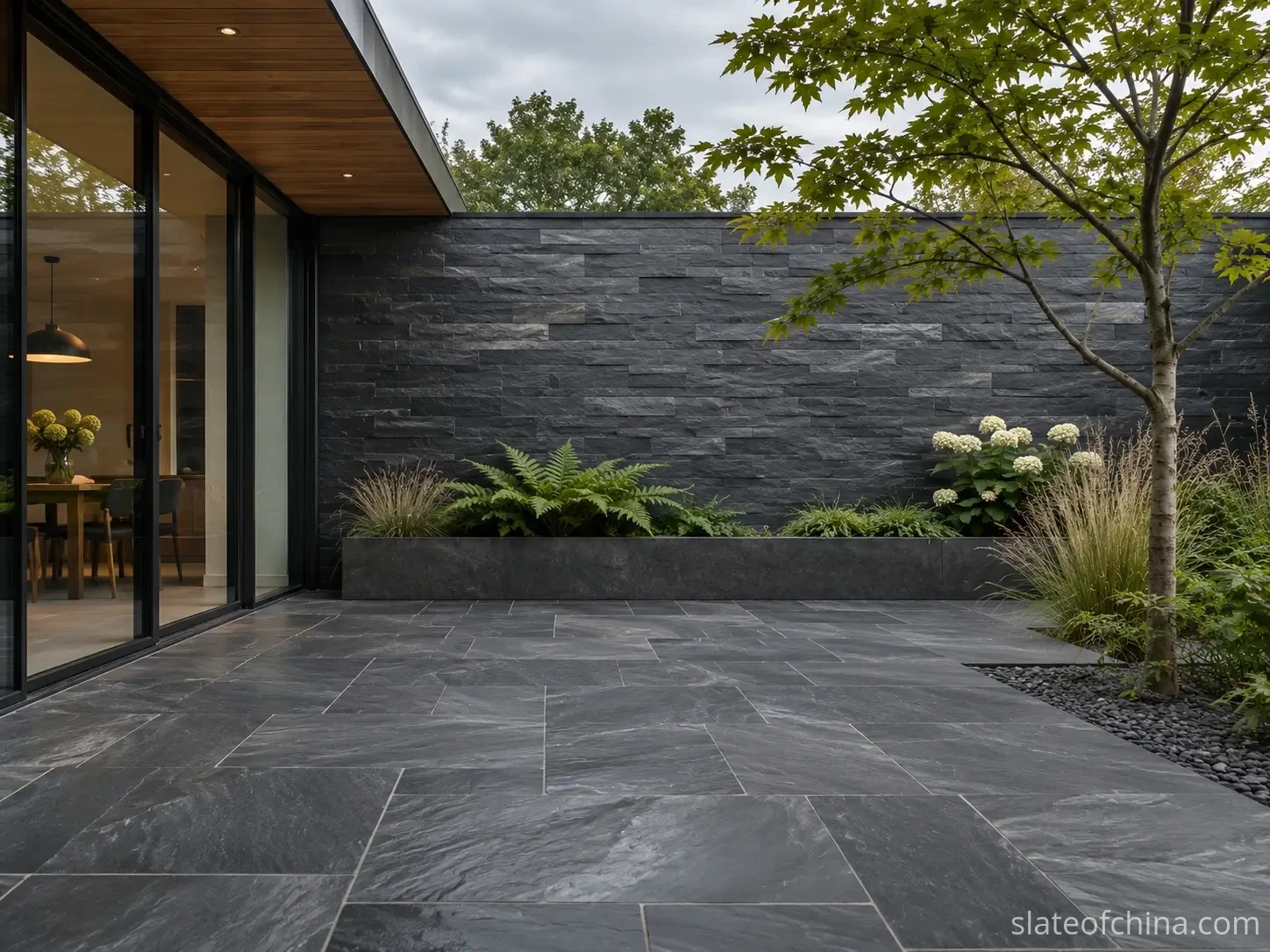
Jump to Outdoor paving · Interior flooring · Wall cladding · Landscape stone · Buying and inspection
| Where you plan to use slate | Start by confirming |
|---|---|
| Patio, terrace or driveway | Traffic, wet slip performance, drainage and bedding |
| Hallway, kitchen or bathroom | Finish, thickness tolerance, substrate and wet-area details |
| Interior feature wall or exterior façade | Panel weight, substrate, fixing system and corners |
| Garden path, edging or water feature | Piece size range, stability, exposure and replacement stock |
Outdoor Paving
Have these ready before you ask: the expected traffic, where the water will go, and whether the slabs will sit on a solid base or span between supports.
1. Is natural slate good for outdoor patio paving?
Yes, when the stone and finish suit the exposure and the paving has a stable base and a way to drain. Ask whether the quoted slate is intended for exterior paving and which finish the supplier is offering. For an exposed terrace, request evidence for wet slip performance and, where freezing is relevant, freeze–thaw performance. The slate paving buyer’s guide walks through the full check.
2. How thick should outdoor slate paving slabs be?
Give the supplier the slab dimensions, the expected traffic and the bedding system first. A small flag fully supported across its underside and a large slab spanning between pedestals face completely different loads, so a single thickness rarely answers both. Ask for a thickness recommendation for your exact format and support condition, with a stated tolerance or minimum delivered thickness. Paving support systems explains the difference in plain terms.
3. Is slate paving slippery when wet?
It can be. Texture, water, dirt, algae and surface treatments all affect grip, and two slabs with the same finish can behave differently in practice. Ask for a wet slip result for the quoted finish, with the test method and conditions stated. If a sealer will be used, confirm how the treated surface will be assessed. On public projects, compare results using the method your specification requires. The numbers and their limits are covered in how slate slip resistance is measured.

4. Does low water absorption mean slate is frost-resistant?
Low absorption is a useful screening figure, not a verdict on its own. For freezing climates, ask for relevant freeze–thaw results for the stone being offered and confirm what the report measured after cycling. Then check where rainwater goes at the surface and beneath the slab: water that collects around the installation can still cause problems in freezing conditions even when the stone itself reads fine. Freeze–thaw resistance for outdoor slate takes this apart.
5. Can slate paving be used on a driveway?
Yes, if the stone and the pavement assembly are specified for vehicle use. Tell the supplier and the installer the vehicle type, how often it is used and whether wheels will turn or brake on the paving, then ask them to check slab format, thickness, base support and edge restraint for that duty. Do not let a patio thickness stand in for a vehicle. Slate driveways and vehicle areas sets out the checks.
Interior Flooring
Have these ready: the finish, the thickness tolerance, the substrate, and any wet-area detail such as a shower tray or a drain.
6. What is the difference between cleft, honed and calibrated slate tiles?
Cleft describes the naturally split face. Honed describes a face ground to a smoother, usually matte finish. Calibrated describes machining that controls the tile thickness, often on the back. A single tile can have a cleft face and a calibrated back, which is why you should read both sides. If a flush threshold matters, ask for the actual thickness range and the degree of face relief. Slate surface finishes shows the full family.

7. Can slate floor tiles be used with underfloor heating?
Slate can work with compatible underfloor heating systems. Have the installer check the complete build-up including the substrate, the adhesive, movement joints and the commissioning schedule, because the finished floor is a layered system and the responsibility is spread across those layers. For large tiles or a retrofit, confirm the finished floor height at doors and transitions before you order. Slate and underfloor heating explains which parts to verify.
8. Is slate suitable for bathroom or wet-room floors?
Suitable slate can be used in wet rooms, but the word “suitable” is doing the work. Choose a finish with relevant wet slip evidence and review the waterproofing, the falls and the drain detail with the installer. If the floor falls in several directions towards a point drain, check the tile layout early; smaller modules make changes in slope easier to accommodate. Slate in wet rooms and bathrooms covers the water management.
9. Do interior slate tiles need sealing, and how do I clean them?
Sealing depends on the stone, the finish and the spills it will face. Try the proposed product on a spare tile first to see whether it changes the colour or sheen. For routine cleaning, remove grit and use a pH-neutral cleaner meant for natural stone. For entrances and kitchens, check how readily the chosen texture releases dirt while cleaning. Interior slate floor care holds the maintenance notes.

Wall Cladding
Have these ready: the panel size and weight, the substrate, the exposure, and whether you are buying stone units or a complete system.
10. Can the same slate cladding be used indoors and outdoors?
A product may suit both, but the installation system and its documented scope decide. For an exterior wall, confirm exposure, panel weight, substrate, water management and the fixing design. Then ask which component the supplier is actually quoting: individual stone units, backed veneer panels, or a complete cladding system. The slate wall cladding buyer’s overview helps you tell them apart.
11. Can slate wall cladding be glued, or does it need mechanical fixings?
Some veneer systems are designed for bonded installation; others are specified as mechanically fixed. Share the panel size and weight, the installation height, the substrate and the exposure with the project designer or system provider, and ask them to confirm the attachment design and any applicable project requirements. For facades, do not guess the fixing from a general answer. Slate cladding fixing methods compares the four paths.
12. How do I order outside corners for slate wall cladding?
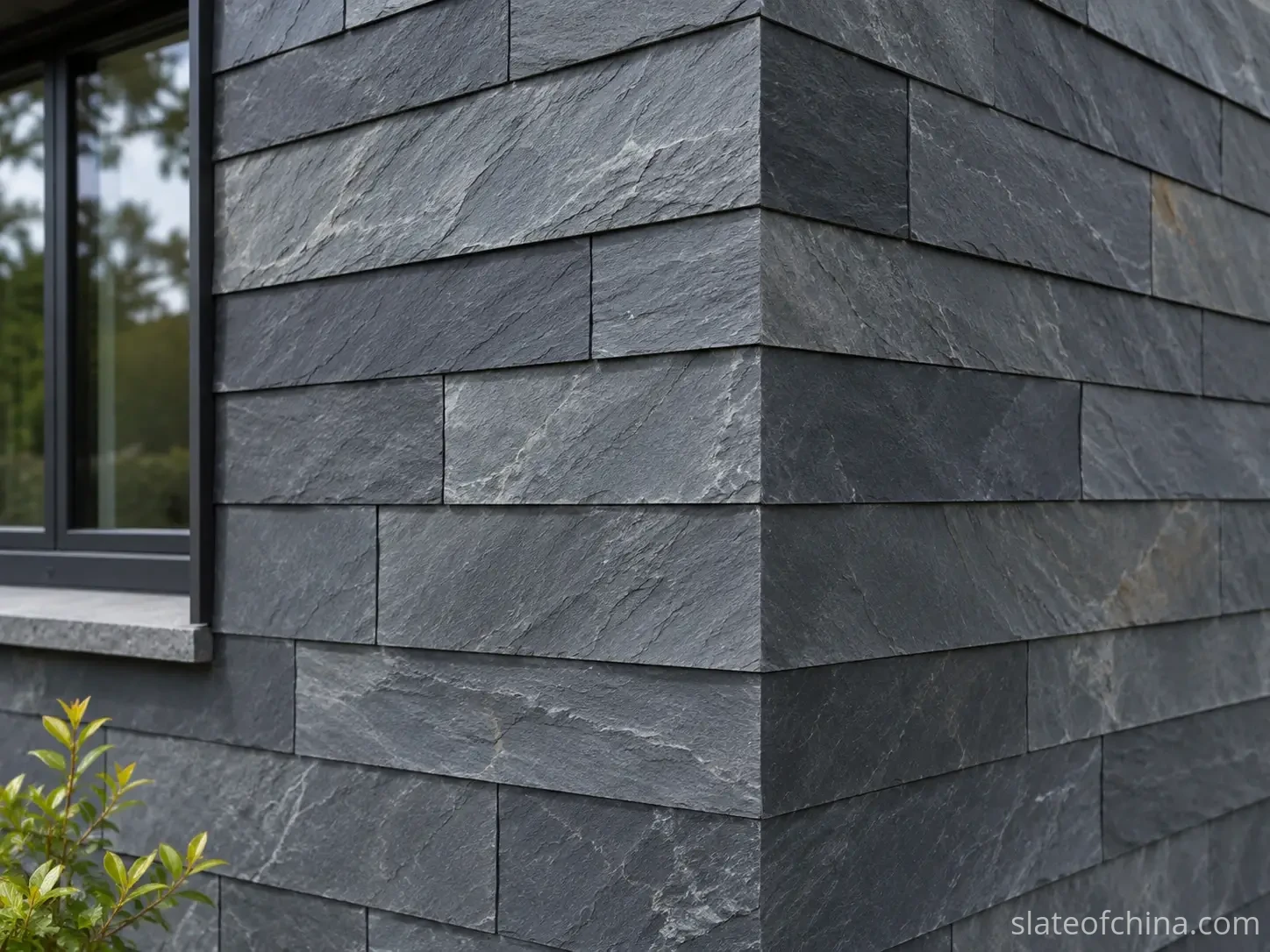
Send an elevation and a corner detail with the wall thickness, the exposed returns and the joint layout. Ask whether the quoted range offers matching corner units, mitred pieces or factory-cut returns. If a corner will be prominent, approve a sample corner, and list the corners separately from the flat panels on the order. Slate cladding corners details the ordering steps.
Landscape Stone
Have these ready: the piece size range you will accept, the way the stone is bedded, and how much replacement stock you want to hold.
13. Can slate stepping stones be laid in grass or gravel?
Yes, with a stable bed suited to the site and pieces that sit securely underfoot. In grass, coordinate the finished stone level with mowing and walking. In gravel, check that the stone stays stable as the surrounding gravel moves. For irregular pieces, agree an approximate size range and a minimum usable walking face rather than promising a single size. Slate stepping stones covers formats and laying patterns.

14. Should I use slate chippings or slabs for a garden path?
Chippings work well where a loose surface and a flexible outline suit the design; slabs give a firmer, more defined path when properly laid. If the route needs to carry wheels, review accessibility and maintenance before choosing. For chippings, request the grading, the coverage assumptions and the recommended edge restraint. Slate chippings and gravel walks through the decision.
15. Can slate be used in a pond, fountain or water feature?
Ask whether the particular slate and finish suit continuous immersion, flowing water or occasional splashing, because these conditions change how the stone looks and how often it needs cleaning. Check the sample wet, discuss mineral deposits and algae, and verify any sealant or adhesive for the intended water, especially where fish are present. Slate water features sets out the checks.
Buying and Inspection
Have these ready: the approved sample range, the drawing revision, and a clear idea of what the price does and does not cover.
16. Will a slate sample match the entire delivery?
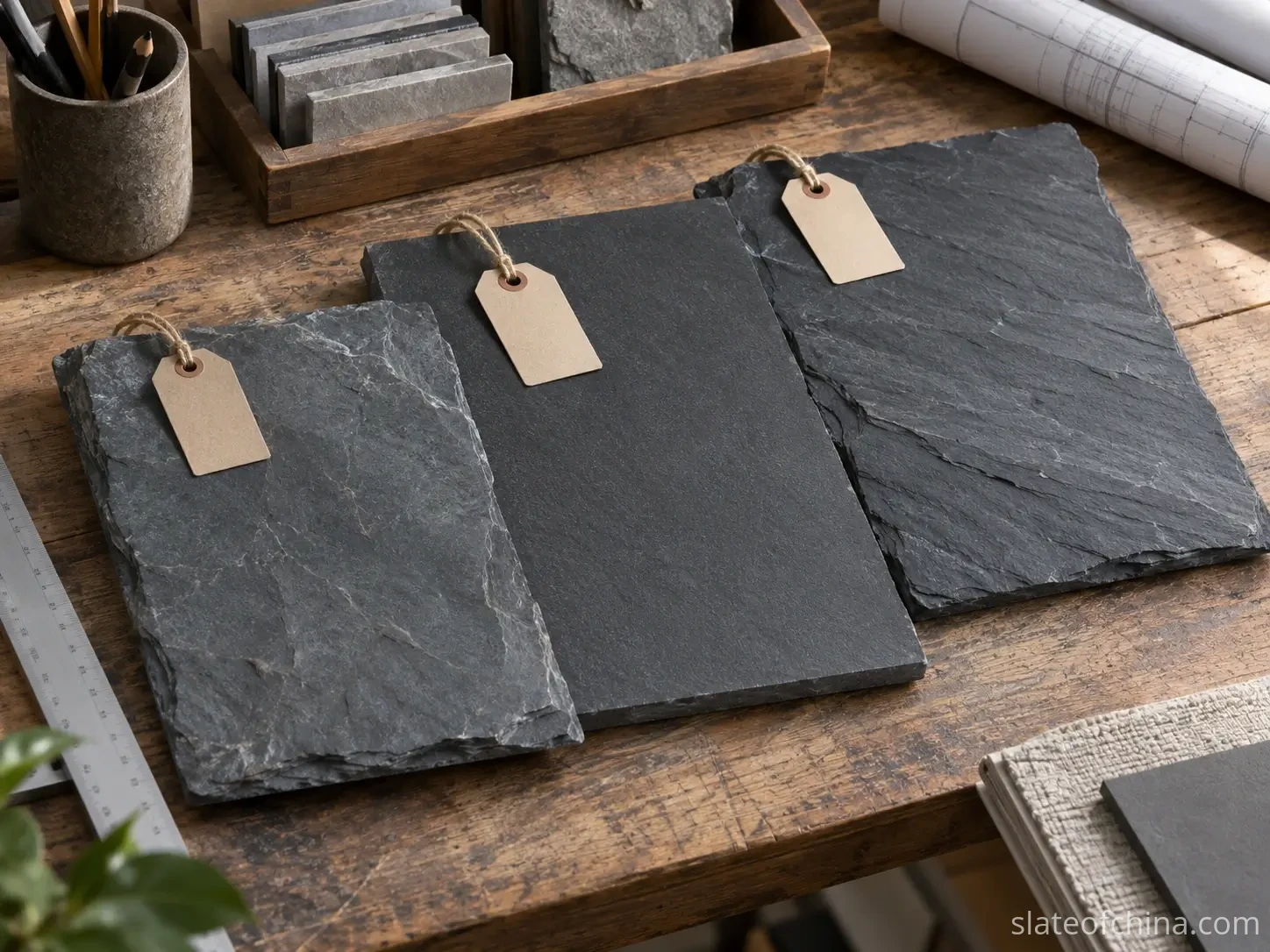
One sample shows one piece, not a batch. For a larger order, approve several pieces or a small range that brackets the acceptable spread of colour and texture. Record the sample IDs, finish, inspection conditions and the limits for visible features such as mineral marks, pronounced cleft or chipped edges. For a feature wall, a small dry layout gives a better sense of how pieces sit together. How physical samples work covers this in full.
17. Which test reports should I ask for when buying architectural slate?
Start with the product form and the destination market. European references may cite EN 1341 for external paving slabs, EN 12058 for floors and stairs, and EN 1469 for cladding slabs; ASTM C629/C629M covers slate dimension stone and excludes roofing slate. Check the report’s material identification, the tested characteristics, the specimen details and how they relate to the offered product. A roofing report cannot stand for an architectural application. Architectural slate standards keeps the scope clear.
18. What should I include in a request for a slate quotation?
Send the use, the location, a drawing, the dimensions, the thickness and tolerance, the face finish, the edge finish, the quantity and the delivery point. For cut-to-size work, attach a piece schedule and identify the drawing revision. Ask the supplier to state what the price actually covers: sorting, packing, samples and the delivery term. The slate spec sheet gives you the fill-in list.
19. How much extra slate should I order?
Use the layout to calculate cuts and offcuts first, then decide how much replacement stock to keep. A rectangular terrace with a regular module has different needs from a stair package with numbered pieces or a feature wall with several returns. Confirm quantities in pieces as well as in area, and ask whether special sizes can be reordered in a similar colour range rather than assuming a full re-cut.
20. What should I check before a slate shipment leaves the factory?
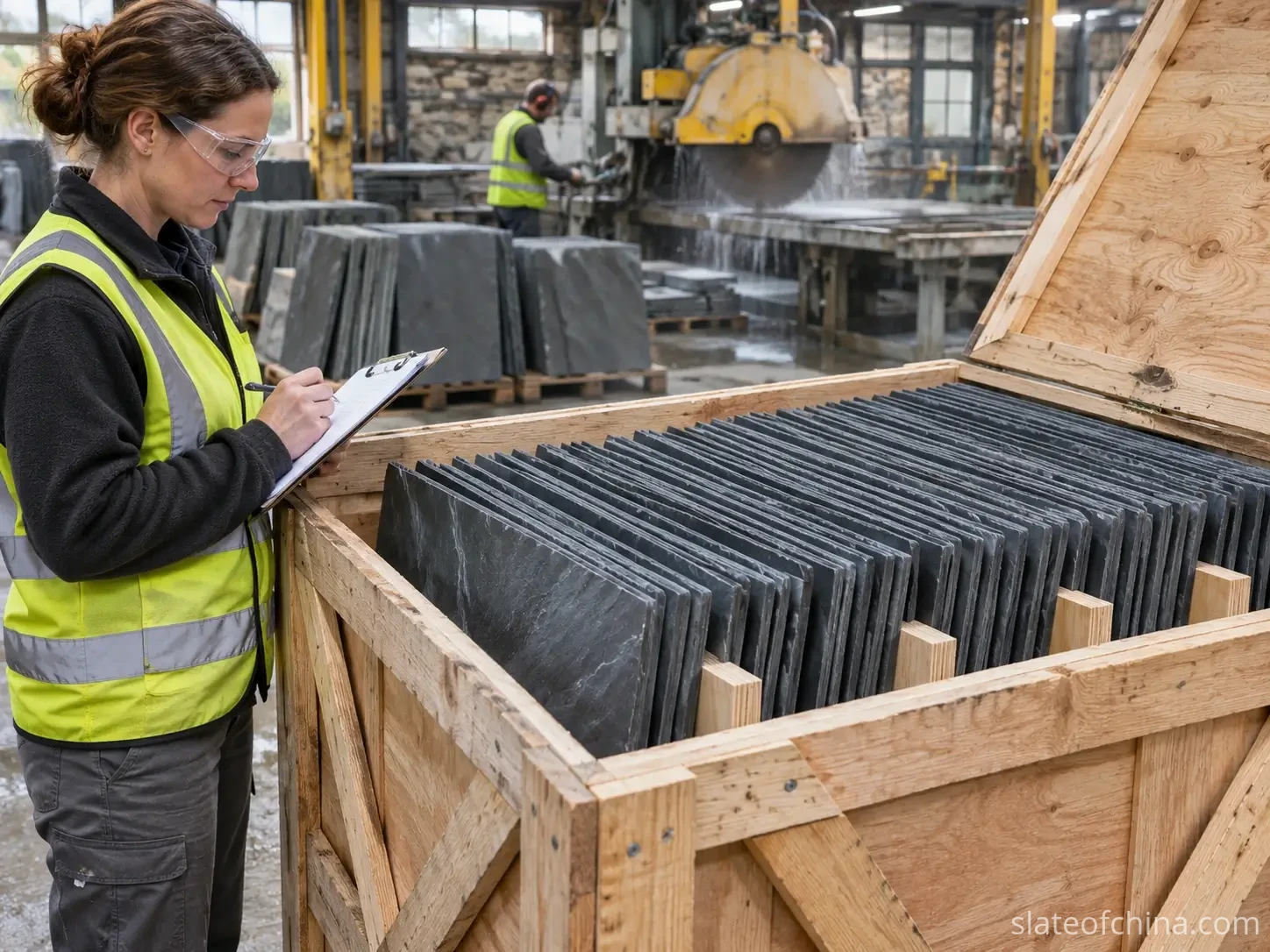
Agree which checks the supplier will document: measurements of representative pieces, finish and colour against the approved samples, counts by size, and crate labels and weights. Ask for photos of the stone before crating, then of the crate interior and the finished packing. At Slate of China, architectural slate tiles are generally packed upright on edge in timber crates, with the packing detail agreed for the format and order. Slate export packaging and crating shows the packing checks.
If your project sits somewhere between two groups, ask the question that matches the surface the stone will actually face. The group table at the top of this page is the quick route back in.
Related Reading
Ready to request a quote?
Send your application, drawing or size list, preferred finish, quantity and destination. If you are comparing two formats or finishes, tell us what matters most on site — a flush threshold, a wet terrace or a clean outside corner. Contact Slate of China.