
How Slip Resistance Is Measured: Pendulum, Ramp and ANSI Tests
Somewhere in most paving projects there is an email that reads: “Non-slip slate required — please confirm R11 wet, or PTV 36, or DCOF 0.42.”
The three numbers come from three different machines, built on three different continents, that ask three slightly different questions of a stone. To reply “confirmed” is to answer all three and none of them, because the numbers are not three ways of writing one property. They are readings in three separate test languages, and there is no honest translator between them.
This page is a tour of those three languages, taken the way a specifier eventually has to take it: one test room at a time. What each machine actually does to the stone, how its number should be read, and what it cannot tell you. Then the parts that decide real projects: wet results against dry ones, the surface finish actually under the test, which dialect belongs to which market, and how to read a slate slip resistance report until it tells the truth — or admits it has nothing to say.
Quick answer: three tests, three numbers, and no exchange rate between them
| Test | The number it produces | Where it is asked for |
|---|---|---|
| Pendulum test EN 16165, Annex C | PTV, 0–100; 36 and above reads as low slip potential in UK guidance | UK, Ireland, much of Europe, Australia; can be run on site |
| Ramp tests EN 16165, Annex A barefoot / Annex B footwear | R9–R13 with oil and boots; Classes A–C barefoot and wet | Germany and continental Europe; work floors and barefoot wet areas |
| ANSI A326.3 DCOF test, North America | Wet DCOF, a decimal such as 0.42 (level interior criterion) | United States and Canada; hard-surface flooring specifications |
For outdoor slate paving, three checks do the work: the method your market recognises; a test condition that matches the use — water for rain-worn shoes, oil and boots for work floors, a barefoot regime for pools; and proof that the surface tested is the finish supplied. Read every result as a comparison between surfaces, never as a promise about a person — and never trade one family’s number against another’s.
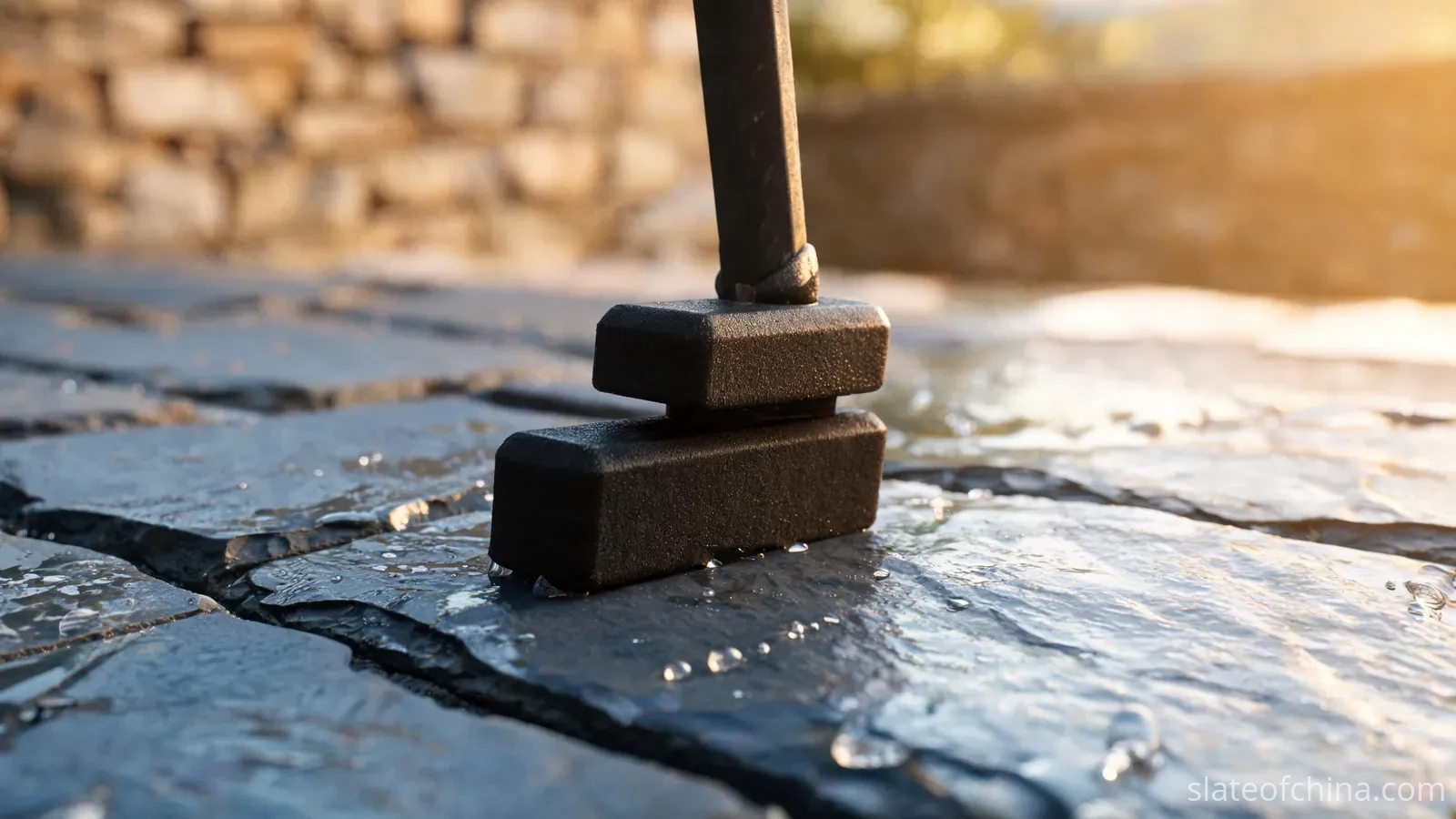
One wet shoe, three national answers
Behind every slip resistance number is the same physical worry: will a heel, a sole or a bare foot skid across this surface in its worst ordinary condition? The worry was formalised in three places, by three institutions with three different habits of footwear, contamination and liability.
In Britain, a swinging-arm device developed from road-surface skid work was carried into pedestrian flooring, and its reading — the Pendulum Test Value — became the working language of UK floor practice. In Germany, occupational safety rules for factories and commercial kitchens produced the ramp walk, graded by the angle a person can walk before losing footing. In the United States, the tile industry and a litigious flooring market produced a powered tribometer and a single decimal, the dynamic coefficient of friction. Different origins, different accents, one shared subject.
Europe has since done some housekeeping. EN 16165 now carries the continent’s common test methods in one document: the barefoot ramp in Annex A, the footwear ramp in Annex B, the pendulum in Annex C, and a drag-type friction method in Annex D. The German DIN standards behind the familiar letters were withdrawn as the European standard took over their methods — the 2023 revision completed that succession — but the classes they invented, R9 to R13 and A to C, still organise specifications from Hamburg to Milan to Warsaw.
Two facts from that consolidation deserve to be widely known, because they prevent most of the arguments. First, EN 16165 standardises how to measure; it does not set what must be achieved. Pass thresholds belong to national regulations and project specifications, not to the test method. Second, the standard’s own foreword states that results obtained by the different methods cannot be transferred to one another, because the parameters and the test materials differ. Three machines, three honest numbers, no exchange rate.
The reason is simple once seen: slip resistance is not an ingredient sealed inside the stone, waiting to be read out by whichever machine is nearest. It is the outcome of a controlled re-enactment of a small accident — a rubber heel, a booted foot or a bare sole skidding under declared conditions. Change the performer and the stage, and the honest number changes with it. The same slate slab, sent to three laboratories, can come back with three different, entirely respectable results.
The pendulum room: a rubber heel on a weighted arm
The pendulum test is the method most outdoor slate buyers in Britain, Ireland and much of Europe will encounter first, and it is the one that travels best in the field.
What the machine actually does
A weighted arm swings from a pivot above the sample. At its end sits a spring-loaded slider of standardised rubber. As the arm passes through its low point, the slider skids across the stone for a short, fixed distance, and the friction of that skid takes energy out of the swing. A pointer on a dial records how much was lost, scaled onto a 0–100 reading: the Pendulum Test Value. A higher value means the skid lost more energy — in plain language, that the surface dragged harder on the rubber.
Two rubbers matter. Slider 96, the harder compound, represents the shod pedestrian: shoes, boots, ordinary urban traffic. For barefoot areas — pool surrounds, showers, changing rooms — a softer slider is used, and here the families diverge: UK practice, from BS 7976 through the UK Slip Resistance Group guidelines, works with Slider 55, while the pendulum method in EN 16165’s Annex C specifies Slider 57. The two soft rubbers are close relations, but they are not the same designation, and a report should say which one carried the number. The outdoor reading that matters is taken with water on the surface, and the instrument itself is portable enough to be carried to an installed floor, which makes the pendulum the only one of the three European methods that routinely works on site. In North America the pendulum also exists as ASTM E303, revised in 2022 to align more closely with current European and Australian practice.
Reading the number
Readings are usually interpreted through the classification used in United Kingdom guidance, which divides the scale into three bands:
| Pendulum Test Value (PTV) | How UK guidance reads it |
|---|---|
| 0–24 | High slip potential |
| 25–35 | Moderate slip potential |
| 36 and above | Low slip potential |
For outdoor paving, a wet reading of 36 or above is the usual starting expectation for level pedestrian surfaces — a UK guidance framework, not a universal legal limit; other regulators read the same scale through their own rules. The bands are guidance for interpretation, not statutory pass marks: a slope, a shaded corner or a line of algae changes the risk while the number stays the same. And a wet area used barefoot should not be judged on a Slider 96 result alone — the barefoot regime, with a soft-slider pendulum or a barefoot ramp class, is the one that matches the user. A water-wet reading typically falls well below its dry twin on the same stone; a drop from a dry 58 to something near a wet 38 is an ordinary shape of result, offered here as an illustration rather than any particular slate’s figure. Neither number is wrong. Only the wet one describes the day the client walks out into rain.
So when a supplier quotes a PTV, the question worth returning is a small, precise one: measured wet or dry, with which slider, to which edition of the method, and on which finish of the stone?
What it cannot tell you
The pendulum re-enacts one rubber on one declared condition. It does not know your visitor’s worn trainers, the film of algae on the north corner, or the fact that the paving now falls towards the front door. It also has a declared difficulty with strongly profiled floors: on deep riven relief the slider rides the ridges rather than the whole face, so on a very coarse cleft slate it matters who operated the machine and how the texture was handled. And 36 is the border of a guidance band, not a certificate. It remains, for all that, a genuinely useful number — because it can be taken on the supplied finish, wet, on site, before the project is signed off.
The ramp hall: walking until the floor loses the argument
Germany answered the question with the most direct instrument available: a human being, walking.
What the machine actually does
A test platform, hinged at one end, is surfaced with the stone and raised in steps. A trained operator walks up and down it. In the footwear ramp method — the shod test, historically DIN 51130 and now EN 16165 Annex B — the surface is contaminated with a standard oil and the operator wears standardised safety boots. The angle at which the walk becomes uncontrollable decides the class:
| Class (oil, safety boots) | Acceptance angle |
|---|---|
| R9 | 6° to 10° |
| R10 | Over 10° up to and including 19° |
| R11 | Over 19° up to and including 27° |
| R12 | Over 27° up to and including 35° |
| R13 | Over 35° |
The barefoot ramp method — formerly DIN 51097, now EN 16165 Annex A — is the same idea for different skin. The operator walks barefoot on a floor wetted with water containing a wetting agent, and the angle accepted sets the class: A at 12° or more, B at 18° or more, C at 24° or more. These are the letters behind pool, spa and shower specifications across Europe, and for wet barefoot areas they are the right letters to ask for.

One structural fact about the ramp: it is a laboratory instrument. An installed patio cannot be carried to it, and the method cannot be repeated on site. Whatever a ramp report says, it says about a sample prepared in advance — which makes the link between that sample and the shipped crate a matter of paperwork, not of physics.
Reading the number
R11 is the figure the opening email asked for, and the workhorse demand of continental commercial flooring. Read honestly, it says: in oil, under standard safety boots, this surface held its footing past 19° and up to 27°. That is a strong industrial result — and a deliberately harsh one, because oil is reproducible and rain is not. For a wet residential path in ordinary shoes it is persuasive evidence, but it is a different question, asked in oil and boots. The question about rain under urban shoes is answered by the wet pendulum; the question about a wet pool edge in bare feet is answered by the barefoot ramp class.
One practical note: the R-classes are broad bands, and the underlying acceptance angle, which good reports include, is the more informative number. A stone newly across a boundary at 19.5° and an old hand at 26° share the same letter and not the same floor.
What it cannot tell you
The ramp result is welded to its boots and its contaminant. Dress shoes, trainers and bare soles behave differently from safety footwear, and a rain film behaves differently from engine oil. Because the method lives in the laboratory, its result cannot be verified against a delivered floor except through batch records and retained samples. And nothing in the R scale speaks to slope or drainage on site: the test platform is flat by construction and raised artificially, so the method reports on the surface, never on the pavement.
The tribometer bench: DCOF and the 0.42 everyone quotes
What the machine actually does
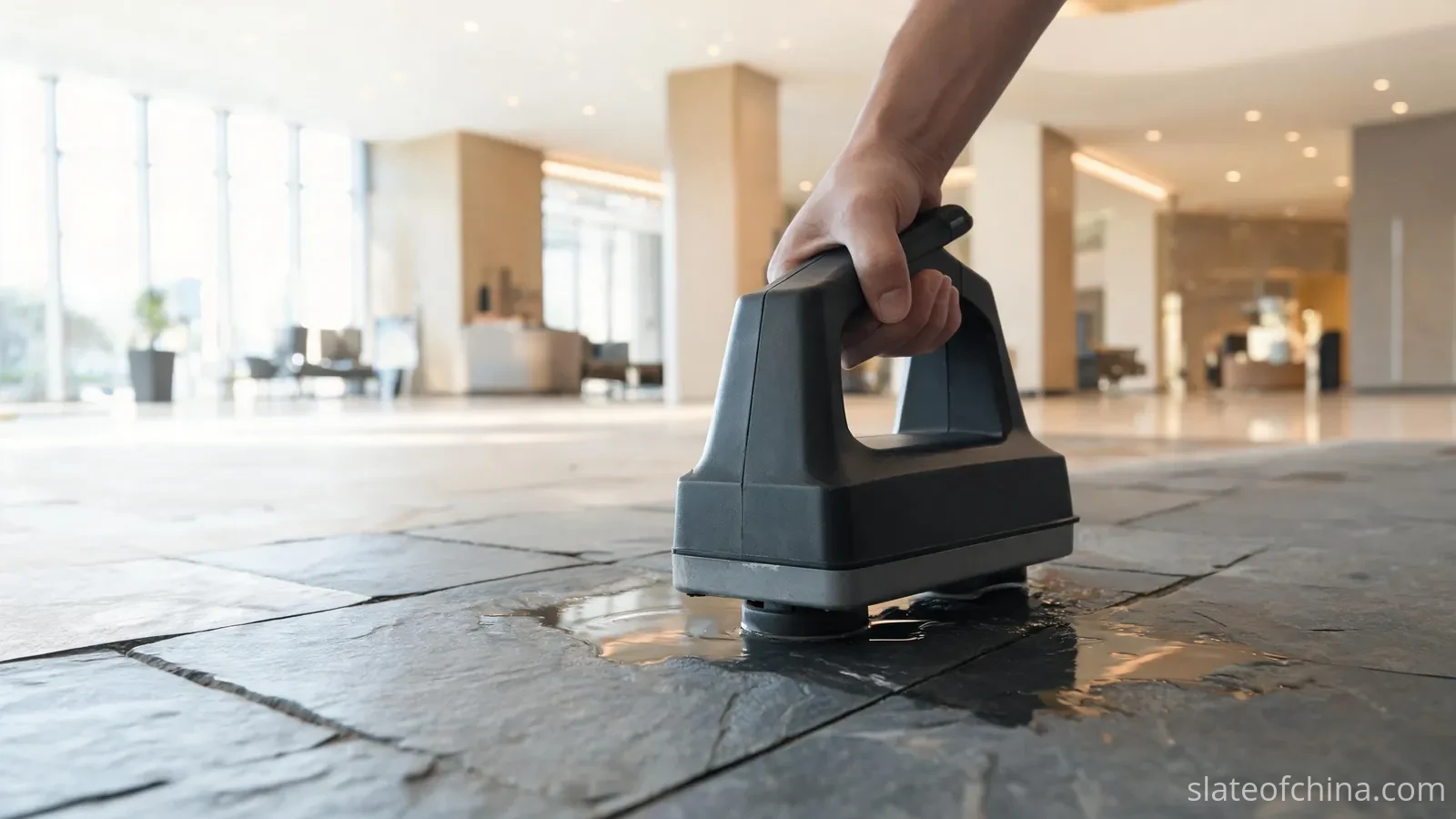
North America’s instrument is a powered tribometer: a motorised device that drags a standardised rubber test foot across the surface at a controlled speed and load. Under ANSI A326.3, the American National Standard test method for hard-surface flooring, the measurement is run wet, and the machine reports the dynamic coefficient of friction — the friction between the two surfaces while they are already moving relative to each other — as a decimal such as 0.42. The standard covers hard-surface flooring generally, ceramic and natural stone flooring alike, and the devices are quick and portable enough to be used in factories, warehouses and showrooms as well as laboratories.
Reading the number
The figure everyone quotes is 0.42. Under the 2021 edition, revised in February 2022, a wet DCOF of at least 0.42 is the specified criterion for hard-surface flooring suitable for level interior spaces expected to be walked on when wet, unless otherwise declared by the manufacturer — and the phrase to underline is level interior. The same edition classifies products by intended use, and how the numbers attach to each category matters as much as the numbers themselves:
| Product-use category | Intended application | How the number attaches |
|---|---|---|
| ID | Interior, Dry | 0.42 dry DCOF criterion in the standard’s text |
| IW | Interior, Wet | 0.42 wet DCOF criterion, unless the manufacturer declares otherwise |
| IW+ | Interior, Wet Plus — more demanding wet areas, including barefoot | Manufacturer-declared classification; the text cites 0.50 wet DCOF as its recommended minimum |
| EW | Exterior, Wet | The text cites 0.55 wet DCOF as its recommended minimum; outdoor suitability still rests on project assessment |
| O/G | Areas exposed to oils and greases | The text cites 0.55 wet DCOF, though a wet-water figure does not directly describe oil performance |
A precise reading of that table: ANSI A326.3 does not set one universal numerical pass mark for every category. The 0.42 criterion is the standard’s specified wet DCOF for level interior flooring; the figures attached to IW+ and EW are recommended minimums tied to classifications the manufacturer declares, not general acceptance thresholds. A supplier should therefore be able to state which category a product is declared for, the wet DCOF behind the declaration and what it rests on — and a specifier compares that package against the project, not the single decimal against a brochure.
The categories exist for a reason the standard is unusually frank about. In its own words, the test “can provide a useful comparison of surfaces, but does not predict the likelihood a person will or will not slip on a hard surface flooring material.” That sentence sits on the first page of the method, and it belongs in every specification that cites it: DCOF is a comparison instrument, and turning its decimal into a safety guarantee is a decision the specifier makes and owns. The standard itself declines to make it.
What it cannot tell you
Beyond the standard’s own disclaimer, two limits matter to a natural slate buyer. First, the test foot. A flat rubber foot drawn across deep cleft relief can bridge the hollows and read the ridges, so a DCOF report on riven slate should state how the texture was handled; a ground or polished face gives the device an easier and more faithful job. Second, category fit. A wet result obtained under level-interior conditions does not certify exterior paving, where standing water, slope and contamination change the question — which is precisely why the exterior-wet category carries its own classification route rather than borrowing 0.42 from the lobby.
Why the three numbers cannot be converted
Since EN 16165 states that results of its own member methods cannot be transferred to one another, it is no surprise that no sanctioned conversion exists between a PTV, an R-class and a DCOF value either. The three families use different contact materials, different contaminants, different mechanics and different bodies — machines versus a walking person. A PTV of 36, an R10 and a DCOF of 0.42 are not three spellings of “adequate”; they are three verdicts from three separate courts:
| Pendulum | Ramp | ANSI A326.3 | |
|---|---|---|---|
| Moving body | Rubber slider on a weighted swing arm | A walking person, shod or barefoot | Powered rubber test foot |
| Condition | Dry or wet, to the declared method | Oil under boots; wetting agent under bare feet | Wet, standard water application |
| Result | PTV, 0–100 | R9–R13 / Classes A–C | Wet DCOF decimal |
| Where spoken | UK, Ireland, much of Europe, Australia | Germany and continental Europe | United States and Canada |
| Runs on site? | Yes — portable, works on installed floors | No — laboratory samples only | Yes — portable tribometers |
The comparison that trips buyers up is the three-number data sheet. A catalogue page listing “PTV 42 / R11 / DCOF 0.48” appears to offer triple confirmation and offers none: those are three different tests, each honest, each answering a different question, usually performed on different samples. The legitimate uses of the numbers are the cautious ones — comparing candidate finishes under one common method, tracking a surface against its own earlier result, or satisfying two markets by running the same finish through two different tests. Setting one supplier’s pendulum beside another supplier’s tribometer is not one of them.
What water does to every number
Water is the reason this entire subject exists in its present form. Its effect on friction depends on the surface’s microtexture, on how quickly water can escape the contact, on the two materials involved and on how much water there is. On some finishes a film of water can lift the shoe away from the stone and lower the measured friction sharply; on others the change is modest. Microtexture — texture finer than the eye resolves — often decides which family a given slate belongs to. That is why dry and wet results are reported as separate figures, never read across each other: the wet figure is the honest basis for rain-exposed paving, and a report showing a dry result alone is not evidence at all. The wider sequence of decisions an outdoor slate order runs through is set out in Slate Paving: The Buyer’s Overview.
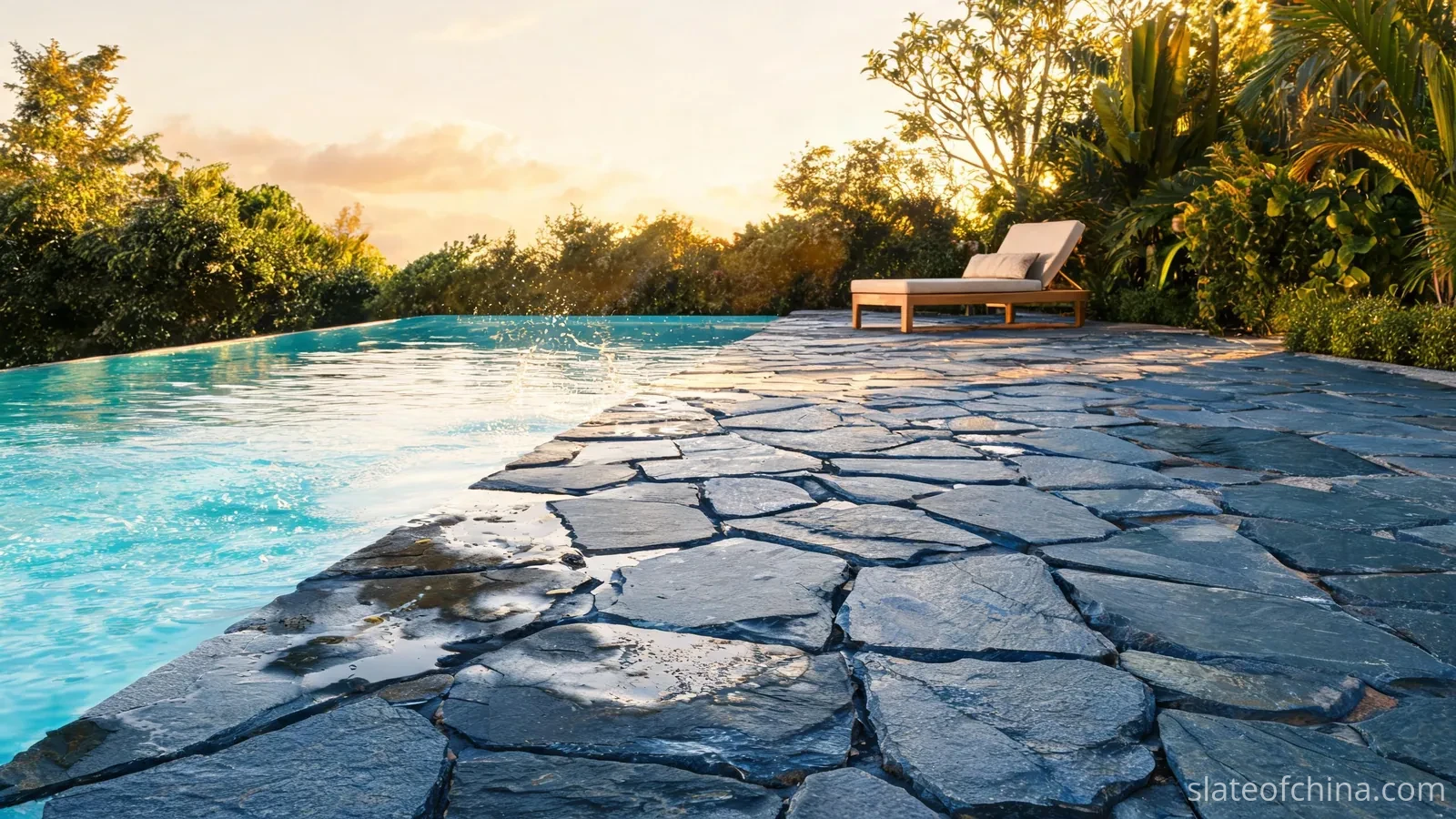
Rain, for all the attention it gets, is not the worst condition a paved surface meets. An algae-slicked shady corner is worse; a film of mud or leaf pulp is worse; a kitchen or workshop with oil on the floor belongs to another conversation altogether. A water-wet laboratory test is the honest baseline for most paving, and a demanding one — but it is a baseline, not a preview of every wet Tuesday the stone will see. The division of labour is worth writing down once and trusting afterwards: the test covers the surface, and the design covers the site. The best pendulum figure will not rescue a pavement that holds water, and the best fall will not save a face that measures low when wet.
The same test, another face: finish changes the answer
The number is never attached to “slate”. It is attached to one face of one stone in one condition. Natural cleft, sawn, honed and brushed faces from the very same slab can return different readings from the very same machine, because the topography a shoe meets is the variable the test reads. How each face is produced is described in Slate Surface Finishes; what matters here is that the tested face and the ordered face are the same face.
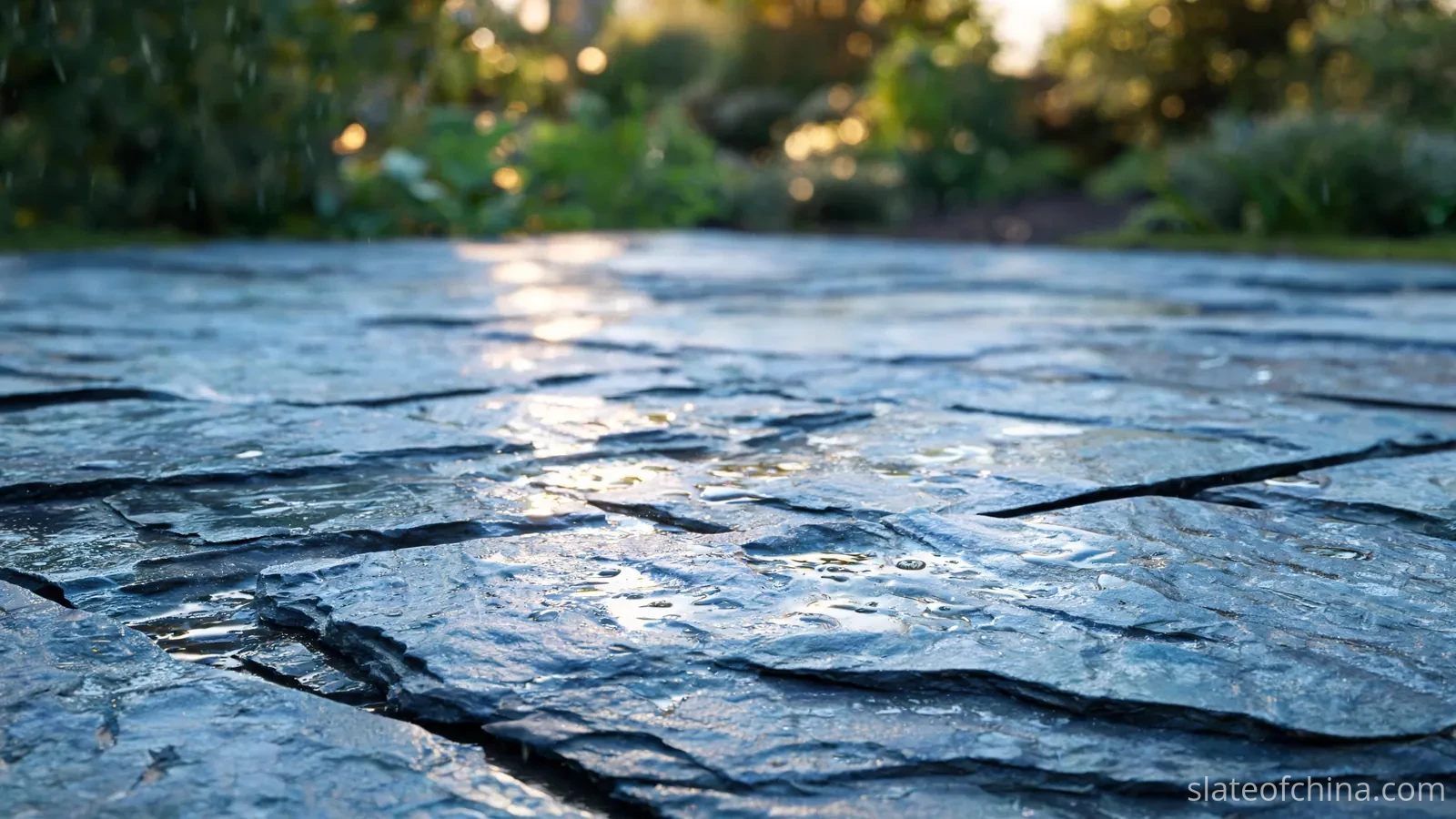
Cleft earns its outdoor reputation from physical relief, but relief varies from bed to bed and quarry to quarry, and the microtexture beneath the visible roughness matters just as much. Visually rough is not the same as measured good: a fine-textured sawn face can outperform a coarse one whose high points have been polished smooth, and the eye cannot tell which is which. Only the wet test can.
Two vocabulary traps recur in specifications. Calibrated is a thickness operation performed largely on the back of the slab, and it says nothing about the top face: a calibrated paving slab can still carry a full cleft surface, so calibration must never be underwritten as “smooth”. The back of the tile and what calibration controls are covered properly in Calibrated vs Hand-Cleft Slate. Textured, likewise, is a description of appearance, not a performance class. The only honest bridge between a finish word and a number is a report that names the finish, the stone, the condition and the date.
The report-to-crate connection deserves the same suspicion. A slip figure earned by an approved finish, then quoted for a substituted stone, is a metaphor rather than evidence. A sealer applied after testing can change the friction of the face it went onto, in either direction, and the change belongs with the sealer’s data sheet — which is another reason a report should name everything that was on the surface.
Which dialect your project should be speaking
The choice of method usually belongs to geography before it belongs to physics. A British contractor will ask for a pendulum figure; a German project engineer will ask by class letter; a United States specification will cite A326.3 by section. Asking for the local dialect is not parochialism — it is how the resulting number stays meaningful to the people who will audit it:
| Project and market | The test to request | Why |
|---|---|---|
| UK, Ireland, much of Europe — outdoor residential and commercial paving | Wet pendulum test (EN 16165 Annex C / long UK practice), Slider 96, top face as supplied | Portable and verifiable on site; reads in the guidance band local specifiers know |
| European pool surrounds, spas, showers | Barefoot ramp (EN 16165 Annex A, Class A–C) or a wet pendulum test with the soft slider — 55 under UK practice, 57 under EN 16165 | The test’s skin and water should match the user’s |
| Germany, central Europe — commercial kitchens, industrial and public floors | Footwear ramp (EN 16165 Annex B), R-classes | The local specification language, tested in oil under boots |
| United States — interior hard-surface flooring | ANSI A326.3 wet DCOF, level-interior criterion (0.42 unless otherwise declared) | The method named in US flooring specifications and audits |
| United States — exterior wet paving | ANSI A326.3 exterior-wet route with project-specific assessment; pendulum (ASTM E303) also in use | A level-interior 0.42 does not travel outdoors |
| Anywhere — steps, ramps and significant slopes | Same dialect as the field, read with the geometry | A class earned on the level is not automatically earned on an incline |
If steps, ramps or a genuine gradient appear, keep the dialect and add the geometry: slope, cross-fall, nosing details and where the water goes. On the residential side, the surrounding format, colour and edge decisions sit in Slate Patio Paving; on the public side, the duty, accessibility and maintenance framework is set out in Commercial Slate Paving.

How to read a slip test report without being charmed
A test report, like any piece of evidence, describes exactly what it describes and nothing more. Seven checks, in about two minutes, separate an honest document from a decorative one:
| What to check | What an honest page says |
|---|---|
| Product identity | The exact stone named — quarry and product — not “slate” |
| Surface finish | The tested face equals the supplied face; any sealer named |
| Standard and edition | Full citation — EN 16165 and which annex, or ANSI A326.3 (2021), and so on |
| Test condition | Wet, dry, oil-contaminated or barefoot — stated, not implied |
| Slider or device | Slider 96, or the soft slider used (55 in UK practice, 57 under EN 16165); tribometer model; handling of profiled faces |
| Laboratory and date | Named laboratory, report number, recent date |
| Sample basis | Production material, not a purpose-made coupon; who commissioned the test |
Then there are the phrases worth weighing carefully. “Non-slip slate” — no such product exists in nature or in law. “R11 rated” with no method and no condition — a letter without its sentence. “Meets 0.42” printed beside a photograph of an outdoor terrace — a level-interior criterion quoted next to a slope in the rain. None of this necessarily signals dishonesty; in most catalogues it is inherited marketing language. But none of it is evidence.
And the supplier with no current slip data for a finish? The honest reply is not a conversion and not a figure borrowed from a sister product. It is a plan: a wet test of the supplied finish, at a named laboratory, on production material, before the order ships. Testing is proportionate to use — a suburban garden path may reasonably proceed on samples and experience, while a public forecourt or a hotel pool deck cannot. The right supplier answer to “what is your R-value for rain?” is often that rain does not speak that language, and here is the number that does.
What to write into the order
One sentence, written well, does the work of a negotiation. It names the method, the condition, the face and the receipt of proof:
“Wet slip resistance: pendulum test to EN 16165 Annex C, Slider 96, wet, on the top face as supplied; result from a named laboratory, on production material, to accompany the shipping documents.”
Substitute the dialect your market speaks — a barefoot class, an R-class, or a wet DCOF figure — and the sentence changes shape without losing its spine. Around it sit the quieter parts of the order: an approved sample retained by both parties, the finish and its accepted variation written down, the batch recorded, the maintenance regime agreed while enthusiasm is still high. The full sequence of decisions a paving buyer works through is set out in How to Choose Architectural Slate; the slip lines slot into it as a single, load-bearing clause.
Where the numbers stop helping
Every honest test number is a controlled comparison, and the project around the stone is where the remaining risk lives. The fall of the paving, the cross-fall, the drainage inlets, the matting at the threshold, the leaves nobody swept in November, the algae on the shaded run, the cleaning product used weekly, the wear that slowly polishes whatever feet touch most — none of these has ever been measured by a pendulum, a ramp or a tribometer, and all of them decide whether the finished floor keeps the numbers’ promise.
So the closing advice repeats the opening advice. Ask for the wet number, in the dialect your market speaks. Read it as a comparison, not as a promise. Put the site’s part of the work into the design, and the supplier’s part of the work into the order. A slip-resistant paved surface is not a stone with a number printed beside it; it is a stone chosen on evidence, laid to drain, and maintained by someone who knows what water does. That combination can be specified. None of its parts can stand in for the others.
The source documents
The three test families each answer to a published standard, and no summary — this page included — replaces the documents themselves. Specifiers comparing a quotation against a standard should work from the current edition of each; the references below are the entry points:
- UK Slip Resistance Group, The Assessment of Pedestrian Slip Resistance — the UK practice behind PTV interpretation and the Slider 96 / Slider 55 regime; current edition Issue 6.
- EN 16165, Determination of slip resistance of pedestrian surfaces — Methods of evaluation — the European consolidation: barefoot ramp in Annex A, footwear ramp in Annex B, pendulum in Annex C, drag-type friction in Annex D.
- ANSI A326.3, Test Method for Measuring Dynamic Coefficient of Friction of Hard Surface Flooring Materials (2021 edition, revised February 2022) — the product-use categories and figures cited above; available free of charge from the Tile Council of North America.
- ASTM E303 — the American standard for the pendulum slip test, revised in 2022 to align with European and Australian practice.
Slip resistance testing — common questions
Is there a single correct slip resistance number for natural slate?
No. The number depends on the method, the condition — dry, wet, oiled, barefoot — the slider or footwear, and which finish is tested. The same slab tested by pendulum, ramp and tribometer returns three different honest results, because each test asks a different question under different conditions.
What is a good PTV for outdoor slate paving?
UK guidance reads the pendulum scale as 0–24 high, 25–35 moderate and 36 and above low slip potential for level pedestrian surfaces. For outdoor paving, ask for the wet PTV and treat 36 as the starting expectation on level ground — slope, shade and contamination then shift the real risk in either direction.
What does R11 actually mean on a slate data sheet?
It records a result from the footwear ramp method — historically DIN 51130, now EN 16165 Annex B. R11 means a booted operator, on oil-contaminated stone, walked angles between 19° and 27° before slipping became uncontrollable. Strong industrial evidence, and a different question from rain under ordinary shoes.
Does DCOF 0.42 mean a slate floor is safe?
Not on its own. Under ANSI A326.3-2021, 0.42 is the wet DCOF criterion for level interior spaces expected to be walked on when wet. The standard itself states that the test compares surfaces and does not predict whether a person will slip; the specifier keeps responsibility for the actual conditions of use.
Can PTV, R-values and DCOF be converted into each other?
No sanctioned conversion exists, and EN 16165 states that results of its own methods cannot be transferred between one another. Cross-family arithmetic produces confident, meaningless numbers. Compare like with like: one method, a similar condition, a comparable finish — ideally the same laboratory.
Which slip test suits a swimming pool surround?
The barefoot ramp test — EN 16165 Annex A, Classes A to C — or a wet pendulum test using the soft slider (Slider 55 in UK practice, Slider 57 under EN 16165). Pool surrounds are barefoot territory tested wet; shod ramp classes and level-interior DCOF figures answer different questions for different places.
Should slate paving be tested again after installation?
Not always, but it is the cleanest way to close the loop. The pendulum can be run on an installed surface; the ramp methods cannot, being laboratory instruments. A site pendulum check is worth commissioning where the laid face differs from the approved sample, or where a public project requires evidential sign-off.
What should a buyer do when a supplier has no slip test data?
Ask for a plan rather than a number. The honest route is a wet test of the supplied finish, at a named laboratory, on production material — proportionate to the project’s size and public exposure. A converted figure, or one borrowed from another product, is a signal rather than a substitute.
Related reading
Specifying a wet-tested slate surface?
Send the requirement as written — a wet PTV, an R-class, a DCOF figure or a barefoot class — together with the place it will be laid and the traffic it will carry. The reply comes back with production samples of the finish under consideration, the technical documentation that belongs to that exact surface, and a straight answer on any test that has not yet been run for it.
For a project still choosing rather than specifying, the conversation runs just as easily in the other direction: describe the place the stone will live, the finish under consideration and the slip standard the project must satisfy, and the reply can lay suitable natural slate options, representative production samples and the available technical documentation side by side.