
Slate Driveways and Vehicle Areas: Load Sets Thickness
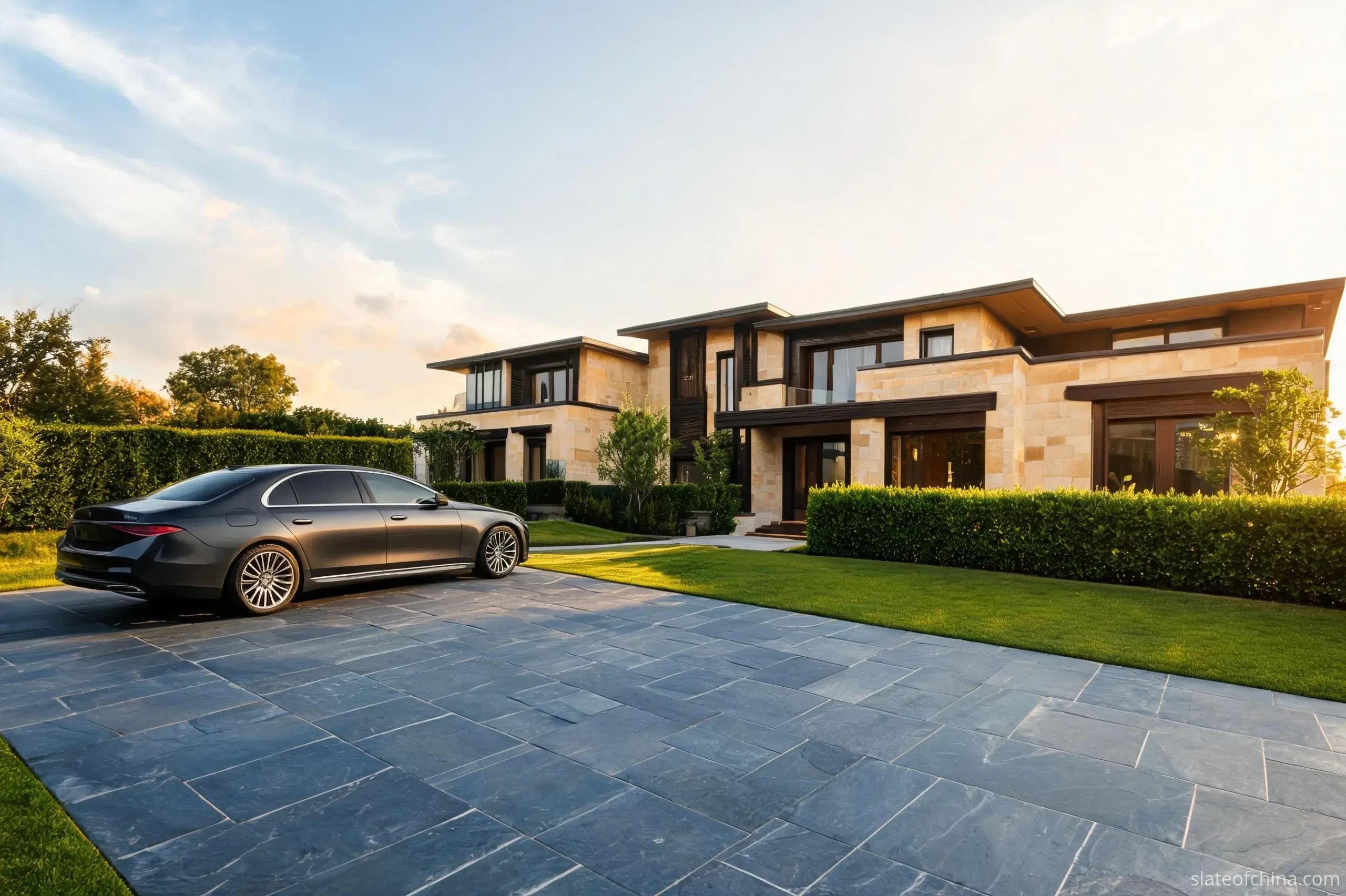
A family car weighs about one and a half tonnes, and every kilogram of it reaches the paving through four tyre contact patches, each roughly the size of an adult palm. That is the picture a driveway presents to the stone: not a blanket weight spread politely across the surface, but four small moving pressure points that brake, steer and park on the same few square metres, several times a day, for decades.
Natural slate can live in that world. Slate driveways exist, and on the right structure they are among the best-looking vehicle surfaces a property can have. But a slate driveway is specified as a pavement structure, not chosen off a shelf by thickness, and that distinction runs through everything below: the load sets the thickness, and it never sets it alone — the slab size, the stone’s measured strength and the base beneath the stone set it together with the load.
This guide reads a slate driveway the way a pavement engineer reads one: downwards, layer by layer, from the tyre to the ground. It covers what a car actually does to paving, how thick the slate needs to be for different vehicle areas, what to check in the stone itself, how driveways fail when something in the structure is wrong, and what to send a supplier so the enquiry comes back as an engineering answer rather than a price per square metre.
Where the load enters: four patches and three extra forces
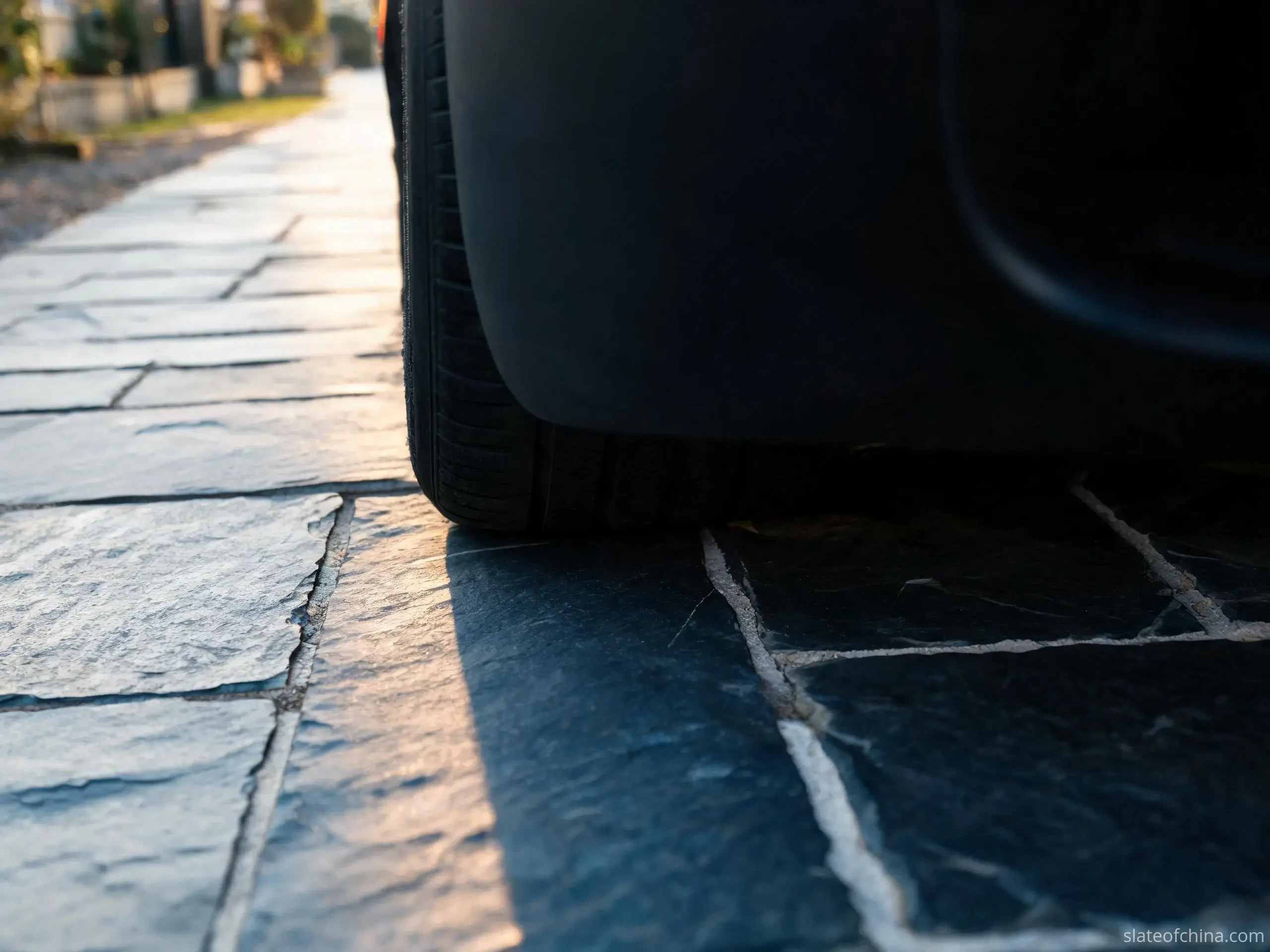
Pedestrian paving and vehicle paving differ in one thing above all: intensity. A garden path asks the stone to carry a person’s weight, spread over two shoe-sized patches, at walking pace. A car arrives as four smaller patches carrying several hundred kilos each — and it does not arrive politely. It brakes into the drive, turns on the steering scrub of its front tyres, and stops in the same patch of shade every evening.
Concentrated wheel loads. Because the vehicle’s weight travels through four small contact areas, the pressure on the paving is concentrated, not averaged. A slab that is too thin for the load, or poorly supported under it, develops bending stress between its supported points — and bending, not crushing, is how stone fails in service.
Dynamic loads. Braking, accelerating and steering add horizontal forces on top of the weight. The places that work hardest are the entrance, the turning head, and anywhere a car regularly stops and starts — not the long straight run in the middle.
Repeated traffic. A driveway used twice a day accumulates thousands of load cycles a year. Repetition finds weakness, especially once the base begins to settle: a load the stone shrugs off once is not a load it shrugs off ten thousand times.
Edge and corner loading. The most exposed place on any slab is an unsupported edge or corner, and a tyre passing close by loads the stone exactly where it has the least help. Large-format slabs raise the stakes: longer edges, bigger corners, more of the slab sitting where the wheel can find it.
Not all driveways carry the same traffic, either, and the differences matter more than the word “driveway” suggests:
- Passenger cars impose the modest end of vehicle loading — but the specification changes from a patio the moment wheels arrive, whatever the car weighs.
- SUVs, pickups and vans load the paving harder, and family vehicles have grown heavier over the years. Areas used daily by larger vehicles deserve a more careful look than the word “occasionally” invites.
- Delivery and service vehicles are a different class again: delivery vans, heating-oil tankers, refuse trucks that swing into a drive to turn. A driveway specified for the family car is not automatically a driveway specified for them.
- Heavy commercial access — lorries, loading zones, shared hardstandings — belongs to slate only where the structural suitability of the stone has been established by design, not by optimism.
So the first question about slate paving for driveways is never “how thick?”. It is: what exactly will drive here, how often, and turning where? The same reading applies to slate paving for car parking areas, forecourts and turning courts — the layout decides where the loads concentrate. The pedestrian half of the same ground — paths, patios, terraces — is covered in Slate Paving and, for the family end of the garden, Slate Patio Paving.
How thick should a slate driveway be?
Directly: there is no universally safe thickness for natural slate driveway paving. Any honest answer on natural stone driveway thickness starts with the traffic, because the same millimetres can be right or wrong depending on everything that travels with them:
- the weight and axle loading of the vehicles, and how often they come and go
- the length and width of the slab — a small slab and a large-format slab of the same thickness are not the same product under a wheel
- the flexural strength of the actual stone, measured, not assumed
- the type and thickness of the base, and the ground beneath it
- the bedding method, and whether the slab is fully supported
- the drainage and moisture conditions around the paving
- where the loads concentrate: entrances, turning heads, parking bays
Set those, and the thickness follows from them. Leave them open, and any number — 30, 40, 50 mm — is just a guess with a figure attached to it.
The table below is orientation, not a specification. It shows how the industry roughly brackets vehicle areas; the figures are indicative, they depend on the base and the loading case, and they are not guaranteed safe thicknesses for every slate.
| What the area carries | Thickness context | What must come with it |
|---|---|---|
| Foot traffic only — paths, patios, terraces | 20–30 mm — the common pedestrian paving product range, not a driveway specification | A correct bed and base for pedestrian loading; no vehicles, by design |
| An occasional light vehicle — a van crossing to a barn a few times a year | Substantially thicker; project-specific | Full support and a designed base, confirmed for the actual vehicle |
| Regular cars, daily use | Commonly assessed from 30 mm upward, with 40–50 mm frequent on engineered bases | Slab size limits, measured flexural strength, an engineered foundation |
| Heavier vehicles — deliveries, service vehicles, regular van traffic | UK industry guidance references around 50 mm for some light-vehicle cases and 80 mm or more for heavier loading — qualified guidance, dependent on the base and the loading case | Structural design and verified material data — heavy duty slate paving is engineered, not upgraded |
Read the table the right way round: slate driveway thickness is decided by the structure around the stone, never by the gauge alone. None of these figures is a guarantee for a vehicle class — 50 mm does not automatically clear a family car, and 80 mm does not automatically clear a delivery lorry. The figures describe stone working inside a designed structure, and the slab size, the measured strength, the bedding and the foundation decide whether the number holds. A supplier who answers “40 mm is fine for any driveway” has not answered the question — the honest version asks for the load case first and puts the support proposal in writing.
At driveway gauges, thickness consistency matters more, not less. Calibrated slate — machined to a consistent thickness — takes the guesswork out of the bed, while a natural thickness band that is perfectly charming on a rustic patio behaves differently under a wheel, because the thin end of the band is the end that meets the tyre first. The full reading of calibrated versus hand-cleft slate is in Calibrated vs Hand-Cleft Slate. For the formats and thickness numbers themselves — the sizes the trade actually ships and the arithmetic that follows from them — the numbers library is Paving Slate Sizes & Thicknesses.
Size and strength: the two numbers that travel with thickness
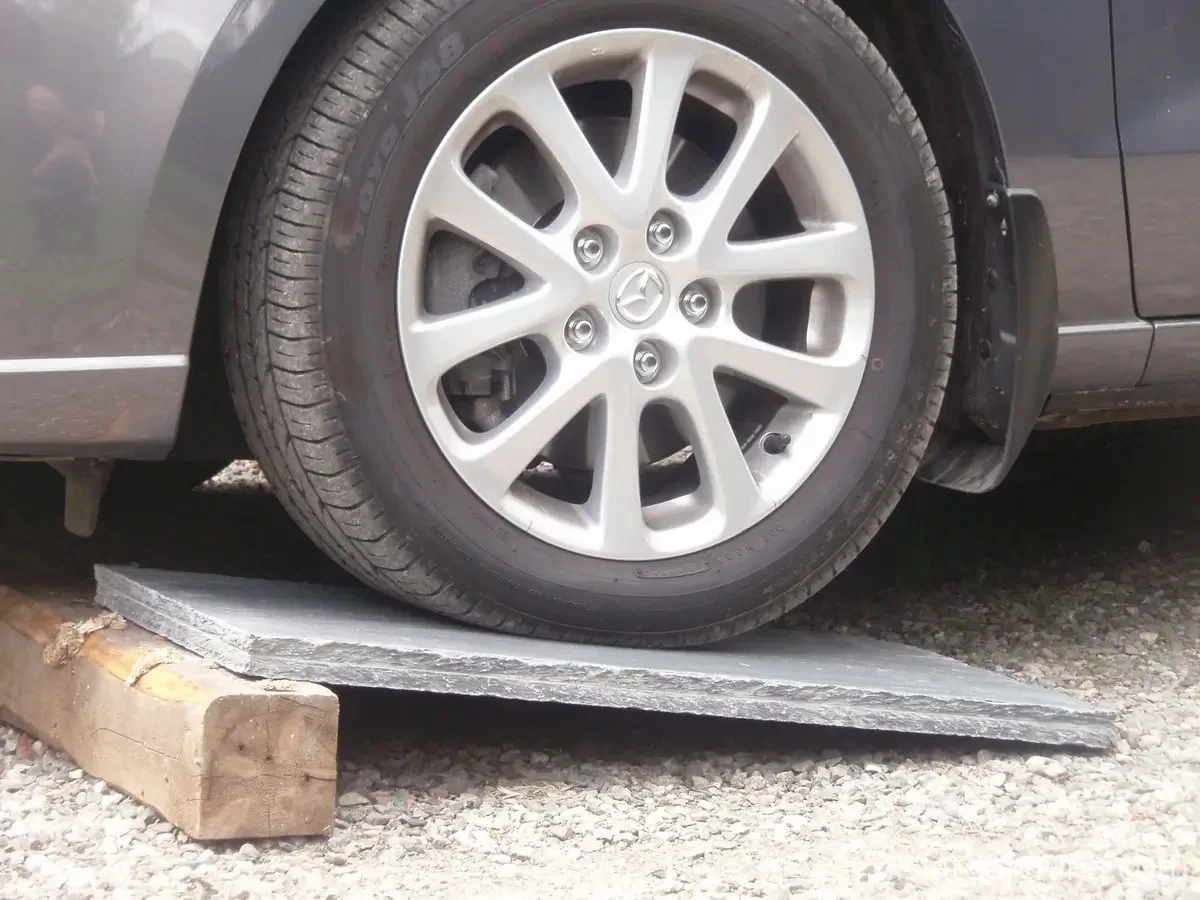
Thickness is only one of three numbers that decide how a slab behaves under a wheel. The other two are the slab’s size and the stone’s measured strength, and neither can be read alone. Bending does not care about the gauge in isolation; it cares about the distance a slab has to bridge between its supported points. A 900 × 600 slab and a 400 × 400 slab at the same thickness are different products in a driveway: the large slab spans further, asks more of its own strength, and puts more of its length and its corners where a tyre can find them.
Large-format slate paving slabs can absolutely live in vehicle areas — on proportionally thicker stone, over a structure designed for the span. The working habit in the trade is the reverse of the showroom instinct: keep formats moderate in vehicle areas, or raise the thickness and the support to meet the format. Irregular slab dimensions work against the same logic — they make consistent bedding harder and leave more edges sitting where loads arrive.
Flexural strength is the number a driveway specification runs on: how much bending stress a stone specimen takes before it fails, measured for external paving slabs under EN 12372. Higher is better, but it never replaces sizing and support — a strong slate over a poor base still loses to a weaker slate over a designed one. Ask for the report for the grade being offered, not for the species: a report from a different bed, or a different quarry, describes stone you are not buying. And ask that the report identifies the test direction and method — slate is a layered, cleaved rock, and a bending result measured across the cleavage is not the same number as one measured along it.
Two further numbers matter outdoors. Water absorption (EN 13755) says how much water the stone takes on at atmospheric pressure — relevant in any rain climate, and doubly so where water sits and freezes. Frost resistance (EN 12371) says how the stone behaves through freeze–thaw cycling. Neither substitutes for the structural numbers, but a failure in either eventually becomes a structural problem of its own. The property evidence behind paving slate — why one bed of stone holds up outdoors while another fades — is set out in Why Jiujiang Slate Works for Paving.
Slate is a natural material, and batches vary — in texture, in mineral mix, in the cleavage that gives the stone its character. For a vehicle area, ask for representative samples from the production lot and judge the delivered batch against them, the same as you would judge the paperwork.
Then do the weight arithmetic, because it changes the whole job. The paving slate supplied from the Jiujiang quarries measures about 2,819 kg/m³ on representative material — roughly 2.8 kg per square metre for every millimetre of thickness, calculated and indicative, and to be confirmed against the test report for the batch actually shipped. At 30 mm that is about 85 kg per square metre; at 50 mm, around 140. A single 600 × 400 slab at 50 mm is a piece over 30 kg, and slate driveway slabs in this class leave the yard standing on edge in crates, packed the way heavy stone has to travel. A driveway order is not a pallet of tiles; it is a materials handling exercise that happens to end beautifully.
One boundary note on standards: EN 1341 is the European product standard for natural stone slabs for external paving, and the EN test methods above are the vocabulary a UK or EU specifier will use. In the United States, ASTM C629/C629M covers slate dimension stone for general building purposes — it is not a direct equivalent of EN 1341, and not a standalone design specification for vehicle pavements. The two families describe the same material through different dialects, and results from one are not interchangeable with the other — worth remembering when a quotation arrives with an impressive certificate attached.
Below the slate: the half nobody photographs
The stone is the visible half. In a vehicle pavement, the half below grade does at least as much of the work, and most driveway failures that get blamed on “the slate” began somewhere inside it. A typical build-up for slate driveway installation reads, from the surface down: the paving slabs, a full bedding layer, a structural base — commonly reinforced concrete under vehicle loading — a compacted aggregate sub-base where the design calls for one, and the prepared ground itself.
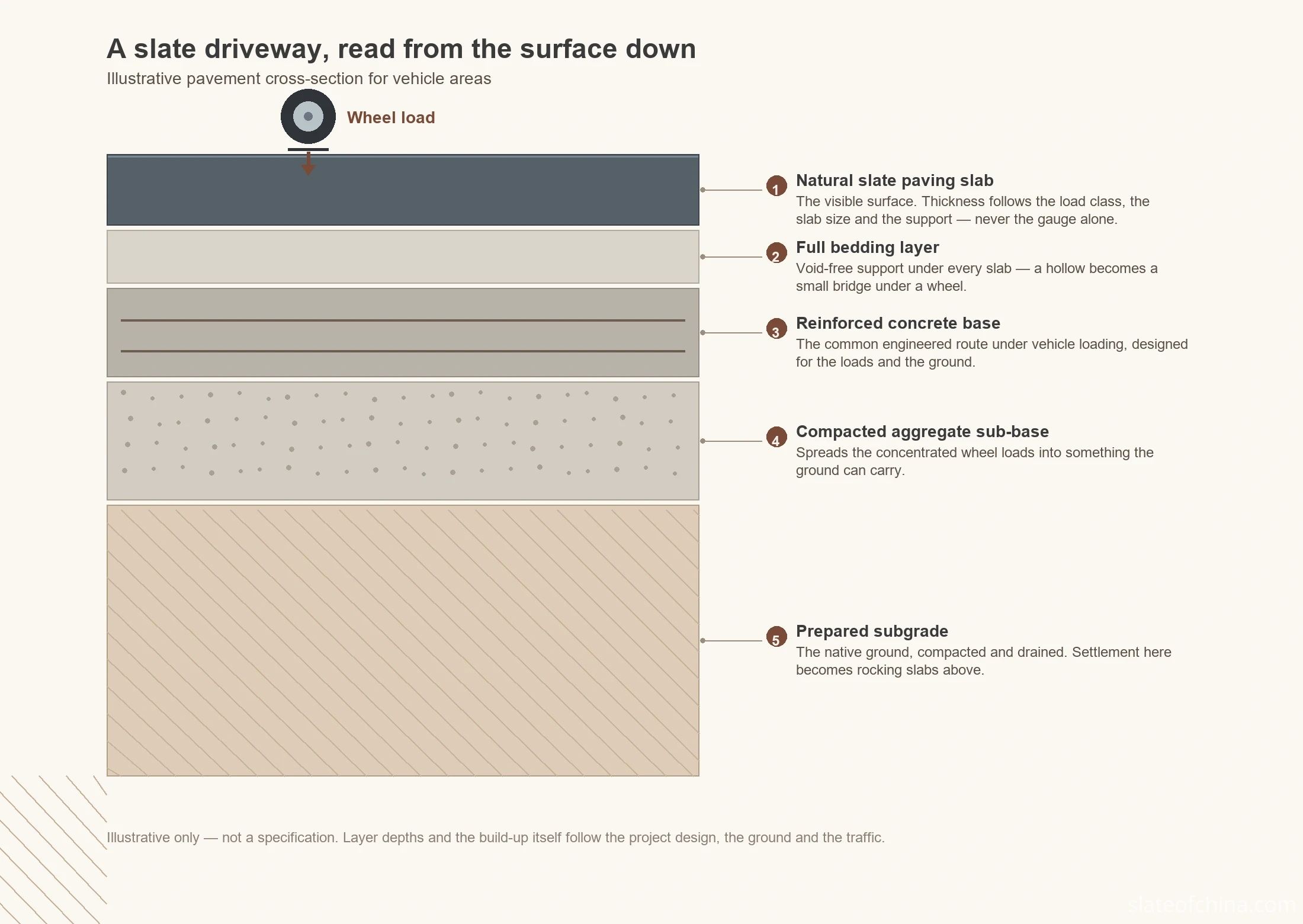
The bedding: no voids, ever. The underside of every slab should be fully supported by the specified system. A void converts a paving slab into a small bridge, and slate never volunteered to be a bridge. Under a wheel, the slab bends into the hollow until it cracks — usually along the line of the void, which is why a crack is such a useful witness.
The base: engineered, not assumed. For vehicle areas, a reinforced concrete base with a full bedding system is the common engineered route for natural stone — it gives the slabs consistent support and keeps the structure’s behaviour predictable. The base itself has to be designed for the loading and the ground. It is a structural element, not a convenience.
The sub-base: where the load spreads. Beneath it, a compacted aggregate sub-base distributes the concentrated wheel loads into something the ground can carry. Slate paving sub-base requirements follow the soil’s bearing capacity, the drainage and the traffic — which is why two driveways on the same street can legitimately ask for two different build-ups. And no increase in slate thickness compensates for a weak or poorly compacted foundation; the stone cannot be thick enough to replace the ground.
The ground: where the load ends. Finally, the subgrade. Soft soil, poorly compacted fill and always-wet ground settle — and settlement under a paved surface arrives as rocking slabs, opened joints and a driveway that holds puddles in new places. Where the ground is bad, the answer is excavation, improvement or engineered reinforcement, decided before the paving is ordered rather than after it dips.
How the support system is chosen — full mortar bed, sand bed, pedestals, and what each asks of the stone — is a specification conversation of its own, covered in a separate guide to slate paving support systems. Water has a vote as well: falls, drainage and joint design decide whether the structure stays dry, and they have a guide of their own too. Public and heavily trafficked projects add a further layer of written requirements; those live in Commercial Slate Paving. On the pedestrian side, the ground rules for paths and patios are set out in Slate Paving and Slate Patio Paving.
The surface on a wet day: finish and traction
A driveway is driven on wet, hosed down, and walked across in shoes that have just cut across a lawn. The finish is the third specification, after structure and stone: it decides how the surface looks, how it grips, and how it cleans.
Natural cleft is the common choice outdoors: the split face keeps a texture that reads as stone and hides the small scars of daily use. It should not be read as a slip result, though — the wet performance of a cleft driveway is confirmed by appropriate wet slip-resistance testing, not judged by appearance alone. Sawn and textured finishes give a cleaner, more architectural surface. Honed is the refined end of the range and, on a driveway, the one to treat with respect: a smooth surface and a wet tyre are a combination to specify carefully, not to discover in the rain.
Two disciplines travel with all of them. First, the evidence is per finish and per lot: ask for the tested wet slip value the same way you ask for flexural data. How slip resistance is actually measured — pendulum, ramp and the rest — is covered in a separate guide. Second, match the finish to the use rather than to the showroom: the full family of finishes and what each one is for is set out in Slate Surface Finishes, and the pairing of paving finishes with their uses has a guide of its own.
How slate driveways fail, and what each failure is telling you
Failures are diagnostic. A driveway that cracks, rocks or settles is reporting a specific weakness somewhere in the structure, and learning to read the report is the cheapest skill in this whole subject.
- A crack across one slab is the classic signature of an undersized system: a gauge too thin for the load, a format too large for the span, or a void under the line of the crack. A crack that runs straight is usually tracing the hollow beneath it.
- Rocking or loose slabs point to the bed, the edge restraint or the jointing — rarely to the stone. A slab that rocks is reporting that something below it moved.
- Uneven settlement points down, not up: subgrade soft spots, fill that was never compacted, or water working under the build-up. The stone followed the ground.
- Standing water points at the falls and the drainage, which belong to the design. In a freeze–thaw climate, trapped water converts a cosmetic problem into a structural one, and every layer in this guide pays for it.
- A surface that polished or turned greasy points at the finish, the contamination or the maintenance regime — a subject covered in its own guide. On a sloping driveway this one is about safety, not looks.
The pattern in that list is the point. Most failures arrive from below, and the slate is the one that gets named — it is the only layer in the driveway with a name on it. In a properly specified slate driveway, the structure carries the loads, and the slate is left to do the two things it is actually good at: looking like stone, and lasting like stone.
The enquiry that gets an engineering answer
The weakest possible opening message to a slate supplier is also the most common one: “Do you have 30 mm slate?” It comes back as a price, because it asks for a product — and everything that decides whether the product works was left out of the question.
A better enquiry carries the project in a few lines: the area and its layout, including where cars turn and stop; the vehicles and how often they come; the ground, as far as it is known; and the look in mind — format, finish, colour. Faced with that, a supplier who knows vehicle areas can answer with a material proposal instead of a bare quotation.
On the material side, these are the questions worth sending:
- Which thicknesses are offered for vehicle use, with the dimensional tolerances stated in writing?
- What is the measured flexural strength of the grade on offer, and is the test report available?
- What are the water absorption and freeze–thaw figures, for the destination climate?
- Which slab sizes are available — and what size ceiling would you recommend for the traffic described?
- Is the material suited to fully bedded external paving?
- Can representative samples be provided from the production lot, rather than the showroom tray?
- Has the supplier shipped slate for vehicle-access areas before, and are there references?
- Can consistent quality be held across the required quantity — and how are slabs of this weight class packed?
Then hold one boundary line, because it protects both sides. The supplier’s side of the work is the material: the stone’s specifications, the test data behind them, the consistency of the batch, the packing that gets it there intact, and an honest recommendation on which thickness and format suit which traffic. The project designer’s or engineer’s side is the structure: the load calculations, the base design, the setting-out — and the thickness the structure, not the shelf, finally calls for. A supplier who offers to decide the structure for you is selling something that is not theirs to give; a supplier who hands over clean data and a straight recommendation is worth keeping.
For the purchase around the stone — samples and approval, documents, packing standards, container arithmetic — the step-by-step guide is the Architectural Slate Buying Guide.
Slate driveways — common questions
Can you use natural slate for a driveway?
Yes, where the stone, the slab size, the base and the installation are specified for the vehicles that will actually use it. Slate driveways are built and they last — what they do not offer is a thickness-only route to that result.
Is 20 mm slate suitable for a driveway?
Not as a default for direct vehicle traffic. Around 20–30 mm is the band common in residential paving products for foot traffic; the moment wheels are in the brief, the thickness becomes a structural question with its own assessment.
Is 30 mm slate thick enough for cars?
Sometimes, in the right structure: modest slab sizes, measured flexural strength and an engineered base carrying most of the work. As a blanket yes applied to any driveway, 30 mm is a number that belongs to a load case, not to a product page.
What is the best thickness for a slate driveway?
There is no single best. The thickness is calculated for the project from the vehicle loading, the frequency, the slab size, the stone’s strength and the base design — a number with a derivation behind it, not a figure picked from a chart.
Can a slate driveway take SUVs and delivery vans?
Potentially, yes — when the pavement is designed for those axle loads. A structure specified for the family car does not silently scale up when a heavier vehicle arrives, and the entrance and turning areas are where the difference shows first.
Should slate driveway slabs be laid on concrete?
For vehicle areas, a reinforced concrete base with full bedding is the common engineered route, and often the safest answer for heavier traffic. The choice belongs to the designer, weighed against ground, drainage and loading; the full support under every slab is the part that is never optional.
Is natural cleft slate suitable for a driveway surface?
It is the most common choice for outdoor paving: the split face gives a traditional stone appearance and hides daily wear. Its suitability for a driveway is confirmed by appropriate wet slip-resistance testing — the tested value for the finish and the lot, not the look of the texture.
How do you stop slate driveway slabs from cracking?
The same way the rest of it is specified: the right stone for the load class, conservative slab formats, full bedding with no voids, an engineered base on prepared ground, and drainage that keeps the structure dry. A crack is almost never just weak stone; it is the structure filing a report.
Related reading
Specifying slate for a driveway or vehicle area?
Send the vehicles, the area and the layout — including where cars turn and stop — and the reply comes back with matching thicknesses, formats and finishes, together with the technical data behind them: flexural strength, water absorption, frost resistance and the tested wet slip value.