
Slate Paving: The Buyer’s Overview
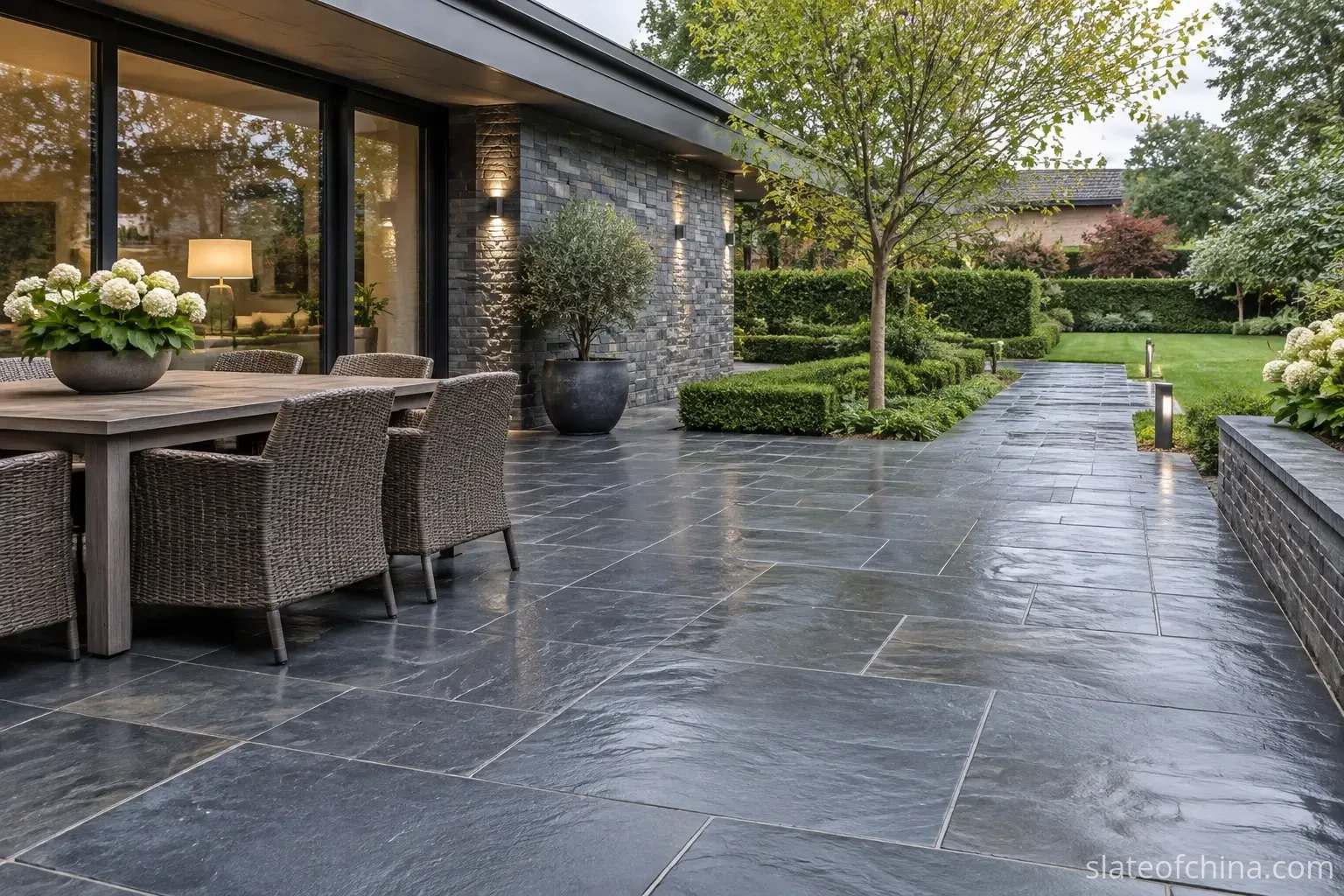
Outdoor slate paving is not a stone purchase that happens to include a base, a bed and some joints. It is a ground-engineering decision that happens to include a stone. The photographs in a catalogue are the easy part. The real work sits underneath, where exposure, load, format, finish and joint design have to be settled before a single sample is cut.
This page is the entry to the paving and outdoor flooring section of the Architectural Slate Guide. It is written for the people who sign the order: homeowners planning a terrace, landscape designers drawing a garden, architects specifying a plaza, contractors pricing the work, importers buying by the container. One worked example runs through the whole page — a residential terrace of about 60 square metres, open to the sky, in a climate with frost. Every few sections its enquiry line gains a clause. By the end, the line is complete, and it is the enquiry you send.
Quick Answer: The Order of Decisions
Quick answer: buy the system, then the stone — that is how slate paving is specified well. Work through the decisions in this order: exposure and duty (where the paving lies, what weather and loads it takes), test evidence (absorption, freeze-thaw and strength for the actual product), thickness (matched to the support system, not picked from a photograph), finish (judged on its wettest day), format (the sizes that set the joint lines), joints and falls (how water leaves the pavement) — and only then colour, read in batches rather than in a single picture. Each section below settles one decision, and the enquiry line at the bottom of the page collects them.
Start Where the Slate Will Lie
Before comparing slate paving products, describe the ground honestly. A sheltered terrace behind a house, a public walkway outside a hotel entrance and a driveway carry three different lives: different water, different frost, different loads, different consequences when something goes wrong. The same slab that serves quietly for decades on the first can fail in a single winter on the second or third — not because the stone changed, but because the job did.
| Setting | What sets the specification | What usually gets under-specified |
|---|---|---|
| Residential patios and terraces | Foot traffic, furniture, wet-weather comfort, frost in cold climates | Thickness range and calibration for even finished levels |
| Garden paths and walkways | Regular foot traffic, soil and leaf contamination, constant moisture | Support under every slab, and the fall that keeps water off the path |
| Public plazas and commercial ground | Frequent heavy use, concentrated loads, accessibility, cleaning regimes | Flexural and breaking-load data, and wet slip results for the finished face |
| Pool surrounds and wet areas | Constant water, bare feet, cleaning chemicals, algae | Wet slip-resistance evidence and drainage detail — appearance alone proves nothing |
| Driveways and vehicle areas | Wheel and axle loads, braking and turning forces, sub-base behaviour | Everything: vehicle areas are engineered, not catalogued |
The table is a scan, not a verdict; every project still reads its own conditions. Where slate sits in the wider building — grounds, floors, walls, garden — is mapped in Where Slate Is Used in and around Buildings. The principle for this section is simple: a paving specification is written for the pavement’s worst week, not for its best photograph.
Enquiry line, step 1 — after exposure:
Natural slate paving — application: residential terrace, ~60 m², open to rain and frost, foot traffic only.
The Evidence Behind the Stone
Not every slate suits every outdoor job, and no buyer can see the difference in a photograph. The difference lives in the test reports — and in what a supplier is willing to put on paper.
Water absorption tells you how much water a stone takes in under specified test conditions. For outdoor work, lower is generally better, because less moisture enters the stone with every rainstorm. But absorption alone decides nothing: two slates with identical absorption can behave differently in frost, in traffic, on different beds. Read it together with freeze-thaw behaviour, flexural strength, the surface condition and the installation system — never as a single magic number. Ask for the report, not the adjective: “low absorption” is a claim; a test result is a number with a method behind it.
Freeze-thaw matters wherever winter is real. Water that enters a slab — or collects beneath it — expands when it freezes, and repeated cycles work at the stone, the bed and the joints. For projects in northern Europe, the UK, Canada and similar climates, ask for freeze-thaw evidence for the specific product. A supplier who cannot distinguish between what a stone family generally does and what this exact product, in this thickness, has actually been tested to do is not yet ready to quote your pavement.
Flexural strength — resistance to bending — is the quiet number behind paving performance, because a slab’s working life depends on how it is supported. A slab on a full, well-prepared bed lives an easy life; the same slab bridging a void carries every load at its weakest point. Large formats, public ground and vehicle areas put this number to work, so it belongs with the installation design, not in a drawer. In busy commercial settings, add abrasion and wear behaviour to the questions.
The standards give the paperwork its shape. In Europe, external paving slabs of natural stone fall under EN 1341, slabs of natural stone for external paving; interior flooring and stairs have their own standard in EN 12058; the US specification for slate dimension stone is ASTM C629. Professional readers can obtain the full text of the European paving standard through BSI, the British Standards Institution. A roofing slate report (EN 12326) says nothing about a pavement — different product, different scope, different tests. When paving is quoted, the report offered should be the paving report. Where the roofing line ends and the architectural line begins is drawn in Architectural Slate vs Roofing Slate. How one slate’s paving credentials — absorption, density, cleft surface — are read and cross-checked rather than asserted is shown in Why Jiujiang Slate Works for Paving.
Thickness Is a System Decision
There is no single correct thickness for outdoor natural slate paving slabs, because thickness is an output of four inputs: the strength of the stone, the format of the slab, the support beneath it and the load above it. A catalogue number is a starting point for a conversation, not the answer to a specification. The same 20 mm product can serve one residential system beautifully and fail in another where the bed, the base or the traffic is different.
Take the worked example. For this project, 600 × 300 mm slabs at a nominal 30 mm thickness provide a useful starting specification for discussion, assuming a properly designed and fully supported installation; the final thickness should be confirmed against the stone’s declared flexural strength, the slab dimensions, the bedding system and the project requirements. At the measured density of the slate we ship from Jiujiang — 2,819 kg/m³ — that is roughly 15 kg per piece, about 85 kg per square metre (indicative, calculated from the measured density). At that weight the units remain reasonably manageable for handling, though appropriate manual-handling precautions should always be followed. Thickness, in other words, is also a handling and logistics decision — per piece, per pallet, per container — and it deserves the same seriousness as the colour.
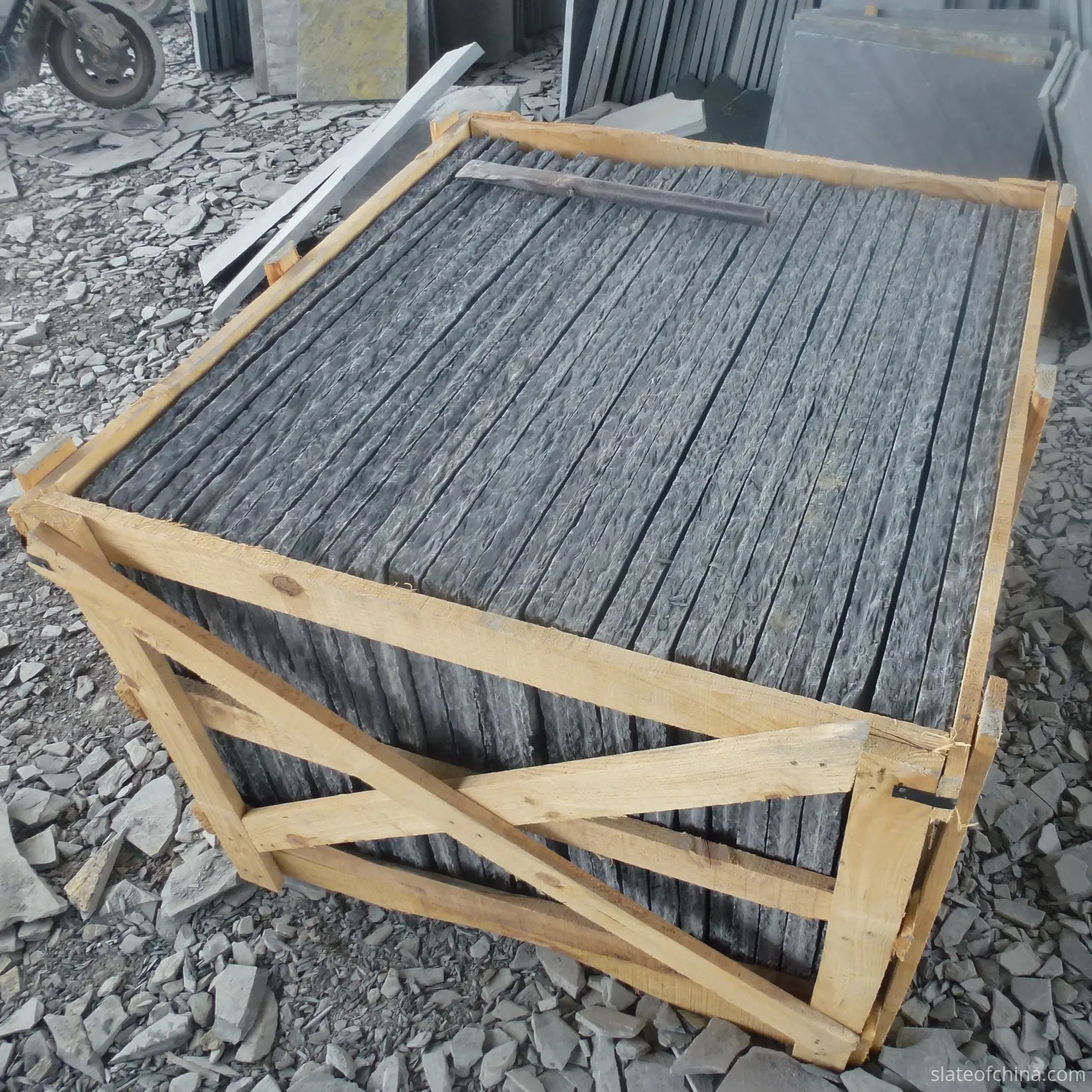
Export packaging deserves its own line in the specification. For export orders, packing should be agreed according to slab dimensions, thickness, weight and transport conditions: timber pallets or reinforced crates, adequate edge protection, and restraint that prevents movement during handling and sea transit. Before production is completed, confirm the loading arrangement, the packaging dimensions and the container loading plan with the supplier. Buyers who import by the container should treat packaging as part of the product, not as an afterthought.
Calibration is the second half of the thickness decision. A calibrated batch has been mechanically worked to a target thickness range, so the slabs set to one depth and the joints and finished levels stay honest. A hand-cleft batch keeps the natural variation of the split stone — character that many traditional settings want, and a job of adjustment during laying. Either is legitimate; what matters is that the thickness range is stated in writing before the order, not discovered on site. The full comparison — how to read the back of a tile, what each route asks of the bedding — is in Calibrated vs Hand-Cleft Slate.
The complete numbers library — formats, thickness categories, indicative weights per band, tolerance distances, and a worked quantity example — is tabulated in Paving Slate Sizes & Thicknesses. Use it after the decisions above, not instead of them.
What thickness of slate paving do I need for a patio?
There is no universal number — slate paving thickness follows the support system, the slab format, the base and the load. Fully supported residential systems are served by thinner products than a slab bridging gaps on sand; products around 15–20 mm exist for suitable fully supported systems, much residential and light-commercial ground sits nearer 20–40 mm, and heavier or vehicle duty is a design output rather than a catalogue row. State the nominal thickness and the acceptable range when you ask for a price.
Enquiry line, step 2 — after thickness:
+ 600 × 300 × 30 mm, calibrated, sawn edges — thickness range stated in writing.
The Finish Is the Walking Surface
A finish is not a colour choice. It is the surface the project will walk on for the next few decades, and it should be judged on its wettest day, not its most photogenic one. Slate offers four working faces, each with its own temperament.
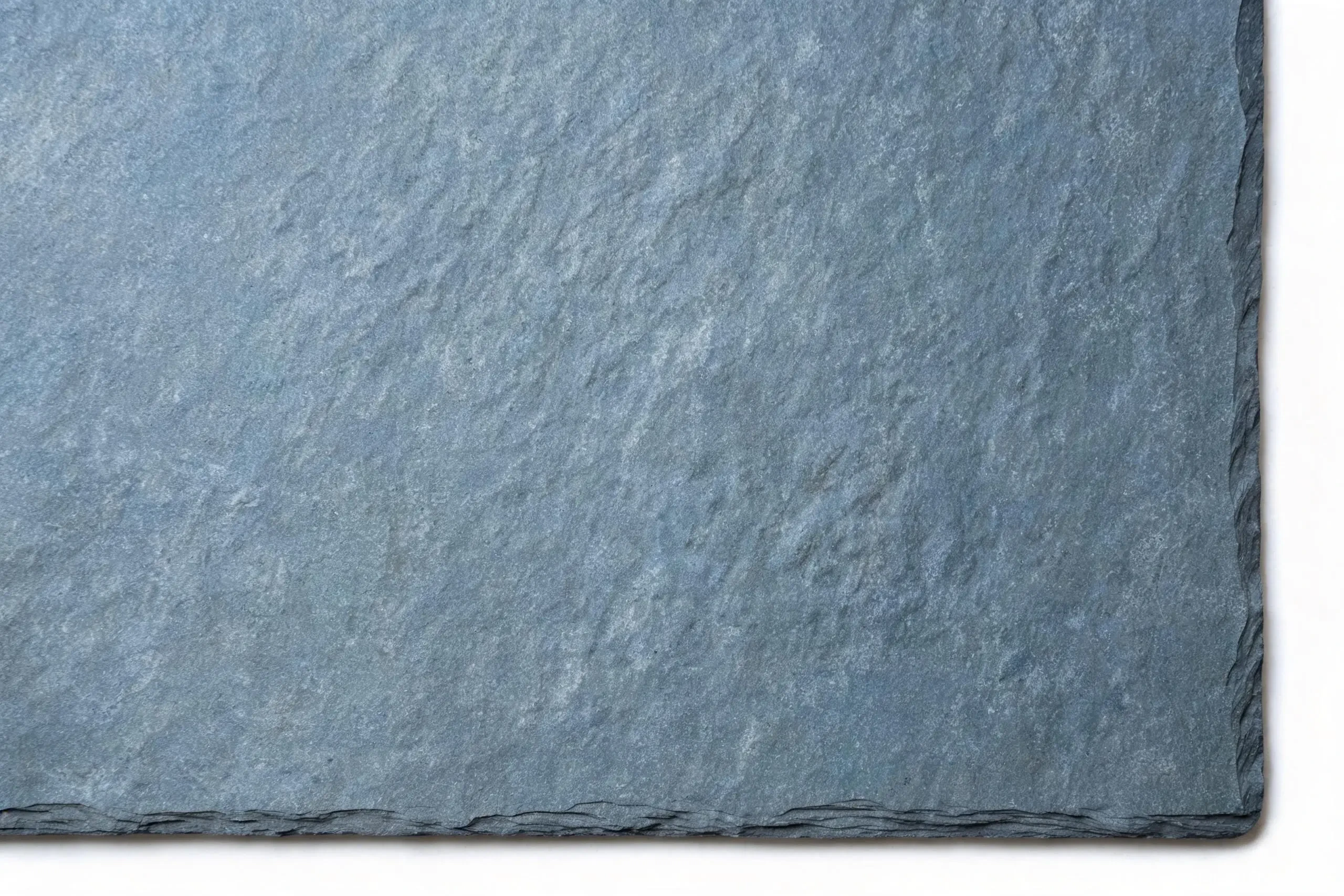
Natural cleft keeps the face the stone split along its own cleavage — the texture, the light and shadow, the character buyers mean when they say “real stone”. It is a popular choice for exposed outdoor paving because it keeps the stone’s natural texture and character, and its suitability for wet or heavily trafficked areas should still be verified through appropriate slip-resistance testing. It suits patios, paths and rustic settings — and the degree of variation still matters: a lively cleft face that delights on a garden path can fight with furniture feet and accessible routes on a formal terrace.
Sawn faces and edges are mechanically cut: cleaner lines, a more contemporary geometry, easier joints. Depending on the processing, the face can be relatively smooth — so confirm wet slip performance for the finished product rather than assuming that crisp equals safe.
Honed faces are smooth and uniform, at home on interior floors and under-cover architectural work. On exposed, frequently wet ground they need careful evaluation; a smooth face should not be chosen outdoors because it looks calm in a drawing. Brushed faces sit in between — texture taken back toward cleft while keeping a disciplined surface — and suit settings that want both.
Heavier mechanical textures exist for some stones, but a note of caution belongs here: flamed finishes are most commonly associated with granite and other suitable stones, and they are not a standard finish for most slate paving products. If a supplier offers flame-textured slate, request samples and verify the processing method and the resulting surface performance. For the finish-to-finish comparison — cleft, sawn, honed, brushed, face by face — read Slate Surface Finishes.
Is slate paving slippery when wet?
It depends on the finish, the water, what sits on the surface and how it is maintained. Cleft and mechanically textured faces generally offer more underfoot grip than honed or polished ones, but texture seen with the eye is not a slip measurement. Where wet performance matters — entrances, pool surrounds, shaded north-facing routes — ask for wet slip-resistance test results for the actual finish, and ask before the order, not after the first rainy autumn.
Enquiry line, step 3 — after finish:
+ natural cleft face — wet slip data for the finished product to accompany the quotation.
Format Decides More Than Appearance
The size of the slab sets the rhythm of the surface: how many joint lines the eye crosses, how modern or how traditional the ground reads, how the paving meets steps, borders and drains. Regular rectangles — 300 × 300, 400 × 400, 600 × 300, 600 × 600 mm as illustrative modules — laid in a running bond remain the workhorse for everything from commercial modules to slate slabs for a patio: predictable coverage, honest joints, straightforward cutting.
Large-format slate looks contemporary because fewer joints interrupt the face. It also asks more of everything around it: flatter base, thicker or stronger slabs, more disciplined tolerances, heavier handling. A large slab of the same thickness is not automatically stronger than a small one — on a marginal bed it is usually the more demanding choice, because a longer slab bridges more of the base’s sins.
Mixed and random formats create the natural, less repetitive look of traditional gardens and country properties. They work beautifully — when the size mix and the laying pattern are agreed in writing before the order. Without that agreement, the delivered pallet and the sample photograph can become two different memories. Stepping stones set into grass or gravel are the informal end of the family; even they need appropriate thickness, bearing support and spacing for the feet that will use them.
The module logic behind these choices — how formats combine, what each band weighs, how a mixed pattern is calculated — is laid out in the sizes and thicknesses library.
Enquiry line, step 4 — after format:
+ 600 × 300 mm modules laid in running bond.
The Slab Is Only Half the Pavement
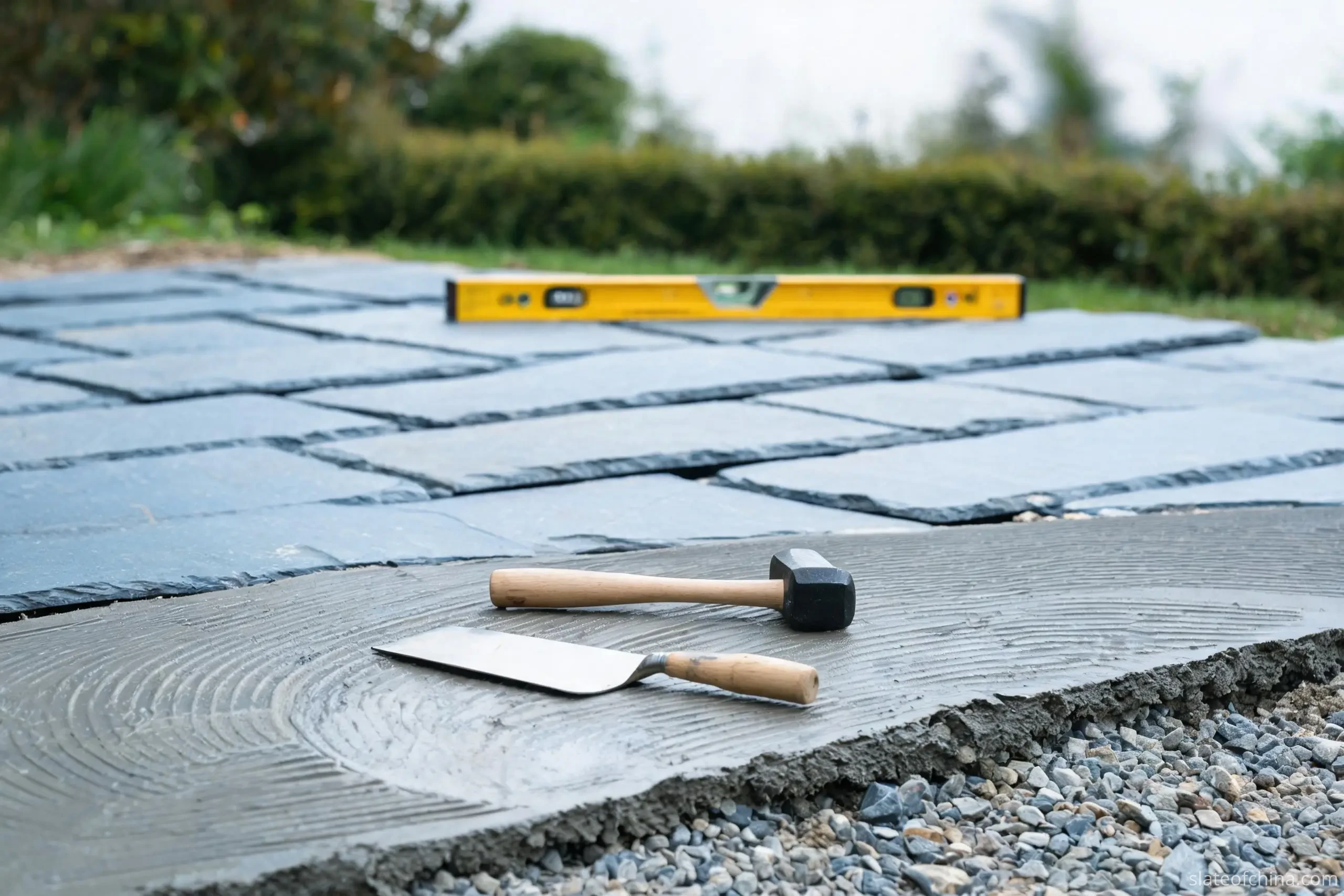
The stone arrives on site with half of its performance already decided at the quarry. The other half is built there, in the base, the bed and the joints. Almost every slate paving installation is built on one of three bedding systems, and the choice between them is a project decision — ground conditions, slab format and expected loading — not a habit.
A mortar-bed system is a commonly used option for patios, terraces and formal paved areas where bonded, continuous support is required; the appropriate bedding, bonding materials and base construction should be specified for the particular stone and site conditions. It asks for a properly prepared base, suitable mortar and bonding, full support beneath every slab, correct joint widths and movement joints where the design requires them. Spot bedding should not be substituted for full support where a continuous bed is specified — a slab that rings hollow today is a slab that rocks next year.
An unbound sand or aggregate bed suits many garden paths and informal landscape paving. It allows adjustment and easy local repair, and it asks in exchange for suitable ground preparation, edge restraint, and attention to joint stability and water movement. It is not automatically right for vehicle traffic, nor for every large-format slab.
Pedestal systems carry raised terraces, balconies and roof decks, with a void beneath the slabs for services and drainage routes. Not every slab qualifies: the stone must suit the support spacing, the loading and the format, and the thickness and strength for a pedestal build are confirmed by the system designer — not assumed from a pedestrian catalogue.
Where the Water Goes
Water is the patient one. It does not attack a pavement; it waits — in a low spot, beneath a slab, inside a joint that never drained — and lets frost, staining and joint deterioration do the visible work over the years. Drainage is not a finishing detail; it is part of the specification.
Outdoor paving needs falls — gentle gradients — that carry surface water toward drainage points or designed runoff areas. How much fall, and in which direction, depends on the surface texture, the system, the site and the drainage design; the direction should be planned before the first slab is laid, because it cannot be adjusted afterward.
Joint width is half appearance, half engineering. Narrow joints read as continuous and architectural; wider joints absorb format variation, installation tolerances and movement, and suit some jointing materials better. Do not assume that every slate slab can be laid with hairline joints — dimensional consistency, edge treatment and the laying system decide what is honest. Large paved areas also need movement joints, planned into the laying design from the start rather than cut in as an afterthought.
Enquiry line, step 5 — after the system:
+ full mortar bed, falls to drainage points, joint widths and movement joints per the laying design.
Colour Comes Last, and It Arrives in Batches
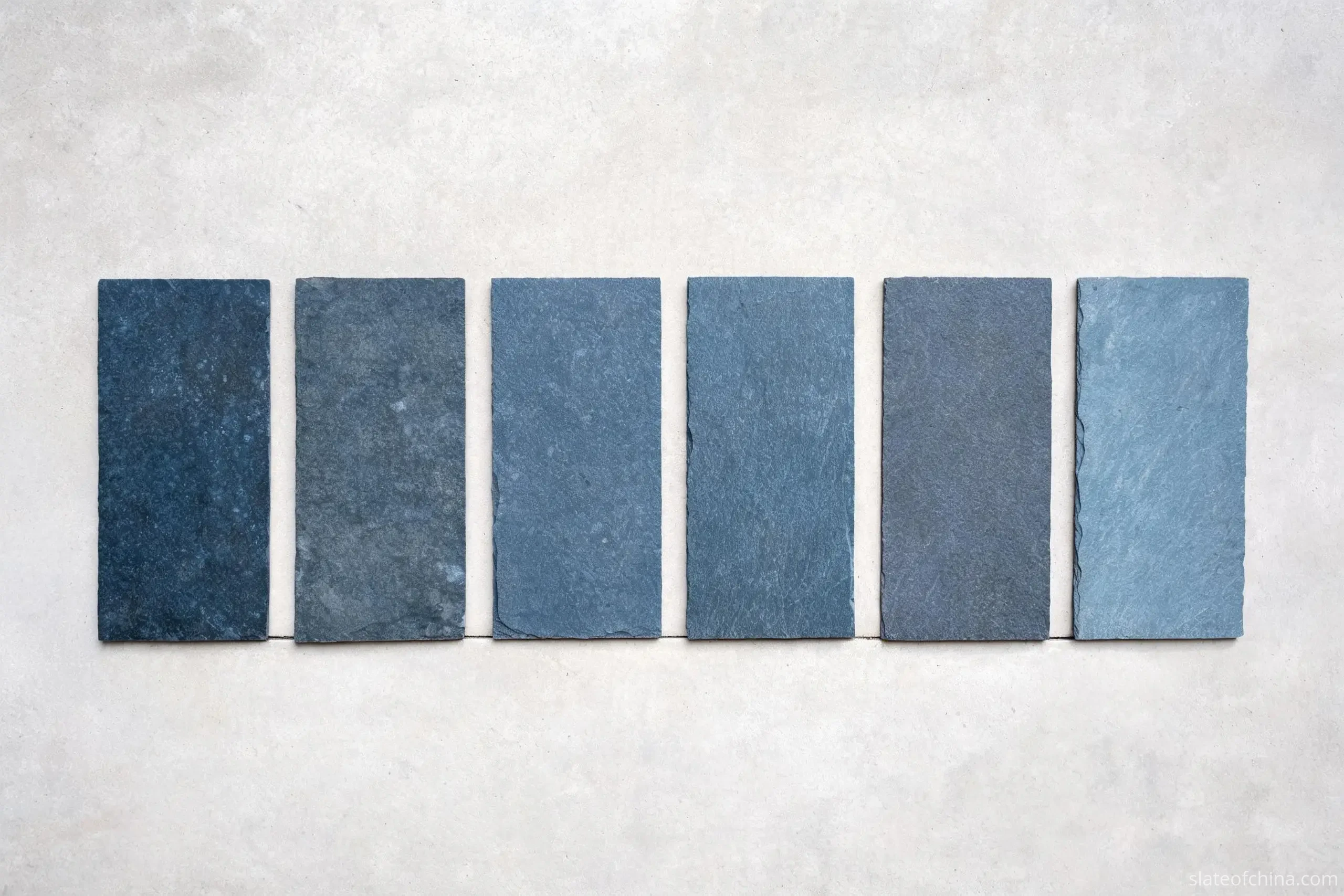
Colour is the decision everyone wants to make first, and it is the one that should be made last — not because colour does not matter, but because no colour rescues a mis-specified system, while a well-specified pavement can be served by almost any tone in the family. Slate families run from blue-black and charcoal through dark and silver grey to green-grey and rustic mixed tones; each reads differently against planting, timber and pale walls. Dark slate against green planting is a classic for a reason.
A sample speaks for the family; the batch photographs speak for the order. Request representative samples, and for larger projects ask for photographs of the actual production batch before shipment. Look at colour consistency, natural mineral markings, surface texture and edge quality — and remember that natural stone varies by design, within the agreed range, not by defect. How to read that variation — light, texture, batch — is its own lesson, covered in Architectural Slate Colour and Texture. The formats and colour families as they are shipped are browsable in the paving slate range.
What Should Be Checked Before Shipment?
Choosing well and ordering well still leave one act of verification, and it belongs to the buyer as much as to the supplier. Before a paving order leaves the factory, a short pre-shipment check protects both sides of the transaction.
- Thickness consistency across the batch — the range agreed in writing, read on the slabs themselves.
- Length and width — dimensions against the agreed tolerances.
- Surface condition — defects, cracks and visible mineral variation against the approved reference.
- Edges and corners — edge treatment as ordered, corners protected for transit.
- Colour consistency — the batch read against the approved samples, not against memory.
- Packing and quantity — crates stable, counts verified, loading plan confirmed.
Photographs of the checked batch, taken before loading, close the loop between the sample that won the order and the shipment that has to match it.
The Enquiry That Answers Itself
An enquiry for slate paving that describes the use gets an answer that fits the project. An enquiry that describes only a colour and a size gets a catalogue page. The difference is not politeness — it is information: everything the quotation depends on, stated once, up front. It is also the quickest way to tell slate paving suppliers apart: the ones who can specify answer with a specification.
| Enquiry row | What to confirm |
|---|---|
| Application | Patio, path, public ground, pool surround or vehicle area — and the traffic it takes |
| Stone and colour family | Natural slate; blue-black, grey, green-grey or other family offered |
| Format | Length × width, the module or size mix, and the laying pattern |
| Thickness | Nominal thickness and the agreed range, in writing |
| Surface finish | Natural cleft, sawn, honed or brushed — and where it will walk |
| Edges | Sawn, split or hand-dressed |
| Water absorption | The test result for the quoted product, not the claim |
| Strength | Flexural and breaking-load results |
| Freeze-thaw | Evidence for the exposure, where the climate demands it |
| Wet slip | Test method and result for the finished face |
| Quantity and packaging | Area, pieces, and packing — pallets or crates, flat or on edge |
| Destination | Country and delivery port, so freight and documents are planned with the stone |
Assembled, the worked example has become one complete line:
Enquiry line, complete:
Natural slate paving — blue-black, 600 × 300 × 30 mm, calibrated, sawn edges, natural cleft face; ~60 m²; residential terrace, open to rain and frost, foot traffic only; full mortar bed, falls and joints per laying design; packed on edge in export crates; destination port to confirm. Written thickness range, absorption, freeze-thaw, flexural and wet slip data for the quoted product requested with the quotation.
When an enquiry reaches our export desk in this shape, it can be answered with a specification and a price rather than a week of clarifying questions — everything the quotation depends on is already on the page. Your line will differ: a public plaza replaces the terrace, pedestals replace the mortar bed, the port changes. The order of the decisions does not.
Where Paving Buys Go Wrong
The same few mistakes recur, and each costs more than the sentence that prevents it.
- Choosing by appearance alone. A beautiful face does not carry a wet, heavily used location; the tests and the system do.
- Using indoor slate outdoors without verification. Interior flooring products are not automatically fit for exposed weather; the evidence must match the duty.
- Assuming thicker is always better. Thickness must pair with strength, format, loading and support — a thick slab on a poor bed is still a wrong slab.
- Ignoring wet slip resistance. A surface that feels fine dry may behave differently wet or contaminated; ask for the tested wet value.
- Overlooking drainage. Standing and trapped water drive movement, staining, joint deterioration and frost damage — quietly, for years.
- Leaving tolerances verbal. Unwritten expectations about thickness, edges and surface variation become installation disputes.
- Ordering without seeing the batch. Natural stone varies within its range; samples and batch photographs set expectations the shipment can meet.
When Slate Is the Right Answer
Slate earns its place where character underfoot matters: texture that weathers gracefully, tone that sits well with planting and timber, a surface that can be lifted, re-bedded and re-pointed piece by piece decades after it was laid. Contemporary terraces, traditional courtyards, outdoor dining areas, garden paths and selected commercial pedestrian ground are all natural territory for it.
It is not the automatic answer to every question. Porcelain paving brings dimensional consistency and a strong low-maintenance case; granite brings its own hardness and texture. Where a project needs strict uniformity, certified slip performance or minimal upkeep, compare the materials honestly before deciding — the indoor material-by-material comparison in Slate Flooring vs Other Stone Flooring shows how those conversations should be held, and its outdoor counterpart is treated later in this guide.
The best paving material is rarely the most photographed one. It is the one whose tests, format and system fit the ground it will lie on — and the buyer who can show why, in one enquiry line, usually pays the right price for it.
Frequently Asked Questions
Is natural slate paving a good choice for outdoor use?
Yes — selected products perform well outdoors when water absorption, freeze-thaw behaviour, strength, finish and thickness match the project, and when the bedding and drainage are designed for the site. The stone is one half of the decision; the system above and below it is the other half.
Can slate paving withstand frost?
Some natural slate products handle freeze-thaw climates well, but frost-resistant slate paving is a test result, not a stone’s birthright. For cold regions, ask for freeze-thaw evidence for the specific product — and remember that water trapped beneath slabs or in poorly drained joints does most of the winter damage. Drainage is part of frost resistance.
Can slate paving be used on a driveway?
Not automatically. Vehicle areas change the specification: axle loads, braking forces, sub-base design, slab thickness and breaking-load performance all have to be engineered for the traffic. A pedestrian-grade slab laid where a car turns is a warranty dispute waiting for winter.
Does slate paving need sealing?
Not always. Whether sealing helps depends on the stone, the finish, the setting and the maintenance the owner wants. An appropriate impregnating sealer can reduce staining on some surfaces, but it does not fix drainage and it does not make an unsuitable stone suitable. If a sealer is used, check compatibility with the finish and follow the sealer manufacturer’s instructions.
Can roofing slate be used for paving?
Not as a like-for-like substitution. Roofing slate and paving slabs are the same rock cut to different jobs: a roof tile hangs from fixings and sheds water, a paving slab carries loads from the ground. Their thicknesses, edge treatments and test standards differ, and a roofing slate report does not certify a pavement. The boundary between the two product lines is drawn in Architectural Slate vs Roofing Slate.
What joint width should slate paving have?
There is no single correct width. Narrow joints read as continuous and architectural; wider joints absorb format variation, tolerances and movement, and suit some jointing materials better. The right width follows the slabs’ dimensional consistency, the edge treatment and the laying system — which is why it belongs in the laying design rather than in a guess. Large paved areas also need movement joints, planned from the start.
What is the best natural stone for outdoor paving?
There is no single best stone — the right material follows the duty. Granite suits heavy wear and vehicle loads; porcelain suits projects that prioritise dimensional consistency and low maintenance; slate suits projects that value natural character and a surface that can be lifted, re-bedded and re-pointed piece by piece. Compare materials against the project’s traffic, climate and maintenance plan, not against photographs.
How long does natural slate paving last?
There is no honest single figure. A pavement’s service life is a system outcome — it depends on the stone selected, the thickness and finish, the bedding and drainage, and the maintenance it receives. Slate roofs centuries old show how durable the rock itself can be; a specification that matches the stone to its duty is what puts that durability to work underfoot.
What is the difference between slate paving and porcelain paving?
Slate is a natural stone cut from the rock: natural variation in tone and texture, a surface that can be lifted, re-bedded and re-pointed piece by piece, and weathering that reads as stone. Porcelain is a manufactured tile: highly consistent dimensions, low absorption by design and a controlled finish — at the cost of a more industrial look and repairs that usually mean replacing tiles. Neither is universally better; the honest comparison runs through joints, repairability, slip testing and whole-life cost against the project’s needs.
Related Reading
Buying slate paving for a project? Send the assembled line — application, format, thickness, finish, quantity and destination — and we will answer it with a specification and a quotation.