
The Slate Spec Sheet: What to Send a Supplier
An email like this one lands on stone export desks almost every week:
“We need 500 square metres of grey slate. Please send your best price.”
Thirteen words, no attachment, a courteous sign-off. It is not a careless email — the buyer usually knows exactly what they want. The problem is that the supplier cannot know any of it. Thirteen words leave seven decisions unmade, and every one of those decisions moves the price, the production route, the packing plan or the sailing schedule.
Is it roofing slate or paving slate — split thin and holed, or cut thick and sized? Split face or honed? Sawn edges or hand-cut? Does 20 mm mean a controlled finished thickness or an intention? Strapped crates or pallets, and to which port? And when the email says June, does it mean goods ready in June or arrival in June? A supplier who replies with a number anyway is not being efficient. The number is a guess wearing a price tag — and guesses are settled later, at whatever price urgency allows.
This page is about the other side of that email. An architectural slate specification sheet is a short, structured document that tells a supplier exactly what to price: the product, the format, the thickness, the finishes, the quantity, the packing, the destination and the dates. Earlier pages in this guide set the scene — What Is Architectural Slate? defined the material and its product families, and How to Choose Architectural Slate ordered the decisions that build a specification. The buying guide then walks the whole purchase in seven locks and closes its first one with a promise: the full specification template arrives later in the guide. This is that template. The questions page lists what to ask a supplier once a shortlist exists; a specification sheet is what earns the shortlist.
The short version: a quotable slate specification sheet carries eight lines — application, product and colour, format, thickness with its tolerance, surface and edge finish, quantity with packing, destination with Incoterm and dates, and the evidence you want attached. Send those eight, and the quotation that comes back is answering your project. Send four, and someone else quietly completes the other four — their way, at your cost.

What Thirteen Words Force the Desk to Guess
An incomplete enquiry costs money in two currencies: days and assumptions.
The days are spent on round trips. Each missing line becomes a clarification question, each question waits for a time-zone to wake up, and a price that could have existed on Tuesday arrives the following week. Multiply by three suppliers and the shortlist is a fortnight late before anyone has quoted a number.
The assumptions are worse, because they are invisible. To quote at all, the supplier must fill in every blank you left — and will fill it with the product they can supply most reliably, the thickness their line holds naturally, the packing their warehouse uses anyway. None of that is dishonest; it is arithmetic. Every blank is a decision handed to whoever fills it in, and the filler is rarely the payer.
A complete sheet changes the arithmetic. It earns:
- First prices that mean something — three offers that answer the same specification, not three different products wearing the same words.
- Fewer round trips — one clarification thread instead of seven, and a shortlist built in days rather than weeks.
- Constraints surfacing early — a supplier can say “that tolerance is not realistic in this stone” while the comment is still free, instead of after a deposit.
- Sample and quality terms in writing from the start — the reference, the variation policy and the evidence named before production, not negotiated after it.
- A referee — if the delivered goods ever argue with the order, the sheet is the document both sides read.
The reply has a shape too. A supplier who receives a complete enquiry can answer in about eleven lines — each line one of the measurements this page teaches you to write. The paving sizes and thicknesses guide works one terrace enquiry all the way through to that eleven-line reply; this page is the request that earns it. “Best price” is not a specification. It is a request for a guess.
The Sheet at a Glance: Eight Lines
A natural slate RFQ — a request for quotation — does not need to be long. It needs to be complete in the right places. Treat the eight lines below as a slate supplier quotation checklist: everything a stone desk needs before a price can be honest.
| The line | What you state | What it decides |
|---|---|---|
| Application | Roofing, paving, flooring or cladding — plus site conditions | The product family, and which standards apply |
| Product and colour | Natural slate, colour family, reference | The stone itself, and how much variation is acceptable |
| Format | Length × width; single size or module mix | Cutting plan, yield, piece count |
| Thickness | Nominal, acceptable range, calibration | Weight, freight, whether it installs as drawn |
| Surface finish | Cleft, honed, brushed — by name | Processing steps, appearance, slip behaviour |
| Edge finish | Sawn or hand-cut | Look, manufacturing time, cost |
| Quantity and packing | Net area or pieces, allowance, crate or pallet | Price basis, freight, handling |
| Commercial terms | Incoterm and named port, four dates, evidence required | Quotation scope, feasibility, the schedule |
The rest of this page walks those lines in six rows, in the order they appear on the fillable sheet at the end. Each row closes with the exact words that go on the sheet — written for one running example, a 400 m² terrace in Hamburg, so you can watch a specification assemble itself line by line. The worked examples near the end bend the same sheet to a roof and a façade.
Jump to the free slate RFQ template ↓
Row One — Application and Product: Name the Job Before the Stone
The same geological slate becomes four different products depending on the job. Split thin and holed, it is roofing slate. Cut thick and sized, it is paving. Calibrated flat, it is flooring. Cut to panel and fixed to a wall, it is cladding. A tile suitable for a decorative indoor floor should never be assumed suitable for an exterior pavement, let alone a roof — the first line of the sheet is the job, not the stone.
State it plainly, the way a site states it:
- Natural slate for a pitched residential roof.
- Natural split slate paving for an outdoor pedestrian terrace.
- Calibrated slate flooring for an indoor commercial space.
- Sawn-edge slate panels for ventilated exterior wall cladding.
| The family | What it must survive | What the sheet should state |
|---|---|---|
| Roofing slate | Weather on a pitch, fixing loads, the lap arrangement | Pitch, exposure, headlap, fixing method, hole positions |
| Paving slate | Foot or vehicle load, standing water, frost | Traffic, substrate or support system, drainage, joint width |
| Flooring slate | Daily traffic, flatness, cleaning regimes | Traffic, finish, maintenance expectations |
| Cladding slate | Wind, rain, its own weight on the fixings | Fixing system, panel format, exposure, cavity or bedded |

For demanding work, add the conditions the stone will work under: freeze–thaw exposure, expected traffic, a slip-resistance requirement, the facade fixing system. State the conditions and let the supplier match evidence to them — that is faster than asking for “good quality” and hoping. And if the decisions themselves are still open, the choosing page earlier in this guide orders them; this sheet simply records the answers.
On the sheet:
Application: exterior pedestrian terrace on a full mortar bed; freeze–thaw climate; domestic foot traffic and garden furniture
Product: natural split slate paving, mid blue-grey
Row Two — Format and Thickness: The Numbers That Move the Price
Write the format the way the trade reads it
Length × width × thickness, in that order, in one measurement system, every time. Then say which kind of size you mean: a nominal production size, a finished size after processing, or an installation module. The three can differ by more than a joint width, and only one of them is the number the factory cuts to.
For mixed formats — a field size with a border band, a running pattern of three sizes — attach the size schedule: each format with its quantity or share of the area. A layout drawing, if one exists, is better still. A size schedule on the sheet beats a photograph of a catalogue page, and the piece count follows the layout, not the total area.
Thickness is four words, not one
“20 mm slate” is where quotations start diverging, because the phrase is unfinished. A slate tile thickness specification needs four terms:
- Nominal thickness — the figure quoted and intended.
- Acceptable range — the minimum and maximum that still installs as drawn.
- Calibration — whether the underside is processed for thickness control, and whether that work is in the price.
- Tolerance — the permitted deviation from an agreed target, and how it is measured.
Written out, the running example reads: “Nominal 20 mm, acceptable finished thickness 18–22 mm, subject to sample approval and supplier confirmation.” That range is an illustrative purchasing requirement, not a universal industry tolerance — what a given stone and production line can actually hold is a supplier conversation, and it belongs on the quotation, not in folklore.
Because natural split surfaces carry relief, say where the measurement lands: on the calibrated back, at the centre of the piece, per an agreed sampling plan. “Calibrated” on its own is a claim; a number with a measuring rule is a specification. And when offers arrive, ask whether calibration, dimensional sorting or additional inspection are inside the unit price or added lines — “about 20 mm” is how a tolerance becomes a dispute.

On the sheet:
Format: 600 × 300 mm finished size, single format
Thickness: nominal 20 mm; acceptable finished range 18–22 mm; calibration and measuring plan to be confirmed with the supplier
Row Three — Surface and Edge: Two Words, Two Different Products
Surface and edge are the two shortest lines on the sheet, and the two easiest to leave ambiguous — “natural” alone means nothing a factory can cut. Natural slate surface finishes are a small vocabulary; use its words.
| Finish | What it is | What to confirm |
|---|---|---|
| Natural split / cleft | The stone’s own layered face, split along the bed | Thickness relief and surface texture; slip behaviour where it is walked on |
| Honed | Mechanically smoothed, generally matte | Appearance in wet areas; state the slip requirement rather than the hope |
| Calibrated back | Underside processed for thickness control | Whether the work is included in the quoted price |
| Brushed | Mechanically treated texture | Availability for the stone in question; sample approval |
| Custom | Project-specific treatment | Feasibility, cost and minimum quantity — before it is specified, not after |
Edges are the same story in fewer words. A sawn edge gives controlled geometry and straight lines; a hand-cut or chipped edge is more irregular, more rustic, and slower to make. Different processing, different look, different price — “natural split face with sawn edges” and “natural split face with hand-cut edges” are not interchangeable products, and a quotation that does not say which it priced is not yet a quotation. If edge appearance matters — picture-led facades, detailing around openings — attach a close-up photograph of the approved reference edge.
The finish vocabulary, and what each surface does to a design, has its own page in this guide: Slate Surface Finishes.
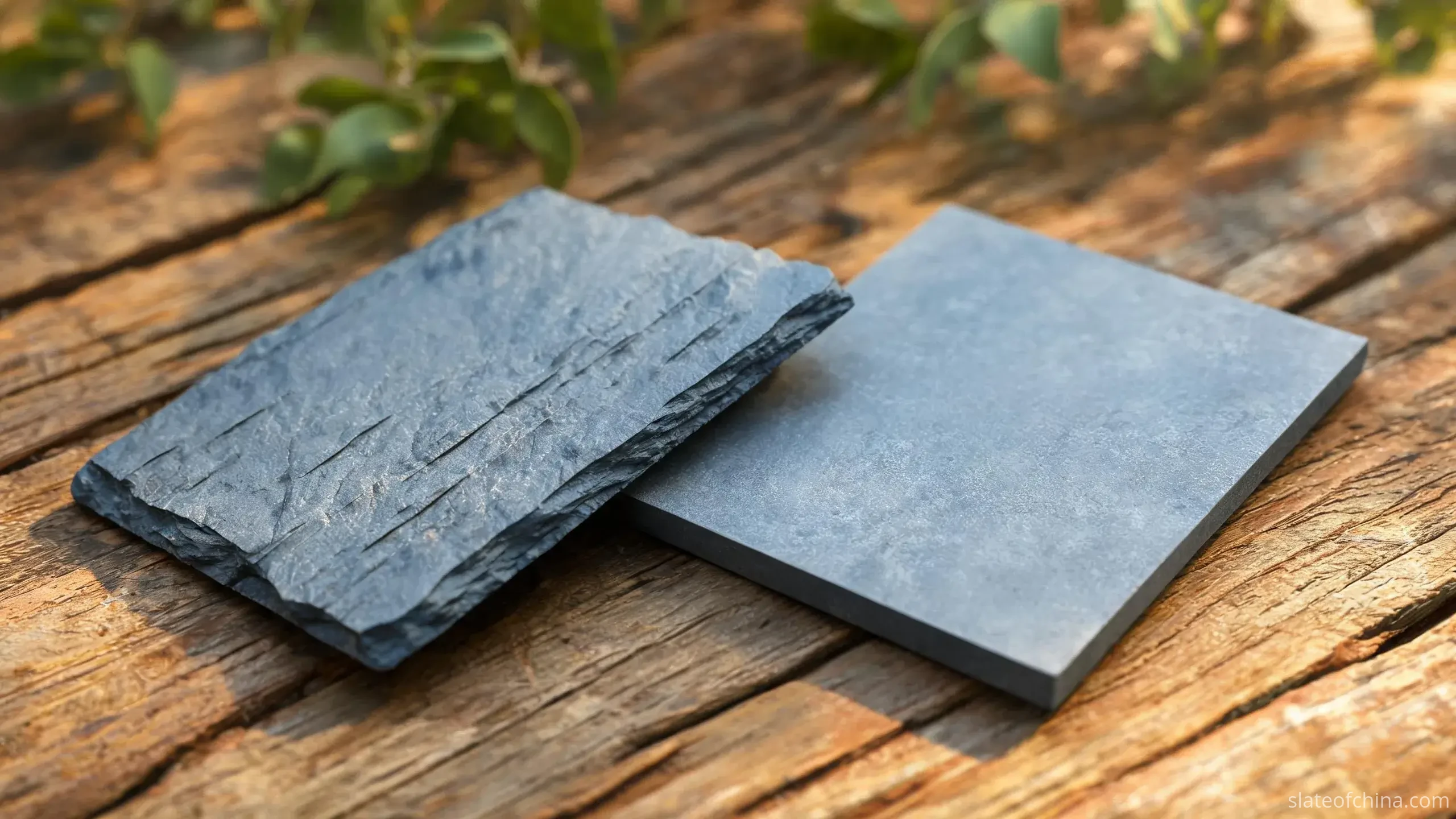
On the sheet:
Surface finish: natural cleft face
Edge finish: sawn, four sides — reference photograph attached
Row Four — Colour, Variation and the Approved Reference
Natural slate varies in shade, mineral markings, texture and visible layering — between sources, between batches, and piece to piece within a batch. A buyer asking for “uniform dark grey” and a producer accustomed to supplying naturally mixed grey tones are describing two different orders of the same stone. The sheet is where the two pictures meet.
State the colour family and attach reference images. Say whether natural variation is acceptable, and name any exclusions — prominent rust-coloured markings, for instance, if the design cannot carry them. Then state the sample terms: what will be approved, by whom, and when. A small sample demonstrates colour and texture, but it cannot represent the variation of a shipment; for larger projects, ask for a representative range — several pieces showing the expected lightest, darkest and most textured — and record the approval in writing, tied to the purchase order.
One sentence on the sheet does the work of a fortnight of photographs after delivery: “Bulk production shall be consistent with the approved reference sample range, allowing for agreed natural variations in colour and surface texture.”
How to read a colour range — what the band of acceptable tones actually looks like — is its own topic in this guide: Natural Slate Colours. The slate sample approval process, step by step, is covered on the roofing guide’s sample approval page; the mechanics are the same for architectural stone.
On the sheet:
Colour: mid blue-grey family; natural variation acceptable; rust-band markings excluded
Reference: approved sample range to be recorded against the purchase order
Row Five — Quantity, Packing, Destination and the Four Dates
Quantity: net is not purchase
State the net required area or piece count; say whether a cutting or breakage allowance is included — and how large; say whether the figure is firm or still an estimate. The distinctions are not pedantry: 500 m² of small-format roofing slate and 500 m² of thick paving slate are different worlds of piece count, gross weight, crate count and handling, and the price follows the world, not the number.

Packing is part of the product
Slate packing requirements decide how the stone survives its longest day. Name the format — strapped export crates, pallets, or both — and the extras that matter: interleaving between pieces, edge protection, crate labels, any handling limits at destination. Confirm the destination’s wood-packaging treatment requirements with the supplier rather than discovering them at customs. And before freight is booked, ask for the packing data a real quotation should carry: crate dimensions, net and gross weights, crate count, estimated loading per container. The crating standards page on the roofing guide goes deeper into export packing for slate; the principles carry across the product families: Packaging and Crate Standards.

Destination, Incoterm — and the four dates
A country is not a destination: name the port or delivery point, because freight is quoted to a place. Then name the Incoterm and its place — FOB or CIF or otherwise, with the named port and the edition, for example CIF Hamburg (Incoterms 2020) — so that the offer states who pays for what, up to where, and where the risk changes hands.
Dates come in four kinds, and the sheet should carry all of them: when you need the quotation, when samples will be approved, when goods must be ready, and when they should arrive. “Delivery required in June” is ambiguous enough to cost a month; “goods ready for shipment by 10 June, subject to sample approval and deposit” is a schedule. A date without a schedule behind it is not yet a commitment.
On the sheet:
Quantity: 400 m² net, firm; +5 % allowance to be quoted separately
Packing: strapped export crates with edge protection; piece counts and gross weights on the packing list
Destination: Hamburg, Germany — CIF Hamburg (Incoterms 2020)
Dates: quotation by [date]; sample approval by [date]; goods ready [date]; arrival [date]
Row Six — Evidence: What to Ask the Sheet to Prove
Buyers often ask “does your slate meet the standard?” without naming the application — and the honest answer is “which one?”. Roofing slate and architectural dimension slate are not evaluated under the same specifications, and a report written for a roof has never yet proved a floor. The sheet’s last row names the evidence that matches the job:
| Reference | What it covers | What to write on the sheet |
|---|---|---|
| EN 12326 series | Slate for discontinuous roofing and external wall covering | For roofing slates and roof-type wall covering |
| EN 1341 | Slabs of natural stone for external paving | For paving flags and terraces |
| EN 12058 | Slabs of natural stone for floors and stairs | For flooring, indoor or outdoor within its scope |
| EN 1469 | Natural stone slabs for wall and ceiling cladding | For cladding slabs and facade panels — modular tiles fall under EN 12057; roof-type wall covering stays with EN 12326 |
| ASTM C406 | Roofing slate, graded by service | For roofing slates into North American projects |
| ASTM C629 | Slate dimension stone — roofing slate excluded from its scope | For architectural dimension slate generally |
The applicable requirement depends on the market, the use and the current edition of each standard — the full walkthrough, including how to read a slate test report line by line, is this guide’s Architectural Slate Standards page. What the sheet itself should demand of any report is four answers: which test method and edition, what date, which material and batch was tested, and whether that material is the one being offered. Batch-linked data for the delivered stone is the standard worth asking for; a generic marketing sheet is not data. For an example of what published, batch-linked results look like on a supplier’s site, see the published test results on the roofing guide.
“High-quality slate” is a sentence. A method, a date, a tested material and a number are evidence. For regulated applications, confirm the applicable standard and documentation with the project’s architect, engineer or authority — the sheet states what you need; it does not certify the stone.
On the sheet:
Evidence: EN 1341 test data for the delivered batch; reports to reference the proposed stone source
Inspection: pre-shipment inspection per the agreed checklist
The Fillable Slate Specification Sheet: One Page, Fourteen Blanks
Every line above now has a home. If you have been wondering how to request a slate quotation without a week of clarification emails, the answer is the form below: fourteen blanks, grouped the way the six rows walked. Fill them in, then copy the completed sheet into an email, a Word file, a spreadsheet or an online RFQ form — or download it as a text file and attach it. Printing the page works too; the sheet travels well on paper at a yard visit.
Fields you cannot fill yet are not left silent. They go out as “To be confirmed” — because an open field invites a guess, and a flagged field invites an answer. “Load the terrace example” fills every blank with the 400 m² running example from this page; clear it and write yours.

A name the supplier can quote back. Add your RFQ number and revision here — references keep long threads findable.
Who signs, and where the reply should go.
The job first: roofing, paving, flooring or cladding, plus exposure, traffic and fixing context.
The stone and its colour family. Reference images can be attached.
Length × width; nominal, finished or module; each size with its share.
Nominal, acceptable range, calibration, and how thickness is measured.
By name: cleft, honed, brushed — never “natural” alone.
Sawn or hand-cut; attach a close-up of the approved edge where appearance matters.
The variation policy, any exclusions, and what the approval is tied to.
Net figure, allowance in or out, firm or estimated.
Crate or pallet, protection, labelling, and any destination treatment requirements.
A named place, not a country; the term, the place, the edition.
All four: quotation, approval, goods-ready, arrival.
The standard that matches the application, and what the reports must name.
The completed sheet, ready to paste or edit:
The Covering Email: Eight Things to Ask For
The sheet is the attachment; the email is the wrapper. Keep the wrapper short — what you are sourcing, that the specification is attached, and what the offer must contain. The last part is where most enquiry emails stop too early: an offer is only as comparable as the information it is required to carry. Ask for eight things:
- The price, stated — unit and total, currency, and the pricing basis.
- The minimum order quantity — and any additional processing charges: calibration, sorting, custom cuts.
- The production lead time — counted from deposit and sample approval, not from the reply.
- The packing plan — method, estimated crate count, gross weight.
- The technical data — test reports for the proposed stone, batch-linked where offered.
- The sample terms — availability, cost, and the approval procedure.
- The commercial frame — payment terms and how long the quotation stays valid.
- The deviations — anything that differs from the specification, quoted separately.
That eighth request matters more than it looks. An alternative offered openly — a thickness the line holds better, a format nearer a standing module — is often a better product at a better price. An alternative substituted silently changes the product without changing the paperwork.
The covering email below wraps the completed sheet. Copy it, replace the brackets, attach the sheet:
Three Enquiries, Worked Through
The three examples below are hypothetical — illustrations of how far a sheet goes in three different jobs, not stock specifications and not availability promises. Example B is the terrace this page has been assembling, row by row; A and C bend the same fourteen blanks to a roof and a facade.
Example A — Roofing: 12,000 pieces to Rotterdam
Roofing slate specifications carry a vocabulary of their own — pitch, exposure, headlap, fixing — and the sheet should show it has been considered:
| Item | Example specification |
|---|---|
| Application | Pitched residential roof |
| Product | Natural grey roofing slate |
| Format | 500 × 250 mm |
| Thickness | Nominal 5 mm, acceptable range to be agreed |
| Surface and edge | Natural split; dressed roofing slate edge |
| Fixing | Pre-punched holes to approved drawing |
| Quantity | 12,000 pieces |
| Quality | Roofing-grade requirements and applicable test documentation |
| Packing | Export wooden crates |
| Destination and quotation | Rotterdam, Netherlands — FOB named port and CIF Rotterdam options |
For roofing, the sheet should also carry the roof’s own numbers: pitch, exposure, required headlap, fixing method, hole positions. Coverage follows the approved lap arrangement — not the roof area divided by the nominal slate area — so the piece count is a drawing decision, and the supplier should not be asked to guess it.
Example B — Paving: the terrace, complete
A slate paving specification in full — every line earned in the six rows above:
| Item | Example specification |
|---|---|
| Application | Outdoor pedestrian terrace, full mortar bed, freeze–thaw climate |
| Product | Natural dark grey slate paving, mid blue-grey family |
| Format and thickness | 600 × 300 mm; nominal 20 mm, finished range 18–22 mm proposed |
| Surface and edge | Natural split; sawn, four sides |
| Quantity | 400 m² net; +5 % allowance quoted separately |
| Packing | Strapped export crates with protection |
| Destination | Hamburg, Germany — CIF Hamburg (Incoterms 2020) |
| Technical requirement | Performance evidence for the intended exterior conditions |
The 5 % allowance is an example, not a rule — real waste follows the layout, the cuts and the laying method. The installation system, substrate and drainage belong to the project designer, and the sheet says so by not pretending otherwise. To see what standing formats look like before writing your own line, the paving slate range is open on the product pages.
Example C — Cladding: 800 m² on fixings
A slate cladding specification answers to engineering as much as to aesthetics:
| Item | Example specification |
|---|---|
| Application | Exterior wall cladding, commercial building |
| Product | Natural charcoal grey slate |
| Format and thickness | 600 × 300 mm; 15 mm nominal, subject to engineering approval |
| Surface and edge | Natural split face; sawn |
| Quantity | 800 m² |
| Installation | Mechanical fixing system to be defined |
| Drawings | Panel layout and fixing drawings required |
| Samples | Representative range for approval |
| Packing | Numbered crates by elevation where feasible |
| Delivery | According to project schedule |
For exterior cladding, panel dimensions and thickness must be checked against the fixing system, the design loads, the substrate and the relevant regulations — a supplier’s quotation is not facade engineering, and the sheet should never imply that it is. The cladding family and its fixing paths have their own overview in this guide: Slate Wall Cladding; the wall cladding slate category shows the standing product range.
Reading the Replies: Compare on One Basis
When the offers arrive, the sheet earns its last job: making the offers comparable. A lower unit price is not a lower project cost until both quotations answer the same specification. Run the eight checks:
- Same stone, dimensions, thickness and finish — word for word.
- Tolerances and acceptance criteria stated, not implied.
- Same quantity, unit and size breakdown.
- Same packing method, with the same materials included.
- Same Incoterm, named place and freight scope.
- Sample costs, tooling and processing charges visible, not absorbed.
- Lead time, payment terms and validity on the same footing.
- Assumptions and exceptions listed — every one of them.
Where it helps, ask for two prices: one for the exact specification, one for a clearly described, more economical alternative. A supplier who quotes a different thickness “because the requested one is difficult” is giving you information, not cheating — as long as it is labelled. What you cannot compare against is a quotation that quietly quotes something else.
The roofing guide carries the same discipline for roof tile offers — How to Compare Roofing Slate Quotations — and while you compare, the twenty questions on Questions to Ask an Architectural Slate Supplier are what you ask about the people behind the numbers. Two quotations are only comparable when they answer the same sheet.

Seven Mistakes That Restart the Clock
- Describing only the colour. “Black slate” defines nothing a factory can cut. The job, the size and the finish come first.
- Leaving the thickness tolerance undefined. Natural split material varies; the installation system may not. Say the range.
- Omitting the edge treatment. Sawn and hand-cut are different work, different looks, different prices.
- Confusing net area with purchase quantity. Say whether waste, breakage and spares are inside the number.
- Giving a country instead of a port. A named port or delivery point is needed for a meaningful freight quotation.
- Skipping the representative sample approval. One photograph is not a variation policy.
- Giving an arrival date without a production schedule. Samples, approval, manufacturing, packing and sailing all live inside that date.
One habit prevents most of them: separating must-haves from preferences. A thickness range can be structural — the installation system depends on it. A slightly different grey may be perfectly acceptable if it arrives through an approved sample range. Marking which is which, line by line, lets a supplier propose alternatives without touching the parts that matter. The distinction costs one word per line — “firm” or “to be confirmed” — and it is the difference between a helpful alternative and a broken specification.
Fill the fourteen blanks, attach the drawings, and send. “As per attached” is still the cheapest sentence in this trade.
Frequently Asked Questions
What is a slate specification sheet?
It is a short, structured document that tells a slate supplier exactly what to price and produce: application, product and colour, format, thickness with tolerance, surface and edge finish, quantity with packing, destination with commercial terms and dates, and the quality evidence required. It usually fits on one page and travels with an RFQ email.
What is the minimum information a slate supplier needs to quote accurately?
At minimum: the application, the product family and colour, the dimensions, the thickness, the finish, the quantity, and the destination with delivery terms. Drawings, tolerances, packing requirements and sample references sharpen the price further. Anything left out becomes either a follow-up question or a supplier's assumption.
Should I write slate dimensions in millimetres or inches?
Either works, but use one system throughout and never mix units on the same sheet. Metric dimensions are the common language of the international stone trade. Whatever you choose, state tolerances in the same unit.
Can I request custom slate sizes and finishes?
Often yes, subject to the stone's characteristics, the supplier's equipment, minimum quantities and manufacturing feasibility. Send drawings for non-standard shapes, and expect the feasibility answer, the price and the lead time to be quoted against the drawing — which is exactly where a complete specification sheet earns its keep.
What should I do with fields I cannot fill in yet?
Send them as "To be confirmed" rather than deleting them. An open field invites a guess; a flagged field invites an answer. The supplier then knows which decisions are still open, and can quote the certainties separately from the variables.
How should quantity be stated — area, pieces, or both?
State the net requirement, whether a cutting or breakage allowance is included, and whether the figure is firm or estimated. For mixed formats, give the piece count per size from the layout. For roofing, coverage follows the approved lap arrangement, not the nominal slate area.
Should the quotation be FOB or CIF?
It depends on who arranges freight and insurance, and where the risk transfers. Name the Incoterm, the named place and the edition — for example CIF Hamburg (Incoterms 2020). If you are unsure, ask for both options priced clearly and separately.
Related Reading
Send the sheet — and get a quotation that answers it.
A complete specification travels faster than a short email. Send your application, dimensions, thickness and tolerance, finish, quantity, destination port and dates — with drawings or photographs if you have them. Our desk reads detailed enquiries first, replies with the questions that matter, and quotes against the sheet, not around it.