
Architectural Slate Standards: EN 1341, EN 12058, EN 1469 and ASTM C629
The standard follows the finished product, not the rock. EN 1341 governs slate slabs for external paving, EN 12058 for floors and stairs, EN 1469 for wall and ceiling cladding, and ASTM C629/C629M for slate dimension stone in US-market projects. A roofing slate report is stamped for the roof — it does not certify a floor, and it should never be sold as one.
Picture the receiving bay on a busy project. A container of natural slate has arrived for the courtyard and the lobby. The supplier's file comes with it: one laboratory report, and on the cover sheet the word roofing. That report may be genuine, the material may be good, and yet the document is asking to be used for two surfaces it was never written for.
This is one of the most common (and most expensive) mismatches in architectural stone procurement — not because the slate fails, but because the evidence fails. A roofing slate test report demonstrates properties relevant to roof shingles. It does not automatically establish the performance of slate used for pedestrian paving, a busy floor or mechanically fixed cladding.
For architects, importers, contractors and project specifiers, the practical question is: which standard governs which product, and what documentation actually counts. This guide reads each standard as a gate with a single stamp — a stamp that is only valid at the gate that issued it.
1. Architectural Slate Standards at a Glance
Before matching a standard to a stone, match it to the finished product. Slate is a geological material; the standards below are organised around intended use and product type. This is the first habit to build: identify the application first, then the standard.
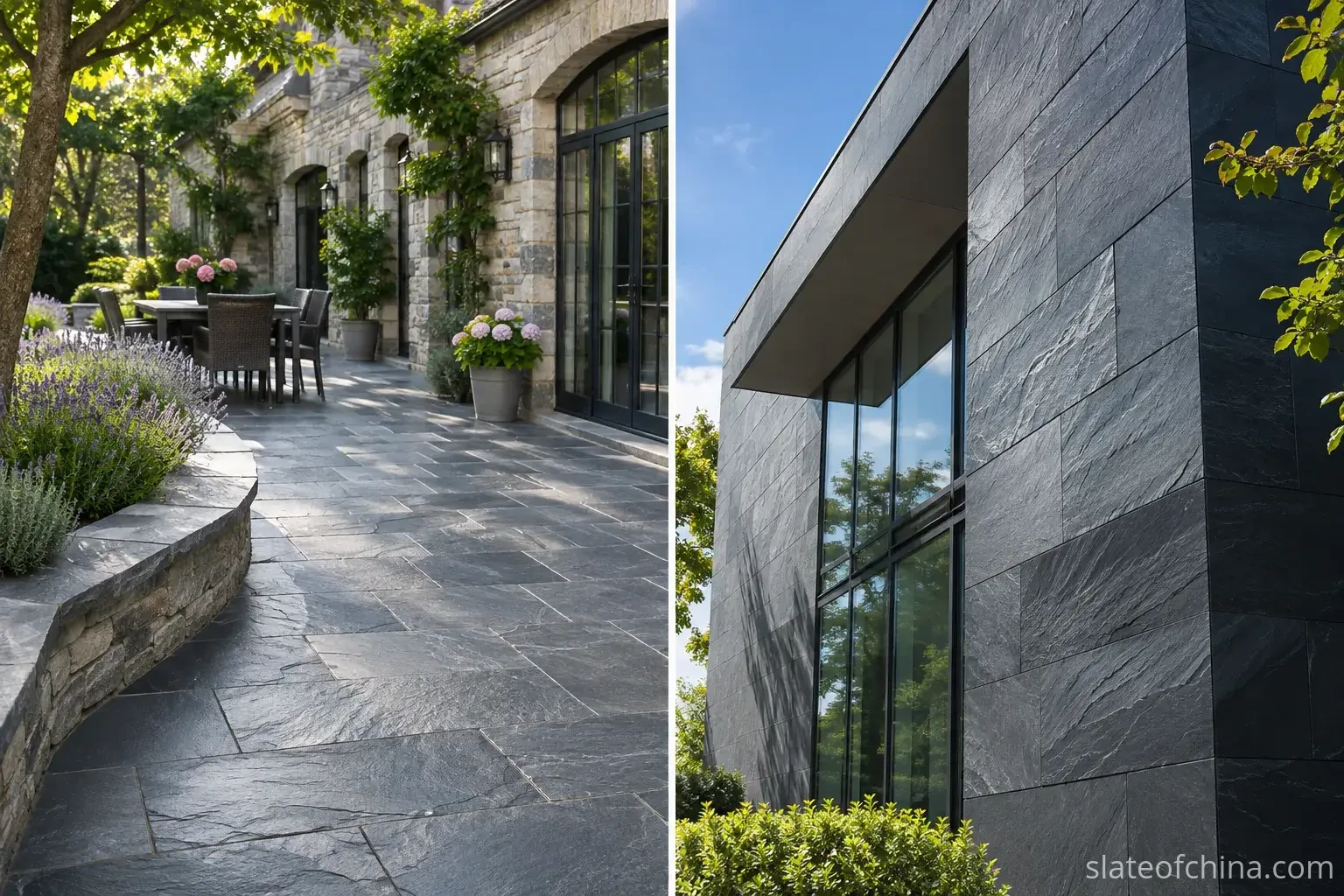
| Standard | Governs | Typical examples | What to verify |
|---|---|---|---|
| EN 1341 | Natural stone slabs for external paving and road finishes | Patios, public squares, pedestrian pathways | Load and breaking behaviour, slip resistance, freeze–thaw durability, dimensions |
| EN 12058 | Natural stone slabs for floors and stairs (incl. applicable external uses) | Interior floors, stair treads, qualifying exterior floors | Mechanical performance, slip, abrasion, dimensional tolerances |
| EN 1469 | Natural stone slabs for wall and ceiling cladding | Architectural facade panels, interior wall slabs | Flexural strength, anchorage and fixing-zone performance, exterior durability |
| ASTM C629/C629M | Slate dimension stone for general building purposes (US markets) | Building slate specified for US-market projects | Water absorption, abrasion, acid resistance, modulus of rupture |
| EN 12326-1 | Slate for discontinuous roofing and external cladding | Roofing slates, overlapping slate facade elements | Roofing-product requirements (roof domain) |
| ASTM C406/C406M | Roofing slate | Natural slate roof shingles | Roofing-slate material requirements (roof domain) |
The first three are European product standards; ASTM C629/C629M is an American material specification. None of them is interchangeable with the others, and none replaces project-specific structural design, installation specifications or local building regulations. Always confirm the applicable edition and national adoption for the destination market.
2. EN 1341: Slate Slabs for External Paving
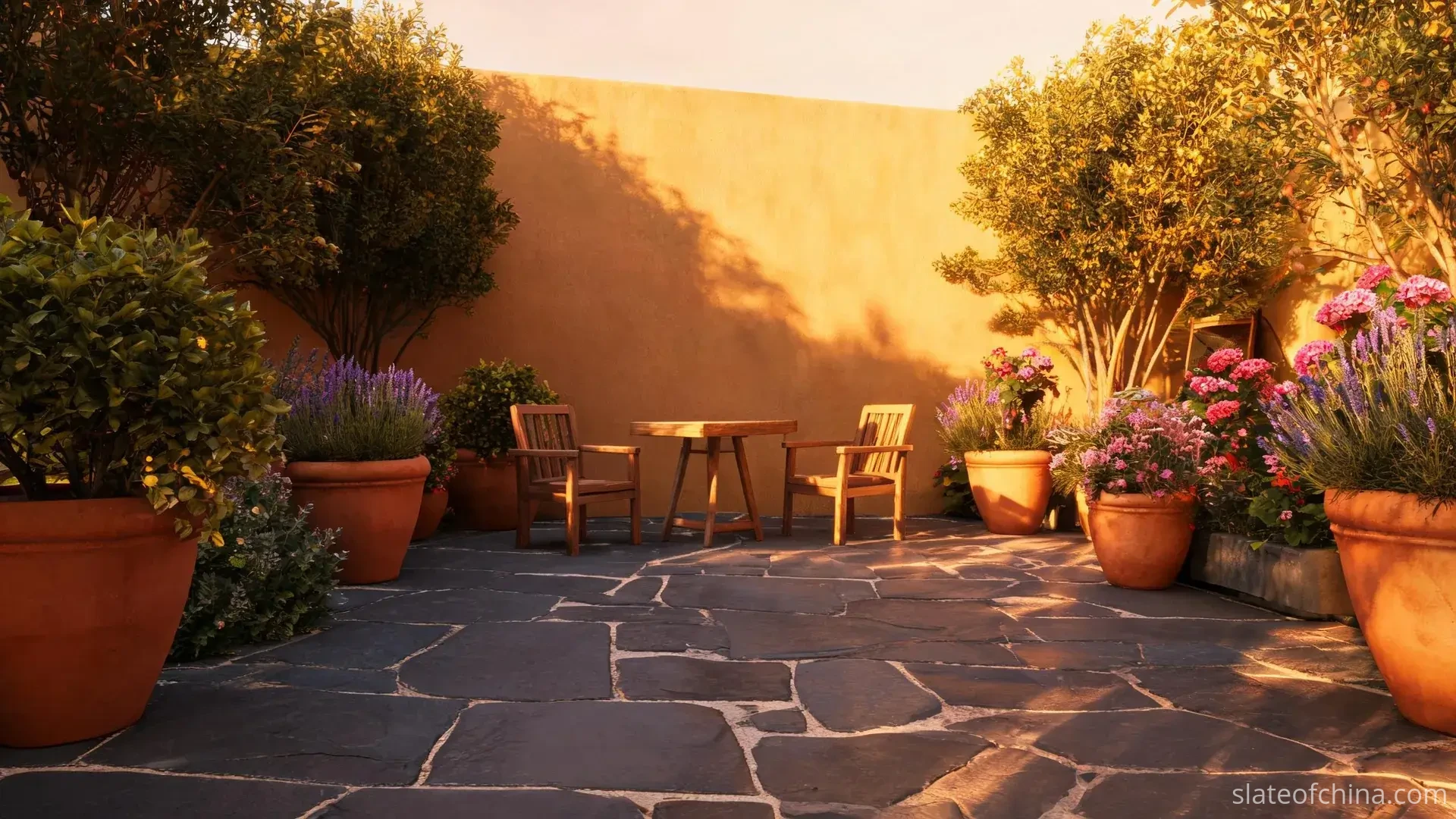
EN 1341:2012 — Slabs of Natural Stone for External Paving: Requirements and Test Methods addresses natural stone slabs used for external paving and road finishes. It is a key reference for qualifying natural stone slabs in external paving, from residential patios to commercial plazas. As with every entry in the table above, the applicable standard should be confirmed against the finished product's classification and intended use.
Outdoor paving lives through temperature swings, moisture, foot traffic and — in many climates — freezing conditions. A useful specification therefore goes beyond colour and appearance, and considers:
- Flexural strength and breaking load. The slab must suit the loads it carries; a good lab figure still needs an adequate thickness, a sound base and proper support.
- Slip and skid resistance. Surface finish changes the result — natural cleft, sawn and honed are not the same on a wet day. A textured look is not proof of slip safety.
- Freeze–thaw durability. Where outdoor paving freezes, cycling resistance matters; water absorption alone does not prove performance in every freezing environment.
- Dimensional accuracy. Length, width, thickness and flatness drive joint consistency and finished quality.
A typical procurement: an importer sourcing dark grey natural slate paving slabs for a European hotel courtyard should request documentation relevant to EN 1341 and to the project's intended use — dimensions, nominal thickness, surface finish, loading and installation method. A supplier's sentence "weather resistant" is not a substitute for relevant evidence.
Important boundary: EN 1341 excludes slabs for floors and stairs inside buildings. Those products sit under EN 12058 — which, depending on product classification, can also cover exterior floors and stairs. For the decision path that precedes a paving order — exposure, load, format, finish — the slate paving buyer's overview walks it end to end.
3. EN 12058: Slate Slabs for Floors and Stairs
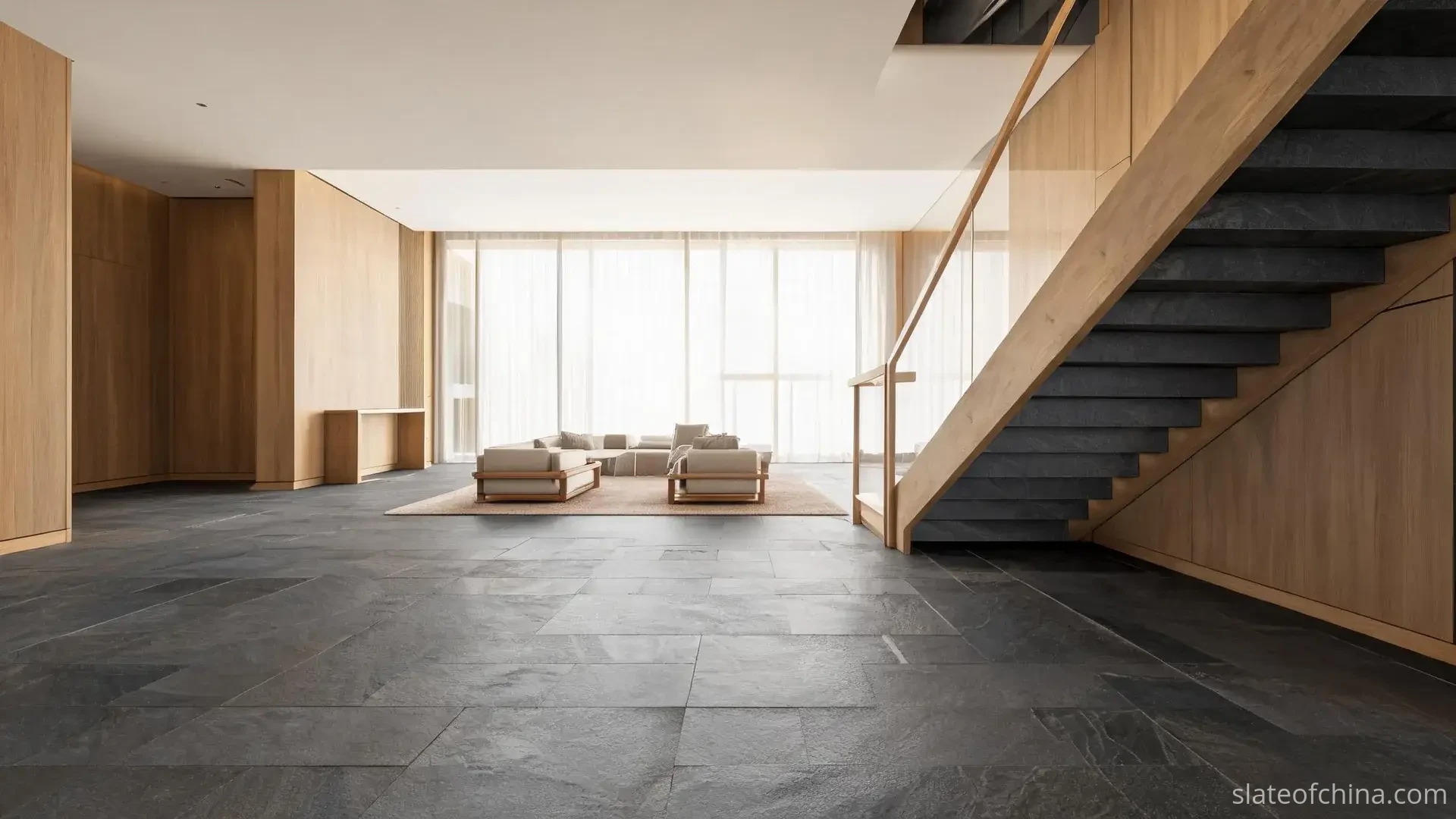
EN 12058:2015 — Natural Stone Products: Slabs for Floors and Stairs: Requirements covers flat natural stone slabs intended for floors and stairs, including qualifying internal and external uses.
The first thing buyers should unlearn: EN 12058 is not an indoor-only standard. It covers floor and stair slabs, and where the product classifies that way, it can apply to exterior floors and stairs too. A building entrance, external staircase or terrace is not automatically "EN 1341 territory" — the deciding factor is the product's intended use and classification, not whether it happens to sit outside.
Floors carry foot traffic, furniture and concentrated loads. Useful checks include:
- Mechanical performance — flexural strength and the support conditions proposed.
- Slip resistance — a dry residential room and a wet commercial entrance face different slip risks; the finish and conditions of use matter.
- Abrasion and wear — busy public areas may need abrasion assessment.
- Dimensional tolerances — consistent thickness and flat edges make a floor read even.
- Durability and moisture — wet areas or exterior floors depend on the complete assembly, not the stone's appearance.
EN 12058 vs EN 1341. The difference is not "indoor versus outdoor". EN 1341 focuses on slabs for external paving and road finishes; EN 12058 covers slabs for floors and stairs, including qualifying external applications. Where the application is ambiguous, the designer or specifier should confirm the applicable standard before testing or purchasing. The full indoor rules — thickness bands, gauged backs, substrate flatness — are collected in the interior slate flooring overview.
4. EN 1469: Natural Slate for Wall and Ceiling Cladding
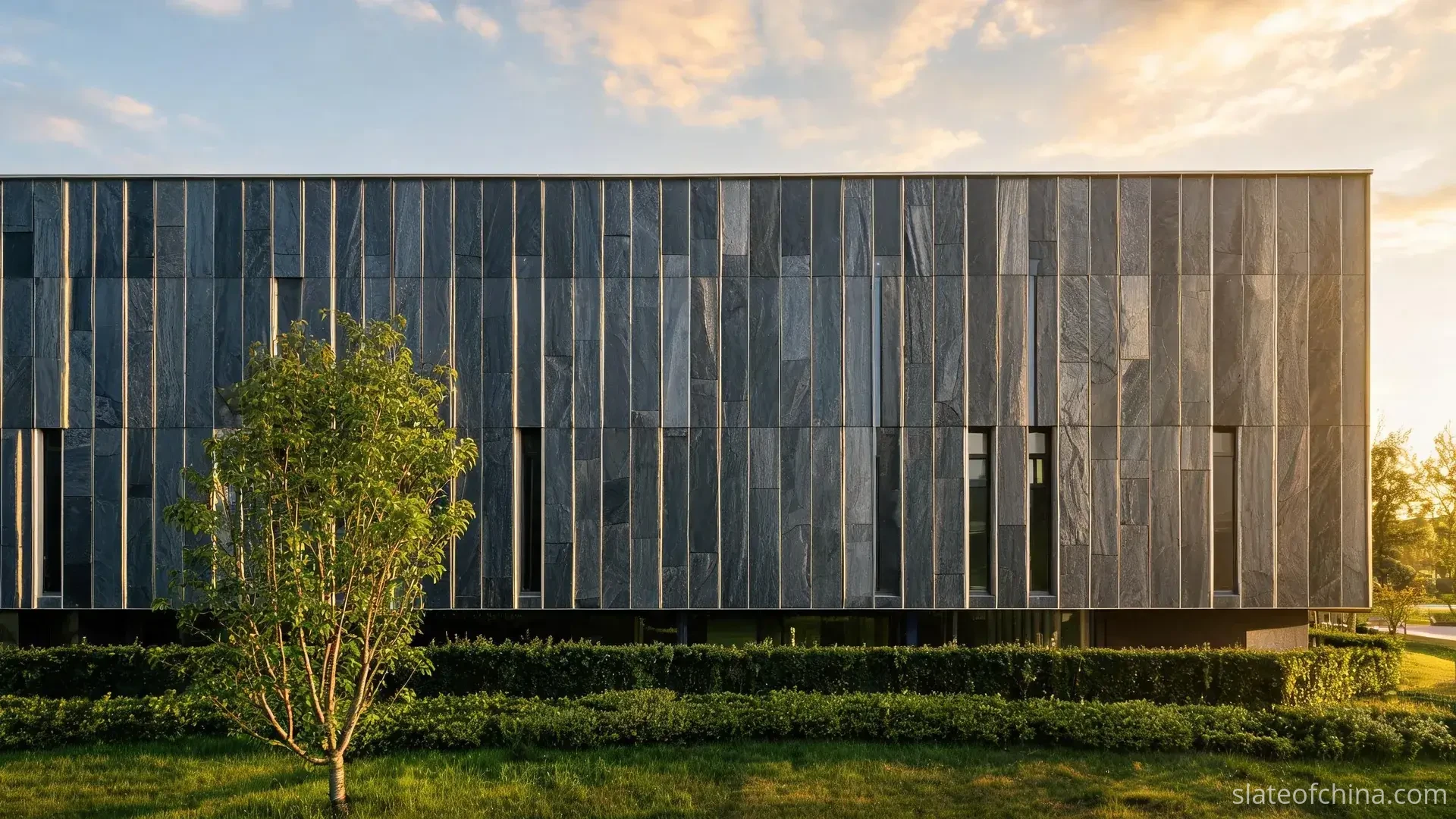
EN 1469:2015 — Natural Stone Products: Slabs for Cladding: Requirements covers natural stone slabs made for internal and external wall and ceiling finishes, including mechanically supported facade panels.
Cladding changes the engineering questions. A conventionally bedded floor slab is generally supported from below, whereas a wall cladding slab may be held at discrete fixing points and face wind pressure, suction and thermal movement. So the specification pays attention to:
- Flexural strength — the stone's bending behaviour under the proposed loading and support.
- Fixing and anchorage performance — anchor-hole geometry, edge distances, panel thickness and the strength of the fixing zone.
- Panel dimensions and thickness — large-format panels need careful geometry, stone characteristics and fixing design.
- Exterior durability — moisture, temperature swing, freeze conditions and pollutants.
A critical boundary of EN 1469: it does not cover roofing slates used as external cladding, nor slate intended for discontinuous roofing and external cladding systems — those may fall under EN 12326-1. EN 1469 also is not an installation design standard, and it does not cover fixing by mortar or adhesives. A test report citing EN 1469 is not approval of a particular anchoring system or facade design; the engineer evaluates the complete cladding system. The slate wall cladding overview maps the panel families each fixing route has to carry.
5. ASTM C629/C629M: Slate Dimension Stone
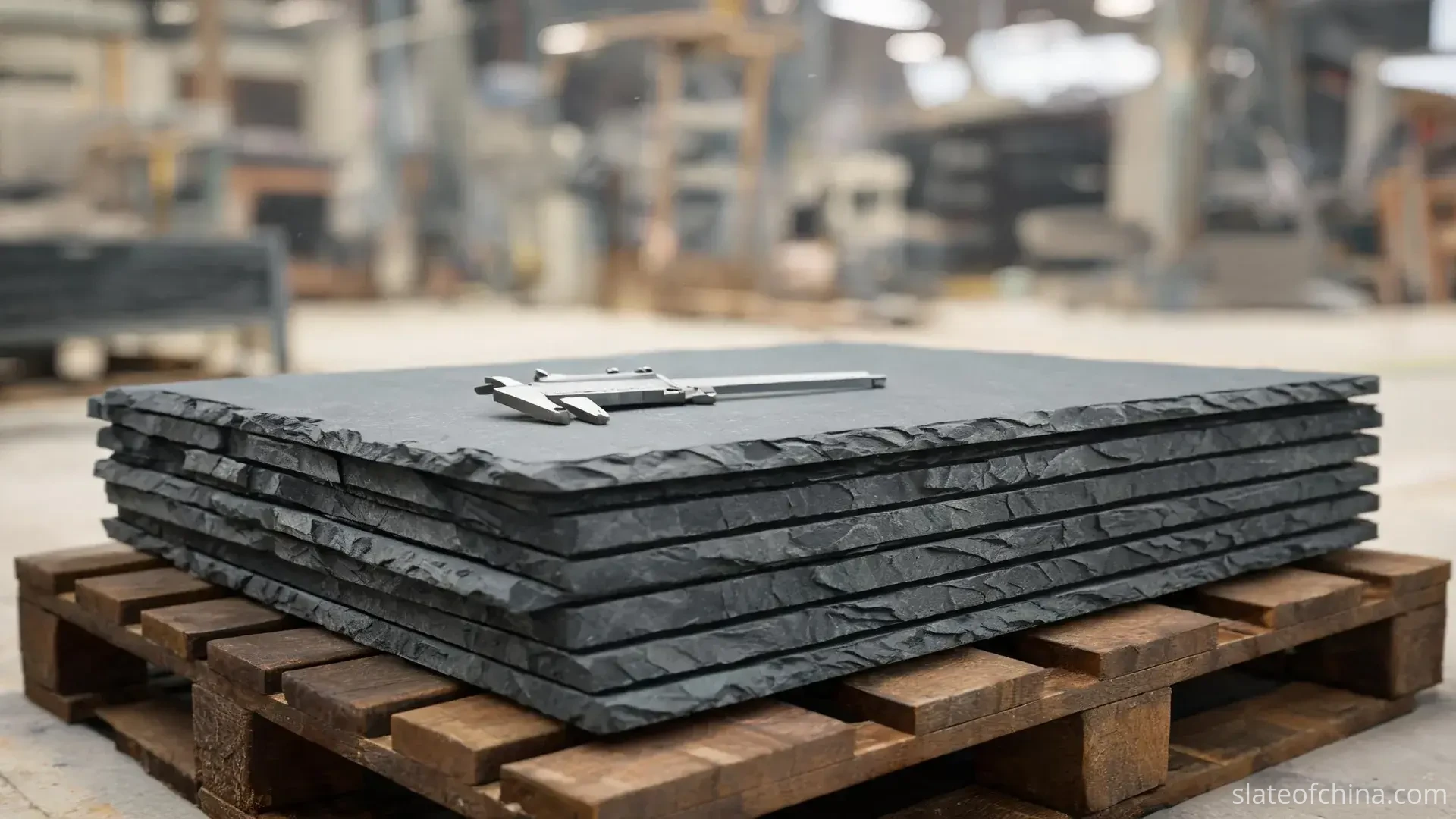
For projects that use ASTM specifications, ASTM C629/C629M-22 — Standard Specification for Slate Dimension Stone is the reference. It addresses the material characteristics, physical requirements and sampling of slate dimension stone intended for general building and structural purposes — slate that has been cut, sawn, split, shaped or otherwise finished into dimension stone.
The specification explicitly excludes roofing slate and industrial slate, and it sets physical requirements around:
- Water absorption
- Abrasion resistance
- Acid resistance
- Modulus of rupture, including along-grain and across-grain performance
A clear caveat: ASTM C629/C629M is a material specification, not a floor design standard, a facade installation specification, or a universal certification. Compliant material does not automatically mean a floor is slip-resistant or an anchored facade is structurally adequate. Additional testing and engineering are often required. For international suppliers, knowing both the European product standards and the ASTM material specification helps prevent documentation mismatches when exporting to different markets.
6. Why a Roofing Slate Test Report Does Not Certify a Floor
This is the heart of the matter. A supplier offers slate flooring and provides a laboratory report issued for roofing slate under EN 12326-1 (or ASTM C406). The report may be genuine and the slate excellent — but the document does not, on its own, establish compliance with the flooring standard.
| Roofing slate | Flooring slate |
|---|---|
| Designed for a roof covering system | Designed for walking and floor-use conditions |
| Exposed to roof weathering | Exposed to pedestrian traffic and surface wear |
| Assessed with roofing product requirements | Assessed with flooring product requirements |
| Fixed as part of a roof assembly | Supported and installed as part of a floor assembly |
| Governed by roofing specifications | Governed by flooring product specifications |
Roofing and flooring standards share some stone properties, but they do not evaluate the same complete set of product requirements. Compliance must be established against the applicable product standard, not inferred from another product's scope of testing.
Can roofing test data still help? Sometimes yes. Existing laboratory data can be useful background on the slate's material characteristics, particularly when the source is the same. But reusing test results requires checking:
- Whether the tested material represents the proposed architectural product.
- Whether the original test method matches the required method.
- Whether the thickness, finish and production characteristics are covered.
- Whether the data satisfy the applicable product standard and project specification.
A roofing report is supporting evidence. It is not an EN 12058 flooring compliance report unless the relevant requirements have actually been established. Ask for the applicable product standard, then the evidence within its scope.
7. What Test Reports Should You Request from a Slate Supplier?

A reliable specification starts with a clear description of the finished product. Before requesting tests, give the supplier the intended use, dimensions, thickness, surface finish, destination market and any project-specific criteria. The table below is a practical guide, not a mandatory list — requirements depend on the applicable standard, exposure class and project.
| Property or evidence | Why it matters |
|---|---|
| Product standard and intended use | Sets the correct assessment framework |
| Flexural strength | Helps assess bending performance |
| Breaking load, where applicable | Relevant to slab performance under load |
| Water absorption | Moisture-related characteristics |
| Freeze–thaw resistance, where relevant | Durability in freezing climates |
| Slip or skid resistance | Important for walking surfaces |
| Abrasion resistance | Relevant to wear-prone flooring |
| Anchorage or fixing-zone performance | Relevant to mechanically fixed cladding |
| Dimensional tolerances | Consistent fabrication and installation |
| Traceable laboratory documentation | Connects reported results to the supplied material |
Six questions to ask before accepting a report:
- Which product standard and edition does the report reference?
- What quarry source, slate type and product description were tested?
- Do the samples represent the supplied thickness and finish?
- Which test methods were used, and what are the actual measured results?
- Is the report traceable to an identifiable laboratory and test date?
- Are additional declarations, assessments or project-specific tests needed?
For slip claims in particular, refer to how slip resistance is measured — a wet figure must carry its method. And for tested material data, the Jiujiang test results page publishes what has actually been measured.
Need to specify natural slate for a project? Send the intended application, finished dimensions, thickness, surface finish, quantity and destination market. We can review suitable product options and identify the technical documentation your procurement team should request — start at the enquiry desk.
8. Three Real-World Specification Scenarios
Scenario A — an outdoor hotel courtyard. A buyer orders natural split slate paving slabs for a European hotel landscape. Starting point: EN 1341 for qualifying external paving, with attention to loading, surface resistance, durability and dimensions.
Scenario B — a commercial lobby floor. A designer specifies natural slate floor slabs for a busy indoor entrance. Starting point: EN 12058 for qualifying floor slabs, with attention to slip, wear, dimensional accuracy and intended loads.
Scenario C — a mechanically fixed facade. A contractor selects rectangular slate cladding panels for an exterior envelope. Starting point: EN 1469 for qualifying cladding, together with project-specific structural and anchorage assessment.
In each case the standard is identified before the purchase order is finalised — the application drives the evidence, not the other way round.
9. Six Common Specification Mistakes
Mistake 1: Treating all natural slate as one product category. Slate is one rock; the standards organise around use. Application decides.
Mistake 2: Assuming one report covers every thickness. A report for one sample configuration does not prove every size and thickness of the same rock.
Mistake 3: Confusing material strength with system performance. Strong stone does not guarantee a safe floor or a secure facade — base, support, fixings and installation still decide.
Mistake 4: Assuming natural split slate is always slip-resistant. Slip performance depends on finish and conditions of use; ask for the tested wet value.
Mistake 5: Treating EN and ASTM as equivalent. They examine related characteristics with different scope, methods and criteria; equivalence should never be presumed without a documented technical assessment.
Mistake 6: Accepting an untraceable report. A credible report names the material, samples, methods, laboratory and results clearly enough to evaluate.
10. Frequently Asked Questions
What is the main standard for natural slate paving slabs in Europe?
EN 1341 is the principal European product standard for qualifying natural stone slabs used in external paving and road finishes. Confirm the exact application and product classification.
Is EN 12058 only for indoor slate flooring?
No. EN 12058 covers natural stone slabs for floors and stairs, including applicable exterior uses. It should not be described as an indoor-only standard.
Does EN 1469 cover all slate wall cladding?
It covers qualifying natural stone cladding slabs but excludes roofing slates used as external cladding and discontinuous roofing and external cladding products; EN 12326-1 may be relevant to those systems.
What is the difference between ASTM C629 and ASTM C406?
ASTM C629/C629M addresses slate dimension stone for general building and structural purposes, while ASTM C406/C406M concerns roofing slate.
Can I use a roofing slate test report for flooring?
A roofing report may contain useful material information, but it does not automatically demonstrate compliance with the flooring standard. Additional assessment or testing may be necessary.
Which standard should I request when importing Chinese architectural slate?
Start with the intended use and destination market. For qualifying European paving, flooring or cladding products, consider the relevant EN product standard; for US slate dimension stone, ASTM C629/C629M may be relevant. The project specification determines the final documentation requirements.
For a closer look at the numbers behind these standards, see the Jiujiang test results page: measured water absorption, flexural strength and freeze–thaw data. Water absorption in particular is the first number to ask for — a later guide in this section covers it in depth.
11. Conclusion: Specify the Application Before the Standard
The right architectural slate standard is decided by what the finished product is meant to do. EN 1341 serves qualifying external paving slabs. EN 12058 serves floor and stair slabs. EN 1469 serves qualifying wall and ceiling cladding. ASTM C629/C629M is a material specification for slate dimension stone in general building applications.
Roofing slate standards sit in a different product category. They cannot automatically certify a floor or conventional cladding, and no supplier should present a roof report as if it did. The practical route for a buyer is simple: identify the application, confirm the applicable standard, specify the relevant performance characteristics, and request traceable evidence — from the supplier.
Technical References
Full titles, editions and scope statements for the standards cited in this guide:
- EN 1341:2012 — Slabs of natural stone for external paving: requirements and test methods.
- EN 12058:2015 — Natural stone products: slabs for floors and stairs: requirements.
- EN 1469:2015 — Natural stone products: slabs for cladding: requirements.
- EN 12326-1:2014 — Slate and stone for discontinuous roofing and external cladding: product specification (roof domain).
- ASTM C629/C629M-22 — Standard specification for slate dimension stone; the current edition is available from the ASTM catalogue.
- ASTM C406/C406M — Standard specification for roofing slate (roof domain).
EN texts are distributed by CEN's national members such as BSI and DIN rather than a single open catalogue entry, so the EN standards are cited by title and edition here. Editions and national adoptions should always be confirmed for the destination market; this guide is a procurement and product-selection reference and does not replace the full published standards or project engineering.
Unsure which standard your project needs?
Tell us the application — paving, flooring or cladding — with the finished dimensions, thickness, surface finish, quantity and destination port. We will recommend the suitable product and the technical documentation your procurement review should ask for.