
Why Jiujiang Slate Is Ideal for Crafts: Fine Grain, Natural Cleft Surfaces and Consistent Thickness
A craft enquiry rarely arrives as a specification. It arrives as a photograph — a page from a gift catalogue, a competitor's gift set shot at a trade fair, a saved image of four coasters in a kraft box — and the question underneath is almost always the same one: can this, or something like it, be made in stone?
The honest answer starts with the material, not the design. Coasters, placemats and serving boards, engraved gifts, house plaques and personalised pieces can all be cut from slate — but small slate products require careful control of surface appearance, thickness and edge quality, because these details are easily noticed when individual pieces are compared side by side. The piece is still picked up, turned under a lamp, and photographed for a product page with the whole surface in frame. What carries those products is the selection of the stone, and in the Jiujiang slate crafts trade three properties do most of the work: fine grain, a natural cleft or honed finish, and consistent thickness. This page is about those three — what each one actually does for a small product, and how any buyer can check all of them on a sample before a wholesale or OEM order is placed.
One boundary belongs in the first hundred words. "Jiujiang slate" names a producing region, not a single uniform material: many beds, several grades, and a range of workshops sit behind the name, and the properties that matter to a craft range belong to the batch you can see and measure, not to the region it came from. What follows is therefore a guide to checking a material, not to trusting a name. It sits inside the wider Jiujiang Slate Guide, alongside the product-specific pages it points to — and, when the material question is settled, the buying and export pages that take over from there.
Quick answer: Jiujiang slate suits craft products when three properties can be verified in a physical sample of the actual batch.
- Fine grain — a near-uniform mineral surface that reads quiet and premium at reading distance and holds lettering and logos cleanly.
- Natural cleft or honed finish — genuine stone character where the design wants it, machined uniformity where the product needs it; the finish is chosen on the order, not by the word "natural".
- Consistent thickness — a written nominal and tolerance, so a set stacks as one product and a production run reads as one brand.
What the photograph cannot tell you, the sample can.
What Does Fine Grain Actually Give a Small Product?
Grain, in slate, is the size of the mineral particles the rock is made of. A fine-grained slate reads as one continuous field: a smooth, quiet ground colour with no visible crystals, no flecks catching the light, no coarse patches interrupting the surface. On a roof or a terrace this is a matter of taste. At the span of a hand from the eye — the distance at which a coaster or small plaque is actually used, judged, and photographed — it is the difference between a piece that presents as a designed product and one that presents as a building material cut small.
The practical consequences run in three directions. First, a fine-grained, visually consistent face can provide a cleaner background for logos, lettering and decorative designs — the ground does not compete with the mark. How cleanly it finally reads still depends on the surface finish, the marking method and the stone selected for production, which is why grain quality matters before the first design question is asked, not after. Second, a near-uniform surface behaves under retail lighting: it photographs the same from angle after angle, which is exactly what a gift set's product page needs — six pieces that look like one design rather than six stones that happen to share a box. Third, in the hand, fine grain is part of why a small piece reads as deliberate. A coarse, flashy mineral texture wants to be large; at coaster scale it reads as clutter, and a sparkle in the wrong place reads as a flaw.
What fine grain does not promise deserves the same clarity. It is not smoothness — smoothness is a finish, produced by grinding or honing, and a fine-grained stone can wear a textured cleft face (the two ideas are separated in the next section). It is not colour uniformity, which is a matter of batch selection rather than grain. And it is not a property of every block from the region: beds vary, and stone selected for paving does not always leave the shed alongside stone selected for giftware. The geological background — why one bed runs finer than its neighbour — has a page of its own; what it means for buying is simpler. Grain is checked on the sample of the batch being bought, with the finish the product will actually carry.
The answer sits in the piece in your hand, not in the photograph.
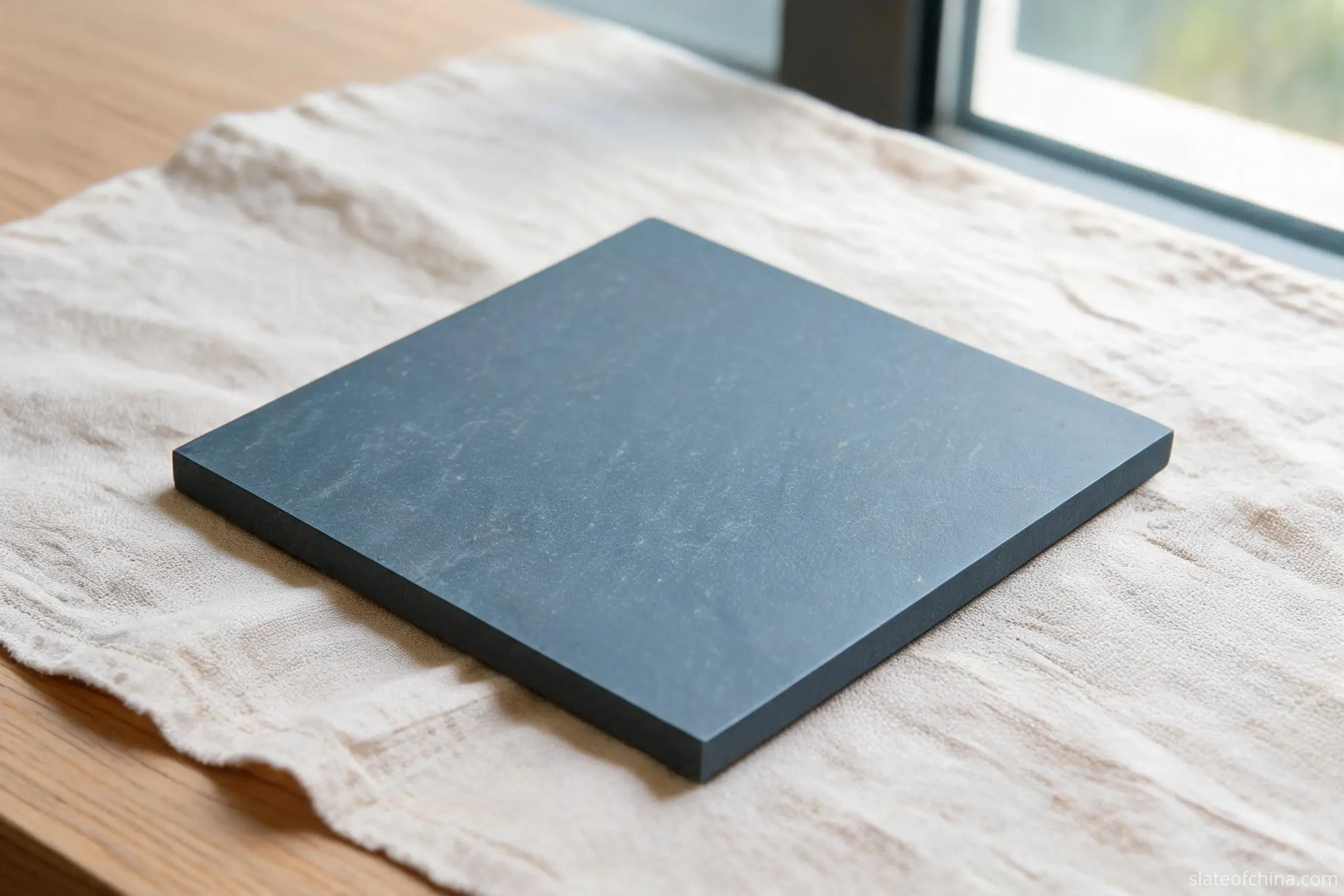
What Does a Natural Cleft Face Do That a Machined Finish Cannot?
Slate is split, not sculpted. When a block is parted along a bedding plane, the face it opens keeps a record of the layers that formed it — subtle ridges, a stepped micro-relief, the faint signature of the split itself. That is what a natural cleft face carries into a product: texture that has no repeatable master, because every piece opens along its own plane. Moulded and printed imitations can copy the colour of stone; the layered relief of a cleft face is what they cannot hold, and it is what a customer's thumb registers as "real" before anything conscious happens.
For craft ranges this cuts both ways. A rustic positioning leans on the cleft face — natural-edge gifts, heritage-style pieces, table ranges sold on authenticity — and for those products the variation is the product. But a cleft face is not a precision surface. Its thickness varies across the piece, its relief has real height, and marking methods have opinions about both: a fine logo engraved across a ridge loses definition where the ridge breaks the line, and printing prefers a prepared face. None of this is an argument against cleft; it is an argument for being specific.
The useful habit is naming the finish on the order. "Natural slate" describes the material; it does not choose a surface, and a quotation built on the word alone can deliver either the cleft face that made the sample attractive or a ground face the buyer never asked for. How blocks are split and processed on the spot is covered in the quarries and processing guide; the selection logic is compact enough to set out here.
| Finish or edge | What the piece gets | Typical craft use |
|---|---|---|
| Natural cleft face | The stone's own layered relief; piece-to-piece variation | Rustic coasters, natural-edge gifts, heritage-style ranges |
| Calibrated face (ground both sides) | Controlled thickness and repeatable geometry — a processing step the order asks for, not a default of cutting | Stacked sets, boxed sets, insert packaging |
| Honed face | A subdued, smooth matte surface | Contemporary tabletop ranges, fine engraved work |
| Natural edge | An unrepeatable organic silhouette | One-off pieces, gift positioning, rustic sets |
| Machine-cut edge (sawn, chamfered) | Repeated geometry; sets read as engineered | Retail sets, brand ranges, ODM work |
A cleft face and a machined edge can share one piece — the pairing is common, and it says something specific: the stone speaks on the face, the workshop speaks on the edge. What the buyer chooses is which of the two gets to talk loudest.
The answer sits in the finish you write on the order.
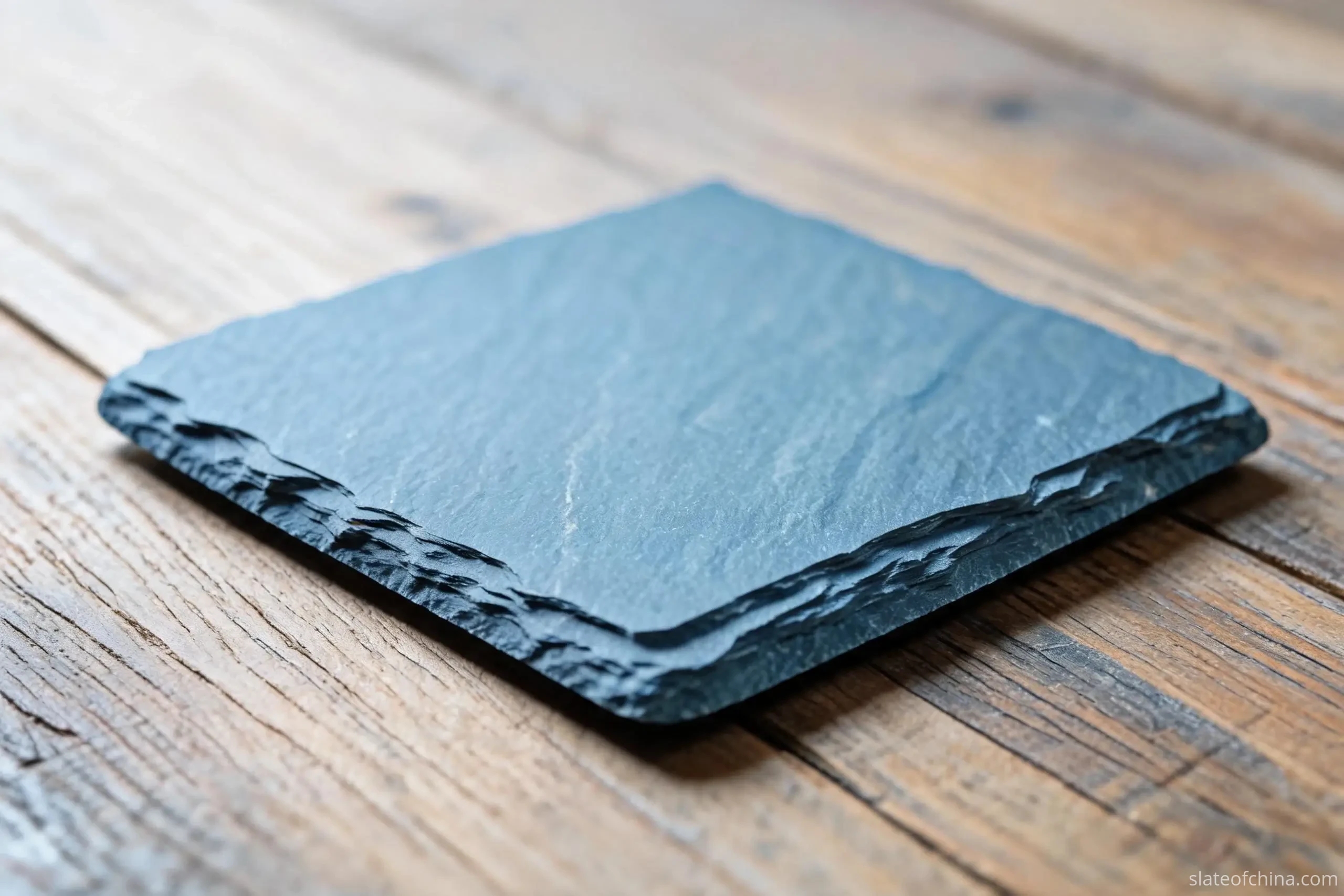
Why Does Thickness Consistency Decide Whether a Range Scales?
Almost no craft product is sold as a single piece. Coaster ranges sell in sets; placemats sell by the table; gift collections assemble several products under one retail name. The moment a product is sold in multiples, thickness stops being a private property of each piece and becomes a visible relationship between pieces — on the stack, in the box insert, and side by side across a table. That relationship is what buyers are actually seeing when a set strikes them as well made, and it is manufactured, not quarried.
This is where thickness consistency earns its place on the shortlist of properties that decide whether a range can scale. Uneven thickness shows up in the places a set lives: an insert cut for one thickness that holds some pieces loose and others tight; a stack that leans because each piece carries a different step; placemats that sit at slightly different heights along a laid table. In production the same variation costs yield — pieces sorted out at the bench, reworked, or packed into a carton whose weight and fill stop being predictable. None of it is visible in a photograph of one piece, where an inconsistent range looks exactly like a consistent one.
Consistency is therefore a purchased property, and it is purchased twice. Once in the stone: calibrated material — ground on both faces to a nominal thickness — is what a boxed set or a stacking range is built on, while natural cleft pieces keep more variation by intention. And once on paper: a nominal thickness with an agreed tolerance, a named measurement method (which instrument, at which points on the piece), and a plain statement of whether the tolerance applies before or after the finish. "Uniform thickness" without an agreed standard is a sentence, not a specification; with one, it becomes something an inspector can hold a run to — and that difference is the difference between a craft range that scales and one that merely gets bigger.
Thickness is also where weight and robustness trade against each other, per product rather than in general. A thicker piece reads as substantial and survives handling; it also ships heavier, and at gift-set quantities the difference arrives on the freight invoice. A thinner piece cuts weight and cost, and then has to survive the same journey with less stone. The right answer belongs to the product design — the coaster formats, with their sets, stacks and box fill, are worked through piece by piece in the coasters guide — not to a habit of always ordering the thickest available cut.
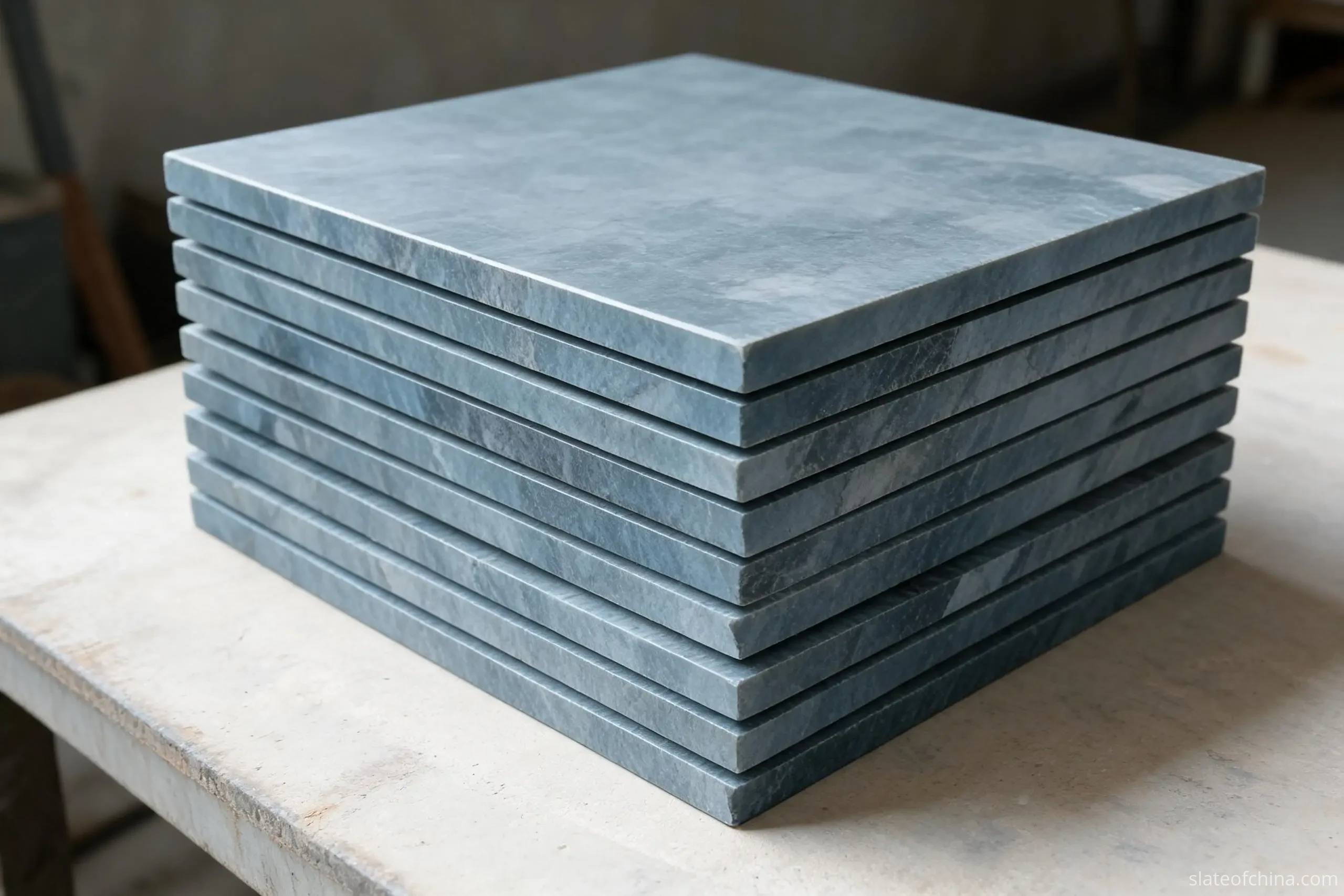
Which Craft Families Sit Naturally on This Stone?
The families that make up the Jiujiang slate crafts catalogue do not ask the stone the same questions, and a buyer choosing between them is choosing which property carries the product. Read from the product's side of that choice, the decision compresses into one reference table:
| Product need | Finish or material to prioritise | What to confirm before ordering |
|---|---|---|
| Rustic coasters and natural-edge gifts | Natural cleft face | Surface relief, thickness variation, edge character |
| Stacking sets, boxed sets and mat ranges | Calibrated or ground face | Thickness tolerance, flatness, how the pieces fit the box |
| Fine lettering and detailed logos | A honed or calibrated face suited to marking | A marked sample on the actual batch stone, thin-line behaviour |
| coloured artwork and branded graphics | A surface prepared for the printing process | Ink adhesion, abrasion resistance, cleaning method |
| Outdoor signs, plaques and nameplates | Stone, finish and fixing suited to outdoor conditions | Climate and exposure, fixing method, coatings and mark durability |
| Coordinated collections across several products | One agreed finish, one production lot | An approved sample with the variation range written around it |
Each family has a page of its own. The coaster formats — sets, stack behaviour, backings and gift packaging — are covered in Slate Coasters from Jiujiang; the table range, including the questions a tabletop product must answer, in Slate Placemats & Tableware Accessories; the marking itself in Engraved & Custom-Printed Slate Products; and the sign family — where reading distance, fixing and weather exposure change the brief — in Slate Signs & House Number Plates.
Two boundaries follow these families around, and this guide keeps them honest rather than convenient. Food contact is a property of a finished product — its finish, any coating, the destination market's requirements — not of the mineral, and it is established for the finished article rather than inherited from the rock. Outdoor exposure is a conditions question: the stone, the fixing, the orientation and the climate decide it together, which is why the sign family treats weather on its own page. Ranges already built on this material are collected in the slate crafts and living category, and that collection is the real opportunity this page points at: one agreed material, coordinated dimensions, a finish specification that repeats — a range that grows order by order and still looks like one family on the shelf.
Developing a custom slate craft product? Share your reference image, dimensions, preferred surface finish and estimated quantity — we can help identify the material and processing requirements to confirm before sampling.
How Do the Three Properties Behave Under Marking?
Most craft ranges carry a mark — a logo, a name, a line of lettering, a small engraving — and marking is where fine grain pays its second dividend. An even mineral field lets a thin line hold its width from end to end; lettering stays crisp because nothing in the surface interrupts the strokes. On a coarse or strongly figured face the same artwork fights its background, and fine letterforms lose first. The marking techniques themselves — laser engraving, screen and UV printing, and how each is specified — have a dedicated page; what belongs here is the material side of the decision: the finish and the marking method are chosen together, not in sequence.
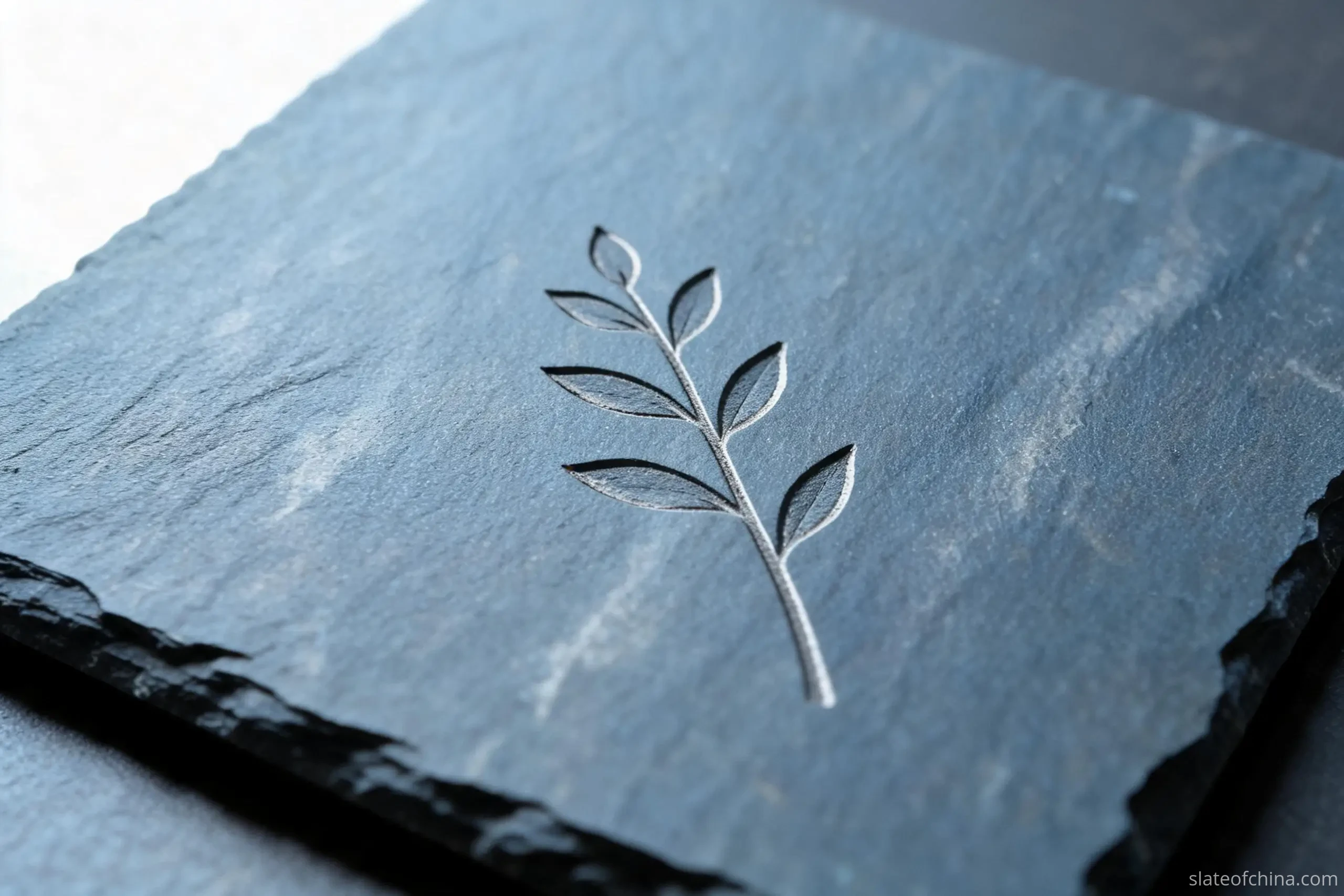
The joint choices are few and practical. A fine logo on a cleft face risks the ridge problem — the split's relief breaking a thin line where it crosses a step — so cleft work tends toward bolder artwork, while fine detail prefers a honed or calibrated face. Engraving on this blue-grey stone reveals a paler line against the darker face; the exact tone is a joint product of the stone's mineral makeup and the machine settings, which is why the approval object is a marked sample of the actual batch, never a mock-up on screen. Printing adds its own compatibility question — surface preparation, ink system, and how the mark will be used and cleaned — and those are settled with test pieces, not assumptions.
That last sentence is the whole marking chapter in one rule. A supplier's marking samples may be beautiful and still be irrelevant if they were made on different stone from the run being quoted; the mark, the stone and the finish have to be approved as one object. Buyers who skip this discover the difference at unboxing, in front of a retail buyer, at the moment the range is supposed to look like one product.
Is fine-grained slate the same thing as smooth slate?
No — they describe different layers of the material. Grain is the mineral scale of the stone: how fine the particles are. Smoothness is a finish, produced by grinding or honing. A fine-grained slate can carry a textured cleft face, and a coarser stone can be honed smooth. What grain adds is visual evenness; what a finish adds is geometry. Craft products often need both, and they are specified separately and deliberately.
Can One Production Batch Really Look Like One Product?
Natural stone does not do clones, and an honest guide says so early. Colour shifts a band either way between beds; mineral lines and grain drift vary piece to piece within a bed; two blocks that left the same quarry in the same week can read as two stones. If a brand's brief is absolute uniformity, the material is already answering no — and hearing that early is cheaper than discovering it at the destination.
What a craft range does instead is control a range. The working instruments are unglamorous: one production lot held for one order, so the pieces share a source; sorting at the bench, so pieces that fall outside the agreed band do not reach the box; an approved sample with the acceptable variation written around it — what the retail trade signs off as this collection's look. Photographs at defined stages and an inspection before packing are reasonable to request for any first order, and they are how the written range gets enforced rather than merely stated. None of this is exotic; it is ordinary workshop discipline, and a supplier who describes it plainly is describing a system.
The variation itself is not a defect to be hidden, either. It is the visible difference between stone and a printed surface — the thing customers are paying a natural material to be. A brand that writes the range controls it, keeps the authenticity and can repeat the look order after order; a brand that asks for perfection simply meets the range later, in the shop, in front of a customer. The region's material character — what its stone genuinely is, and is not — is set out in what makes this slate different, and that background is worth one read before any collection is specified.
What Should a Buyer Do With a Sample?
Everything above collapses into one short routine on a physical sample — fifteen unhurried minutes, three passes, no special equipment. The three passes map one-to-one onto the three questions this page is built around.
The reading pass. Daylight, low-angled across the face, at the distance the product will actually be used. Read the grain from corner to corner: an even field, or a coarse patch waiting for a photographer to find it. Look for the band where a sawn edge meets the cleft face, and for any colour drift between the sample and the batch photographs. This pass catches what a fine-grain claim is made of — and what it was made on.
The hand pass. Close the eyes and move a fingertip slowly across the face; the cleft speaks here — ridges, steps, the character the design either wants or does not. Then the thumb around the edge: chips, rough sawn spots, the standard of chamfering where the order asks for it. Stack three or four pieces if the product is sold stacked. None of this requires expertise; it requires exactly the attention the end customer will give the piece in a shop.
The measure pass. A caliper, several pieces from the same run, the same points on each piece — and the reading that matters is the spread, not any single number. Then the spread against what was written: the nominal, the tolerance, the measurement method. This is where thickness consistency stops being a promise and becomes a measurement. For marked ranges, add one pass more: the actual mark, on the actual stone, in the finish that will ship.
The sample itself has a life cycle, and it is short if handled well: the sample approval page covers how a sample becomes the standard a production run is inspected against — and how to keep it from being a sales gesture instead. For everything that is not material — the workshop's claims, its records, its photographs — the supplier verification guide covers the checks in the same spirit.
How many pieces should I measure for thickness consistency?
A reasoned sample, not a fixed number: with the same instrument, at the same points on each piece, measure enough pieces — from the middle of the run and its edges — to see a spread. Consistency is a property of the batch, not of any single piece, so one measurement flatters the stone while a sample of the run describes the carton. For larger orders, agree a written sampling plan and acceptance criteria before production or pre-shipment inspection; the number of pieces measured should reflect the batch size, the order requirements and the inspection method. That written basis is also what allows the same check to be repeated later — by either side — without an argument about method.
Where Do Craft Pieces Actually Come From?
Craft formats in this region are not quarried small. Pieces are cut to plan from larger slabs and blocks, moving through the same working landscape as the big formats — the splitting sheds, saws and finishing benches described in how Jiujiang slate is made — and then either finished on a dedicated small-format line or alongside larger work, depending on the supplier. For a buyer, that origin story is not trivia. It is why a region known for roofing and billiard stone can serve a coaster programme at all: the machines, the benches and the calibre of workmanship already exist at small-format precision.
Two sourcing logics sit behind that statement, and they behave differently. Pieces cut to plan from selected stock give the selection control that a boxed set needs — one source, one band, sorted to one standard. Pieces cut from offcuts inherit whatever variety the offcuts carry, and while that is exactly wrong for a uniform retail set, it is a genuinely sensible route into rustic and natural-edge ranges where character is the selling point. Neither logic is wrong; a buyer simply needs to know which one a supplier is proposing, because it decides how much selection control has to be written into the specification.
Which returns this page to its boundary. A region narrows the search — it tells you the material, the machines and the workshops exist. A sample and a written specification settle the choice, because they describe the batch the order would actually be cut from. And once the material question is closed, the order-side questions — minimums, price tiers, cartons, and the calendar a gift season actually runs on — belong to the wholesale crafts guide, which takes the baton from here.
When the Answer Is Yes — and When It Is Not
The answer is yes for product lines that can say yes to three sentences: the sample's grain reads quiet at reading distance, the finish on the order is the finish the design needs — cleft for character, machined for precision — and the thickness is written down with a nominal, a tolerance and a method. Those three sentences cost one sample cycle to obtain, and they are the difference between a range that survives its second order and one that quietly ends after the first.
The honest no is shorter: absolute uniformity piece to piece, food-contact performance assumed from the mineral, durability numbers without a test basis, one grade of stone expected to do every job in the catalogue. None of those are failures of this material — they are requests natural stone declines by nature, and a supplier who quietly accepts them is storing up a dispute.
The photograph that opened this enquiry showed a finished product, not a material. It hid every decision this page has walked through — the selection, the finish, the tolerance, the range — because a photograph of a beautiful piece is always the output of those decisions, never the evidence of them. That is the working method this page leaves behind: the photograph starts the enquiry; the sample, the finish on the order and the written range close it. For buyers of Jiujiang slate crafts, three properties carry the work — fine grain, natural cleft and consistent thickness — and all three can be checked by hand, in fifteen minutes, before the first carton is ever sealed.
Frequently Asked Questions
The questions below are the ones material-focused buyers ask once the design exists — about grain, finish, batches and verification. Each answer gives the working rule first; the sections above carry the full treatments.
Is Jiujiang slate good for small craft products?
For most small formats in the gift and tabletop trade — yes, when the batch is selected for the work. The trade in Jiujiang slate crafts runs on three checkable properties: fine grain, a natural cleft or honed finish, and consistent thickness, and all three are visible on a physical sample. What "good" means in detail depends on the product family, and the family pages linked above take each one piece by piece.
Does fine grain make the stone more expensive?
Not by itself — price follows grade, selection and processing. A batch selected for even grain usually costs more than mixed stock, because sorting and selection are real work; but the buyer is paying for the selection and the processing control, not for the word "fine". Ask what the selection actually removed from the run, and where a price difference exists, it explains itself.
Can craft pieces be cut from offcuts of larger slate production?
Sometimes, and for rustic ranges it is a sensible use of material — but offcuts inherit the variety of the stock they came from, which is exactly what a boxed set struggles with. Pieces cut to plan from selected slabs give the selection control a set needs. Both routes exist in the region; the productive question for a buyer is which one the supplier is proposing, and the answer belongs in the written specification.
Can a gift collection keep the same grain and colour across different products?
Across an agreed range around an approved sample, yes; as an absolute across an entire catalogue, no. Bed-to-bed and piece-to-piece variation are facts of natural stone. A collection keeps its appearance by buying one production lot, agreeing a written range of variation, and repeating against the approved sample. That is a specification discipline, not a quarry constant.
Isn't slate too heavy or too brittle for small products?
In the small formats this page discusses, piece weight stays manageable — the per-piece arithmetic for a square coaster is worked through in the coasters guide. Brittleness is managed rather than suffered: thickness chosen for the format, edges finished where chipping matters, and packing designed for small pieces with each unit separated and cushioned. Most small-format breakage happens on the journey rather than in use, which makes the packing specification part of the material decision.
How do I verify a supplier's fine-grain claim?
In the sample, not in the brochure. Ask for pieces from the production lot your order would come from, photographed unedited in daylight, then run the reading pass from this page's sample check on the physical piece. For a marked range, add the marked sample on the actual stone. Claims live in marketing; verification lives in a physical piece and a written specification — and the supplier verification guide covers the full set of checks in the same spirit.
Related Reading
Developing a slate craft range on this stone? The fastest route to a quotation that means something is a specification that names the three properties — so before anything else, this is what helps:
- A reference image or drawing — the photograph that started the enquiry, or better, the product it should become
- Dimensions, thickness and finish — with the finish named from the table above, not assumed
- The marking plan — what goes on the piece and roughly how permanent it should read
- Quantity and destination — even as a range, it frames the sample and the quotation
Not every enquiry arrives finished — a reference photo and a rough quantity are a workable start, and we can help identify which of the three properties needs to be confirmed before a sample is cut and a quotation is prepared.