
Wholesale Slate Crafts from China: MOQ, Pricing, Packaging and Lead Times
Two importers can order what is, piece for piece, the same blank slate coaster from the same workshop — and receive unit prices that look like a disagreement. It usually is not one. The first buyer ordered catalogue blanks in bulk inner cartons at routine volume. The second ordered the same blank inside a printed retail gift box, as a four-piece set, in trial quantity. Same stone, same workshop; different orders. Almost everything a wholesale buyer wants to pin down — the minimum, the unit price, the carton, the calendar — is an answer to a question about quantity and configuration, and it is worth asking the question before the price.
This page is about that layer. It is written for importers, gift wholesalers, promotional-product distributors, retailers and private-label brands researching wholesale slate crafts from China — coasters, placemats and serving boards, custom engraved slate products, signs and plaques, and the gift sets assembled from them. What each of those items is — the edge it should survive, the table heat it must tolerate, the mark it carries — belongs to the product-by-product guides linked from the first section. What this page covers is the layer above them: what quantity does to a price, why the carton deserves engineering attention, and how a delivery calendar is actually assembled.
The short version: a wholesale order runs on three minimums, three price levels and three clocks, and the practice of buying well consists largely of refusing to collapse any of them into a single number. The sections below take the four subjects in the order they hit an order sheet — minimums, prices, cartons, calendars — followed by the two questions that decide whether an order repeats, and the private-label layer that sits over all of them. The page sits inside the wider Jiujiang Slate Guide, alongside the buying-and-exporting pages that go further into sourcing routes and shipping mechanics.
Quick answer: Ask for three minimums, not one — the product, the customisation and the packaging can each carry a different minimum, and the packaging line is often the one that binds. Request the same configuration quoted at trial, routine and volume levels, and compare quotations like-for-like all the way to landed cost per saleable unit. Choose packaging per carton purpose — bulk transport or retail-ready box — and build the schedule backwards from the date the goods must be on a shelf, remembering that production time is only the middle part of the timeline.
Before any quotation is requested, five points make an enquiry ready to be answered — and compared:
- Product specification — dimensions, thickness, finish and design, written as one specification
- Three minimums — product, customisation and retail packaging, each requested as its own number
- Price comparison — identical specifications, quantities and Incoterms, compared as landed cost per saleable unit
- Export packaging — carton quantity, gross weight and breakage protection, chosen for bulk transport or for the shelf
- Delivery schedule — sample approval, production, dispatch and transit, planned backwards from the shelf date
The exact MOQ, price and lead time are confirmed per configuration; these five points are what make the numbers comparable at all.
What a Wholesale Slate Crafts Order Can Contain
The catalogue of wholesale slate crafts from China is wider than most single suppliers show, but it does not all scale the same way, and knowing which family an item belongs to predicts how it will behave as a wholesale order. At the bulk end sit the standard blank products — square, round and rectangular coasters, placemats, cheese and serving boards — cut to existing dimensions from existing drawings: the territory covered piece by piece in Slate Coasters from Jiujiang and Slate Placemats & Tableware Accessories. These are the products that leave the workshop as wholesale slate coasters and bulk table ranges with the least ceremony: one drawing, one specification, one repeatable run.
Next to them sit the marked products — logo coasters, personalised gifts and wholesale slate signs — where every additional design, name or piece of artwork multiplies the set-up and inspection work. The marking methods behind them have a guide of their own, and the sign family a page of its own; what matters at the wholesale layer is simpler: a run of one design is one order, a run of forty designs is forty orders on one pallet, and it is quoted as such.
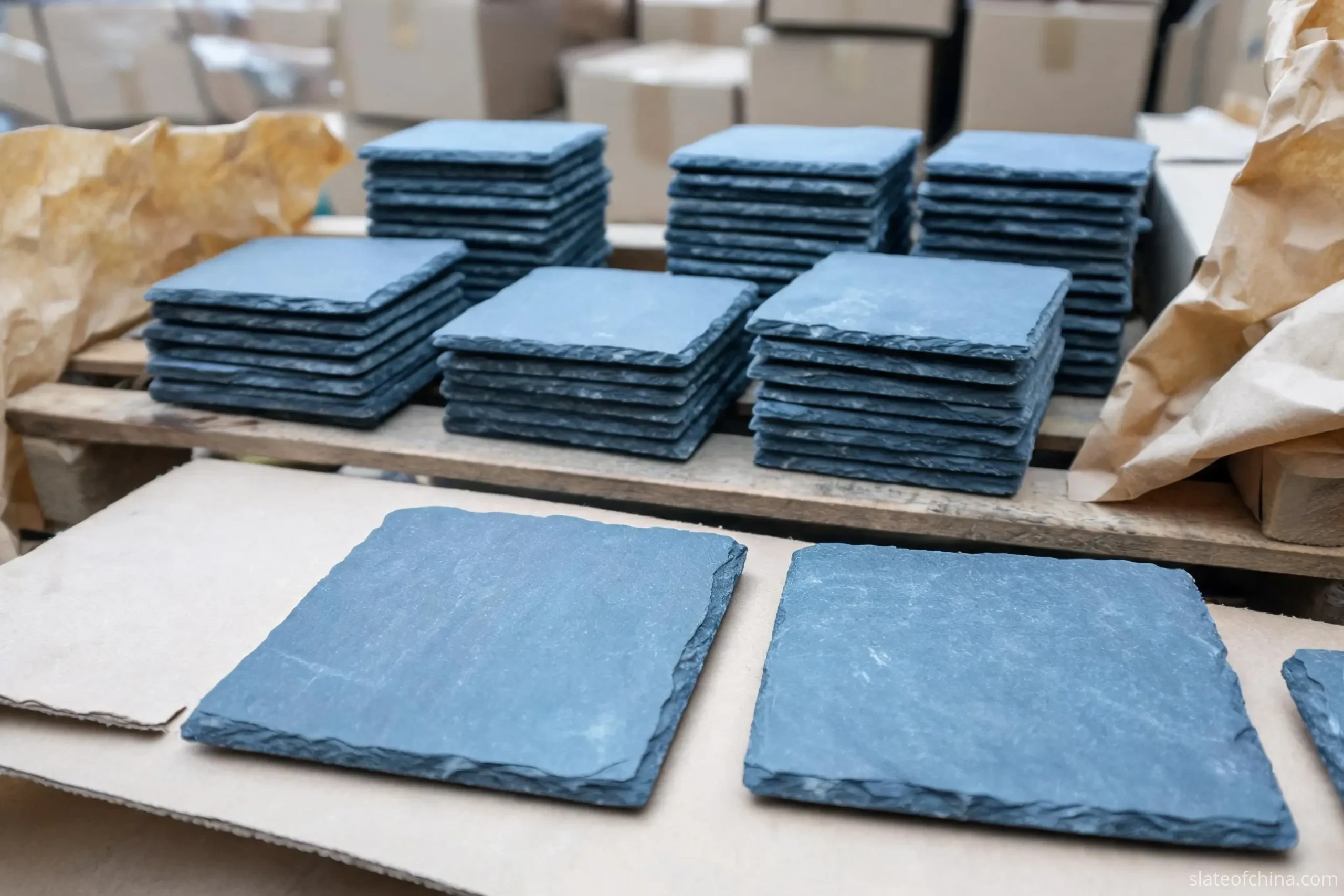
The third family is the assembled set — a board with its tools, a coaster run in a printed sleeve, plaques packed with their fixings — and it is where bulk slate gifts live: wedding-favour programmes, corporate gift ranges, seasonal giftware assembled by the inner carton. Sets multiply part numbers. Every component has its own supplier, its own lead time and its own packing behavior, and the coordination of those parts is a real item of work that belongs somewhere in the order — usually on whichever party holds the specification.
All three families answer one test that predicts how easily any item will scale. If it can be drawn once and repeated a thousand times, it scales comfortably. If every piece needs its own drawing, it scales at a price, or declines to scale at all. And because natural slate varies from piece to piece, a wholesale run is specified as an agreed range of variation rather than an expectation of clones — written into the order, not discovered at the destination.
The Three Minimums Behind Every MOQ
“What is your MOQ?” is the most common opening question in a wholesale enquiry, and the least answerable as asked. One number cannot govern an order because the minimum is not set by the stone. It is set by whichever of three lines runs longest, and the three lines are owned by different parts of the supply chain.
The product minimum is the workshop's line. It exists because small runs waste set-up: a machine changed over for two hundred pieces carries the same changeover as one for two thousand, and a run that fills half a schedule costs the same morning as one that fills it. The customisation minimum is the marking line. One logo on one product is a set-up; forty names on forty pieces is forty set-ups, and per-piece personalisation is the most expensive version of the same work — every extra design is a new drawing to check, and the inspection bill grows with it. The packaging minimum belongs to the print trade. Printed retail boxes and labels are manufactured in their own runs, with their own tooling, and their minimums are set by the box printer's schedule — not by the stone workshop at all.
| Order configuration | What actually sets the minimum |
|---|---|
| Standard product, existing drawing | Light set-up; usually the shortest of the three lines |
| Custom shape or per-piece artwork | More cutting, more marking set-ups, more inspection per piece — the common driver of a higher minimum |
| Branded retail packaging | Printed boxes and labels carry minimums of their own; frequently the longest of the three lines |
| Several designs mixed in one run | May share a schedule, or may not — ask whether designs can share a run, and whether each carries its own minimum |
| Trial order before repeat purchasing | Often possible above steady-state pricing; its job is to prove repeatability, not to win the price |
Buyers usually discover the third line late. An order is negotiated down to a comfortable number of pieces, the workshop confirms — and then the printed gift box arrives with a minimum of its own that no one put on the table, because the question asked on day one was about the product, and the product was never the binding constraint. The fix is a habit rather than a negotiation: ask for three numbers every time — the minimum for the product as specified, the minimum with the customisation included, and the minimum with the packaging included. Suppliers who answer in three numbers can be compared with anyone; suppliers who answer in one number are quoting an order you have not described.
That is why the honest form of the question is: what is the MOQ for slate crafts in this configuration — and which of the three lines does it come from? A figure quoted for “wholesale slate coasters” means nothing until it says whether it covers blanks into bulk cartons or engraved sets into printed boxes, because the two orders share nothing but the stone.
Trial orders deserve their own sentence, because they are where the three lines are most often blurred. A trial run exists to prove two things a sample cannot: that the workshop can repeat the specification across a real run, and that the market buys the product at its landed price. It is legitimate, and usually modestly priced above steady state. What it is not, is the price — repeat orders are where the tier structure stops pretending, and a trial quoted as if it were a volume run should be treated as a number to be re-asked later, not a number to be banked.
How Wholesale Price Tiers Are Built
The honest way to read wholesale slate crafts pricing is as a build-up rather than a number. A unit price is where nine separate decisions meet, and two products with identical dimensions can sit far apart once the decisions are seen. The build-up is worth requesting line by line:
| Cost factor | What to specify when asking |
|---|---|
| Dimensions and thickness | Finished size, gauge, and the tolerance that matters for the use |
| Material selection | Agreed tone range and the acceptable natural variation within it |
| Cutting and shape | Straight-edged or custom outline; machined or natural edge |
| Surface finish | Natural cleft face, honed face, or other agreed finish |
| Marking method | Engraving or printing, artwork, positions per piece, colours, and how many designs in the run |
| Accessories | Cork or felt backings, feet, hanging hardware, sleeves for sets |
| Packaging | Bulk inner cartons, individual protection, or printed retail boxes |
| Quantity | Per design and in total, at the levels you want compared |
| Trade terms | Incoterm and delivery scope, so two quotes are describing the same order |
On quantity: ask for the same configuration at three levels — a trial quantity that proves the market, a routine quantity that fits replenishment, and a volume level that would change how the order is made. These are purchasing categories, not industry-wide bands; nothing in the trade fixes where one ends and the next begins, and a supplier will reasonably want the levels named before quoting them. When the quotations arrive, read where the steps fall, not only how large they are. The position of the first step is where set-up stops dominating the price; the second is where the run starts filling the schedule. A supplier whose first step sits late is saying the set-up is light; a price that never steps down is saying the run never left the ground.
Comparison between suppliers is a discipline of its own, and it starts by refusing to compare unlike orders. A quotation for blanks packed in bulk cartons and a quotation for the same blanks in printed retail boxes are two different products, and the six-point check before comparing any two numbers is: the same dimensions and finish, the same marking specification, the same accessories, the same packing protection, the same inspection expectations, and the same Incoterm.
Take the two importers from the opening paragraph, now in quotation form. The same blank coaster, quoted by two suppliers as two different orders:
| Quotation line | Supplier A | Supplier B |
|---|---|---|
| Product | Standard blank coaster | The same coaster |
| Branding | None | Custom logo engraving |
| Packaging | Bulk inner carton | Individual printed gift box |
| Order quantity | Routine production run | Smaller trial order |
| Unit price | Lower quoted price | Higher quoted price |
An illustrative example — not a price list; the figures are deliberately absent, because they belong to each enquiry.
Both numbers are honest, and neither can be compared with the other on unit price alone. The fair comparison asks each supplier to re-quote the same specification — same customisation, same packaging, same quantity, same Incoterm — and then carries both to landed cost per saleable unit. The purpose of comparing quotations is not to find the lowest number; it is to establish exactly what each supplier will deliver for it.
The landed figure — freight, duty and destination handling brought back onto each piece that can actually be sold — is where the comparison belongs. The cheapest FOB line is not always the cheapest order, and the ocean leg belongs to a page of its own — containers, freight and delivery from Jiujiang — while this page stays with the order sheet.
Packaging the Stone for Export
The first principle of slate crafts packaging is unglamorous, and it governs everything else: in a moving carton, the thing most likely to chip a piece of slate is another piece of slate. Every credible packing arrangement is a version of one idea — keep stone away from stone, and keep everything away from the carton walls. Interleaves between layers, dividers between pieces, individual sleeves, inserts that stop movement: they are all the same idea wearing different paper.
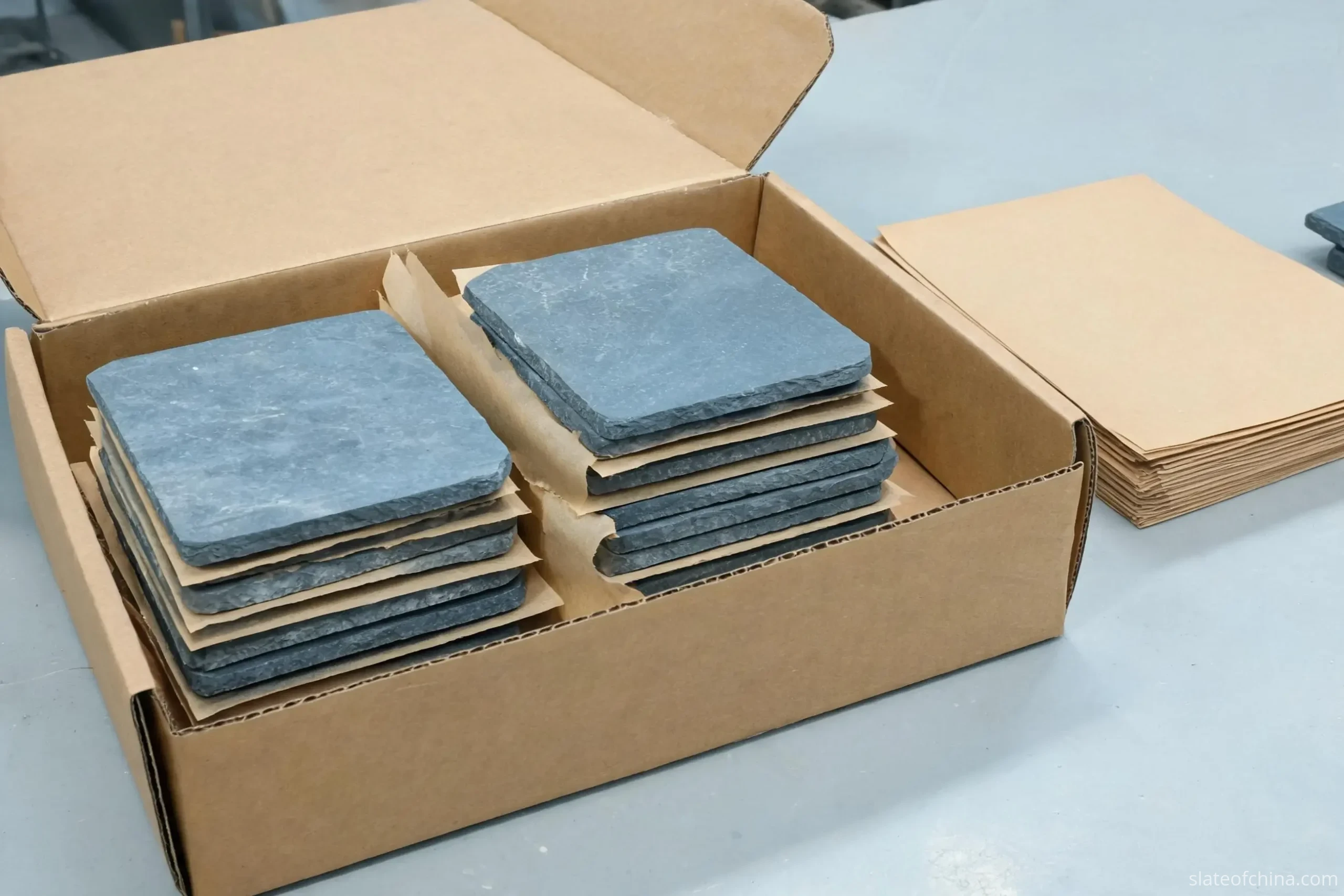
Packaging is asked to do two different jobs, and the buyer should decide early which one is being paid for. Transport packing has to survive the ocean: plain kraft inner cartons, protection at the right points, dimensions and weights that the forwarder can work with. Presentation packaging has to sell on a shelf: printed boxes, sleeves, inserts and labels, arriving as retail-ready units. The two overlap less often than catalogues imply — an attractive box that lets the product rattle has solved the wrong problem — and whole orders are built around the choice. Bulk-packed goods are repacked by the importer; retail-boxed goods ship bulkier and land shelf-ready.
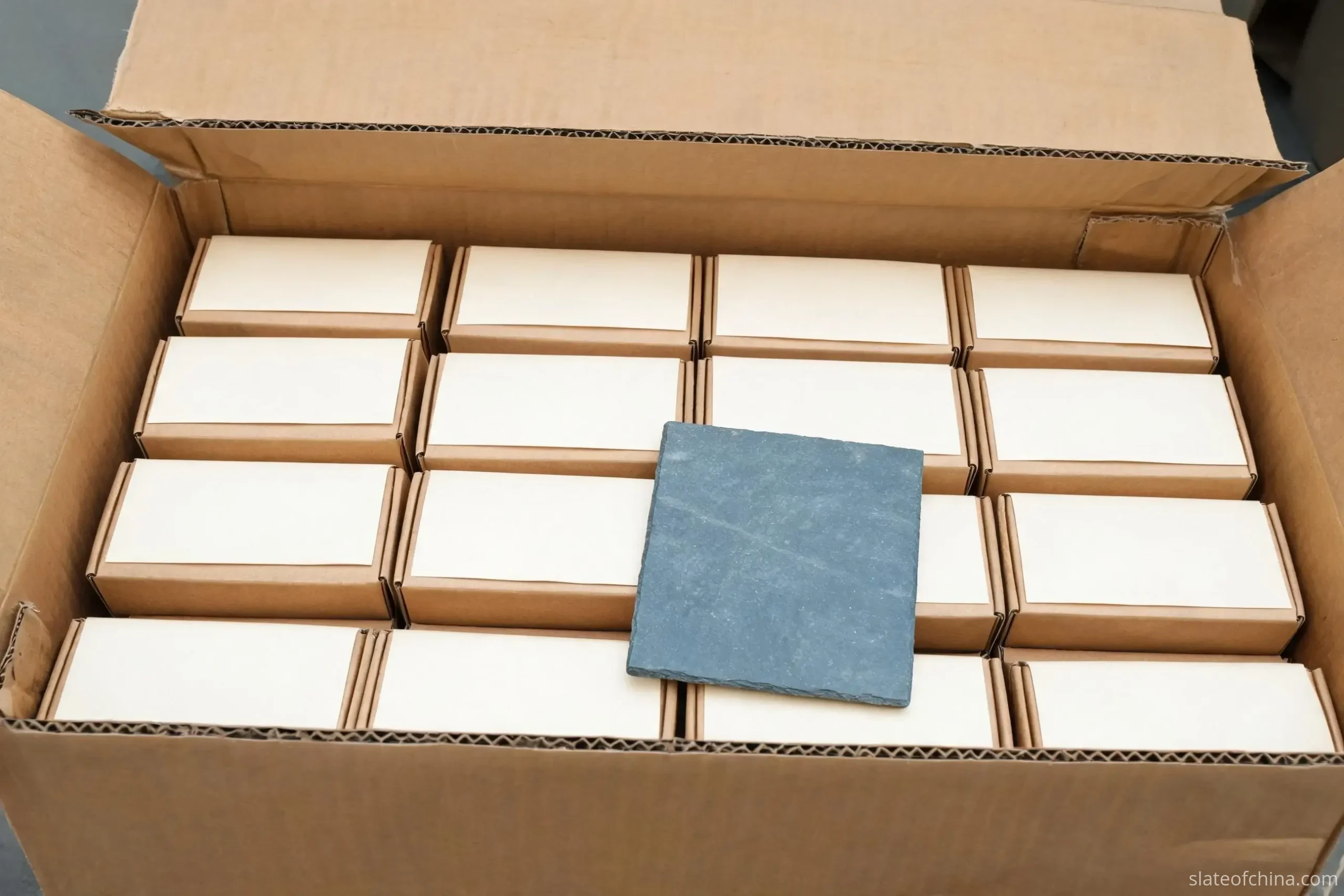
Whichever route the order takes, the carton is worth approving before production rather than after it. The questions that matter are plain: how many pieces per inner box, how many inner boxes per master carton, what the gross weight is, how the cartons stack and whether they will be palletised. Fragile configurations — pieces with drilled holes, narrow waists or natural edges — need support built into the carton rather than stronger carton walls, and photographs of the packed carton before dispatch are a reasonable thing to ask for and a cheap thing to provide. Packing full-size slabs and machined panels into timber crates is a different discipline entirely; it is covered in how Jiujiang slate is packed and shipped, and this page deliberately stops at the craft carton.
Lead Times and the Three Clocks
Questions about slate crafts lead times are really questions about three different calendars, and conflating them is how delivery dates go wrong. The sample clock runs from drawing to proof to revision to approved sample — artwork confirmed, a production sample made and signed off, corrections absorbed on paper rather than in stone. What a physical sample can and cannot tell you about a run, and how to run a fair sample test, have a page of their own; at the wholesale layer the operative fact is that this clock runs before any production clock and is the one most often compressed by optimism.
The production clock is set less by the number of pieces than by the number of designs. A run of one thousand pieces in one specification behaves like one order; a run of one thousand pieces in forty designs behaves like forty small orders sharing a schedule. Accessories and packaging lead times sit inside it — cork backings, fixings and printed packaging arrive from other suppliers on their own calendars — and so does season: the weeks ahead of the main gifting seasons are when schedules across the whole trade are most fragile, and a lead time taken from an off-peak example should be checked again before it is relied on.
The transport clock is the voyage and clearance, and it is the patient one: the freight page covers it in detail. What belongs here is the order in which the three clocks are read. A supplier's production estimate describes the middle of the timeline, not all of it. Before it sit artwork approval and packaging procurement; after it sit inspection, export documentation, the voyage and destination clearance. Any schedule built from the production estimate alone has, in effect, planned a delivery that omits the ocean.

The professional habit is to plan backwards from the shelf date: the date the goods must be on sale fixes the clearance date, which fixes the vessel, which fixes the dispatch date, which fixes the inspection, which fixes the end of production — and only then does anyone ask how long the marking takes. Once the calendar is built backwards, every stage has its own confirmation list:
| Stage | What the buyer confirms |
|---|---|
| Design and sampling | Drawings, logo files, dimensions and the approved sample |
| Packaging preparation | Box design, labels, inserts, and the packaging MOQ |
| Production | The date the schedule starts, and the expected completion date |
| Inspection | Sampling or full inspection, and the packing confirmation |
| Dispatch | Booking, export documents and the expected sailing date |
| Arrival | Transit time, clearance and local delivery |
No durations are filled in here, deliberately. They are set by the product's complexity, the factory's real schedule and the route to the destination — which is why the table is built from the shelf date, not from a template.
Gift ranges aimed at the winter retail season are typically approved in the middle of summer, which surprises no one who has done it twice and everyone who has done it once.
One more habit, because it is the cheapest one on this list: ask when the clock starts. For some suppliers it starts at the deposit; for most it starts at artwork approval or sample sign-off. That single answer usually moves the delivery date further than any amount of pressing after production has begun — which is to say, the fastest way to shorten a lead time is approval discipline on the buyer's side of the table.
Quality Control at Batch Scale
The difference between a sample order and a production order is not size; it is that at sample scale quality can be an opinion, and at batch scale it has to be a procedure. At twenty pieces a buyer can look at everything; at two thousand nobody looks at everything, so what “looked at” means has to be designed in advance, or it will not happen at all.
The design starts in a written specification. The items that carry a batch are known in advance, and every one of them belongs on paper: dimensions and thickness with the tolerance that matters for the use; the agreed range of natural variation in tone and texture; the policy on edges and visible chips; the surface cleanliness expected; the marking position, legibility and consistency across a run; the backing and accessories; and the packing configuration with its labeling. Where the product is sold as a matched set, the specification also says how pieces are expected to match within a set — matched sets are made by sorting, not by luck.
Before mass production, the reference sample is the gate: an approved sample of the actual run, signed off and — ideally — physically retained by both sides, so that “as agreed” has an address. Where pieces are personalised, names, dates and logos are verified in writing first; with engraving, corrections are not an option, they are a new piece. The sample-approval page covers the process in full for buyers who want it.
During the run, the inspection plan is what separates a procedure from a hope. Defect categories are defined before the run, not argued after it. Whether the plan is sampling or full inspection is a decision made by value and risk, and it is the buyer's decision as much as the supplier's; photographs and records at defined stages are reasonable to request, and a third-party pre-shipment inspection is a normal instrument for higher-value or first orders. The line that closes the section is the one the whole trade keeps relearning: a standard agreed before production is a document; the same argument after delivery is a dispute.
Supplier Questions That Matter for Crafts Orders
Supplier evaluation has a page of its own, the sourcing route another, and the general question list a third. What belongs here are the two questions specific to craft-scale work. The first is the category test: a workshop that is excellent at blank coasters is not automatically the right workshop for multi-part gift sets or signage with drilled fixings, so ask to see a comparable run — a repetition of the same order, not a portfolio of singles. The second is the coordination test: in this trade, some stages are commonly run in partner facilities rather than one roof, and what the buyer is verifying is the coordination — who integrates cutting, marking, accessories and packing, and who holds the written specification between orders. That last clause matters more than any of the others, because the second order is where a wholesale relationship is actually chosen, and the third order is the one the buyer has to trust sight unseen.
Repeat-order consistency is the quiet criterion under all of it. A supplier who can say how approved samples and specifications are retained, how changes will be communicated, and how future orders will be checked against the original requirement is describing a system; a supplier who answers “same as last time” is describing a memory. In wholesale, the memory is the thing that fails.
Private Label and Custom Giftware Projects
Private label slate gifts put the buyer's brand on the front of the piece and the supplier's name nowhere. The stone, the cut and the run remain the manufacturer's; the mark, the box, the insert and the story on the shelf become the buyer's. What that layer actually contains is worth listing, because it is longer than a logo: piece marking to brand artwork, printed retail boxes and sleeves, inserts and information cards, and often a coordinated set assembled from several products — a coaster run, a board, a plaque — sold under one name.
What the buyer brings to it is equally specific: the target market and intended retail price, the product dimensions and material preference, brand assets as vector artwork rather than photographs, the marking method suited to how the brand intends its durability to read, the packaging design and its labeling, the quantity plan across the first three orders, and the destination with its deadlines. Custom slate giftware programmes usually begin from an established product design carrying the new brand rather than from a new product — demand is proven first, and additional sizes and coordinated ranges follow once the first order has repeated. The ranges currently running in this direction are gathered in the slate crafts category.
Two pieces of fine print belong in writing before the first carton. The first is ownership and permitted use of custom artwork, logos and packaging designs — who holds what, and for how long. The second is the repeatability promise itself: a private label lives or dies on the third order matching the first, which is why the reference sample and the written specification from the quality section carry through here unchanged. When we take on projects of this kind, what gets written down first is usually the division this guide has been repeating throughout: which line is ours to hold, and which is the buyer's to approve.
The RFQ That Produces a Comparable Quotation
Write an enquiry once, for one supplier, and it brings back one price. Write the same ten lines to every supplier, and the answers line up for comparison. Each of the lines earns its place:
| RFQ line | What to send |
|---|---|
| Product and family | What the item is, and which of the three families it belongs to |
| Dimensions and finish | Finished size, thickness, edge and surface finish as one specification |
| Quantity levels | Per design, at trial / routine / volume — the three levels to be quoted |
| Customisation | Shape, marking method, artwork positions, any per-piece personalisation |
| Artwork files | Vector art for marking and print, fonts, colour references, ownership status |
| Packaging route | Bulk inner cartons, individual protection, or printed retail boxes |
| Quality note | The agreed variation range, the edge and chip policy, and inspection expectations |
| Trade terms | Incoterm and delivery scope — EXW, FOB or as agreed |
| Dates | The sample-approval target and the shelf date the order works back from |
| Destination | Country, port and any compliance needs at the destination |
Sent like this, the quotation normally comes back itemised — stone, marking, accessories, packaging and transport on their own lines — the form that can genuinely be compared between suppliers, and that makes the sixth section of this guide unnecessary. A photograph of a design found on another website invites a price for a different product, and the industry's least productive correspondence is the one that follows it.
If parts of the specification are still moving, say so in the RFQ rather than hiding it: an initial quotation against a clearly named reference design, refined once the details settle, is a normal way to start and a better one than pretending the enquiry is final when it is not.
Plan Backwards from the Shelf
The whole of this page compresses into one sequence, run in the right order: product family chosen, configuration fixed, the three minimums requested, three price levels quoted, the carton route decided, the calendar built backwards from the shelf date — and every one of those decisions in writing. The most useful quotation a wholesaler ever receives is not the lowest number. It is the one that states exactly what arrives, how it will be checked, how it is packed, and when it can reasonably be expected to ship.
The two importers from the first paragraph received different quotations because they had placed different orders. Once the configuration is fixed, the honest quotes converge, and what separates suppliers after that is the part no unit price contains: repeatability, communication, and the discipline to write things down. Wholesale slate crafts from China rewards exactly that habit — and the four product guides linked above reward the next step, which is deciding what, precisely, is going in the carton.
Frequently Asked Questions
The questions below are the ones wholesale buyers ask most often once the product is chosen and the order begins — minimums, tiers, cartons, calendars and comparison. Each answer gives the working rule first and the reasoning after it; the sections above carry the full treatments.
Can I buy slate crafts in bulk directly from China?
Yes. Importers, gift wholesalers, promotional-product distributors, retailers and private-label brands all order natural slate crafts from Chinese manufacturers and export suppliers, either from the producer's own export desk or through a partner who coordinates several workshops. The practical variables are the product family, the degree of customisation and the packaging route, because those — not the country — are what set the minimums and the schedule. The sourcing routes themselves, including when a trading desk is the right answer, are covered in the buying-and-exporting pages linked above.
What is the MOQ for wholesale slate coasters?
There is no single figure, because a minimum is a function of configuration, not of product name. Blank coasters to an existing drawing carry the shortest line; engraved or personalised runs a longer one, growing with the number of designs; printed retail gift boxes a line of their own, set by the box printer's schedule. Ask for three numbers — product, customisation, packaging — and the question answers itself, because the binding constraint is usually visible immediately: for shelf-ready gift sets, it is often the box, not the coaster.
How do wholesale price tiers work?
As purchasing categories, not industry-wide bands. Ask for the same configuration quoted at three levels — trial, routine replenishment and a volume level — and treat them as your own labels rather than fixed thresholds. When the quotes arrive, read where the steps fall, not only how large they are, because the steps are what show where set-up stops dominating the price. Numbers quoted without the configuration attached are not comparable with anything.
Bulk cartons or retail gift boxes — which should I choose?
Decide which job the packaging is being paid to do. Bulk inner cartons are transport packing: interleaves between stone layers, protection at the walls, and repacking by the importer at destination. Printed retail boxes are presentation packaging: units arrive shelf-ready, at the cost of a box that carries its own minimum, adds volume to the shipment, and must still stop the product from rattling. Many first orders split the difference — bulk-packed product, a retail sleeve added close to market — and that sequence is usually cheaper than guessing wrong at volume.
How long does a wholesale slate crafts order take?
Three separate clocks, and the honest answer has to name all of them. The sample clock runs from artwork to approved production sample; the production clock is set more by the number of designs than the number of pieces, and carries accessory and packaging lead times inside it; the transport clock is the voyage and clearance. Ask two questions of every estimate: what it includes, and when it starts — at deposit, or at artwork approval. Then plan backwards from the shelf date, not forwards from the production estimate, because the production estimate describes the middle of the timeline, not all of it.
Can different slate crafts be combined in one wholesale order?
Often, and it is a sensible way to build an assortment — but each design is still its own order on the schedule. Mixing product families in one shipment is normal; what the buyer should confirm is whether the mixed designs can share a production run, whether each design carries its own minimum, and who inspects and packs the combined order. One container of coordinated products is a coordination job as much as a manufacturing one, and the party holding the written specification is the one who can be held to it.
Do suppliers offer private-label packaging for slate gifts?
Yes — printed retail boxes, sleeves, inserts, labels and information cards to the buyer's brand, with the stone carrying the buyer's mark rather than the supplier's. The two things to settle in writing are the packaging MOQ, which belongs to the print trade and is frequently the binding minimum of the whole order, and the ownership and permitted use of artwork, logos and packaging designs. A first private-label order normally begins from an established product design carrying the new brand; the ranges are usually widened after the first order has repeated, not before.
How do I compare two wholesale quotations fairly?
With a six-point identity check before any number is trusted: the same dimensions and finish, the same marking specification, the same accessories, the same packing protection, the same inspection expectations, and the same Incoterm. If any of the six differ, the orders are different products, and the comparison is between fictions. Once the six match, compare at landed cost per saleable unit — freight, duty and destination handling brought onto each sellable piece — because the factory line by itself does not include what it takes for the goods to arrive.
Related Reading
Planning a wholesale slate crafts order — from a first trial run to a shelf-ready container? Send the ten lines of the RFQ above and an itemised quotation normally follows — stone, marking, accessories, packaging and transport on their own lines, with the three minimums named separately.
- Product & family: what the item is, and which family it belongs to
- Dimensions & finish: size, thickness, edge and surface finish as one specification
- Quantity levels: per design, at trial / routine / volume
- Customisation & artwork: shape, marking method, vector files, any per-piece personalisation
- Packaging route: bulk inner cartons or printed retail boxes — with the three minimums asked separately
- Terms & dates: Incoterm, destination, and the shelf date the calendar works back from
Specifications not finalised yet? Tell us what you want to buy, how many pieces you need, and where the goods will be delivered — a reference photo and a target quantity are a workable starting point. We can review the requirements and help identify which specifications need to be confirmed before a quotation can be prepared.