
Engraved & Custom-Printed Slate Products: Laser Engraving, Screen Printing and Custom Branding on Natural Slate
A mark reaches natural slate by one of two routes: laser engraving removes material from the dark face of the stone, while screen printing and UV digital printing bond a pigment layer onto the surface. Natural slate products — coasters, placemats, serving boards, plaques and gift pieces — can be customised with company logos, text, patterns or full-colour graphics by either route. Each method produces a different appearance and sets different requirements for surface preparation, durability, production quantity and cost.
Most engraved slate products sold into hotels, corporate gift programmes, promotional distribution and private-label ranges carry one of those two routes, or a hybrid of both, since an engraved recess can be backfilled with colour. Buyers meet the consequences at the sampling table, and again in a washing-up sink or a sunlit shop entrance, where a route matched to the wrong product becomes visible months later. This guide compares the main customization methods and explains what importers, wholesalers and private-label buyers should specify when sourcing custom slate products from China.
The page sits in the Crafts & Giftware section of the Jiujiang Slate Guide. Its two neighbours cover the products themselves — the coaster page follows one object through a careful buyer's hands, and the tableware page maps the placemat-and-board family. Here the mark is the whole subject: how each process behaves on natural slate, how to choose between them, what artwork to send, what to write on the order, and what to check before production is released. It is written for buyers specifying engraved and custom-printed slate products from China.
In three lines
- Laser engraving (stone removed) — the mark is uncovered stone: one colour, the stone's pale grey, and no ink to lift. Each piece inherits the face it was cut from. Verify contrast, fine detail and tone spread on a physical sample.
- Screen printing (layer added) — chosen ink colours through a mesh stencil; strong, bold marks on long runs of one design. Every extra colour adds a screen and a registration risk. Verify adhesion after the real cleaning regime.
- UV digital printing (layer added) — multicolour, variable-data and short-run friendly, usually over a white underbase on dark slate. Verify adhesion, scratch resistance and colour accuracy on the stone, not on paper.
Choose by what the mark must survive — cleaning, contact, weather — then by colour needs and order quantity; and approve a pre-production sample made on the actual stone before any run.
Two Routes to a Mark: What Laser, Screen and UV Actually Do
Engraved and custom-printed slate products are natural slate pieces — coasters, placemats, cheese and serving boards, nameplates, plaques and gift items — personalised with a logo, monogram, name, date or decorative pattern after the stone has been cut and finished. The personalisation runs on the finished piece, which is what separates it from any pattern work done while the batch is still slabs, and it makes the marking process a purchasing decision in its own right rather than a detail of the drawing.
How a logo gets onto slate, physically, is simpler than the vocabulary around it. A laser engraver moves a focused beam across the mark area at a power and speed the operator sets for the stone in hand. The beam applies nothing; it removes. On many dark blue-grey slates it takes off the thin dark surface layer and exposes the paler body of the stone; the visible mark is typically the stone's own pale grey, though other colours are possible — the tone depends on the material, its surface condition and the machine parameters, and lighter, chalkier or near-white results occur on some faces. Because the ink-free mark is simply stone that has been uncovered, there is nothing to peel — and its exact tone is a joint product of the mineral face and the machine settings, which is why two tiles from one batch can carry slightly different greys, and why an exact shade cannot be promised from a design file alone. Heavier subtractive marks exist for other formats in the trade: mechanical engraving and sandblasting cut deeper into the stone and suit bold lettering and relief work, trading fine detail for depth.
Screen printing arrives from the opposite direction. The artwork is divided by colour; each colour gets a mesh screen; ink is pushed through the open mesh onto the slate face and cured. One colour means one screen, and a three-colour design means three screens that must be registered to each other on every piece. Each screen is a setup with real cost in it, so screen printing tends to reward repetition — hundreds or thousands of the same bold design, dividing the setup across the run — though where the break-even sits depends on the setup charges, the number of colours, the run length and the supplier's pricing. UV digital printing skips the screens entirely: jetted droplets of ink are cured on the stone by ultraviolet lamps as the print head passes, so every piece can carry different artwork, names or numbering. On dark slate, faithful colour often depends on a white ink layer printed first as an underbase; whether one is needed depends on the stone's base colour, the ink system and the target effect, and the layer changes both the appearance and the price — a detail worth raising in the first exchange.
The two routes also combine. An engraved mark can be backfilled with enamel or ink — paint-filled engraving — so that colour sits inside a recess the laser cut. The geometry is subtractive, the colour is additive, and each half still obeys its own rules: the recess holds the shape, while the fill remains a layer that has to prove its adhesion like any other ink.
Why does laser engraving on slate look grey rather than white?
Because the mark is usually the colour of the stone itself, not an applied material. On many dark slates the laser removes the dark outer face and uncovers the paler body, and that pale grey is the stone's own colour — though the mechanism and the tone vary with the mineral face, its surface condition and the machine settings, and some faces render lighter, chalkier or near-white. The tone is never decided by the artwork file, and an exact shade cannot be promised from a design file alone: the shade is approved on a pre-production sample, and a tolerance range is written into the order.
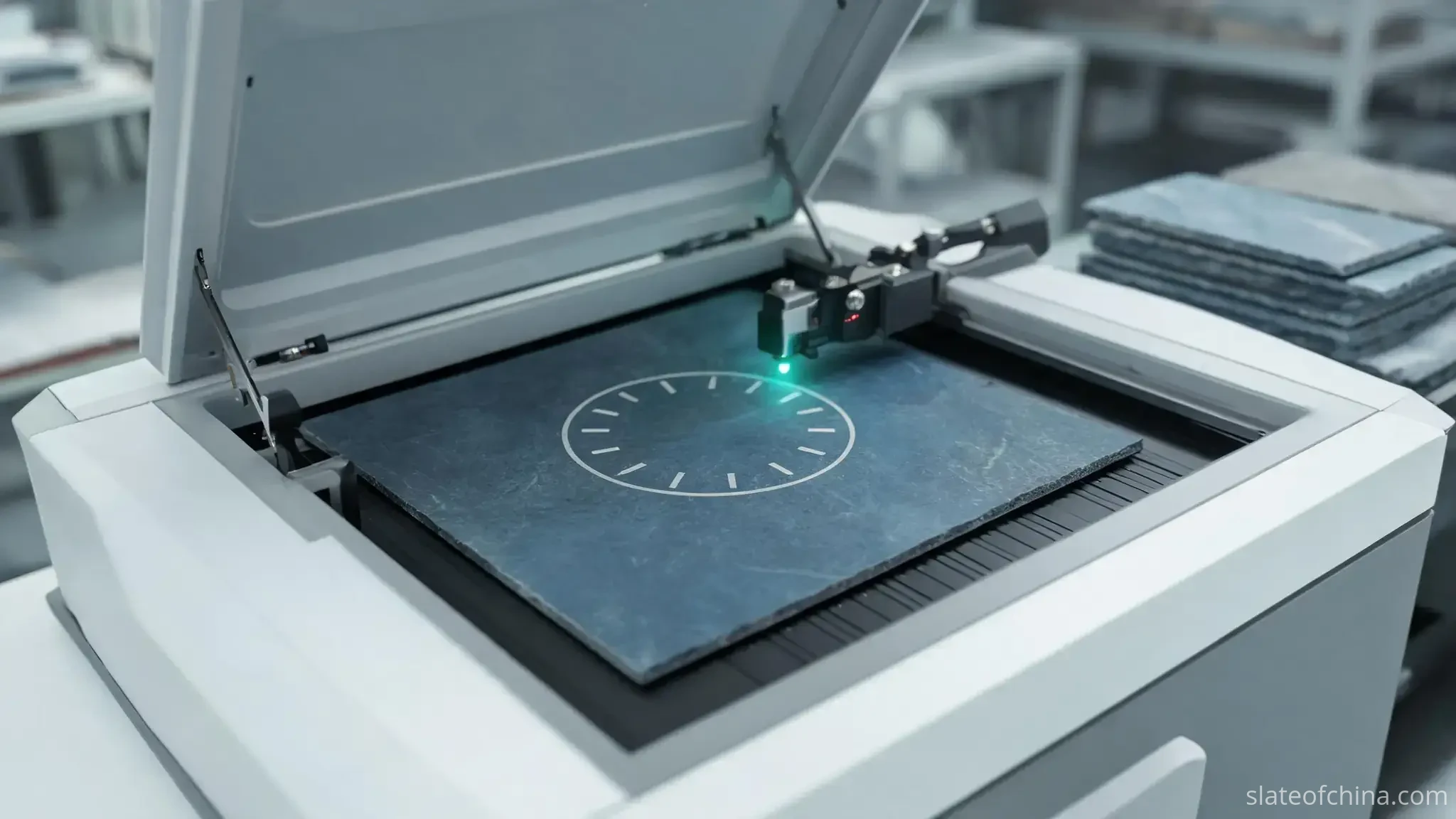
The first specification on a branded slate order is therefore not a logo decision at all. It is a route decision — stone removed, or layer added — and every section that follows is an elaboration of which route the project takes.
What Follows from the Route: Colour, Wear, Care and Contact
The two routes fail differently, and a buyer who knows how each one fails writes a better order for engraved slate products. Six consequences carry most of the weight.
Colour. A removed mark comes in exactly one colour — the stone's own grey — and its consistency across a run is a property of the stone batch: plates vary slightly, and the acceptance clause has to bound that spread in writing. An added mark comes in whatever ink the brand chooses, and its consistency is a property of ink matching and process control: colour references are agreed in advance and confirmed on the sample, under lighting both sides accept.
Feel. A fingertip finds the difference before an eye does. Run a fingernail across the mark: a laser mark sits in the plane of the stone or fractionally below it, while a printed layer declares itself as a step at the mark's edge, most boldly where ink coverage is heaviest. On a strongly riven face the finger also tells the printing story — a heavy layer tends to bridge the low spots rather than follow them, which is one reason deep-cleft surfaces and fine printing do not combine.
Wear. The two routes wear differently. Engraving wears only as stone wears; there is no ink edge to lift, and a mark that has dulled over years of handling has dulled with the face it lives in. A printed layer commonly begins to wear at the boundary between ink and stone — edges and corners are a frequent first point — though the actual failure mode depends on the ink system, the coverage and the service it meets. Neither route is dishwasher-safe by default: a hot, detergent-heavy cycle is a specific chemical and thermal environment that the complete product — stone, ink, any coating, and the feet or fixings on the piece — either was built for or was not.
Contact and weather. Food-contact scrutiny follows the same split. Adding a layer puts the ink system, any topcoat and the curing schedule inside the question; removing material adds no foreign substance but still changes the surface the food meets — and any sealer, feet or adhesive on the piece is in scope either way. The assessment always runs on the finished article under the rules of the market it ships to, as the tableware page sets out for the food-side formats. Outdoor exposure sorts the routes yet again: ultraviolet and weathering attack ink systems by chemistry that suppliers state per system, while an engraved mark weathers with the stone face it belongs to. The honest wording is identical in both cases — confirm the finished product for the actual exposure, not for an exposure category.
| WHAT YOU ARE DECIDING | STONE REMOVED (LASER MARKING) | LAYER ADDED (SCREEN / UV PRINTING) |
|---|---|---|
| Colour available | One colour: the stone's pale grey; tone set by the face and the settings | Chosen pigments; faithful colour on dark slate often needs a white underbase |
| Tone across the run | Varies slightly with each plate in the batch; bounded by acceptance criteria | Held by ink matching and process control; colour references agreed in advance |
| Feel under hand | Flush with or just under the stone face; no edge to find | A physical layer; a fingernail finds its step, thickest at full coverage |
| After repeated washing | Wears only as the stone face wears; nothing to peel or lift | Edges and corners can wear first, if the cleaning regime outpaces the ink system |
| Food-contact scrutiny | No ink enters the question; the finished piece is still assessed whole | Ink system, curing and any coating all enter the assessment |
| Outdoor exposure | Mark weathers with the stone face it was cut into | Ink suitability for UV and weathering confirmed per system, per product |
Six consequences, one cause. Stone removed, or layer added — the route sets the terms, and the specification sets the limits.
Choosing the Process: A Decision Table, Not a Ranking
No marking process is superior to the others in any general sense. A dark coaster programme with a restrained single mark and a gift programme with a full-colour crest are not disagreeing about the best process; they are asking different questions of the same stone. The workable sequence is shorter than it looks: what the mark must survive, what colour it must carry, how it reads at the final size, and how many pieces carry it.
| THE NEED ON THE ORDER | ROUTE AND PROCESS TO CONSIDER | WHAT THE SAMPLE MUST PROVE |
|---|---|---|
| A restrained, permanent-looking single-colour mark | Removal — laser engraving | Contrast, fine-detail reproduction, tone spread across pieces |
| Personalisation that changes piece to piece — names, numbering, dates | Removal — laser; or UV digital where colour is needed | Variable-data quality on individual pieces |
| One bold house colour across a long run of identical pieces | Addition — screen printing; or laser for the stone-grey variant | Ink adhesion after the actual cleaning regime; setup terms |
| Exact brand colours, matched to a reference | Addition — screen printing | Colour match on the stone, with or without an underbase |
| A multicolour emblem or photographic artwork | Addition — UV digital printing | Colour accuracy, edge sharpness, adhesion and scratch resistance |
| Several different designs travelling in one order | UV digital or laser — no per-design screens | Setup terms and unit cost, design by design |
| Marks facing aggressive washing, weather or food contact | Test before choosing — both routes are eligible | The route shortlists the process; the test on the finished piece decides |
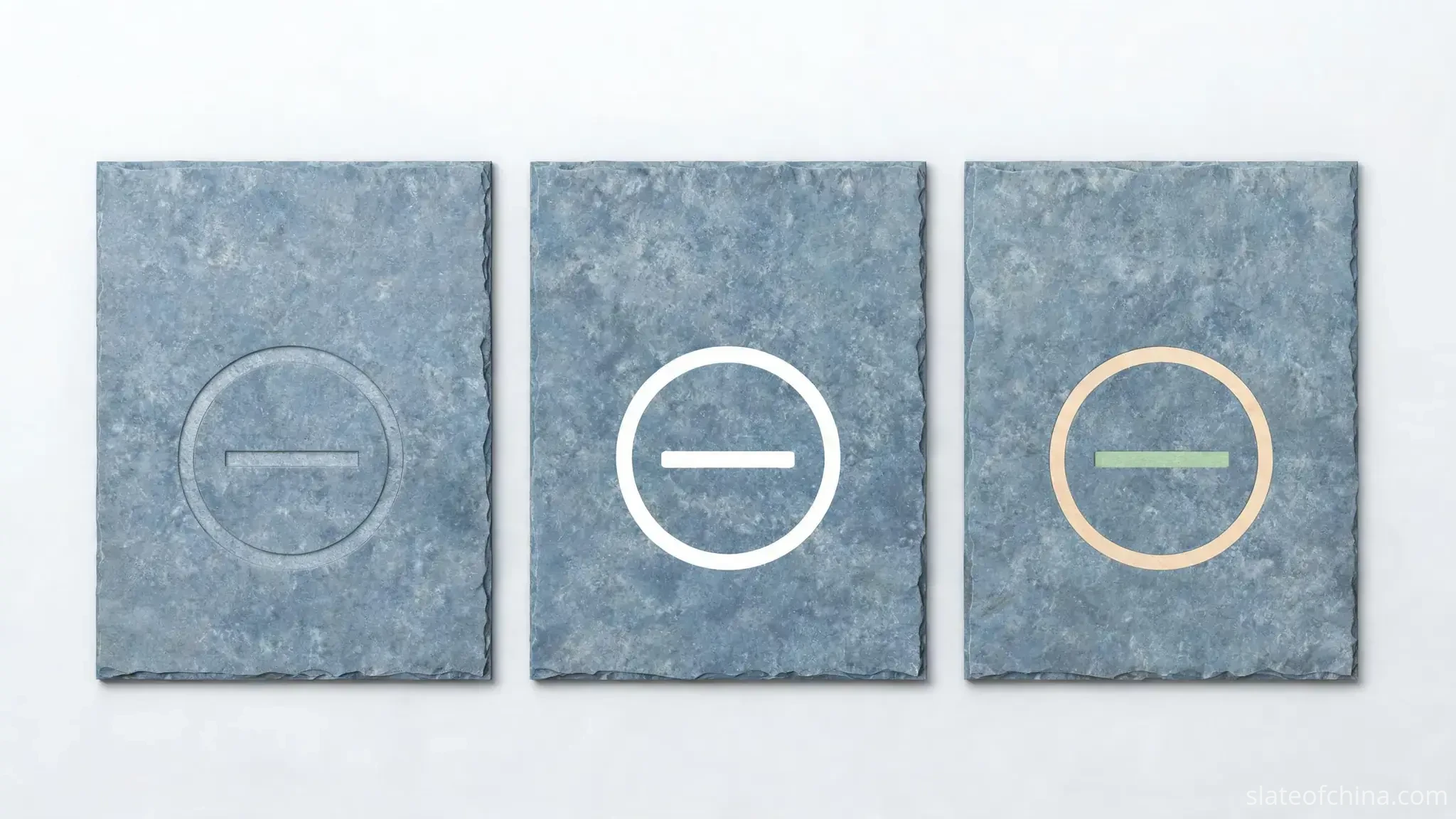
The three most common orders in practice land like this. A promotional distributor with a thousand dark coasters and a simple wordmark may find laser engraving the better fit: the stone-grey mark is consistent, there is no house colour to match, and a long run absorbs the per-piece marking time — though the final comparison depends on equipment efficiency and the supplier's pricing. A restaurant brand that must land its exact signature colour on tableware tends toward screen printing with the colour reference agreed in writing. A gift programme carrying a crest in several colours, or whose pieces each take a different name, points to UV digital printing, approved against a white-underbase sample. One market, three right answers — chosen route first, process second.
Whichever row the project lands on, the words doing the deciding are the same six: stone removed, or layer added.
Which Slate Products Take Which Marks
Almost any flat slate product can carry a mark; the practical constraints come from the face and the format. Coasters, placemats and cheese and serving boards — the three formats this section treats in depth on their own pages, and the backbone of the current crafts range — share standard marking canvases: a face that is honed smooth or riven with a fine, regular cleavage. A honed face carries thin strokes and small lettering; a riven face gives the mark a quieter, more organic ground but interrupts hairlines with its texture. The same finish flatters the two routes differently: printing onto a textured face asks the ink layer to bridge the low spots, while laser engraving simply follows the surface it is given.
Formats answer to their own product rules first. Large placemats show tone variation between pieces more openly than coasters do, and a coordinated set needs its variation band defined before the run. Serving boards take the full food-contact position of the tableware page onto any printed mark as well. And a curved, drilled or unusually thin piece may sit outside a marking machine's comfortable envelope altogether — something the supplier should say before the quotation, not after it. When in doubt, the drawing and a representative sample travel with the enquiry.
Nameplates, house plaques and other signage formats — a family this guide will treat separately, since it brings its own thicknesses, fixings and exposure questions — step up in stone gauge, add fixing holes or standoffs, and meet the outdoor questions of the previous section whenever they face weather. Their marks are commonly engraving, paint-filled engraving or robust single-colour printing, always rated for the actual exposure. Personalised slate gifts and promotional pieces round out the category, and for a customs or logo slate coasters programme the coaster page covers the format side in detail.
Two placement facts belong in every drawing, whatever the product. First, marks sit centred and away from edges, corners, holes and feet — not because machines cannot reach the edge, but because chipped corners and rubbing edges are where a mark meets the transport system first. Second, marking and sealing have an order of operations, and it is a specification, not a habit: ink bonded to bare stone, to a sealed face, or under a sealer applied over the mark are three different products in a washing test. Whichever sequence suits the piece, the order is written down, and the sample is made in that same order.
Artwork: What to Send and What to Specify
Artwork is the most controllable variable in the chain, which is why weak files cost so many rounds of correspondence. For logos and line artwork, the file a supplier can actually work from is a vector — AI, EPS, SVG or a PDF containing live vector artwork — because a vector scales from a 40 mm coaster face to a 300 mm board without losing an edge. High-resolution PNG, TIFF or JPEG files carry their pixels with them; they can be enough for photographic artwork bound for UV printing, but for clean engraving and printing edges a raster file leaves the supplier guessing where the line really is.
A logo that only exists as a small raster file is a common, solvable case: the supplier either redraws it into vector artwork or simplifies it so the essential shapes survive at final size. What is not solvable is expecting hairlines and very small lettering to hold on a textured stone face — there is a minimum scale at which a mark survives, and it is measured on the stone, not on a screen.
The artwork submission carries seven decisions, all of them cheap to make on day one and expensive to renegotiate later:
- The exact artwork to be reproduced — one file, in the supplier's preferred format.
- The finished product dimensions, and the maximum area the mark may occupy.
- The position and orientation of the mark: centred, offset, one face or two.
- The intended colour — a tone range for removal, or a colour reference for addition.
- Any critical detail that must survive: a minimum text size, a thin stroke, a reading distance.
- Whether the file may be adjusted — traced, simplified, thickened — and who decides.
- The process and the sealing order from the previous section, restated as part of the artwork approval.
What artwork file format should go to a slate manufacturer?
For logos and line artwork: AI, EPS, SVG or a vector PDF, with fonts outlined and minimum stroke widths stated. For photographic artwork: a high-resolution PNG, TIFF or JPEG at the final print size. Suppliers differ in what they prefer, and in whether artwork preparation is a service included, quoted or declined — so the file conversation and the quotation conversation belong together. Sending the best file that exists, with its history attached, saves a round of proofing and a later argument about whose file blurred the line.
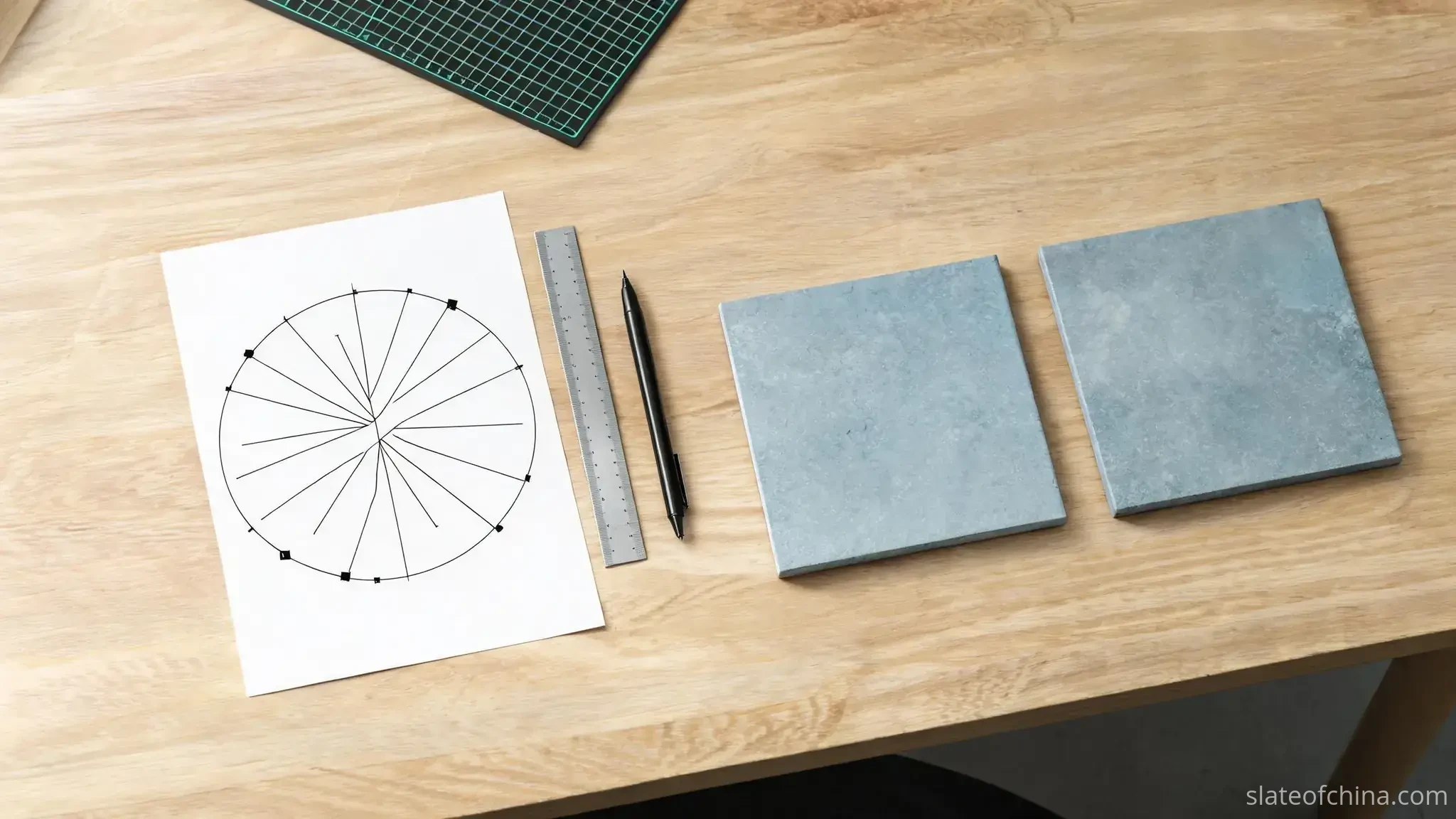
A digital mock-up confirms placement, scale and composition. It proves nothing about the stone. A riven face interrupts fine strokes in ways no monitor predicts, and a dark, variable ground changes contrast by the plate. Where the appearance is commercial — and on a branded piece it always is — approval runs in two steps: the digital proof settles the geometry, and the marked sample on the batch stone settles everything the proof cannot see.
The Branding Specification: Requesting the Quotation
"Please quote 1,000 coasters with our logo" is not a specification; it is the opening line of a correspondence. The quotation that comes back accurate comes back against a written brief, and on branded slate the brief has standard lines:
| LINE ON THE ORDER | WHAT TO WRITE INTO IT |
|---|---|
| Product type | Coaster, placemat, serving board, nameplate, gift piece |
| Material and face | Natural slate; face colour band; honed or riven finish |
| Dimensions and thickness | Length, width and thickness, with the tolerance band if one is needed |
| Shape and edge | Square, rectangular, round or custom; natural, hand-chipped or sawn edge |
| Marking process | Laser engraving, screen printing or UV printing — or "recommend and quote the two main options" |
| Artwork, mark size and placement | File reference, mark area, position, single or double face |
| Colour or tone | Engraving tone range, or ink colour references and any underbase |
| Quantity | Total, and per design where the order carries several |
| Accessories | Rubber feet, backings, hanging hardware, gift sleeves |
| Packaging | Bulk carton, individual sleeve, or retail box with printed insert |
| Use, market and destination | Intended use, destination market, and the shipping terms the quotation should assume |
Those lines cover the recurring cost. Three one-time costs sit alongside them and decide whether two quotations can be compared at all: artwork preparation, if a redraw is needed; process setup, which for screen printing means one screen per colour; and sampling, courier included. A quotation that folds these quietly into the unit price is not the same document as one that lists them — asking for the split is not negotiating, it is reading. And where an order carries several designs, the quantity per design matters as much as the total, because setups and minimums are charged per design, not per shipment. Private label slate products — where the buyer's brand arrives on the box as well as the stone — add label printing and packaging approval to the same checklist.
Reading the Sample: First-Article Checks for a Mark
A marked sample is evidence, not decoration. Five checks read it for the questions the production run will ask, and the gap between a sample that passed and a batch that pleased is always one of the five.
Legibility at use distance. A mark that only reads at reading-glass range is not the mark the customer bought. Hold the piece at arm's length, where a coaster lives on a table; if the wordmark or emblem dissolves, the artwork needs simplification, not the buyer's optimism.
Contrast and continuity. For engraving, read the tone against its face, the evenness of the grey across the emblem, and whether the thin strokes survived the texture. Ask for two marked samples from two different tiles of the batch — the pair shows the tone spread the way a single hero piece never will — and tilt both toward the window: in raking light, a hairline that failed reads as a dotted grey suggestion of itself.
Registration and coverage. For printing, read whether the colours of a multi-pass mark sit cleanly on top of each other, whether the ink covers evenly across the stone's texture, and whether any low spots in the face show through the layer.
Adhesion and endurance. Then the tests, agreed before the sample is made, because a test that arrives after approval tests the relationship instead of the mark: controlled rubbing, exposure to moisture, and a cycle of the actual cleaning method the product will meet in service. An informal wipe proves enthusiasm, not endurance. Laser marking has no ink to detach, but it still answers the same tests for legibility, surface condition and consistency.
Function and provenance. The marked piece is still a slate product: it sits flat, its feet hold, its edges arrive honest. And the approval itself runs best as the disciplined signing ritual the Samples and Sample Approval page formalises, because the signed reference sample, retained by both sides, is the record the finished batch is checked against — more reliable than any description in a dispute.
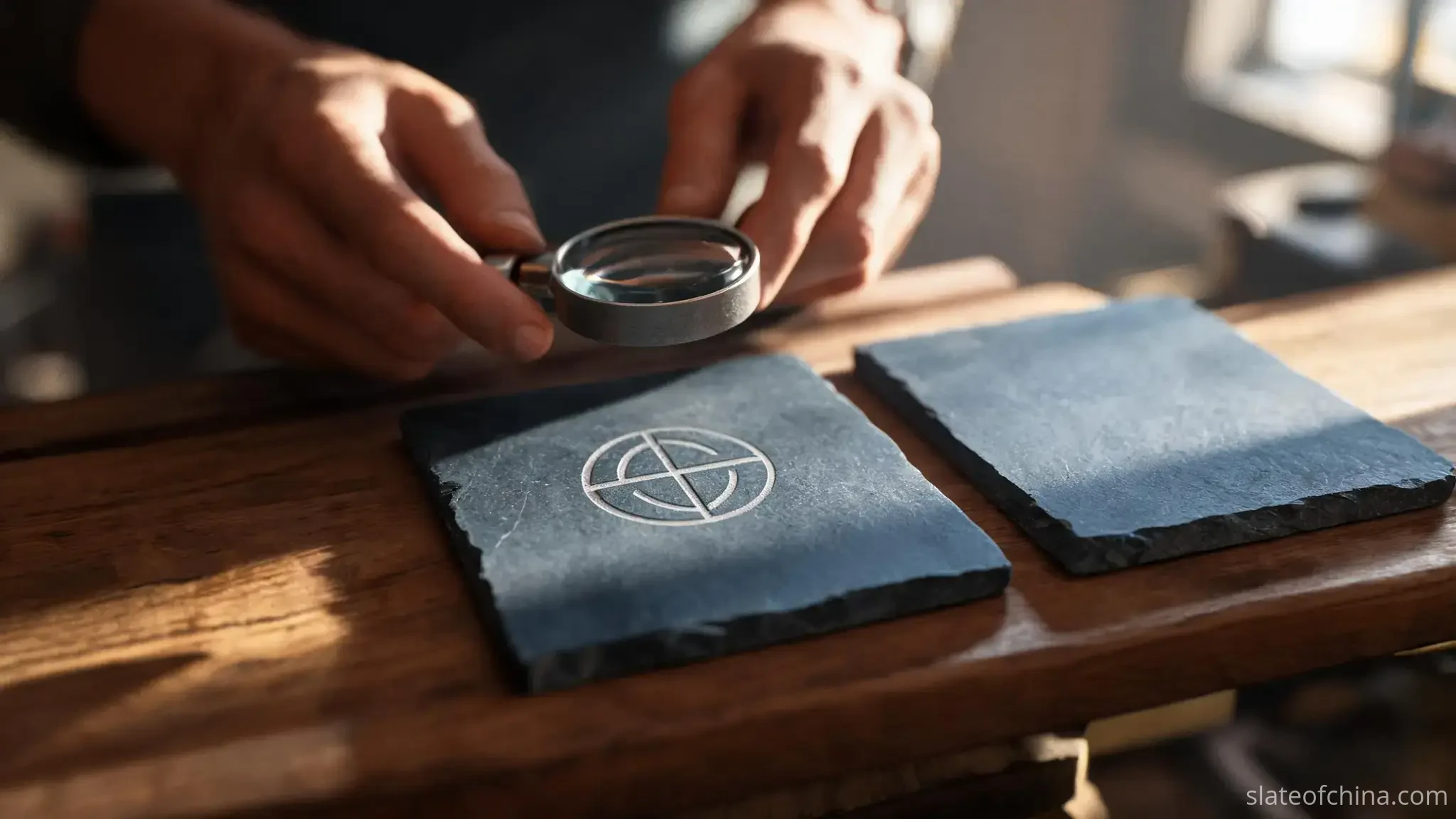
The sample is where the route finally speaks. Stone removed, or layer added — five checks, one of which always decides the order.
Use, Care and the Care Card
Durability is not a property the mark brings with it; it is a match between the route and the life engraved slate products lead. Six questions, answered before the order is placed, prevent most disputes before they exist:
- Does the piece live indoors continuously, or face the weather at an entrance or terrace?
- Will it stand under condensation from glasses, splashes from service, or repeated washing?
- Is it in direct contact with food and drink, or only near them?
- What cleans it — mild soap, a spray detergent, a sanitiser, a dishwashing machine?
- How often is it handled, and by whom — once a week by a careful owner, or all day by a bar team?
- Does the piece carry feet, backings, coatings or adhesives that age at their own speed?
The answers belong on the care card the product ships with, and the care card belongs in the specification, because it is the quiet half of the product brief. A printed table piece sent into hospitality with "dishwasher safe" printed on the sleeve is making a claim only the ink system can honour; an engraved gift piece whose card says "wipe with a damp cloth, avoid abrasive pads" sets expectations that keep the mark looking the way the sample did. Writing the care instruction is brand work: it is the sentence the customer reads the first time something goes slightly wrong, and it is cheaper to write well before the shipment than after the first complaint.
Where the Money Goes in Branded Slate
A branded slate price has two engines: the stone product underneath, and the mark applied to it. The stone side moves with size, thickness, shape and edge; the mark side moves with the process and the artwork; and the two interact through the quantity structure of the order. Six levers move most of the figure:
- Product size, thickness and shape — more stone, more machining, heavier and larger packaging downstream.
- Edge treatment — a sawn and honed edge is a different cost line from a hand-chipped natural one.
- Process and passes — per-piece laser time against one screen per colour against digital passes and underbase layers.
- Artwork complexity — large graphics, fine detail and multiple colours add preparation time or slow the process.
- Order structure — one design at ten thousand pieces amortises its setup politely; ten designs at one thousand each pay ten setups.
- Packaging and proofing — retail boxes, printed inserts, couriered samples and colour-matching rounds are real cost lines, and the ones quotations most often leave out.
That is also why branded orders are compared like for like, after agreeing what the unit price is carrying. A unit price quoted without the setup, the sample and the packaging is not a lower price — it is an earlier stage of the same price.
From Artwork to Production Release: The Order Sequence
A branded slate order runs through seven stations, and the discipline lives in the hand-over points between them:
- Define the product — stone, dimensions, edge, face finish, accessories. The marking surface is fixed here, before any mark exists.
- Submit the artwork — the file plus the seven decisions of the artwork section.
- Confirm the process — let the supplier recommend against the actual stone face, the artwork and the quantities, and explain the recommendation in process terms rather than in adjectives.
- Read the quotation — with revisions, as a full landscape: unit price, setup, artwork, sampling, packaging, and the split per design.
- Approve the pre-production sample — the first article, marked on batch stone, checked against the five gates of this guide and signed by both sides.
- Fix the acceptance criteria — marking position and size, the tone range or colour reference, the adhesion and cleaning tests, and the inspection basis for the run.
- Pack for the journey — interleaf and corner protection are brand protection: a chipped corner carrying the logo is still a brand complaint.
Repeat orders are where the paperwork earns its keep. A signed reference sample on both sides, the process settings or ink references the supplier records, and the acceptance criteria kept in writing let a second batch match a first without renegotiating the standard. And since laser and UV capacity in the crafts trade often runs at a partner facility rather than the supplier's own floor, who runs the marking step belongs in the conversation too — alongside the factory-versus-trading-company distinctions and the general sourcing route this guide covers elsewhere. Wholesale engraved slate products behave like everything else in the stone trade: the cheaper surprise is the one that never happens.
Both routes end at the same document — a signed sample and a written standard. Stone removed or layer added, the release sequence is identical; only the tests inside it differ.
What to Ask a Marking Supplier
The questions below are marking-specific; they slot in behind the ten general sourcing questions elsewhere in this guide, and each one should be answerable in process terms rather than in reassurance:
- Which marking processes can you actually run on this product, on this face — and which do you recommend, in one sentence of process reasoning?
- Can you show marked samples of comparable artwork on a comparable slate face?
- Can you reproduce this mark at this size, and what are your minimum line widths and text sizes on this finish?
- What file format do you want, and is artwork preparation included, quoted, or declined?
- How do you hold engraving tone or print colour from batch to batch, and how is that written into acceptance?
- Which durability tests — rub, moisture, cleaning, weathering — will you run, and which are charged?
- What are the setup terms: per colour, per design, and any minimums per variation?
- How do repeats work — retained reference sample, recorded settings, change notification?
The answers separate a marking supplier from a marking repainter — see the sourcing questions page and the supplier verification page for the wider evidence trail. A supplier who answers in the names of screens, inks, passes, settings and tests is describing a process. A supplier who answers only in quality, high precision and rich experience is describing something that cannot be checked — buyers should ask for measurable specifications, representative samples, documented inspection procedures and agreed acceptance criteria instead. The work order goes to the process.
Engraved and custom-printed slate products earn their place in a range when the mark and the stone behave as one article: chosen by route, specified in writing, proved on a marked sample, and shipped with a care card that tells the truth. The buyer's side of the work is compact — decide what the mark must survive, write those lines into the order, and refuse at ten samples what would be unacceptable at ten thousand pieces. Suppliers are used to buyers who stop at the logo; they remember the ones who ask about the stone.
Frequently Asked Questions
Is laser engraving or screen printing better for slate logos?
Neither leads in general; each leads for a reason. Engraving is the natural answer for a restrained single-colour mark that should look permanent and never lift, and for personalised pieces whose artwork changes from piece to piece. Screen printing is the natural answer when the mark must carry exact chosen colours at volume — same design, same inks, run after run. The route decides, stone removed or layer added, and the sample with the agreed tests confirms it.
Can slate products be printed in full colour?
Yes, where the supplier runs suitable digital UV printing on natural slate. Multicolour and photographic artwork generally print over a white underbase that lifts the colour off the dark stone, and the result depends on the printer, the ink system, the surface preparation and the face texture together. Approve a printed sample on the actual stone before ordering in bulk, and check the adhesion and cleaning tests alongside the colour.
Does laser engraving on slate fade or peel off?
Peeling is not the mechanism to worry about, because an engraved mark is uncovered stone, not an applied layer. What can happen is dulling — the exposed grey settles quieter as the surface wears, like the rest of the face — and damage to the piece itself through impact or abrasion. For demanding applications, the sample is tested against the intended cleaning and handling regime before the run, exactly as an ink would be.
Can one bulk order include several different designs?
Usually yes, with the terms named in advance. Screen printing carries a screen and a setup per colour per design, so multi-design orders often lean toward laser or digital printing, where changing the artwork between pieces costs little. State the quantity per design and ask for the setup terms per variation; a single total quantity across designs hides the structure the price is actually built on.
How do I keep branding consistent across repeat orders?
With instruments, not intentions: an approved and signed reference sample on both sides; a written specification covering the stone, face finish, mark size and placement; the tone range or ink references with their acceptable variation; the process settings the supplier records; and a change-notification clause. Repeat orders drift when the standard lives in one side's memory.
Are printed or engraved slate serving boards food-safe?
That is established for the finished article, not for the process. A printed surface puts the ink system, the curing and any coating inside the assessment; an engraved face adds no foreign material but still brings any sealer, feet and adhesives into scope, and the rules land differently by destination market. The supplier's documentation for the complete product and its intended use is the answer to buy against — and where doubt remains, presentation use with a food-safe liner keeps the mark and the menu apart.
Related Reading
Customization and Production Coordination
Slate of China works from the Jiujiang quarrying and processing base behind this guide. The availability of laser engraving, screen printing and UV digital printing depends on the product specification and the equipment a project requires; where specialised marking is carried out by a partner facility, the production arrangement is confirmed before the order is placed, with the partner running the marking step while Slate of China coordinates the specification, the sample approval, the agreed quality requirements and the export packing.
Slate of China can assess the slate product, the artwork, the quantity and the intended application, then coordinate the quotation, the sampling and the acceptance criteria for the project. The proposed marking method and the production arrangement are confirmed on the pre-production sample, before mass production begins.
Drawings and logo files are welcome at any stage of the decision, including while the marking method is still undecided — the checklist below shows what a complete enquiry carries.
Request a Quote for Custom Slate Products
Send the following information to help us evaluate your project:
- Product: coasters, placemats, serving boards, nameplates or other slate items
- Dimensions: finished size and thickness
- Customization: laser engraving, screen printing, UV printing — or an undecided option
- Artwork: logo file, drawing or reference image
- Quantity: total quantity and quantity per design
- Packaging: bulk packing, individual packaging or private-label retail packaging
- Destination: country and preferred shipping terms
Not sure which marking method is suitable? Send the product reference and the artwork first — we can assess the requirements and discuss the suitable options before sampling.