
Sustainability of Slate Quarrying in Jiujiang
No working slate quarry anywhere is environmentally free — not in Wales, not in Galicia, and not in the hills south of the Yangtze where this guide's slate comes from — and a page that tells you otherwise is selling you a mood, not a material. So this page will not open with a green statement. It opens with an accounting one: the environmental impact of slate quarrying in Jiujiang is real, specific, and — like every industrial impact — a question of management. What separates a responsible supplier from a careless one is not whether the impact exists. It is whether the operation that cut your stone understands it, controls it, and can show you the evidence.
What does the honest environmental picture of this industry contain? Open land, first: a quarry face is a landscape held open for decades, and no brochure closes it. Rock that never ships: extraction moves more material than any container sees — cover rock, failed blocks, offcuts, breakage, and the fine slurry that wet machining leaves behind. Water, which in this belt is spent mostly where machines grind, not where splitters work. Dust, noise, and the electricity that feeds the yard. And at the end, land that has to be put right — restoration, the one chapter of environmental management written after the revenue stops.
We ship slate out of this belt, so the account below is written from inside it — including the claims we make ourselves, which deserve the same test we apply to anyone else's. The test has three steps, and it is short enough to carry in your head: say, do, prove.
Quick Answer. Natural does not mean sustainable; natural moves the question to management. Every environmental claim a slate supplier makes stands on one of three rungs: what they say — a policy line, a brochure sentence; what they do — the settling basins, the sorted offcut piles, the sprayed roads that are there whether or not you visit; and what they can prove — permits in the right name, dated photographs, records kept across seasons. Slate's genuine strengths — long service life, unfired processing, salvageability — are real. They are also conditional. The rest of this page is the test.
Say, do, prove runs through everything below: waste, water, dust and energy, quarry restoration, the paperwork — and eight questions that survive translation into a supplier's answer.
Say, Do, Prove: The Test That Travels
Rung one is speech. The environmental policy on a website, the green paragraph in a catalogue, the certificate framed in the meeting room. Speech is free, which is exactly why it settles nothing — though it is not necessarily dishonest. Often it describes an intention, or a purchase that has not yet been made. Sometimes it describes somebody else's factory.
Rung two is practice: physical things that exist on a Tuesday afternoon when nobody is visiting. Collection gutters under the saws. A row of settling basins. Offcuts sorted by size instead of bulldozed into a heap. A water bowser wetting the haul road before the wind picks up. Practice costs money and changes behaviour, and it is the first rung that means anything.
Rung three is proof — the artefacts that honest practice leaves behind: documents carrying a facility's name and a date, photographs of the same basin in different seasons, monitoring records, transfer notes for what was hauled away. Proof is what cannot be improvised the week before an audit.
The three rungs, in one table:
| Rung | What it looks like | What settles it |
|---|---|---|
| Said | "Closed-loop water." "Zero waste." "Fully restored." | Nothing on its own — words are free |
| Done | Basins, pumps, drainage channels, sorted piles, sprayed roads | A walk through the yard — or dated photographs of one |
| Proven | Permits with facility names, monitoring records, sludge transfer notes, restoration images across seasons | Third parties, dates on paper, and time in the photographs |
Take the most common brochure sentence in stone processing — "closed-loop water, zero discharge" — and run it down the ladder. Saying it takes one line in a PDF. Doing it means a chain of hardware the water has to pass through, and a routine for removing what settles out. Proving it means the basins exist on a date you can see, the sludge goes somewhere with a paper trail, and someone can say where the losses go — because every loop leaks: to evaporation, to cleaning, to the moisture that leaves with the sludge cake. A supplier stuck on rung one has not necessarily lied; they may simply be describing an aspiration. But a buyer who stops at rung one has not assessed anything. They have collected a slogan.
One property makes the test useful in this trade: it travels. It needs no technical vocabulary, survives translation, works over email and video call alike — and it can be announced to a supplier in advance. Tell an honest one that you are going to ask at three levels and you will receive less paper and better answers. Tell a careless one, and the documents stop arriving — which is also an answer.
The Rock That Never Ships
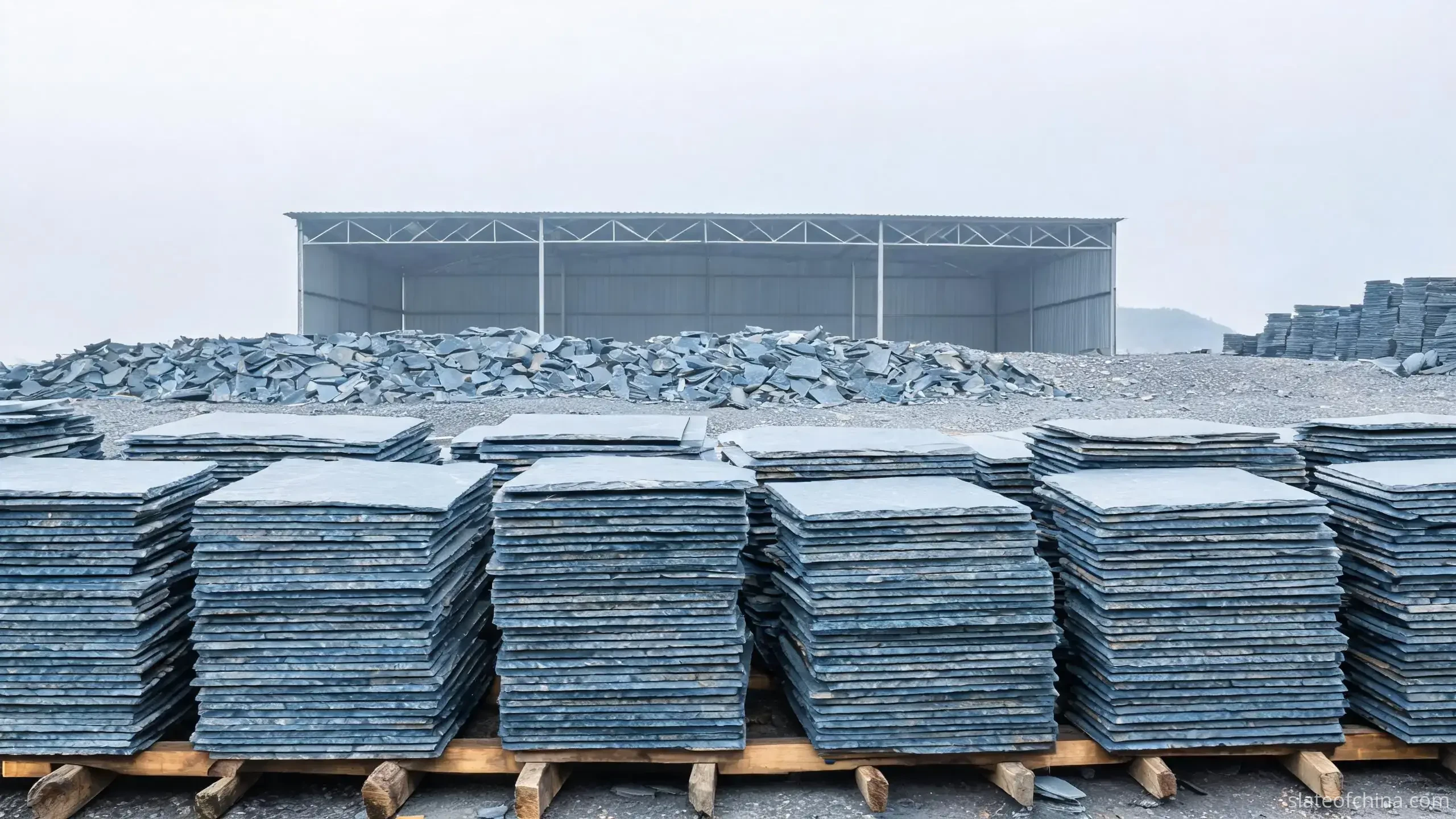
A slate deposit is not a warehouse of finished tiles with rock around it. It is rock, and most of it is not destined to ship. Extraction peels the cover and takes the beds that pass selection; the rest stays — and what stays has names a buyer should know, because each name starts a different management story. Overburden: the soil and weathered material moved before useful beds are reached, stockpiled and, where conditions allow, reused on site. Failed blocks: material that geology, not laziness, rejected — fractured, unsound, off-colour. Offcuts: the trimmings of turning big stone into specified sizes, which is to say the arithmetic of every order ever cut. Breakage: stone that had a future and lost it to a forklift. And in the wet lanes, sludge — fine mineral suspended in cutting water, neither rock nor water, and the least glamorous entry in the whole account.
What separates a managed yard from a heap is mostly decision-making — slate quarry waste management is largely choices made months before anyone says the word environment: how well the deposit was read before cutting started; whether block selection matched the dimensions actually ordered; whether cutting layouts were planned per order or improvised on the bench; whether handling discipline exists, since every dropped tile has already consumed rock, water, electricity and wages — breakage is never free. Waste and expense share a long border, and most yards patrol that border for the second reason first. Nobody in this trade should apologise for that; incentives that point the same way are what make improvements durable.
Where the leftovers go next is where honesty becomes concrete. Usable offcuts can step down into smaller formats — smaller tile sizes, paving, walling, garden stone — wherever a market exists for them. Hard fragments can go to permitted mineral uses where the technical requirements and the local rules allow. But not everything has a second life: badly fractured material may have no economic use at all, and sludge is a chapter of its own — settled out, dried, and dispositioned under whatever the applicable rules say, with a composition check before anyone claims a reuse for it. The distinction that matters to you is the one a serious operator can draw without flinching: reused, stored pending a use, or disposed of under rule. Three different outcomes. A supplier who folds all three into the word "recycled" has flattened an account into an adjective.
In the brochure: "Zero-waste quarrying."
On the ground: every quarry moves more rock than it ships. Managed operations sort the difference at the source — usable offcuts by size, fragments by permitted route, sludge under its own rules.
Ask to see: the sorting area of the yard, and a straight answer about where each pile goes next.
Nor does the account end at the stone. Export packing is a modest but real waste stream — timber, strapping, corner protection — and it answers to the same discipline as the rock: crates designed for the cargo rather than improvised around it, as the packing and shipping page of this guide shows in detail. The extraction steps themselves, in order, are walked through on how Jiujiang slate is quarried; this page concerns itself with what they leave behind.
Water Runs in a Loop, Not a Circle
Two facts organise the water question in this belt. The first is universal: stone is cut wet because heat and dust both have to go somewhere — water cools the blade, carries the fines away from the cut, and keeps dust out of the air at the source rather than filtering it back out later. The second is local, and buyers who know it ask better questions: Jiujiang runs two kinds of production on one material, and they spend water very differently. The roofing lane lives on cleavage — blocks split along the grain in sheds that are, for most of the process, dry work. The machining lane — the saws, grinders and machining centres that flatten and dimension table beds — is where the water is actually spent. The practical consequence: the water account of a table-bed order centres on the machine hall; the water account of a roofing order centres on the yard, the roads and the drainage, rather than on the tiles themselves. The two-lane layout of the region's sheds and halls is described on the quarries-and-processing page of this guide.
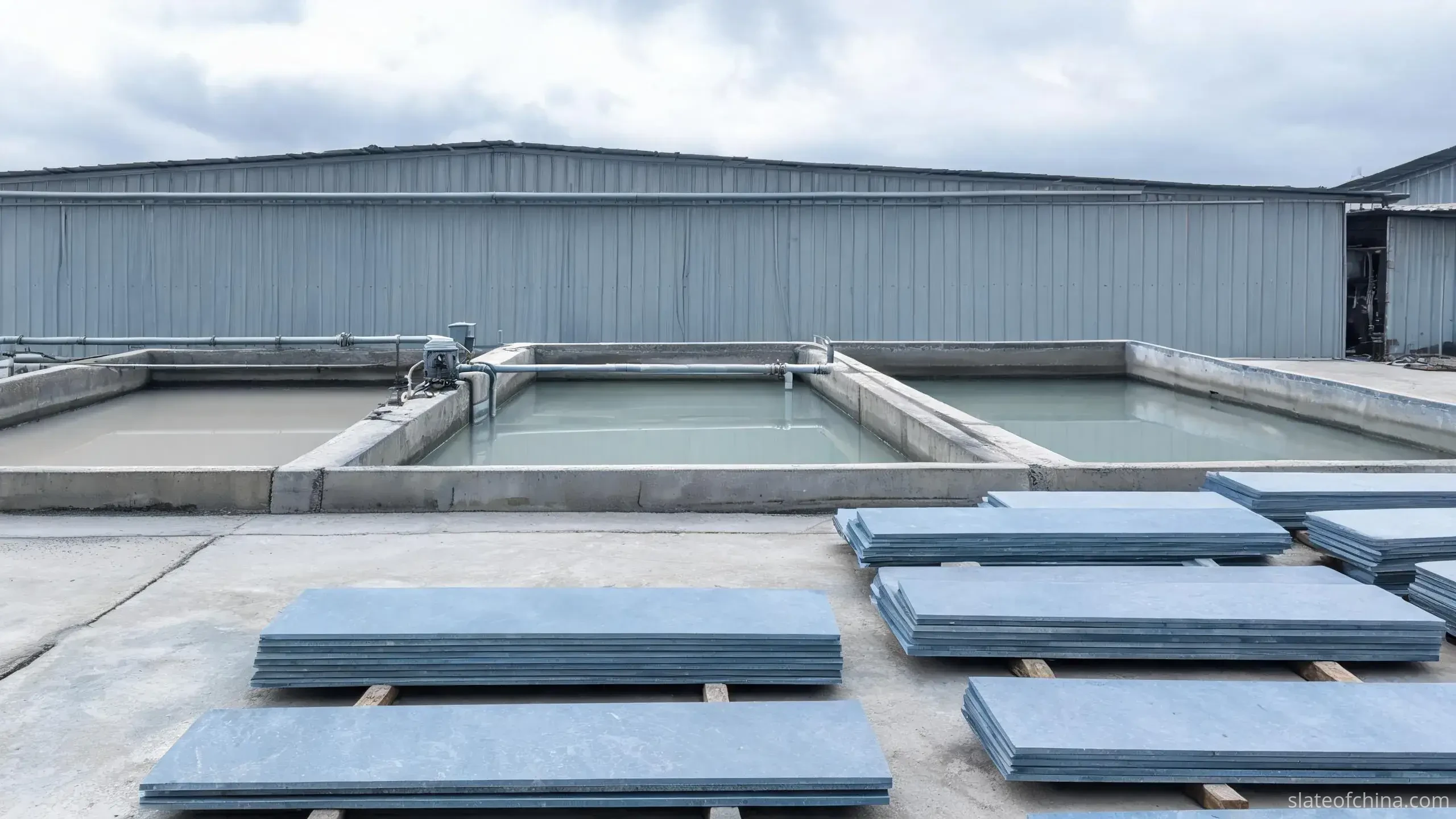
In a machine hall that takes water seriously, it runs in a loop — and the loop is simple enough to hold in your head. Water goes to the saws. Used water, clouded with mineral fines, runs down collection channels rather than into a ditch. It drops its load in a sequence of settling basins, each calmer than the last. The clarified end of the sequence is pumped back to the machines. What settles out does not vanish: it accumulates as sludge, and at intervals it is dredged, dried and hauled to a disposition the applicable rules recognise. Every station of that loop is a physical object a camera could find.
Now the sentence that keeps this section honest: a loop is not a circle. Water leaves every recirculating system — to evaporation in summer, to cleaning, to the moisture that rides out with the sludge cake. A well-run loop genuinely reduces both the fresh draw and the sediment that could reach a watercourse, and that reduction is worth having. It is not zero, and water recycling in slate processing is an operation, not an installation: the difference between the two is maintenance, season and whoever is in charge of the pump. So when a supplier quotes a recycling rate — any rate — the number itself is not the answer. The answer is the follow-up: how is it measured, over what period, and where do the losses go? A settling tank proves a system exists. Operation proves it works. Neither one is a slogan.
In the brochure: "100% recycled water."
On the ground: recirculation cuts the fresh draw and the sediment risk — and still leaks to evaporation, sludge moisture and cleaning, season after season.
Ask to see: the basins (dated photographs do fine), the sludge storage area — and permission to ask where the dried sludge is taken.
Dust, Noise and the Electricity Bill
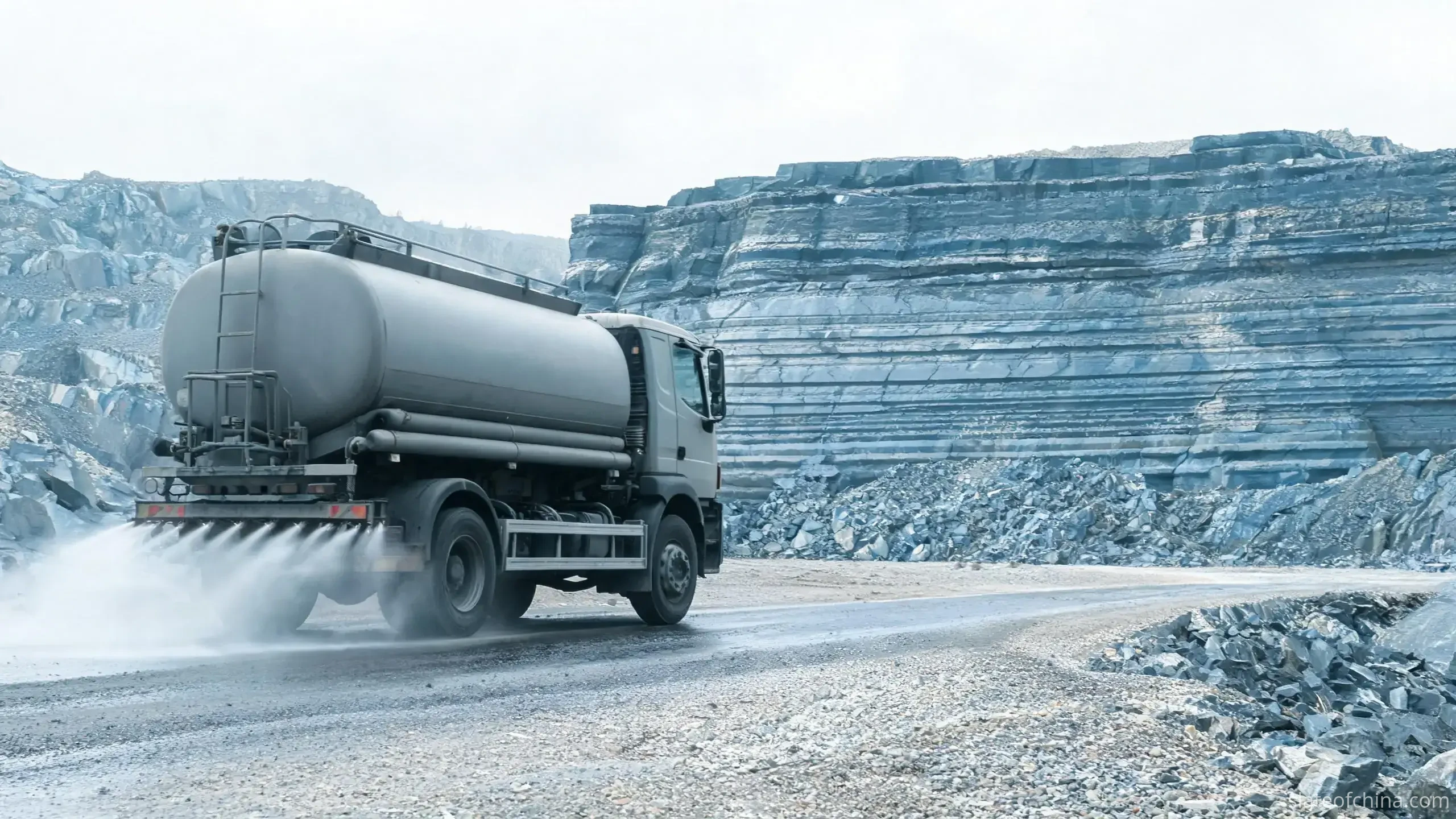
The shorter chapter, kept short because its controls are mostly things you can see with a visitor's eyes. Cutting happens wet, which settles most airborne dust at the source. The noisy machines live inside halls rather than in the open air. On dry days someone drives a water bowser along the haul road, so the wind does not carry the yard to the neighbours. And maintenance, which is an environmental control wearing overalls: a dull blade screams, cuts slow, draws more power and breaks more edges — most noise complaints and dust complaints in this trade trace back to a machine somebody stopped listening to.
Energy sits in the same account in quieter handwriting: extraction machinery, saws, grinders, pumps, loaders, the lamps over the sorting tables. The honest unit is not kilowatt-hours per site but energy per delivered unit — the electricity already spent on every square metre of roof, every table bed, that leaves the gate. Breakage is where the two chapters fuse, because a tile that breaks in handling wastes its own share of rock, water and electricity at once, and the account charges it twice — once as waste, once as the energy that must be spent again. Which makes careful handling quietly one of the greenest measures in this trade: nothing to install, nothing to stamp, just stone that survives its own factory.
The Slow Half of the Promise: Quarry Restoration
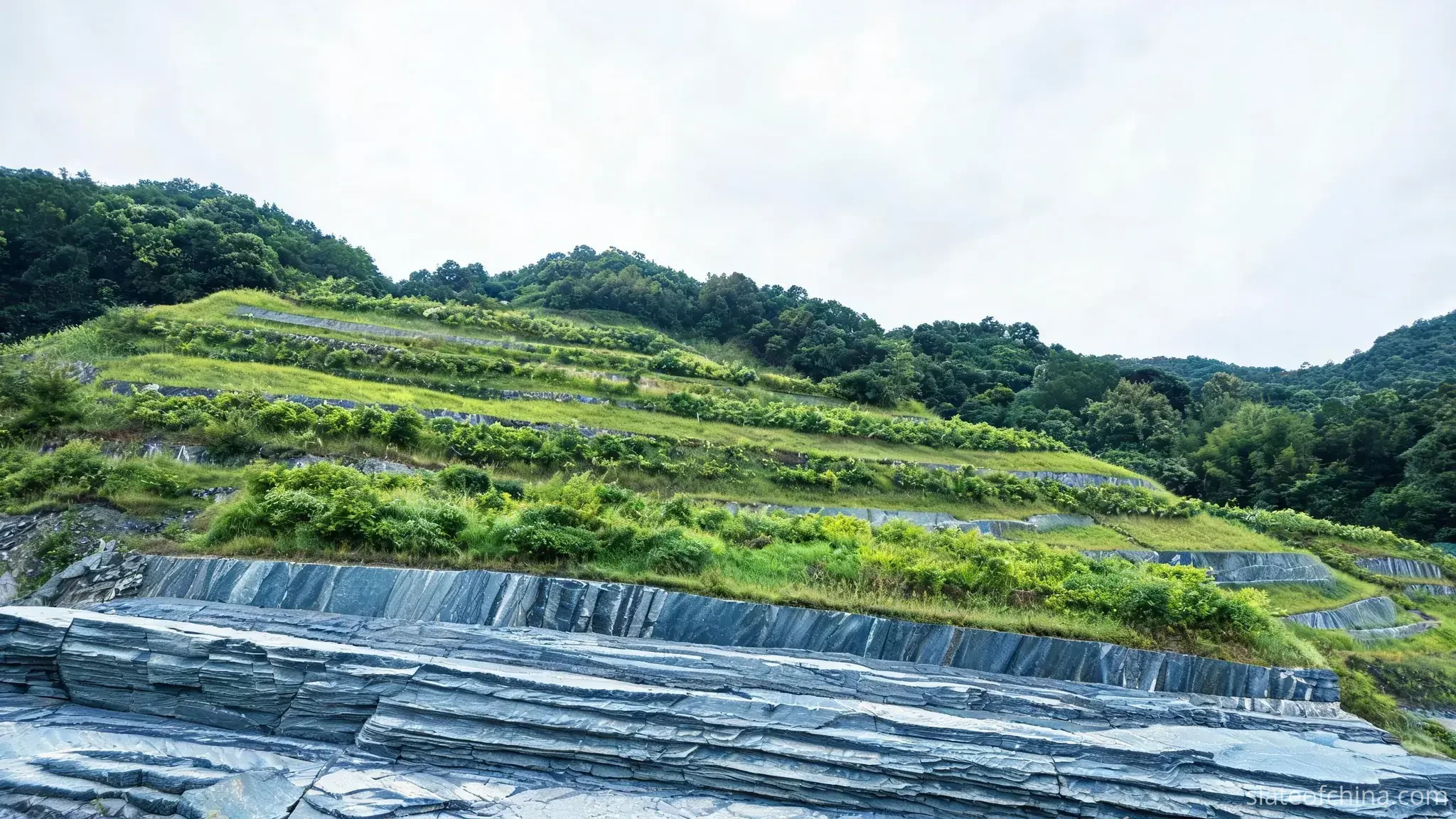
Restoration is the environmental chapter written after the revenue stops, which makes it the truest test of whether an operator's earlier words meant anything. A face is worked for years; the trucks stop; and the land then answers a question the brochure never asked — what now? What good restoration actually does is specific and unheroic. It takes slopes to a stable angle, so loose rock stays where it is. It manages the drainage, so a storm runs off as sheet flow rather than a sediment plume. It returns soil where the site kept any, and establishes vegetation that local conditions will accept. The result is land that is safe, stable and quiet — not land as it never was.
That last clause is the honesty test, because restoration is not a rewind button. The original hillside does not come back — geology does not run in reverse — and a restored quarry is a new landscape with old rock in it. Some faces, too steep to re-shape at sane cost, are left as rock with a stabilised crest and toe. Benches are the workable ground: grade them, soil them, green them. The old faces of this belt — some untouched for decades, now greening on their own — sit at one end of that spectrum, and the facilities page of this guide shows one and tells its story. A managed closure sits at the other end. Most real sites live somewhere between leaving and landscaping, and an honest supplier will say which kind of site your order depends on.
Which turns restoration from a promise into paperwork — and the paperwork comes in three very different depths, the same ladder again. A restoration plan is a document describing an intent; in China's system it is legally meaningful, but it describes the future, and futures are cheap. Restoration work under way is visible mid-operation: drainage being cut, benches being graded, soil being spread — photographs with dust on them, not renderings. Restoration holding up is the rarest and only conclusive kind: the same slopes photographed after seasons have passed, vegetation still established, drainage still running, no fresh scars. A photograph from one afternoon proves one afternoon.
In the brochure: "Fully restored quarry."
On the ground: slate quarry restoration stabilises slopes, controls run-off and puts vegetation back. It does not rebuild the original hillside — and a plan only describes the future.
Ask to see: staged photographs with dates on them, ideally across more than one season, and the closure obligations attached to the site.
For slate specifically, the long view helps: what actually runs out of a belt like this — and what "reserves" does and cannot promise an individual order — is a question the reserves page of this guide takes up. But the sequencing is worth noticing here, because a region that knows its resource arithmetic is also more likely to have planned its endings: both require the same unpopular habit of looking past the next container.
Whose Name Is on the Paper
In China's system — as in most systems — the documents that matter to a quarry's environmental record do not travel together, and none of them is a business licence. Extraction sits under mineral-resource approvals. Discharge and site impacts sit under environmental acceptances and the conditions attached to them. Land, safety and transport each have their own instruments. Each document carries a holder's name, and a supplier who shows you one impressive red-stamped page has shown you one page of an account with several.
The second complication is structural, and Jiujiang shares it with most stone regions: the roles are separate companies. A quarry works the face. A processor buys blocks and runs the sheds and halls. An exporter coordinates documents, packing and freight. Which hats your supplier wears — and which it doesn't — is untangled on the factory-vs-trading-company page, and it matters environmentally for one reason: documents attach to facilities, not relationships. The environmental file of the yard that cut your order belongs to that yard, whoever sells you the result. The industry page of this guide maps who does what between quarry and quay, link by link.
From that structure follow five practical separations, worth carrying into any document review. A registration is not a permit, and a permit is not an environmental acceptance. A processing factory may buy its blocks from quarries it does not own — common practice, and not a fault, but it means a quarry's record remains the quarry's record. Documents from one site say nothing about another, so ask for paper that matches the facility that will actually touch your order. Certificates carry a scope, a validity and an issuing body; read all three before reading the title. And documents age — conditions get added, permits get renewed — so the honest question is never "do you have paper?" but "what is the current state of the paper?"
The direction of travel, for what one desk's view is worth, is visible in the surviving operations themselves: fewer, larger, better-documented sites, and an appetite for paperwork that would have seemed unreal a generation ago. That is not a certificate and should not be mistaken for one. What it means for a buyer is simpler: the questions below are easier to answer here than they used to be — and a supplier who still cannot answer them has told you something. The general verification procedure — how to test a Jiujiang supplier without visiting China — is set out elsewhere in this guide; this page supplies the environmental questions you load into it.
The Other Side of the Account
An honest ledger has two columns, and so far this page has only debited. So — what does slate itself bring? Three genuine credits and one honest deduction. The first credit is service life: a roof laid in well-selected, correctly specified and properly installed slate is not a consumable, and actual life depends on slate quality, climate, roof design, fixing and maintenance — which is why this page says conditions rather than years. The environmental logic of durability is arithmetic, not sentiment: a roof you never remake never remakes its impacts.
The second credit is the shortness of the processing chain: slate is quarried, split and cut — it is not synthesised, and it is not fired into being; there is no kiln anywhere in its story. The third is salvageability: slates come off roofs and go back onto them, which makes reclaimed slate a functioning market rather than a theory — a chapter this site tells elsewhere.
The honest deduction is transport. Stone is heavy, and export stone crosses an ocean; that cost is real and per-unit efficiency is the honest lever a buyer actually controls — a full, well-planned container spreads it in a way a half-empty one does not, and how containers are planned and loaded at this end is documented on the freight page. The material-level audit — extraction through end-of-life, with the number-work that embodied-carbon questionnaires demand — is not this page's job. It is done properly on the roofing side of this site: the five-stage sustainability audit and the environmental-impact walkthrough. What buying from Jiujiang adds to those pages is not a different material. It is a management layer: the same stone, cut and documented by a particular set of hands, whose practices you are entitled to test at the rungs above.
Notice what both columns share, though: nothing in the credits column is automatic. Durability is earned by selection and installation. Salvageability is earned by careful removal. Transport efficiency is earned by disciplined loading. All three are management outcomes — which is why this page has spent its length on management, and only this section on the material.
Eight Questions That Survive Translation
Environmental questionnaires cross a language gap, and abstract questions come back as abstract answers — "green", "compliant", "environmentally friendly", each about as informative as a smile over a video call. The questions below are built to come back as nouns: a basin, a name, a date, a pile, a photograph. Ask them by email, and judge the specificity of the answers, not their warmth. Pace them, too — two or three in the first exchange, the rest only after the first answers have earned the next questions.
- Which quarry will our blocks come from, and who holds the extraction approval for it?
- Which operations in your processing use water — and which facility performs them?
- Is the process water recirculated — and where does the sludge that settles out go?
- How are stone offcuts handled at this yard: reused, stored, or disposed of — and by whom?
- What dust controls run at the saws, and on the yard roads on a dry day?
- Which environmental documents can you share with us — and in whose name are they issued?
- When extraction at the site ends, what is the approved end state — and has any restoration work actually started?
- Could you send dated photographs of the settling system, the drainage channels, and the offcut storage areas?
The first thing a good answer contains is a noun — "the middle basin", "the north yard", "the transfer note from last quarter". The first thing a weak answer contains is an adjective. That distinction survives every translation in this trade, and it is the fastest filter between a sustainable slate supplier in China and a well-worded one. The rest of the pre-purchase question set — specification, quality, commercial terms — lives on the questions-to-ask page, and the verification procedure shows how to pace the whole exercise across a real order.
Our Own Entry in the Account
A page like this, written by a supplier, owes its readers one more paragraph of plainness. Here it is. We are an exporter and sourcing house, not the owner of every facility our orders pass through — the layers of that chain are mapped on their own page — and our own environmental claims should therefore be read with the same ladder as anyone else's. There are things we can speak for directly: which quarries and yards an order involves, what documentation exists for those facilities, what the packing uses, what the freight plan is. Those are coordination facts, and coordination is our actual job.
There are things that are not ours to claim, and pretending otherwise would put us one rung up the ladder from where we stand. Site-level rates belong to sites. A specific quarry's restoration state belongs to that quarry, and a facility's monitoring record belongs to that facility. When a questionnaire asks us for a number we cannot support, you will get the honest answer — that it has to come from the facility — along with the name of the facility and the question it should be asked in. We would rather lose a fast order than win one with a slogan.
If that is the kind of answer your project needs, we think we will get along.
Frequently Asked Questions
Is slate an environmentally friendly building material?
It can be, and the material starts with real advantages: it is quarried rather than manufactured, its processing chain is short because slate is never fired, a well-selected and well-installed roof serves for generations, and slates can be salvaged and relaid. None of that is automatic. The environmental performance of a slate product depends on how the quarry read its deposit, managed its waste and water, handled its land obligations and documented the lot. Natural origin is a starting position, not a score.
Does slate quarrying produce waste?
Yes. Overburden, rock that fails selection, offcuts, breakage and processing sludge are all real, and no quarry ships everything it moves. The useful question is what the operation does with the difference: which offcuts step down into second products, what is stored pending a use, and what is disposed of under the applicable rules. A supplier who can hold those three categories apart is describing a managed yard; one who folds them all into "recycled" is describing a mood.
Can water be recycled in slate processing?
In suitable facilities, yes. Used cutting water is collected, the mineral fines are settled out in a sequence of basins, and the clarified water returns to the machines. Recirculation genuinely reduces both the fresh-water draw and the sediment risk — but a loop is not a circle: water still leaves through evaporation, cleaning and the moisture carried away with the sludge. What to check is not whether a settling tank exists but how the loop is actually operated, and where the sludge goes.
What does quarry restoration actually achieve?
It stabilises slopes, manages drainage, restores soil where the site kept any, and establishes vegetation. What it does not do is return the original hillside — a restored quarry is a new landscape, not the old one. A restoration plan is only a description of intent; work under way, and work that has held up across seasons, are different and rarer things. Dated, staged photographs of the same slopes are the evidence that travels.
What environmental documents should I request from a slate supplier in China?
It depends on the order, but the useful pattern is: extraction approvals for the quarry, environmental documentation for the processing facility, and any certificates read for their scope, validity and issuing body — all matched to the facilities that will actually touch your order. Documents belong to sites, so paper from one quarry or yard proves nothing about another. The names, dates and scopes on the documents matter far more than the number of documents.
Does buying directly from a manufacturer make sourcing more sustainable?
Not automatically. Direct trade can shorten the communication chain and make facility-level questions easier to ask — which helps — but the environmental record belongs to the facilities, not the relationship. A manufacturer may buy its blocks from quarries it does not own, in which case the quarry's record is still the quarry's record. Run the same say-do-prove test on any supplier; the desk that answers in nouns rather than adjectives is the one worth deepening.
Related Reading
Bring the questionnaire, not just the order.
Environmental questions are welcome as first questions in this trade, and they travel surprisingly well over email. Name the product and the destination market, and the desk will identify the facilities the order would involve and establish which site-specific documents can be verified before you place it — both lanes included:
- Roofing — tile format, thickness band, the destination market's test language, and any of the eight questions above, asked of the yards your order would run through.
- Billiard — table type, drawing and hole layout, thickness and panel matching, plus the documentation trail of the facilities involved.
Browse the roofing slate range or the billiard slate range, or send the questions straight to the desk — whichever arrives first. If your questionnaire has boxes we cannot tick honestly, we will tell you which boxes, and why, before you have to find out the slow way.