
OEM Billiard Slate Manufacturing Process: From Drawing to Container
Ask our production office what an OEM order is actually made of, and the answer will not be “slate”. It will be a file. Between the first inquiry email and the sealed container, one drawing is opened, questioned, corrected, frozen, set up at the machines, measured against, and finally compressed into the marks that travel with the pallets. The panels themselves are cut once. The drawing is used a hundred times.
OEM billiard slate manufacturing is the process of producing slate table beds to a customer’s own specification rather than to a factory stock size — from specification confirmation and drawing review, through sample approval, raw slate selection, CNC machining and surface grinding, to inspection, packing and container loading. This page walks that process one stage at a time, from the production office rather than the sales office: what each stage decides, what the factory owes the buyer at each stage, and where orders go wrong when a stage is skipped.
Most of an OEM order’s life is decision-making, and the manufacturing — the part people picture first — is the disciplined repetition of decisions that were already made. A specification that was never truly settled does not disappear when production starts. It simply gets re-made, panel by panel, by people who never agreed to it.
AN OEM ORDER, READ AS DECISIONS
Specification — what the bed has to be. Agreed in writing before any stone is touched.
Drawing review — whether it can be made as drawn, in this material, for this table.
Sample — whether two companies are pointing at the same object.
Material — which stone can carry these dimensions honestly.
Production — no new decisions. The agreed ones, repeated panel after panel.
Inspection — whether the stone matches the drawing, and whether the record proves it.
Packing and loading — how the set’s identity travels to your warehouse.
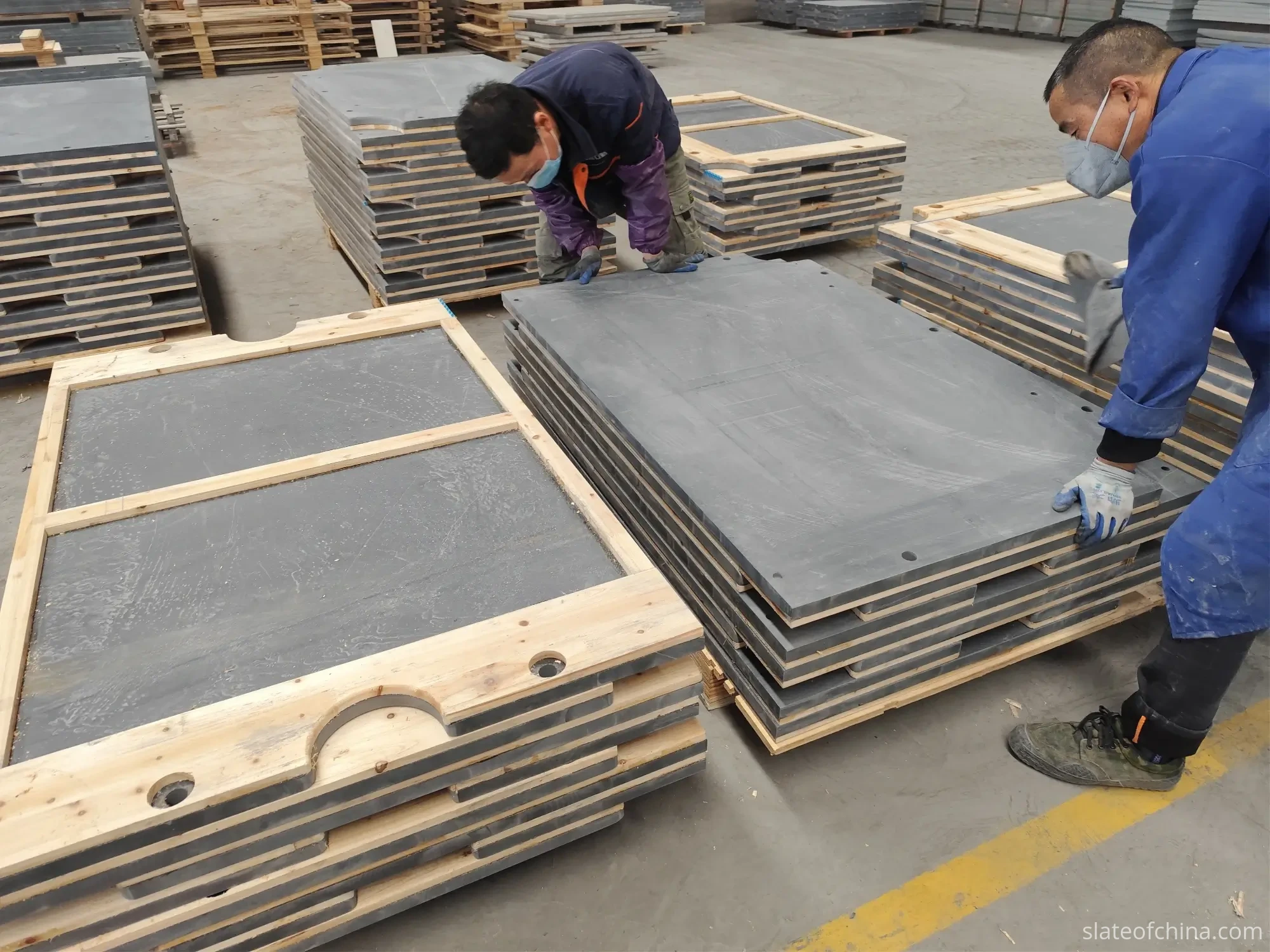
The OEM Billiard Slate Manufacturing Process at a Glance
Stripped to its sequence, one OEM order moves through ten stages. The early stages make decisions; the middle stages repeat them in stone; the last stages prove the result and move it:
- Specification Confirmation — the table’s requirements become a written slate specification
- Drawing Review — dimensions, thickness, hole pattern, pockets and tolerances interrogated and agreed
- Sample / First Article — the agreed drawing gets a physical body to point at
- Raw Slate Selection — blocks and slabs chosen to carry the drawing’s largest piece honestly
- Cutting — panels cut to production allowance for the grinding that follows
- CNC Machining — pockets, mounting holes and edge work machined from the drawing’s datums
- Surface Grinding — the playing surface brought to the specified flatness and finish
- Joint and Edge Processing — multi-piece sets prepared to meet as one surface
- Quality Inspection — dimensions, thickness, flatness, machining and surface judged against the drawing
- Packing and Container Loading — each set protected, identified and loaded against the plan
Notice that stages five to eight add no new decisions. That is this page’s whole argument compressed into one line: specification, review and sample decide; cutting, machining and grinding repeat what was decided; inspection, packing and loading prove it and move it. The sections that follow walk the same journey with the reasoning attached.
What Is OEM Billiard Slate Manufacturing?
Buying standard billiard slate means choosing from sizes a factory already makes, to dimensions the catalogue already owns. An OEM order works the other way around. The bed is defined by the customer’s table design — overall dimensions, playing area, thickness, piece count, hole pattern, pocket geometry, edge treatment, surface finish — and the factory builds its process around that definition rather than around its stock list.
What makes it OEM is not complexity. Some OEM drawings are simpler than our catalogue sizes. It is ownership: the specification belongs to your table, not to the catalogue, and every later decision in the order traces back to it. A three-piece pool bed, a five-piece snooker bed, a custom Chinese 8-ball specification, a one-piece carom bed — the piece-count decision and every other choice in the chain belongs to the drawing, not to habit.
For the supplier, that changes the job. A stock-size producer has to be good at stone. An OEM billiard slate supplier also has to understand how a bed fits a table: the frame it sits on, the cloth that goes over it, the cushions it meets, the leveling it will live through, the installation it must survive. The slate is not an isolated product — its dimensions and machining have to match a cabinet the factory may never see. How that relationship works over years and repeat batches, rather than over one order, is the subject of the OEM supply guide; this page stays inside a single order.
The Specification Conversation
Every OEM order begins with something incomplete — not because buyers are careless, but because a table manufacturer knows its tables, not our machines. “9 ft pool slate, one inch, three-piece” is a sentence that starts a conversation; it does not end one. Two table brands can build what they both call a 9 ft table and need two different beds. The name is a label, not a manufacturing specification.
What the factory sends back matters as much as what arrives. In our production office, the reply is rarely a price first — it is questions, and every question has a machine somewhere behind it. Where are the mounting holes measured from — which edge, which datum? Is the pocket a simple radius or a shaped opening, and to which reference line? Which edge carries the frame? What does the drawing say about billiard slate thickness — one number, but measured where, and held to what tolerance, checked with what method? A tolerance with no measuring method attached is a wish with a decimal point.
Where the incoming drawing is incomplete — a CAD file (.dwg) missing its datums, a PDF without hole coordinates, a photograph of an old bed — our job as a custom billiard slate manufacturer is not to fill the gaps silently with habit. It is to turn what arrived into a full dimensioned proposal, mark every assumption, and send it back for the buyer to confirm or correct. The complete checklist of what a finished drawing should carry — outline, playing area, thickness, hole coordinates, pocket geometry, edge profiles, tolerances — lives in the custom manufacturing guide, and the standard specification page shows the sizes OEM projects usually start from. A drawing is worth more than a description, because language is a lossy format for geometry: the same words can shelter two different beds, and only lines and numbers settle the argument.
The output of this stage is written, and both sides recognise it: a specification that names dimensions, thickness, piece count, machining, finish, tolerances and their measuring methods, inspection scope, packing and marks. When that sheet exists, the order has something to be judged against. Until it exists, nothing downstream can be.
The Technical Review: Interrogating the Drawing
Before a drawing is “agreed”, it gets interrogated — by the people whose job is to find the exact place where this drawing and this material will argue with each other. Natural slate has grain, bedding and character; a dimension that is routine in steel or MDF can be delicate in stone. A hole specified close to an edge is the classic case: fine on the print, nervous in the rock, and the answer is decided here — datum shifted, position confirmed with the buyer, or the feature re-thought — not discovered at the machine.
The review walks the whole drawing against the whole process. Can the largest piece be cut from sound stone, and will it fit the pallet, the container door and the handling path between them? Does the pocket geometry suit real tooling, and do the tolerances carry a measuring method that actually exists on the bench — a question the tolerance guide treats in full? Is the piece layout something this material wants to carry at this thickness? Anything that fails here costs a red-pen mark. The same question asked after cutting costs a panel.
The review ends with a revision — for a first order, usually the first agreed revision of the drawing — and, where the project warrants it, a sample. “Agreed” has a specific meaning at this point: both companies are pointing at the same document, with the same revision number, and production will be judged against that document and nothing else. How a buyer structures that approval — and the trial assembly that proves the bed against the actual cabinet — is walked through from the buyer’s side in the manufacturer’s buying guide.
The Sample: Where a Drawing Gets a Body
For a first OEM order, the sample is the cheapest insurance in the whole process. Depending on the project it can be a full set, a single panel, or a machining sample that carries only the critical features — a pocket, a bolt-hole pattern, an edge profile, the specified finish. What the sample is matters less than what it does: it converts a shared opinion into a shared object. Two companies that have been agreeing in writing discover, over a physical piece of stone, whether they were pointing at the same thing. Usually they were. The exceptions are worth the entire exercise.
A sample is checked for more than appearance. Dimensions and hole positions against the drawing. Edge treatment as drawn. Joint condition where the bed is multi-piece, so the mating faces are read before there are three of them to align. The finish, and the natural character of the stone against the agreed appearance criteria — because a sample is also the moment to see what this quarry’s material actually looks like under this specification. Approval is recorded: dated, photographed, measured, attached to the drawing revision. From that point the approved sample is part of the order’s reference, alongside the drawing itself.
One practical note: a first sample is part of engineering, not an obstacle to it. And repeat orders can often run without a new physical sample — the approved record already exists. That quiet speed-up is one of the rewards of doing this stage properly once.
Choosing the Stone the Drawing Calls For
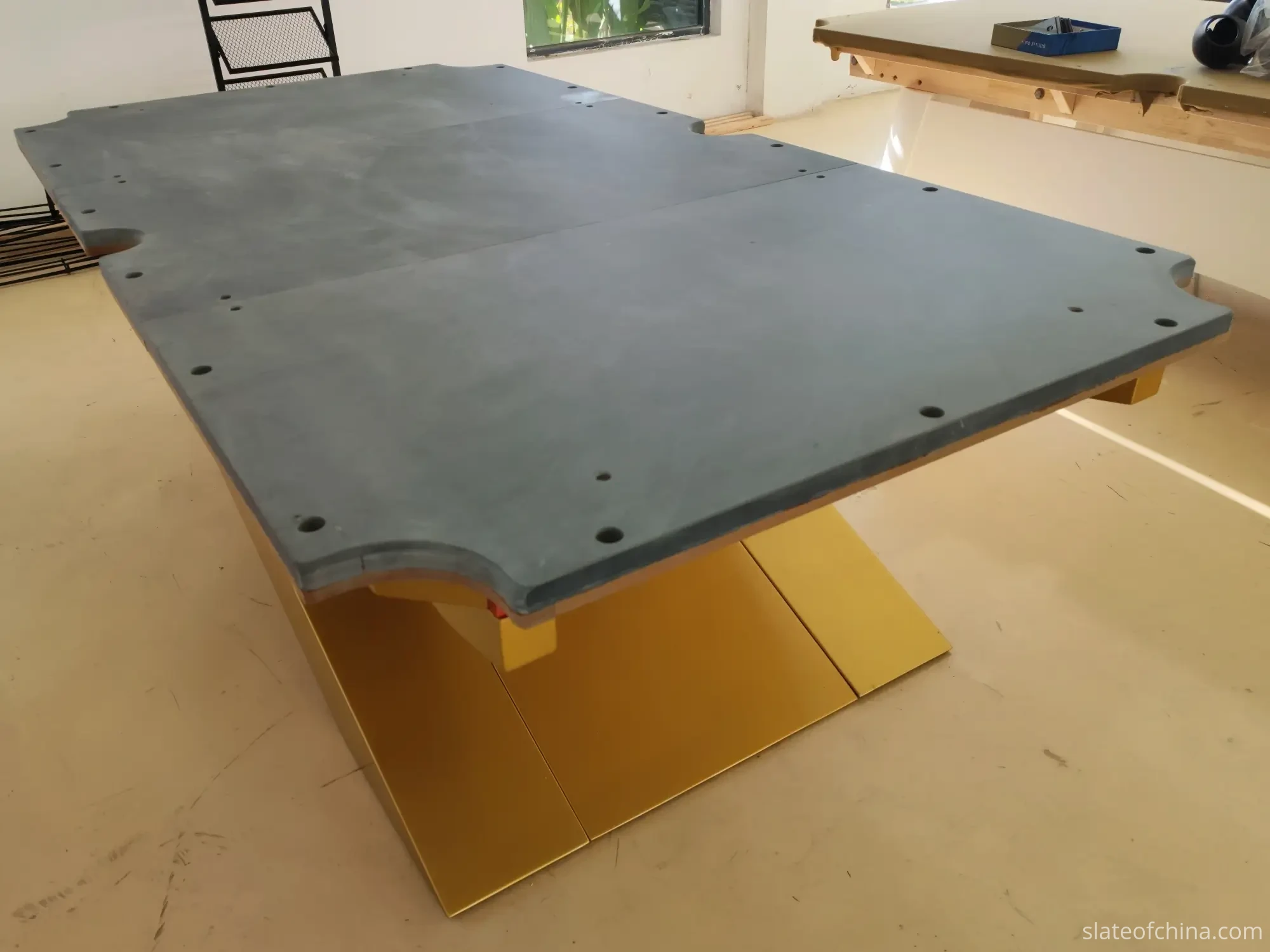
Once the drawing is agreed, material selection stops being a general question and becomes a specific one: which blocks and slabs can honestly carry these finished dimensions, at this thickness, while staying inside the appearance criteria that were written down. The largest finished piece decides the block. The thickness decides the slab. The acceptance criteria decide how much natural character may travel through to the finished bed — tone, grain, the quiet veining that is this stone’s signature rather than its fault.
Natural slate is a geological material, and two pieces from the same quarry face are not twins. For multi-piece beds the selection carries a second duty: consistency across the pieces of one set. A five-piece snooker slate should read as one surface under the cloth — five stones that were chosen to belong together, not five stones that happened to ship together. The full material background, from quarry block to finished bed, has its own start-to-finish page.
What an OEM buyer needs to know from this side of the fence is simpler: material selection is a production stage with consequences, and it happens after the drawing is agreed, not before. A factory that selects stone before the specification exists is building inventory. An order selects stone for a drawing it can name.
CNC Machining for OEM Billiard Slate: The Drawing Goes to the Machines
Now the part everyone pictures — and the shortest section of this page, because in a well-run OEM order production is deliberately undramatic. The sequence for an OEM bed runs cutting to allowance, CNC machining of the features the drawing calls for (pocket cuts, mounting holes, edge and joint faces), grinding, then the set-level work. What the machines themselves do — and what CNC brings to a bed — has its own machining guide; how the playing surface is ground flat has a grinding page; how the pieces of a multi-piece bed are made to meet as one surface is the story of slate joint alignment.
The OEM-specific point is not the machinery. It is what the machinery is fed. CNC does not re-interpret a drawing; it consumes it — the same datums, the same toolpath family, panel after panel, set after set. Production adds no new decisions. It repeats, as faithfully as stone allows, the decisions that were made before the first cut. Repetition is still a physical process, which is why the inspection stage later in this page exists. When the material argues with the drawing — a feature the stone declines to carry — the answer is not a silent workshop judgment. The finding goes back to the agreed specification, and whatever is decided lands in the order’s record, where the buyer can see it.
For the buyer, production is also the stage of evidence. Agree in advance what the order includes: progress photographs at defined points, machining photographs of the first panel of the batch, and the inspection records at the end. Evidence should be scoped like any other line of the specification. A factory that is running your drawing properly will not find it difficult to document.
Questions Buyers Ask While the Order Runs
How long does an OEM billiard slate order take?
There is no honest universal figure, because a first order spends much of its calendar before the first cut: specification confirmation, drawing review and sample approval together can rival the production and inspection time that follows. The reliable way to plan is to agree the sequence — drawing, sample, production, inspection, packing, loading — and let each completed stage move the next one rather than trusting a single promised date. Repeat orders run faster, because the decisions already exist.
Can the specification be changed after production starts?
Changes are always possible; free changes are not. Before material is committed, a change is an edit to a drawing. After cutting and machining begin, it means remachining or replacing panels, and the calendar absorbs the cost — stone cannot be un-cut. The professional route is a frozen revision before production, with any later change entering as a new revision, and a new sample where the change touches a machined feature.
What tolerances can be specified for OEM billiard slate?
The honest answer is: whichever ones you write down, each with its measuring method. On an OEM drawing the buyer and supplier agree the tolerance for each measured item — thickness, flatness over a stated measuring length, hole positions, overall dimensions — and each number carries the method that will check it. The ranges we work to and what our inspection records look like are on the quality and test data and tolerance guide pages; the manufacturing point is that a tolerance agreed in writing before production is the only kind that can be enforced at the inspection bench.
Can a first OEM order skip the sample stage to save time?
It can, and some buyers do — but the first full production batch then becomes the sample, at batch quantities instead of sample quantities. Whether that is a reasonable risk depends on how mature the drawing is and how much surprise the table design tolerates. On repeat orders the question usually disappears by itself, because the approved record already exists.
Will I see photos and inspection records while the order runs?
Agree on it before production, not during. Progress photos at defined points, machining photos of the first panel, and the final inspection records are normal parts of an OEM order — but they are evidence, and evidence should be scoped in the specification like everything else. What billiard slate inspection actually measures is covered in its own pages, from dimensions to flatness and the surface read.
What paperwork should arrive with an OEM slate order?
Alongside the pallets: a packing list that matches the pallet marks, the QC record naming the drawing revision the stone was judged against, and the approved drawing kept on file for repeat orders. The packing list, the marks on the pallets and the loading photographs should tell one consistent story — the same sets, the same numbers, the same identity. The import side has its own import guide.
Can OEM billiard slate be produced for snooker and carom tables too?
OEM production is not limited to one game. The same ten-stage process runs for pool tables (commonly three-piece beds), snooker tables (commonly five-piece beds), carom and Chinese 8-ball designs — the process does not change, the drawing does. Piece layout follows the table’s design, and its manufacturing consequences are covered in the piece-count guide for manufacturers.
Does a repeat OEM order go through the same manufacturing process again?
Not all of it — and that is the point. The office stages are inherited: the agreed revision and its records stand, so a repeat order normally enters at material selection. The floor stages re-run every time — stone is selected, machined, ground, inspected and packed batch by batch, each against the same frozen specification. How those batches are kept identical over years is the subject of the OEM supply guide.
Is OEM billiard slate more expensive than standard sizes?
Per panel, an OEM order usually carries setup that the catalogue does not: programming, fixturing, first-article checking. Those costs amortise across the batch, which is why OEM economics favour quantities, and why a prototype quantity and a production quantity are priced differently. Over a whole programme — including the cost of a bed that fits the cabinet versus one that merely approximates it — the comparison rarely stays simple.
Billiard Slate Quality Inspection: Judged Against the Drawing
Every measurement in an OEM inspection points at one document. Dimensions against the drawing — the thickness and dimensional check with its grids and datums. Flatness to the agreed method and measuring length on the flatness page. The surface read before packing — holes, chips, veins, finish. The mating faces of the set, which is the province of joint alignment. Hole positions and pocket geometry back to their datums. The inspection scope — full or sampling — is the one agreed in the order, and the record says which.
The question all of this answers is not “is this good slate?” It is “is this the slate that was agreed?” Those sound like the same question until a dispute, and then they are different planets. A panel is not fine in the abstract; it is conforming or not conforming to a named drawing revision — and the record is the receipt that says which one. What our measured QC data actually looks like is shown in the quality and test data page, and how a buyer structures their own checking — before the order and at the container — is laid out in what buyers should check.
OEM Billiard Slate Packing and Shipping: The Paper Trail
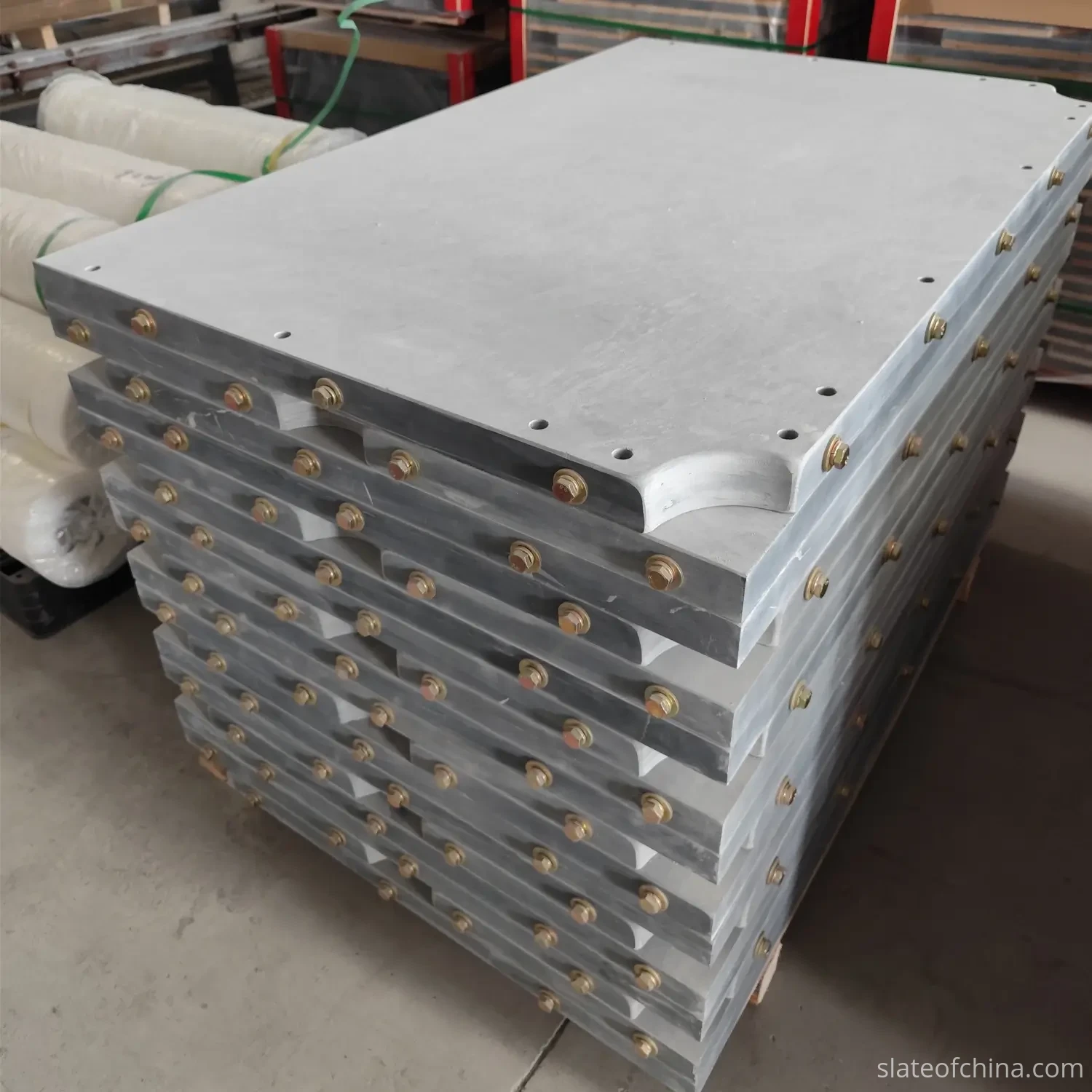
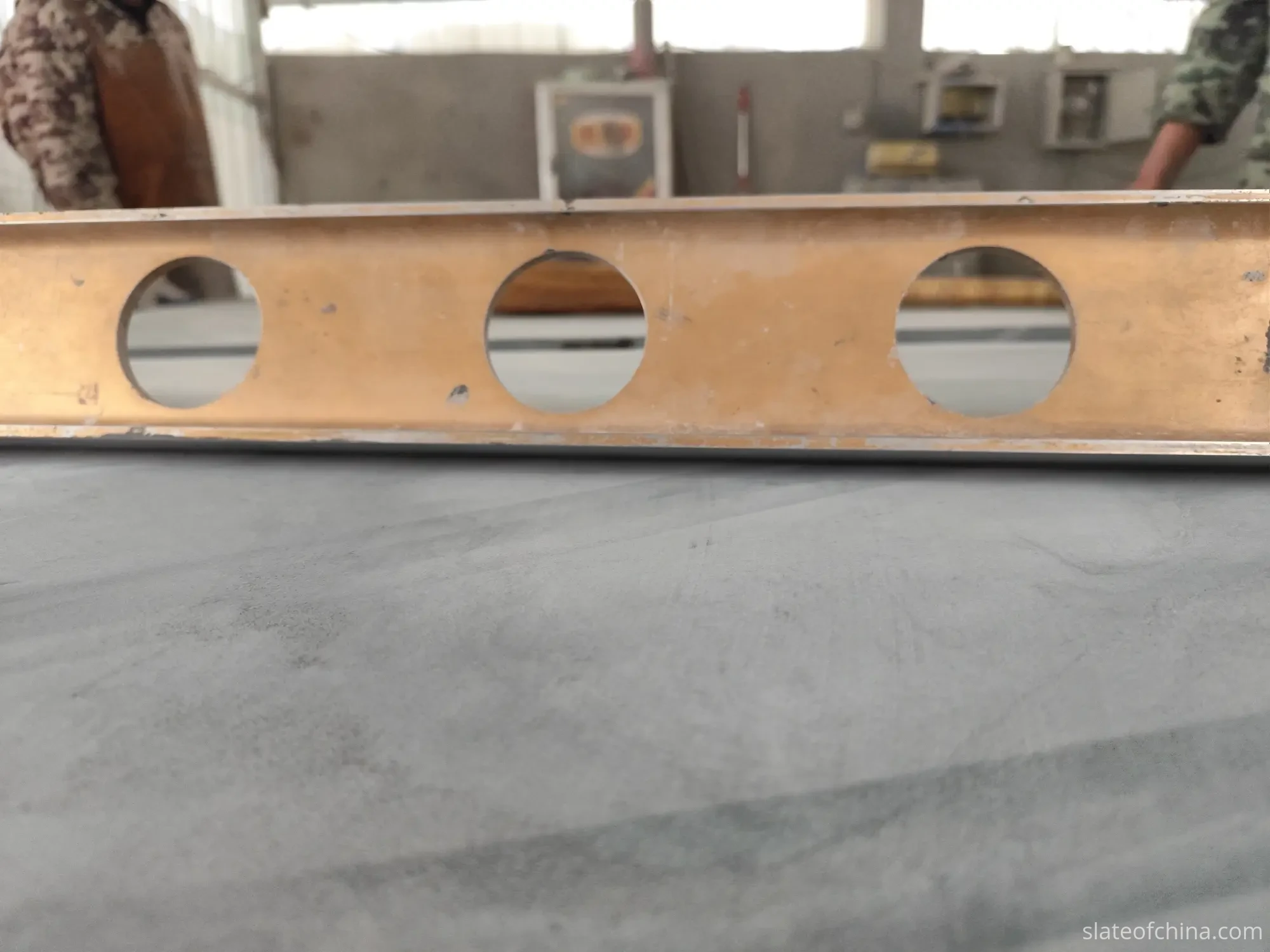
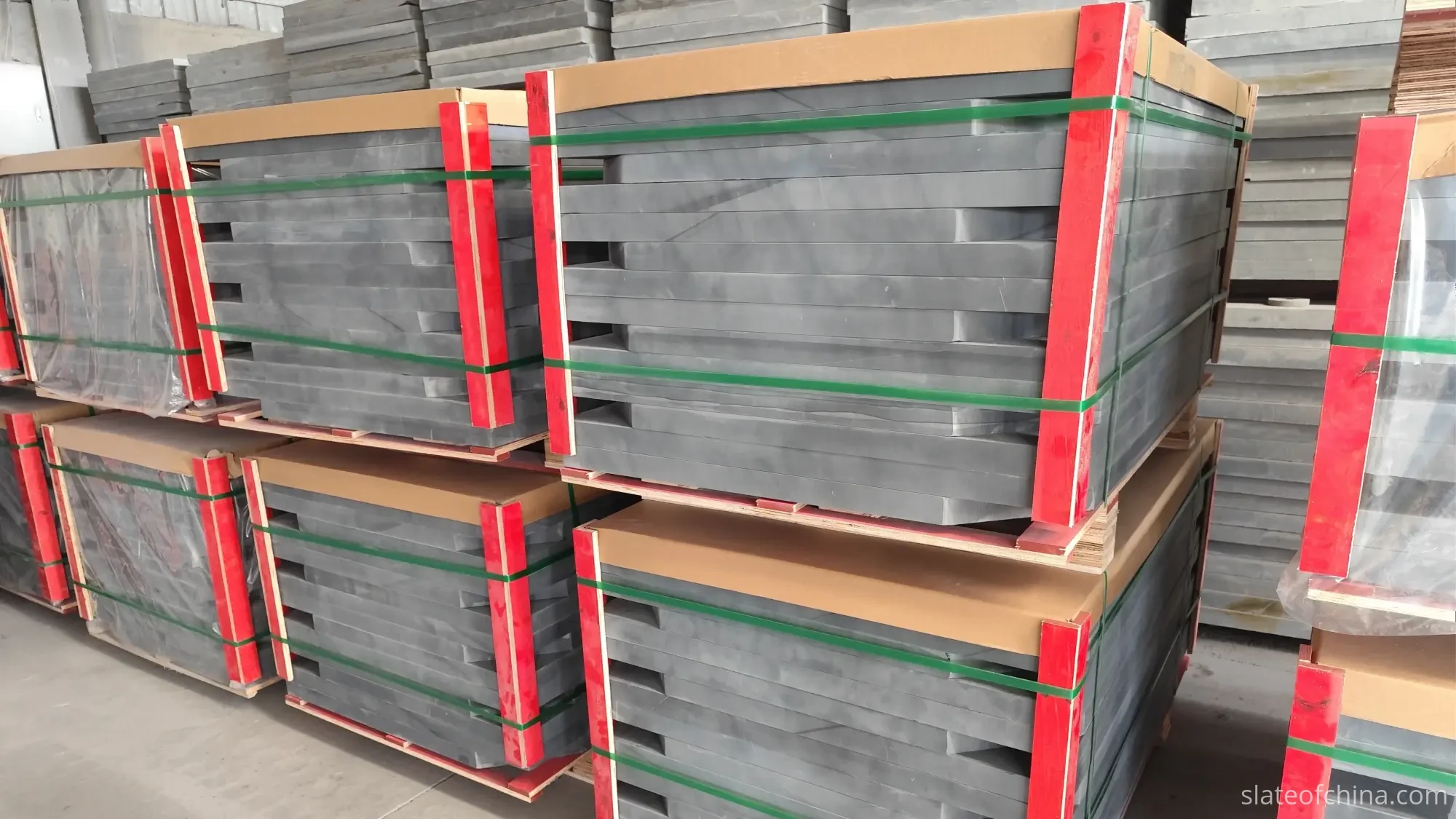
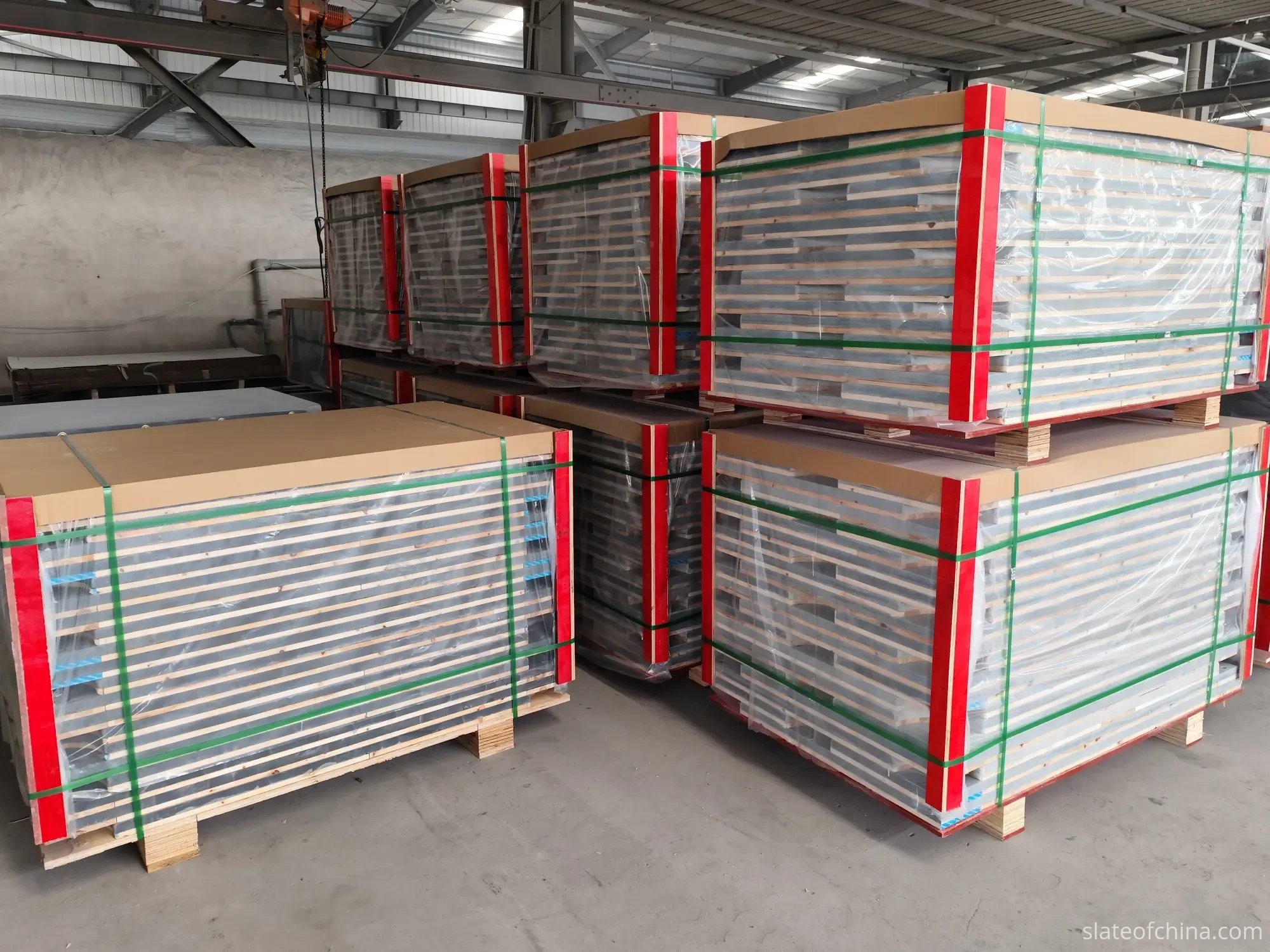
Billiard slate is heavy, rigid and unforgiving at its edges, so export packing is part of the manufacturing process, not an afterthought. In our export packing, finished beds travel on heat-treated wood-framed pallets (ISPM 15), panels layered with foam separators, edges and corners protected, the stack strapped and wrapped for the ocean leg. A three-piece 25 mm nine-foot set weighs roughly 250–270 kg; a pallet carrying several sets is engineered, not improvised. The full packing and shipping reference — pallet construction, container planning, the voyage itself — has its own packing and shipping guide.
The OEM-specific layer is identity. Marks come from the order, not from improvisation: table model, set number, piece number — so a receiving warehouse on another continent can tell at a glance which pallets belong together and which panel is which. A pallet mark is a compressed drawing: small, stencilled, and directly traceable to the file the whole order was run from. Loading follows the plan — heaviest pallets low, marks readable from the door, bracing where the plan calls for it — and the photographs of the loaded container are part of the order’s evidence, not a courtesy.
| Stage | What the stage should leave in your hands |
|---|---|
| Specification | A written specification sheet — not a quotation with numbers in it |
| Drawing review | An agreed drawing with a revision number |
| Sample | An approval record: photographs and measurements, dated |
| Production | The progress evidence agreed in the order |
| Inspection | The QC record, naming the drawing revision it measured against |
| Packing and loading | Packing list, pallet marks, loading photographs |
| Delivery | The same numbers on your documents as on the pallets |
That table is the paper trail this page keeps returning to. When every stage leaves its piece of paper, an order can be audited years later by someone who was never in the room. When one stage leaves nothing, the whole chain inherits the gap.
After the Container: The Drawing Outlives the Order
A container is delivered; an order is not finished — a specification is. What survives the voyage is the part that makes the next one easier: the approved drawing revision, the sample approval record, the inspection records, the packing story. That file becomes the production reference for every future batch of the same model.
WHY REPEAT OEM ORDERS BECOME EASIER
Once the drawing, the sample, the inspection method and the packing specification have been approved, the next production batch does not need to start from zero. The office stages are inherited; the floor stages — material selection, production, inspection, packing — simply re-run against the same agreed answers. The second order does not re-open the questions; it inherits the answers.
This is where OEM earns its meaning, and it is why we treat the paperwork of the first order with the seriousness other factories reserve for the stone. For a table manufacturer sourcing OEM billiard slate from China, the reassurance is not the first container — it is the second: same drawing, same records, same result, without re-negotiating the product. How a supplier keeps set #51 identical to set #1 — the golden references, revision discipline and batch checks that make repeat supply boring in the best way — is the subject of the OEM supply page. And when your container does arrive, the flatness check to run at your end — straightedge, supports, pass/fail — is written up in the incoming inspection guide.
Where OEM Orders Go Wrong
Order failures are rarely mysteries. In our experience they are stage failures — predictable, named, and almost always cheaper to prevent than to fix. Six of them cover most of what we have ever had to rescue:
| Stage | What goes wrong | What it costs | What prevents it |
|---|---|---|---|
| Specification | Order placed on a table name alone | Every later stage re-decides the spec, and the schedule absorbs the arguing | A written specification both sides recognise |
| Drawing review | “Agreed” without a revision number | Production works from one version; the buyer remembers another | Numbered revisions, approval recorded |
| Sample | Skipped to save a week | The first full batch becomes the sample, at batch cost | Sample as a scheduled stage with an approval record |
| Production | Specification changed after cutting | Stone cannot be un-cut: remakes, remachining, calendar slip | Freeze before material is committed; changes enter as new revisions |
| Inspection | A general pass with no reference | QC says fine; the installer’s cabinet disagrees | Records that name the drawing revision |
| Packing | Sets mixed across pallets, vague marks | The container becomes a puzzle 10,000 km from home | Set-level marks and loading photographs |
Notice where these failures cluster: five of the six happen in the office, not at the machines. A machine will execute the file it is given — but a file alone does not guarantee a result: stone varies, tooling wears, calibration drifts, and it is the people at the machines and the inspection records that catch the difference. The real risk lives in the spaces between the stages, in decisions that were postponed because they felt like paperwork.
OEM Billiard Slate RFQ Checklist: 9 Things to Confirm Before Production
Strip this page down to what a buyer actually has to settle before requesting a quotation, and nine lines remain:
1. Dimensions — outline and playing area, from the drawing, not from the table name.
2. Thickness — the number, and where on the panel it is measured.
3. Tolerances — each one with its measuring method attached.
4. Machining — pocket geometry, hole pattern and datums, edge treatment.
5. Surface — the finish specified, and what natural character is acceptable.
6. Inspection — scope (full or sampling), method, and what the record will contain.
7. Packing — pallet specification, protection, and the marks that carry set identity.
8. Quantity — sets and spares, for this batch and for the batches you expect after it.
9. Delivery — documents, photographs, and what travels with the pallets.
Those nine lines are the difference between an order that runs and a conversation that never quite ends. When they are written down and attached to a revision number, most of what remains is scheduling. For a project starting completely from scratch, the fuller RFQ checklist — table type through destination — is in the custom manufacturing guide, and the questions worth asking a supplier before any of this begins are collected in choosing a billiard slate manufacturer.
Related Reading
Have a Drawing? That Is the Whole First Step.
Send your table model, the quantity you are planning, and the drawing you have — at whatever stage it is in. We will return a marked-up proposal with the questions that matter, agree a revision, and take the order from sample to sealed container against it. You can see the range on the billiard slate products page, browse custom billiard slate capabilities, or go straight to contact us with the file attached.