
Slate Joint Alignment
What it is: how accurately the machined edges of neighbouring slate pieces meet — edge to edge, face to face — when the three pieces sit in their final positions on the table.
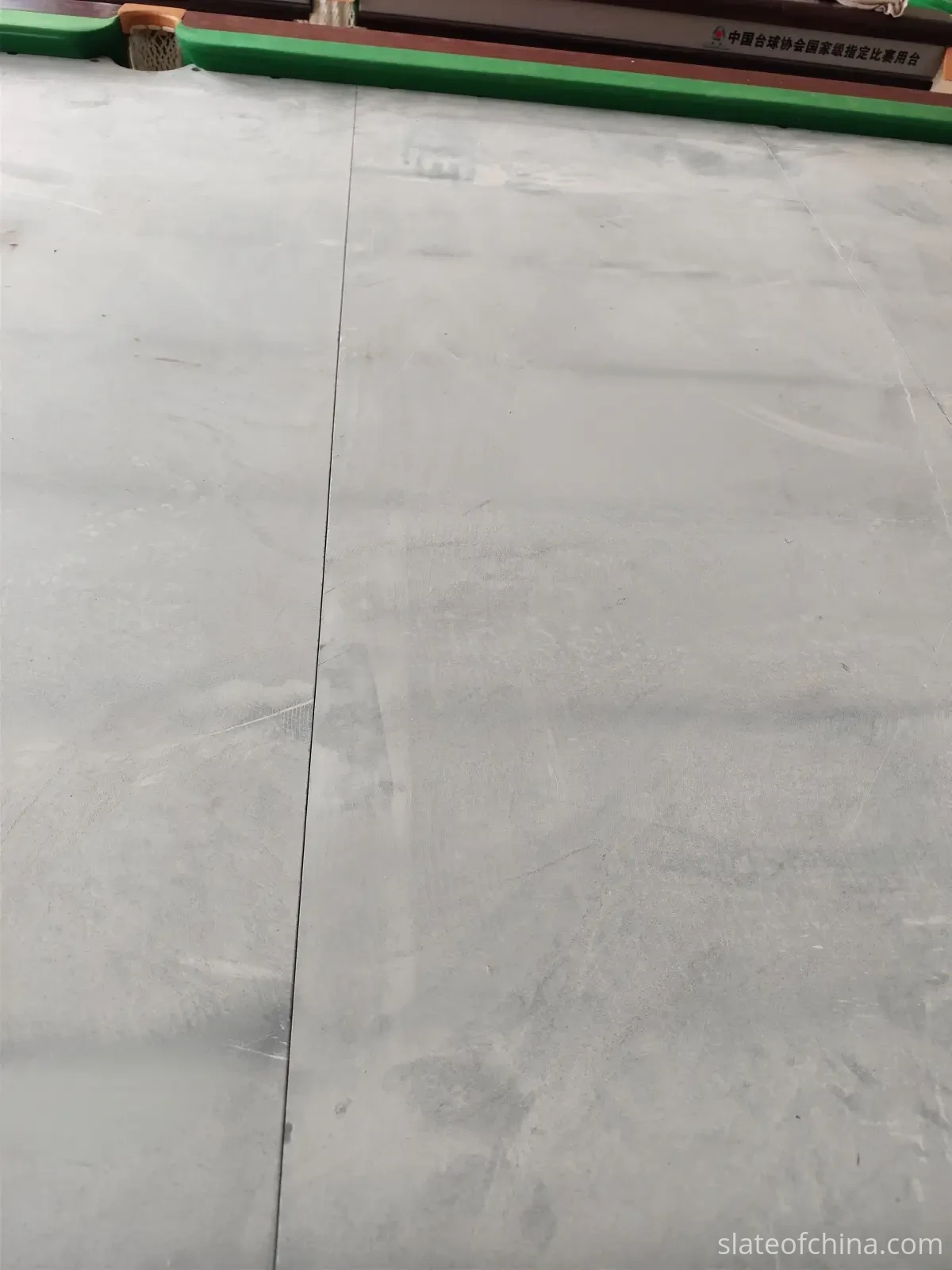
What good looks like: joints close along a straight line, no step under a straightedge, no unexpected gap, edges undamaged.
How we verify it: dimensions and edges first, then a dry assembly of the full set — pieces placed together and checked joint by joint before packing.
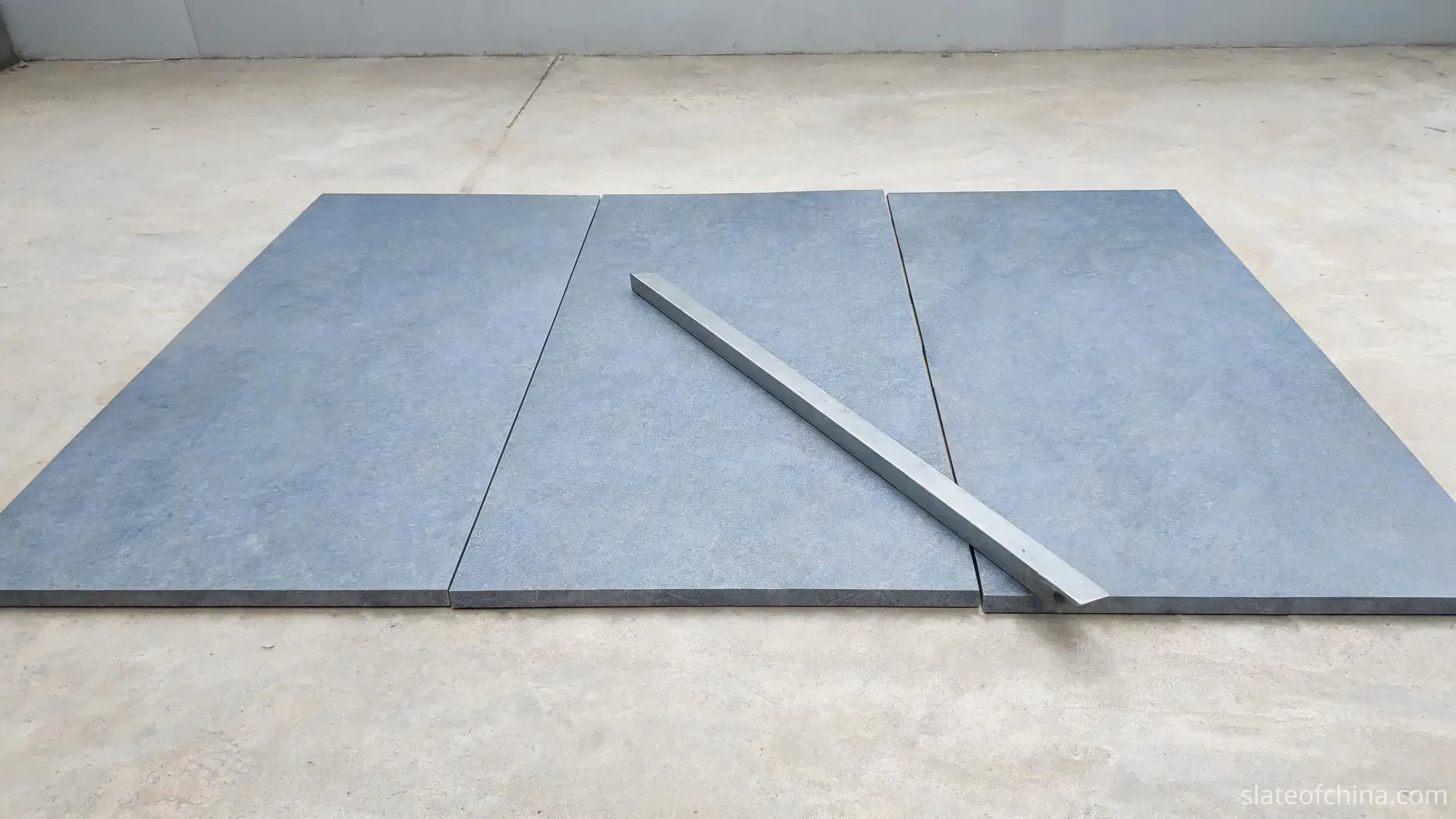
Picture our assembly floor on an ordinary morning. Three slate panels rest on padded trestles — three rectangles, each one ground flat, each one measured and recorded. Individually, all three have passed. Then two technicians lift the centre panel, walk it across the floor, and lower it between its two neighbours. The joints close.
What happens in the next few minutes decides whether this set ships.
Each piece was fine on its own. But a three-piece billiard slate bed is not judged piece by piece. It is judged as a whole — by what happens along the two lines where the pieces meet. That relationship is what we call joint alignment, and it is the part of slate quality that hides from a spec sheet. Thickness, flatness and dimensions all describe a single panel. Joint alignment describes the bed.
Three Pieces, One Bed
A three-piece pool table slate bed is one playing surface made from three stones. On most American-style tables, the three panels sit side by side across the width of the bed, which puts the two joints roughly parallel to the short ends. A ball rolling the length of the table will cross both joints. A ball rolling along the cushion may sit on one panel for its whole journey and never touch a seam.
The installer will fill those joints and cover them with cloth. If the slate underneath is right, the joints stay quiet and the bed plays as one continuous surface. That is the goal — not a physically seamless stone, but properly matched joints that the ball crosses like any other part of the table.
Flat Pieces Do Not Automatically Make a Flat Bed
This is the idea that catches nearly everyone new to multi-piece slate, so it is worth slowing down here.
Flatness is a property of one panel: how closely the playing surface of that panel follows a true plane. Joint alignment is a property of the set: how the panels relate to each other along their shared edges. You can have three panels that each pass a flatness check individually, and still end up with a bed that is not level across the seams. If the joint edge of one panel is machined a fraction higher than its neighbour — or if the two panels simply differ slightly in thickness right at the seam — the assembled bed takes a small step at the joint, even though every individual flatness reading was clean.
How slight a step matters? A ball crossing a raised seam at speed can hop or deflect; a slow roll can die on it. We look at the physics of this in how slate flatness affects ball roll, and the same logic applies to a joint: the ball does not know the bed is three stones, it only feels the surface.
The same goes for the edge itself. Two panels can be the same nominal thickness, both flat, and still fail to meet properly if the joint edge of one is not straight — bowed a little in the middle, so the seam closes tightly at the ends but opens along the centre, or the reverse. None of that shows up on a per-piece measurement sheet.
Before going further, here is where joint alignment sits among the other checks on a billiard slate:
| Quality item | What it describes | Checked on |
|---|---|---|
| Flatness | How flat one playing surface is | Individual slate piece |
| Thickness | Slate thickness consistency | Individual slate piece |
| Dimensions | Length and width against the drawing | Individual slate piece |
| Joint alignment | How adjoining pieces meet along their mating edges | The joint between pieces |
| Slate matching | Whether the pieces belong together as one matched set | Complete set |
A three-piece slate set can have individually acceptable panels and still need attention at the joints — which makes joint alignment a set-level quality, not an individual-panel measurement.
How the Joint Edges Are Machined
Joint alignment is not assembled into the set at the end. It is machined in — or lost — much earlier.
In our production process, the sequence matters. A rough-sawn panel first gets its playing surface ground flat, because that surface is the reference everything else is measured against. Only after the surface is established are the joint edges brought to the drawing — cut, then machined so that the edge is straight along its length, carries the specified geometry relative to the playing surface, and is held to the dimensions the table manufacturer specified. The edge is machined relative to the finished surface, not to whatever the saw happened to leave behind.
For a three-piece set, the joint geometry and related machining features are produced from the approved drawing and matched to the corresponding set — the same discipline behind matched grinding. How all three panels are held to one machining reference is covered in our CNC machining guide.
Four Things a Joint Edge Has to Get Right
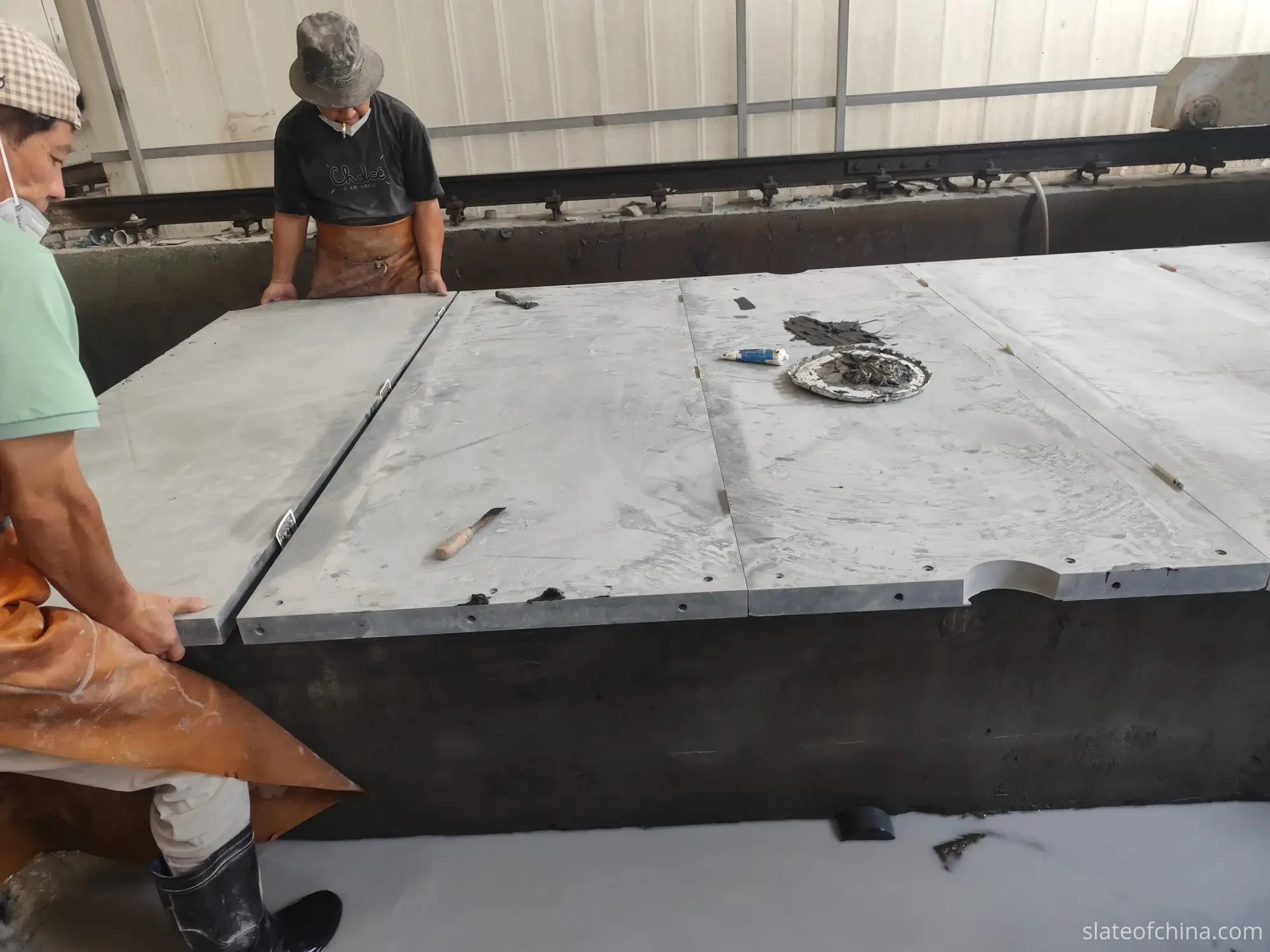
When we inspect a joint edge, four separate qualities are hiding inside the one word "alignment":
- Straight. The edge follows a true line along its full length. A bow in the edge becomes a gap that opens and closes along the seam.
- Correct geometry. The joint edge is machined to the specified relationship with the playing surface, so the two adjoining panels can meet as designed. The exact edge form follows the table manufacturer's drawing, not a fixed angle.
- Consistent. The joint edges of one set are machined as counterparts to the same approved drawing — not three near-identical edges that each came close on their own.
- Intact. The edge arrives undamaged. A dimensionally perfect edge with a bruise or a chip along it is still a problem for the installer.
Get all four right, and the joint is boring — which is exactly what a joint should be.
The Set Is the Unit
Here is the principle that organises our whole approach, and it is worth stating plainly: the set is the unit.
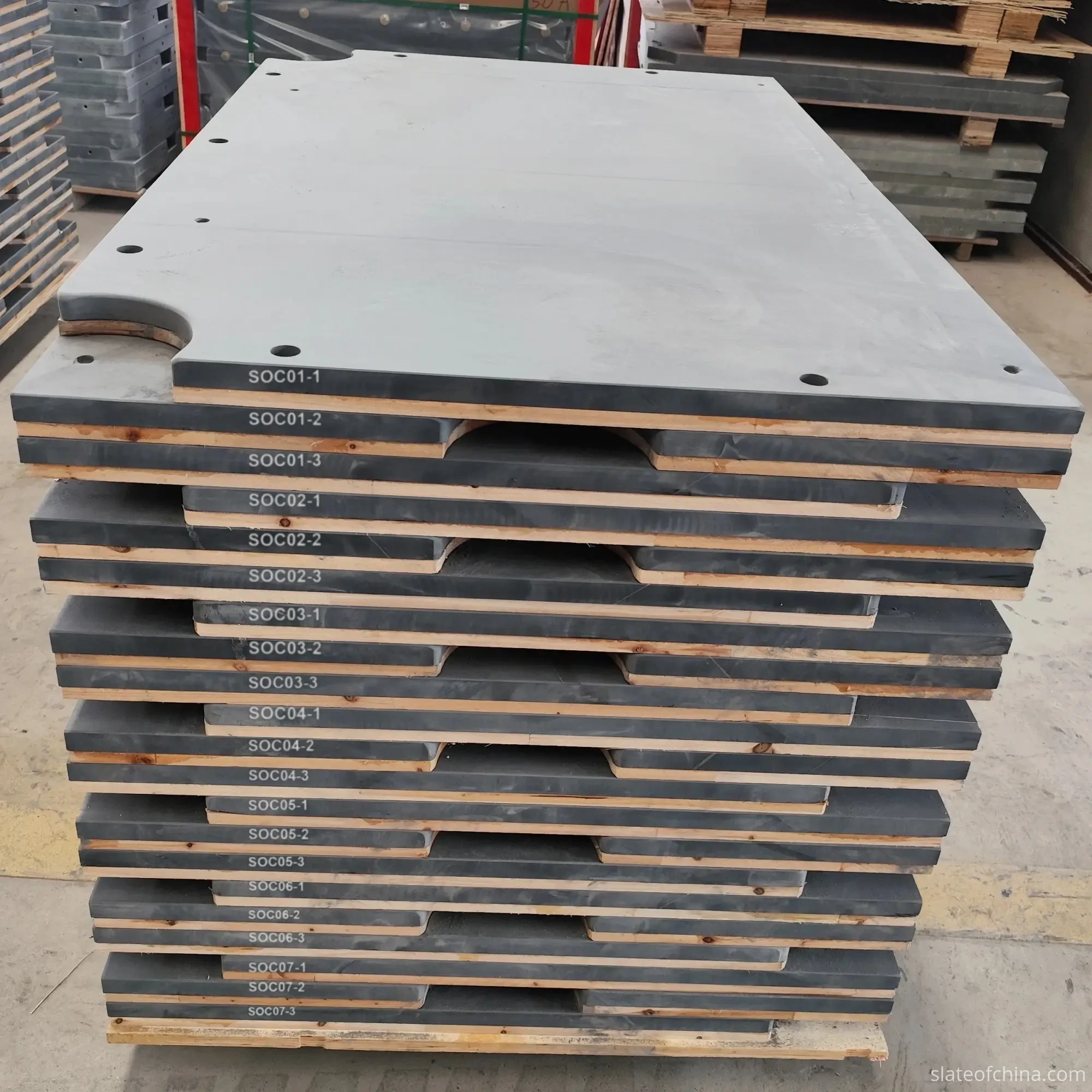
Three pieces of billiard slate are not three products that happen to travel together. They are one product in three parts, moved through machining, inspection, set matching, numbering and packing as a single unit. Each panel carries the set number, the set shares one inspection record and one packing plan, and when the set passes, the unit passes — piece A, piece B, piece C, and the two relationships between them.
This has a practical consequence buyers should understand. You cannot freely mix pieces between sets the way you might mix tiles from two boxes. Two panels machined in different production runs may each be perfectly within their own drawing, but their joint edges were established against different reference surfaces. Push them together and the seam may take a step, or the overall bed length may drift from the drawing — small numbers, but on a playing surface small numbers at a joint are exactly what the installer feels.
So if a single panel is ever broken — in transit, or years later on site — the honest answer is not to grab a spare piece from the next batch. It is to go back to the original drawing and the original order record, and machine the replacement against the same specification. For older or third-party tables this is the heart of ordering replacement slate: the new piece has to meet the survivors, not just the drawing.
How We Verify a Three-Piece Set
Billiard slate joint inspection happens in two layers, because the set has two layers of truth: what each piece is on its own, and what the pieces do together.
Layer one happens on the trestles. Each panel's dimensions are confirmed against the drawing, and each joint edge gets its own attention — measured where the drawing calls for it, sighted along its length for straightness, and looked at closely for chips, bruises or machining marks that do not belong. This layer is part of our routine piece-by-piece inspection; nothing about a joint edge excuses it from being an edge.
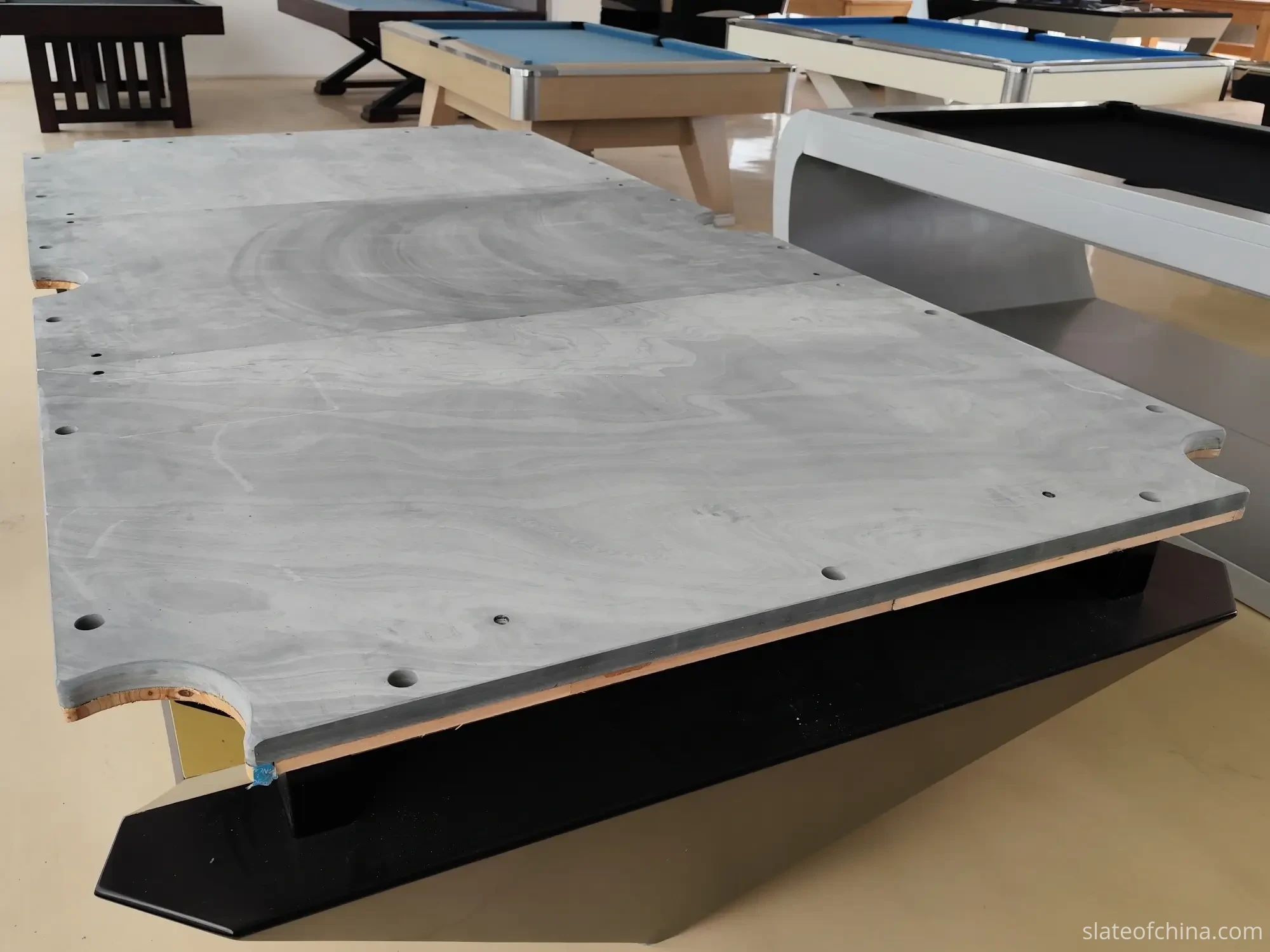
Layer two is the dry assembly — the morning scene from the top of this page. The three pieces are placed in their final relative positions, on a level support, and pushed together exactly as the installer will push them together. Then we read the joints:
- Does each seam close along a straight, even line?
- Does a straightedge laid across the joint sit on both panels at once, or does light show under one side?
- Do the pieces locate against each other the way the drawing intends?
- Are the bolt holes or fixing positions consistent across the seam, where the design uses them?
- Is the assembled bed the overall length and width the drawing calls for?
A dry assembly provides a practical way to verify these relationships, because the joint exists only when the pieces are positioned together — and the questions above are about the relationships, not about any single panel.
What a Dry Assembly Catches That Nothing Else Can
In our production process, the dry-assembly step is part of the routine precisely because it catches what a per-piece inspection cannot see — it is the moment three-piece slate alignment is judged on the bed, not on paper. The recurring offenders are few, and worth naming:
A step at the seam. The two playing surfaces do not sit in one plane. Sometimes the cause is thickness right at the joint edge; sometimes it is a support point under one panel. Either way, the straightedge finds it in seconds.
A gap that changes width. Tight at the ends, open in the middle — or the reverse. That is the signature of a joint edge that is not straight, and it tells the installer the seam will need more compound in places than in others.
A chipped or bruised edge. A small chip on the top arris of a joint edge is invisible in a dimension report and obvious the moment the pieces meet. It sits directly in the ball path, under the cloth.
A seam that closes on one end but not the other. Usually a squareness or bow issue on one edge, or debris caught in the joint. It shows up as one clean corner and one open corner — a geometry problem masquerading as a cleaning problem.
Questions Buyers Ask About Slate Joints
Can I replace just one piece of a three-piece set?
You can, but the replacement has to be made to meet the other two pieces, not just to the general drawing. If the set came from us, we go back to the original order record and machine the new panel against the same specification and reference. If the table came from another maker, the best starting point is a drawing or careful measurements of the surviving pieces — this is the process described for replacement slate for existing tables. What you want to avoid is pairing a new panel with two old ones when nobody has checked how the three edges actually meet.
How wide should the gap between the three pieces be?
The joint gap should not be specified by a universal gap dimension. The required joint condition depends on the table manufacturer's design, its joint-filling method and the installation requirements — which is why we machine the joint to the drawing rather than to a fixed number. What matters for alignment is that the gap is even along the whole seam: a seam that is tight at one end and wider at the other tells you something about the mating edges, whatever the nominal width.
How are three-piece pool table slate joints aligned?
By machining and matching, not by correcting at assembly. The joint edges are machined to the approved drawing after the playing surface is established, the pieces of one set are machined as counterparts, and the finished set is dry-assembled so both joints can be read before packing. Alignment that depends on installer correction is alignment that was never really machined.
Can individually flat slate pieces still have joint alignment problems?
Yes. Flatness describes one panel; joint alignment describes the relationship between panels. A set can pass every individual flatness check and still take a step at a seam — a thickness difference right at the joint edge, a bowed mating edge or a bruised arris never appears on a per-piece measurement sheet. That is exactly why the set, not just the pieces, gets inspected.
Is joint alignment the same thing as table leveling?
No, and the confusion causes real arguments. Joint alignment is machined geometry: it leaves the factory with the slate, and it is the same whether the table ends up in a basement or a tournament hall. Leveling is what the installer does on site — shimming the frame, adjusting to a floor that is never perfectly flat, bringing the assembled bed into a level attitude. A well-aligned set makes leveling faster and more predictable; it does not replace it. Our flatness guide covers the leveling side of the surface in more detail.
Can a poorly aligned joint be corrected during installation?
Installers carry more skill than most factories like to admit. A slight step can be shimmed under a panel, a joint can be dressed locally, and a filling compound can hide a lot. But every one of those fixes has a cost in time, and each has a limit: shimming corrects attitude, not geometry, and no compound fills a joint while also making the bed one plane. Correction on site is a buffer, not a substitute. The better the machining, the less there is to correct — and the more of the installer's day goes into fine leveling instead of fighting seams.
How should buyers inspect three-piece billiard slate joints?
Start with each piece: joint edge straight, correctly formed and undamaged, the panel checked for flatness and thickness as normal. Then read the seams as a set — lay the panels in their final positions and place a straightedge across each joint: a step shows as light under the blade, and a seam that is tight at one end and open at the other tells you the edge is not straight. At the factory this is the dry assembly; the same routine at destination is covered in our incoming inspection guide.
Do pool and snooker tables use the same kind of joints?
Pool and snooker tables can use different slate configurations. American-style pool tables commonly use three-piece beds, while full-size snooker tables may use more sections, including five-piece configurations. The principle is the same: each mating joint must be machined and verified as part of the complete slate set. The wider comparison is covered in pool slate vs snooker slate.
What to Ask Your Slate Supplier
Before ordering three-piece billiard slate, six questions separate a real matched set from three loose panels:
- Are the three panels supplied as a matched set?
- Are the joint edges machined according to the same approved drawing?
- How are joint dimensions checked?
- Are the panels individually inspected for flatness and thickness?
- Are the pieces identified as one complete set?
- Can the supplier provide inspection photos before packing?
A supplier with a straight answer to each is telling you more than a specification sheet can.
Slate Edges Deserve Careful Handling
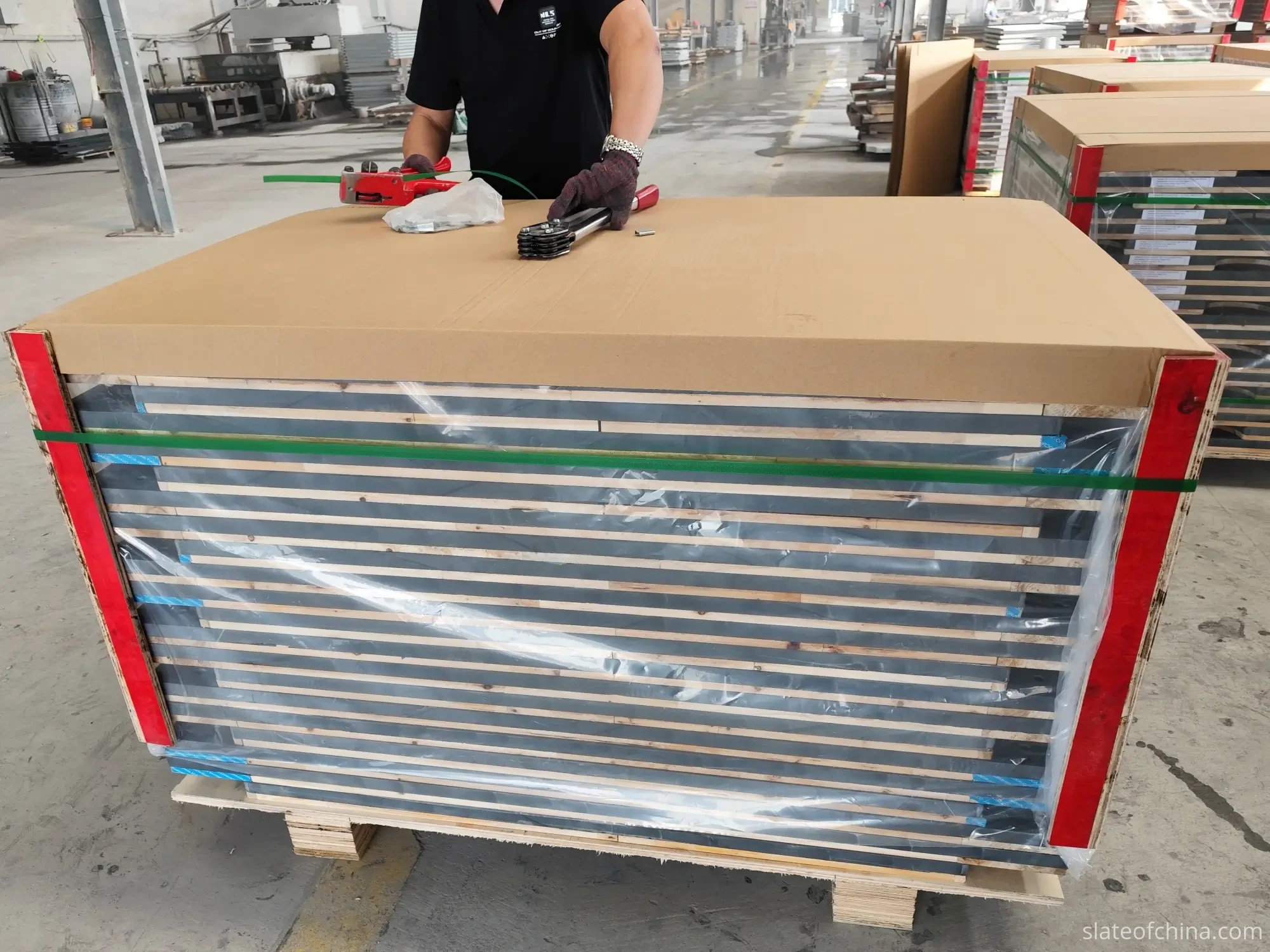
Slate is a metamorphic stone with a cleavage — the same gift that lets it split into sheets is a directional weakness, and the crisp machined edge of a billiard panel is the most vulnerable part of the finished product. In practice, finished joint edges can also be damaged during handling after machining. Moving panels from the inspection area to packing therefore deserves the same attention as machining itself: padded supports, edge protectors, no dragging, no stacking finished edges on finished edges.
What Poor Alignment Costs Later
A misaligned joint rarely costs the factory money. The bill is paid at installation — shimming a step, re-checking the level, building up a filler where a seam is uneven, dressing a joint the cloth will show. None of it is dramatic: a machined joint takes seconds to verify and hours to compensate for, and the compensation is never quite as good as the geometry it replaces.
Alignment Left the Factory Before You Received It
What can be fixed on site comes down to one line: the installer can level the frame, shim the bed and fill the joints, but they cannot re-machine a joint edge. Straightness, correct geometry and set consistency are locked into the stone at the factory. That is why the joint belongs in any incoming inspection: pieces checked individually for flatness and dimensions, then the seams read the way the dry assembly read them at the factory.
Why the Bed Is Three Pieces at All
If joints add all this work, why not ship one solid stone? The answer is weight and doorways. A one-piece bed is a single slab too heavy for many staircases, lifts and hallways. Three pieces turn an impossible lift into three heavy-but-manageable ones — and the trade is that dividing the bed creates joints, so joint quality becomes part of the product. On a three piece pool table slate, that means two joints have to be machined, matched and protected as part of one set. The complete comparison, including where single-piece beds still make sense, is in the one-piece vs three-piece slate for manufacturers.
What to Put on the Drawing for OEM Orders
For table manufacturers, the joint should live on the drawing, not in a conversation. A drawing that says "three-piece slate" has not said enough. To machine and verify joints properly, the drawing wants:
| On the drawing | Why the joint needs it |
|---|---|
| Overall bed length and width | The three pieces are only correct together — the assembled size is the acceptance size |
| Individual piece dimensions | Each panel is machined to its own numbers before the set exists |
| Joint positions | Where the seams fall decides which panels the ball crosses and when |
| Joint edge requirements | Edge geometry, straightness and finish for the mating edges, agreed as measurable requirements |
| Thickness and reference surface | The playing surface is the reference the joint edges are machined against |
| Fixing holes near joints | Where the design bolts across or near a seam, hole positions must respect the joint |
And beneath every line of the drawing, one principle: the tolerance is agreed before production. A joint requirement that exists only in someone's memory is not a requirement — it is an expectation, and expectations are what disputes are made of. Our working practice is to settle the joint specification with the buyer at drawing confirmation, so the machining, the inspection and the record all answer to the same sheet.
One Bed, Three Stones
A three-piece slate set passes our floor twice. Once as three panels — each flat, each on-size, each edge inspected. And once as one bed — the pieces pushed together in their final positions, the seams read along their length, the straightedge laid across, the assembled bed confirmed against the drawing.
The second pass is the one that matters, because that is the shape the table will keep. A billiard bed is not three stones that sit near each other; it is one surface that happens to be made of three. Machine the pieces as a set, verify the set as a unit, pack the set as a unit — and the installer receives not a consignment of slate, but the beginning of a level table.
If you are specifying a three-piece bed — pool, snooker or a custom table — send us the drawing, or the dimensions of the set you are replacing. We will confirm the joint specification the same way we confirm every other requirement: agreed before production, verified before packing. Our custom machining work is described on the custom slate page, and you can reach us directly through the contact page.
Related Reading
Specify your joints, not just your sizes. Send your table drawing or existing set dimensions and we will confirm the joint specification — positions, edge requirements and inspection method — before production begins.