
In This Guide You’ll Learn
✔ What is the standard roofing slate thickness?
✔ Which slate thickness is best for your roof?
✔ Does thicker slate last longer?
✔ How does thickness affect roof weight?
✔ Which thickness is recommended for snow or high-wind areas?
✔ What thickness does EN 12326 require?
Roofing Slate Thickness Guide
Learn how to choose the right roofing slate thickness for your project. Compare standard slate thicknesses, understand weight, durability, installation requirements, and find the best option for residential, commercial, and heritage roofs.
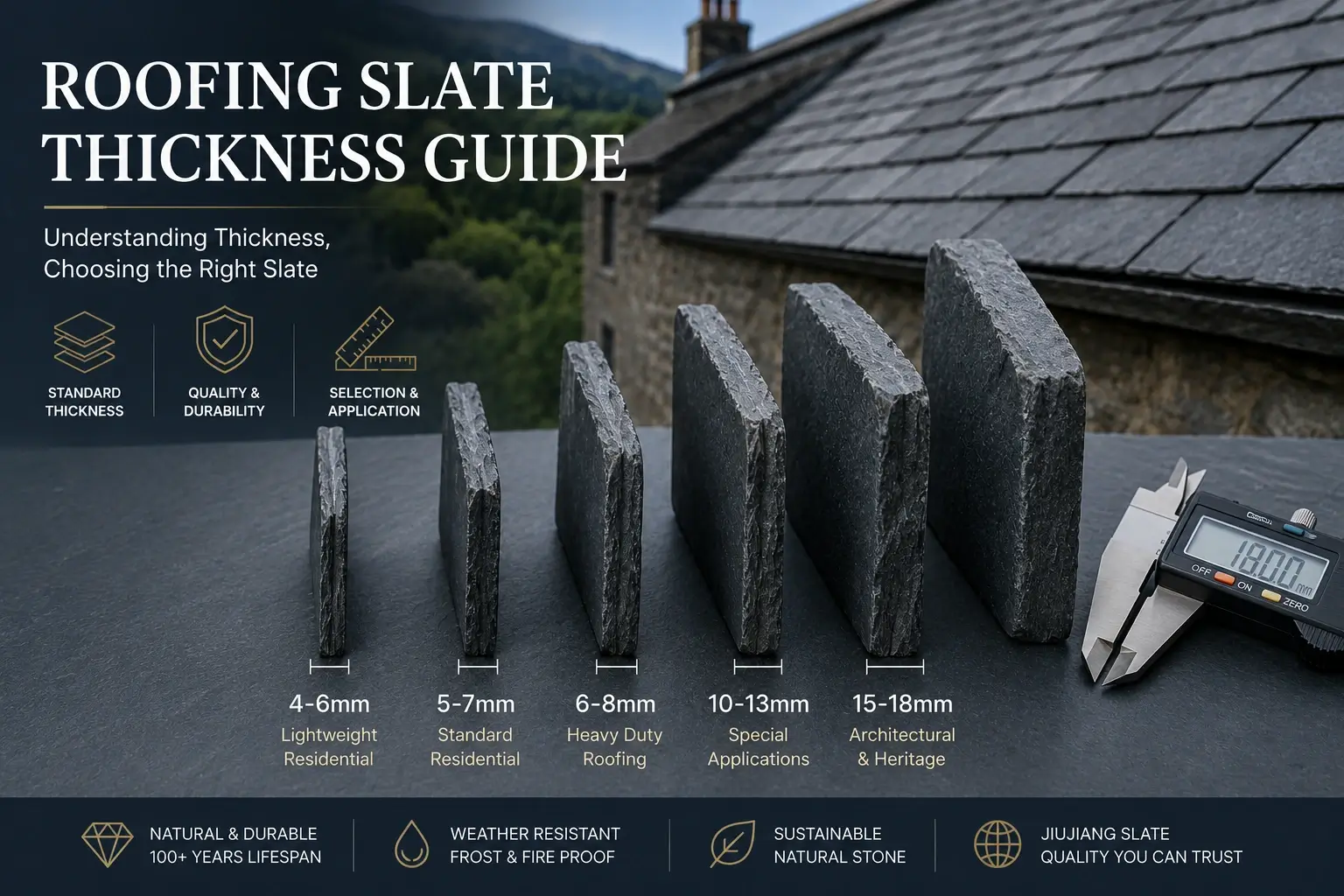
Roofing slate thickness plays a critical role in the performance, appearance, and lifespan of a natural slate roof. Choosing the correct thickness affects structural load, weather resistance, installation methods, and project cost. In this guide, you’ll learn about standard roofing slate thicknesses—from 4–6 mm to 15–18 mm—their typical applications, thickness tolerances, and expert recommendations to help you select the right slate for any roofing project.
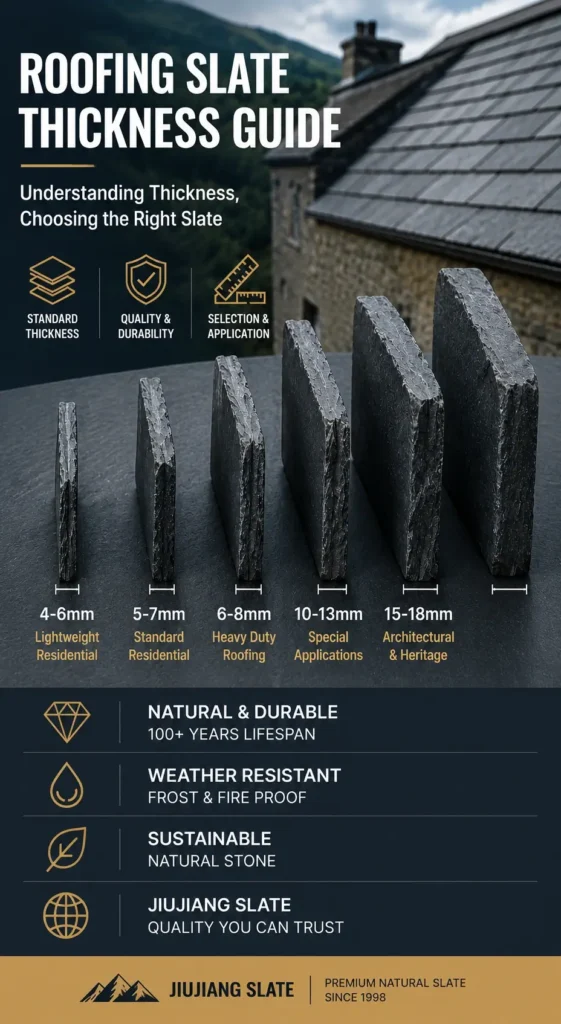
- Standard Thicknesses: 4–6 mm, 5–7 mm, 6–8 mm, 10–13 mm & 15–18 mm
- Compare Weight & Durability
- Choose the Right Thickness for Every Roof
- Installation & Structural Considerations
Table of Contents
Why Roofing Slate Thickness Matters
When choosing natural roofing slate, thickness is far more than just a specification. It is one of the most important factors influencing the performance, appearance, and long-term value of a slate roof.
The right roofing slate thickness helps ensure that your roof not only looks beautiful but also performs reliably under local weather conditions while meeting structural and installation requirements.
Whether you are a homeowner, architect, roofing contractor, or slate importer, understanding slate thickness will help you make informed decisions and avoid unnecessary costs.
Why Thickness Is Important
Roofing slate thickness directly affects several key aspects of a roofing project, including:
- Roof Appearance – Thicker slates create deeper shadow lines and a more traditional, textured roof, while thinner slates offer a cleaner and more uniform appearance.
- Roof Weight – Slate thickness determines the overall dead load placed on the roof structure, making it an important consideration for both new construction and renovation projects.
- Installation Method – Different slate thicknesses may require different batten spacing, nail lengths, hooks, and installation techniques to ensure proper performance.
- Durability & Weather Resistance – While high-quality natural slate is naturally durable, the appropriate thickness helps the roof withstand wind, snow, hail, and other environmental conditions.
- Project Cost – Thicker slates generally use more raw material, weigh more during transportation, and may increase installation time, all of which can affect the total project budget.
Is Thicker Roofing Slate Always Better?
Not necessarily.
A common misconception is that thicker roofing slate always lasts longer or performs better. In reality, thickness is only one part of the equation.
A premium-quality 5–7 mm natural roofing slate can often outperform a lower-quality 10 mm slate if the stone has better strength, lower water absorption, and is installed correctly.
Instead of simply choosing the thickest slate available, the goal is to choose the right thickness for the specific roofing application.
How to Choose the Right Slate Thickness
The ideal roofing slate thickness depends on several factors, including:
- Roof Pitch – Steeper roofs often allow for lighter slate, while low-pitch roofs may require different installation practices.
- Climate Conditions – Areas with heavy snowfall, strong winds, or frequent freeze–thaw cycles may benefit from thicker roofing slate.
- Building Type – Residential homes, luxury villas, commercial buildings, churches, and heritage restoration projects often have different thickness requirements.
- Local Building Standards – Roofing regulations and industry standards vary between countries and regions, particularly across Europe and North America.
- Architectural Style – Some designers prefer thinner slate for a modern appearance, while others choose thicker slate to achieve a more traditional or rustic look.
Key Takeaway
The best roofing slate is not the thickest one—it is the one with the correct thickness for its intended application, structural requirements, and local climate.
Making the right choice from the beginning helps optimize roof performance, simplify installation, control project costs, and maximize the service life of your natural slate roof.
| Factor | Why It Matters |
|---|---|
| 🎨 Appearance | Creates different shadow lines and roof aesthetics |
| ⚖ Weight | Affects structural load and transportation |
| 🔨 Installation | Influences fixing methods, battens, and fasteners |
| 🛡 Durability | Helps roofs perform in different weather conditions |
| 💰 Cost | Impacts material usage, shipping, and installation budget |
Standard Roofing Slate Thickness
Natural roofing slate is available in a variety of thicknesses to meet different architectural styles, structural requirements, and climate conditions. Unlike manufactured roofing materials, natural slate is split from solid stone, so thickness is classified into standard ranges rather than exact dimensions.
Today, the most commonly supplied roofing slate thicknesses range from 4–6 mm for lightweight residential roofing to 15–18 mm for prestigious heritage and architectural projects.
Selecting the appropriate thickness helps achieve the right balance between appearance, roof weight, durability, installation efficiency, and project budget.
Standard Roofing Slate Thickness Chart
| Thickness Range | Common Description | Typical Applications | Appearance |
|---|---|---|---|
| 4–6 mm | Lightweight Slate | Residential houses, villas, renovations | Smooth & modern |
| 5–7 mm | Standard Roofing Slate | Most residential and commercial roofs | Balanced appearance |
| 6–8 mm | Heavy-Duty Slate | Snowy, windy and mountain regions | More pronounced shadow lines |
| 10–13 mm | Architectural Slate | Luxury buildings, churches, feature roofs | Bold & textured |
| 15–18 mm | Heritage Slate | Historic restoration, castles, landmark buildings | Traditional & premium |
What Is the Most Common Roofing Slate Thickness?
For most residential and commercial roofing projects, 4–6 mm and 5–7 mm are the industry’s most widely used thicknesses.
These thicknesses provide an excellent balance between:
- Roof weight
- Structural safety
- Weather resistance
- Ease of installation
- Material cost
- Long-term performance
For regions with heavy snowfall or projects requiring a more traditional appearance, 6–8 mm roofing slate is often preferred.
Architectural landmarks, luxury estates, churches, and heritage restoration projects may specify 10–13 mm or 15–18 mm slate to create deeper shadow lines and a distinctive handcrafted appearance.
Standard Roofing Slate Thickness Produced in Jiujiang, China
Jiujiang roofing slate is manufactured in several standard thickness ranges to satisfy international roofing markets.
The most popular export specifications include:
| Thickness | Export Status | Typical Markets |
|---|---|---|
| 4–6 mm | ★★★★★ | Europe, North America |
| 5–7 mm | ★★★★★ | UK, France, Germany |
| 6–8 mm | ★★★★☆ | Snow regions, premium homes |
| 10–13 mm | ★★★☆☆ | Architectural projects |
| 15–18 mm | ★★☆☆☆ | Heritage & restoration |
These thicknesses can be produced in a wide range of slate sizes, including rectangular, square, fish scale, hexagonal, and custom-cut roofing slates to meet different architectural requirements.
Roofing Slate Thickness Preferences by Market
🇬🇧 United Kingdom
The UK roofing market traditionally prefers 5–7 mm natural roofing slate, providing an excellent balance between durability, appearance, and installation efficiency. Thicker slates are also widely used for heritage restoration and conservation projects.
🇫🇷 France
French projects commonly use 4–6 mm and 5–7 mm roofing slate, especially for residential buildings and traditional slate roofs. Architectural aesthetics often emphasize clean, consistent slate lines.
🇩🇪 Germany
German roofing standards frequently specify uniform, high-quality slate with 5–7 mm or 6–8 mm thickness, particularly in regions subject to snow loads and freeze–thaw cycles.
🇧🇪 Belgium
Belgian slate roofing projects typically use 5–7 mm roofing slate for both new construction and renovation. Historic buildings may require thicker slates depending on restoration specifications.
🇳🇴 Norway
In Norway, thicker roofing slate is commonly preferred due to the country’s cold climate, heavy snow loads, strong winds, and traditional architectural styles. Many Norwegian roofing projects use 10–13 mm and 15–18 mm natural roofing slate, especially for mountain houses, cabins, churches, heritage buildings, and high-end residential projects.
These thicker slates create a strong, traditional appearance with deep shadow lines, while providing excellent resistance to harsh Nordic weather conditions.
Professional Tip: Always confirm the required thickness with local building regulations, roofing specifications, or the project architect before placing an order.
Can Roofing Slate Thickness Be Customized?
Yes.
Although standard thickness ranges are recommended for most projects, many manufacturers—including Jiujiang slate producers—can supply customized thicknesses for specific architectural or restoration requirements.
Custom thicknesses may be requested for:
- Heritage restoration
- Historic buildings
- Churches and cathedrals
- Luxury villas
- Architectural feature roofs
- Landscape and decorative applications
However, custom thicknesses may affect production time, transportation weight, and project cost.
Choosing the Right Thickness
The most expensive or thickest roofing slate is not always the best choice.
The ideal roofing slate thickness depends on your roof structure, local climate, architectural design, and project requirements. Selecting the correct thickness improves installation efficiency, controls costs, and ensures long-term roof performance.
How Slate Thickness Is Measured
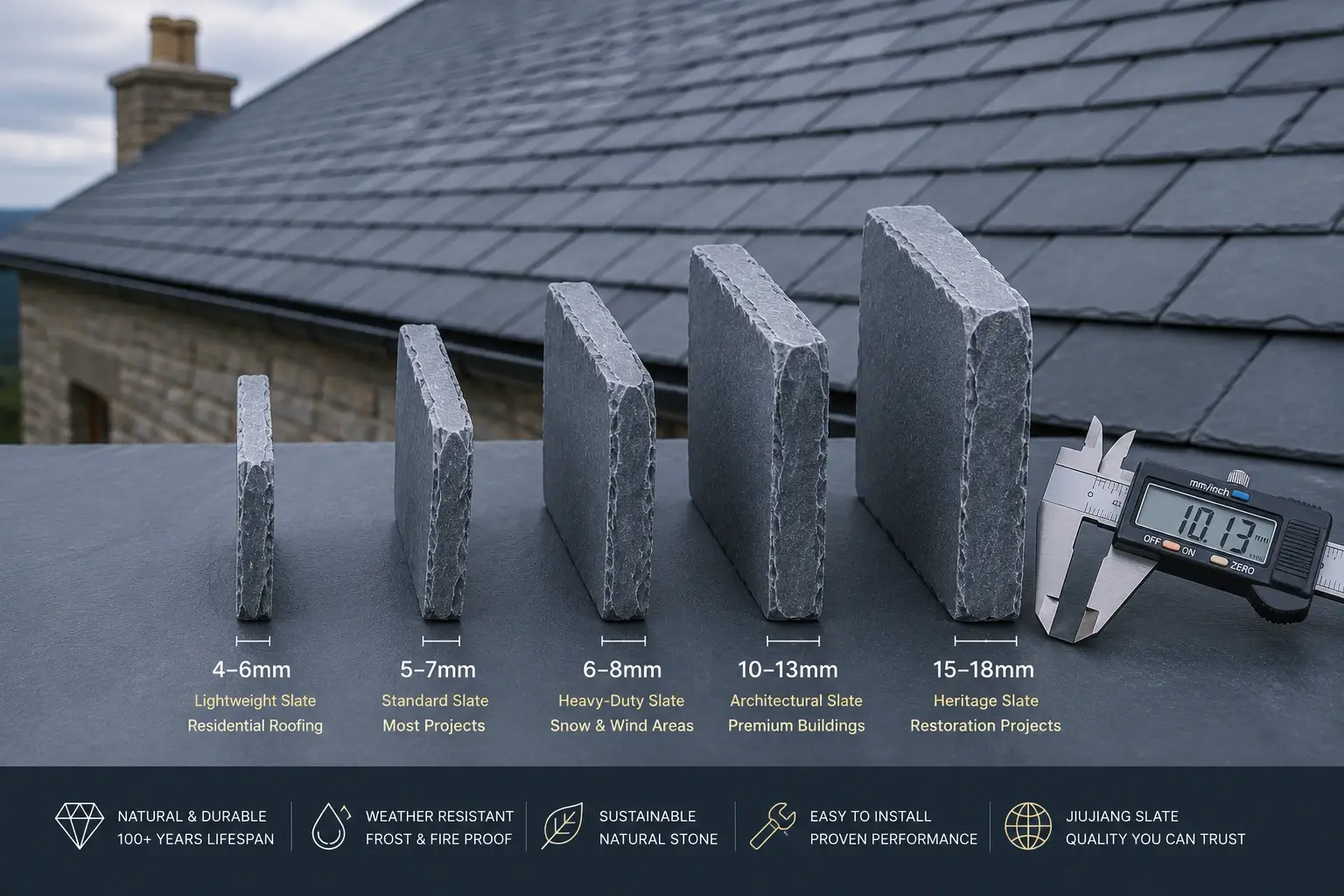
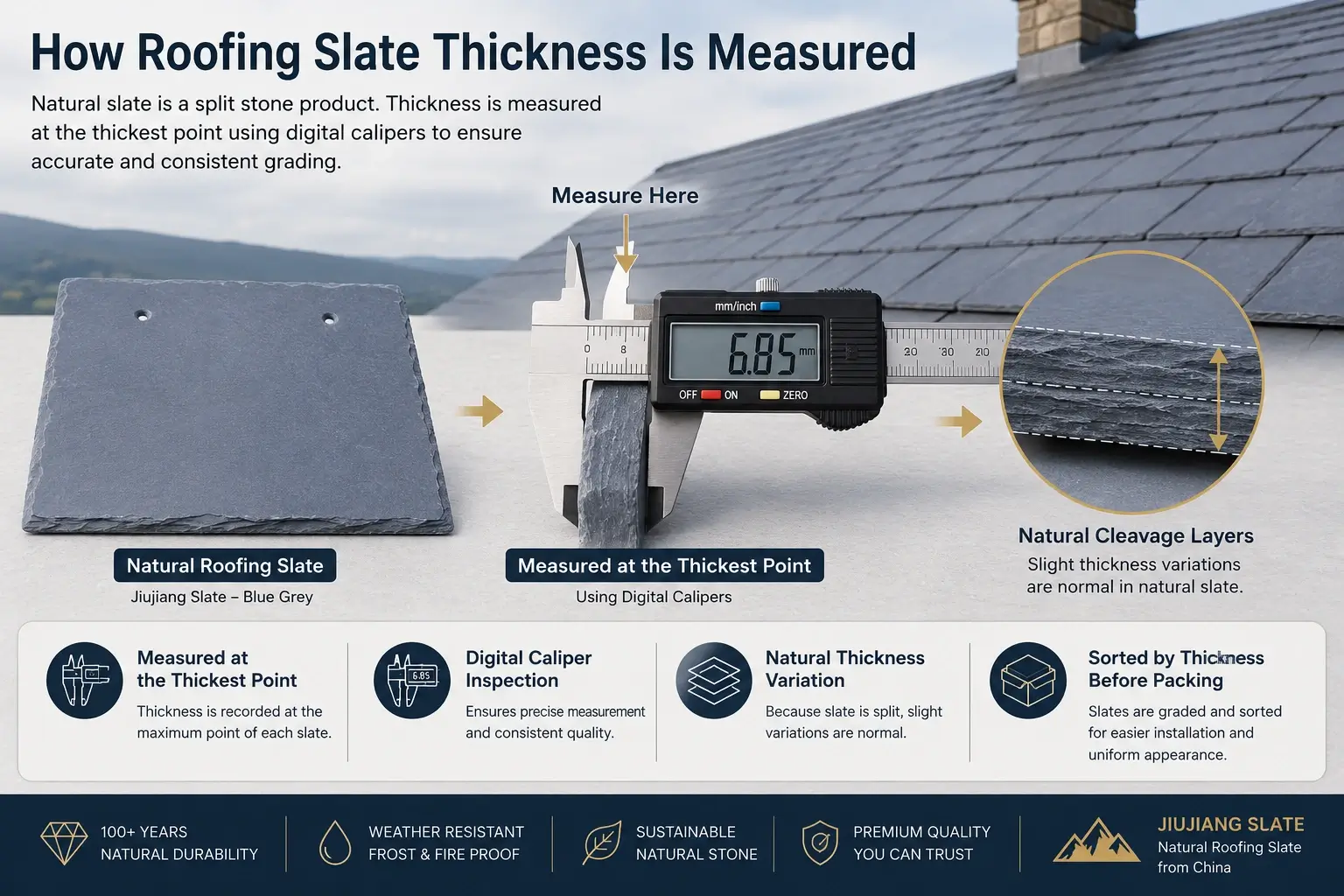
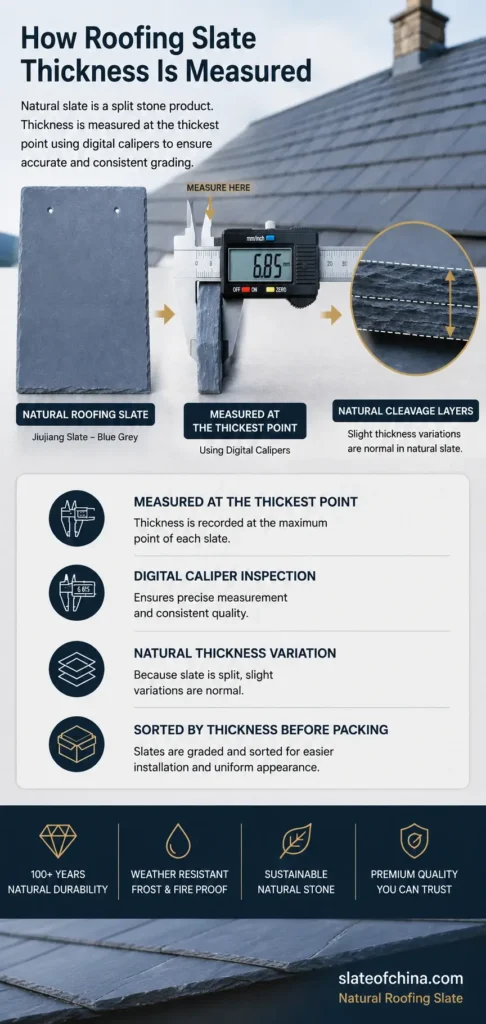
Unlike manufactured roofing materials, natural roofing slate is a split stone product. Each slate is hand-split along its natural cleavage planes, giving it a unique surface texture and slight variations in thickness.
For this reason, roofing slate thickness is measured using standardized methods, rather than relying on visual inspection alone. Understanding how thickness is measured helps buyers compare products accurately, interpret thickness ranges correctly, and communicate clear specifications with suppliers.
Where Is Roofing Slate Thickness Measured?
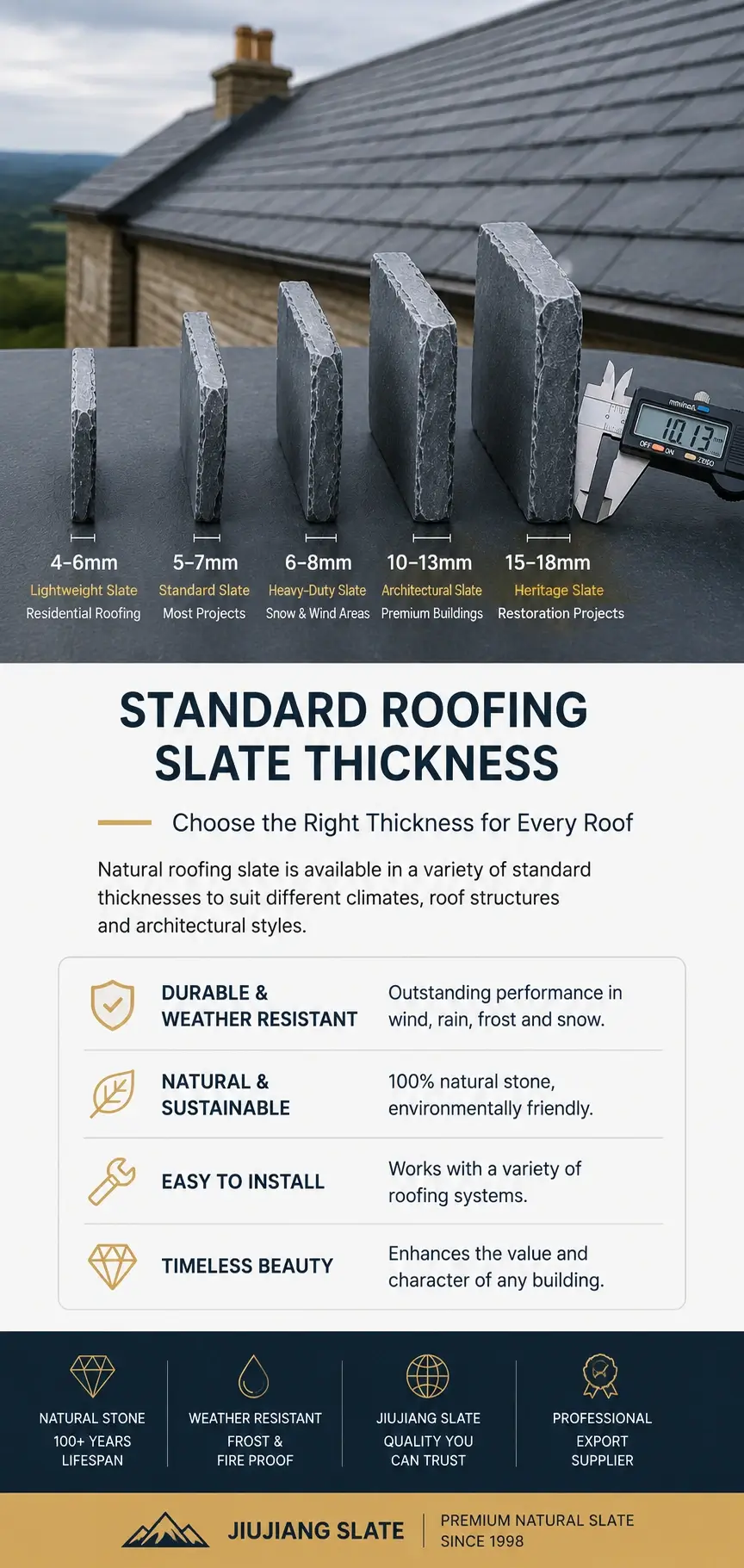
Natural roofing slate is normally measured at its thickest point, as this represents the maximum thickness of the individual slate.
Manufacturers and quality inspectors typically use:
- Digital calipers for precise measurements
- Mechanical thickness gauges for routine production inspections
- Quality control measuring tools during grading and packing
Measuring at the thickest point provides a consistent reference for product classification and helps ensure that roofing slates meet the specified thickness range.
Professional Tip: Always confirm with your supplier whether the stated thickness refers to the maximum (thickest point) or an average thickness, as different manufacturers may use different internal practices.
Why Does Natural Slate Thickness Vary?
Many first-time buyers expect every slate tile to have exactly the same thickness. In reality, slight thickness variations are a natural characteristic of genuine roofing slate.
Unlike concrete or ceramic roof tiles that are molded in factories, natural slate is split from solid stone. During the splitting process, each piece follows the stone’s natural layers rather than an artificial mold.
As a result:
- The surface remains naturally cleft.
- Minor thickness differences are normal.
- Each slate retains the authentic texture and character of natural stone.
These natural variations are one of the features that distinguish genuine slate roofing from manufactured alternatives.
Understanding Nominal Thickness vs. Actual Thickness
When purchasing roofing slate, it is important to understand the difference between nominal thickness and actual thickness.
| Term | Meaning |
|---|---|
| Nominal Thickness | The specified thickness range used for ordering and product classification, such as 4–6 mm or 6–8 mm. |
| Actual Thickness | The measured thickness of an individual slate at its thickest point. Because slate is a natural product, the actual thickness may vary slightly within the specified range. |
For example:
A roofing slate sold as 5–7 mm does not mean that every point on every slate measures exactly 6 mm. Instead, each slate is expected to fall within the agreed thickness range while maintaining consistent overall quality.
What Is Thickness Tolerance?
Thickness tolerance refers to the acceptable variation in slate thickness during production.
Because roofing slate is a natural stone rather than a manufactured material, a reasonable thickness tolerance is expected and accepted throughout the roofing industry.
A well-controlled production process should provide:
- Consistent thickness grading
- Uniform roof appearance after installation
- Easier installation
- Reliable roof performance
High-quality manufacturers sort roofing slates by thickness before packing to minimize variation within each bundle and improve installation efficiency.
How Jiujiang Roofing Slate Ensures Thickness Consistency
At Jiujiang Slate, thickness consistency is achieved through careful material selection and strict quality control throughout the production process.
Each roofing slate is:
- Split by experienced workers following the natural cleavage of the stone
- Sorted into standard thickness ranges (4–6 mm, 5–7 mm, 6–8 mm, 10–13 mm, and 15–18 mm)
- Checked using measuring tools before packing
- Grouped by thickness to ensure easier installation and a more uniform finished roof
This grading process helps roofing contractors install slates more efficiently while maintaining the consistent appearance expected in high-quality roofing projects.
Key Takeaway
Natural roofing slate is measured at its thickest point using professional measuring tools. Slight thickness variations are normal because slate is a naturally split stone, not a factory-molded product. The key to quality is not achieving identical thickness, but maintaining consistent grading within the specified thickness range.
Roofing Slate Thickness Tolerance
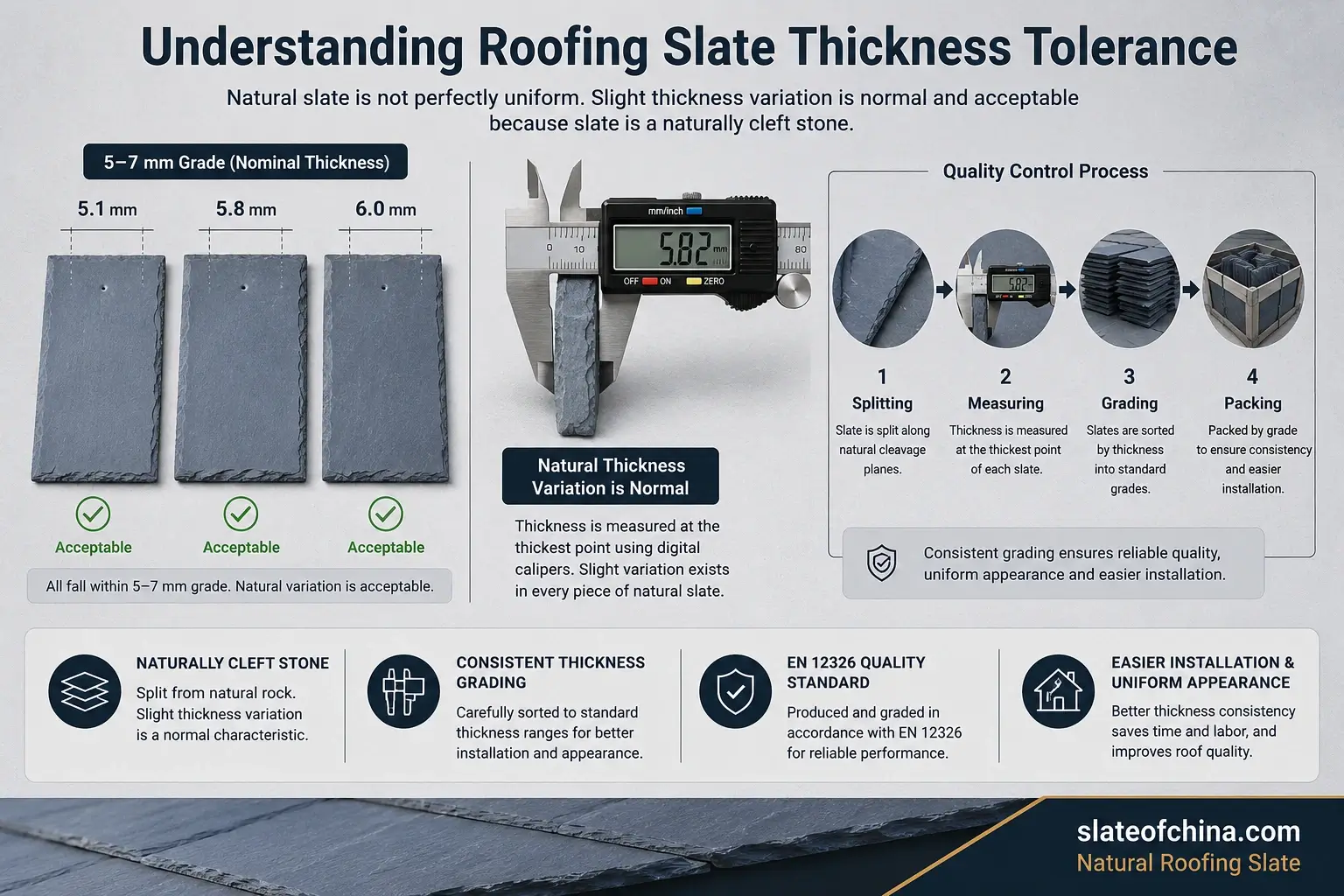
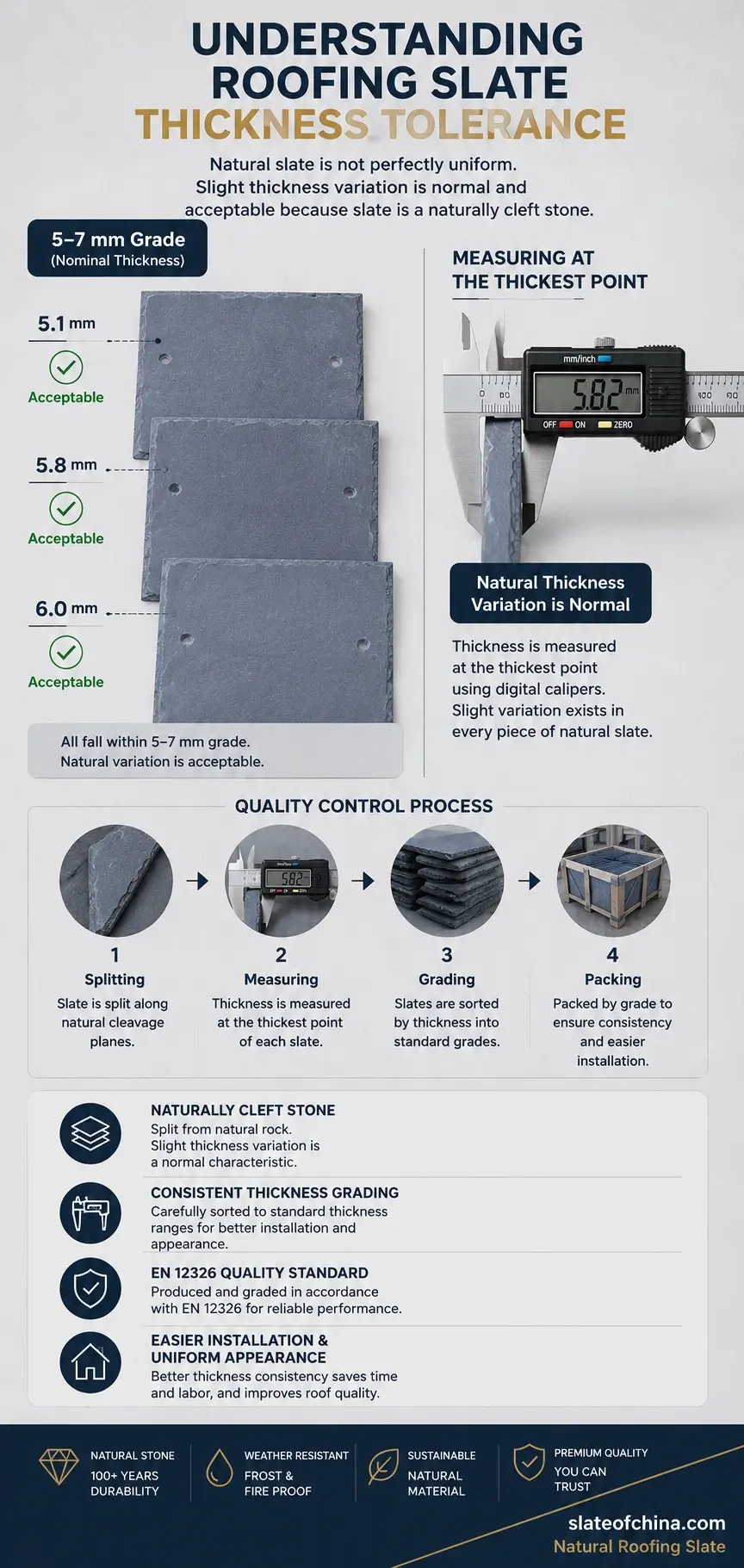
Natural roofing slate is a 100% natural stone product, not a factory-molded material. Because each slate is split along its natural cleavage planes, no two pieces are perfectly identical.
As a result, slight thickness variations are normal and expected. The key indicator of quality is consistent thickness grading, rather than achieving exactly the same thickness on every individual slate.
Understanding thickness tolerance helps buyers distinguish between natural characteristics and manufacturing defects, ensuring realistic quality expectations for natural roofing slate.
Why Does Roofing Slate Have Thickness Tolerance?
Unlike concrete, ceramic, or fiber cement roof tiles that are produced in molds, natural roofing slate is hand-split or machine-split from solid stone.
During the splitting process:
- Each slate follows its natural cleavage layers.
- Minor thickness differences occur naturally.
- Every slate retains its authentic texture and unique character.
For this reason, slight thickness variation is considered a normal feature of genuine natural slate rather than a product defect.
Natural variation is one of the characteristics that makes every natural roofing slate unique.
What Is a Typical Roofing Slate Thickness Tolerance?
Although acceptable tolerances may vary depending on the product specification, manufacturer, and applicable standards, high-quality roofing slate is generally supplied with carefully controlled thickness grading.
For many standard roofing slates, a typical production tolerance is approximately:
| Nominal Thickness | Typical Thickness Tolerance* |
|---|---|
| 4–6 mm | ±1 mm |
| 5–7 mm | ±1 mm |
| 6–8 mm | ±1 mm |
| 10–13 mm | According to project specification |
| 15–18 mm | According to project specification |
*Note: Actual tolerance requirements may vary according to product specifications, customer requirements, and applicable standards such as EN 12326.
Does EN 12326 Specify Thickness Tolerance?
EN 12326, the European Standard for natural slate used in roofing and external cladding, does not simply require every slate to have exactly the same thickness.
Instead, the standard emphasizes:
- Consistent product grading
- Reliable dimensional accuracy
- Appropriate manufacturing quality
- Product classification and performance testing
This approach recognizes that natural slate is a geological material with inherent variations, while still requiring manufacturers to maintain consistent production quality.
For roofing contractors and architects, compliance with EN 12326 provides confidence that the slate has been produced and graded according to recognized industry standards.
Thickness Consistency Is More Important Than Perfect Uniformity
One of the biggest misconceptions among first-time buyers is that every slate should have exactly the same thickness.
In practice, experienced roofing contractors are more concerned with thickness consistency within each batch.
Consistent grading provides several important benefits:
- Faster and easier installation
- Better roof alignment
- More uniform shadow lines
- Improved roof appearance
- Reduced on-site sorting
- Higher installation efficiency
In other words, a well-graded 5–7 mm batch is usually preferable to a batch with inconsistent thickness, even if the average thickness is the same.
How Jiujiang Slate Controls Thickness Consistency
At Slate of China, thickness consistency is maintained through multiple quality control stages.
Each roofing slate is:
- Carefully split along its natural cleavage planes
- Classified into standard thickness ranges
- Measured during quality inspection
- Sorted before packing
- Packed by thickness grade to improve installation efficiency
This grading process helps ensure that each shipment offers consistent appearance and reliable installation performance while preserving the authentic characteristics of natural stone.
Professional Advice
Do not judge roofing slate quality by a single thickness measurement.
The true indicator of quality is whether the slates are consistently graded, meet the specified thickness range, and comply with recognized quality standards such as EN 12326.
Key Takeaway
Natural roofing slate is expected to have slight thickness variations because it is split from natural stone. High-quality slate is defined by consistent thickness grading, accurate quality control, and compliance with industry standards—not by perfectly identical thickness on every piece.
Is thickness variation in roofing slate normal?
Yes. Slight thickness variation is a natural characteristic of genuine roofing slate. As long as the slates fall within the specified thickness range and have been consistently graded, these variations do not affect installation or long-term performance.
Common Roofing Slate Thickness by Application
Choosing the right roofing slate thickness depends on how and where the slate will be used. Different building types, climates, roof structures, and architectural styles require different thickness ranges to achieve the best balance between durability, appearance, structural load, and cost.
While thicker slate creates a stronger visual impact, it is not always the best choice. Selecting the appropriate thickness for each application ensures easier installation, better long-term performance, and improved project value.
Standard Roofing Slate Thickness by Application
建议采用下面这张表,比传统三列表更专业,也更符合采购商的阅读习惯。
| Application | Recommended Thickness | Why It’s Recommended |
|---|---|---|
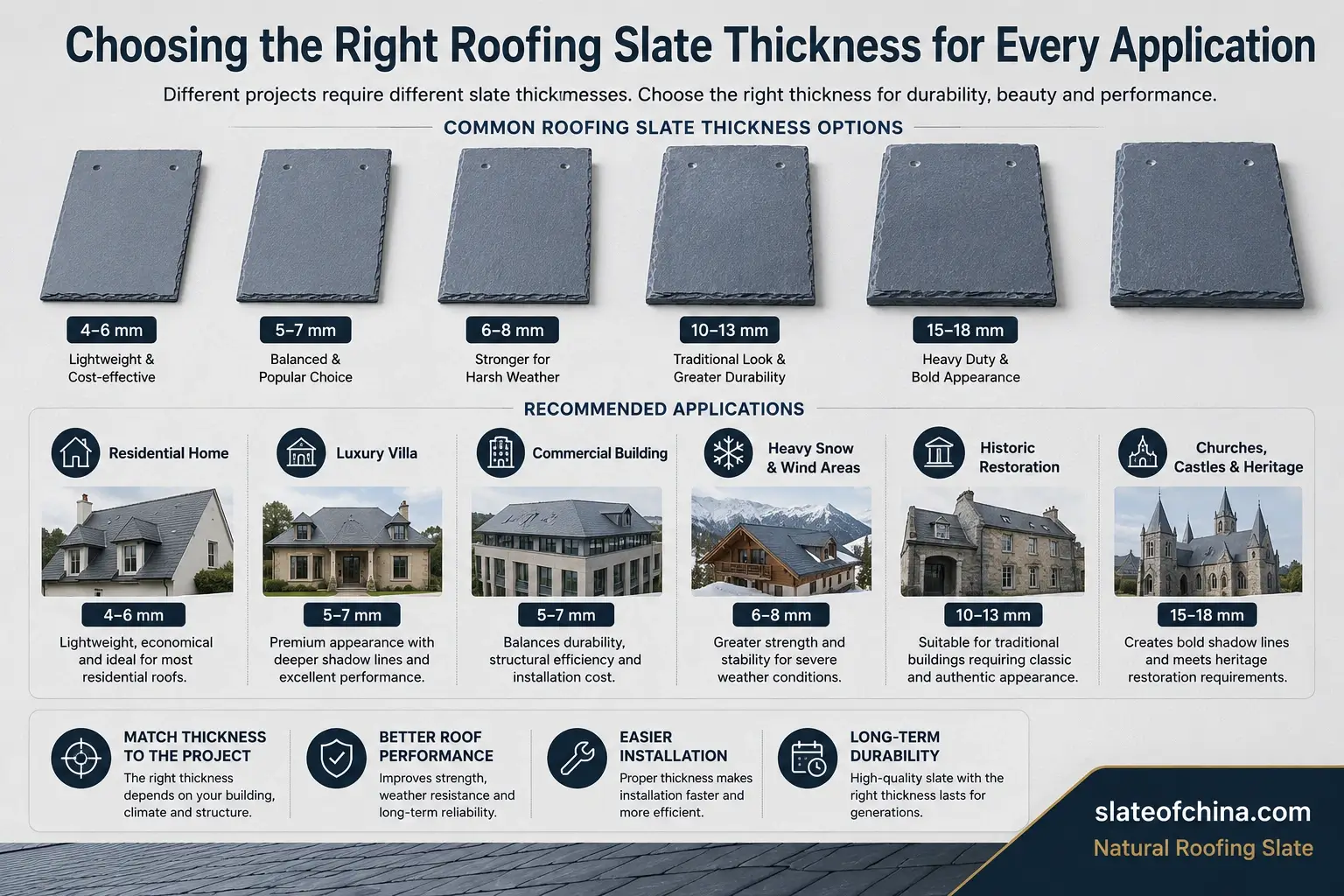
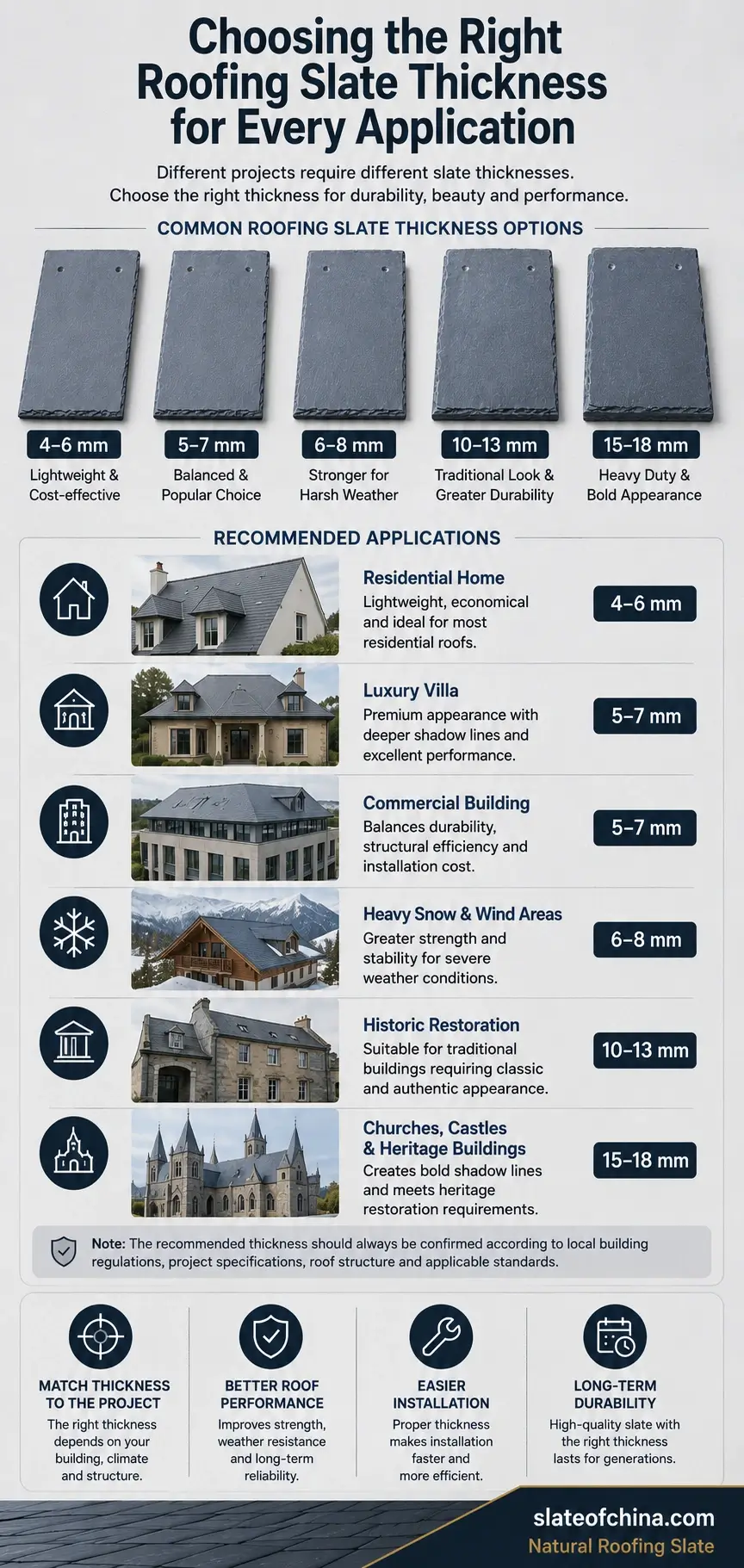
| Residential Roofing | 4–6 mm | Lightweight, economical, easy to install, ideal for most homes. |
| Luxury Homes & Villas | 5–7 mm | Provides a more premium appearance with deeper shadow lines while maintaining manageable roof weight. |
| Commercial Buildings | 5–7 mm | Balances durability, structural efficiency, and installation cost. |
| Heavy Snow & High-Wind Areas | 6–8 mm | Greater strength and stability for demanding weather conditions. |
| Historic Restoration | 10–13 mm | Suitable for traditional buildings requiring a classic, handcrafted appearance. |
| Churches, Castles & Heritage Buildings | 15–18 mm | Creates bold shadow lines and meets many heritage restoration requirements. |
| Architectural Feature Roofs | 10–13 mm or Custom | Used where designers require a distinctive visual effect. |
Note: The recommended thickness should always be confirmed according to local building regulations, project specifications, roof structure, and applicable standards.
Residential Roofing
For most residential homes, 4–6 mm natural roofing slate is the most popular choice.
It offers:
- Lower roof weight
- Cost-effective installation
- Excellent durability
- Suitable for most roof structures
- Attractive and clean appearance
This thickness is widely used throughout Europe and North America for new homes and renovation projects.
Luxury Homes and Villas
High-end residential projects often select 5–7 mm roofing slate to create a richer architectural appearance.
The additional thickness produces:
- More pronounced shadow lines
- Greater visual depth
- Premium roof aesthetics
- Excellent long-term performance
This thickness is especially popular for luxury villas, country houses, and prestigious residential developments.
Heavy Snow and High-Wind Regions
Projects located in mountain regions or areas with severe weather commonly specify 6–8 mm roofing slate.
The increased thickness helps provide:
- Better resistance to snow loads
- Improved stability in strong winds
- Enhanced durability in freeze–thaw conditions
- Longer service life under demanding climates
Typical applications include Alpine regions, northern Europe, and high-altitude buildings.
Historic Restoration and Heritage Projects
Traditional buildings often require thicker roofing slate to preserve their original architectural character.
For these projects:
- 10–13 mm is commonly specified for historic restoration.
- 15–18 mm is frequently used on churches, castles, manor houses, and landmark buildings where a traditional heavy-slate appearance is required.
These thicker slates create distinctive shadow lines that are difficult to achieve with thinner materials.
Architectural Feature Roofs
Architects sometimes specify thicker or custom roofing slate to create unique roof designs.
Applications include:
- Museums
- Public buildings
- Hotels
- Luxury resorts
- Cultural centers
- Contemporary architecture
Depending on the design intent, 10–13 mm, 15–18 mm, or custom thicknesses may be selected to achieve a distinctive visual effect.
Which Roofing Slate Thickness Should You Choose?
If you’re unsure which thickness is right for your project, the following guide provides a quick reference.
| If your project is… | Recommended Thickness |
|---|---|
| Standard residential house | 4–6 mm |
| Luxury villa | 5–7 mm |
| Commercial building | 5–7 mm |
| Snowy or windy region | 6–8 mm |
| Historic restoration | 10–13 mm |
| Church or castle | 15–18 mm |
| Special architectural design | Custom |
Professional Recommendation
The ideal roofing slate thickness is determined by the project—not by choosing the thickest slate available. A well-matched thickness improves roof performance, simplifies installation, controls structural load, and delivers the best long-term value.
Need help selecting the right slate size as well as thickness? Explore our complete guides to Roofing Slate Sizes, Roofing Slate Weight, and Roofing Slate Installation to make the best choice for your project.
Does Thicker Slate Last Longer?
Quick Answer
Generally, yes—but not always.
Thicker roofing slate can provide greater mechanical strength and may perform better in demanding environments. However, thickness alone does not determine the lifespan of a slate roof.
A roof’s service life depends on the combined performance of the slate material, manufacturing quality, installation, and environmental conditions.
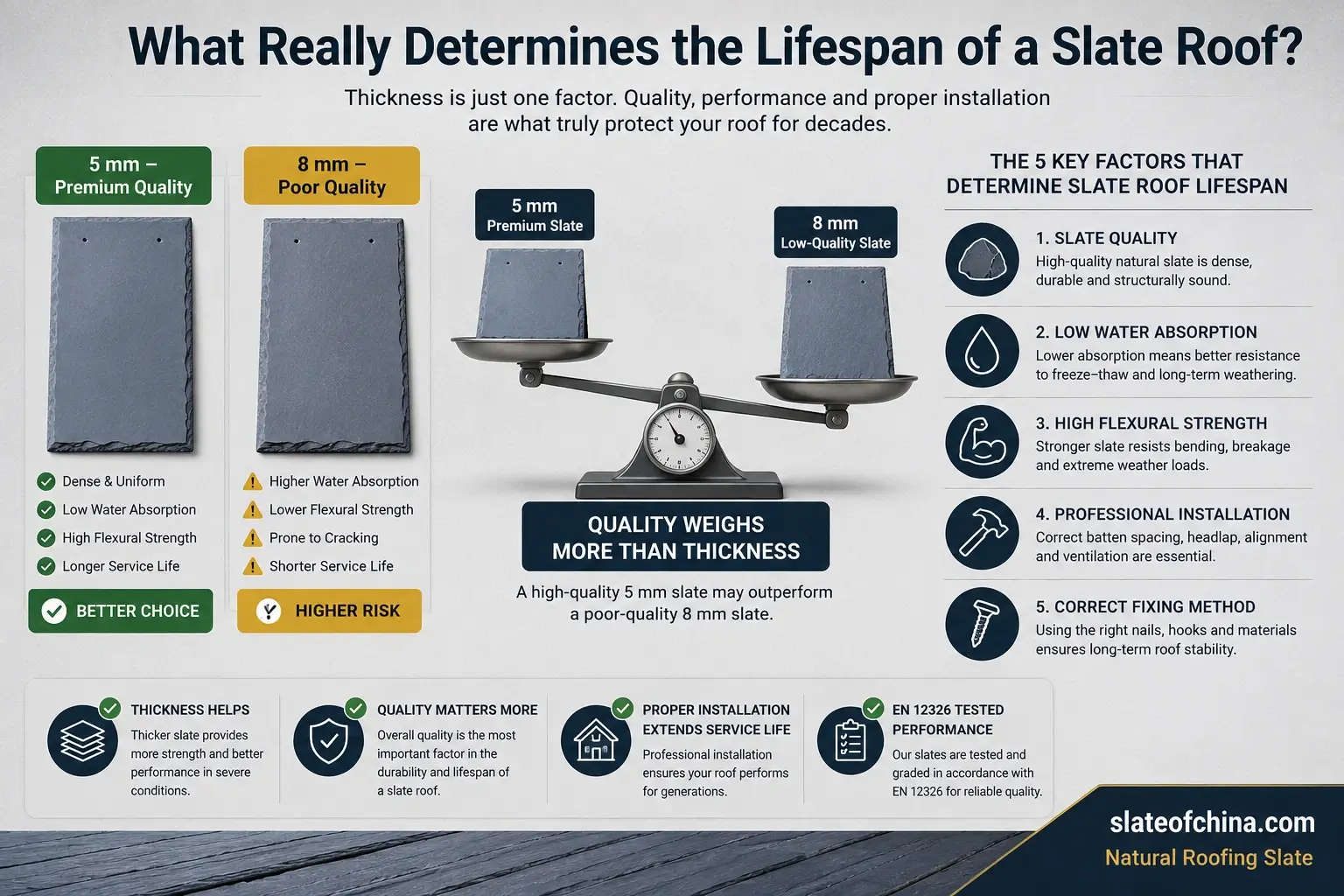
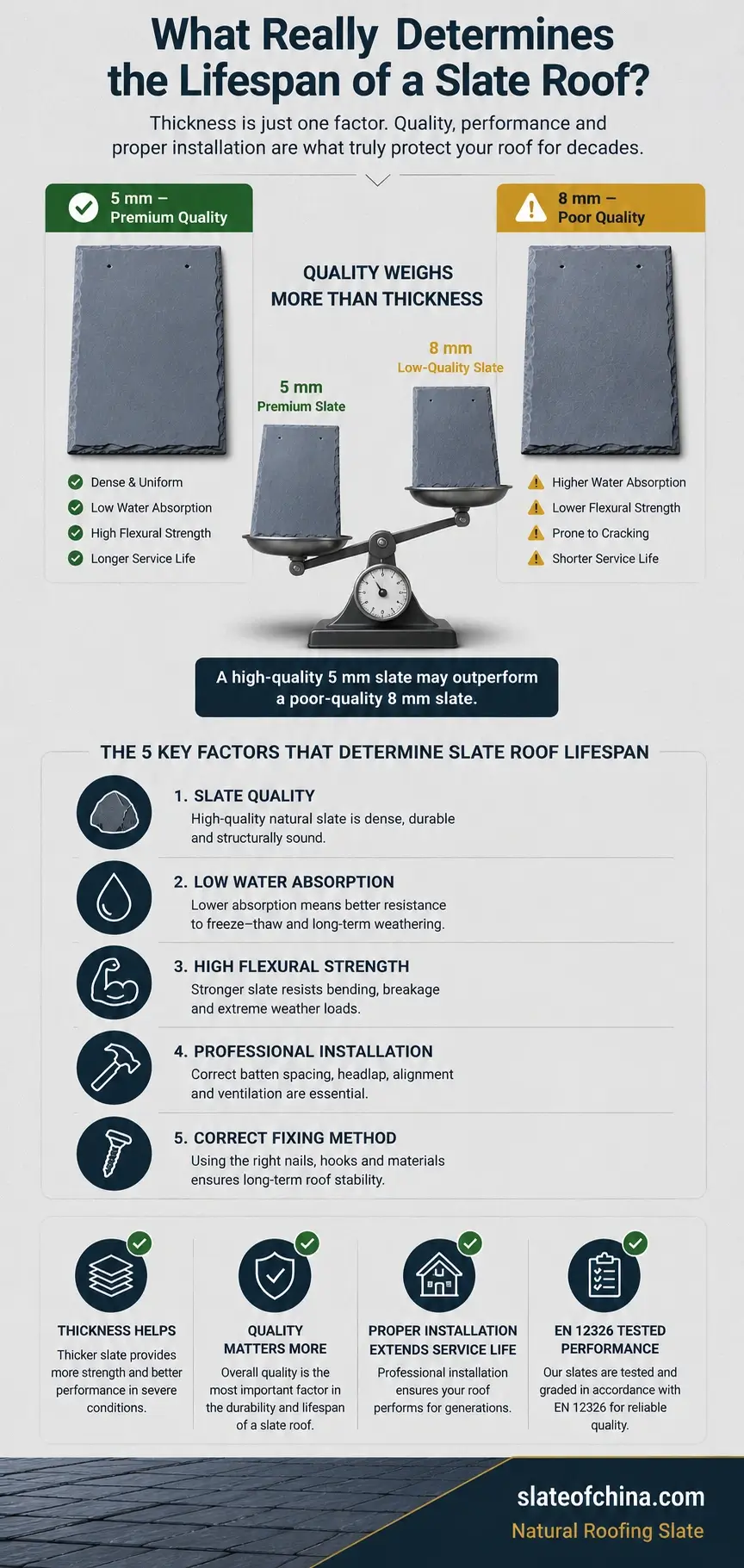
In many cases, a high-quality 5 mm roofing slate can last significantly longer than a poor-quality 8 mm slate.
Why Thicker Slate Can Last Longer
Thicker roofing slate generally offers several advantages.
It may provide:
- Greater resistance to impact from hail or falling branches
- Improved strength under heavy snow loads
- Better performance in exposed coastal or mountain locations
- Deeper shadow lines that create a more traditional roof appearance
- Longer wear life in high-traffic maintenance areas
For these reasons, thicker slate is often specified for historic buildings, churches, castles, and projects located in harsh climates.
However, thickness is only one part of the overall picture.
What Really Determines Slate Roof Lifespan?
The longevity of a natural slate roof depends on several critical factors working together.
1. Slate Quality
The geological quality of the stone is the most important factor.
High-quality roofing slate is:
- Dense
- Uniform
- Free from structural defects
- Naturally durable
Premium natural slate can often remain in service for more than a century when properly installed.
2. Water Absorption
Low water absorption is essential for long-term durability.
Slate with lower water absorption is more resistant to:
- Freeze–thaw cycles
- Moisture penetration
- Surface deterioration
- Long-term weathering
This is one of the key performance requirements evaluated under EN 12326.
3. Flexural Strength
Flexural strength measures the slate’s ability to resist bending and mechanical stress.
Higher flexural strength helps roofing slate withstand:
- Wind uplift
- Snow loads
- Handling during installation
- Long-term structural movement
A thinner slate with excellent flexural strength may outperform a thicker slate with poor mechanical properties.
4. Installation Quality
Even the highest-quality slate cannot achieve its full lifespan if it is installed incorrectly.
Professional installation should include:
- Correct batten spacing
- Proper headlap and sidelap
- Accurate slate alignment
- Appropriate ventilation
- Compliance with local roofing standards
Poor installation is one of the most common causes of premature roof failure.
5. Fixing Method
The fixing system also has a significant influence on roof longevity.
Using the correct:
- Slate nails
- Hooks
- Fasteners
- Corrosion-resistant materials
helps ensure that the roofing system remains secure for decades.
The fixing method should always match the slate thickness and local installation practices.
Thickness vs. Overall Quality
The table below illustrates why thickness alone should never be used to judge roofing slate quality.
| Factor | Importance to Service Life |
|---|---|
| Slate Quality | ⭐⭐⭐⭐⭐ |
| Water Absorption | ⭐⭐⭐⭐⭐ |
| Flexural Strength | ⭐⭐⭐⭐☆ |
| Installation Quality | ⭐⭐⭐⭐⭐ |
| Fixing Method | ⭐⭐⭐⭐☆ |
| Slate Thickness | ⭐⭐⭐☆☆ |
Professional Insight:
A thicker slate cannot compensate for poor stone quality or incorrect installation.
Expert Tip
A high-quality 5 mm natural roofing slate may outperform a poor-quality 8 mm slate if it has lower water absorption, higher flexural strength, and is installed correctly.
When selecting roofing slate, always evaluate the overall quality of the slate—not just its thickness.
So, Should You Choose Thicker Roofing Slate?
Choose thicker roofing slate when your project requires:
- Heavy snow resistance
- Strong wind performance
- Heritage restoration
- Traditional architectural appearance
- Greater visual depth and shadow lines
For most residential and commercial buildings, however, 4–6 mm or 5–7 mm high-quality natural roofing slate provides an excellent balance of durability, appearance, roof weight, and installation efficiency.
Key Takeaway
Thickness contributes to roofing performance, but it is only one part of a high-quality slate roof. The longest-lasting roofs combine premium natural slate, low water absorption, high flexural strength, professional installation, and the correct fixing method.
Does thicker roofing slate always last longer?
No. While thicker slate can provide greater strength in demanding environments, the lifespan of a slate roof depends more on slate quality, water absorption, flexural strength, installation quality, and fixing methods than thickness alone.
At Slate of China, we believe the best roofing slate is not simply the thickest one—it is the slate that combines premium stone quality, controlled thickness, low water absorption, high flexural strength, and consistent manufacturing to deliver decades of reliable performance.
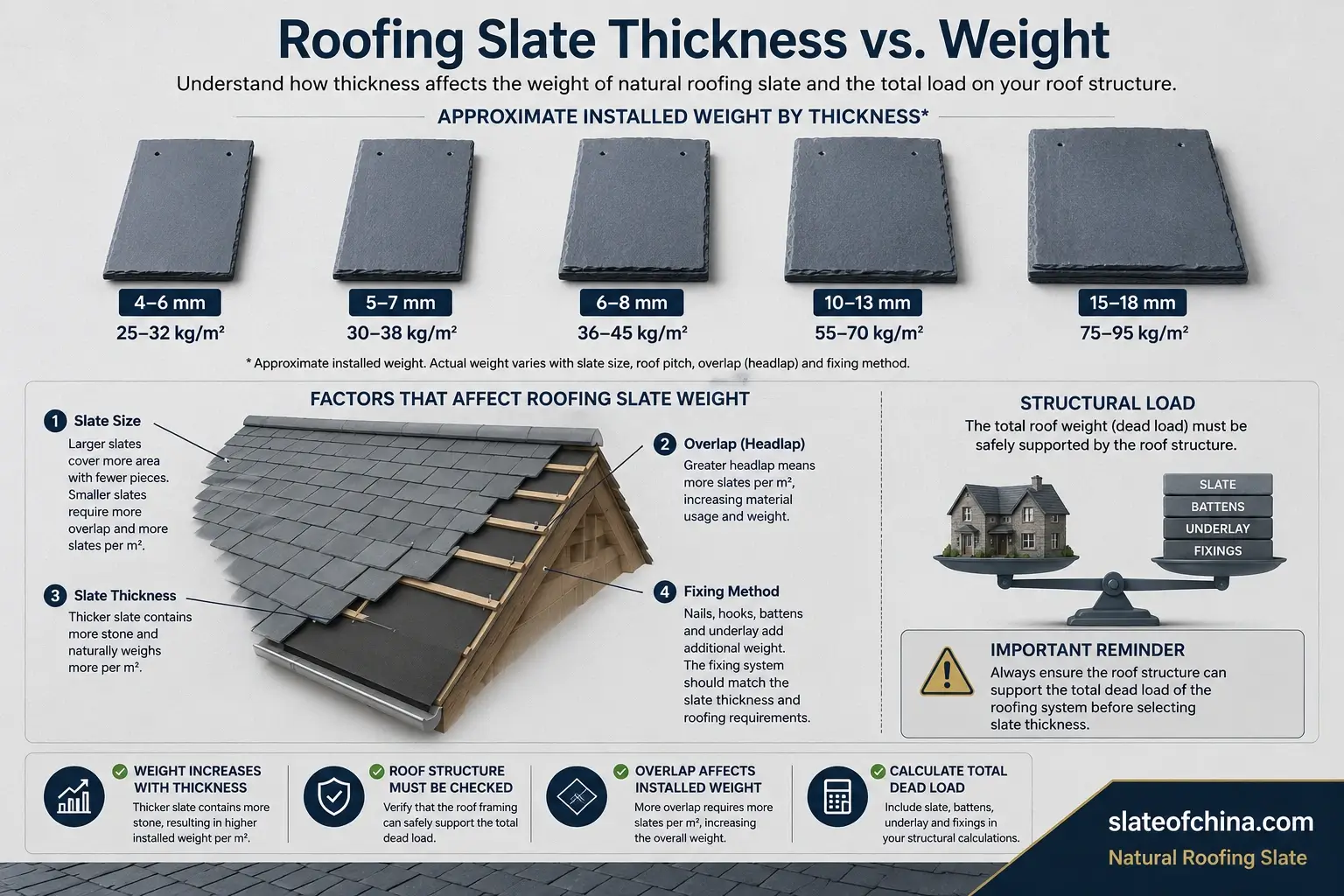
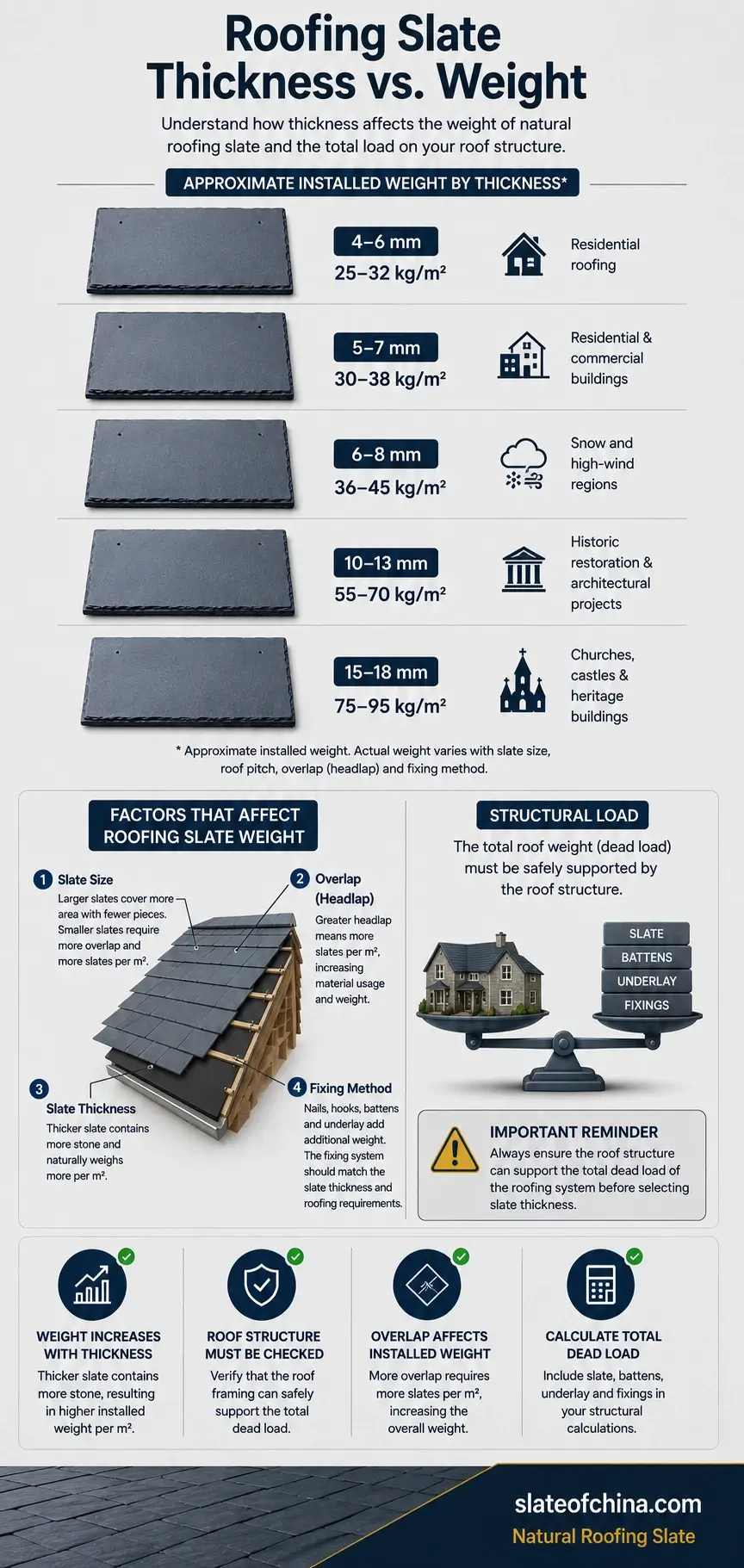
Roofing Slate Thickness vs. Weight
Roofing slate thickness has a direct impact on the overall weight of a slate roof. As the thickness increases, the weight per square metre also increases, affecting roof structure design, transportation costs, installation efficiency, and project budgeting.
However, roofing slate weight is influenced by more than thickness alone. Slate size, roof overlap, installation method, and the density of the stone all contribute to the final installed weight.
Understanding these factors helps architects, contractors, and homeowners choose the right roofing slate while ensuring that the roof structure is properly designed to support the total dead load.
Approximate Roofing Slate Weight by Thickness
The table below provides a general comparison of installed roofing slate weight for common thickness ranges.
Note: Values are approximate and may vary depending on slate size, roof pitch, overlap, fixing method, and the density of the natural stone.
| Slate Thickness | Approximate Installed Weight* | Typical Applications |
|---|---|---|
| 4–6 mm | 25–32 kg/m² | Residential roofing |
| 5–7 mm | 30–38 kg/m² | Residential & commercial buildings |
| 6–8 mm | 36–45 kg/m² | Snow and high-wind regions |
| 10–13 mm | 55–70 kg/m² | Historic restoration & architectural projects |
| 15–18 mm | 75–95 kg/m² | Churches, castles & heritage buildings |
Approximate installed weight based on standard roofing practice. Actual weight varies with slate dimensions, headlap, roof pitch, and fixing system.
What Affects Roofing Slate Weight?
The total weight of a slate roof depends on several factors, not just thickness.
Slate Size
Larger slates cover more roof area with fewer pieces, while smaller slates require more overlap and more individual slates per square metre. This changes the overall installed weight.
Roof Overlap (Headlap)
Headlap is the portion of each slate covered by the slate above it.
Greater overlap means:
- More slates per square metre
- Increased material usage
- Higher roof weight
Roof pitch and local climate often determine the required overlap.
Slate Thickness
Thicker slate naturally weighs more because it contains more stone.
For example:
- 4–6 mm slate is ideal for lightweight residential roofs.
- 10–13 mm and 15–18 mm slate provide a heavier, traditional appearance but require stronger roof structures.
Fixing Method
The roofing system also contributes to the total dead load.
Installed roof weight may vary depending on:
- Copper nails
- Stainless steel nails
- Slate hooks
- Battens
- Underlay
Although these materials contribute less weight than the slate itself, they should be included when calculating the complete roofing system.
Stone Density
Natural slate from different quarries may have slightly different densities.
High-density slate generally offers:
- Higher mechanical strength
- Lower water absorption
- Greater durability
It may also result in a slightly higher weight per square metre.
Why Roof Weight Matters
Understanding roofing slate weight is essential before selecting slate thickness.
The total roof weight influences:
- Structural design
- Roof framing requirements
- Transportation costs
- Crane lifting capacity
- Installation efficiency
- Long-term building safety
This is particularly important for renovation projects, where the existing roof structure may have limited load-bearing capacity.
Structural Safety Reminder
Always ensure that the roof structure can safely support the total dead load of the roofing system before selecting slate thickness.
If you are replacing an existing roof or restoring a historic building, consult a structural engineer or roofing professional to verify load capacity.
Does Heavier Slate Mean Better Quality?
Not necessarily.
A heavier roofing slate does not automatically indicate higher quality.
Quality should be evaluated based on:
- Geological quality
- Water absorption
- Flexural strength
- Thickness consistency
- Compliance with EN 12326
- Proper installation
A lighter, high-quality natural slate may outperform a heavier slate made from lower-quality stone.
Key Takeaway
Roofing slate thickness and roof weight are closely related, but thickness is only one factor. Always consider slate size, overlap, fixing method, and roof structure to select the most suitable natural roofing slate for your project.
How much does roofing slate weigh?
The installed weight of natural roofing slate typically ranges from 25–95 kg/m², depending on the slate thickness, size, overlap, fixing method, and stone density. Thicker slate generally weighs more, but the total roof weight should always be calculated for the complete roofing system rather than the slate alone.
Roofing Slate Thickness and Installation Guide
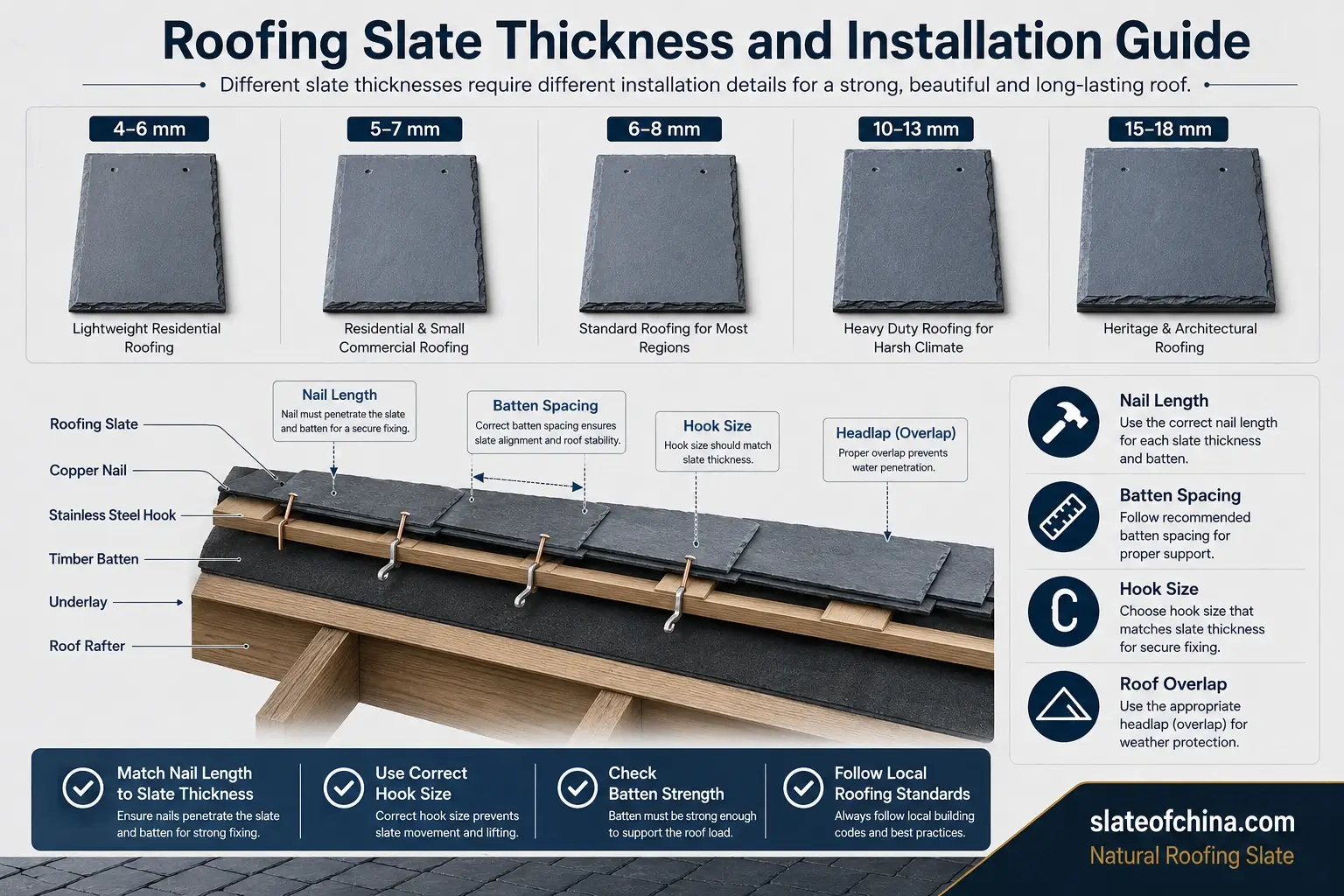
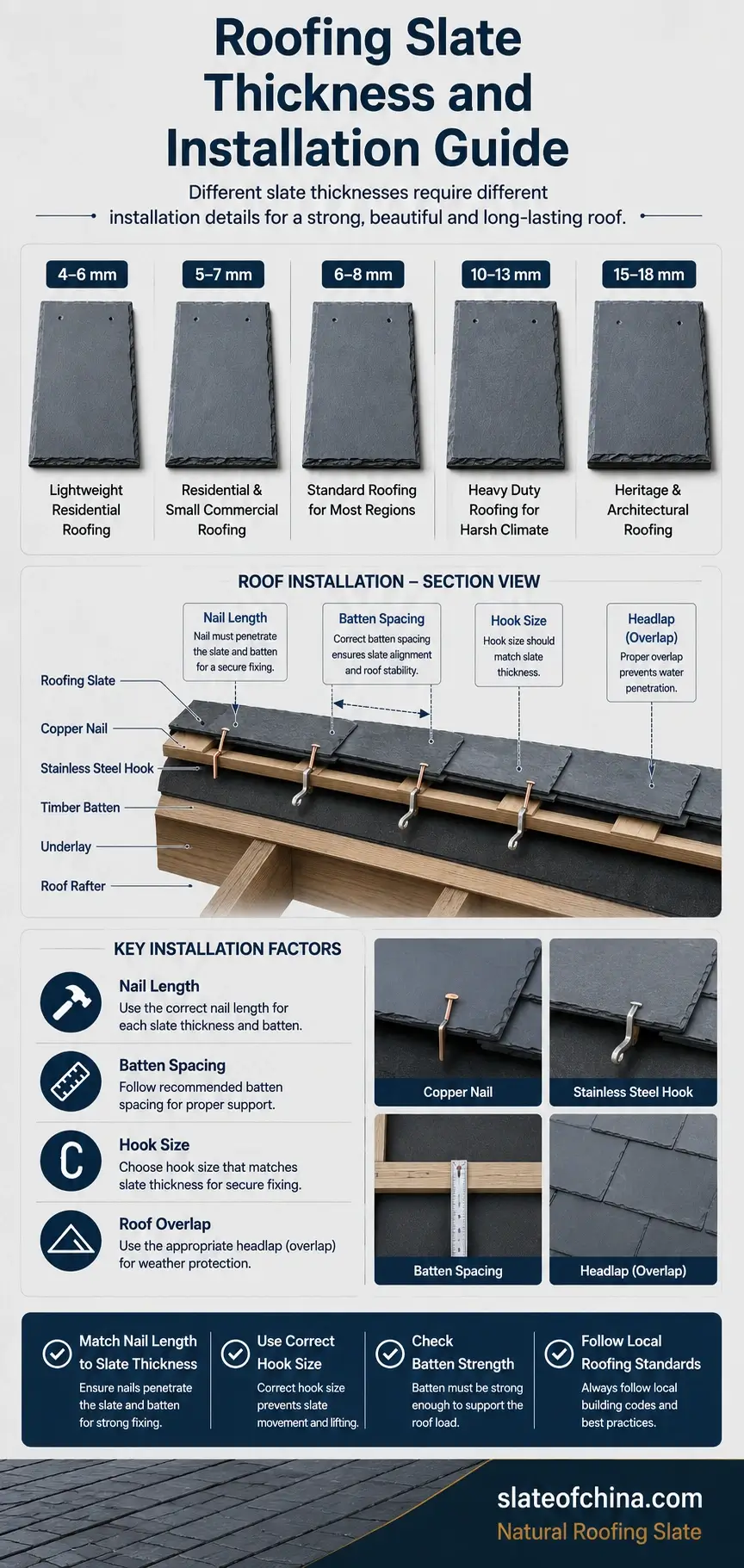
Selecting the correct roofing slate thickness is only the first step toward building a durable slate roof. Different slate thicknesses require different installation methods to ensure proper fixing, weather resistance, and long-term performance.
Using incorrect nails, battens, hooks, or overlap for a particular slate thickness may affect roof appearance, increase installation time, and reduce the lifespan of the roofing system.
Whether you are installing a residential roof or restoring a historic building, matching the installation method to the slate thickness is essential for a safe and reliable roof.
How Slate Thickness Affects Installation
As roofing slate becomes thicker, several installation details must be adjusted accordingly.
These include:
- Nail length
- Batten spacing
- Slate hook size
- Roof overlap (headlap)
- Overall roof weight
Proper coordination between these elements helps ensure that every slate is securely fixed and performs as intended throughout its service life.
Roofing Slate Installation Requirements by Thickness
| Slate Thickness | Typical Installation Considerations |
|---|---|
| 4–6 mm | Standard nail length, standard batten spacing, suitable for most residential roofs |
| 5–7 mm | Slightly longer nails may be required depending on batten thickness |
| 6–8 mm | Stronger fixing system recommended for heavy snow and high-wind areas |
| 10–13 mm | Longer nails, stronger battens, larger hooks where applicable |
| 15–18 mm | Heavy-duty installation system designed for heritage and architectural projects |
Note: Installation details vary by country, roofing specification, slate size, and local building regulations.
Nail Length
The nail should penetrate securely through the slate and into the timber batten without causing excessive movement.
As slate thickness increases, longer nails are generally required to provide sufficient fixing strength.
Using nails that are too short may reduce fixing security, while excessively long nails may split the battens.
For long-term durability, copper or stainless steel nails are commonly recommended.
Batten Spacing
Batten spacing is determined primarily by:
- Slate length
- Headlap
- Roof pitch
However, thicker roofing slate may require stronger battens because of the increased roof weight.
Proper batten spacing helps:
- Maintain uniform roof alignment
- Improve installation efficiency
- Support the increased dead load
Slate Hooks
Hook fixing systems are widely used in many European countries.
The hook size should match the slate thickness.
Generally:
- Thinner slate uses smaller hooks.
- Thicker slate requires larger hook sizes to accommodate the increased thickness.
Selecting the correct hook size helps prevent movement while maintaining proper slate alignment.
Roof Overlap (Headlap)
Roof overlap is another important factor influenced by the roofing design.
Required overlap depends on:
- Roof pitch
- Local rainfall
- Wind exposure
- Roofing standards
Although overlap is not determined solely by slate thickness, thicker slate often forms part of roofing systems designed for more demanding weather conditions.
Best Installation Practices
For the best roofing performance:
✔ Use the recommended fixing method for the selected slate thickness.
✔ Select corrosion-resistant nails or hooks.
✔ Follow local roofing standards and manufacturer recommendations.
✔ Check roof structure before installing heavy roofing slate.
✔ Ensure consistent slate grading for easier installation.
Professional Recommendation
Never choose installation accessories based only on slate size.
Nail length, hook size, batten strength, and overlap should always be matched to the roofing slate thickness and the project’s structural requirements.
Installation Is Just as Important as Slate Quality
Even premium natural roofing slate cannot deliver its full service life without proper installation.
Correct installation helps:
- Improve weather resistance
- Prevent slate movement
- Reduce maintenance
- Extend roof lifespan
- Preserve the roof’s visual appearance
A professionally installed slate roof can provide reliable performance for generations.
Key Takeaway
Choosing the correct roofing slate thickness is only part of a successful roofing project. Matching the installation method—including nail length, batten spacing, hook size, and roof overlap—to the slate thickness is essential for long-term durability and safety.
Does thicker roofing slate require different installation?
Yes. Thicker roofing slate generally requires longer nails, stronger battens, larger slate hooks (where used), and careful consideration of roof weight and overlap. Installation methods should always follow local roofing standards and project specifications.
Jiujiang Roofing Slate Thickness Options
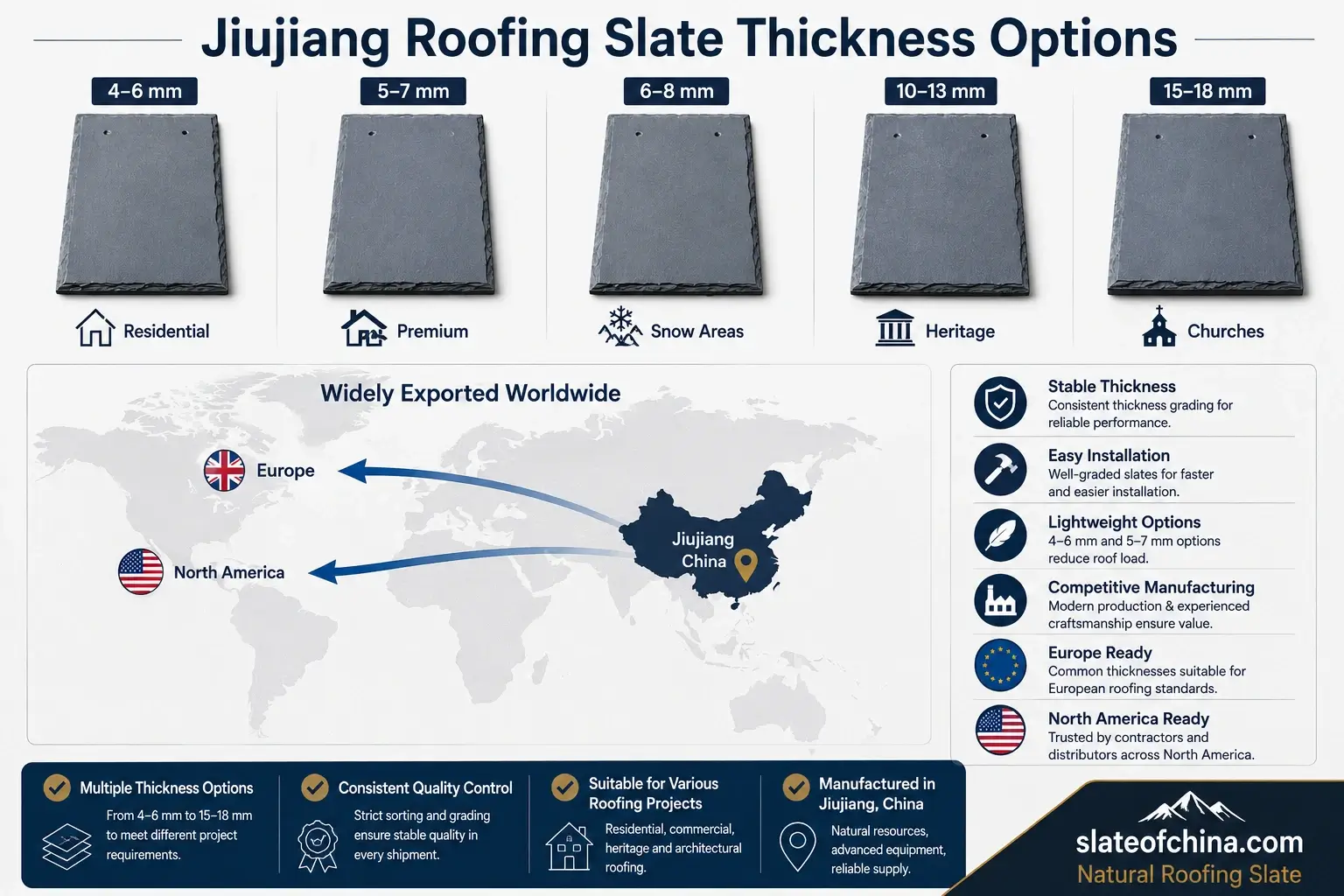
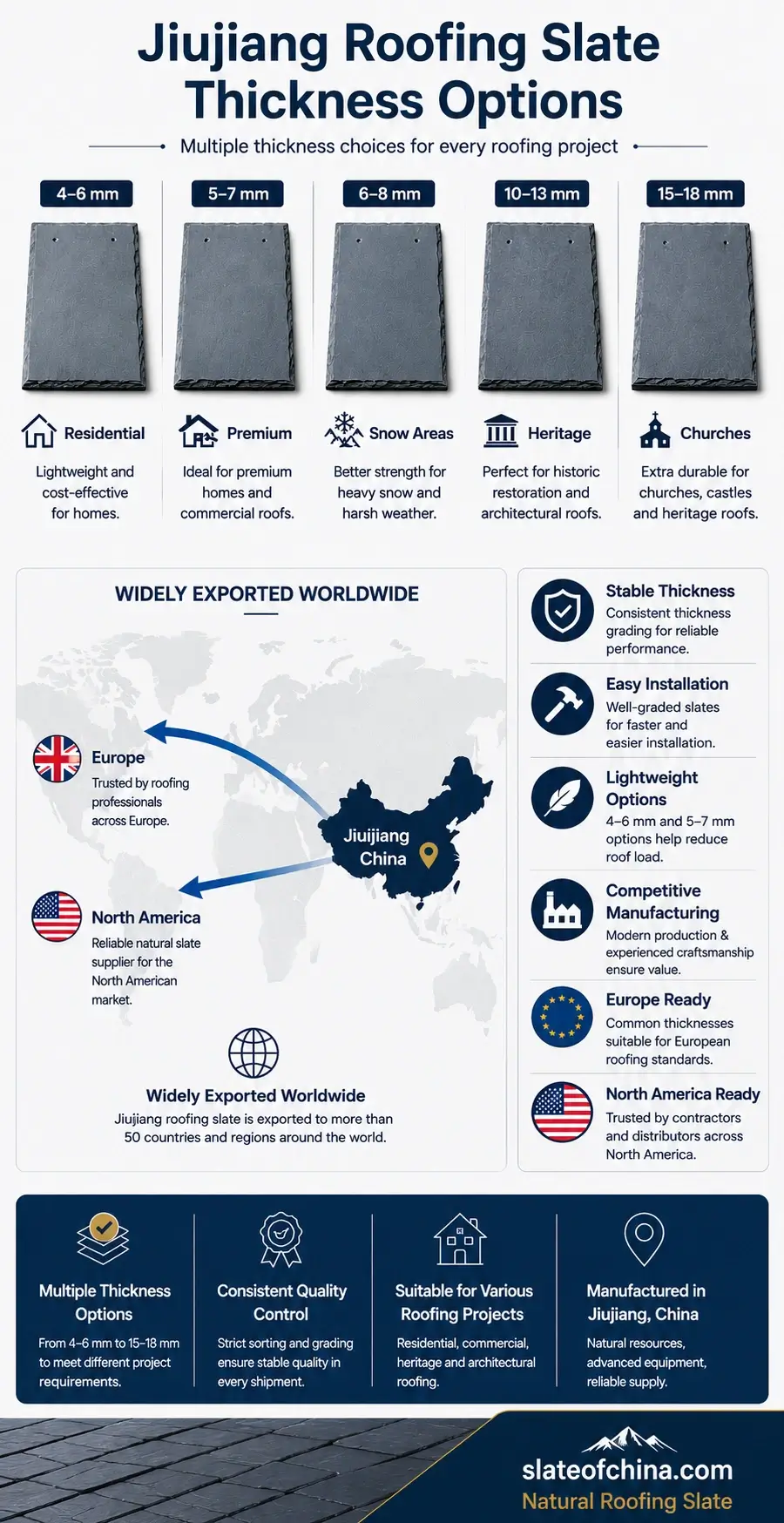
Jiujiang, located in Jiangxi Province, China, is one of the world’s well-known production regions for natural roofing slate. Thanks to its abundant slate resources and decades of manufacturing experience, Jiujiang roofing slate is widely exported to Europe, North America, and other international markets.
One of the advantages of Jiujiang roofing slate is the availability of multiple standard thickness options, allowing architects, distributors, roofing contractors, and project developers to select the most suitable slate for different building types and climate conditions.
Standard Jiujiang Roofing Slate Thickness Options
The following thickness ranges are among the most commonly produced and exported from Jiujiang.
| Thickness | Typical Applications |
|---|---|
| 4–6 mm | Residential roofing, lightweight roofing projects |
| 5–7 mm | Residential, commercial, and premium housing |
| 6–8 mm | Heavy snow regions and exposed weather conditions |
| 10–13 mm | Historic restoration, architectural roofing, feature roofs |
| 15–18 mm | Churches, castles, heritage buildings, traditional roofing |
These thicknesses can be supplied in a wide range of slate sizes to meet different roofing specifications and national standards.
Why Are These Thicknesses So Popular?
The popularity of these standard thicknesses is based on years of international roofing practice.
Each range offers a balance between:
- Roof weight
- Structural performance
- Installation efficiency
- Visual appearance
- Material cost
Rather than using a single thickness for every project, professional roofing designers select the most appropriate thickness according to the building’s structural requirements, climate, and architectural style.
Advantages of Jiujiang Roofing Slate Thickness Options
Jiujiang roofing slate is valued not only for its appearance but also for its practical installation characteristics.
Key advantages include:
✓ Stable Thickness Grading
Roofing slates are sorted into standard thickness ranges, helping improve consistency within each shipment and making installation more efficient.
✓ Easy Installation
Consistent thickness grading allows roofing contractors to install slates more quickly while achieving a more uniform finished roof.
✓ Lightweight Solutions Available
The popular 4–6 mm and 5–7 mm options provide an excellent balance between durability and roof weight, making them suitable for many residential and commercial roofing projects.
✓ Competitive Manufacturing
Jiujiang has a well-established natural slate industry with modern processing facilities and experienced craftsmen, enabling reliable production and competitive pricing for international markets.
✓ Suitable for European Roofing Projects
Common thicknesses such as 4–6 mm, 5–7 mm, 6–8 mm, 10–13 mm, and 15–18 mm are widely supplied for projects across Europe, where different countries and roofing traditions specify different thickness requirements.
✓ Suitable for North American Markets
Jiujiang roofing slate is also widely used for residential, commercial, and restoration projects in North America, where architects and roofing contractors value its natural appearance, durability, and range of available thicknesses.
Choosing the Right Jiujiang Roofing Slate Thickness
There is no single “best” thickness for every project.
As a general guide:
| Project Type | Recommended Thickness |
|---|---|
| Residential Roofing | 4–6 mm |
| Luxury Homes | 5–7 mm |
| Commercial Roofing | 5–7 mm |
| Snowy & Windy Areas | 6–8 mm |
| Historic Restoration | 10–13 mm |
| Churches & Heritage Buildings | 15–18 mm |
Selecting the correct thickness depends on:
- Roof structure
- Local climate
- Building regulations
- Architectural design
- Installation method
Why Contractors Choose Jiujiang Roofing Slate
✔ Multiple standard thickness options
✔ Consistent thickness grading
✔ Easy installation
✔ Natural blue-grey appearance
✔ Suitable for European and North American projects
✔ Reliable long-term roofing performance
Key Takeaway
Jiujiang roofing slate offers a comprehensive range of standard thickness options to suit residential, commercial, and heritage roofing projects. Rather than focusing on a single thickness, the best choice depends on the building type, climate, structural design, and installation requirements. Consistent thickness grading and reliable manufacturing make Jiujiang roofing slate a practical solution for roofing projects worldwide.
How to Choose the Right Roofing Slate Thickness
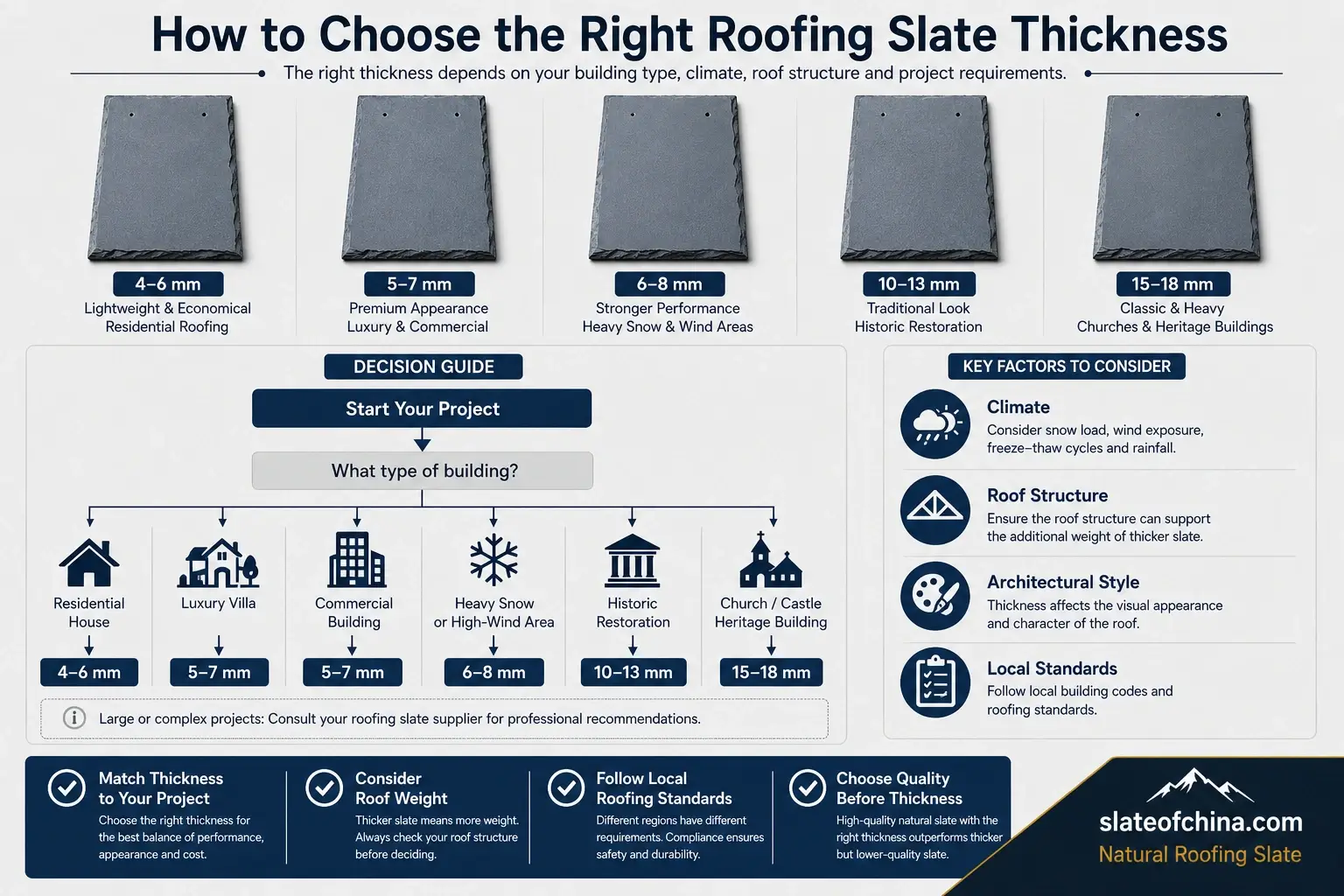
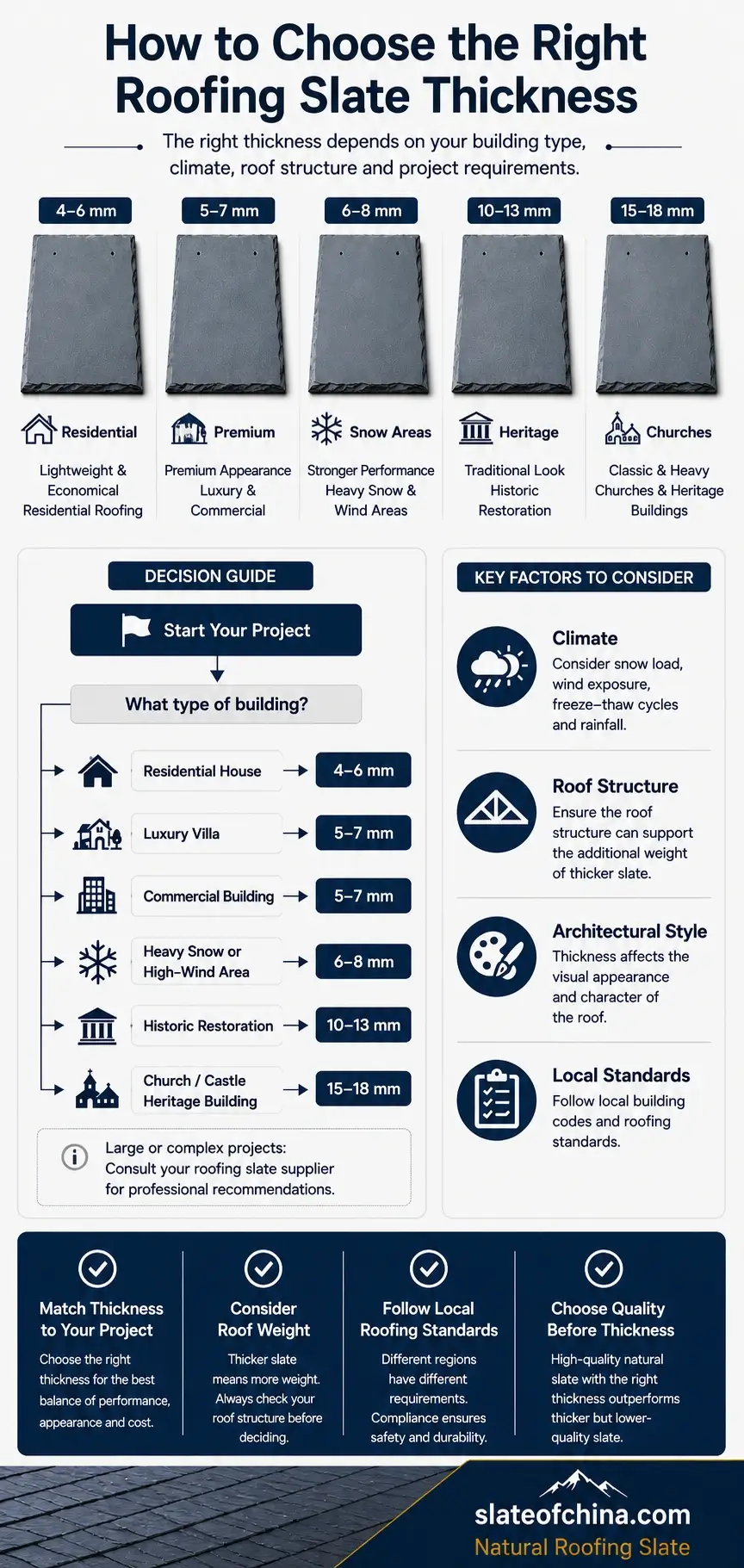
Choosing the right roofing slate thickness is one of the most important decisions when planning a natural slate roof. The ideal thickness depends on the building type, local climate, roof structure, architectural style, and project budget—not simply on selecting the thickest slate available.
Whether you are building a new home, restoring a historic property, or specifying materials for a commercial project, selecting the correct thickness helps achieve the best balance between durability, appearance, structural load, and installation efficiency.
The following guide provides a quick and practical reference for choosing the most suitable roofing slate thickness for your project.
Roofing Slate Thickness Decision Guide
| If Your Project Is… | Recommended Thickness | Why It’s Recommended |
|---|---|---|
| Residential House | 4–6 mm | Lightweight, economical, and suitable for most residential roofs. |
| Luxury Villa | 5–7 mm | Creates deeper shadow lines with a premium architectural appearance. |
| Commercial Building | 5–7 mm | Offers a balanced combination of durability, installation efficiency, and structural performance. |
| Heavy Snow or High-Wind Area | 6–8 mm | Provides greater strength and stability under demanding weather conditions. |
| Historic Restoration | 10–13 mm | Maintains traditional roof character while meeting restoration requirements. |
| Churches & Heritage Buildings | 15–18 mm | Produces a classic heavy-slate appearance for prestigious historical projects. |
| Large or Complex Roofing Projects | Consult Your Supplier | Slate thickness should be selected according to roof structure, local standards, and project specifications. |
Four Questions to Help You Choose
Before selecting a roofing slate thickness, ask yourself these four questions:
1. What Type of Building Are You Roofing?
Different buildings often require different slate thicknesses.
- Residential homes generally use 4–6 mm.
- Luxury homes often use 5–7 mm.
- Heritage buildings may require 10–13 mm or 15–18 mm.
2. What Is the Local Climate?
Weather conditions play an important role in thickness selection.
Consider:
- Snow load
- Wind exposure
- Freeze–thaw cycles
- Heavy rainfall
More demanding environments often benefit from thicker roofing slate.
3. Can the Roof Structure Support the Weight?
As slate thickness increases, the overall roof weight also increases.
Before choosing thicker slate, verify that the roof structure can safely support the total dead load, particularly for renovation and restoration projects.
4. What Appearance Do You Want?
Roofing slate thickness also influences aesthetics.
- Thinner slate creates a cleaner and lighter roof profile.
- Thicker slate produces stronger shadow lines and a more traditional handcrafted appearance.
Architectural style is often just as important as structural requirements.
Quick Selection Guide
| Your Priority | Recommended Thickness |
|---|---|
| Lowest Roof Weight | 4–6 mm |
| Best Value for Most Projects | 5–7 mm |
| Severe Weather Resistance | 6–8 mm |
| Heritage Restoration | 10–13 mm |
| Traditional Heavy Slate Appearance | 15–18 mm |
Professional Recommendation
The best roofing slate thickness is the one that matches your project’s structural requirements, climate, architectural style, and local roofing standards—not simply the thickest slate available.
Choosing the right thickness improves installation efficiency, controls roof weight, reduces long-term maintenance, and delivers the best overall value.
Need Professional Advice?
If you are unsure which roofing slate thickness is suitable for your project, provide the following information to your roofing slate supplier:
- Roof location and climate
- Building type
- Roof pitch
- Preferred slate size
- Architectural style
- Local roofing standards (if applicable)
With this information, an experienced supplier can recommend the most appropriate thickness for your project.
Key Takeaway
Selecting the right roofing slate thickness is about matching the slate to the project. By considering building type, climate, roof structure, appearance, and installation requirements, you can choose a natural roofing slate that delivers long-lasting performance and outstanding visual appeal.
What is the best roofing slate thickness?
There is no single best roofing slate thickness for every project. 4–6 mm is suitable for most residential roofs, 5–7 mm is ideal for premium homes and commercial buildings, 6–8 mm is recommended for harsh climates, while 10–13 mm and 15–18 mm are commonly specified for historic restoration and heritage buildings.
Frequently Asked Questions About Roofing Slate Thickness Introduction
Choosing the correct roofing slate thickness often raises practical questions about durability, weight, installation, and international roofing standards.
Below are answers to some of the most frequently asked questions from architects, roofing contractors, distributors, and homeowners. These FAQs provide quick guidance to help you select the right natural roofing slate for your project.
Still Have Questions?
Every roofing project is different.
If you need assistance selecting the right roofing slate thickness, consider the following before making your decision:
✔ Building type
✔ Local climate
✔ Roof pitch
✔ Roof structure
✔ Slate size
✔ Installation method
✔ National roofing standards
Choosing the right thickness at the beginning of the project helps ensure long-term roof performance and installation efficiency.
Looking for more detailed information? Explore our complete guides on What Is Roofing Slate, Roofing Slate Sizes, Roofing Slate Weight, Roofing Slate Installation, and EN 12326 Natural Slate Standards to learn more about selecting the right natural roofing slate.
Choosing the Right Roofing Slate Thickness Starts with Understanding Your Project
Selecting the correct roofing slate thickness is about much more than choosing a number. Thickness influences the appearance, structural performance, installation requirements, and long-term durability of a natural slate roof.
Throughout this guide, we have explored how different thickness options affect roof weight, installation methods, project applications, and overall performance. Understanding these factors helps architects, contractors, distributors, and homeowners make informed decisions that balance aesthetics, safety, and cost.
Rather than assuming that thicker slate is always better, the most successful roofing projects begin by selecting the thickness that best matches the building’s design, local climate, roof structure, and intended service life.
Key Factors Influenced by Roofing Slate Thickness
When choosing natural roofing slate, thickness directly affects:
- Roof appearance – Thicker slate creates deeper shadow lines and a more traditional architectural character.
- Structural load – Increased thickness adds weight, requiring adequate roof support.
- Durability – Appropriate thickness contributes to long-term performance when combined with high-quality slate.
- Installation – Nail length, hook size, batten spacing, and overlap should all match the selected thickness.
- Overall project cost – Thickness influences material consumption, transportation, installation efficiency, and structural requirements.
Considering these factors together leads to a safer, more attractive, and cost-effective roofing system.
The Best Roofing Slate Thickness Is the Right Thickness
There is no universal “best” roofing slate thickness.
Instead, the ideal choice depends on:
- Building type
- Roof pitch
- Local climate
- Architectural style
- Structural capacity
- National roofing standards
- Project budget
For example:
- 4–6 mm is an excellent choice for most residential roofs.
- 5–7 mm offers a balanced solution for premium homes and commercial buildings.
- 6–8 mm is well suited to areas with heavy snow or strong winds.
- 10–13 mm and 15–18 mm are commonly selected for historic restoration and heritage roofing projects.
Selecting the appropriate thickness ensures both technical performance and visual harmony.
Professional Recommendation
When evaluating roofing slate, remember that thickness is only one part of the equation.
A successful slate roof also depends on:
- What Is Roofing Slate?
- Roofing Slate Sizes Guide
- Roofing Slate Thickness Guide
- Roofing Slate Weight Guide
- Roofing Slate Installation Guide
- Roofing Slate Colors Guide
- Roofing Slate Grades Guide
- EN 12326 Guide
A premium-quality 5 mm slate installed correctly can often deliver better long-term performance than a poor-quality 8 mm slate.
Final Takeaway
The best roofing slate thickness is the one that matches your project’s requirements—not simply the thickest slate available. By considering building type, climate, structural load, installation requirements, and slate quality, you can select a natural roofing slate that delivers outstanding beauty, durability, and long-term value.
Need Help Choosing the Right Roofing Slate Thickness?
Every roofing project has unique requirements. If you are unsure which slate thickness is best for your application, compare your building type, climate, roof structure, and installation method before making a final decision.
Our technical team can also provide guidance on suitable slate thicknesses, standard sizes, and project-specific recommendations for residential, commercial, and heritage roofing applications.
Continue Exploring Our Roofing Slate Guides
To help you choose the right natural roofing slate with confidence, explore our related guides:
- What Is Roofing Slate?
- Roofing Slate Sizes Guide
- Roofing Slate Thickness Guide
- Roofing Slate Weight Guide
- Roofing Slate Installation Guide
- Roofing Slate Colors Guide
- Roofing Slate Grades Guide
- EN 12326 Guide