
Slate Roof vs. Metal Roofing: A Contractor's Honest Verdict After 22 Years
I need to tell you how I earn my living before you believe a word of this comparison. I've been a roofer for twenty-two years. My crews have put up roughly three hundred metal roofs and something over two hundred slate roofs. I've torn both off, repaired both, and answered the phone calls both of them generate. If I talk you into slate, I win a job. If I talk you into metal, I win a job. I have no incentive to lie in either direction — which is exactly why customers ask me to write things like this down.
And here's the first honest thing: this is not a battle between a premium roof and a cheap one. Asphalt shingles are the cheap one, and we've compared them against slate separately. Slate and metal are the two roofs you graduate to when you've decided the roof should outlive you. The real question is which kind of forever you want.
Short answer from someone who installs both: metal wins on weight, low-pitch ability and modern architecture — a standing seam roof lasts 40–70 years and suits roof pitches down to a few degrees. Slate wins on lifespan (100–150 years), colour that never fades, single-tile repairability, and resale value in traditional housing. Metal fails by panel and by coating; slate fails by individual tile. A standing seam metal roof and a natural slate roof cost roughly the same territory per square metre installed — the difference is what happens in year 30, 50 and 80.
What You're Actually Choosing Between
Most comparisons go wrong at the start, because "metal roofing" isn't one material — it's a family, and the differences inside the family are bigger than the gap between metal and slate.
There's standing seam: long steel or aluminium panels with raised ribs folded together, fixed with hidden sliding clips. This is the premium end. Then there's exposed-fastener corrugated sheeting — the sheets you see on barns, fixed with screws you can see from the ground. Cheaper, faster, and a completely different lifespan. Then metal tiles pressed to imitate clay or slate, and stone-coated steel with a granular finish. When a neighbour tells you "metal roofs are rubbish" or "metal roofs are brilliant," ask which one they mean. It's like saying "cars are fast" without saying whether you mean a hatchback or a Formula 1.
Slate has a family too — thickness grades, colour origins, standard and random widths — but the spread is narrower. A good slate is a good slate. The spread in metal is a canyon.
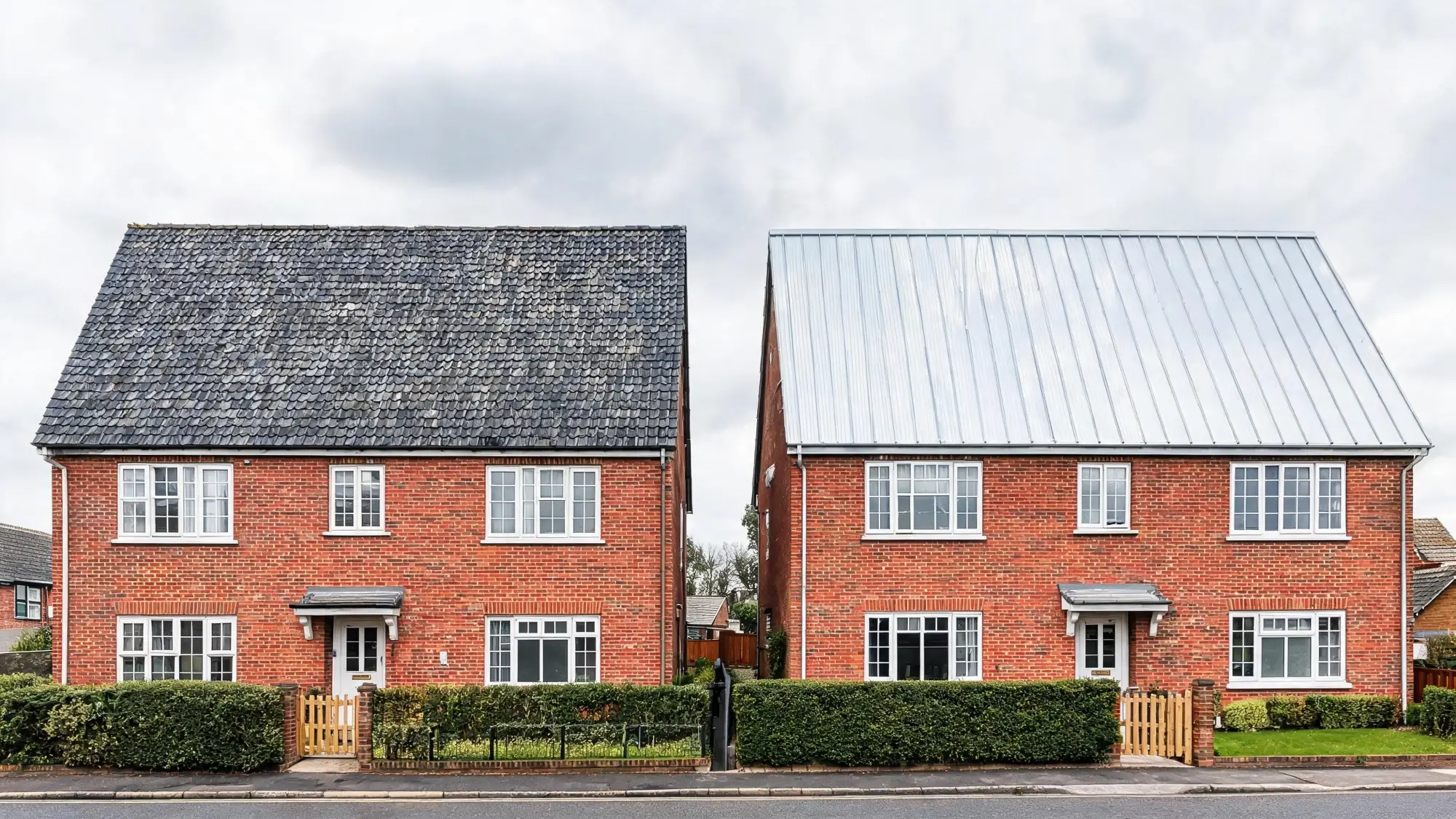
One more thing before the numbers, because it decides more roofs than any table in this article will: both of these roofs fail the same way — installation. I've seen a coated steel roof ruined by a crew that walked all over it in hobnail boots, and a slate roof ruined by a builder who nailed with the wrong gauge galvanised shanks. The material is rarely the villain. The hands on the material usually are.
Lifespan: The Numbers on Paper and the Roofs I've Torn Off
The brochures will tell you a metal roof lasts 40–70 years. That number is true, and it hides the most important sentence in this whole comparison: the metal lasts, but the coating doesn't.
Steel doesn't rust because it's painted — really painted, with a zinc layer under a factory coating. On premium panels that outer coating is PVDF (sold under names like Kynar 500), and it should hold its colour and gloss for 30–40 years in serious weather. On cheaper panels it's a polyester finish, and I've watched those chalk and fade inside 15 years. Once the coating goes, you're not shopping for a new roof, but you are shopping for a repaint or a re-sheet on a schedule you didn't choose. Aluminium doesn't rust the same way, but it fades and stains all the same.
The oldest standing seam roof I ever tore off was 38 years old. The steel was still sound, honestly — we replaced it because the coating had chalked grey and the owner couldn't sell the house looking like that. The oldest exposed-fastener corrugated roof I removed was 22, and every screw grommet had turned to powder. That's the ceiling nobody prints in the brochure: with exposed fasteners, the screws are the lifespan. Fifteen to twenty-five years, then you're re-fixing the whole roof.
Slate doesn't have a coating to lose. The colour is minerals, all the way through. The oldest roof I've worked on was a Welsh slate roof from 1904 — we stripped it, and the slates came down cleaner than most new imports. The owner sold every one of them for reuse. That roof was 118 years old and its second act was being sold.
So when people ask me which lasts longer, the honest answer is: a good slate outlasts the building's fashion, and a good metal roof outlasts its own finish. Both are "lifetime" roofs by the standards of anything else on the market. Slate simply has no layer that expires. For the full picture of what determines slate's service life, read How Long Does a Natural Slate Roof Last?
Weather Performance: Rain, Hail, Wind and Heat
Here's where the two roofs behave like different animals, and where I've learned most of what I know from other people's claims forms.
Wind
Slate loses tiles in wind. Metal loses panels in wind. That sounds like metal is worse — it's more dramatic, certainly; a peeled standing seam sheet looks like the sky opened — but the frequency is what matters. A properly nailed slate roof sheds a tile or two in a gale that recurs every decade. When metal comes off, it's almost always a clip spacing error or a corner panel installed over the wrong underlayment.
The detail for wind is on this page about slate in high-wind areas; the honest one-line version for the comparison is this: both roofs handle weather that destroys asphalt. Between the two of them, wind is a workmanship test, not a material test.
Hail
Now the uncomfortable one for metal. In the hail season of 2018 we did storm-claim work for months. For every slate claim I inspected, I filed roughly three metal claims — almost all cosmetic denting on lightweight aluminium and thin-gauge panels. None of them leaked. All of them were on the customer's mind every time they parked the car in the driveway.
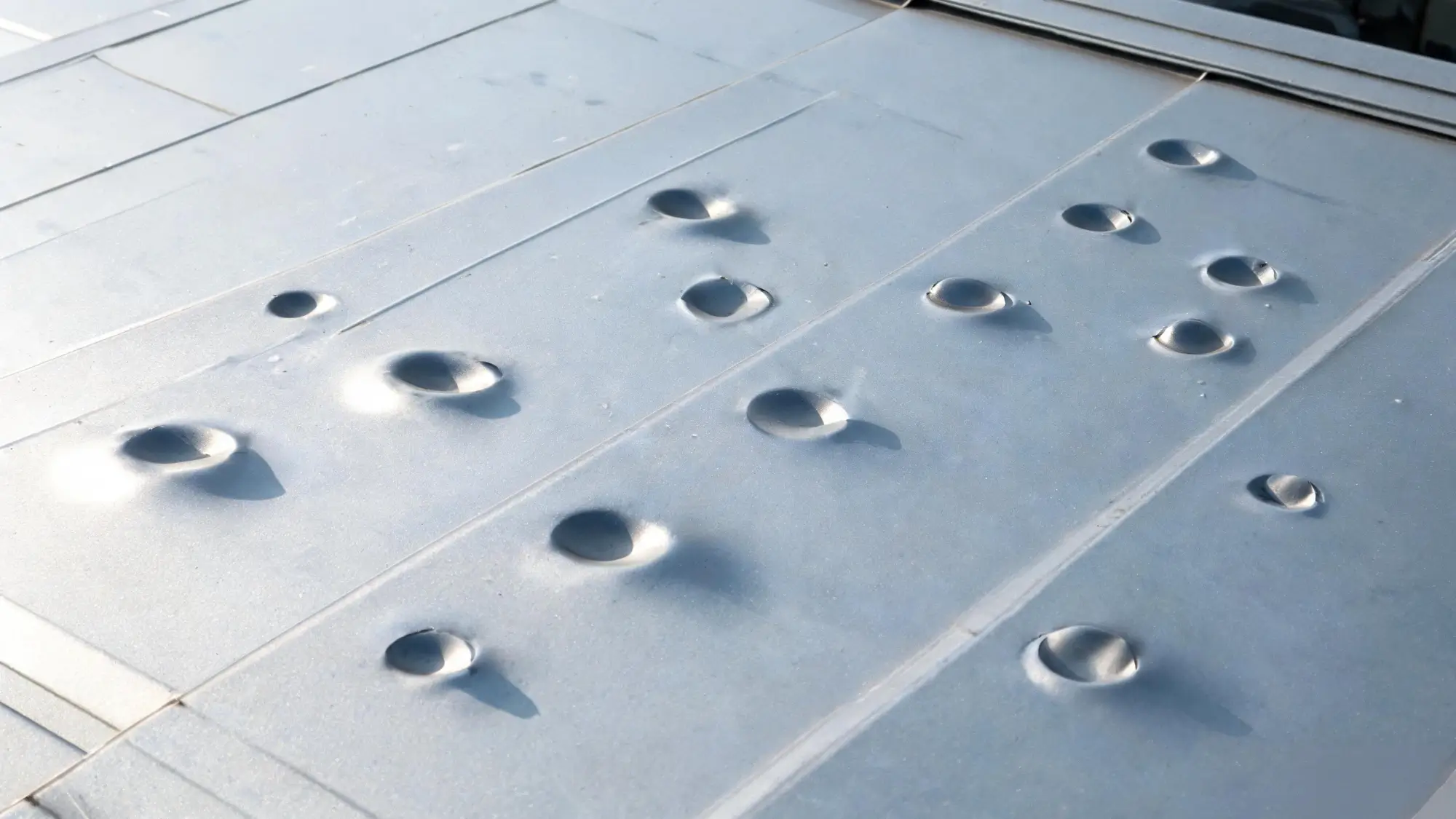
Slate in the same storm either survives untouched or cracks the odd tile — a £100 repair, not an insurance negotiation. If you live somewhere with serious hail, ask your insurer before you choose. Some insurers charge more for certain metal panels in hail zones, something almost nobody mentions until renewal.
Heat and Thermal Cycling
Metal moves. Steel grows about 6mm over a 10-metre panel when the sun swings the temperature by 50°C; aluminium grows about 12mm. That's the whole reason standing seam panels are held by sliding clips rather than screwed down tight — the ribs aren't decoration, they're expansion joints you can see from the street.
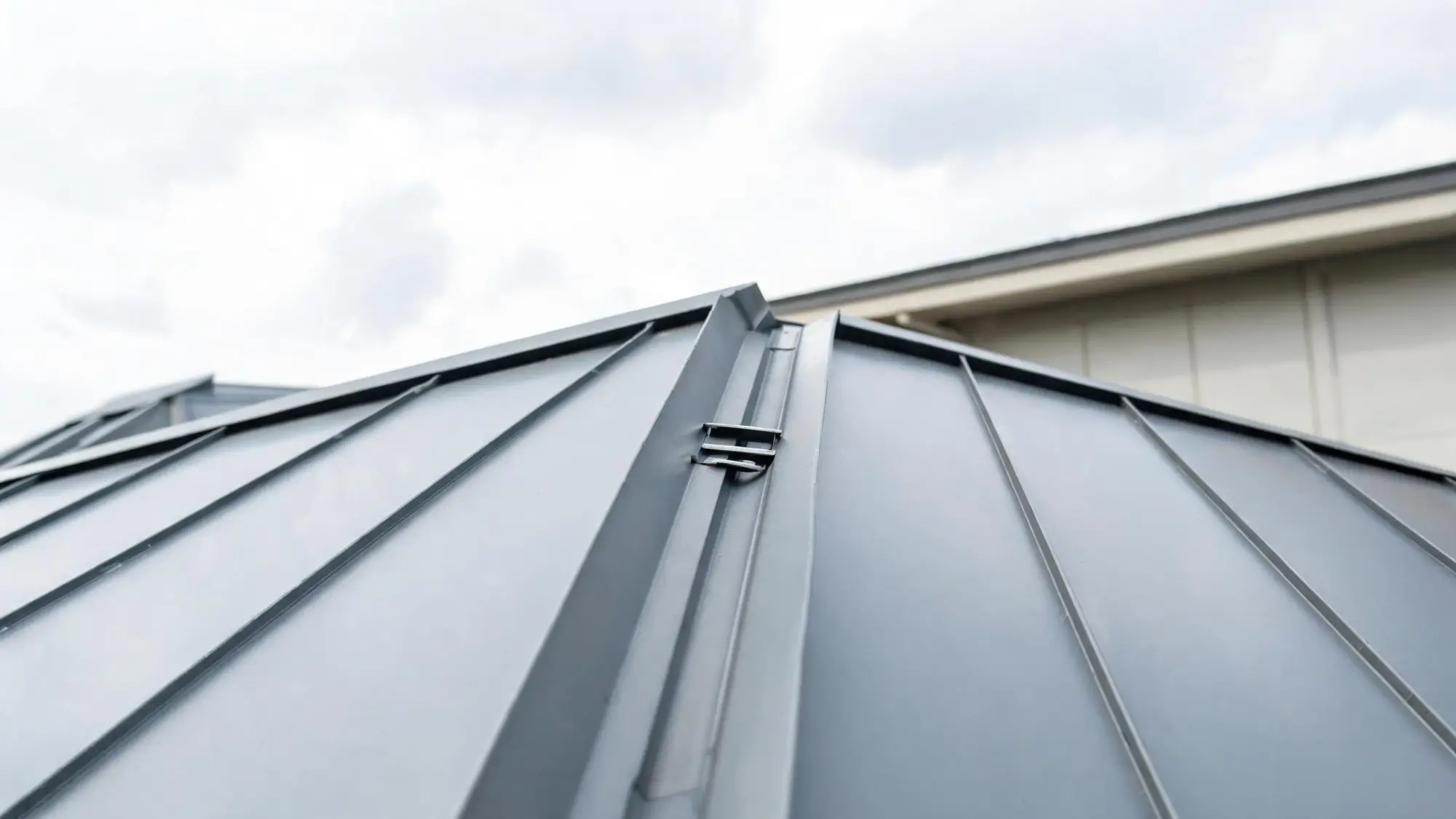
So when a homeowner calls me in a panic about a tick-tick sound from their new roof on a summer evening, I tell them the same thing every time: that's not a fault, that's the roof breathing. Slate, meanwhile, sits there like the stone it is. Two hundred years of a roof and it never once makes a sound. Some customers find that silence restful. Others never notice either way. Nobody calls me about a noisy slate.
Rain
Both shed water perfectly, provided the details at valleys, eaves and chimneys are done right. One genuine difference worth knowing: metal roofs on a low pitch can let wind-driven rain work uphill under the seams. Below about 15 degrees I stop recommending standing seam for exposed sites, and below about 20 degrees slate starts needing specific pitch rules. Below 10 degrees, metal is often the only serious option. That's a real point to metal — I'll say so plainly in the "where metal wins" section.
The Noise Question (Yes, People Really Ask)
"Won't a metal roof sound like a drum every time it rains?" I've answered this question maybe a thousand times, so here's the thousand-time answer.
An uninsulated metal sheet over an open frame — a barn, a carport, a livestock shed — is loud. Rain on that is genuinely theatrical. But a house roof is a system: panels, underlay, ventilation gap, insulation, plasterboard. With that stack under a modern standing seam roof, you'd struggle to tell me from inside whether the rain is landing on metal or on slate. The old drum reputation comes from the sheds, and it's stuck to the houses unfairly.
Slate, for the record, is naturally near-silent — heavy stone, tiny air gaps, nothing to vibrate. If you're a light sleeper with a loft bedroom and zero insulation plans, that's a point to slate. Otherwise, treat noise as an insulation question, not a roofing question.
Weight: The Number That Decides Before You Do
Slate at the common 6–8mm thickness runs roughly 19–24 kg per square metre once fixed. A standing seam steel roof is about 5–7 kg; aluminium, even less. That's a factor of three or four, and it's the one difference in this whole comparison that can take slate off the table before we've discussed anything else. The full weight maths is here, but the contractor's shortcut is simpler: pre-1950s buildings were usually framed for stone or clay tile loads and carry slate happily; lightweight modern timber frames need a structural check before anyone orders anything.
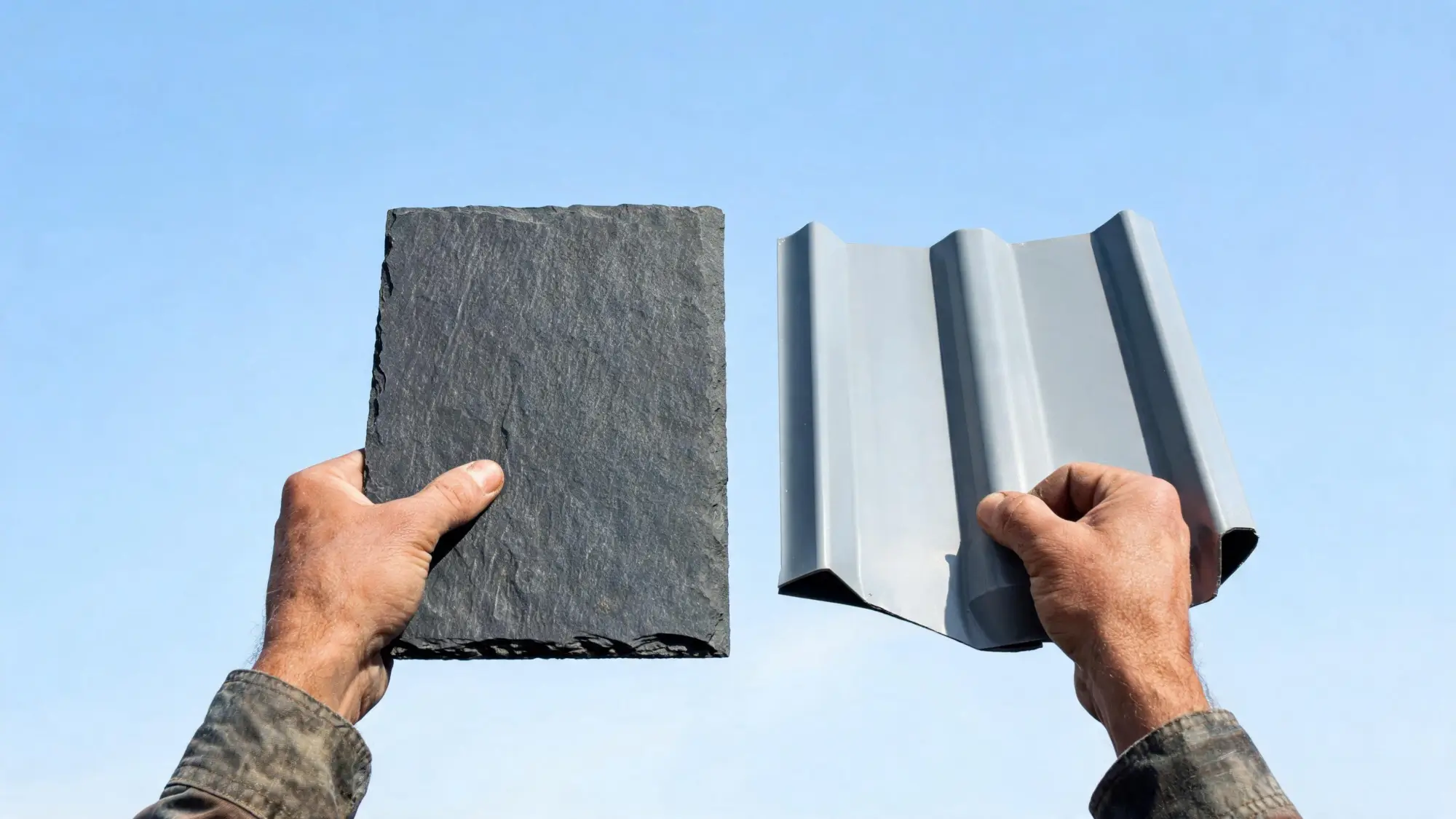
Now the honest counterweight — literally. That heft is a large part of why slate sits through gales that worry lighter roofs. And weight isn't the one-way advantage people assume. Metal's lightness has a flip side I've seen on a dozen sites: condensation. A metal sheet over a poorly ventilated loft space in winter becomes a cold surface for warm moist air to weep on. Get the ventilation wrong and you'll get a drip pattern under the panels that looks exactly like a leak. It's manageable with proper underlay and airflow, but it's a thing — slate's bulk simply doesn't have this conversation with you.
Maintenance: The Repair Calls I Actually Get
Every roof sends you a bill eventually. The difference is what arrives in the envelope, and how often.
My metal-roof call log, honestly ranked: loose screws on exposed-fastener roofs (the rubber washers age out; on a twelve-year-old roof I'll find 5% of fixings needing re-torque), scratched coating after someone cleaned the moss with a pressure washer — don't do this — and tree-branch scrapes at the eaves. On standing seam, calls are rare, and usually about the flashings at junctions, not the panels.
My slate-roof call log: a slipped tile after a storm, a cracked tile from someone walking wrong during a TV aerial installation, moss build-up on a shaded north slope, and — the classic — nail sickness, where old fixings corrode and let tiles slide. The moss and inspection habits are covered properly in our maintenance guide and moss removal article.
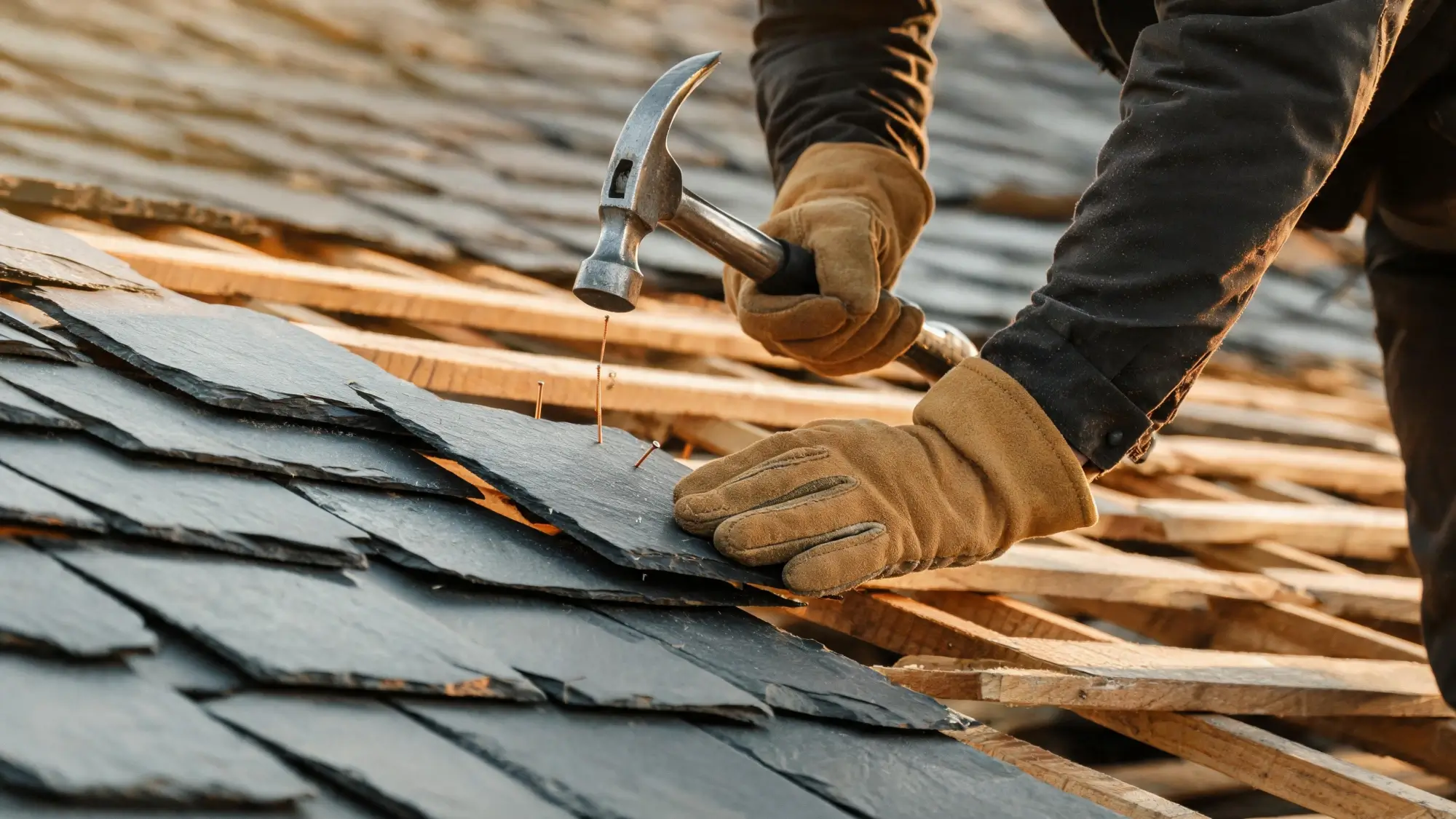
Here's the structural difference that matters more than the list: slate fails by the tile, metal fails by the panel. A slate repair is one tile, one ripper, £80–150 in my area, and the roof forgets it ever happened. A panel replacement might involve ordering coated steel, colour-matching a discontinued batch, and £200–400 of labour for one dent. The slate call comes more often; the metal call costs more when it comes.
Cost: Two Honest Invoices From My Desk
I'm not going to build you a fifty-year cost model — we've done that properly in the asphalt comparison, and the detailed slate pricing is here. What I can give you is what two real invoices looked like last spring on two similar detached houses near me, about 180 m² of roof each.
Standing seam steel, mid-grey, mid-spec: £60–90 per square metre installed, before you add any extras. Natural slate, 6–8mm, imported material, traditional fixed: £80–150 per square metre installed. The cheap end of metal (exposed-fastener sheeting) comes in under both — and delivers a roof that, as above, you'll be re-fixing in 15–25 years.
So the honest summary: top-metal and entry-slate overlap in price. The deciding money isn't in the material line — it's in three other places: whether your structure needs upgrading for slate (it usually doesn't, but the survey costs something), whether your roofline has the dormers and valleys that punish metal detailing, and whether you'll own the building long enough for the two repair-call patterns to matter. Slate's higher invoice buys you the extra 50–80 years and the repair economics. Metal's lower invoice buys you a lighter structure and a straighter modern line.
Appearance and Ageing: 30 Years From Now
Stand in front of a standing seam roof and you see precision: long straight ribs, crisp shadow lines, a roof that looks drawn rather than built. Architects love it for exactly this reason, and on a modern extension or a crisp new build, slate can look slightly like a costume.
Stand in front of a slate roof and you see texture: slight thickness variation, tone variation from tile to tile, a surface that plays differently in every light. On period buildings slate isn't a roof choice — it's the correct answer.
Ageing is where they split hard. Metal ages at its coating; slate ages at all — and by ages I mean it doesn't. Give a polyester-coated panel 15 years of sun and it goes chalky. Give a PVDF panel 30 and it goes quieter. Give a slate roof 30 years and it looks distinguished — the minerals don't fade because the colour was never a finish. Our colours guide explains where those tones come from, and why a natural range of shade is a good sign rather than a defect.
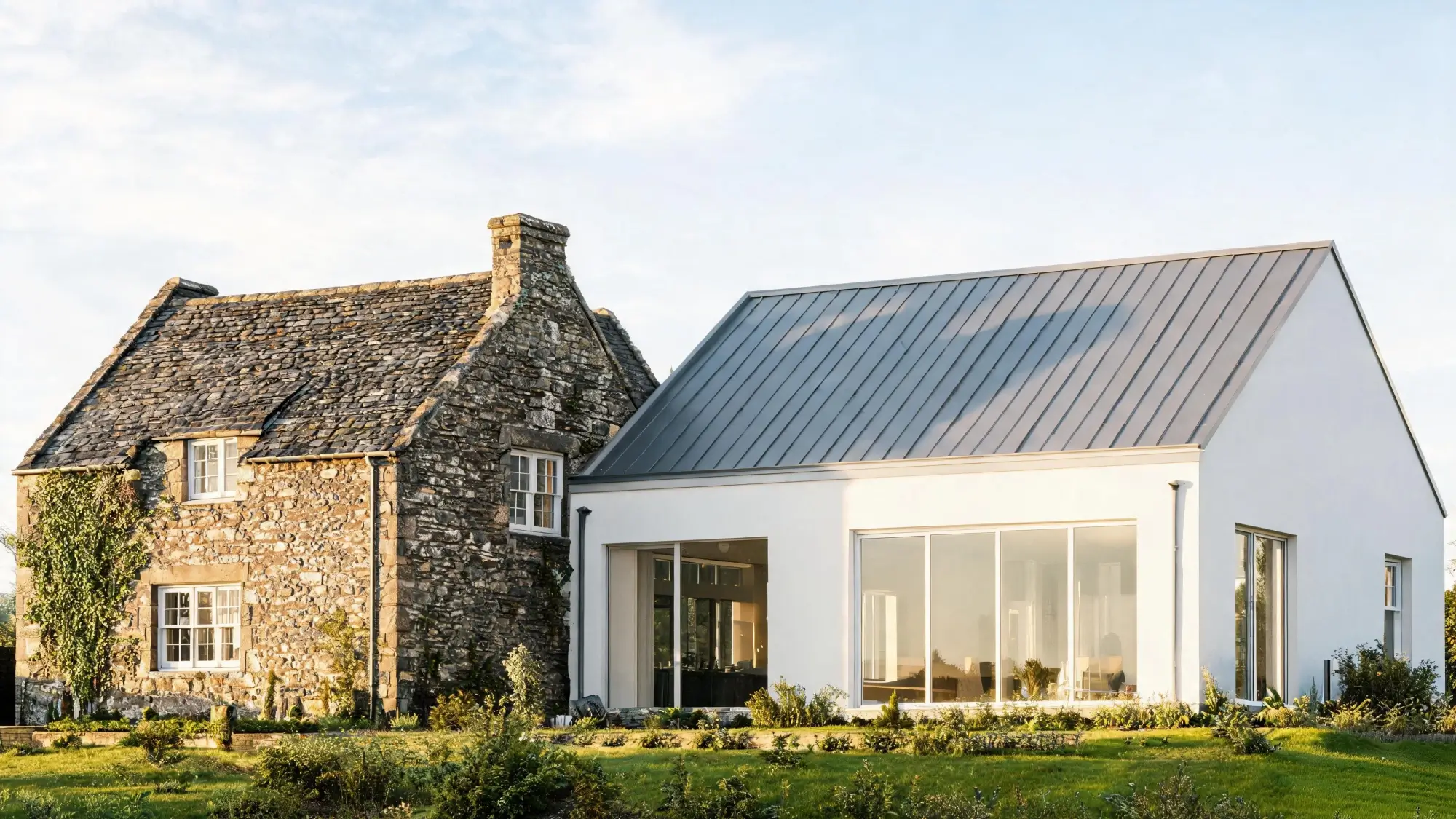
There's a line I use with customers who are torn: a metal roof looks the same on day one as on day three thousand — that's its strength. A slate roof looks better on day three thousand than day one — that's its trick. Not many materials improve with weathering. Stone is one of them.
Resale Value: What the Surveyor Writes
I read a lot of surveyors' reports — you do, when you repair roofs for long enough. The phrasing tells you what the market hears.
A metal roof gets written down as a system: "Standing seam covering, condition good, expected serviceable life 30+ years." Useful, factual, done. A natural slate roof gets written up as a feature: "Natural slate covering, traditional character, well maintained." I have watched that sentence shorten a negotiation and stiffen an offer. Estate agents in conservation areas know it too — some period listings barely bother marketing the roof, because the slate photographs sell the house.
Does slate put a fixed percentage on the price? Anyone quoting you one number for every street in the country is guessing. What I can say from the buying end: on period properties in slate country, a natural slate roof is a default expectation — anything else is a discount conversation. On a modern self-build, no buyer discounts you for metal. The full slate pros and cons are here if you want the ledger rather than the anecdotes.
Where Metal Wins Without Argument
I install slate for a living and I'll happily tell you when metal is simply the right roof.
Low pitch. Under 20 degrees, slate starts to struggle and under 15 it's off the menu; metal panels handle single-figure pitches. Flat-ish modern extensions are metal territory, full stop.
Weight-limited structures. If the frame genuinely can't carry stone — old lightweight extensions, some conversions — metal isn't the compromise, it's the only adult option.
Modern architecture. Sharp horizontal lines, zinc-look finishes, long runs without joints — you cannot fake this with slate, and you shouldn't try.
Speed of installation. A standing seam roof goes down several times faster than a slate roof. If the building needs covering before winter, that's not a trivial argument.
Recycling at end of life. A steel roof is close to fully recyclable and aluminium carries real scrap value. Slate is inert and reusable, but the secondhand market depends on demand.
Where Slate Wins Without Argument
And here's the mirror list, delivered with the same straight face.
Lifespan without an expiry layer. 100–150 years with no coating to renew and no fixings exposed to the weather — nothing else in this article can say that.
Colour that never fades. Mineral colour all the way through, not a finish on top of the material.
Repairability. One tile, one ripper, done — for the rest of the century. The safe way up onto one is covered here; the point for the comparison is that the repair is surgically small.
Traditional and protected buildings. In conservation areas and on heritage work, slate is frequently not a preference but a requirement.
Insurance and fire. Both materials are non-combustible, but slate additionally shrugs off the hail claims that lightweight metal panels generate in some regions.
The Decision Table
Twenty-two years of phone calls, compressed into one table. Find your row; that's your roof.
| Your situation | The roof that earns its keep |
|---|---|
| Period property, traditional street, conservation area | Slate — it's the correct answer, and often the lawful one |
| Modern build, crisp lines, low-pitch or mono-pitch design | Standing seam metal — don't fight the architecture |
| Lightweight frame that can't take 20 kg/m² | Metal — the structure decides this one, not taste |
| Hail-prone region | Slate, or heavier-gauge metal — check insurance first |
| You plan to own it 50+ years | Slate — the repair economics compound in your favour |
| Budget building, agricultural, short ownership | Exposed-fastener metal — honest roof, honest lifespan |
| Roof pitch under 15° | Metal — slate leaves the menu below 20° |
| Resale in a period market matters to you | Slate — the surveyor's sentence sells the house |
What's on My Own House
People ask me this at the end, and they're right to. My house wears slate — 1908 roof, re-laid once in the 1980s, and I expect it to outlive me with nothing but a moss check every few years. My workshop wears metal — standing seam, on a light steel frame I put up myself, pitch around 12 degrees.
That's not indecision. That's the whole article in two buildings: stone where stone belongs, metal where metal is honest. If your roof is a period structure you intend to pass down — slate. If your roof is a low-pitch modern design on a light frame — metal. The only genuinely bad choice in this comparison is putting the wrong one on the wrong building, and then blaming the material for it.
If slate is the roof your building deserves, our Jiujiang factory produces EN 12326 / ASTM C406 tested natural roofing slate with CNC-processed tolerances and 100% individual tile inspection — you can see the actual test results here. Send us your roof dimensions, pitch and location, and we'll quote the material honestly — including telling you if your project is actually a metal-roof project. You can also browse the roofing slate range or start with physical samples, because no one should buy stone they haven't held.
Frequently Asked Questions
Are metal roofs really noisy when it rains?
Not on houses. Rain is loud on an uninsulated sheet over an open frame — a barn or carport — and that's where the drum reputation comes from. A house roof has panels, underlay, ventilation, insulation and plasterboard beneath it, and with that stack the rain noise is close to a slate roof's. If you have a loft conversion with minimal insulation, slate's natural silence is a genuine advantage; otherwise treat noise as an insulation question, not a roofing one.
Will a metal roof get dented by hail?
Lightweight aluminium and thin-gauge steel panels, often — the dents are usually cosmetic rather than leaks, but they're permanent and visible from the ground. Heavier-gauge steel resists better, and slate typically either shrugs hail off entirely or cracks the odd tile, which is a small repair. In hail-prone regions this difference is worth real money: some insurers charge extra for certain metal panels, and slate claims are much rarer.
Do metal roofs attract lightning?
No. Lightning strikes tall and conductive paths to ground regardless of the roof material below. A metal roof is non-combustible, so if anything it behaves better in a strike than a flammable covering. This worry comes from an old instinct that metal "attracts" lightning — building codes don't treat a metal roof as a strike risk, and neither should you.
Which costs less, a slate roof or a metal roof?
Top-spec standing seam metal (£60–90 per m² installed) and entry natural slate (£80–150) overlap, so the honest answer is that quality levels matter more than the material names. Cheap exposed-fastener metal undercuts both — but its 15–25 year fastener lifespan makes it a different class of roof. Over decades, slate's single-tile repairs and no-coating-to-renew economics generally pull it ahead of anything except a properly installed premium metal roof.
Can my old roof structure carry slate instead of metal?
Usually yes. Most buildings framed before the 1950s were designed for stone or clay tile loads, and slate at 19–24 kg/m² sits comfortably within them. Lightweight modern timber frames need a structural check first — a modest surveyor's fee for certainty. If the structure genuinely can't take the load, metal at 5–10 kg/m² is the right answer, and no amount of preference for slate changes physics.
Which roof adds more to property value, slate or metal?
It depends on the market. On period properties in traditional streets — especially conservation areas — a natural slate roof is the default expectation, and anything else reads as a discount conversation; surveyors write it up as a feature. On modern homes, a crisp standing seam roof loses you nothing and may help with design-led buyers. The one clear pattern: slate's value is strongest exactly where the building's character already argues for it.
One Roof Is Right for Your Building — Ask Us Which
Slate belongs on some buildings and metal on others, and the difference is usually settled by pitch, structure and period character. Send us your roof dimensions, pitch and location — we'll tell you honestly which side of that line your project falls on, and quote the material if it's ours.
Get a quote and physical samples → | Browse roofing slate products