
Slate Roofing Pros and Cons: 3 Advantages, 5 Disadvantages
Almost every month, the same email lands in my inbox. Someone in the UK or Ireland is re-roofing a house. They have two quotes on the table — one from a slate specialist, one from a general roofing firm that undercuts him on price and promises the job done weeks faster. And they ask us, at the quarry, a simple question: is slate worth it?
My answer always starts with a different question. Do you want a roof that can still be doing its job in a century, or a roof you will replace two or three times in your lifetime? That single answer decides which material you buy, which crew you hire, and how much you should expect to pay.
That is what this article is about. I am not going to tell you slate is wonderful and leave it there, because that would be a half-truth. We have split and shipped slate from Jiujiang for over thirty years, and in that time we have seen exactly what happens when it is bought badly, fitted badly, or matched to the wrong building. So here is the honest version: the genuine advantages, the genuine disadvantages, and the numbers that should drive your decision.
The short answer: natural slate can last 75–150 years, does not burn, and — fixed properly — stands up to wind and driving rain, improving with age instead of wearing out. The other side: it is expensive, heavy, demands a specialist roofer, and is unforgiving if installed wrong. The material is rarely the problem. The mistake is choosing it for the wrong reasons, or skimping on the work.
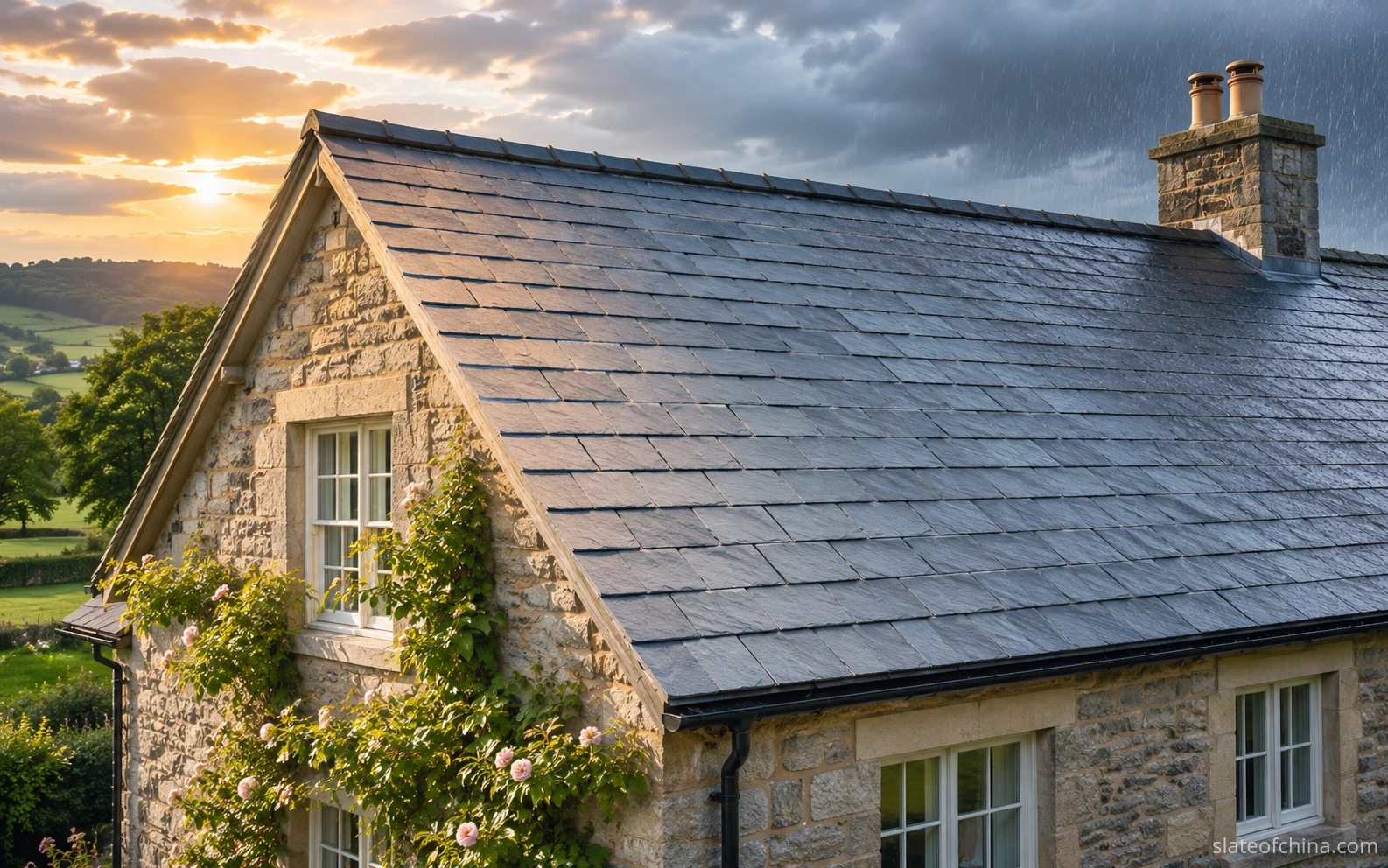
First, the Baseline: Slate vs the Other Three Options
You cannot judge the pros and cons of slate in a vacuum. So here is the comparison table I draw on the back of an envelope when an importer asks — lifespan, weight, cost and installation, for the four roofing families you will actually choose between:
| Material | Typical lifespan | Weight per m² | Relative cost | Installation |
|---|---|---|---|---|
| Natural slate | 75–150 years | 27–35 kg/m² (standard 5–7 mm) | Highest | Specialist slater |
| Clay tiles | 50–100 years | 40–60 kg/m² | High | Standard roofer |
| Fibre-cement | 30–50 years | 10–15 kg/m² | Low | Standard roofer |
| Asphalt shingles | 15–30 years | 8–15 kg/m² | Lowest | Standard roofer |
I left prices out of the table on purpose. A square metre of slate can cost two or three times more from one quarry than another — Spanish, Welsh and Chinese Jiujiang slate sit in different price bands, and so does their performance. So before you compare "slate vs shingles" on price, remember this one line: very few roofing materials are engineered on a century scale — good natural slate and the best clay tiles are the two that are, and slate does it while weighing less per square metre.
Everything below follows from that. If you want to see what a real range looks like before comparing, our roofing slate range shows the current tiles, sizes and finishes exactly as they leave the splitter.
Not All Slate Performs the Same: Quarry, Seam and Grade
One honest point most pros-and-cons articles skip: "natural slate" is not one material. Two slates from two different quarries — or even two seams in the same quarry — can differ in water absorption, strength, colour and how they age. The rock decides, and the rock varies. That is why both major standards classify slate by measured performance, not by name:
- EN 12326 (Europe) grades each slate with letter codes from laboratory tests: W for water absorption (W1 means 0.6% or less; anything above 0.6% must also pass a freeze–thaw test before it can be used), T for thermal cycling, and S for sulphur-dioxide exposure, which matters for slates whose carbonate content is low.
- ASTM C406 (US) grades slates S1, S2 and S3 by expected service life — S1 means 75 years or more — based on laboratory absorption and strength testing. These are life-expectancy grades, not strength grades.
One naming trap worth knowing: the two systems both use the letter S, but for different things. In Europe, S is the sulphur-dioxide exposure test; in the ASTM system, S1/S2/S3 are service-life grades. When a supplier quotes "S1" at you, ask which standard they mean.
The practical consequence is simple. A slate with published test data — its W grade, its declared flexural strength, its service-life grade — is a known quantity. A cheap slate with no data is a lottery. We publish our own numbers on the slate test results page, and that is the standard every serious buyer should hold their supplier to. It also explains why every advantage and disadvantage below carries a condition: performance depends on the specific slate and the specific installation, not on the word "slate".
Advantage 1: It Can Outlive the Building — When the Slate and the Work Both Hold
Ask any roofer in Britain how old the slates are on the house he is repairing today, and he will point at roofs that have been up 120, 150 years without replacement. Slate does not do that because someone is good at selling it. It does that because of the rock.
Slate is mudstone cooked and squeezed by geology until its mineral grains lie in parallel sheets — that grain is called cleavage, and it is what lets a block split into tiles in the first place. The same fine-grained structure is what gives a good slate its low water absorption — graded W1 (0.6% or less) under EN 12326 — and a flexural strength that is measured and declared in every proper test report, to EN 12326 and ASTM C406. These are not claims in a brochure; they are laboratory numbers, and a serious supplier will publish them. We publish ours on our slate test results page.
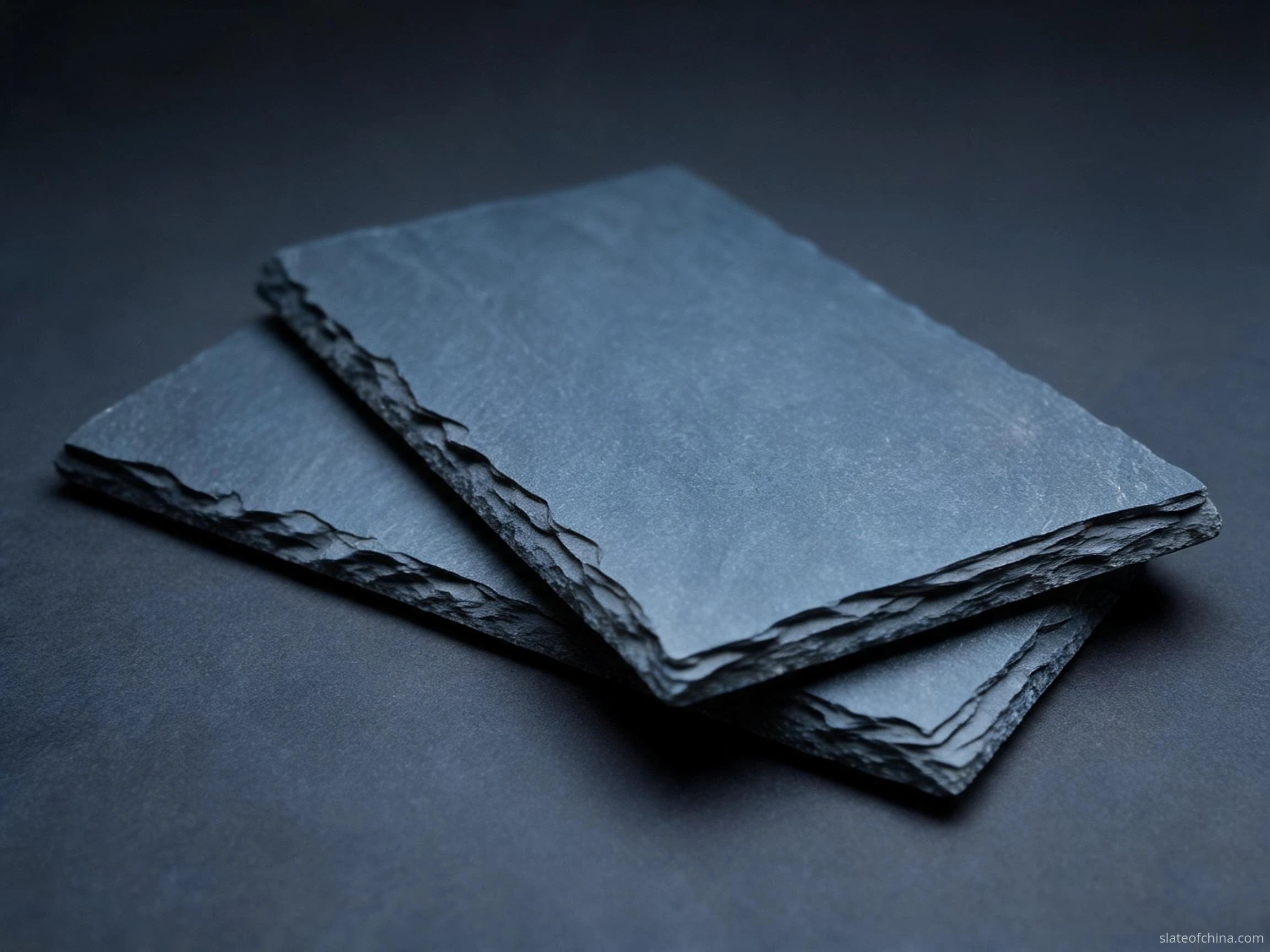
But here is the honest cold water. A 100-year slate roof is the result of the right slate plus the right installation. Slate will not rot, rust or be eaten by insects — but nails rust, roofers make mistakes, and moss will find a home if you ignore it. In thirty years I have seen far more failed slate roofs caused by bad workmanship than by bad slate. You are not buying a stone; you are buying "the right stone, fitted right". Get both and you have a family heirloom.
Advantage 2: It Is Beautiful, and It Gets Better Looking
Slate's colour is not painted on. Iron makes it purple-red, chlorite makes it green, carbon makes it near-black — every tile carries a slightly different face, and a finished roof has a kind of living, non-repeating texture that no factory-formed tile can copy. It is why old towns, cathedrals and farmhouses across Europe still wear the same material after centuries.
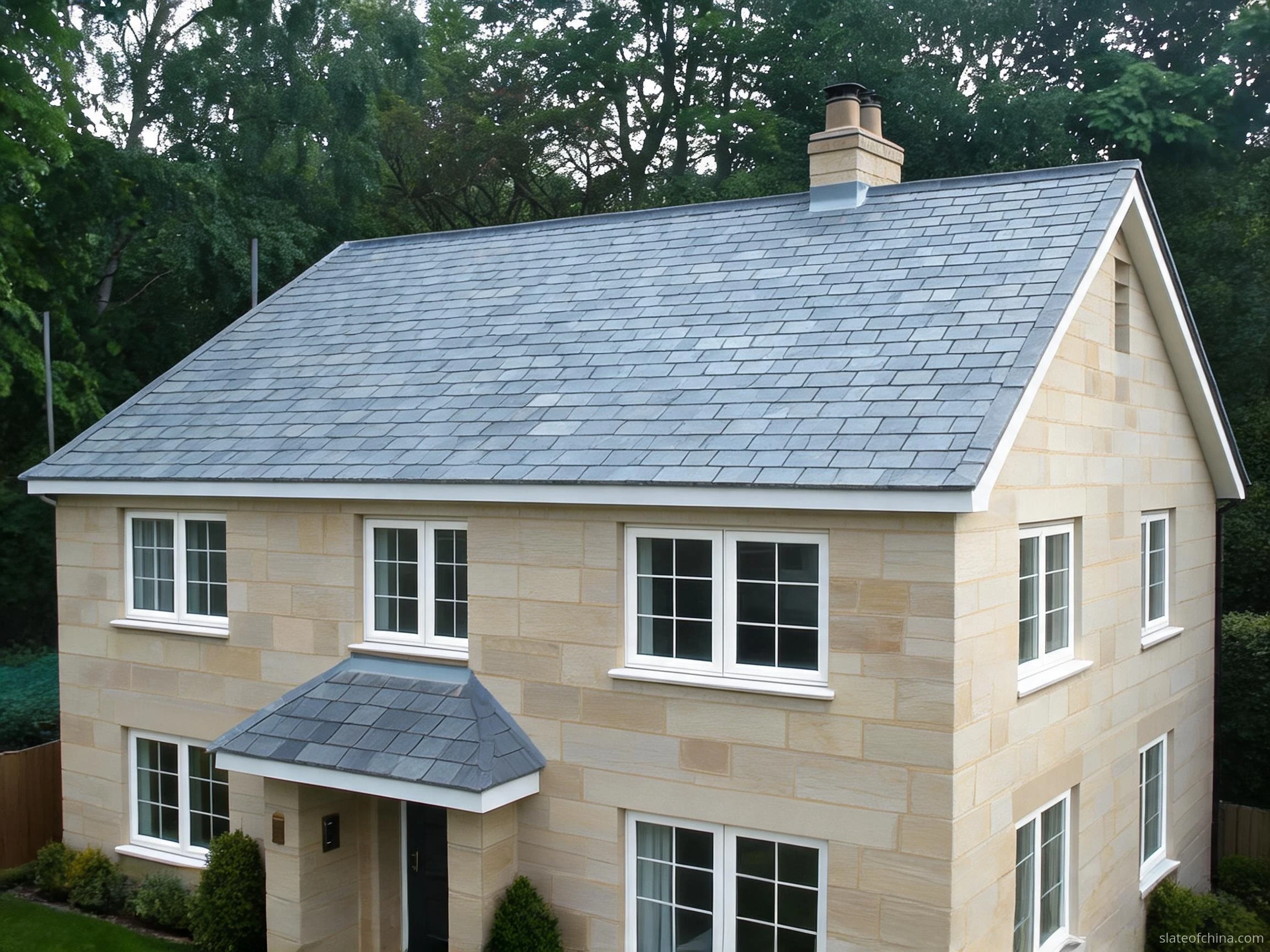
If you are building a home with any character — a farmhouse, a guest house, a project that will be photographed — slate does something to the whole building that a shingle cannot. Buyers tell me all the time: "I can't say why, I just like it." That is slate working on them.
If you want to match colour to your building rather than hope for the best, our slate colours guide explains how each colour forms and which suits what architecture.
Advantage 3: Fire, Wind and Water — When the Fixing System Holds
Three physical strengths, all from the same rock — and all of them, honestly, shared with the system that fixes it:
- Fire. Slate is a non-combustible stone, and in fire-prone regions that is a genuine, code-recognised advantage. One honest footnote: the fire performance of a roof system always depends on the underlay, the battens and the detailing as well — the tile alone is only part of the story.
- Wind. A slate roof is fixed tile by tile — each slate nailed or hooked — and on exposed coasts it has been the traditional answer to Atlantic weather. But wind resistance is a property of the fixing system: method, headlap, battens and workmanship decide it. Fitted right, slate weathers gales that strip lighter coverings; fitted wrong, any roof can lose tiles.
- Water. With absorption of 0.6% or less (the W1 grade), water does not soak into the tile — it runs off the cleft surface. That is why a properly detailed slate roof stays dry in driving rain that can push under an asphalt shingle.
Those three points are exactly the three weakest points of asphalt. Asphalt coverings start degrading in a decade or two; a good slate roof is still on the same house a century later. That is a big reason heritage and listed buildings default to natural slate — and to clay tile, its fellow century material.
Disadvantage 1: It Costs Real Money (and Not Just in the Stone)
Now the honest half. I will not polish it.
Slate roofing is expensive. Five to ten times the material cost of asphalt shingles, three to four times fibre-cement. And the premium does not stop at the tile:
- Freight. Slate is dense. A 20-ft container of slate hits its 22–24-tonne weight limit before it is physically full — importers learn this on the first shipment. Always ask whether a quote is per square metre or per tonne.
- Labour. A slate roof must be fitted by a slater, not a general roofer. In slating countries (UK, Ireland especially), slater day rates run well above a roofer's, and good ones are booked out.
- Structure. The roof has to carry 27–35 kg/m² from the slates alone. If your trusses or ceiling joists were built for shingles, you may need reinforcement before a single tile goes up.
The line I give every importer is simple: slate is not expensive per tile — it is expensive because every part of the job has to be done to slate standard. Fit slate with shingle-grade habits and you will have spent a fortune to build something that leaks.
Disadvantage 2: It Is Heavy — It Sits on the Building for a Century
Same roof area, the slate covering sits at 27–35 kg/m² against 8–15 for shingles. On a 100 m² roof that is roughly two tonnes of difference sitting up there — permanently. Two small cars parked on your rafters.
Two practical consequences:
- Check the structure first. If you are re-roofing an old timber house, get a structural engineer to confirm the loading before ordering anything. If the answer is no, the honest answer may be a different material.
- You pay for the weight twice. Once in freight, once in the labour of lifting it onto a roof. That is a big part of why slate costs more per m² than fibre-cement — you are buying both the stone and the man-power.
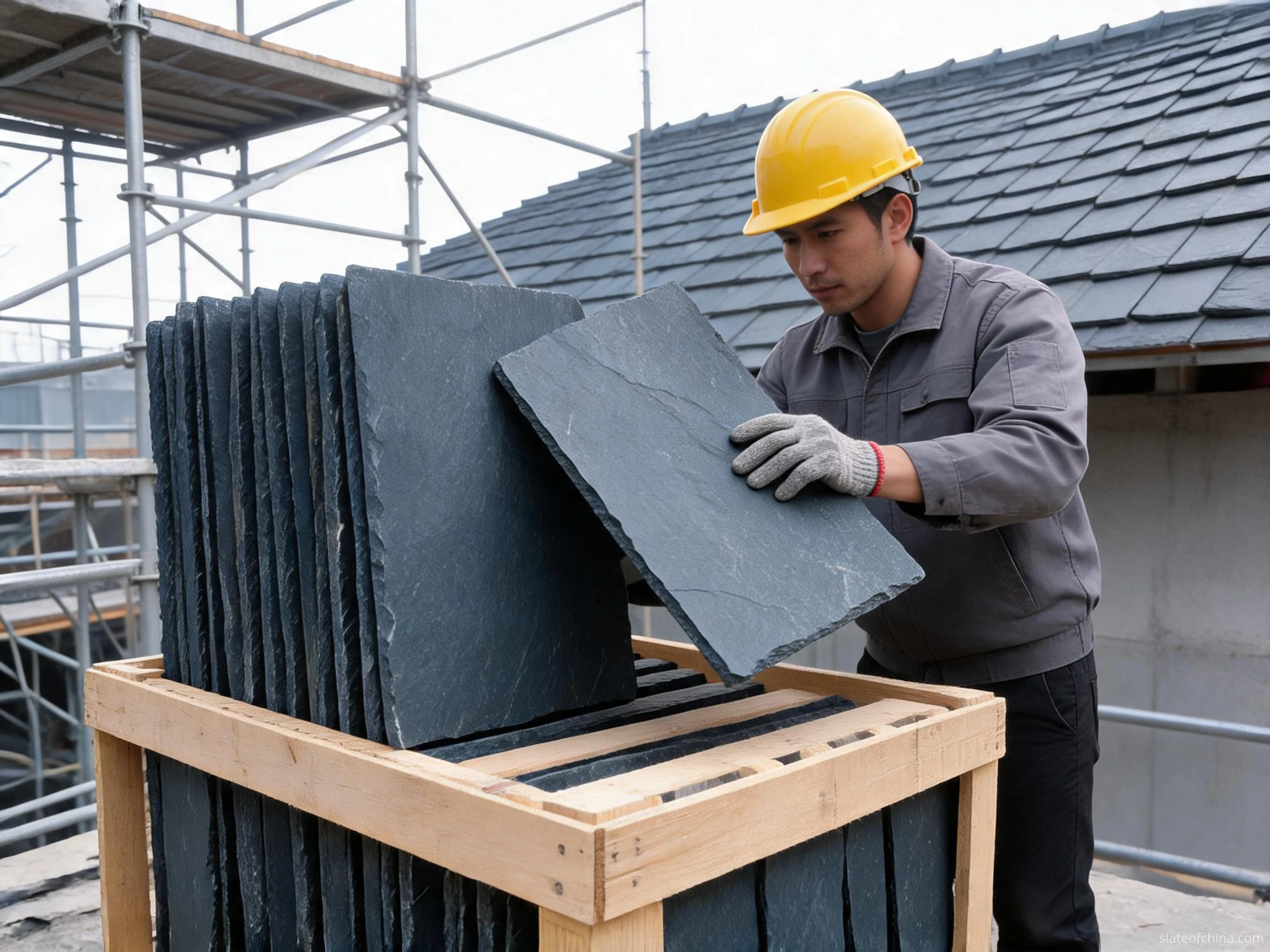
The good news: slate comes in different thicknesses — 5 mm, 6 mm, 8 mm — and the difference is real. If your structure is tight, the 5 mm grade is noticeably lighter. Our weight guide shows what each thickness actually loads on your roof.
Disadvantage 3: It Needs a Slater, Not "a Roofer"
This may sound precious, but it is the honest truth of the trade.
Laying slate is a craft, and the details are exactly where leaks are born: how the headlap is set, where the nails go, how the courses lap from below, how the verge and ridge are closed, how the flashings are finished. Get the headlap wrong, and wind-driven rain slides up under the tile. Get the nailing wrong, and a strong gust lifts a slate like a lever.
Take headlap alone: in British practice it is usually a minimum of 75 mm, more on windy elevations. Set it short and rain gets in; set it overlong and you cut the covered area per square metre — paying for slate you cannot see. None of this is guesswork a first-time roofer can improvise. Our installation guide walks through a proper slating job step by step; reading it is the fastest way to understand why the trade exists.
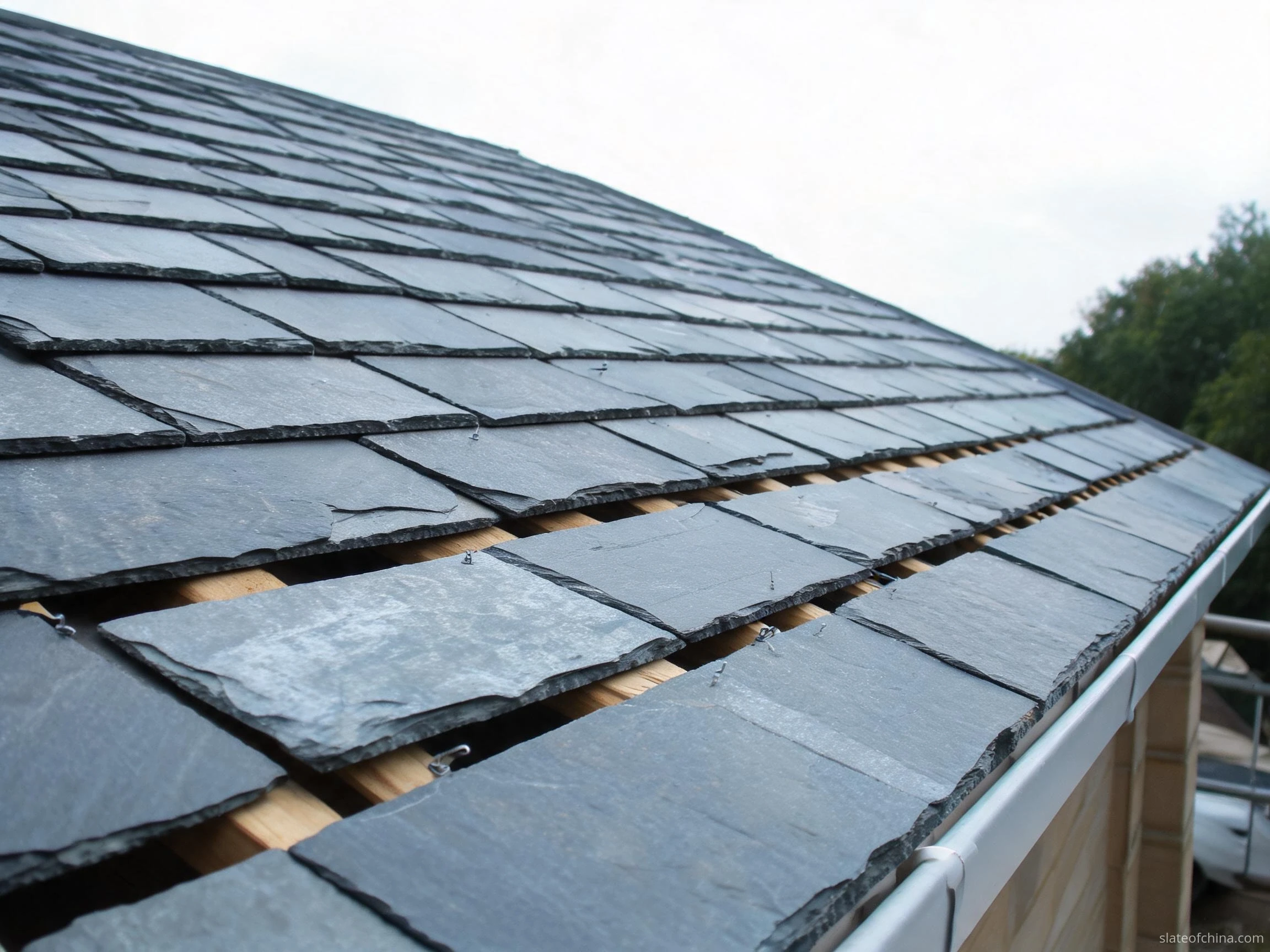
Hire a roofer who has never slated, and the instinct to treat slate like clay tile is too strong. The slate might look fine for a year. The trouble, when it comes, comes with interest. A good slater costs more per hour and is worth every extra penny.
Disadvantage 4: Replacement Slates Are Hard to Match
Slate is not a tile you re-order from a warehouse. Because its colour and grain come from the rock, every quarry is different. When a slate breaks after forty years, you are matching colour, size, thickness and even grain direction — or you will end up with a patch that shouts at you from across the street.
Worse, some quarries have closed; some old roof colours no longer exist in new production. That is why restorers of old buildings spend real money tracking down salvaged slate from the era. We have had customers send a single broken slate to China by courier just so we can match its tone.
The cheap insurance is to order 5–10% spare at the start and store them. That pile of extras is the future — itself, written in slate.
Disadvantage 5: It Needs a Maintenance Routine — Not "Set and Forget"
Slate is tough, but "tough" is not "zero-care". Moss loves a slate roof: the mineral surface holds moisture in tiny pockets. Honestly, moss is a drainage and dampness problem more than a slate problem — but left alone, trapped moisture works into the tile edges, and in freeze–thaw climates that can open a path to damage. Which roofs suffer and which do not depends on pitch, shading and how quickly water leaves the surface.
The remedy is simple, but not "half an hour with a bucket". Look at the roof once a year before winter — from the ground and the eaves: clear gutters and valleys, cut back overhanging branches, note any slipped or cracked slates. Anything that needs hands on the roof itself — moss clearance on the slopes, slate replacement, chimney flashings — should be done by a qualified roofing professional using roof ladders and crawling boards, not by walking on the tiles. Annual attention is cheap; ignoring a roof for a decade is not. The maintenance guide covers the tools, the timing, and the rules for when to call in a professional.
When Is Slate Roofing Worth the Investment?
Read the eight factors above and you know the trade-offs. The practical question is shorter: does your project sit on the slate side of the line, or the other side? Here is the table I would draw for a customer who asks.
| Suitable for natural slate | Consider alternatives |
|---|---|
| Long-term residential buildings | Short-term or temporary buildings |
| Heritage restoration and listed properties | Projects with very limited roofing budgets |
| Premium architectural projects | Structures with insufficient load capacity |
| Coastal and fire-prone locations, where the material's strengths pay | Locations with no experienced slate installers available |
| Owners who can hire a specialist and maintain it | Owners who need a fit-and-forget roof for the next 15–30 years |
If you sit on the border — a long-term building on a tight budget — the honest route is a thinner 5–6 mm grade on a simple roof plane, not a cheap heavy imitation. The material is still genuine slate; you are simply spending your budget where it counts.
So Is It Worth It?
I have said the honest. Now the honest balance.
Every disadvantage listed above is a money and skill problem, not a material problem. If your budget carries, your structure carries, and you can find a real slater — the disadvantages stop being disadvantages. What remains is what very few roofing materials can offer: a century of service plus a beauty that improves with age.
My advice has always been one sentence:
If the house is meant to last — the family home, the building you want to leave behind — and the budget allows, slate is the roofing that turns your roof into an asset instead of a liability. If the house just needs to keep the rain out and the budget is tight, there is no shame in shingles or fibre-cement. It is honest to want either.
If you have decided to look seriously, the next step is to see the stone, not just the price list. Start with a specific tile — our charcoal grey rectangular roofing slate is the grade we ship most often — and do not take our word for it: request samples, weigh them in your hand, tap them on the edge. A roof that has to last a century deserves a decision made from a sample, not a screenshot.
Frequently Asked Questions
What is the biggest disadvantage of a slate roof?
Cost and the need for a specialist. The material is several times dearer than asphalt, installation must be done by an experienced slater, and the roof structure has to carry 27–35 kg/m² of slates. Skimping on any of those three turns an expensive roof into a leaking one.
How long does a slate roof last?
With quality slate and quality work, 75–150 years is normal; many European roofs pass 100 with no sign of giving up. The lifespan is decided by the slate's own test classification — its water-absorption grade and, under ASTM C406, its S1 service-life grade — and by the installation. See our lifespan guide.
Why is slate roofing so expensive?
Three reasons stack: slate of good quality is rare (only certain rock formations yield tiles); it is heavy, so freight and lifting cost more; and it needs skilled slaters whose labour is not cheap. The result is the most expensive roof material, and one of the very few built to last a century.
Can you walk on a slate roof?
Not directly, and not without the right equipment. Natural slate roofs should not be walked on without appropriate access equipment and protection; inspection and repairs should be performed by qualified roofing professionals using roof ladders and crawling boards. Stepping on the middle of an exposed tile is exactly how slates crack. More detail in the maintenance guide and the repair guide.
Will a slate roof leak?
Good slate itself is close to waterproof — W1-grade slate absorbs 0.6% or less, so water does not pass through the tile. When a slate roof leaks, the water is usually coming in at a detail: the valley, the flashings, the verge, a nail worked loose in the wind. That is why the quality of the slater, especially at the details, matters more than the brand of the slate.
Slate vs asphalt shingles — which is better?
It depends on what you are trying to do. Shingles are cheap, light, and quick to fit — but you will re-roof every 15–30 years. Slate is expensive, heavy, and requires a specialist — but it can be the last roof you ever buy. Over 100 years the cumulative cost of re-shingling three or four times usually exceeds the slate roof. Compare it all in our slate vs synthetic guide.
Related Reading
Not decided yet? Hold the stone in your hand.
We have split slate in Jiujiang for over 30 years and we do not mind you comparing. Our test numbers are published — start with the test results, then request samples. Weigh the tile, run a finger across the cleft, tap it on the edge. The roof will decide for you.