
Natural Characteristics of Roofing Slate: 8 Key Properties Explained
A slate roof can outlive the building it covers — but only some slates do. The difference is set by the rock itself, long before any tile reaches a roof: how the stone formed, which minerals it carries, how much water it can absorb, and how it behaves when it bends, freezes and weathers. These are the natural characteristics of roofing slate, and unlike colour or size, they cannot be adjusted at the factory. They can only be measured, classified and declared.
This guide walks through the eight characteristics that matter, what each one means in plain terms, and where to find it on the paperwork — an EN 12326 declaration of performance in Europe, an ASTM C406 report in North America — so you can judge a slate on evidence rather than adjectives.
Quick answer — the eight characteristics, and where each is written on the paperwork:
- Cleavage & surface — visible on the tile itself: the natural cleft face is the rock's internal layering, exposed.
- Water absorption — EN 12326 classifies results around 0.6%: W1 (≤ 0.6%), W1 (> 0.6%, with freeze–thaw testing) or W2.
- Density & weight — around 2,700–2,900 kg/m³, which comes out at roughly 27–35 kg/m² of finished roof in standard formats.
- Flexural strength — the characteristic modulus of rupture, declared in N/mm² in two orientations.
- Freeze–thaw resistance — additional testing is required when absorption exceeds 0.6%.
- Mineral composition & weathering — covered by the thermal-cycle code (T1–T3), the sulphur-dioxide exposure code (S1–S3) and carbonate content.
- Colour & appearance — set by trace minerals; tile-to-tile variation is normal, not a defect.
- Thermal & fire behaviour — the rock is non-combustible; a roof's fire rating depends on the full assembly.
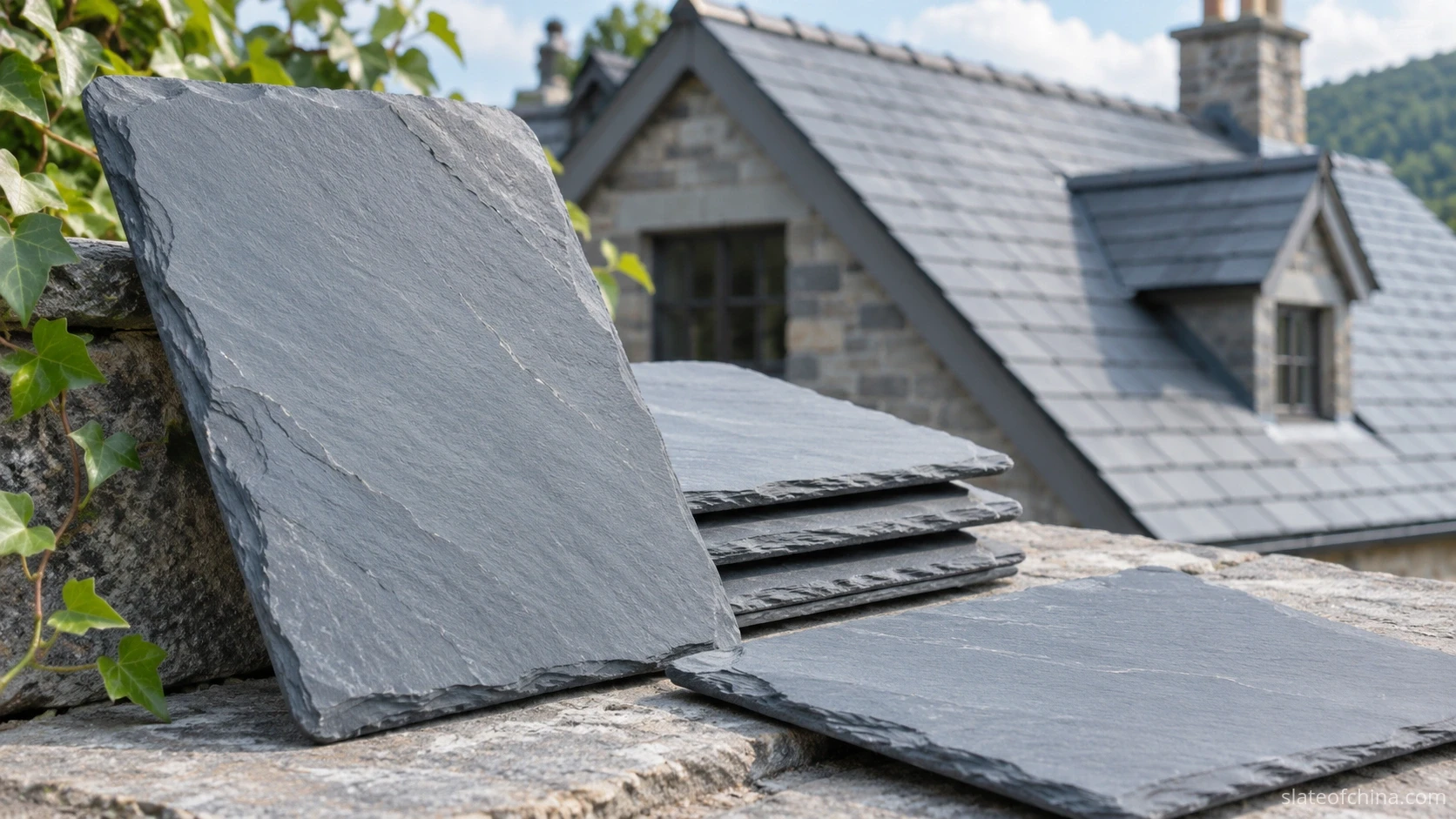
1. Natural Cleavage and Surface Texture
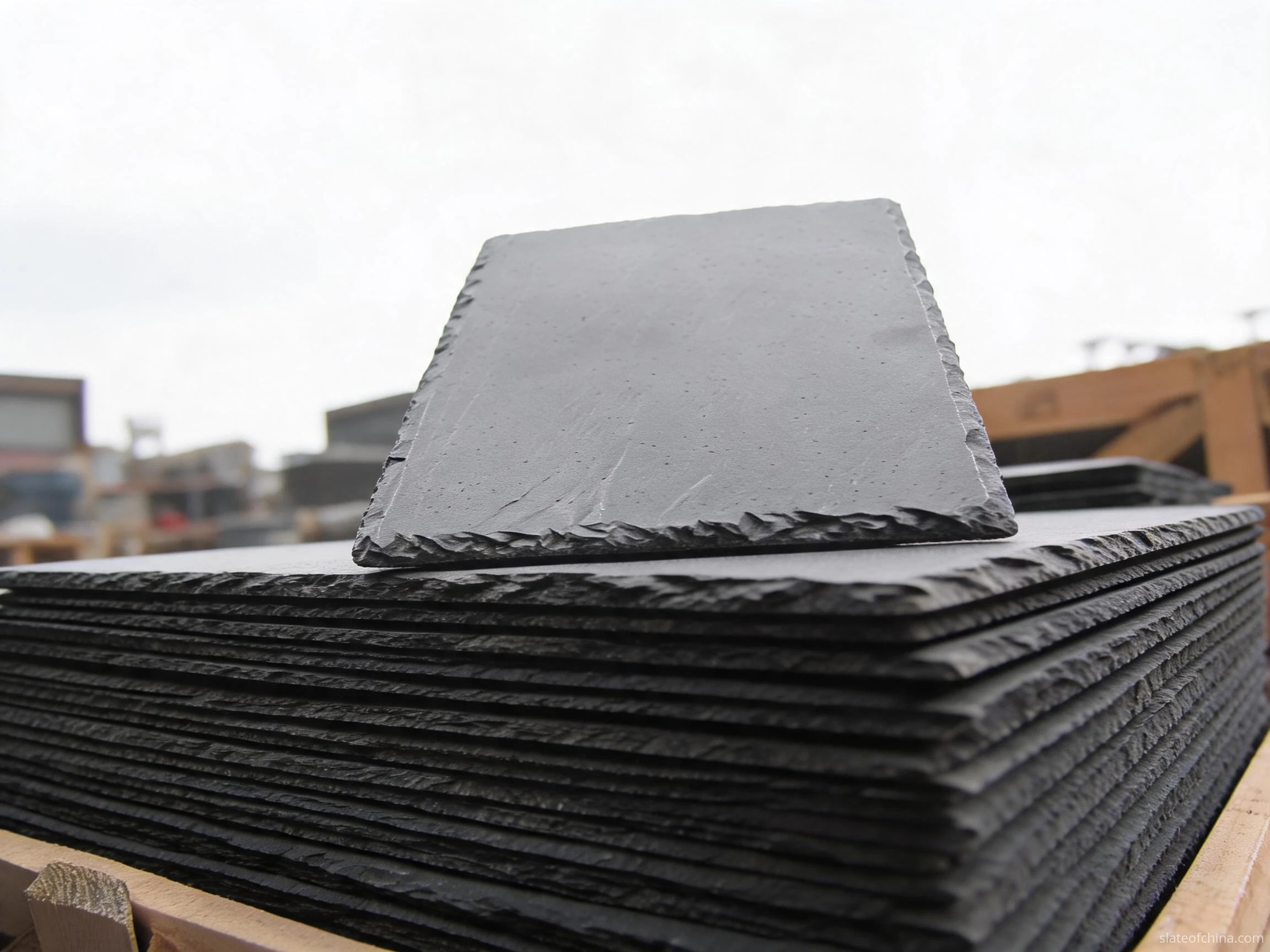
Slate begins as mudstone or shale — a compacted bed of clay and silt. Buried, squeezed and gently heated over geological time, the flat clay minerals realign into parallel sheets. That alignment is cleavage, the most important word in slate vocabulary: it is what lets a solid block split into thin, even tiles, and the split face — the natural cleft surface, with its faint ripple and tactile grain — cannot be moulded, printed or faked. It is the internal structure of the rock, exposed.
This is also why identical-looking deposits trade at very different prices. A quarry can only produce roofing slate if the cleavage runs regular enough for tiles to come out flat; the trade still calls it "reading" the block before it is split.
Two things to check whenever you handle a tile:
- The cleft face. Every tile shows a slightly different face — near-uniform in tone, never repeating like a pressed product. Slate roofs gain their living, non-repeating texture precisely from this variation.
- The ring. Tap a tile on its edge: sound slate rings; cracked slate sounds dead. It is the oldest quality test in the trade, and it still catches hidden cracks a visual inspection misses. When a pallet arrives, tap a few tiles at random before the roofers start.
To see what natural cleft surfaces actually look like before you order, browse the charcoal grey rectangular roofing slate product page or the wider natural roofing slate range — the tiles are shown exactly as they leave the splitter.
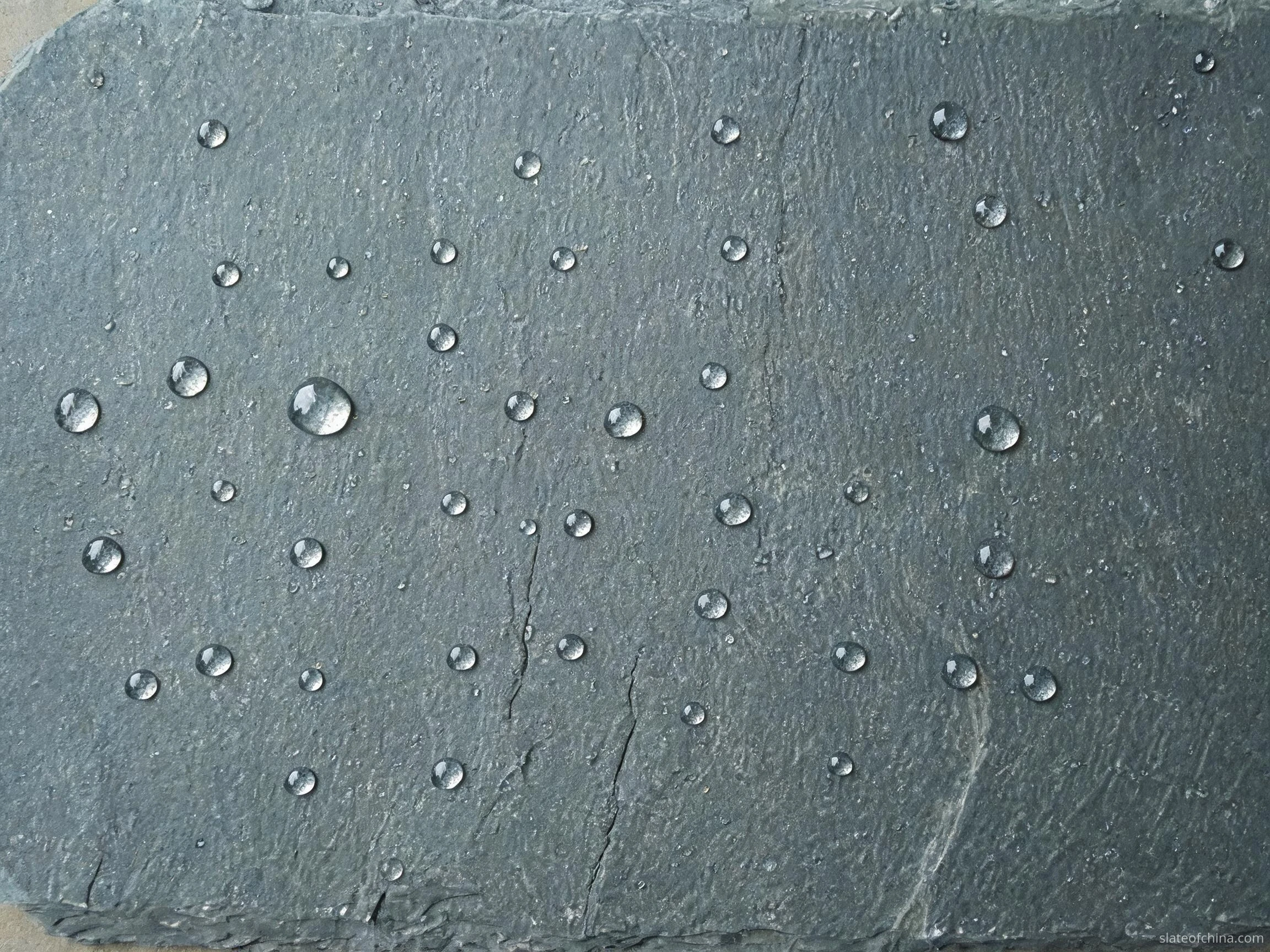
2. Water Absorption and Porosity
Slate is watertight not because of any coating, but because the rock itself is practically impermeable — fine-grained, with almost no connected porosity for water to travel into. The property that quantifies this is water absorption, and EN 12326 handles it precisely, classifying each slate by code:
- W1 (≤ 0.6%) — absorption at or below the 0.6% threshold.
- W1 (> 0.6%) — absorption above the threshold, with the freeze–thaw test carried out and the flexural results before and after it reported.
- W2 — above the threshold without that testing.
So 0.6% is not a free-floating universal "pass mark" — it is the classification threshold at which the standard demands extra proof of frost behaviour. A slate that absorbs more water must demonstrate, by test, what cycling through frost does to its strength.
For the buyer, the practical reading is simple. The lower the absorption value, the denser and more frost-resistant the stone tends to be, because there is less water inside it to freeze. Ask for the declaration of performance and read the actual value and code — not the brochure adjective.
3. Density and Weight
Roofing slate typically weighs 2,700–2,900 kg/m³, with the Jiujiang slate falling inside this range. The number means little on its own, but multiplied out, it shapes the whole project:
- Per tile. A 500×250 mm slate at 5–7 mm weighs about 1.9 kg — manageable on the bench, but a full pallet is fork-lift territory.
- Per square metre. A finished slate roof comes out at roughly 27–35 kg/m² in standard residential formats, and toward 50–70 kg/m² where heavy traditional slates are used. That is heavier than lightweight sheet or shingle systems and in the same broad range as concrete and clay tiled roofs — the structure has to be designed for the actual covering, not assumed.
- Per shipment. Slate is quoted by weight because a container reaches its payload limit well before it is physically full; comparing suppliers means comparing per-tonne and per-m² figures on the same basis.
The full tile-weight, coverage and roof-load tables are in the roofing slate weight guide, and the size implications are covered in the thickness guide.
4. Flexural Strength
Strong in bending, weak in impact — that is slate in one sentence. A tile spanning a batten carries a surprising load, yet the same tile cracked by a dropped tool is scrap. The measured property is flexural strength, expressed as the modulus of rupture.
EN 12326 declares it precisely: a three-point bending test, reported as the characteristic modulus of rupture in N/mm², separately for the longitudinal and transverse orientations — slate is anisotropic, so its grain makes it stronger one way than the other. There is no single universal minimum figure. Instead, the declared strength feeds the calculation of minimum tile thickness: stronger rock can legitimately be split thinner. That is why two roof slates of the same size can differ in thickness — the thickness follows the strength.
In the North American system, ASTM C406 grades slate into Types S1, S2 and S3 by expected service life, with Type S1 covering the longest expectation. The roofing slate grades guide explains the grades and what feeds them. What you should never do is read a laboratory strength figure as a licence to walk on tiles: slate roofs are worked from roof ladders or crawling boards with fall protection, whatever the paperwork says.
5. Freeze–Thaw Resistance
Frost damage on a slate roof is almost always a porosity story. Water that has soaked into the rock freezes, expands by roughly 9%, and repeats the stress every cold night until the surface flakes or the tile splits. Dense slate barely takes the water in — which is why absorption and frost resistance travel together.
The standard links them directly. Freeze–thaw testing under EN 12326 is required when water absorption exceeds 0.6%, and what gets reported is the mean modulus of rupture before and after the cycling. The strength retained through the test is the evidence that matters.
Two cautions for buyers:
- Do not convert laboratory cycles into years of service life. A "passed 200 cycles" claim is only meaningful with the full test method attached, and no honest laboratory projects a cycle count onto a calendar.
- Read the code, not the adjective. "Excellent frost resistance" is marketing; a W1 code — and, where absorption exceeds 0.6%, the before-and-after flexural values — is a result you can compare between suppliers.
6. Mineral Composition and Weathering
A petrographic examination is part of EN 12326 compliance — the standard wants the stone identified and the relationship between its bedding and cleavage established. What the microscope finds decides how the slate will age.
The matrix of good roofing slate is quartz, mica and chlorite — stable minerals that hold a surface for a century and keep the dressed edge crisp (slate sits around 3–4 on the Mohs scale, which is why the arris of a well-dressed tile stays sharp rather than rounding off like soft clay tile). The troublemakers are the guests:
- Carbonate minerals (calcite and dolomite) are slowly dissolved by acidic environments, softening the surface and etching away the cleft texture.
- Metallic minerals — pyrite above all — oxidise over time, causing rust runs and, in bad cases, pits that can penetrate the tile.
The standard attacks both with named tests and codes:
- The thermal-cycle test declares a T1, T2 or T3 code. T1 means no changes in appearance; T3 means oxidation penetrating the slate with a risk of forming holes — the standard allows T3 slates only for selective use, with construction methods chosen to avoid water penetration.
- The sulphur-dioxide exposure test declares an S1, S2 or S3 code for slates with a calcium carbonate content of 20% or less, with S1 the best behaviour.
- Slates above 20% carbonate form their own category, carbonate slate, controlled by the measured depth of softening; if that softened layer exceeds 0.7 mm, the standard rules the stone not suitable for roofing at all.
A buyer does not need a chemistry degree — just the codes. Buyers in polluted or acid-exposed locations, and heritage specifiers in particular, commonly add their own preference for low-carbonate slate; that is a procurement choice on top of the standard, not a universal rule.
7. Natural Colors and Appearance
Every natural slate colour comes from a trace mineral baked into the rock: iron for the purples and reds, chlorite for greens, carbon for charcoal and blue-grey. Blue-grey and grey-black dominate British and northern-European roofs because those are the beds most quarries work. The roofing slate colors guide walks through the palette by region and architecture.
What colour charts never quite show is the variation: two tiles from the same pallet can sit side by side on a roof a shade apart. That is the honest signature of natural stone — expect it in texture as well. A roof of hundreds of perfectly identical faces is not natural split slate; it is a sawn, heavily sorted or coated product.
There is also a weathering side to colour. On a slate carrying metallic minerals, rust runs appearing after some years are the visible face of the T-code behaviour described above: slight tone change within a tile is normal, but streaking and bleed marks are a warning sign to monitor.
8. Thermal and Fire Properties
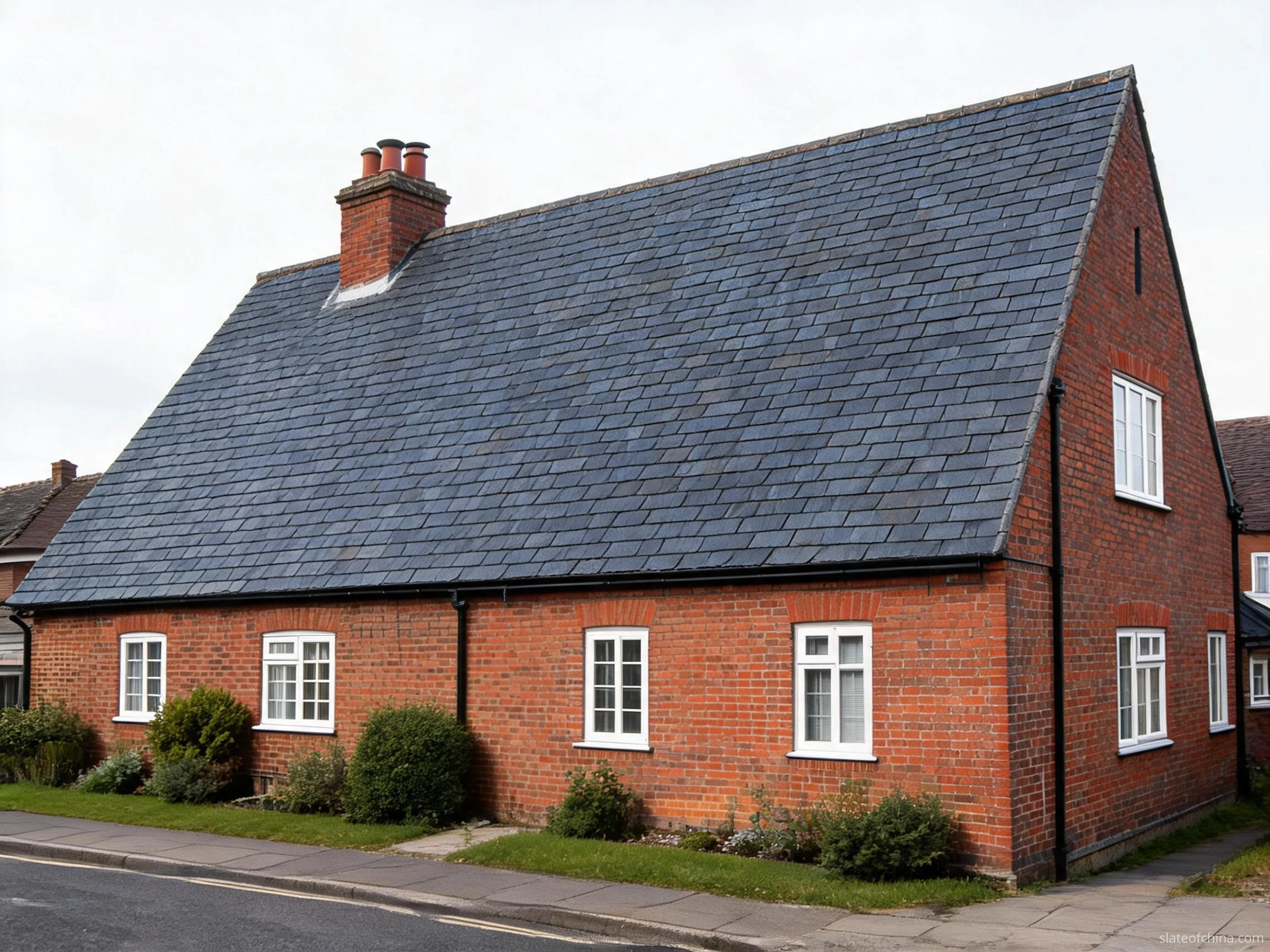
As a material, slate is non-combustible rock: it does not burn, does not feed flame and gives off no toxic smoke in a building fire. That is a property of the stone itself. What it is not, automatically, is a fire rating: the classification of a finished roof depends on the whole assembly — underlay, battens, deck and fixings — evaluated under the local building code. A fire-rated slate roof is a tested system, and your architect or the supplier's technical documentation should state which one applies.
Thermally, slate behaves like the dense stone it is: the surface heats slowly through the day and releases that heat slowly at night — a roof covering with genuine thermal mass, and one reason slate roofs stay comfortable in hot climates when paired with the right insulation build-up. The smooth cleft plane sheds rain cleanly and, pitch and fixings permitting, sheds snow the same way. These are quiet, cumulative advantages rather than headline numbers, and they hold only in a well-designed roof.
The Characteristics Checklist Before You Buy
To close, here is the working checklist — what to ask for, and what a good answer looks like on paper:
| Characteristic | What the paperwork shows | What you want to see |
|---|---|---|
| Water absorption | Declared value + W code | 0.6% or below, coded W1 (≤ 0.6%) |
| Flexural strength | Characteristic modulus of rupture, both orientations, N/mm² | Clearly declared; consistent with the thickness offered (stronger rock splits thinner) |
| Thermal cycling | T code | T1; T3 only for selective uses |
| Sulphur-dioxide exposure | S code, or softening depth for carbonate slates | S1 or S2; softening depth within the standard's limits |
| Carbonate content | Declared class per EN 12326 | Low, for acid-exposed or heritage sites |
| Density | kg/m³ | 2,700–2,900 typical for roofing slate |
| ASTM grade (North America) | Type S1 / S2 / S3 | S1 for the longest service expectation |
| Source | Declared quarry of origin | A single declared source, with full test documentation available |
Good slate is not simply expensive slate. It is rock that formed the right way, tested to consistent standards and declared plainly. Suppliers who publish the numbers — like the test results placed on public view for the Jiujiang slate — are doing exactly what the standards intended.
Frequently Asked Questions
What are the natural characteristics of roofing slate?
Natural roofing slate combines a split cleavage surface (the natural cleft face), low water absorption, high density (around 2,700–2,900 kg/m³), measurable flexural strength, resistance to freeze–thaw cycling, a stable mineral composition, mineral-driven colours and non-combustible material behaviour. Each is measured and declared under EN 12326 in Europe or ASTM C406 in North America.
What do the W, T and S codes on a slate test report mean?
EN 12326 uses three code systems. W codes classify water absorption: W1 (≤ 0.6%), W1 (> 0.6%, which requires freeze–thaw testing), or W2 (above threshold, untested). T codes (T1–T3) record behaviour in the thermal-cycle test. S codes (S1–S3) record behaviour in the sulphur-dioxide exposure test. ASTM C406 separately uses Type S1/S2/S3 for expected service life — a different system, so codes from the two standards should never be mixed.
What water absorption should roofing slate have?
EN 12326 sets 0.6% as the classification threshold: at or below it, a slate is coded W1; above it, the standard requires freeze–thaw testing with flexural results reported before and after. Lower absorption generally means denser, more frost-resistant stone. Always read the declared value rather than a marketing claim.
Why is slate so good for roofs?
Because it is dense and practically impermeable, water cannot soak into the tile and freeze there; it is strong in bending for its weight; the mineral matrix weathers slowly; and the cleft surface sheds water. As a material it is also non-combustible. Provided the tiles are properly graded, sized and fixed, these are the properties behind slate's long service life.
How heavy is a natural slate roof?
Standard residential formats come out at roughly 27–35 kg/m² of finished roof, with heavy traditional slates reaching 50–70 kg/m². A 500×250 mm tile at 5–7 mm weighs about 1.9 kg. Roof structures should always be checked against the actual tile specification before ordering.
Why are slate tiles different colours?
Trace minerals set the palette: iron gives purples and reds, chlorite gives green, and carbon gives charcoal and blue-grey tones. Slight tile-to-tile variation in colour and texture is a natural feature of split slate — a perfectly uniform roof usually indicates a sawn, sorted or coated product.
Does a slate roof burn?
No — natural slate is a non-combustible material that does not burn or release toxic smoke in a building fire. The fire classification of a completed roof, however, depends on the full assembly — underlay, battens, decking and fixings — and on local building-code approvals.
Natural slate, with the documentation to match.
Looking for natural roofing slate with documented technical properties? Explore our Jiujiang roofing slate range, review the available test reports, or contact our team to discuss your project requirements.