
Jiujiang Slate Mineral Composition: What the Stone Is Made Of and Why It Decides Everything
SPECIMEN ID: JSL-001 | ORIGIN: LUSHAN–XINGZI BELT, JIANGXI | CLASS: LOW-CARBONATE MUSCOVITE–QUARTZ SLATE
Dominant minerals: muscovite (sericite) + quartz + chlorite, with minor plagioclase, calcite and trace pyrite
Key chemistry: SiO₂ 66.46%, Al₂O₃ 15.81%, CaO 0.56%, loss-on-ignition 2.20%
Why it matters: the mineral mix sets the hardness, the cleavage, the density, the water resistance — and ultimately, whether the stone survives a Norwegian winter or a billiard tournament
I have a piece of slate on my bench. It came from a quarry face in Hengtang, a town at the foot of Mount Lushan in Jiangxi Province. By the time it reaches my desk it has been split, dried and labelled — just another dark grey tile, about the size of a paperback book, 8 mm thick.
But I can tell you, from the minerals inside it, why this specific piece will still be on a roof in Bergen in fifty years — and why a piece that looks almost identical, from a different mountain, might not last ten. The answer isn't in the colour or the thickness. It's in the recipe.
Every physical property people argue about when they buy slate — density, water absorption, flexural strength, hardness, freeze–thaw survival — all of them are downstream of one thing: what the rock is actually made of. This page is that thing.
Step 1: What Minerals Are in This Stone
A rock isn't a single material. It's a composite — several minerals pressed and interlocked, each contributing something different to how the whole stone behaves. Slate, in particular, is a metamorphic rock: it started as muddy sediment on an ancient sea floor and was recrystallised under pressure and heat over geological time. The clay minerals re-formed as mica; the silt re-formed as quartz; and the pressure aligned everything into parallel sheets.
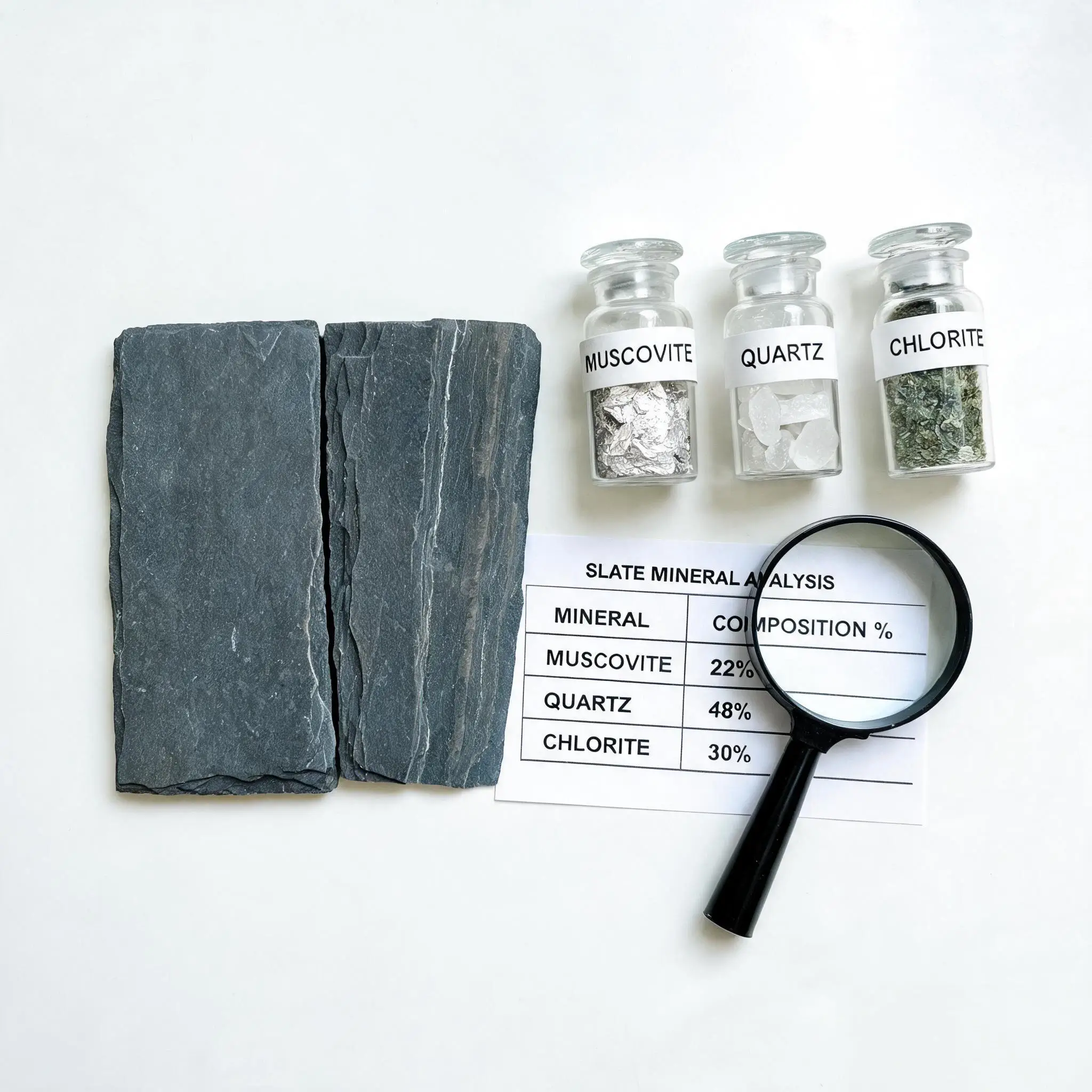
When I identify the minerals in a piece of Jiujiang slate, I'm working from three sources. The first is a chemical analysis conducted in 2000 by the Ministry of Geology and Mineral Resources, Jiangxi Central Laboratory (batch number 2000-Hua-18, submitted by Xingzi Shunyuan Slate Factory). The second is a 2008 paper in the Journal of East China University of Technology that independently confirmed the mineral identification. The third is what I see every day on the splitting bench — the way the stone cleaves, the way it sparkles when you angle it to the light, the golden flecks that appear on a polished face.
All three sources agree. The dominant minerals are:
- Muscovite — in its fine-grained form, called sericite. This is the mica that gives slate its cleavage. Platy, flaky, Mohs 2.5–3. When you split a tile and it breaks clean along a flat plane, muscovite is why.
- Quartz — hard, angular grains, Mohs 7. This is the skeleton. It gives the stone its resistance to scratching and surface wear. SiO₂ content tracks it: 66.46% in our analysis.
- Chlorite — a softer, greenish mineral, Mohs 2–3, that sits between the mica sheets and acts as a kind of buffer. It makes the stone slightly more forgiving under the chisel.
- Plagioclase feldspar — a minor component, hardness 6–6.5, contributing to the overall structural frame.
- Calcite — calcium carbonate, CaCO₃. Present in small amounts. This is the one to watch: calcite is the mineral that acid rain dissolves.
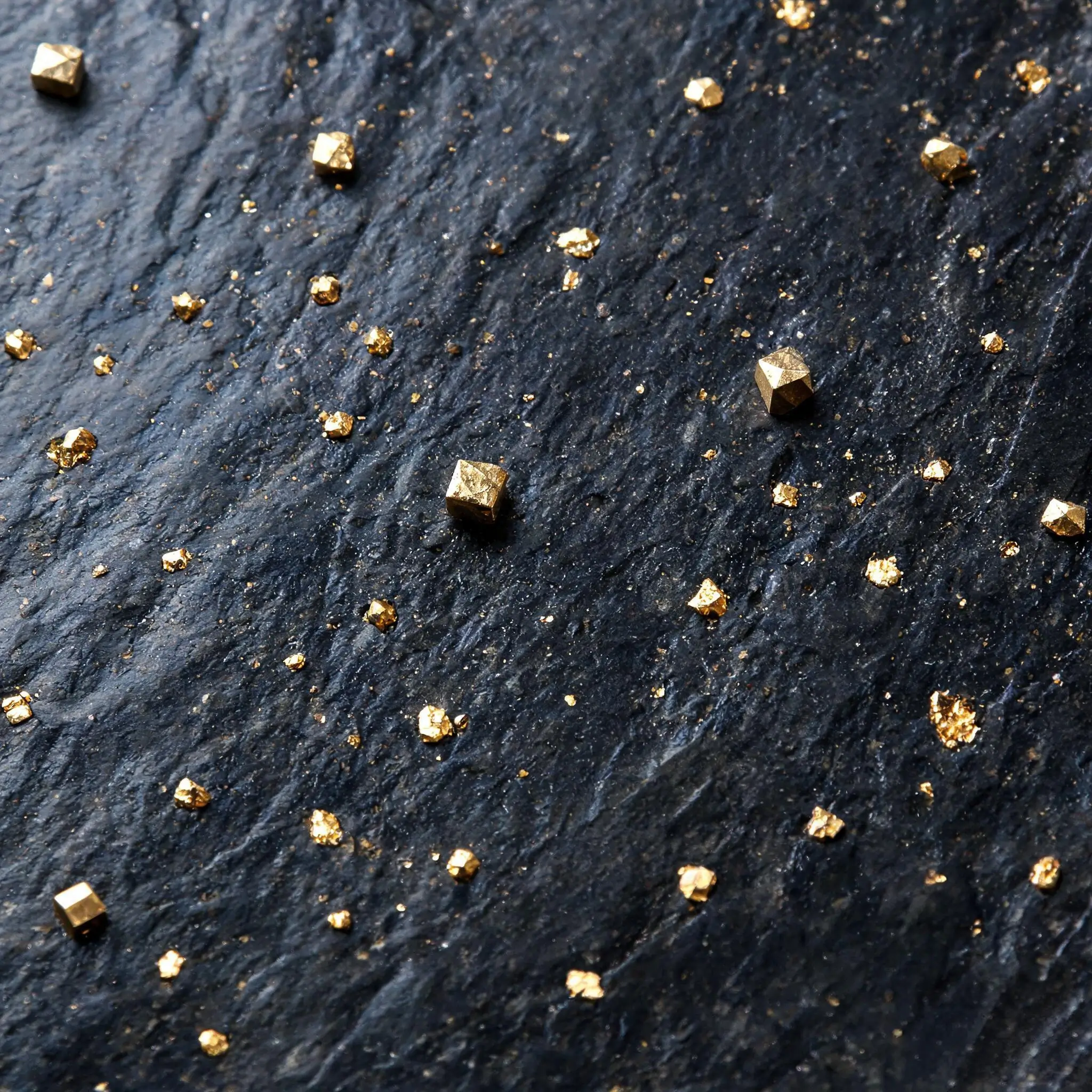
- Pyrite — iron sulphide, FeS₂. Present only as a trace. But it's the most visible trace: those golden flecks you sometimes see on a split face are pyrite crystals. The Song dynasty craftsmen who made inkstones from this same stone called them "gold stars" — jinxing. Same mineral, same rock, a thousand years apart.
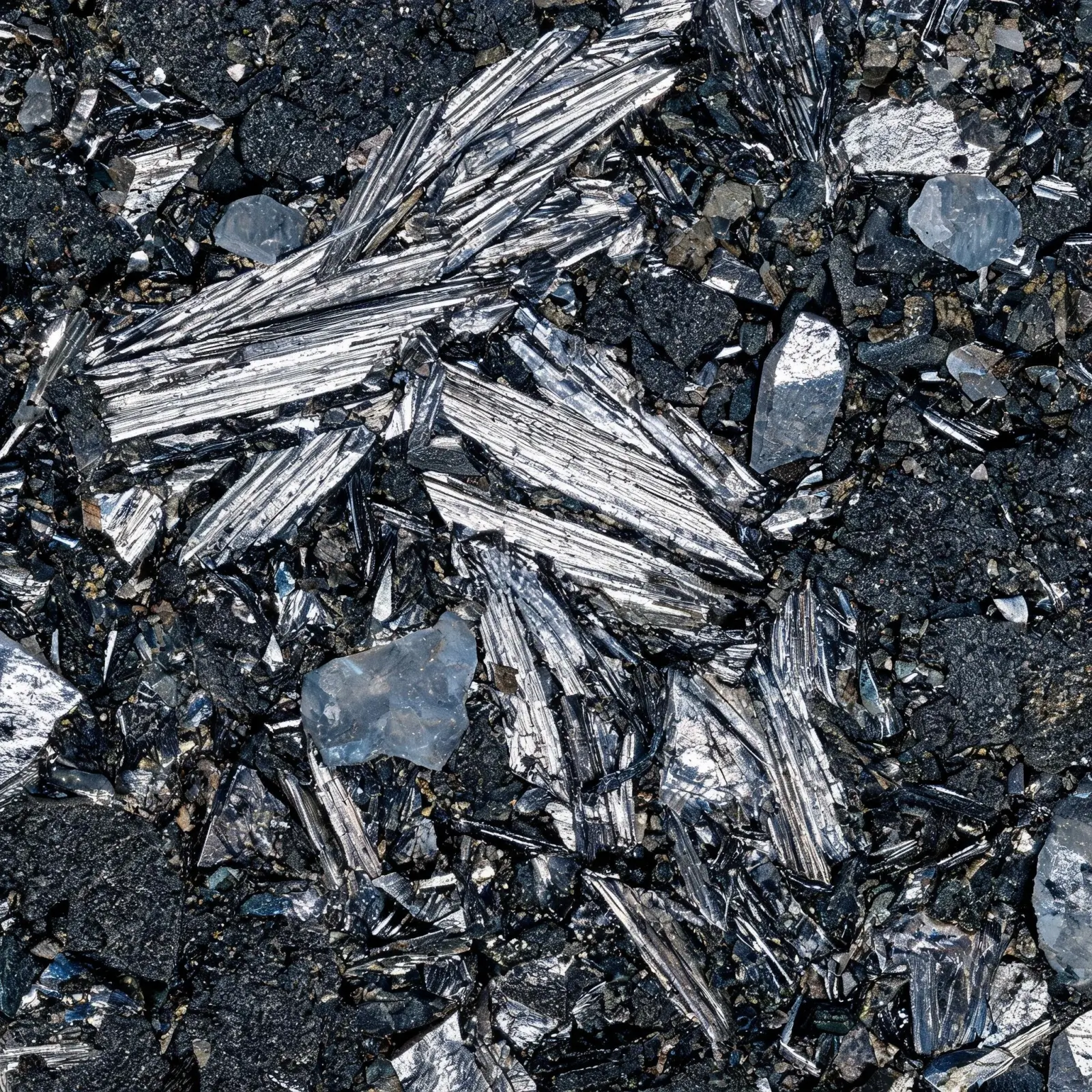
Three minerals do the heavy lifting — muscovite, quartz and chlorite. The others are either minor structural contributors (plagioclase), a potential weakness (calcite), or a fingerprint (pyrite). When I'm assessing a new batch, I'm effectively checking whether the proportions of these three main players are in the right range. If they are, the properties follow. If they aren't, no amount of good splitting or careful machining will rescue the stone.
Step 2: The Chemical Composition — All Eleven Lines
Mineral identification tells you what is in the stone. Chemical analysis tells you how much. The 2000 lab report gives us a full eleven-line breakdown. I'm going to show you all of it, because the full picture matters more than any single number.
| Oxide | Content (%) | What it tracks |
|---|---|---|
| SiO₂ | 66.46 | Quartz content — the hardness skeleton |
| Al₂O₃ | 15.81 | Muscovite content — the cleavage system |
| TFe₂O₃ | 7.38 | Total iron — pyrite + iron-bearing minerals |
| K₂O | 2.20 | Potassium in muscovite crystal structure |
| Na₂O | 2.10 | Sodium — traces in feldspar |
| MgO | 1.88 | Magnesium — chlorite content |
| TiO₂ | 0.75 | Titanium — trace, common in metamorphic rocks |
| CaO | 0.56 | Calcium — the carbonate weakness line |
| MnO | 0.40 | Manganese — trace, no engineering significance |
| P₂O₅ | 0.15 | Phosphorus — trace, no engineering significance |
| Loss on ignition | 2.20 | Volatile content — structural water + carbonates |
Most buyers who ask for the chemical report are looking at one or two numbers. I understand — you don't need eleven lines to decide whether a stone is good. But I'm going to walk you through the ones that actually matter for how the stone performs, because understanding the recipe is different from checking a pass/fail box.
SiO₂ 66.46% — The Hardness Skeleton
Silica at 66.46% is high for a slate. This is your quartz content, and quartz at Mohs 7 is the hardest mineral in the stone. The number tells you the upper limit of the stone's hardness — not a guarantee, but a structural ceiling. A slate with 50% SiO₂ simply doesn't have enough quartz grains in the matrix to resist surface wear the way this one does.
The 2008 paper from East China University of Technology confirmed the mineral identification independently, which matters: a single lab report can be wrong, but two separate analyses eight years apart, using different methods, arriving at the same mineralogy — that's as close to settled as geology gets.
Al₂O₃ 15.81% — The Cleavage System
Alumina tracks the muscovite content. Muscovite is the mineral that gives slate its ability to split into thin, flat sheets — the property that separates slate from every other building stone. 15.81% is in the right range: high enough for clean, consistent cleavage across a full quarry face, not so high that the stone becomes friable or overly mica-rich (which would make it weak in bending).
When a splitter in our factory puts a chisel to a block and the stone opens along a plane as flat as a sheet of glass, that's 15.81% Al₂O₃ doing its job. The muscovite grains are aligned in parallel, and the rock parts along their boundaries. Too little muscovite and the stone won't split cleanly — it fractures randomly. Too much and the sheets delaminate under load. This composition sits in the middle of the window.
CaO 0.56% — The One That Decides Longevity
Here's the number I look at first when I'm handed a chemical report for an unfamiliar slate. Calcium oxide at 0.56% means this is a low-carbonate slate. That single figure does more to predict long-term weathering behaviour than any other line on the report.
To put it in perspective: marble typically runs CaO above 40%. Limestone, above 50%. Even some roofing slates from other regions sit at 3–5% CaO. At 0.56%, Jiujiang slate carries almost no calcium carbonate. The significance is in what that prevents: the classic decay pathway for building stone in polluted air runs through carbonate. Sulphur dioxide from industrial emissions dissolves into rain, forming weak acid. The acid meets calcium carbonate, and the reaction produces gypsum — which takes up more volume than the mineral it replaces. The gypsum crystals grow, prying the surface apart grain by grain. That pathway needs carbonate as fuel. At 0.56% CaO, the fuel is almost gone.
I'm not saying low carbonate causes acid rain resistance — that would be overstating the case. But a stone with almost no carbonate has almost nothing for acid to attack. The pathway is largely closed before the first rain falls. That's a mineralogical fact, not a marketing claim.
Loss on Ignition 2.20% — The Quiet Indicator
Few buyers ask about this one, but it tells a story. Loss on ignition measures what evaporates when you heat the sample to about 1000°C — mostly structural water bound in the mineral lattices, plus any carbonates that decompose. A low figure like 2.20% means the rock has already been thoroughly recrystallised: the original clay minerals have fully converted to mica and quartz, and there's little residual volatile content. In practical terms, low loss-on-ignition correlates with low porosity, because the mineral structure is tight and complete. There aren't half-converted pockets of clay still trying to become something else.
Step 3: The Mineral Lock Chain — How Each Mineral Does Its Job
Now I'll show you how the minerals work together. I think of it as a chain — not a chain of strength, but a chain of consequences. Each mineral sets up a condition that the next one exploits.
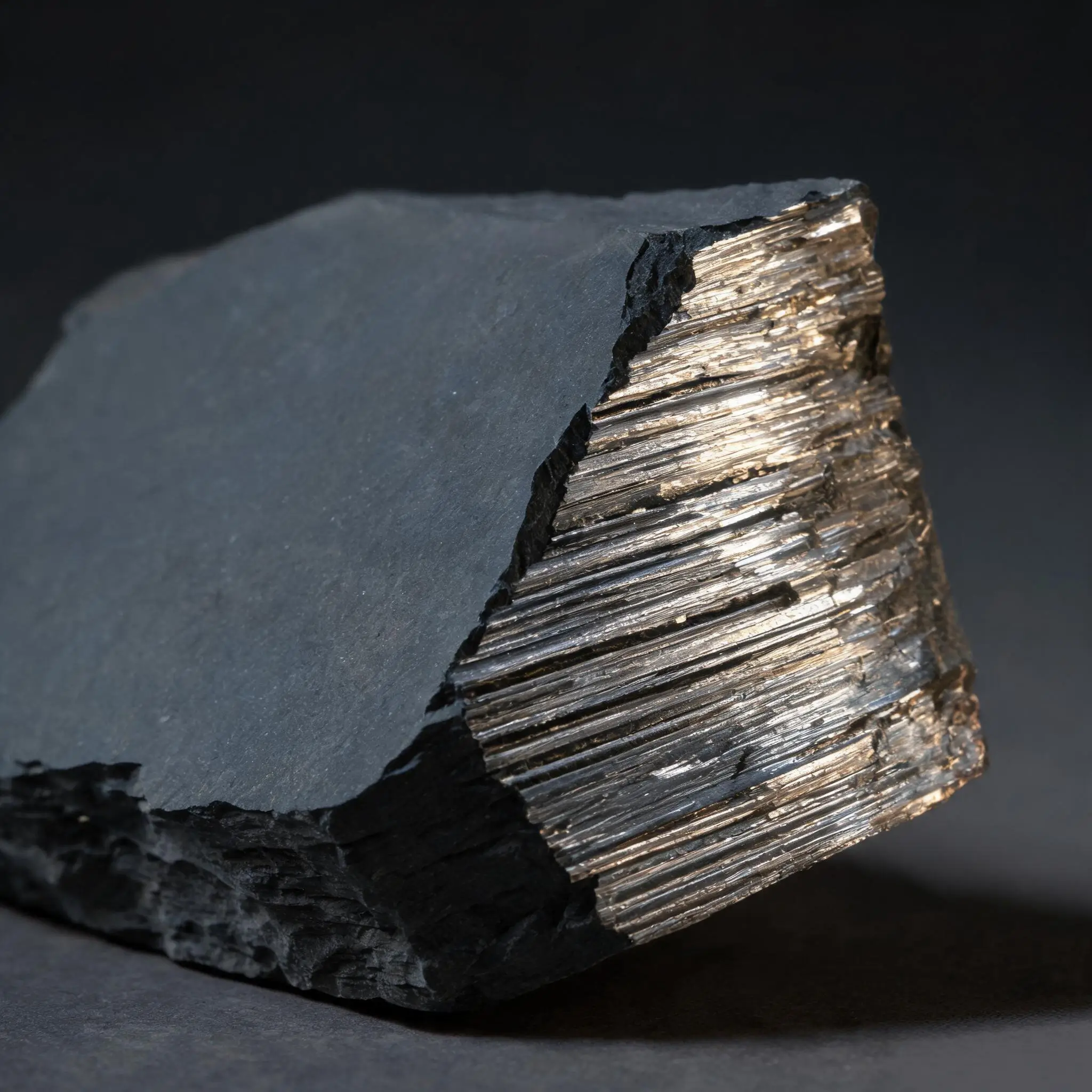
Quartz is the skeleton. Hard, angular, chemically inert. The quartz grains form a rigid frame that resists compression, scratching and surface erosion. When rain carries wind-blown grit across a roof for decades, the quartz grains in the slate are what stand up to it. The mica between them slowly polishes; the quartz doesn't. That's why an old slate roof develops a subtle sheen — the soft minerals wear back, the hard ones stay proud.
Muscovite is the cleavage system. The platy mica grains are aligned in parallel by metamorphic pressure. The rock splits along the boundaries between mica sheets — that's what gives you a flat tile instead of a jagged fragment. The same alignment is what makes the stone anisotropic: strong across the grain, weaker along it. A roofing tile resists the load of snow pressing down on its face, but a slater can split it by tapping a chisel along the edge. Both behaviours trace back to the mica.
Chlorite is the buffer. Sitting between the mica and quartz, the chlorite grains have a lower hardness (Mohs 2–3) and a slightly plastic character under stress. That means when the stone is under load — a heavy snow pack, a footstep, a billiard ball landing hard — the chlorite deforms slightly before the stone fails. It's the difference between a stone that cracks suddenly and one that gives you a warning. In practical terms, chlorite makes the stone more forgiving under the chisel and under the machine. A pure muscovite–quartz rock without chlorite would be more brittle.
Calcite is the weakness. At 0.56% CaO, there's very little of it — and that's the point. Calcite is the mineral that acid rain dissolves. It's also the mineral that thermal cycling can loosen, because calcite has a different thermal expansion coefficient from the surrounding mica and quartz. In a stone with 3–5% CaO, decades of acid rain and temperature cycling gradually open the carbonate-bearing veins, creating entry points for water. In a stone with 0.56%, that process barely starts.
Pyrite is the fingerprint. It does no structural work — it's present in trace amounts. But it's the mineral that connects this stone to its history. The gold-star inkstone — jinxing yan — has been made from the same rock for a thousand years. The "gold stars" are pyrite crystals. When a buyer asks me whether the golden flecks on a split face are a defect, I tell them: in this region, they're a signature. On a roof, many European buyers actively want them — character, like knots in good timber. Under a billiard cloth, a pyrite cluster would telegraph as a bump, so table beds are cut from pyrite-free blocks. Neither verdict is wrong; it's the same mineral meeting two different job descriptions.
Step 4: What the Mineral Recipe Decides for Each Use
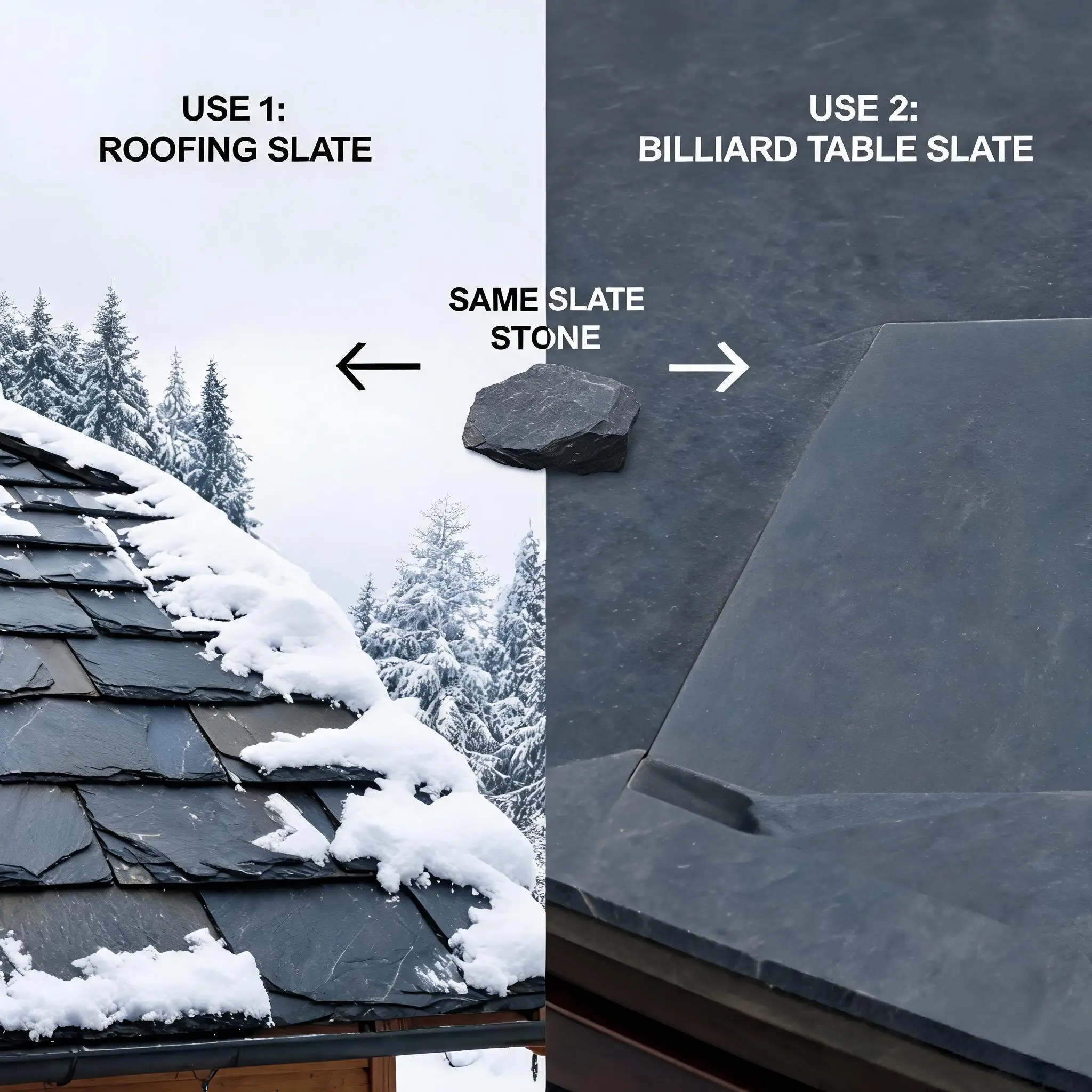
Here's where the mineral composition stops being geology and starts being a purchasing decision. The same mineral recipe makes this stone suitable for two very different products — roofing tiles and billiard table beds — but for different reasons.
For Roofing Slate
A roof tile needs four things from its mineral recipe: it must split thin and flat (muscovite), resist decades of surface wear (quartz), survive freeze–thaw cycling without taking in water (tight interlock + low carbonate), and not dissolve in acid rain (low CaO). Jiujiang slate's recipe hits all four. The muscovite gives you clean splitting down to 4 mm. The quartz gives you Mohs 3–4 surface hardness. The tight interlocked skeleton keeps porosity low — water absorption tested at 0.1–0.2% across three independent labs. And the CaO at 0.56% means acid rain has almost nothing to react with.
When a Norwegian buyer asks me why our slate lasts in their climate, I can point at the chemistry: the freeze–thaw survival comes from the density (which comes from the interlock, which comes from the mineral proportions), and the acid rain resistance comes from the near-absence of carbonate. Both trace back to the recipe.
For Billiard Slate
A billiard table bed needs different things from the same recipe: dimensional stability (so the ball rolls true), consistent density (so the CNC machine cuts evenly), and a tight enough grain that the surface can be ground to ±0.1 mm flatness. The mineral recipe delivers all three, but through a different chain of reasoning.
The quartz skeleton gives the stone rigidity — it doesn't creep or deform under its own weight, which is why a 2.4-metre bed panel can span the table without sagging. The muscovite alignment gives a consistent cleavage plane, which means the block can be split to a rough slab and then machined to precision without the stone fighting the tool. And the low loss-on-ignition (2.20%) means the mineral structure is fully recrystallised — there are no half-converted pockets that would machine differently from the surrounding stone. Consistent mineralogy = consistent machining = consistent flatness.
The Decision Tree
If I had to boil the mineral composition down to a simple rule for buyers, it would be this: the combination of high SiO₂ (quartz skeleton for hardness and wear resistance) and low CaO (near-absence of soluble carbonate for weathering resistance) is what makes the stone suitable for both demanding uses. A slate with high SiO₂ but high CaO might work for paving but would weather badly on a roof in polluted air. A slate with low CaO but low SiO₂ might resist acid rain but wouldn't hold a machined edge on a billiard bed. You need both — and that's a mineralogical constraint, not a marketing preference.
Step 5: The Carbonate Question — Why 0.56% Is Not Just a Number
Buyers from cold-climate markets — Norway, Sweden, the UK, the Baltic states — tend to focus on water absorption and freeze–thaw. Buyers from polluted-city markets — and anyone supplying heritage buildings in industrial regions — focus on something else: carbonate content. Let me explain why, and what the mineral composition tells you about it.
The decay mechanism is straightforward. Rain in industrial areas absorbs sulphur dioxide and nitrogen oxides, forming weak acid. When that acid meets a carbonate-bearing stone, it dissolves the carbonate — slowly, imperceptibly, but relentlessly. The dissolved mineral is replaced by gypsum, which expands as it crystallises. The expansion pries open the surface grain by grain. Over decades, the stone develops a sugary, eroded surface that eventually spalls off.
This is why the carbonate content test is a standard part of EN 12326 and ASTM C406. EN 12326-1 sets carbonate content limits; ASTM C406 requires an acid immersion test. Both are checking the same thing: how much of the stone is soluble in acid?
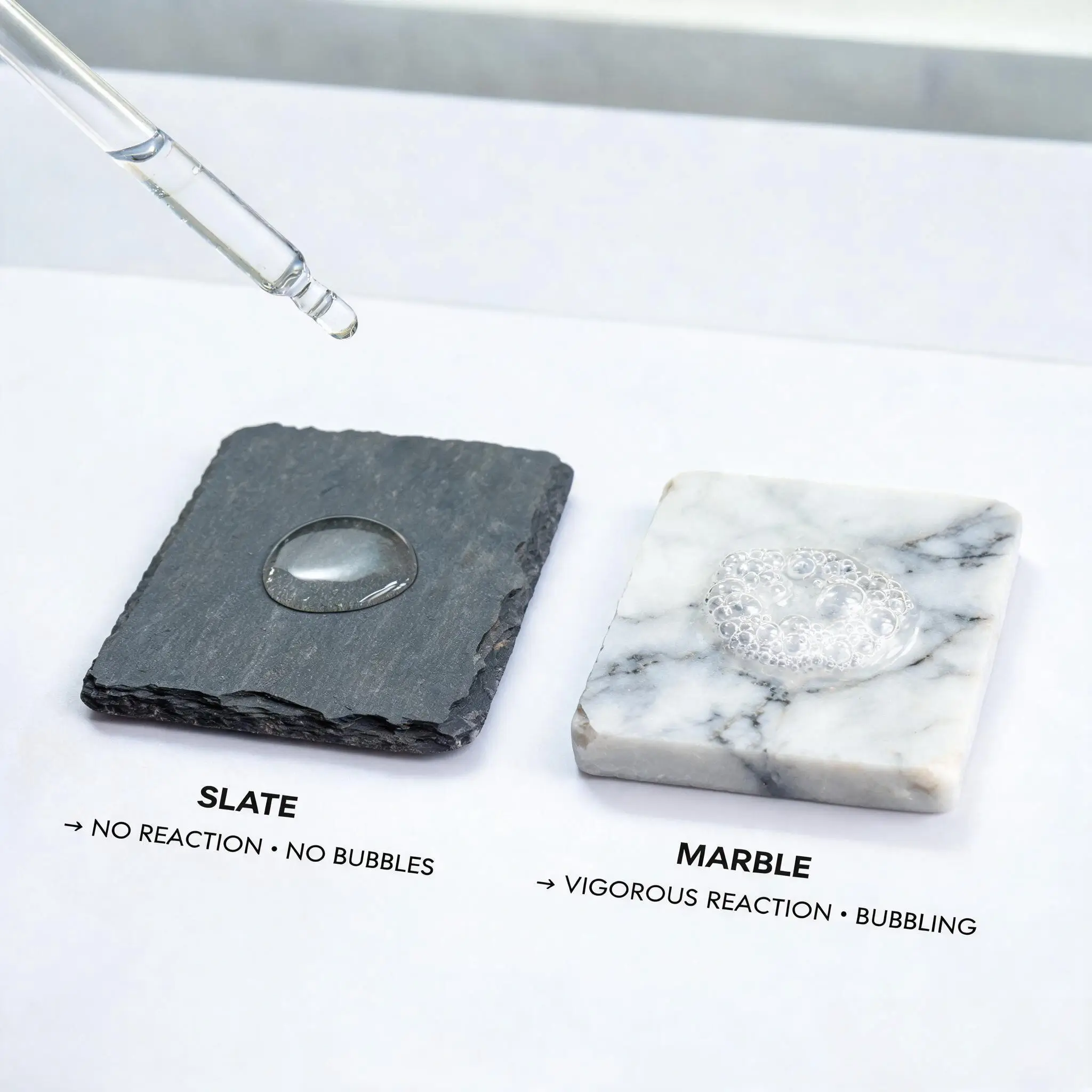
At 0.56% CaO, the answer is: almost none. I've watched the acid test done on our stone in the lab — a drop of dilute hydrochloric acid on a fresh cleavage face produces no visible reaction. Compare that with a piece of marble, which fizzes immediately. The mineral composition of Jiujiang slate means the acid rain decay pathway is effectively closed. Not because the stone is special in some magical way — but because the recipe simply doesn't include the ingredient that acid attacks.
This is also why I'm cautious about drawing a direct causal link between low carbonate and long roof life. The low carbonate is one factor in a system: the tight mineral interlock keeps water out (so acid has less contact time), the low porosity means few pathways for acid to penetrate, and the low carbonate means little for the acid to dissolve even if it gets in. It's a system of mutually reinforcing properties, all rooted in the same mineral recipe. Pull one thread and you'd unravel the whole chain — but you don't need to, because the recipe is stable across the formation.
Step 6: Does the Recipe Hold Across Quarries?
A fair question: the numbers I've quoted come from analyses done in 2000 and 2008, on samples from a specific location. Does the same mineral composition hold across the whole Lushan–Xingzi belt?
The short answer is yes, within the narrow variation you'd expect from any natural stone. The geological reason is that the belt works one broad formation — not scattered pockets of different rock types, but a single continuous body of the same metamorphic rock. Quarries tap different parts of the same formation. The mineral proportions shift a little from one end of the belt to the other — SiO₂ might read 66% in one batch and 67% in another; CaO might be 0.5% or 0.6% — but the mineral frame stays the same: muscovite, quartz, chlorite, low carbonate, trace pyrite. The properties page covers how this consistency translates into batch-to-batch specification reliability.
This is the geological advantage of a single broad formation over scattered pockets. If you're buying slate from a region where each quarry works a different rock type — different metamorphic grade, different mineral proportions, different chemistry — then every container is a new gamble. The test report from the last batch doesn't predict the next one. In a single-formation region like this, the recipe is stable. The lab report from 2000 is still a reasonable guide to what comes out of the ground today, because the formation hasn't changed in 400 million years.
That said, I always recommend asking for a current test report with a batch number. Not because the mineral composition is likely to have shifted, but because a supplier who can produce a dated, batched report is a supplier who is actually testing. A supplier who hands you a photocopied report from fifteen years ago with no batch number is telling you something — just not what you want to hear.
Frequently Asked Questions
What minerals are in Jiujiang slate?
The dominant minerals are muscovite (sericite), quartz and chlorite, with minor plagioclase feldspar, calcite and trace pyrite. The mineral identification was established by a 2000 analysis at the Ministry of Geology Jiangxi Central Laboratory and independently confirmed in a 2008 paper in the Journal of East China University of Technology. Muscovite gives the stone its cleavage, quartz gives it hardness, and chlorite provides a buffer that makes the stone forgiving under the chisel.
What is the SiO₂ content of Jiujiang slate and why does it matter?
SiO₂ is 66.46%, which is high for a roofing slate. Silica tracks the quartz content, and quartz at Mohs 7 is the hardest mineral in the stone. The high silica content sets the upper limit of the stone's surface hardness (Mohs 3–4 overall) and its resistance to decades of abrasive wear from wind-blown grit and rain. A slate with lower SiO₂ simply doesn't have enough quartz grains in the matrix to achieve the same wear resistance.
Why is the CaO (calcium oxide) content of slate important for weathering?
CaO at 0.56% indicates a very low carbonate content. Carbonate minerals (calcite) are the components that acid rain dissolves — the classic decay pathway for building stone in polluted air runs through carbonate, producing gypsum that expands and pries the surface apart. At 0.56% CaO, there is almost no carbonate for acid to attack, so the decay pathway is effectively closed. For comparison, marble typically runs CaO above 40% and limestone above 50%.
Are the golden flecks on slate surfaces a defect?
No. The golden flecks are pyrite crystals — iron sulphide, FeS₂ — and they're a natural feature of this stone. The same flecks appear in the gold-star inkstones (jinxing yan) that have been made from this rock for over a thousand years. On a roof, many European buyers consider them character. Under a billiard cloth, a pyrite cluster would create a surface bump, so billiard bed panels are cut from pyrite-free blocks. It's the same mineral meeting two different quality requirements — neither is a defect in context.
How does mineral composition affect both roofing and billiard slate?
The same mineral recipe suits both uses, but through different causal chains. For roofing: muscovite enables thin splitting, quartz resists surface wear, low carbonate resists acid rain, and the tight interlock keeps water out. For billiard: quartz provides dimensional rigidity (no sagging across a 2.4-metre span), consistent mineralogy enables uniform CNC machining to ±0.1 mm flatness, and low loss-on-ignition means the stone is fully recrystallised with no soft spots that would machine unevenly.
Is the mineral composition consistent across different quarries in the region?
Yes, within the narrow variation expected from any natural stone. The Lushan–Xingzi slate belt is a single broad geological formation — quarries tap different parts of the same rock body, not different rock types. SiO₂ might shift between 66% and 67%, CaO between 0.5% and 0.6%, but the mineral frame (muscovite–quartz–chlorite, low carbonate, trace pyrite) is stable. This is the geological advantage of a single formation: the lab report from one batch is a reasonable predictor of the next. Always ask for a current batch-numbered report, though — a supplier who tests regularly is one who takes quality seriously.
Related Reading
Want the full chemical report for your batch?
Every container we ship comes with a batch-numbered test report. If you need the mineral composition, the water absorption, the flexural strength — or just a straight answer about whether this stone suits your climate — ask us directly. We answer within one working day.