
Jiujiang Slate Paving & Flooring
On a roof, slate gets to shed water within seconds of receiving it. Underfoot, the same stone holds that water — it sits on the surface, soaks into whatever the surface is wearing, freezes overnight, and gets walked on in the morning. That single difference in exposure is why ground-level slate is specified at all: outdoor paving, garden paths, courtyards, entrance areas and indoor floors ask more of a stone, in more directions at once, than a roof tile ever will. I work with Jiujiang-area slate on the exporter's side of the table, helping importers, landscape contractors and architects turn project drawings into orders that match what the belt can actually produce; the pages of this guide follow the slate out of the hills south of the Yangtze, and this page follows it onto the ground.
What follows gathers the ground-level side of the trade: Jiujiang slate paving and flooring — the formats worth discussing with a supplier, the two finish families the region produces, wet-weather grip, winter, and how an order is actually written so that what arrives matches what was specified. The reading order is deliberate. A paved surface is a build-up, and it is best read the way an installer reads a cross-section: from the ground up. The climate sits at the bottom, the base and bedding above it, then the slab itself, then the walking surface — and only at the top does colour arrive. Buyers who read a pavement from the top down tend to choose a colour first and discover the engineering afterwards. Buyers who read it from the bottom up spend their money once.
One honesty rule before anything else, carried over from every page in this guide: Jiujiang slate names a producing belt, not a product grade. Quarries in the belt differ; grades differ; finishes differ. A paving order is specified by grade, finish, thickness and installation system — never by origin alone. The extraction and block selection that decide what a piece of stone becomes are described on how Jiujiang slate is quarried.
The page in one cross-section:
| Layer | What lives there | What you decide |
|---|---|---|
| The ground beneath | Climate, drainage, de-icing salts, freeze cycles | Which test evidence you demand from a supplier |
| The build-up on site | Base, bedding, joints, falls — the layer no factory can supply | Whether good stone survives its installation |
| The slab itself | Format, thickness, calibration, tolerances | What leaves the factory, and how it meets the layer above |
| The walking surface | Cleft, calibrated or sawn finish; joints; cleaning | Underfoot feel, wet grip, and the maintenance you have signed up for |
The colours and the years after the first season sit above all four layers and are covered further down the page, after the engineering has had its say.
One Material, Two Lanes
The slate that ends up on the ground in this trade comes out of the same hillside material as the region's roofing tiles and table beds — one deposit, several destinations. What changes at ground level is not the rock but the processing route, and the belt runs two of them side by side, which is why slate paving arrives in two distinct surface families. The splitting lane works with cleavage: blocks opened along the grain by hand and blade, producing the natural cleft face familiar from roofing — organic, uneven, alive under a hand. The machining lane saws, grinds and dimensions instead, producing calibrated and honed faces of controlled thickness — the flatness route that table beds ride on. The two routes are walked through in person on the quarries-and-processing page of this guide; for a paving buyer the practical meaning is simpler: every surface you will be offered belongs to one of those two families, and each family behaves differently underfoot and in wet weather.
Because origin decides nothing on its own, a ground-level order is really a set of judgements about five things. Density and water absorption — indicators of how much moisture the stone will take on, and therefore of the outdoor story, though figures mean little until they are matched to the actual grade being offered (freeze–thaw evidence is covered in its own section below). Surface texture, which is simultaneously an aesthetic and a safety decision. Thickness and dimensional tolerance, which determine installation depth, finished levels and how pieces meet adjoining surfaces. Flexural strength, which matters wherever a slab does not sit on full support — on sand bedding over a soft spot, on a bridge over services, on pedestals. And weathering behaviour in the actual climate the stone will live in. A supplier who can address these five in writing is specifying a product; one who answers all five with the single word "quality" has not answered any of them — treat it as a request for detail, not as a specification.
The best ground-level specification I have seen written was boring to read and calm to install: application first, installation method second, loads third, climate fourth — and colour last, chosen from real samples in real light. The pages below follow exactly that order.
Where the Ground Allows It
Patios and terraces are where slate paving is at its most domestic and most forgiving: moderate foot traffic, furniture that stays put, and an audience that sees the surface every day. Dark grey and blue-black tones sit quietly against timber, gravel and planting, which is why designers keep reaching for them. The engineering of a good terrace is modest — falls that shed water, a bedding the slabs actually rest on, and a finish chosen for bare feet after rain rather than for the photograph.
Garden paths and walkways split into two species with different rules. Stepping stones are individuals: large single pieces set into gravel or planting gaps, judged one stone at a time — does each sit stable, does each carry a foot without rocking. Continuous paths are a system, and there the stone has to cooperate with itself: reasonably consistent dimensions, controlled joints, finished levels that drain along the run rather than pooling in it. In shaded stretches the finish and the maintenance plan matter more than anywhere else, because shade plus moisture is where organic growth starts — that is a management problem, not a stone problem, but the specification should acknowledge it.
Courtyards and entrance areas combine two demands that roofing never has to face at once: a space that is seen at close quarters every day, and shoes that arrive wet. Slate courtyard paving works well there on both counts, provided wet-weather grip and drainage are assessed under the expected conditions — at the threshold, in the rain, in January — and not in a showroom. Indoors, the same material continues as slate flooring in entrance halls, utility rooms, kitchens and conservatories; outdoor slate flooring has to shrug off weather, indoor flooring has to shrug off cleaning, and the two put different pressure on the finish. Indoors, flatness, thickness consistency and ease of cleaning rise to the top of the list, and textured surfaces trade natural looks against cleaning effort — worth deciding before the order, not after the first mop.
Commercial landscaping and public realm projects can use the same stone, at a different level of paperwork: mechanical performance, installation details, accessibility and the local standards that apply, all specified up front. Two honest cautions from the trade, both learned the slow way. A slab that is sound on a residential patio is not automatically sound where a delivery van mounts the kerb; vehicle areas and driveways need a proper engineering assessment, not a thicker guess. And heavily trafficked public space is a different specification exercise from private gardens, not a scaled-up version of it. The formats that leave this belt are usefully browsable on the paving slate category page, where natural slate paving slabs for gardens sit alongside the formats landscape contractors order in quantity.
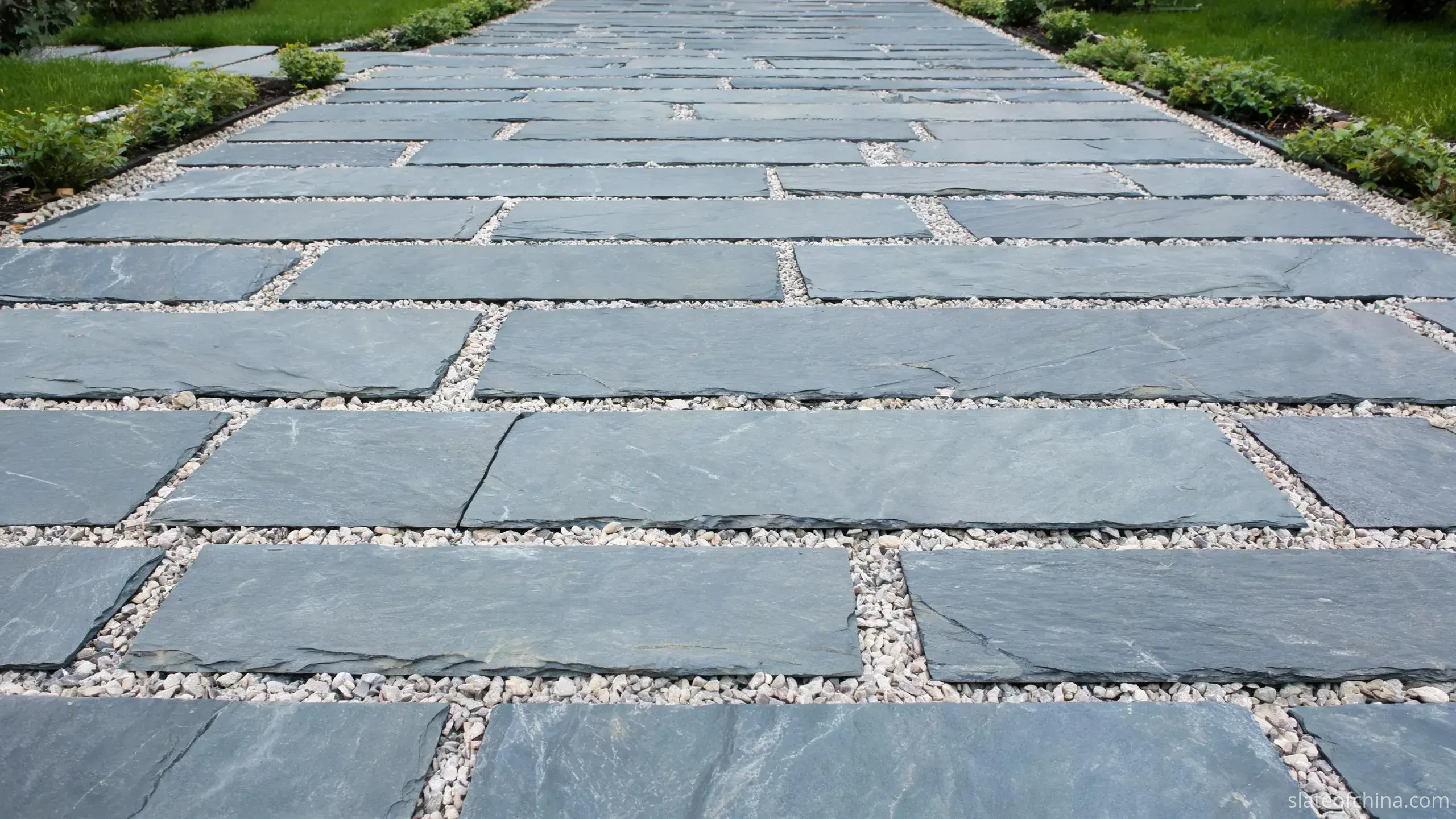
Sizes, Thicknesses, and the Loads They Carry
No single format suits every ground-level project, and the useful question is never "what sizes do you have" but "which formats does my installation system support". The families worth discussing with a supplier, and what each of them is really deciding:
| Format | Typical use | What it is really deciding |
|---|---|---|
| Square slabs | Patios, courtyards, modular layouts | Consistent dimensions and joint spacing |
| Rectangular slabs | Walkways, terraces, contemporary design | Orientation, layout rhythm, cutting waste |
| Large-format | Spacious patios, architectural landscaping | Handling weight, support accuracy, tolerance |
| Stepping stones | Garden paths, informal settings | Individual stability, the ground around each stone |
| Cut-to-size tiles | Indoor floors, coordinated projects | Thickness, flatness, substrate tolerance |
| Mixed-size sets | Traditional paving patterns | A clear laying pattern, and quantity planning against it |
Whatever a catalogue implies, dimensions and thicknesses should be confirmed for the specific quarry and grade under discussion — this belt, like any other, does not issue formats from a single master list.
Whatever the logic table says, buyers ultimately ask for a list of concrete formats. A few examples of ground-level formats this belt produces for paving and landscaping work — offered as examples of what is commonly produced, not as a standing stock list, and confirmed per order:
| Format seen in this belt | Example dimensions | Finishes seen |
|---|---|---|
| Large-format grey panels | 1200 × 600 mm | Honed, natural cleft |
| Natural-edge rectangular flags | 600 × 300 × 50–60 mm | Natural cleft |
| Oversize natural-edge flags | 2200 × 700 mm | Natural cleft |
| Irregular / broken-flag sets | Random edges, sorted per lot | Natural cleft |
| Cut-to-size flooring tiles | Cut to project drawing | Calibrated, honed, brushed |
Available sizes, thicknesses and finishes depend on the selected material grade and the order's requirements — confirm tolerances, finish availability and installation suitability before ordering.
Looking for natural slate paving slabs from China? Tell the desk the dimensions, thickness, surface finish and project quantity, and it will match them to the actual grades available and come back with sample requirements and export packing for your market — request a paving slate quotation or view the paving slate range.
Thickness is where most ground-level orders go wrong, because thickness is not a number — it is an answer to a span question. A slab on a properly prepared, fully supporting base carries mostly compression, and generous thickness there is comfort rather than necessity. The moment support is partial, the conversation changes: on sand over a soft spot, bridging a service run, or laid on pedestals in a raised system, the stone is working in bending, and flexural strength and the unsupported span become the governing facts. A thickness that is comfortable on a full mortar bed can be entirely wrong on air. And a thicker slab is not automatically better in every situation — the correct specification balances performance, dimensions, handling weight and cost; pavers have hurt their backs learning this, and buyers have hurt their budgets.
Calibration earns its place in the same conversation. Calibrated slate paving arrives with thickness brought under control on the back face, which turns installation from an improvisation into a plan: predictable bedding depth, slabs that meet adjoining surfaces without steps, and levels set from a datum instead of negotiated slab by slab. What calibration does not do is make every piece identical in length, width, flatness or surface character — those remain separate tolerances, and they should be confirmed for the actual product, in writing, as part of the order. Indoors the same logic runs one grade lighter: thinner tiles work over a suitable stable substrate, and the installer's adhesive system, level transitions and tile dimensions, not the stone's ambitions, decide what is safe.
For driveway and vehicle areas I will repeat the trade's honest default: pedestrian specifications do not travel there on their own, and nothing in this page should be read as license to try.
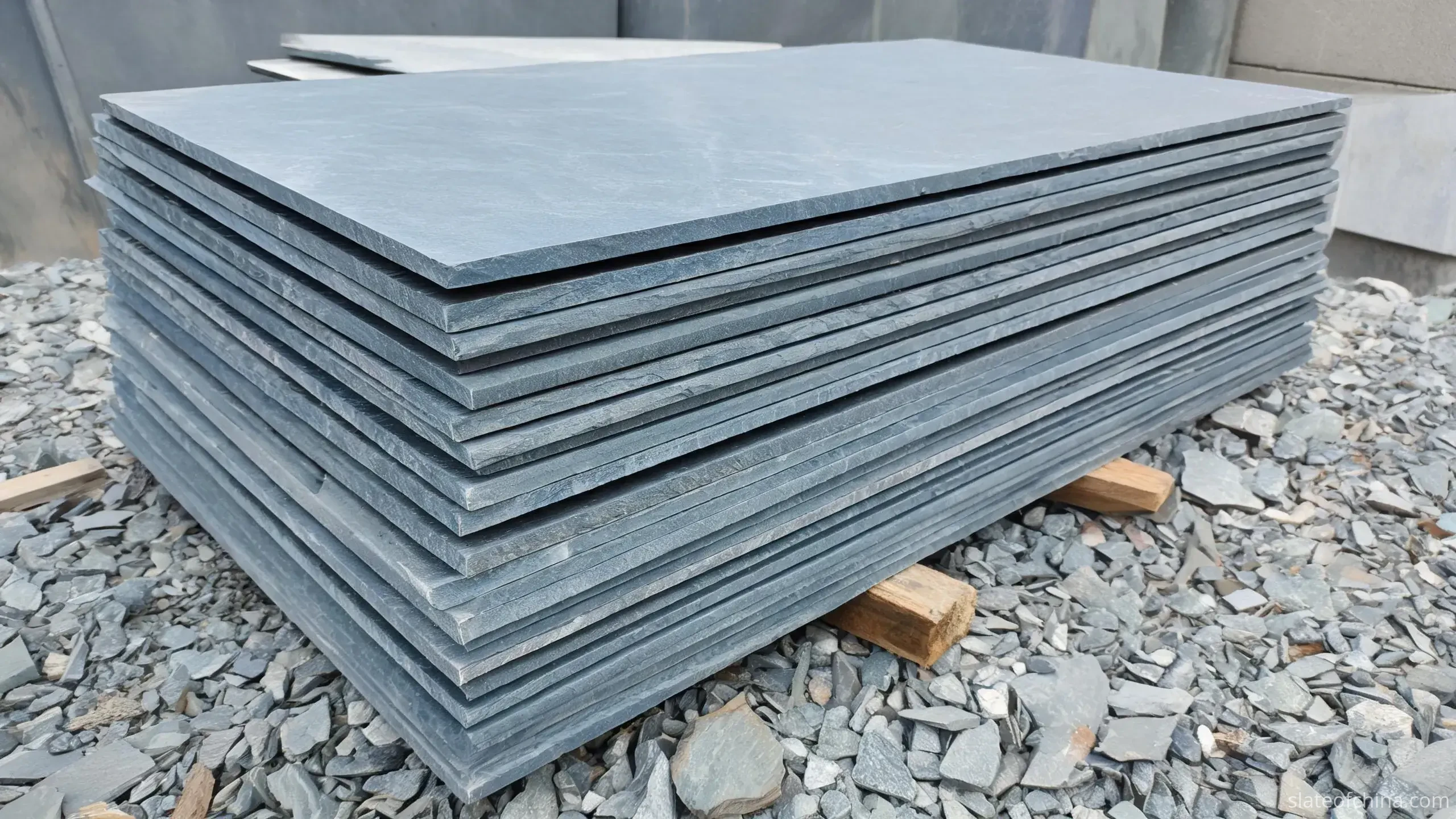
The Walking Surface: Cleft, Calibrated, Sawn
Natural cleft is the face the splitting lane leaves behind, and it is the one stone people reach out and touch in a showroom. Underfoot it gives what designers describe as informal: a visibly layered surface with quiet, shallow relief, no two pieces alike, colour moving across a patio rather than sitting still on it. In a garden that character is usually the point of buying slate at all. The honest limits are equally plain. A cleft face can vary in height from piece to piece and across a single piece, which tables and wheeled equipment notice, and which anyone who wants a dead-level walking surface will feel immediately. And a naturally textured surface is not, by itself, a slip rating — that claim is examined in the next section, because it is the most oversold sentence in this trade.
A sawn or honed face comes from the machining lane: cleaner, more architectural, calmer against modern materials, and easier to clean than a cleft face — which is why interiors that will actually be mopped lean toward it. The same caution applies in mirror image: a smoother-looking finish must not be assumed to provide adequate grip once wet, wherever water is part of the duty. If a project carries a slip-resistance requirement, the request is for test results on the finished product, in the finish being ordered — a certificate for a different finish, a different stone, or a different product is a document about something else.
Choosing between the families is therefore not a taste question with a safety appendix; taste and duty decide it together. A rustic garden terrace leans cleft, and earns wet-weather grip from texture, drainage and maintenance. A formal courtyard or an indoor floor leans calibrated or honed, and pays for the calm with a stricter cleaning and access specification. A shaded, damp walkway is the hardest brief in the list — the finish there is a wet-weather decision first and an appearance decision second. Seeing candidates under both dry and wet conditions before approval is the cheapest insurance in this trade; the approval itself, and how to run it, live on the samples-and-approval page.
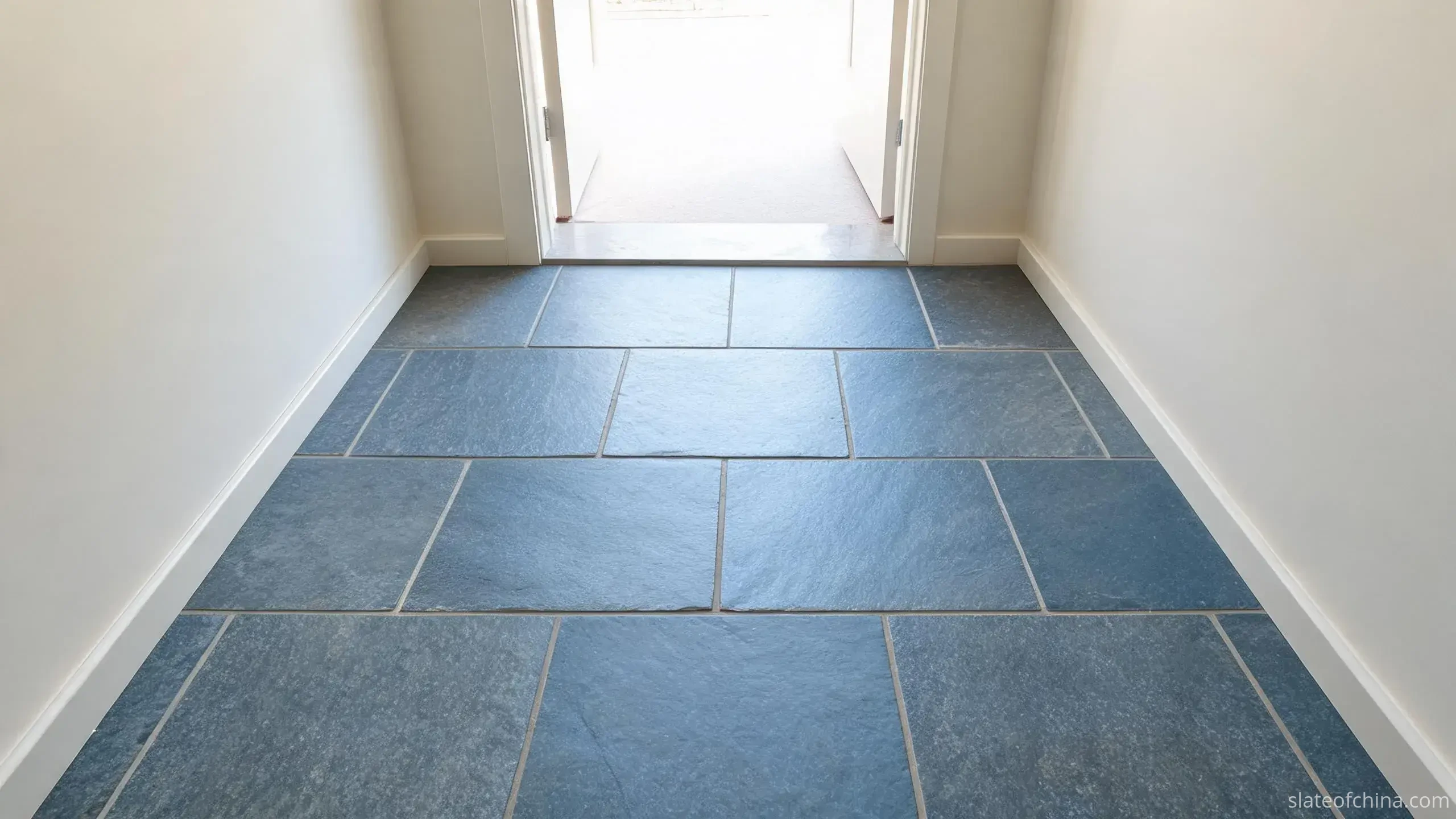
Wet Feet: Slip Resistance Without Superstition
Every so often a quotation crosses my desk offering "high anti-slip performance" for a paving stone, which is a sentence shaped like information and containing none. Grip is not a property a stone possesses; it is a result the whole surface produces on a given day, and at least five things go into it. The finish itself, which sets the base texture. What is on the finish — rain, algae in shade, mud carried in, oil, cleaning residues — because a contaminated surface behaves like the contaminant, not the stone. The geometry: water left standing on a flat in a dip will lubricate it, which is why falls and drainage are part of the slip specification, not separate from it. Wear and maintenance, since surfaces and their cleanliness change over the first winters. And finally the use itself: a private garden path in socks-and-sandals mode is a gentler duty than a public entrance in work boots on a January morning.
For slate paving slip resistance, the professional route is to specify a method, not an adjective. Identify the applicable local standard and the intended test conditions before selecting the stone; in UK and European projects that will usually mean wet pendulum testing or a defined slip-resistance classification for the relevant setting. Write the actual test method into the specification — "wet pendulum, minimum classification X, tested on the ordered finish" settles the question; "high anti-slip performance" merely decorates it. A supplier should be able to say whether testing has been carried out on the relevant finish, and on the relevant stone; the standing list of what to ask a supplier in this domain is on the testing-requests page. For public, commercial or accessibility-sensitive projects the required criteria are confirmed by the architect or project engineer — not negotiated between buyer and seller over email.
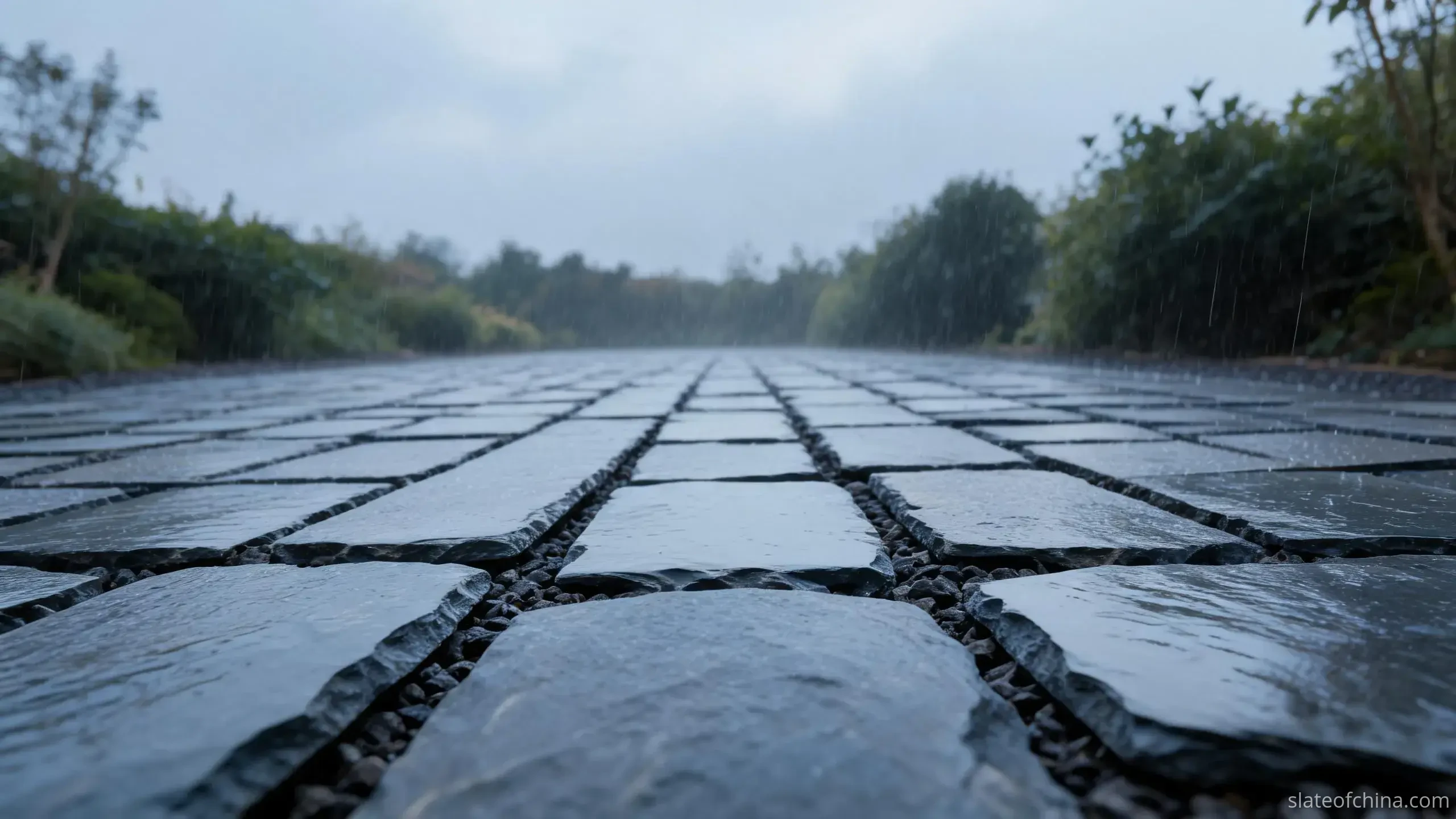
Winter Is a System Test
Freeze–thaw is the one chapter where ground-level slate has to prove itself in a laboratory, because the physics is unforgiving. Water that has entered accessible pores, micro-cracks and openings expands when it freezes; repeated wet–frozen–thawed cycles work the same opening until susceptible material scales, flakes or delaminates. The risk depends on the stone's properties — absorption, pore structure, any weak partings — and equally on the installation, because stone that stays wet freezes more often than stone that drains. Standing water on or beneath the paving multiplies the number of effective freeze–thaw cycles the surface has to survive, which is why drainage belongs in the specification rather than in the wish list.
Low water absorption is the honest headline indicator, and this belt's slate has published test data behind it — figures for absorption, flexural strength and freeze–thaw behaviour sit on the test results page, with the methods and reading explained on how to read a slate test report. What a headline figure never does is exempt a specific product. When you are offered a number, confirm it belongs to the actual grade and finish being quoted, that the test method is known, and that a report stands behind it. Chemical analysis or density on their own prove freeze–thaw durability about as well as a shoe size proves marathon ability.
So for freeze-thaw resistant slate in a cold-market project, the request list is short and non-negotiable: water absorption results; density data; flexural strength appropriate to the installation method; freeze–thaw results under the applicable standard — in European work EN 12371 is the relevant reference for frost resistance determination, and other markets run their own protocols, so name the market's method rather than assuming equivalence — and evidence that the tested material represents the quarry, grade and finish actually being ordered. The material-level story of why absorption drives longevity is told properly on the water absorption page, and the belt's own tested behaviour on the freeze–thaw page.
The half of winter that stone gets blamed for is usually installation. Water trapped beneath slabs, beds that hold moisture, falls that were never going to reach a drain — a well-chosen slate can be ruined by any of them, and outdoor slate paving in freezing climates is a system decision as much as a material one. The system requirements are stable ground, real drainage, bedding and jointing suited to the climate, and no unsupported span quietly bending in frost. In severe winter markets, coastal exposure to de-icing salt, or high-value commercial work, assess the paving system as a system, not the stone as a talisman.
The Stone Beside It
Slate is one voice in a choir, and a buyer usually hears the choir first. These are the general distinctions as I would write them for a client — material families, not a ranking, because grades inside each family outperform each other constantly:
| Material | What it tends to offer | What you then have to check |
|---|---|---|
| Natural slate | Layered look, natural colour movement, cut formats from small to large | Layer integrity, finish, thickness, weathering record |
| Granite | The default for demanding paving duty | Finish texture, traction, weight, cost |
| Sandstone | Broad colour range, traditional landscape appeal | Porosity, absorption, behaviour in your climate |
| Limestone | Contemporary, architectural surfaces | Chemical sensitivity, finish, freeze–thaw requirements |
| Porcelain | Manufactured dimensions, controlled designs | Slip data, installation system, whether it reads as stone at all |
When two quotations arrive, compare the specified product, the test evidence, the dimensions, the finish, the packing and the delivery terms. Comparing only the price per square metre is how buyers discover the difference between a price and a cost.
Colour and natural variation deserve their own paragraph, because they are the part of the order no document fully controls. Slate from this belt moves through a genuine range of grey and blue-grey tones, and pieces differ within a range even from one quarry — which is part of the material's character and the part most likely to be misread as a defect. For projects needing a controlled appearance, the specification states the preferred colour range, the acceptable degree of variation, whether mineral markings are acceptable, and whether approval samples or production photographs are required. A small sample never represents the full range of a bulk shipment; for a large terrace, a commercial phase or a multi-phase programme, approve a representative sample set or a defined visual range before production, and where the paving meets another stone, brick or render, compare them together in the intended lighting — two materials that look well matched under warm indoor light can clash in daylight, so the comparison happens outdoors, in the light the finished work will actually live in.
Laid Well, Kept Simply
A paved surface lives or dies at installation, and most of the sentence is written before the first slab is set. On delivery, check the material against the approved specification — dimensions, thickness, finish, colour range, condition of the slabs — because discovering a substitution after the pallets are opened turns a specification into an argument. The installer confirms that the substrate and bedding suit the intended loads and the ground as actually found, which is where that conversation about support and spans stops being theoretical.
During laying, the paving system's own rules govern: support and bedding as designed, joint widths as drawn, falls as calculated. Irregular pieces should not be forced into positions that create point support or local stress — stone will accept the position and bill you later. On natural cleft work, the installer is managing surface height variation while setting finished levels, which is a skill, and the good ones plan it out loud before starting.
Aftercare is genuinely simple, which is the quiet argument for slate over fussier surfaces. Routine maintenance is removing loose dirt and cleaning with a method that suits the stone and the jointing; not every household cleaner is appropriate for slate, and acidic products deserve suspicion — test any cleaner or sealer on an inconspicuous piece first, always. In damp, shaded ground, the recurring jobs are removing organic growth and correcting whatever drainage is feeding it; that is a site habit, not a material flaw.
Sealing, finally, is a decision, not a default. It is not automatically necessary for every slate or every installation; it depends on the stone, the look wanted, exposure and the maintenance plan. If a sealer is on the table, confirm it suits the actual slate, and that it will not change colour or surface feel unacceptably — a sealer that makes a wet patio shinier has spent money making the surface less safe, which is the opposite of what sealing is for.
Bringing the Specification Across the Sea
For wholesalers, distributors, landscape contractors and project buyers, the order is where everything above either holds together or quietly unravels. The information that gets an accurate paving quotation is unglamorous and short:
- Required dimensions and format, or the laying pattern to be quoted against.
- Required thickness, and the tolerances you will actually accept.
- Total area in square metres, by phase if the project phases.
- Intended application — patio, walkway, indoor floor, other — and the installation method if already chosen.
- Preferred colour range and surface finish.
- Destination country and, where it matters, project location and climate.
- Any required test evidence, standards or documentation, named by method.
Details like these let a supplier recommend a realistic specification instead of quoting something unsuitable on dimensions alone — the difference between a quotation that wins an argument and one that merely wins an enquiry. Drawings, reference photographs and a sample requirement all sharpen the first round.
Quality is then a matter of what was agreed before production, in four groups, and a slate paving supplier shipping from China should be able to put all four in writing before production begins. Specification: source and grade confirmed, dimensions, thickness and tolerances in writing, the finish named, the colour and variation range defined. Performance: the relevant absorption, density, flexural and freeze–thaw evidence requested by method; slip-resistance test method specified where a rating is required. Quality control: representative samples approved before bulk production; inspection procedures and acceptable defects agreed; how dimensions and thickness will be measured; and what happens to material that does not meet the agreed specification — a question far better asked in week one than week nine. Packing: quantity per pallet or crate, gross weights, protection against edge damage and movement, crate dimensions and container loading arrangements, with loading photographs and shipping documents requested as appropriate. The packing and container standards themselves are documented on the packing-and-shipping page; the wider pre-order question set lives on the questions-to-ask page; and for wholesale slate paving orders moving through the export chain, the supply chain page maps who does what between the quarry gate and your port.
One closing habit worth borrowing from the best buyers I have worked with: if you intend to reorder the same material for future phases, say so in the first order. A specification held constant across repeat orders is the difference between a matching second phase and a second phase that almost matches — and it is much easier to promise a supplier you have already briefed honestly than one you are negotiating with from scratch.
Frequently Asked Questions
Is Jiujiang slate suitable for outdoor paving?
It can be, when the actual grade, finish, thickness and installation system meet the project's conditions — the same honesty this guide applies everywhere: the name describes a producing belt, not a product grade. Suitability is assessed for the material being offered, with the relevant absorption, flexural and freeze–thaw evidence, and it is never assumed from origin or from another product's report.
Is natural slate paving slippery when wet?
It depends on the finish, what is on the surface, the drainage and the maintenance — rain itself is the easy case; algae, mud and cleaning residues are the harder ones. A naturally textured surface is not automatically compliant with any slip standard. Where the project carries a requirement, specify the test method (for UK and European projects typically wet pendulum testing) and request results for the finished product in the finish being ordered.
Can slate paving withstand freezing winters?
Suitable slate products perform in freezing climates, but performance is verified for the actual material, not inherited from the belt name. Ask for freeze–thaw results under the applicable standard for your market, confirm the tested material represents the grade and finish you are ordering, and remember that the system carries half the duty — drainage, bedding and the absence of trapped water decide most winter outcomes.
What thickness is best for a slate patio?
There is no universal number, because thickness answers a span question: it depends on the slab dimensions, the stone's flexural strength, the bedding support, the expected loads and local practice. A slab fully supported on a prepared base is a different engineering case from one bridging voids or set on pedestals. Confirm the specification between supplier and installer before ordering, not after the pallets arrive.
Calibrated or natural cleft — which is better?
Neither, universally. Calibration brings thickness under control, which installation planning, finished levels and adjoining surfaces all read from. Natural cleft keeps the surface character that most people are buying slate for. The choice follows the duty: formal courtyards and indoor floors tend toward calibrated or honed finishes, informal gardens lean cleft, and every wet or shaded location decides as a wet-weather question first.
What information gets an accurate paving quotation?
Dimensions or the laying pattern, required thickness and acceptable tolerances, total area by phase, the intended application, the installation method if chosen, colour range and finish, destination country and project climate, and any required test evidence named by method. Drawings, reference photographs and sample requirements all sharpen the first round — and for repeat phases, say so in the first order so the specification is held constant.
Related Reading
Send the specification, not just the square metres.
Ground-level slate rewards buyers who arrive with the cross-section already in their head. Name the project and the climate, the formats and finish under discussion, the installation method, and the test evidence the project requires — and the desk will match them to the actual grades available, quote against what will be installed, and hold the same specification when the second phase follows:
- Outdoor paving and flooring — patio, walkway, courtyard or indoor floor; wet-weather and winter requirements discussed before the order is placed.
- Wholesale and project supply — pallet or crate quantities, packing standards and loading arrangements specified with the stone, not after it.
Every Jiujiang slate paving order starts the same way — formats and finish matched to the actual grades available, confirmed against tolerances and test evidence before production. Browse the paving slate range, or send the specification straight to the desk — whichever arrives first. If your project needs evidence we cannot honestly point to, you will hear which part and why, before you have to find out the slow way.