
Water Absorption: Why It Decides Longevity
Roof lifespan = f(thickness, pitch, installation, exposure, water absorption)
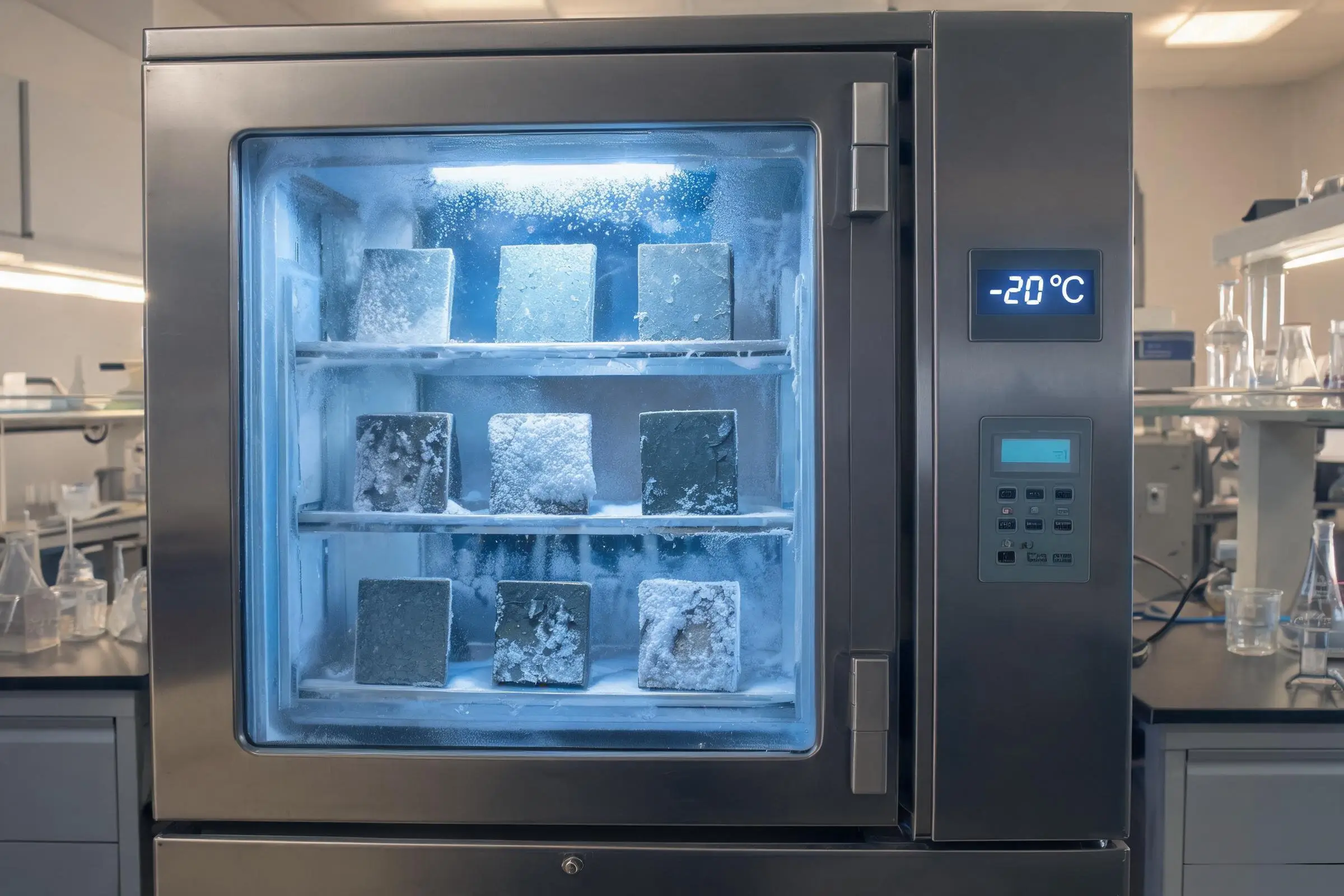
Same street, same builder, same year, same thickness.
Twenty-two years later: one roof is original. The other has been replaced twice.
The only variable that differs: 0.1% vs 0.6% water absorption.
That one number is worth about 70 years of roof life.
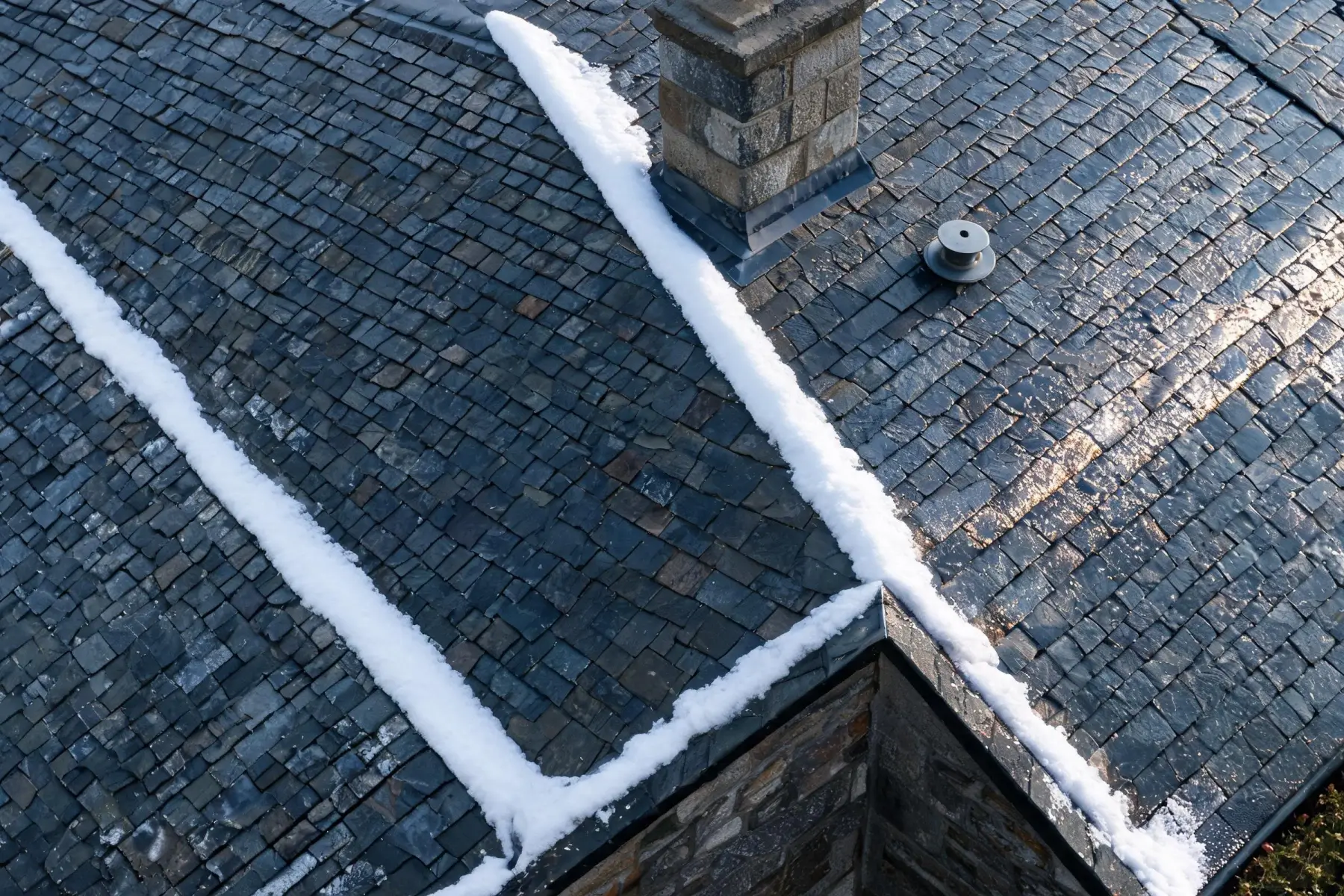
Two houses. Same street in a market town in northern England. Same builder, same year — 2002. Same roof pitch, same 8 mm slate thickness, same underlay, same nails, same battens. Walk past them today and one roof still looks like the day it was laid. The other has been stripped and re-slated twice. The tiles on the replaced roof came from a different quarry — one with water absorption around 0.6%, right at the EN 12326 A1 pass mark. The tiles on the original roof came from a source that tests at 0.1%.
That gap — 0.5 percentage points — is the difference between a roof you replace once a generation and a roof you never replace. This article is about why.
Term 01 · The Variable — What Water Absorption Actually Measures
Water absorption is not about rain. Every slate roof gets rained on. The question is what happens after the rain stops.
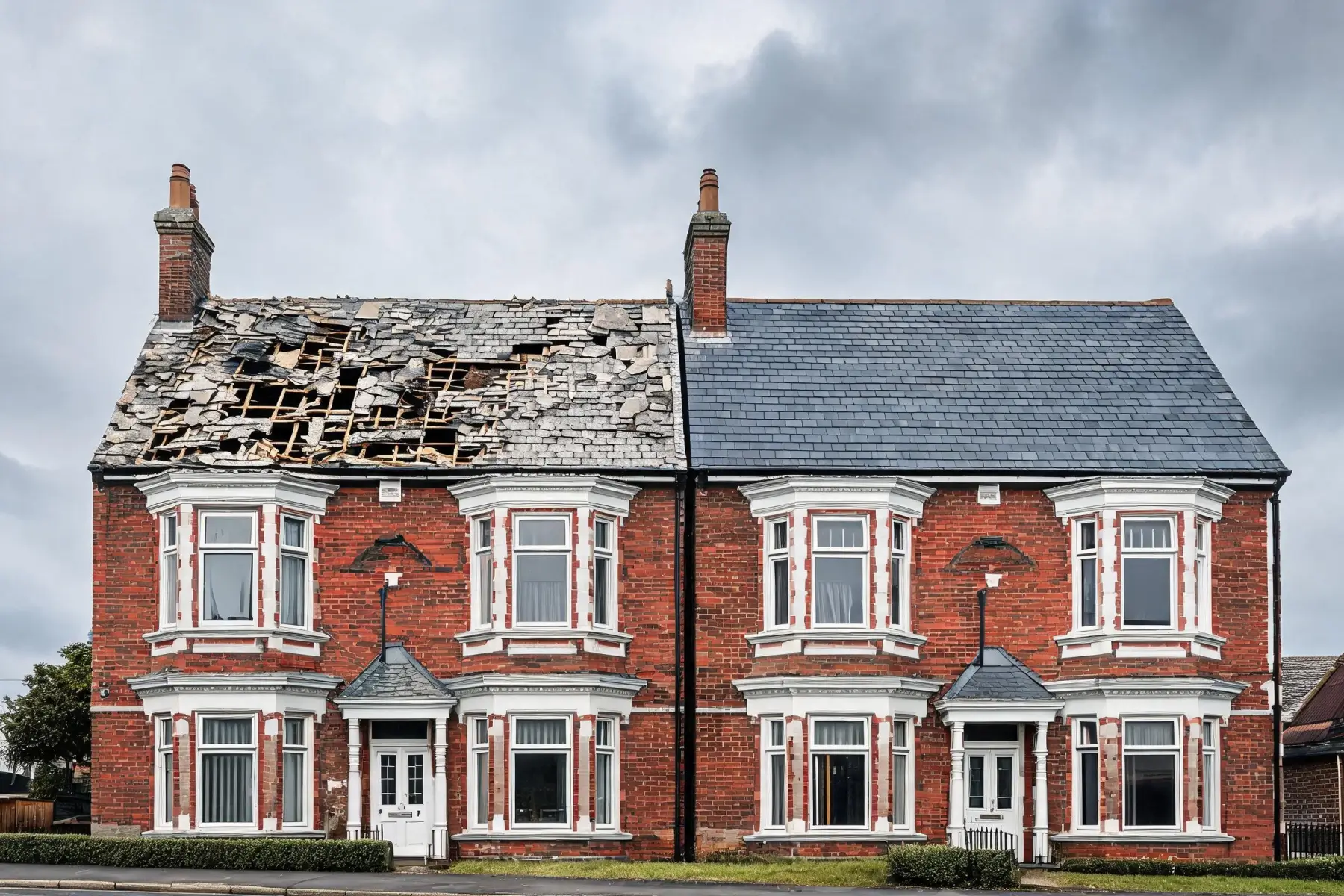
When water hits a slate surface, some of it runs off down the pitch. Some of it sits in the microscopic pores and fissures that exist in every natural stone. The percentage of water the stone takes up by weight, after 48 hours of immersion, is the water absorption value. A slate that absorbs 0.1% takes in one gram of water for every kilogram of stone. A slate that absorbs 0.6% takes in six grams.
That sounds trivial. Six grams of water in a kilogram of stone — who cares? You care because of what happens next, when the temperature drops below zero and that six grams turns into ice.
Water expands by roughly 9% when it freezes. Inside a pore that is already full of water, that expansion is not trivial. It is a hydraulic press operating at the molecular level, exerting pressure against the walls of every fissure it sits in. Do this once and nothing visible happens. Do it three hundred times over twenty winters and the micro-cracks have grown into macro-cracks, the macro-cracks have reached the surface, and the tile starts to delaminate.
The slate with 0.1% absorption has almost no water inside its pores to begin with. The slate with 0.6% has six times more. Every freeze cycle, the high-absorption stone takes a hit six times harder than the low-absorption stone. It is not a linear relationship — it is cumulative, and it accelerates.
Term 02 · The Mechanism — How Water Gets In and Why It Stays
A slate tile is not a glass plate. It is a natural metamorphic rock, and metamorphic rocks have structure. The cleavage plane that lets a quarryman split a block into thin tiles is also the plane where water can travel deepest into the stone. The mica layers that give slate its characteristic flat face are, at the microscopic level, sheets of sericite — a fine-grained muscovite — interleaved with quartz and chlorite. Between those sheets, there are gaps. Not many, if the stone is dense. Quite a lot, if it is not.
Density and absorption are two sides of the same coin. A dense slate — one compacted under high metamorphic pressure — has fewer and smaller pores. Jiujiang slate, for instance, has a density of 2,819 kg/m³, which puts it near the top of the natural slate range. The denser the stone, the less room there is for water, and the less water there is inside when the frost comes.
But density alone does not tell the whole story. Mineral composition matters too. A slate with high calcium carbonate content — high CaO — has a chemical vulnerability that compounds the physical one. Carbonate minerals are slightly soluble in water, especially acidic water. Rain that has absorbed atmospheric carbon dioxide is mildly acidic (pH around 5.6 in unpolluted areas, lower near cities). Over decades, that mildly acidic rain dissolves the carbonate cement between the mineral grains, opening the pores wider, letting more water in, accelerating the cycle. A slate with CaO below 1% — like Jiujiang's 0.56% — has almost no soluble component. Water has no chemical grip on the stone. It can enter the physical pores, but it cannot widen them through dissolution.
This is why two slates with similar density can have very different longevities. The physical pore structure controls how much water gets in. The chemical composition controls whether that water makes the pores bigger over time. A low-absorption slate with low carbonate content has two independent defence lines. A high-absorption slate with high carbonate content has neither.
Term 03 · The Freeze-Thaw Kill Chain — How One Number Becomes a Death Sentence
Here is the sequence, step by step:
Step 1: Infiltration. Rain falls on the roof. Most runs off. A fraction enters the surface pores and capillary channels. How much enters depends on the absorption rate. At 0.1%, it is almost nothing. At 0.6%, it is six times more — and remember, the EN 12326 A1 limit allows up to 0.6%, so 0.6% is a passing grade.
Step 2: Retention. The rain stops. The sun comes out. The surface dries. But the water inside the pores does not dry as fast — it is protected from sun and wind by the stone itself. The deeper the pores, the longer the water stays. A dense slate with shallow surface pores dries quickly. A porous slate with deep capillary channels holds water for days after the surface looks dry.
Step 3: Freezing. Night falls. The temperature drops below zero. The water inside the pores freezes and expands by 9%. That expansion exerts pressure on the walls of every pore and fissure it occupies. The pressure is not enormous in a single event, but it is applied to the weakest points in the stone's internal structure — the pre-existing micro-cracks and grain boundaries.
Step 4: Crack propagation. The micro-cracks grow. Not by much in one cycle — perhaps a fraction of a micron. But the next rainstorm sends water into those slightly wider cracks. The next freeze expands it again. Each cycle adds a little more. After 50 cycles, the cracks are visible. After 200, the tile is splitting along its own internal fault lines.
Step 5: Delamination. The cracks reach the cleavage plane — the same plane the quarryman used to split the tile thin. The tile begins to separate into layers. First, a thin surface flake lifts. Then a larger piece drops off. The tile gets thinner at that spot. Water pools in the exposed area. The next freeze finishes the job.
None of this happens to a slate with 0.1% absorption. Not because the physics is different — the same forces are at work — but because the amount of water inside the stone is so small that the expansion pressure is negligible. You cannot break a stone with ice if there is almost no water inside it to freeze.
There is a concept that durability analysts use called saturation ratio — the fraction of total pore volume that is filled with water at any given time. A slate with 0.1% absorption has so few pores that even after prolonged rain, the saturation ratio stays low. A slate with 0.6% has many more pores, and a single heavy rainstorm can push the saturation ratio close to 100%. When saturation reaches that level, the next freeze is not just damaging — it is catastrophic. The stone has no air space to absorb the expansion. Every pore is full. Every freeze is a maximum-force event.
Term 04 · The Lab Evidence — What 120 Freeze-Thaw Cycles Prove
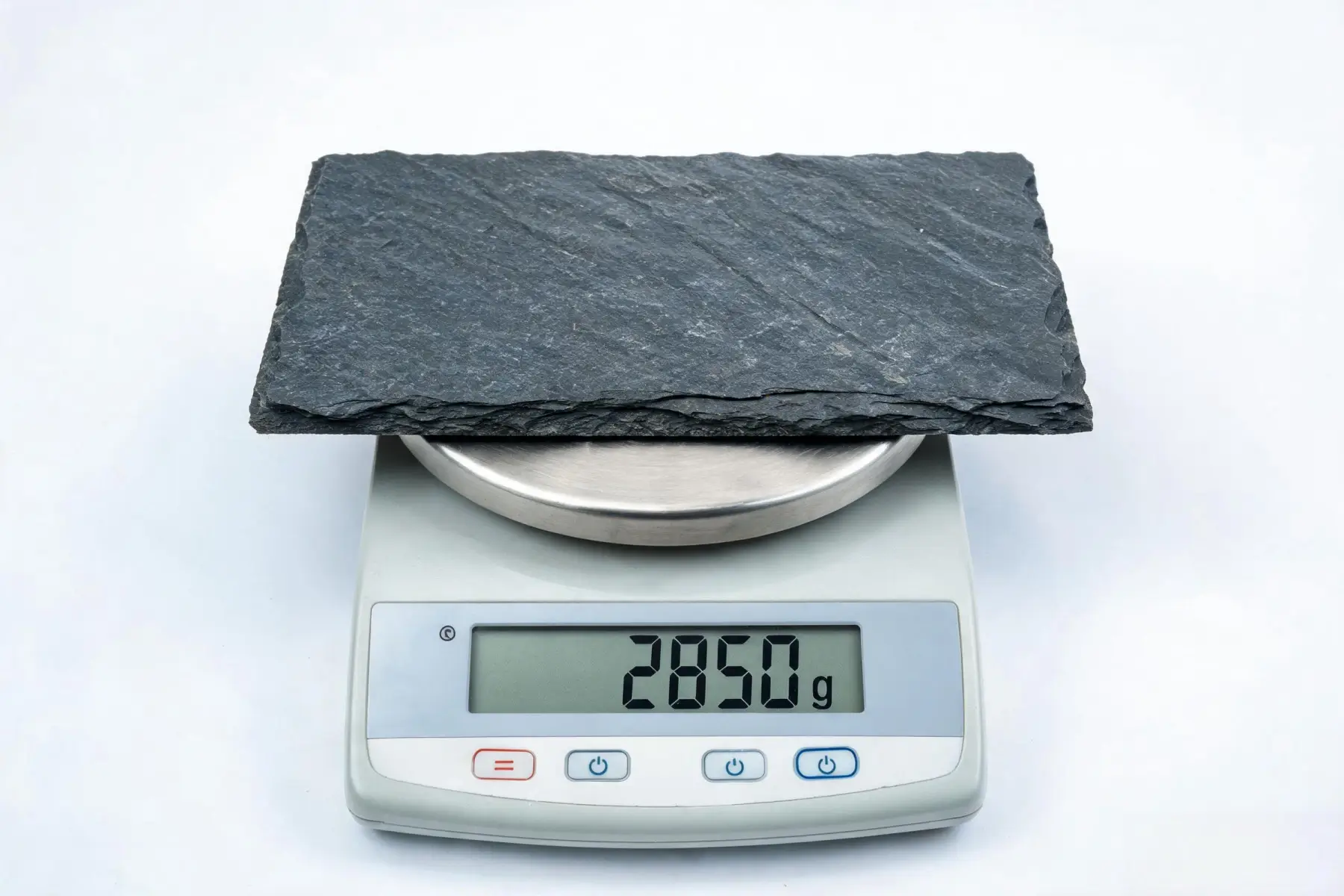
The standard freeze-thaw test for roofing slate is brutal by design. The sample goes into a chamber at -20°C for several hours. Then it comes out and thaws in water at +20°C. Then back into the freezer. Each cycle compresses what nature takes weeks to do into a few hours.
Jiujiang slate has been through 120 of these cycles in laboratory testing. The results are documented:
- Compressive strength before freezing: 156 MPa (dry state)
- Compressive strength after 120 cycles: 144.7 MPa (frozen-thawed state)
- Strength retention: 92.7%
- Loss: 7.3% — well below the 8% threshold that most standards use as a pass mark
What does 92.7% retention actually mean? It means the stone lost less than 8% of its load-bearing capacity after being frozen and thawed 120 times. For context, 120 cycles is roughly equivalent to 120 winters of heavy frost exposure — more than most roofs in temperate Europe will experience in a 60-year service life. A roof in a harsh Nordic climate might see 50 freeze-thaw cycles per winter, but those cycles are milder and shorter than the laboratory version. The lab test is an accelerated worst case.
The reason the stone survives is straightforward: there is almost no water inside it to freeze. The 0.1% absorption rate means the freeze-thaw cycle is acting on empty pores. You cannot break stone with ice if the ice has nowhere to form.
Contrast this with a slate at the 0.6% limit. The same test, the same 120 cycles — but each cycle has six times more water to freeze, six times more expansion pressure, and six times more crack growth. A slate at 0.6% does not lose 7.3% of its strength. It loses 20-30%, sometimes more. After 50 cycles, not 120, it is already showing visible delamination. In real-world terms: a roof that starts at the pass mark will begin failing in 15-20 years in a cold climate. A roof that starts at 0.1% will outlive the building.
There is a secondary lab number that matters here: wet flexural strength. When slate absorbs water, its bending strength drops — the water acts as a lubricant between mineral grains, reducing the interlock that gives the stone its rigidity. Jiujiang slate's dry flexural strength is around 60 MPa under EN testing. After saturation, it drops to about 45 MPa — a 75% retention rate. A higher-absorption slate might retain only 50-60% of its dry strength when wet. On a roof under snow load, that difference matters. A wet, weak slate under a metre of snow is a slate at risk of cracking. A wet, strong slate takes the load.
Term 05 · The Field Evidence — 200 Years vs 120 Cycles
Lab tests are convincing, but they have a weakness: they are short. 120 cycles in a chamber is impressive, but a roof is expected to last 75-100 years. Can we extrapolate from 120 cycles to 36,500 days of natural exposure?
In the Jiujiang region, there is evidence that does not require extrapolation. Old tombstones made from the same stone — the same geological formation, the same mineral composition, the same density — have been standing in open fields for over 200 years. These are not sheltered monuments under a portico. They are vertical slabs exposed to full sun, full rain, full frost, and the region's humid subtropical climate, which delivers 30-50 natural freeze-thaw cycles every winter.
200 years × 40 cycles per year (conservative average) = 8,000 natural freeze-thaw cycles. The lab test ran 120. The tombstones have survived 67 times more.
The surfaces are weathered, certainly. The cleft face has softened. Lichen has colonised the north-facing side. But the stones are structurally intact. They have not delaminated. They have not crumbled. They have not split. The inscriptions carved two centuries ago are still legible.
This is the field evidence that the lab test cannot replicate. The tombstones prove that the stone's low absorption rate is not a one-off laboratory curiosity — it is a property that holds under real conditions, over timescales that exceed any building's design life. The 120-cycle lab test does not tell you the ceiling. The tombstones do.
Now return to the two houses on the same street. The house with the original roof has slate that tests at 0.1%. The house that has been re-roofed twice has slate at around 0.6%. The first roof has been through roughly 700 freeze-thaw cycles (22 years × ~30 cycles per winter in northern England). The second roof's first set of tiles failed after about 450 cycles. The second set — from a different source, slightly better, perhaps 0.4% — lasted about 300 more before the owner gave up and re-roofed again.
The equation is not complicated. Lower absorption means less water inside the stone. Less water means less freeze damage per cycle. Less damage per cycle means more cycles before failure. More cycles before failure means more years on the roof. It is a straight line from one number to one outcome.
Term 06 · The Buying Decision — How to Use This Number
Here is what a buyer should do with this information:
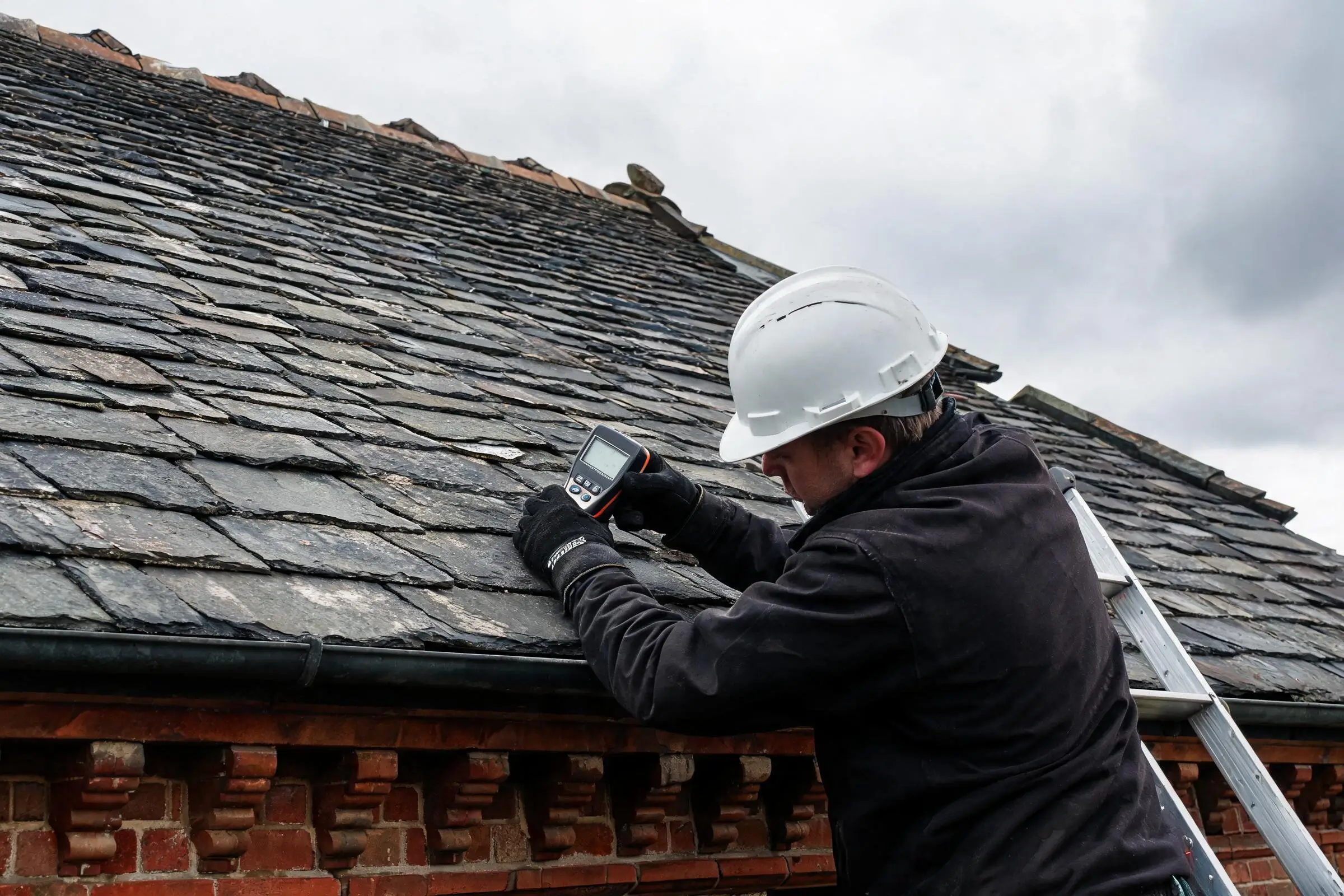
Ask for the number. Any supplier who has had their slate tested to EN 12326 or ASTM C406 will have a water absorption figure. It is one of the first lines on the test certificate. If the supplier cannot produce it, or says "it meets the standard" without giving the actual value, walk away. The difference between 0.1% and 0.6% is the difference between a roof you forget about and a roof you budget for.
Do not accept "pass" as an answer. EN 12326 classifies slate into A1, A2, A3 categories for water absorption. A1 means ≤ 0.6%. That is a pass. But 0.6% is not good — it is the floor of acceptable. A slate at 0.5% passes. A slate at 0.1% also passes. They are not the same stone, and they will not give you the same roof. Ask for the actual number, not the category. The category tells you it is legal to sell. The number tells you how long it will last.
Test it yourself if you need to. The water absorption test is the simplest test in the entire slate testing repertoire. Weigh a dry sample. Soak it for 48 hours. Weigh it again. Calculate the percentage gain. You need a kitchen scale, a bucket, and two days. No laboratory required. If the number your supplier gave you matches your number, you have trust. If it does not, you have a problem.
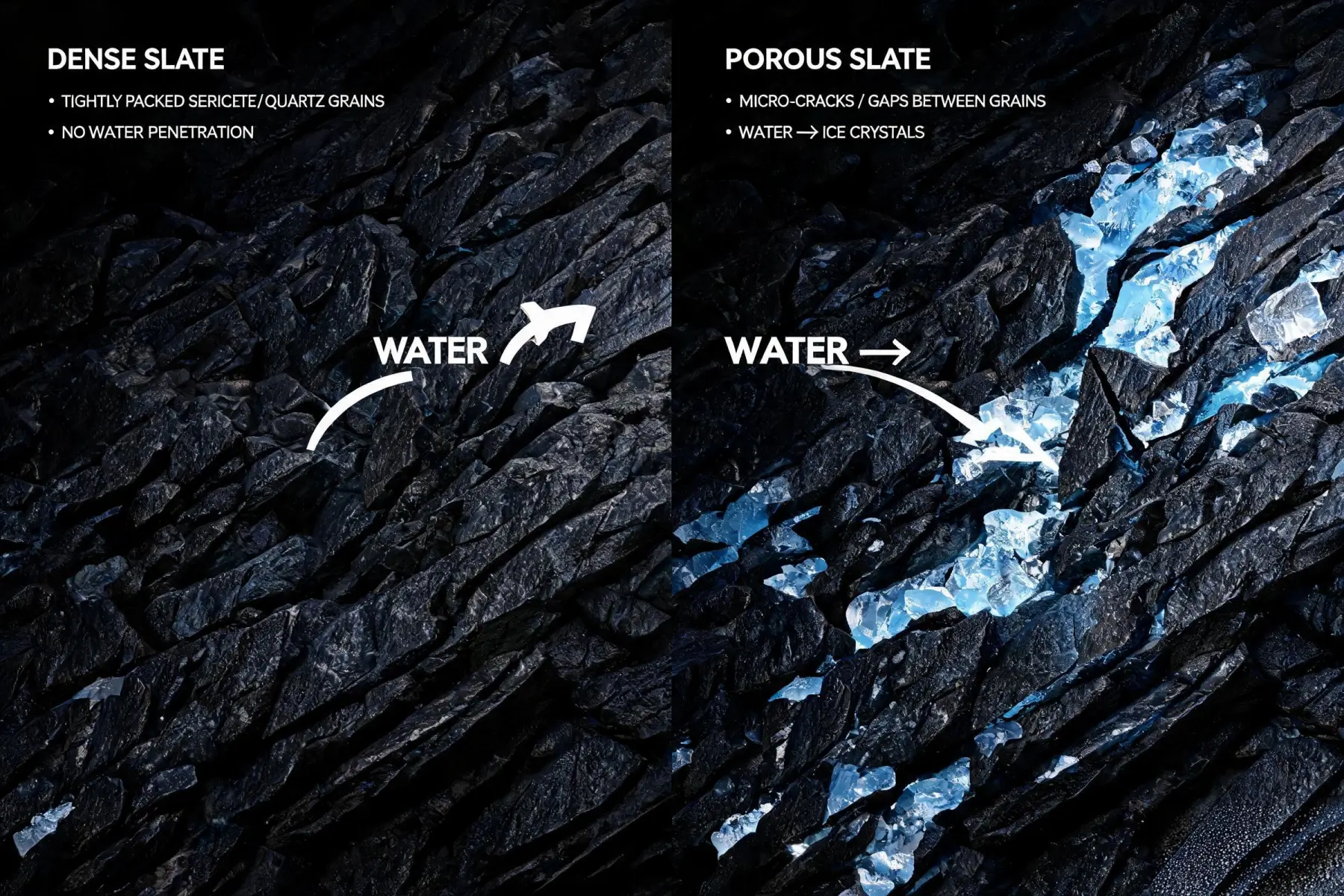
Pair it with the carbonate number. Water absorption tells you how much water gets in. CaO content tells you whether that water will widen the pores over time. Ask for both. A slate with 0.1% absorption and 0.56% CaO has two independent barriers against water-driven failure. A slate with 0.3% absorption and 5% CaO has one barrier that is slowly being dismantled by acid rain. The combination matters more than either number alone.
Think in decades, not in price per square metre. A slate at 0.1% costs more per square metre than a slate at 0.6%. But the 0.6% roof needs replacing every 20-30 years in a cold climate. The 0.1% roof does not. Over a 60-year building life, the cheaper roof costs you two re-roofing projects — labour, scaffold, skip hire, disposal, and the risk of water ingress during the works. The expensive roof costs you nothing. The equation favours the better stone by a wide margin.
For a more detailed breakdown of the test data behind Jiujiang slate — including density, flexural strength, mineral composition and the full freeze-thaw cycle results — see our Jiujiang Slate Test Results page. For the geological reasons why this particular stone tests so low, see Jiujiang Slate Water Absorption. And if you want to understand how to read a full EN 12326 or ASTM C406 test certificate — every line, every number — see How to Read a Slate Test Report.
Frequently Asked Questions
What is a good water absorption rate for roofing slate?
Anything below 0.3% is excellent. Below 0.1% is exceptional — the stone is nearly impermeable. The EN 12326 A1 category allows up to 0.6%, which technically passes, but 0.6% is the floor of acceptable, not the target. In cold climates with frequent freeze-thaw cycles, the difference between 0.1% and 0.6% can mean 50+ years of additional roof life. Always ask for the actual number, not just the category.
Can a slate roof with high water absorption still last a long time in a mild climate?
Yes — if the climate never freezes, the freeze-thaw kill chain never activates. A 0.6% slate on a roof in a warm, dry climate may well last 50-70 years because the water inside the pores never turns to ice. The problem is that climates change, and "never freezes" is a risky assumption over a 75-year planning horizon. One hard winter in twenty can do more damage than ten mild years of none. If the climate has any frost at all, absorption matters.
How do I test water absorption myself without a laboratory?
Weigh a dry slate sample on a kitchen scale accurate to 0.1 g. Submerge it in water for 48 hours. Remove it, surface-dry it with a towel, and weigh it again. The weight gain divided by the original dry weight, multiplied by 100, gives you the percentage. Example: a 4,000 g tile that weighs 4,004 g after soaking has 0.1% absorption. This is the same method as EN 12326, just less precisely controlled. Good enough to tell you if your supplier's number is in the right ballpark.
Why does the EN 12326 standard allow up to 0.6% if that level can fail in 20 years?
Standards set minimum thresholds, not optimal values. The 0.6% A1 limit was set to exclude genuinely unsuitable stone — slate above 0.6% fails even in mild climates. It was not designed to guarantee 100-year service life in cold climates. That is a spec the specifier sets, not the standard. A specifier writing for a Nordic project should set a project-specific limit well below 0.6% — 0.2% or 0.3% at most — based on the climate exposure, not on the standard's pass mark.
Does sealing or coating slate reduce water absorption?
Surface sealers can reduce the rate of water uptake temporarily, but they do not change the stone's inherent porosity. A sealer degrades under UV exposure and eventually wears off — typically in 3-7 years depending on the product and exposure. When it wears off, the stone's natural absorption rate takes over. Sealing is a maintenance commitment, not a substitute for buying low-absorption stone in the first place. For roofing slate, sealing is rarely recommended — the roof is too large and too exposed for resealing to be practical.
Is water absorption the only number that determines slate roof longevity?
No — but it is the one with the strongest causal link to premature failure. Other factors matter: flexural strength (how well the tile resists bending under snow and wind load), carbonate content (whether acid rain will dissolve the stone's internal structure over time), installation quality (correct headlap, nail type, batten spacing), and roof pitch (steeper roofs shed water faster). But water absorption is the gateway variable — it controls whether the most destructive force in roof weathering, freeze-thaw damage, has any material to work with. If absorption is low enough, freeze-thaw damage is negligible regardless of the other factors. If absorption is high, no amount of correct installation will save the roof from the same fate.
Need slate that lasts a century, not a decade?
Jiujiang slate tests at 0.1% water absorption — six times below the European limit, equal to the best Norwegian stone. Ask for the test data. Then compare the numbers.