
Why Jiujiang Slate Works for Paving
Natural slate paving has to withstand prolonged moisture exposure, pedestrian loads, surface wear and, in colder climates, repeated freeze–thaw cycles. Unlike roofing slate, which is installed on a pitched surface to shed water, paving slabs remain in contact with the ground and may stay damp for extended periods. That duty — horizontal, wet, walked on — is what any stone is judged against on this page.
Jiujiang slate is worth considering for outdoor paving because characterized samples from the region show relatively low water absorption and high density, while natural cleft surfaces offer a distinctive finish for paths, patios and landscape projects.
These characteristics are useful starting points, but they do not guarantee suitability for any particular application. The final specification must also account for flexural strength, slip resistance, slab thickness, drainage and installation conditions.
One standing rule from the guide applies here as everywhere else: Jiujiang slate names a producing belt, not a product grade. Quarries differ, grades differ, finishes differ — and every figure quoted on this page belongs to the lot being ordered or it belongs to no one.
The case in three lines
— Water absorption decides what gets into the stone. It does not decide how long the water stays.
— Density decides the stone's mass, its handling and its container arithmetic. It does not decide the load path or the strength class.
— Natural cleft gives the walking surface its character. It does not give it a slip rating.
Each of the three is necessary. None is sufficient. A pavement is decided by reading all three together — and by the installation around them.
From here the page takes the three properties in order: what each genuinely buys at ground level, what it never buys, and how a buyer checks all three before a deposit. Other pages in this guide follow the stone into specific decisions — formats and thicknesses, floors, walls exposed to weather. This one stays with the material and asks what makes any slate suitable for ground contact at all.
Low Water Absorption: What the Number Buys, and What It Never Buys
Water absorption measures how much water a stone takes up under a specified test method. For outdoor slate paving, it is the figure that governs how much of the moisture arriving on faces and exposed cut edges becomes the stone's problem rather than the system's. A low rate can reduce the amount of water entering the stone body — which matters most in climates where repeated wetting and freezing occur; the mechanism behind it, and why this one figure decides so much, has a page of its own on why water absorption decides longevity.
A low rate does not, however, determine how quickly the exposed surface dries, how effectively water drains from beneath a paving slab, or how dimensionally stable the stone remains under changing environmental conditions. Drying depends on wind, sun, temperature, ambient humidity and the exposure of the surface itself; dimensional stability and long-term durability are assessed with their own relevant performance tests, not inferred from this figure. This is why low water absorption slate for outdoor paving tends to be specified by name and by method in cold markets, rather than by adjective.
Published results for characterized samples of this belt sit around 0.1–0.2 % by the applicable method, alongside the rest of the data on the guide's test-results page. As on every page of this guide, those figures belong to the samples tested; a number quoted at a buyer belongs to that buyer's order when it arrives with the applicable method, the report and the material grade behind it — never when it arrives alone.
On standards, a precision worth carrying: in Europe, slabs of natural stone for external paving are governed as a product under EN 1341, whose referenced test methods include water absorption to EN 13755, flexural strength to EN 12372, freeze–thaw to EN 12371, and slip resistance by the pendulum method to EN 14231. EN 12326 — the product standard that covers this belt's roofing and external wall cladding output — does not govern paving flags. A roofing or cladding report is therefore evidence about a different duty, not this one. Other markets run their own documents; the discipline is the same everywhere: name the standard — and the edition in force for your project — and confirm the data were produced against that version, rather than assuming one market's report travels to another.
What low absorption never buys is just as important. It is not proof of frost resistance on its own — necessary, not sufficient; the direct evidence for winter performance is freeze–thaw data. And it is not the surface: what dries, what stains, what grows, live above and around the stone rather than inside it. Low absorption decides what gets into the stone. It does not decide how long the water stays.
High Density: The Most Misread Figure on a Slate Report
Density is mass per volume. For the same characterized samples, the published band runs to about 2,719–2,819 kg/m³ — and like every figure on this page, it belongs to the samples tested and is confirmed per order. What density honestly buys is two jobs:
- Planning arithmetic. Weight is density × volume; for a slab of uniform thickness, volume follows from the format, so piece weights, crate weights and the square metres a container carries all follow in one line. The worked side of that arithmetic, keyed to the same material, lives on slate paving sizes and thicknesses.
- Monitoring material consistency across a lot and between repeat orders. Density is one of the figures a repeat order is checked against; read alongside water absorption, mineral composition and visual inspection, it helps identify meaningful differences between one delivery and the next.
What density does not do is stand in for the other rows. Density and water absorption provide complementary information about the same material: read together — alongside the test methods, the sample identification and the remaining rows — they describe a slate more fully than either number alone, but neither stands as proof of the other. Neither figure independently establishes flexural strength, abrasion resistance or freeze–thaw durability; each is a separate row, measured by its own method, and read on its own merits. And where a result appears inconsistent with the material description or the rest of the report, the professional response is to request clarification from the laboratory or the supplier, not to adjudicate between two numbers.
Where a slab will span anything, then, the governing figure is the flexural row and the support conditions, never the density line — and denser is not automatically better: it buys weight, handling effort and freight before it buys anything the foot can feel. Density tells you how much stone is in the stone. It does not tell you what the stone can carry.
Natural Cleft: The Face the Stone Brings to the Job
The cleft face is not a finish applied to the stone; it is the stone's own parting plane, opened along the cleavage the rock grew — a surface that exists because slate splits true, and the same plane that makes the material economical to produce. How the belt produces it, and why it cannot be imitated, is told properly on the geology page. At ground level the relevance is direct: natural cleft slate paving slabs carry this face out of the quarry and into the garden unchanged, and it is the working surface every foot will meet.
What it gives is character that no two pieces share — gentle, shallow relief that reads to bare feet, stays quiet against planting and timber, and holds its tone beside grass and soil in a way uniform manufactured surfaces have to work hard to imitate. What it does not give is any guarantee of its own. The relief is shallow: tables and wheelbarrows feel where feet do not. Colour varies within the range of the batch, which is character on a terrace and material for discussion on a project that expected uniformity. And above all, texture is not traction. A textured face on a wet morning is an impression; a slip rating is a test result on the ordered finish under the conditions the project answers to — which is why grip belongs to a method, never to an adjective.
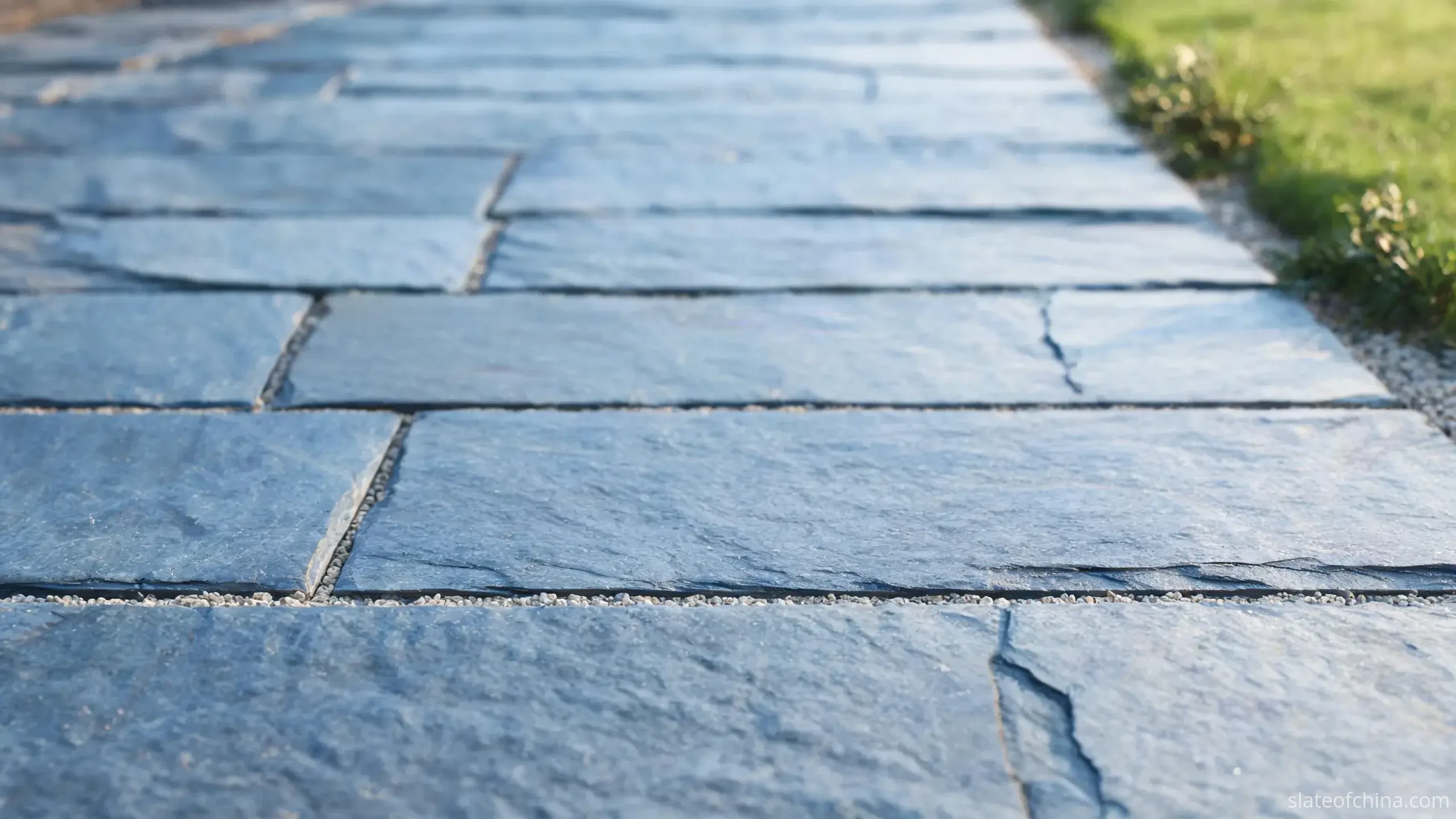
The cleft face gives the walking surface its character. It does not give it a slip rating.
Years Outdoors: Wet Cycles, Wear and Weathering
Outdoor paving is a materials test that runs for decades with no one watching the material. What the stone actually meets, year after year, is a sequence of wet events — rain, condensation, melting frost water passing through the joints — separated by drying intervals that shade and drainage decide. A dense low-absorption slate enters little of it and gives little back; the honest way to say which is freeze–thaw data, not assumption, and the belt's own winter results have their own page on freeze–thaw resistance.
Over the years, three things happen at the surface. Organic film arrives where shade meets moisture: moss and algae establish in the joints and in the dampest corners first, and left alone they can slowly smooth a texture that was bought for its relief. Wear polishes the high lines of a cleft face under traffic, which usually improves grip and gradually mellows the look. And the stone's constituents respond to exposure — where iron-bearing minerals occur, they run with the grade, not with the belt name, and over years they can show at the surface as rust marks; any grade in which that matters should be asked about it directly, before the order, not after the first stain.
Which is why the verdict on weathering is a division of labour, not a single yes. The material's side of the contract is absorption, density and the evidence behind them. The system's side is falls that move water, joints that drain, and maintenance that keeps the film off the surface. Neither side can cover the other, and both sides are cheap to verify and expensive to assume.
Applications: Which Property Governs Which Ground
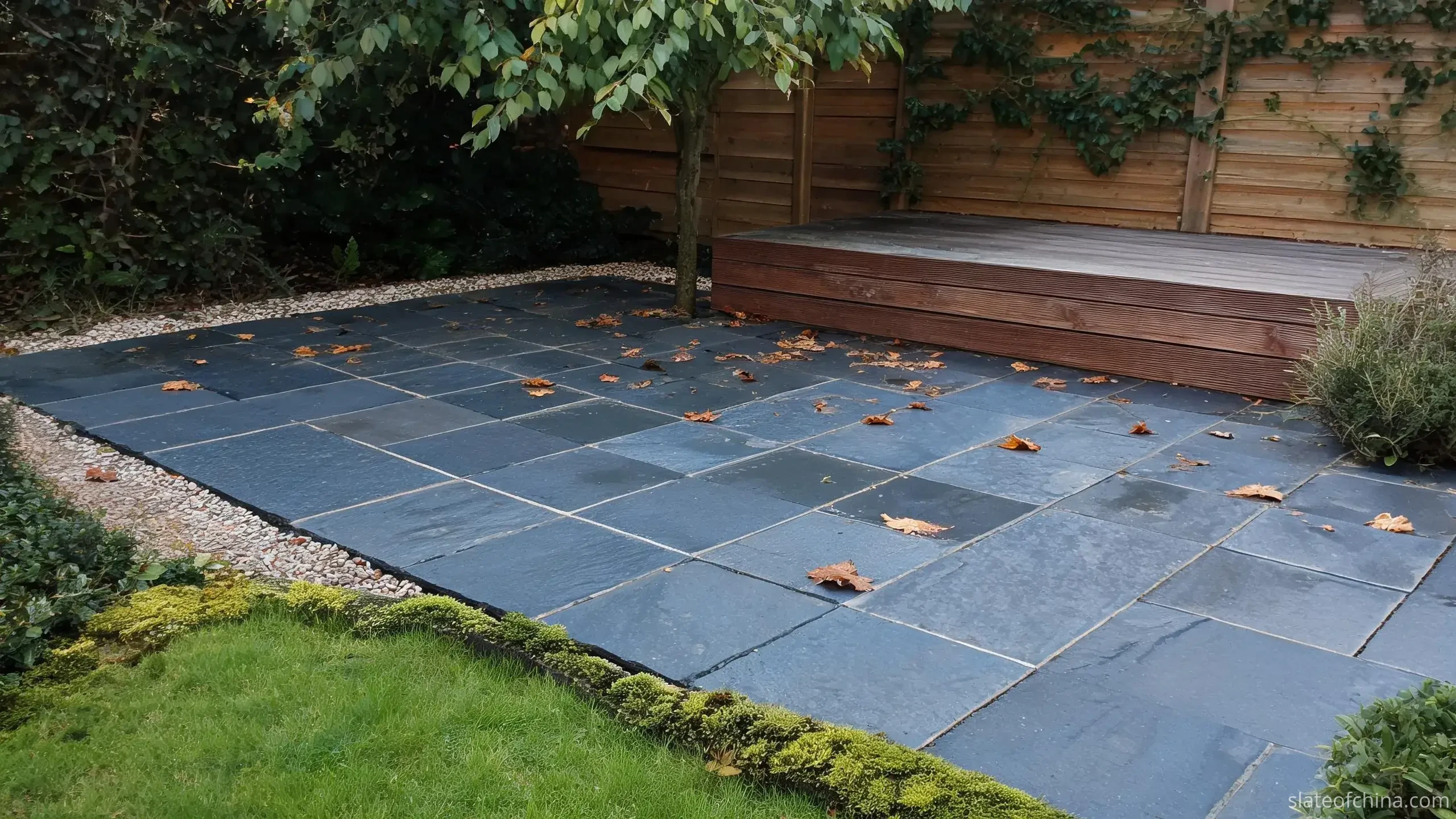
Buyers tend to arrive at this page through a use. Patios get the attention — slate paving for patios is the phrase most of the enquiries use — and the property quietly doing the work there is finish behaviour underfoot plus years of stable tone, with furniture loads modest and a wheelbarrow the heaviest thing that crosses. Underfoot is also the one duty that continues across a threshold: outdoor slate flooring meets its indoor counterpart at the door, where weather hands over to cleaning methods, and readers running the same material on both sides of that line can take the material-by-material side of the decision on the flooring comparison page. For the vertical counterpart — how the same belt's specification splits when the surface stands up into weather — the reading continues on the cladding pages.
The same three properties govern every ground-level use, but each use ranks them differently. The table below is the short version worth keeping at hand while a quotation is being written:
| Ground it is asked to serve | The property that governs it | What you still have to arrange around it |
|---|---|---|
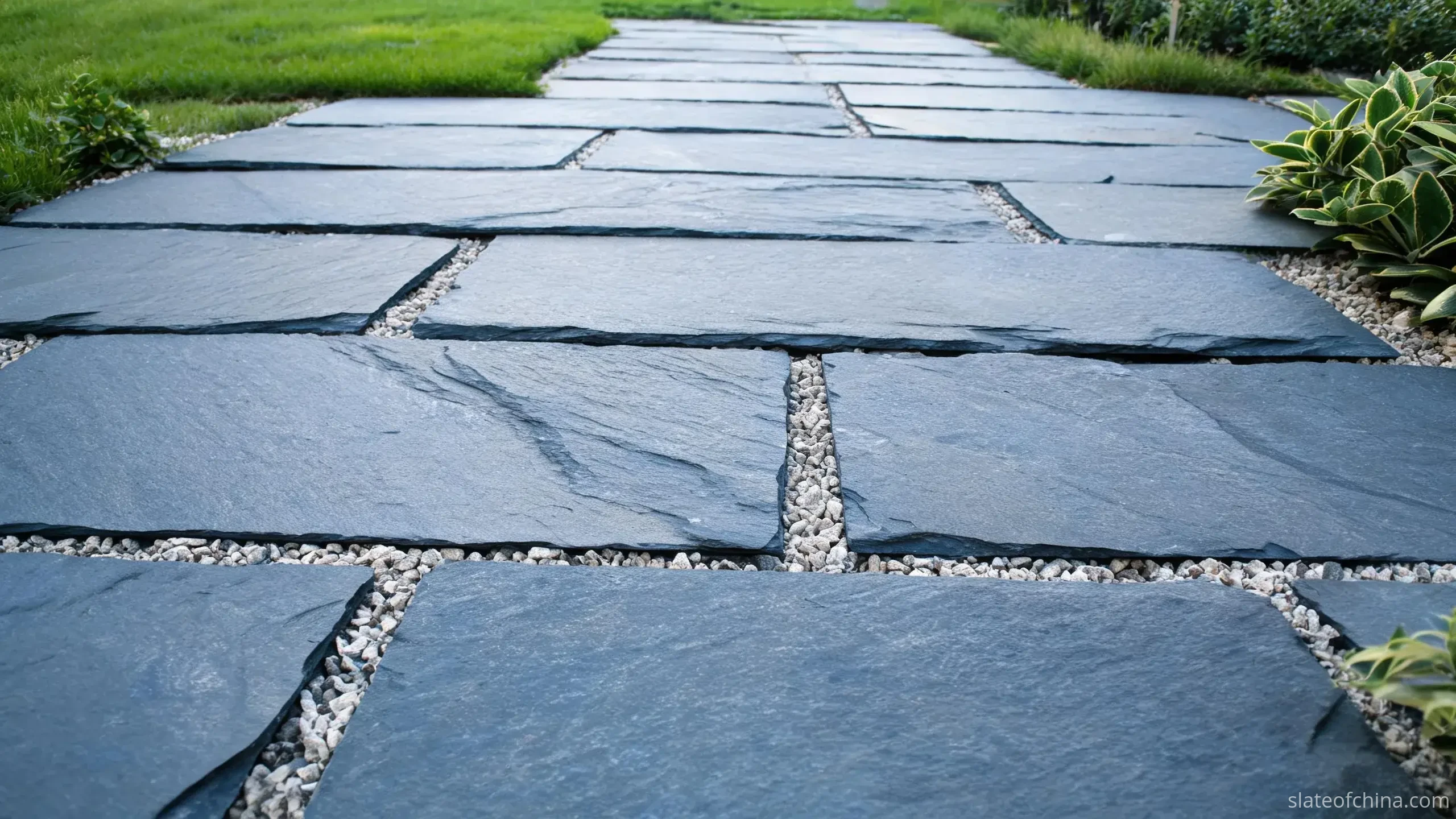
| Garden paths and walkways | A system read — formats that cooperate, tone that holds; absorption carries the shaded stretches | Falls along the run, a dry sub-base, maintenance of shaded corners |
| Patios and terraces | Finish underfoot, colour behaviour over years | Furniture feet, wheelbarrow crossings, a cleaning method chosen for the finish |
| Courtyards and entrances | Cleft underfoot close up, tolerance control at the threshold | Level transitions, threshold drainage, de-icing practice in cold markets |
| Public and commercial ground | Documented performance — slip method, flexural class for the span | Local standards, maintenance regime, salt exposure on paved approaches |
| Driveways and vehicle areas | None of the three qualifies a flag on its own — the governing document is an engineering assessment | Thickness by span and wheel load, sub-base construction, joint design under point loads |
The last row is deliberate: a sound garden-path slate is not automatically a driveway stone, and no property on this page converts one into the other.
What Three Properties Cannot Decide: Thickness, System and Slip
There is a second half to the honest answer, and it is where most disappointment in this trade is manufactured. Three properties qualify the stone. They do not qualify the pavement. Three decisions in particular are routinely and wrongly delegated to the material:
Thickness. A flag's thickness is not prestige, and it is not decided by the rock. It is decided by span and support — the load, the bedding, the unsupported distance — which is why the honest answer to slate paving thickness for garden paths is always support-first, and why the worked side of that question lives where the number side lives, on the sizes-and-thicknesses page, not on a test report.
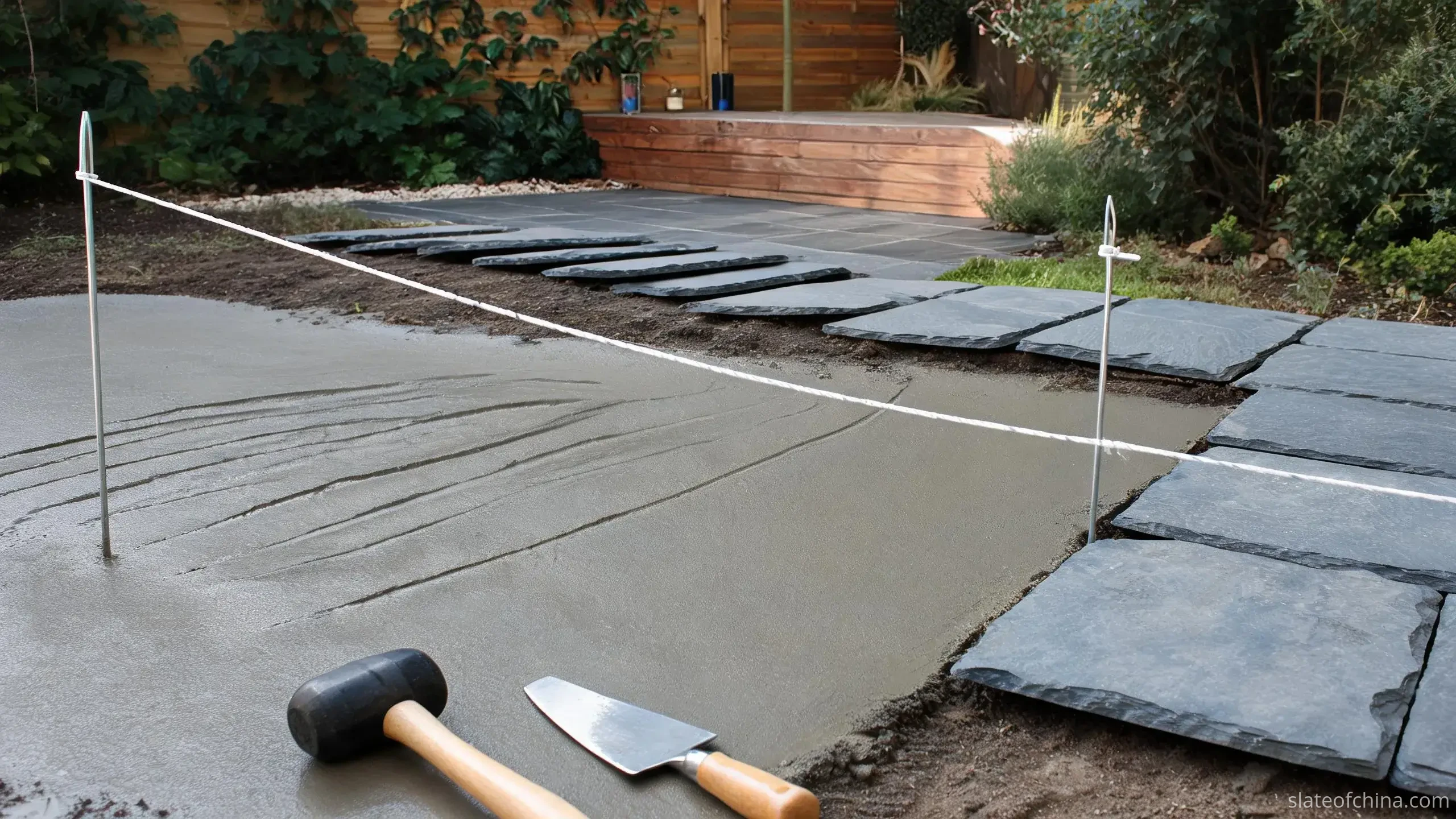
The system. Water that cannot leave multiplies every weather event a pavement has to survive — falls, drainage, bedding and jointing decide how often the stone is wet and how often it freezes while wet. Same slate, different system, different decade.
Slip. Traction at ground level is a joint product of the finish, the drainage, what is growing or lying on the surface, and the shoes that arrive. It is confirmed by a test on the ordered finish under wet conditions, in the method the project answers to — and it is never inherited from texture, from another finish's certificate, or from the belt's name.
Readers ready to move from properties to an order can see natural slate paving slabs as they leave this belt on the paving slate range page, or send the intended ground, formats, quantity and destination to the desk through the contact page — the three-property brief travels better with those four facts attached.
Before the Deposit: Checking the Three Numbers
Choosing is mostly verifying. How to choose slate paving for outdoor projects resolves, in practice, into a fixed sequence that takes less time than one round of rewritten emails. Run it before any deposit:
- Provenance of the data. Every figure must belong to the grade and finish being quoted, backed by the method and report — the reading of those rows is laid out on how to read a slate test report. A figure about another stone, another finish or another market's method is a document about something else.
- Consistency and traceability of the data. A quotation that quotes absorption but not density — or density but not the flexural row a spanning slab needs — is answering a narrower question than your project asked. Ask for the missing rows in writing before comparing anything. And if a returned figure looks inconsistent with the material description or the rest of the report, request clarification from the laboratory or the supplier: which lot, which method and which report — traceability settles what comparisons cannot.
- The surface, wet. The finish is approved with water on it and soil at its edge — under the conditions it will serve — following the sample-approval procedure, never from a showroom tray or a photograph.
- Disclosure on the grade. Ask directly what runs with the grade: iron-bearing minerals, colour range, finish availability in the format wanted. Questions asked before production are specifications; the same questions after arrival are complaints.
- The market's standard, named. For European external paving that is EN 1341 and the methods it references; for other markets, the project's own document. Name it in the order, and match the evidence to it.
None of this protects against a bad stone as well as it protects against a mismatched good one — which is what most "bad slate" deliveries turn out to have been.
The Verdict: A Suitable Stone Is a Specified One
So — does Jiujiang slate work for paving? The belt produces material with published absorption around a tenth of a percent, density in the high-2,700s to mid-2,800s, and a natural cleft face that arrives ready for feet. Read together and matched to the grade actually quoted, those three properties qualify the stone for a wide range of ground-level duty: gardens, paths, terraces, courtyards, entrances, commercial ground with the paperwork to match. A mild-climate pedestrian patio is the straightforward case. A freezing public walkway or any ground that sees wheels is a different exercise — possible, and regularly done, but decided by the flexural row, the system and the named standard, not by the belt's name.
The three properties decide the stone. The project decides the pavement. When both are written down and made to agree — and that agreement is what a specification is — slate from this belt, like any honest material, tends to still be level, whole and quietly good-looking half a lifetime later. A suitable stone is a specified one.
Frequently Asked Questions
Is low water absorption the same as frost resistance?
No. Low absorption is necessary, not sufficient: ice can only expand where water has entered, so a stone that takes in little freezes less hard — but frost resistance itself is measured directly, by freeze–thaw testing of the actual material. Ask for the freeze–thaw row alongside the absorption row, and remember that drainage below and around the paving decides how often the stone is wet in the first place.
What does density actually tell me about a paving flag?
Two things, honestly. It drives the practical arithmetic — piece weights, crate weights, container loading — which you can verify per order with the supplier's numbers. And it works as a consistency indicator across a lot and between repeat phases, read alongside water absorption and visual inspection. It does not tell you load capacity, bending strength or abrasion resistance — those are separate rows, measured separately, and they are the ones to read where a slab will span anything. A density value does not predict an exact absorption rate either; the two measure different properties. Where a figure looks inconsistent with the material description or the rest of the report, request clarification from the laboratory or the supplier rather than judging from two numbers alone.
Does slate paving need sealing outdoors?
Not as a rule. Absorption looks after the inside of the stone; sealers are surface films, and whether one earns its place depends on the finish, the use and the climate. Situations that push toward a sealer are deliberate: dining terraces that will see food and oil, or a look a client wants held. Situations that argue against it are equally practical: a film that makes a wet surface shinier has spent money making it less grippy, and surfaces that are not kept clean film over regardless. If a sealer is on the table, confirm it suits the actual finish, on a wet test piece, before the order.
Is a denser slate always the better choice for paving?
No. Density buys weight, handling effort and freight before it buys anything underfoot, and it does not travel to strength: two slates of the same density can fail differently in the same bending test. For ground work, the stronger questions are support and span — whether the flag sits on a full bed or bridges a void — and even then, thickness and flexural evidence do the deciding. Between two otherwise sound slates from the same grade, the practical differences usually show up in the container plan, not underfoot.
How do I know published test data applies to the slab I am ordering?
Ask three things: whether the tested material is the same grade and finish as your order, since evidence does not travel between finishes or markets' methods; which method produced each figure, so the rows can be compared to anything else in the same units; and which lot the report belongs to — per-order and phase-level data on repeat work is what keeps the second phase matching the first. Published pages give the honest picture of a belt; an order is confirmed by data that names your material.
A shaded corner of my slate paving stays damp for days — is that the stone?
Almost always it is the system. Shade slows evaporation, and water that cannot leave keeps every nearby surface damp — absorption decides what enters the stone, not how long a film sits on it or how slowly a corner dries. Check the falls along that stretch, whether the joints drain or pond, and whether organic growth is establishing in the dampest edge; correcting drainage and clearing the film is a maintenance decision, and it changes the corner faster than any material change would.
Related Reading
Request Jiujiang Slate Paving Specifications
Planning a natural slate paving project?
Tell us where the stone will be used, the required slab dimensions and thickness, the estimated quantity, and the destination country. Slate of China can help you review available material options, surface finishes, dimensional requirements and relevant test documentation.
For projects requiring specific performance criteria, include your technical specification or applicable local standard, so the material can be assessed against the intended application.
Explore the paving slate range · Request a quotation
A quotation built on the three properties travels better than one built on adjectives — and arrives the same way.