
Slate Flooring vs Other Stone Flooring
Slate is what I sell. It has been for years — floor by floor, pallet by pallet, from a quarry belt in Jiangxi to rooms I will never see. And the most useful thing I can tell you about my job is this: several times a month, somebody sits down at my sample table, and by the time they stand up, I have talked them out of slate.
Not because slate is a poor floor — it is a very good one, and this guide will be fair to it. Because a floor is a twenty-year relationship, and buying the wrong material because a slate man happened to be standing nearby is a bad way to start one. Some rooms need granite. A few rooms deserve marble. Quite a few honestly belong to porcelain. Most weeks the comparison that actually arrives at the table is slate flooring vs porcelain tile — porcelain is the default alternative, the easy benchmark, the price baseline — with slate vs granite flooring and slate vs marble flooring taking the quieter seats down the end.
So this guide does what I try to do at that table: take the four floors seriously, and ask the four questions that decide the purchase. Which one survives the life your floor will actually live? Which one grips when it is wet? Which one forgives your cleaning habits? And what does each one really cost, once the pallets are gone and the room is finished?
Two ground rules hold every answer together, so they go first. The material name is not a specification — slate covers a spread of quarries and grades that behave very differently, and so do granite, marble and porcelain. And the finish decides more than the material: a polished anything is a different floor from a textured one, and no material name has ever appeared on a slip test report — only the finish ID does.
From the sample table: the thirty-second answer
Slate — texture you can feel, a face that never repeats, and — in the natural cleft finish — one of the quieter wet floors in the room. The trade: an occasional sealing afternoon and variation you cannot switch off.
Granite — the hardest walking surface on this list, for the traffic that proves it. The trade: a busier look, a more formal room, and seams you will learn to see.
Marble — the most beautiful floor here, and it knows it. The trade: vigilance — acids, grit, and a restoration budget are part of the deal.
Porcelain — consistency, classified low water absorption, and the lightest cleaning routine. The trade: the stone look is printed, and a patient eye can tell.
Every line above is a fair trade for the right room. The rest of this guide is about finding that room — and it starts with one honest table.
The Four-Way Table: Slate, Granite, Marble and Porcelain at a Glance
Comparison tables are how floors get shortlisted, so here is ours — with its health warning printed first, because most of the tables you will find online do not bother. Nearly every cell below depends on grade and finish far more than on the material name. Slate runs from dense, split-clean beds to soft, flaky lots; porcelain runs from building-site commodity to engineered large-format slabs. Read the table for direction; read the test data for the decision.
| What you weigh | Natural slate | Granite | Marble | Porcelain tile |
|---|---|---|---|---|
| What it is | natural rock, split along its own planes | natural rock, crystallised from magma | natural rock, built around calcium carbonate | fired clay body with an engineered face |
| Signature look | layered depth, never repeats | granular speckle, consistent | veins and movement | printed pattern, repeatable |
| Scratch resistance | good lots are tough; weak lots flake — grade decides | excellent | the softest here | good to excellent, glaze-dependent |
| Wet grip | cleft face is textured by birth; honed needs testing | polished reads risky wet; flamed grips | polished presents increased slip risk when wet — a finish, contaminant and test-data question | texture-dependent — good products test well |
| Water absorption | low in dense lots — ask for the sheet | generally low | varies; some lots are thirsty | 0.5% or less, by classification |
| Lemon juice and wine | shrugs them off, as a rule | indifferent | etches — the deal-breaker | indifferent |
| Care routine | pH-neutral wash; sealer by need | pH-neutral wash; sealer by need | strict and stone-specific | simplest of the four |
| Tile-to-tile variation | high — it is the product | moderate | high | low, by design |
| A broken tile, ten years on | the patch reads as character — keep attic stock | replaceable; the seam shows at close range | a restoration trade exists and charges | dye-lot replacement is its party trick |
| Natural home | rooms wanting texture, depth and quiet grip | the hardest-working entries and commercial floors | protected, beautiful rooms | large areas that must behave identically |
Directional only. Grade and finish outrank material in almost every row — the numbers that decide belong to the specific product you are quoting, not to its family name.
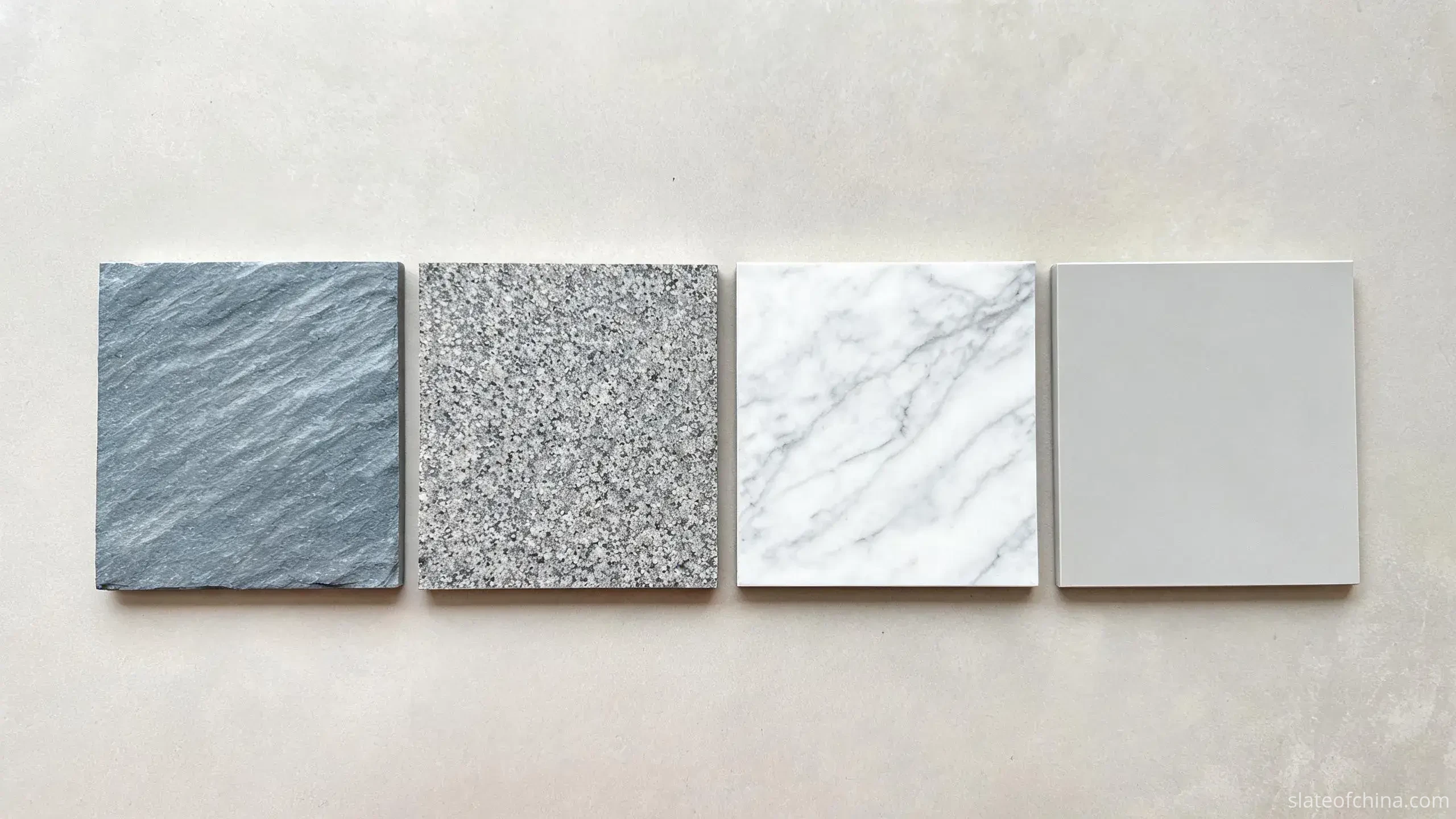
Slate vs Granite Flooring: Hardness Is Not the Whole Story
These two meet underground, but they arrive at a floor by opposite roads. Granite crystallised from magma — an interlocking grain of quartz and feldspar with no preferred direction, which is why granite is cut, never split, and why every granite tile started life on a saw. Slate is the older argument: seabed mud pressed and folded until its minerals lined up in sheets, which is why slate splits into planes — the cleft face underfoot is the stone's own surface, opened like a book. One road buys massive, uniform strength; the other buys a natural texture no machine has to fake.
On the pure scratch-and-abrade contest, granite wins, and I will not argue. Heel points, dragged furniture feet, the grit that rides in on boot treads — granite takes this abuse better than most flooring of any kind, which is why it has owned commercial lobbies for decades. If the brief is "an entrance that will be treated terribly, by everyone, forever", granite is the honest answer on paper, and the lobbies full of it across the world are the proof.
But floors rarely die of scratching. They die of water that gets beneath them, voids in the bed, a substrate that moves, a freeze cycle parked over trapped moisture — and on every one of those, granite has no magic. A tile of any hardness over a soft spot is still tomorrow's crack. The build-up under the floor does most of the deciding, which is why the serious durability conversation is never "which rock is harder". It is "which installation, for which room" — and both stones answer that question the same way.
Where slate earns its place against granite is everything hardness does not measure. The cleft face has a natural tooth that polished granite must be paid to fake — flaming, bush-hammering and textured finishes all cost money to manufacture what slate produces for free. The colour and the texture belong to the stone’s own minerals rather than to a surface treatment, and natural slate can exhibit colour and mineral variation through the stone; the look of a cut edge may differ from the finished cleft face, natural lots vary, and representative samples plus a written colour range are what actually define what arrives. And the quiet one: a cleft face hides wear. Slate arrives looking pre-aged, so a decade of domestic life barely moves the needle. The honest costs sit on the same list — low-grade lots can flake or spit at the edges, which is why grade, not price, is the real variable (Section 10 exists for exactly this), and an ungauged back will cost your installer time that a calibrated tile would not.
Granite carries honest costs of its own. The speckle never repeats, and not everyone loves it. Polished granite reads formal, even corporate, and in wet areas it becomes a different, more slippery product unless the finish does the work. And like slate, it ships and installs heavy — the freight conversation in Section 8 applies to both.
From the sample table: granite wins the fingernail test; slate wins the barefoot one. Floors are walked on far more than they are scratched — so know which insult your room actually plans to deliver, and the choice mostly makes itself.
Slate vs Marble Flooring: Do the Lemon Juice Test Before You Fall in Love
Marble does not need selling. It sells itself, at first sight, usually to the person who came in for something sensible — I have watched it happen at the sample table often enough to stop finding it funny. Veins, movement, light living in the surface: for two thousand years marble has been the flooring word for money, and no honest comparison should pretend a technical table removes that pull. Slate's appeal is the opposite kind. Nobody gasps at slate; they keep coming back to it. Texture, restraint, depth that shows up slowly — a floor you find reasons to like, rather than one that announces itself.
Before anyone falls in love, I hand them a lemon. A slice, or a squeeze — on the marble sample and, for fairness, on the slate beside it. Wait five minutes while we talk about something else, then wipe both. The slate is exactly where you left it. The marble now owns a small ghost: a dull patch where the acid quietly etched, microscopically, into the calcium carbonate the stone is made of. That is not a stain — a stain sits in the pore and can be lifted; an etch is the surface chemically rewritten. Wine, vinegar, citrus, tomato sauce, half the "fresh scent" cleaners on the shelf — marble's beauty comes with a chemical price list, and no sealer on the market pays it. Sealers sit in the pores against liquids; acid etching happens at the surface itself. Kitchens, dining rooms and bathrooms are where this stops being a story and starts being a weekend.
Slate cares less because of what it is made of: silicate minerals — quartz, micas, chlorite — which take household acids with a shrug. Not acid-proof in the laboratory sense; simply not built of the one mineral family that food dissolves. That single line of chemistry separates these two stones more decisively than any aesthetic argument.
Scratch- and wear-wise, marble sits lowest of the four materials here, and grit is its particular enemy — entry mats matter more than they sound. Beyond that sits the ledger nobody shows you in a showroom: a polished marble floor's look is a subscription. Hold the finish, and the floor periodically rejoins the restoration economy — diamond honing, re-polishing, specialists with machines. Accept a honed, lived-with patina instead, and some owners genuinely love what the years write, while others experience it as a slow loss. Both reactions are fair; buyers should simply know the choice exists before the deposit, not after. Both stones age. One of them shows it politely off to the side; the other files a report.
Marble is the floor you photograph; slate is the floor you live on. Run the lemon test on any stone you are considering — five minutes of it will not decide ten years of use, because the intended use, the finish, the maintenance it will get and the owner’s expectations all carry votes too — but it does show you, on the stone in front of you, the same acid sensitivity a kitchen would spend a decade proving.
Slate Flooring vs Porcelain Tile: Real Stone, Stone-Look, and the Repeat Test
Let me start this pairing where most comparisons do not: porcelain is a genuinely good floor, and I sell slate for a living. At my table, slate flooring vs porcelain tile is the weekly main event — and porcelain arrives with a serious record. The body is fired dense enough that water absorption of 0.5% or less, in tile language, is the definition of the class, not a boast. Sizes are dead consistent. Faces are printed so convincingly that professionals touch the edge to be sure. The body never needs sealing, the body never needs sealing, standard ranges usually start below entry-level natural stone — though premium porcelain tiles can out-price plenty of slates — and large formats arrive flat and interchangeable.. If porcelain did not exist, the flooring industry would be smaller and duller. That is the bar slate is up against.
Here is the tell I teach at the table: the pattern is printed in editions. Walk along any large porcelain floor — a showroom has hundreds of square metres — and look for the twins. Sooner or later two tiles wear the same "unique" birthmark, the same "one-off" mineral streak, because printing repeats and editions are finite. Some ranges repeat every few tiles, some every dozen; price has a lot to say about it. Real slate cannot fail a repeat test, because every tile is a different cross-section of four-hundred-million-year-old seabed — no two slices of a rock are alike, at any budget. In a big commercial floor that repeatability is a virtue: sameness at scale, easy replacement, predictable layout. In the one room you photograph, it is the seam in the illusion.
In service, the differences are narrower than marketing suggests on both sides. Both surfaces are stone-hard; both work with underfloor heating — stone just does it with thermal mass, holding and releasing its warmth slowly and evenly, which is part of why slate floors feel solid in a way thin fired clay cannot fully imitate. Porcelain's rectified edges set into tight, machine-even joints, which large rooms read as calm. Slate runs true but human: a calibrated, gauged product lays tidy; a hand-finished lot wants a layer who sorts and blends as they go — and the blending is part of the aesthetic, not a defect. On water, the porcelain body essentially does not drink, by classification. Dense slate runs close behind — but "dense" is a grade, not a birthright, so the absorption sheet for the actual batch is what to ask for. On wet grip, both families run the full range from saint to skate: glazed polished porcelain with water on it belongs in the same sentence as polished marble, while textured, grip-rated porcelain belongs beside swimming pools. Finish and test data — never the material name.
Repair is porcelain's quiet best argument, so I will make it honestly. Keep two boxes from the dye lot, and a tile that breaks ten years later is an invisible swap — colour, sheen, pattern, identical. Stone cannot promise that: a slate patch from a newer batch always shows its age, which is why stone suppliers have been giving the same six words of advice since the trade began: keep a few tiles in the attic.
Price is where everyone eventually aims both materials, and it deserves its own section rather than a slogan. That conversation is Section 8.
From the sample table: porcelain wins the spec sheet; slate wins the fingerprint test. One is a perfectly consistent product; the other is an unrepeatable place. Rooms know which they want — trust the room.
Which Flooring Is Most Durable? It Depends Which Failure You Mean
"Durable" sounds like one property. On a floor it is at least four, and the four materials split them differently. The honest ledger, failure by failure:
- Abrasion and scratching — granite first, then good porcelain and dense slate packed closely behind, marble trailing. Note the words good and dense: on this axis, grade outranks material.
- Moisture — porcelain first, by classification; dense granite close; dense slate depends entirely on the lot's absorption; marble varies, and some lots drink.
- Impact and installation failure — no material wins, because this battleground belongs to the build-up: substrate, bed or adhesive, joints, drainage. Stone and tile merely report, usually in cracking syllables, the failure of what lies beneath them.
- Weather and freeze–thaw — low absorption plus honest drainage governs. In freezing climates the floor-killer is usually water trapped beneath or between tiles, freezing and levering; polished marble is the habitual casualty outdoors, and exterior-rated porcelain and dense slate both behave when the water is managed and the numbers are tested.
That fourth axis deserves a bluntness note. The freeze–thaw and absorption figures for the grade you are actually buying belong on paper before the deposit — a serious supplier can produce them, and ours are published. And the cheapest durability intervention on this whole page: mats. Most "wear" on hard floors is grit traffic — dragged mineral doing in a year what a decade of feet cannot. A coarse mat at every door, shaken weekly, buys more floor life than most specification upgrades. Nobody sells you this advice, because nobody makes a margin on a doormat.
If you came here for the phrase — the best stone flooring for high-traffic areas — the honest expansion is: it depends what the traffic is. Constant feet with grit: granite, or porcelain rated for heavy commercial use. Rolling and point loads: that is an engineering question about the build-up, not a material question. A busy family kitchen: dense, gauged slate has covered those floors for a century, hiding the scratches as it goes. A hotel lobby: granite's home ground, with tested porcelain and dense slate competing on looks and budget. The material with the wrong installation loses to the humble material with the right one, every time it has been tried.
Is Slate Flooring Slippery When Wet? How to Actually Buy the Answer
The short, honest answer: a natural cleft slate face is often among the more forgiving wet surfaces in mainstream flooring — its texture was not designed, it was inherited from the stone's own splitting planes — and that sentence is worth exactly nothing in a specification. What the specifier, the insurer and your family actually need is a number, and the number belongs to the finish, not the material. So the real question behind is slate flooring slippery when wet is: what wet data does this specific finished product carry? — and every honest supplier can answer that, or should lose the job to one who can.
Wet slip testing has regional dialects, and asking in the right one gets better results. In the UK and much of the Commonwealth, the pendulum test reports a PTV — a pendulum test value, worked up in the UK slip-resistance regime. Through much of continental Europe, the ramp test sorts surfaces into R-classes, R9 up to R13, with higher classes for more demanding conditions. In the United States, the tile industry references ANSI A326.3, which measures dynamic coefficient of friction. The methods differ, none is a single global standard, and what counts as acceptable depends on the application and the local requirements. What matters for you is simpler: get the report for the exact finish code you are buying, in the dialect your project's jurisdiction reads — and treat a supplier who cannot produce one as data about the supplier.
Because finish is the decider, here is the wet-behaviour picture by finish, not by material:
| Surface | Wet behaviour, honestly | The question to ask |
|---|---|---|
| Natural cleft slate | textured by geology, which may provide useful traction — verify wet data for the actual product | the wet rating for this cleft finish |
| Honed slate | generally smoother than cleft, more contemporary; any slip difference is product-specific — confirm by testing | the same data, for the honed code |
| Polished granite / polished marble | smooth polished finishes carry heightened wet risk, especially with contamination in play — suitability is a test-data question | where the water will stand — and keep these finishes away from it |
| Textured granite (flamed, bush-hammered) | deliberately roughened; the standard exterior granite answer | the tested rating, and how it cleans |
| Matte or textured porcelain | can provide suitable wet grip when selected on relevant test results | the rating and the maintenance plan that keeps it |
| Glazed polished porcelain | can be treacherous wet, despite the category's tidy reputation | keep it out of wet rooms — or take the rating seriously |
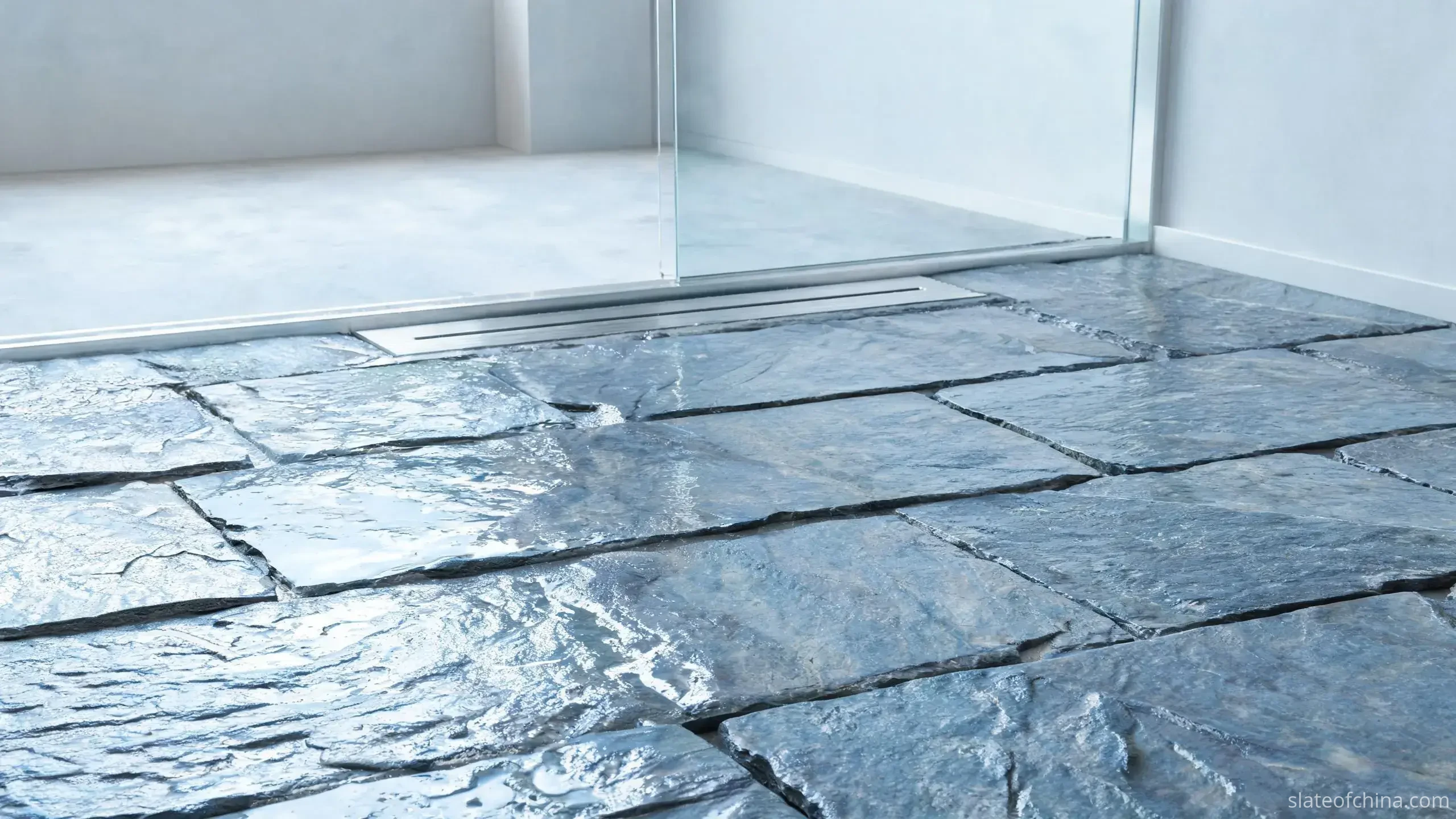
Two contaminant caveats separate lab reports from real rooms. Soap changes everything: a bathroom floor is not merely wet, it is soapy, and soapy measurably lowers every slip rating there is. Outdoors, algae and leaf-film do the same work. Buy the data, then design against the contaminant that will actually be present — drainage falls, a mat at the threshold, a squeegee habit in wet rooms.
And one trade to know before choosing roughness on purpose: texture that grips also holds. Cleft and flamed faces collect more dust and dirt than polished ones — that is part of the price of their safety, not a flaw. The best floor balances traction against the person who will clean it, which is why this decision belongs in the same conversation as Section 7, not after it.
From the sample table: pour a little water on the sample and feel it with a flat palm — that sells you the floor. Then ask for the finish's wet test number in your market's dialect — that keeps the floor out of the accident report. Neither is enough alone.
Maintenance and Sealing: What Each Floor Will Ask of You
Here is the maintenance truth nobody pins to a sample board: for all four floors, routine care is nearly identical — dry-clean often, damp-mop with a pH-neutral cleanser, do not let spills set up housekeeping. Slate flooring maintenance and sealing is a five-minute conversation, not a lifestyle; so is granite's. The real differences live in sealing policy, chemical discipline and long-term finishing — and they are smaller than the internet's horror stories claim on both sides.
Porcelain asks least. The body never needs sealing — that is what the absorption classification is for. The grout is the only real tenant and wants normal cleaning, and a textured face holds a little more dust between cleanings: more sweeping, that is all. Granite takes the same pH-neutral routine, with a sealer only if the actual lot absorbs — "some do, some don't" is a perfectly honest answer after a simple test. Marble is the discipline case: no vinegar-based anything, no citrus cleaners, no acidic bathroom products, spills wiped today rather than tomorrow, and eventually the restoration question from Section 3. Slate takes a pH-neutral wash and a penetrating sealer when — and only when — the lot drinks; an enhancing sealer can deepen the colour if you want it darker, but patch-test first, because an appearance change is not reversible.
Sealing decisions start with a five-minute test anyone can run, on the back of a sample or a spare tile. A coin-sized drop of water, left five minutes: if it sits proud like water on a waxed car, the stone is shrugging off that drop; if it soaks in and darkens the patch, the stone drinks. Treat the result as an initial indication rather than a verdict — the decision also weighs the stone’s absorption data, the intended use, the stain exposure and the sealer manufacturer’s recommendations. Outdoors, a sealer is never a substitute for drainage, waterproofing and freeze–thaw suitability. One habit survives every version of this decision: test any proposed sealer on a sample first, because some products deepen or shift the stone’s colour, and that appearance change is not reversible.
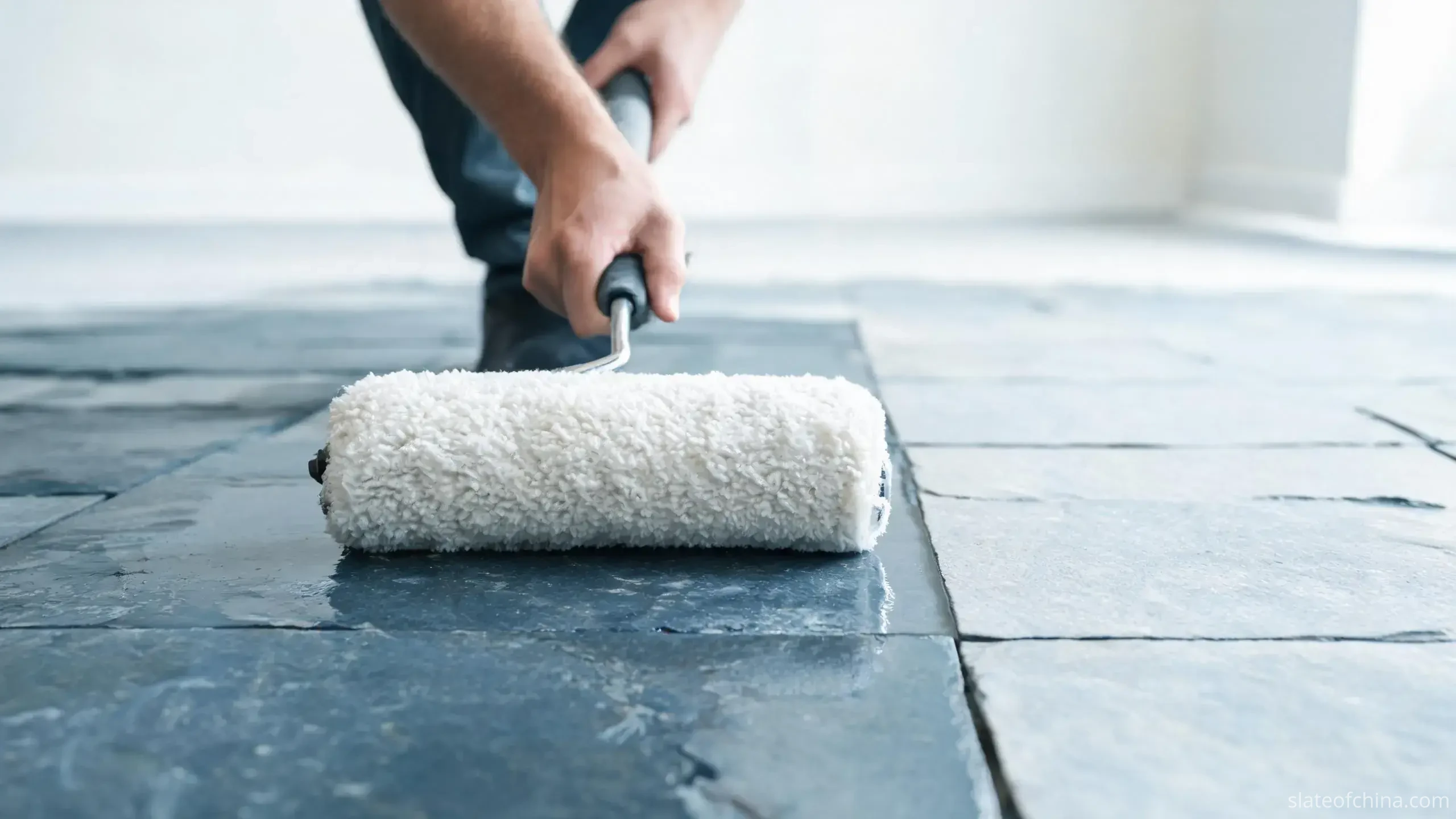
The whole routine, honestly, fits one afternoon a year plus four habits:
- Dry-clean more than you mop. Dust is grit is scratches, on every material above — the broom is the floor's best friend.
- Damp-mop pH-neutral, wrung nearly dry. Standing water is the enemy of every finish and every grout line.
- Wipe spills today. On marble it is chemistry; on everything else it is housekeeping.
- Once a year, re-run the water-drop test. On a sealed floor the bead should still hold; if water starts soaking in, the calendar is calling for a reseal — the interval follows the sealer's data sheet and your floor's life, not folklore.
From the sample table: the maintenance question is secretly a question about you. Some people enjoy the small ritual of looking after a natural material; some want a floor they are allowed to ignore. Both are valid customers — only one of them should buy marble.
Slate Flooring Cost vs Granite, Marble and Porcelain: The Invoice Is Not the Floor
Let me show you where price comparisons go to die: two square-metre prices, from two different continents, for two different products, compared as though they described the same thing. Material price is where comparisons start; installed-and-lived-with cost is where they end. No honest article can hand you fixed price ranges — grade, quarry, thickness, finish, order size, freight distance and local labour rates all outrank the material name — so instead of invented numbers, here is the real bill:
- Material per square metre — the number everyone quotes and compares; the least meaningful line on the page.
- Processing — gauging, calibration, edge finishes. A calibrated, gauged natural slate is a different product from hand-split stock — better behaved at installation, and priced for the difference.
- Packaging, freight and import — stone is heavy: a packed pallet of 20 mm floor slate passes a tonne comfortably (indicative). Porcelain ships heavy too; freight is a fight between thicknesses, not between philosophies. The per-container arithmetic lives in the sizes and thicknesses guide.
- Installation labour and setting materials — substrate preparation, adhesive or bed, grout or jointing. Stone-setting and large-format porcelain handling are skilled trades, and priced like them, very differently from country to country.
- Sealing and the first year — one sealer round for porous stone; an afternoon and a cloth.
- The decade line — reseal cycles where applicable, cleaners, a repair, for polished stone possibly a restoration visit.
Total ownership cost is therefore a sum, not a sticker: installed cost + care + repairs + restoration, over the years you intend to own the floor. It is a planning framework, not a prophecy — traffic, habits, product quality and local labour bend it. But even as a framework it changes answers. Porcelain usually owns the lowest routine bill; stone usually owns the look-per-decade argument; and on a twenty-year ledger, good stone and good porcelain often land closer together than their material prices ever suggested. Compare two quotations the way the materials deserve: same room, same area, same finish class, same period of years, both fully installed with their decade of care included.
And because the phrase is the reason some of you are here — slate flooring cost vs porcelain tile has no universal winner. I have watched budget porcelain undercut budget slate, and premium porcelain out-price premium slate, within the same month, for rooms that were nearly twins. The invoice is not the floor; the room, the decade and the cleaner finish the sentence.
From the sample table: ask both suppliers for the same thing — a fully installed price for this room, including its decade of care — and watch which one changes the subject.
Which Floor for Which Room?
Natural slate flooring for indoor and outdoor use is specified in two dialects — thinner gauged tiles inside, thicker sawn-edged slabs over built bases outside — and the same split runs through every material in this comparison. That is why "which material" questions resolve into "which material, which room, which side of the door". The table builds the shortlist; the room supplies the veto.
| Room | Materials worth shortlisting | What actually decides |
|---|---|---|
| Living areas | slate, granite, porcelain; marble if the room lives gently | the look you will live with daily — durability is rarely the bottleneck indoors |
| Kitchen | slate, granite, porcelain | acid-and-stain chemistry first — anything but marble, unless you love it more than you love chemistry |
| Bathroom and wet room | cleft-face slate, rated porcelain, honed slate with data | wet slip data for the finish; sealing; waterproofing and drainage |
| Entrance and hallway | dense slate, granite, rated porcelain | grit, moisture, daily abuse — and the doormat from Section 5 |
| Commercial interior | granite, heavy-commercial porcelain, dense slate | traffic-class test data, repair strategy, cleaning regime |
| Covered patio | exterior-grade slate or porcelain, flamed granite | drainage, freeze–thaw data for the lot, thickness for the build-up |
| Garden path and paving | thick slate paving, textured granite, exterior porcelain | thickness over the bed and the base — the paving sizes guide owns this conversation |
| The beautiful, quiet room | marble, slate, premium porcelain | budget for care — and honest odds you will learn to love the patina |
Two footnotes the table cannot carry. Kitchens end marble romances faster than any other room — run the lemon test there before the heart gets involved. And outdoor rooms should read Section 5's build-up paragraph as scripture: the stone or tile you can see is only ever reporting what the bed, the fall and the drainage decided underneath it.
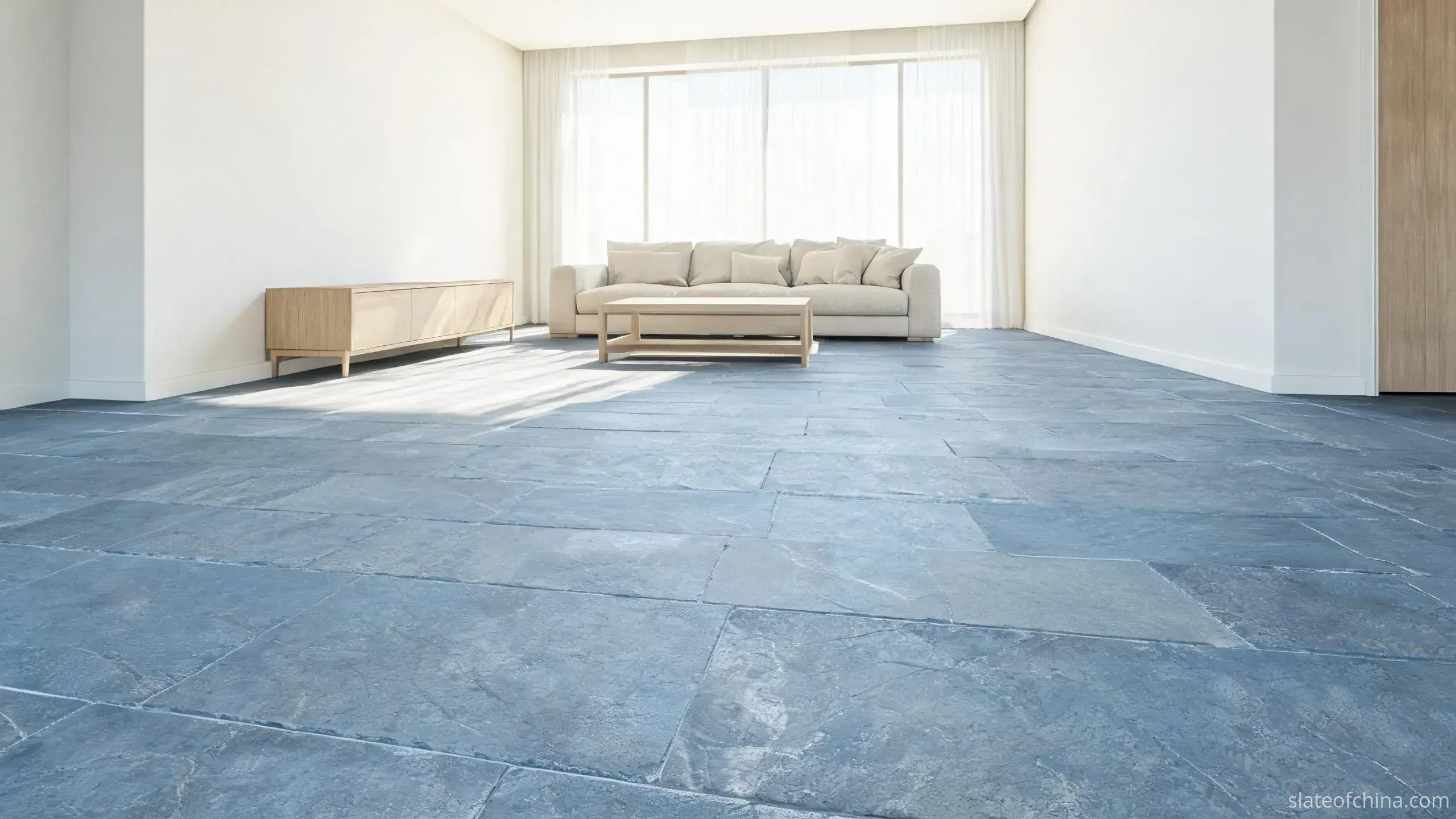
If Slate Wins Your Comparison: Seven Checks Before the Deposit
If this guide has done its job, you already know whether the room belongs to slate. The last thing standing between a good slate floor and a disappointing one is not geology — it is the concrete checks on the order. These are the seven I walk buyers through, and they apply to any slate supplier, not only to ours.
One — name the room, in writing. Interior or exterior, wet service or dry, slippers or boots, underfloor heating or not. That single sentence decides which physical figures matter in every check that follows.
Two — ask how the back was finished. Gauged, calibrated backs are machine-flattened: tiles set flat and fast in a thin adhesive bed. Hand-cleft backs are natural, characterful, and want a fuller, more patient bed. Neither is better. They are different systems at different prices, and pairing the wrong back with the wrong bed is a classic slow-motion floor failure.
Three — ask how thickness spreads, not what it averages. A crate can average exactly 20 mm and still hide a 17 and a 23. The number that protects you is the permitted deviation around nominal, written on the order or proforma invoice — not a catalogue claim.
Four — for anything wet or exterior, absorption evidence for the batch. Not the generic stone type: the actual production lot. This is a request a serious supplier expects — and asking for help reading a test report is a fair follow-up question.
Five — wet slip data against the finish code you will receive. Section 6 applies to buying as much as to specifying. If traction matters to the room, the finish carries a number, and the order can name it.
Six — read the cleft, not just the colour. Colour is how samples get chosen; the cleft is how floors get judged. Clean, sound faces, firm edges, no lifting laminae along the sides — judge the edges of the actual batch samples, never a website's best tile.
Seven — seal a reference sample, with numbers. One tile or a small set, marked with the specification, agreed and initialled by both sides, quoted in the order as what production is checked against. The sample approval routine is documented for slate orders generally; on a floor-sized order it is the smallest formality with the longest memory.
Run those seven, and the word slate stops being a bet and becomes a batch of stone with a face, a finish and a file. When you reach that point, the comparison with granite, marble and porcelain is already over — materials do not compete on honesty. If you would like to see what a calibrated, cleft-face floor slate actually looks like before that conversation, the paving and flooring slate range is on the product pages; if you already know your room and your square metres, the desk answers enquiries within one working day, with whichever of the four floors the room honestly calls for.
When the shortlisted slate comes from Jiujiang, one more check belongs at the desk level. Jiujiang is a regional source, not a single standardised grade — the name covers a whole quarry belt, and the material you receive is defined by the specification you write. For a flooring or paving order, confirm the thickness, the dimensional tolerances, the surface finish code, absorption evidence for the actual batch, and the suitability of that material for the intended environment — wet, exterior or freezing service. On exterior installations, drainage and freeze–thaw performance join the list. And when weighing Chinese slate against porcelain or any other natural stone, judge the complete specification and the delivered cost: origin and material name alone have never carried a floor safely across the sea.
From the sample table, one last time: none of the four floors is "the best". Each is the best for a room that agrees with it — and you now know how to get the room, the water, the budget and the cleaner to all vote. Let them.
Frequently Asked Questions
Is slate flooring better than porcelain tile?
Not automatically — better for what? Slate wins on authentic texture, a face that never repeats, thermal mass underfoot and wet grip from a natural cleft finish; porcelain wins on consistency, classified low water absorption, a no-sealing care routine and invisible dye-lot replacement. Rooms that reward character lean slate; rooms that reward predictability lean porcelain. Name the room first, and the question answers itself.
Which is more durable, slate or granite flooring?
Granite is harder and more scratch-resistant, so for genuinely brutal entrances it is the safer answer on paper. But floors more often fail through water, substrate voids and installation errors than through scratching, and on those both stones are equally exposed. Dense, well-graded slate covers most residential and much commercial service; a low grade of either stone is a problem waiting for a warranty claim.
Which is less slippery when wet: slate, granite, marble or porcelain?
The finish votes, not the material. Textured slate and quality textured porcelain typically read as the safer wet choices; polished marble and polished granite demand genuine caution wherever water stands; in-between surfaces — honed slate among them — are settled by test data. Ask for wet slip data for the exact finish — pendulum PTV readings in the UK, R-classes in much of Europe, ANSI A326.3 in the US — and compare numbers, not material names.
Does slate flooring need to be sealed?
Depends on the lot, the room and the sealer — a five-minute water-drop test on the back of a sample gives an initial indication, not a verdict: a drop that stands proud suggests low absorption, while a drop that soaks in and darkens the stone suggests a penetrating sealer belongs in the plan for kitchens and wet areas. Weigh that reading together with the stone’s absorption data, the intended use and the sealer manufacturer’s recommendations. Sealers slow staining; they do not make stone waterproof, and the reseal interval follows the sealer's data sheet.
Is slate flooring cheaper than porcelain tile?
There is no universal ranking. Grade, thickness, finish, order size, freight and local installation rates all move the final figure more than the material name does. Budget porcelain can undercut budget slate and premium porcelain can out-price premium slate within the same month. Compare fully installed quotations for the same room — material, fixing, sealing and a decade of care — rather than square-metre prices from different continents.
Which of these floors is best for a bathroom?
Wet rooms are decided by finish and details, not by material: textured porcelain and cleft-face slate with slip data for the finish are the established safe pair, polished marble is a poor bathroom bet, and granite works in textured or honed finishes. For any natural stone in wet service, add absorption evidence for the actual batch, correct waterproofing and a drainage plan — the floor is only one part of a wet room that wants to stay dry.
What is the easiest flooring to maintain: slate, granite, marble or porcelain?
Porcelain is usually the simplest: the body takes a pH-neutral mop and forgets, with grout the only detail. Granite is close behind. Slate adds one habit — an occasional sealing check — and marble adds acid discipline: no vinegar-based cleaners, no citrus products, spills wiped promptly. None of the four is difficult; the differences live in sealing schedules and how much chemistry you allow near the floor.
What is the best stone flooring for high-traffic areas?
It depends what the traffic is. Constant footfall with grit says granite or porcelain rated for heavy commercial use; rolling or point loads are an engineering question about the build-up, not a material question; and a dense, gauged slate quietly covers busy domestic floors for decades while hiding the scratches as it goes. Ask for abrasion and absorption data for the actual product, and put a coarse mat at every door — most floor wear is grit traffic, and mats are the cheapest durability upgrade there is.
Related Reading
Bring the room, not just the sample number.
Tell the desk where your floor will live — the room, wet or dry, boots or bare feet, the area, the finish you liked, and the destination — and the reply will be an honest read: which of the four materials actually fits, and if it is slate, which grade and finish, with the batch evidence to hold it to.
If the honest answer for your room turns out to be porcelain, we will say so plainly — it costs us one order and earns a decade of better ones. Browse the paving and flooring slate range, or write to the deck.