
Choosing Slate for Professional & Tournament Tables: Thickness, Tolerance & Certified Flatness
Quick answer: a tournament bed is not simply a thicker bed. Professional and tournament tables run on natural slate at the thickness the table design calls for, held to a written flatness tolerance with a measurement method behind it, machined to an approved drawing, and shipped with per-piece inspection records. Thickness is the visible half of the specification — tolerance and documentation are the half that decides the tier.
TOURNAMENT SLATE — THE SPEC, AS AN RFQ SHOULD READ IT
MATERIAL Natural slate, machined to the approved table drawing — why that is the professional bed
THICKNESS Follows the table design: 25 mm on many 9 ft professional pool beds, 45 mm on a full-size snooker bed
FLATNESS An agreed tolerance, a stated measurement method, verified and recorded per piece
PIECES A design decision: three on a 9 ft bed, five on a 12 ft snooker bed — not a quality grade
RECORDS Per-piece inspection records and the drawing revision travel with the set
For fifteen years I have been the person who reads the slate pages of tournament table RFQs — the championship-line specifications from table brands, the tender documents from clubs refitting an event room, the short emails from distributors asking for "the good stone". The most expensive mistake I meet again and again is none of the obvious ones. Not a thin bed. Not a warped one. It is the word certified on a quotation that arrived with nothing behind it: no measurement method, no inspection record, no document a referee or a QC manager could actually hold. The buyer paid tournament money. What arrived was good commercial stone wearing a confident adjective, and the gap between the two surfaced at the worst possible moment — the first incoming inspection, with an event date already printed on the tickets.
This page is written for the people on the other side of that RFQ: table manufacturers building professional and tournament lines, tournament suppliers preparing event rooms, importers quoting a championship range. For them, professional billiard table slate is not a materials romance — the material question was settled long ago, and the honest case for natural stone is argued out on Why Are Pool Tables Made with Slate?, with the full comparison against the boards sold as its substitutes on Natural Slate vs Alternative Playing Surfaces. What remains is a specification problem with a delivery date: what exactly do professional and tournament tables spec that ordinary commercial tables do not — and how do you confirm, before the stone is cut, that a supplier can hold it?
The short version: tournament grade is not a different stone. It is the same stone with four things tightened. Thickness follows the table design — and the designs get more demanding at this scale. Flatness stops being a description and becomes a written tolerance with a measurement method attached. Machining is tied to an approved drawing rather than a catalogue. And documentation travels with the set — per-piece records, the drawing revision, the batch identity. Buyers who purchase the vocabulary without the four things behind it end up buying the same stone twice. The sections below take those four in order, then look at the two worlds that spec them hardest — snooker and pool — and close with the verification asks and the three RFQ lines that put the whole agreement in writing. If your question is the broader one — which slate to choose at all, across table types and budgets — start with How to Choose Billiard Slate; this page is the deep cut for the professional tier.
What "Tournament Grade" Actually Changes
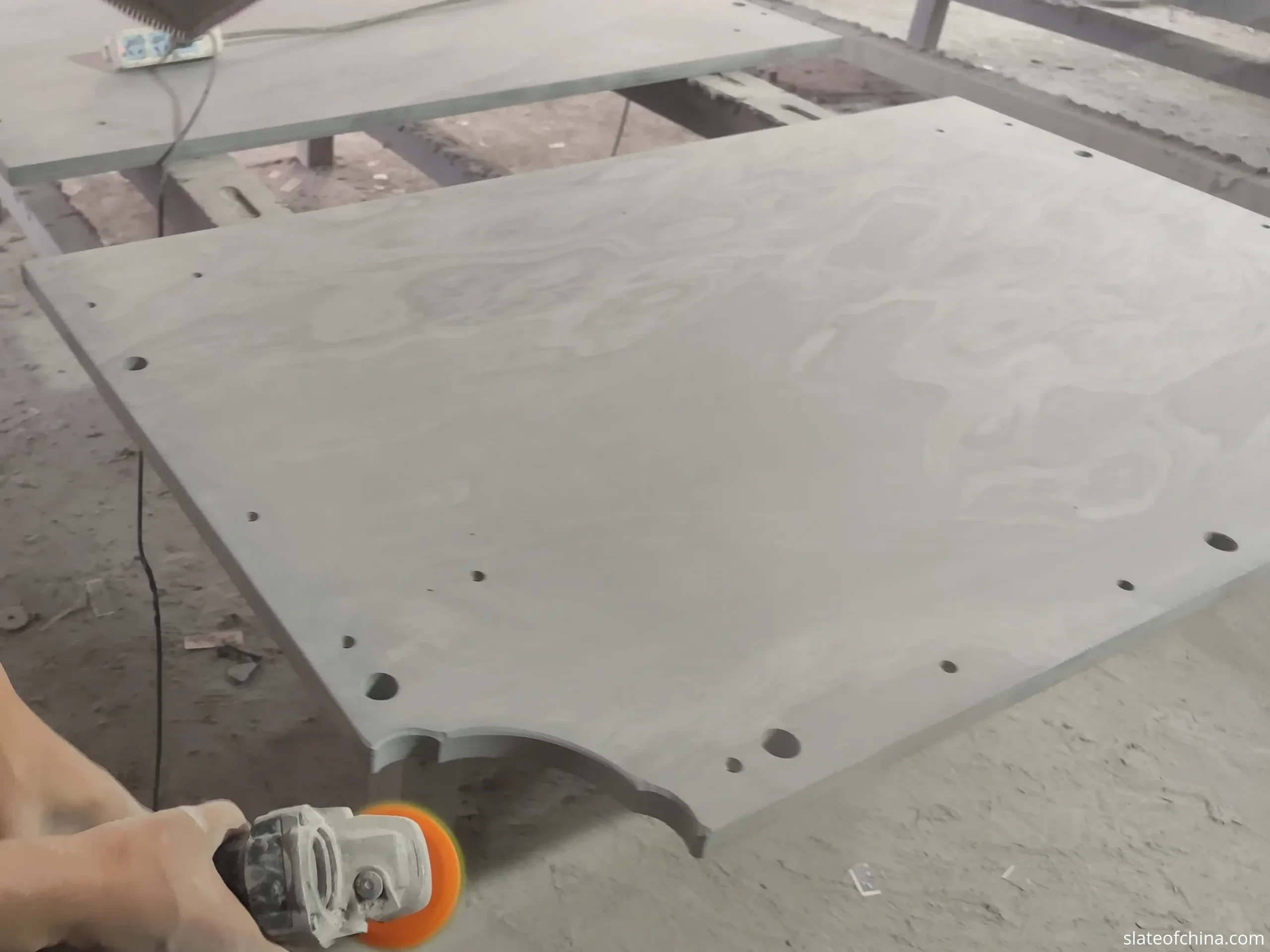
Walk a commercial order and a tournament order through the same factory and the first stations look identical. The same blocks are selected. The same saws open the panels. The same grinding lines dress the faces. Anyone shopping for competition grade billiard slate should understand this before anything else: the tier is not created at the quarry, and it is not created by the word premium on a price list. It is created at the points where the order is written down — and then measured.
Four things separate the two RFQs on my desk. Thickness, specified by the table design rather than by ambition. Flatness, written as a tolerance with a measurement method instead of a compliment. Machining, tied to an approved drawing with a revision number instead of "standard pockets" — pockets, bolt holes and joint faces alike. And documentation — per-piece records, batch identity and repeatability between sets that travel with the shipment instead of a promise that someone checked. Everything else about tournament slate, including most of what gets printed in brochures, is downstream of those four.
Two wrong purchases dominate this tier, and they are mirror images of each other. The first is buying millimetres the design never asked for: a brand pays for a heavier bed, skips the tolerance clause, waives the records, and discovers at set-up that a 30 mm bed with per-piece documentation passes the inspection a 45 mm bed shipped on its thickness alone cannot. The second is quoting a commercial QC package against a tender that quietly required per-piece verification — a supplier loses that order not on price but on page three of the technical annex, without ever being told why. The tier lives in the tolerance and the paperwork. The stone simply has to be good enough to carry them.
Tournament Table Slate Thickness: Follow the Table, Not the Tier
Thickness is the line every buyer sees first, because it is the line that shows up on the packing list. It is also, on its own, the least informative specification in the document. Tournament table slate thickness answers one question — how much stone the design calls for — and answers nothing about the plane that stone will hold.
| Table class | Typical slate specification | What the spec sheet should say |
|---|---|---|
| 7–8 ft home & light-commercial pool | 19–22 mm | Thickness is usually the whole spec at this level — acceptable here, fatal at the next tier |
| 9 ft club & commercial pool | 25 mm, usually three-piece (250–270 kg the set) | The workhorse standard; per-set weight drives freight and crew planning |
| 9–10 ft premium & tournament pool designs | 30 mm where the frame is engineered for it | Bought for stiffness and feel — must be matched by records, not assumed |
| 10 ft snooker | 38 mm | The intermediate professional snooker specification |
| 12 ft professional snooker | 45 mm, five-piece (close to 800 kg the set) | The heaviest common spec in the game; single pieces run 160–170 kg |
| Chinese 8-ball tournament beds | 45 mm | The standard order in this discipline; playing area and outline to drawing |
| Carom & Russian pyramid tournament beds | 45 mm and up, association-dependent | Confirm against the association's current published table rules, not from memory |
Commonly produced specifications, not a universal standard — thickness is set by the table design and confirmed on the approved drawing.
The complete size, thickness and weight tables for every table type — the reference behind the summary above — sit on Billiard Slate Technical Specifications.
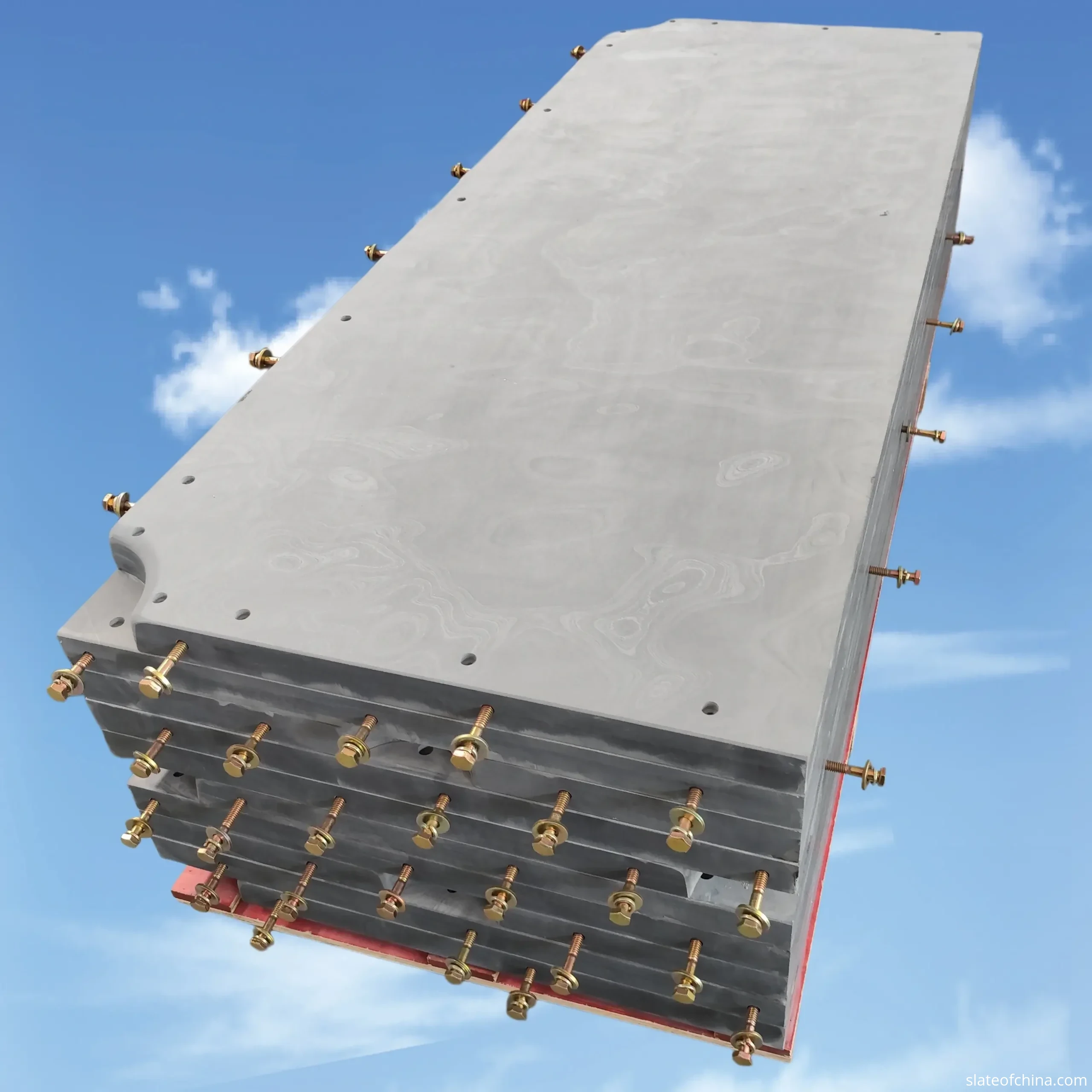
Thickness earns its place at tournament scale for reasons that are structural more than mystical. A 12 ft bed has to span its frame without pretending the frame will hold it. A five-piece set spends its life being lifted, levelled, stripped and re-clothed — a heavier panel takes that routine without learning bad habits. And a thick bed gives the grinding process more stone to work with: the face is dressed flat, not inherited flat, and a deeper section holds the machined plane through decades of handling that a thinner panel would gradually renegotiate with the room.
Does Tournament Slate Need More Than 45 mm?
Usually, no. Forty-five millimetres is where full-size snooker settled — the commonly produced professional specification — and the mass it puts in the bed, close to 800 kg in five pieces, is already at the practical limit of what a club staircase and an installation crew want to meet. Fifty-millimetre beds exist as an option for specific requirements: designs whose frames are engineered for the extra load, tables that will rarely if ever be moved, and the occasional tender that asks for the mass on purpose. If a design genuinely calls for it, the drawing says so. What extra millimetres never buy is the thing this page is about — a 50 mm bed finished carelessly is a heavier problem, not a flatter table, and the tier comes down to tolerance, machining and records either way. Why the industry treats 45 mm as the working answer rather than a compromise — and where the extra millimetres stop paying — is argued properly on Pool vs Snooker vs Chinese 8-Ball Slate Thickness.
What thickness does not do is certify anything — a tournament RFQ that specifies millimetres and nothing else has specified the easy half of the bed. This page moves on to the harder half.
Flatness: The Specification That Separates the Tiers
Flatness is the spec that actually separates commercial from tournament, because it is the one that cannot be seen. A bed can arrive at the right thickness, the right dimensions, the right piece count — and still throw the first long diagonal a professional sends down it. Thickness shows on the packing list. Flatness waits.
Why Small Deviations Matter More at Tournament Scale
A deviation a short shot forgives, a long one punishes. On a club table most shots cross a metre or two of slate before they arrive, so whatever the bed does to the ball has only that much distance in which to do it. A 12 ft tournament table asks the same bed to carry a ball over three and a half metres of dressed stone — and any departure from the plane has the whole length of the shot to develop into something a professional can see. Tournament pockets then take away the margin: a ball that arrives a few millimetres off its line on a club table is a bad shot, and the same arrival on a tournament bed is a lost frame. That amplification — not any change in the material — is why the flatness discipline tightens as the table gets serious.
A complete flatness clause has four parts, and a billiard slate flatness tolerance is only as strong as its weakest one. The number: agreed between buyer and supplier, in writing — what real measured values look like on actual records is shown in detail on Billiard Slate Quality & Test Data. The method: a straightedge with feeler gauges, a dial indicator traversing a controlled reference surface, or a scan — each measures something slightly different, which is why the clause must name one. The pattern: across the face, along both diagonals, and deliberately into the joint zone rather than around it. And the evidence: verified per piece, recorded, dated, attached to a batch. A tolerance without a measurement method is an adjective. It fills the line on a quotation and empties the line at verification.
| Application tier | Flatness discipline | What to require in writing |
|---|---|---|
| Home & light-commercial (7–8 ft) | Dressed faces; accuracy taken on trust | Thickness and dimensions — the honest whole spec at this level |
| Club & commercial (9 ft) | Main faces ground and verified | A named tolerance plus a per-set check |
| Professional & tournament pool | The full clause — tolerance, method, pattern, per-piece records | All four parts written into the RFQ |
| Tournament snooker (12 ft, five-piece) | The strictest tier — the seam zone inspected hardest of all | Per-piece records, matched-set verification, an agreed incoming inspection plan |
| Multi-table event orders | Flatness plus batch-to-batch consistency | Every batch cut to the same revision, verified against the same retained reference |
Discipline tiers, not published standards — flatness numbers are agreed between buyer and supplier; what measured records actually look like is shown on Billiard Slate Quality & Test Data.
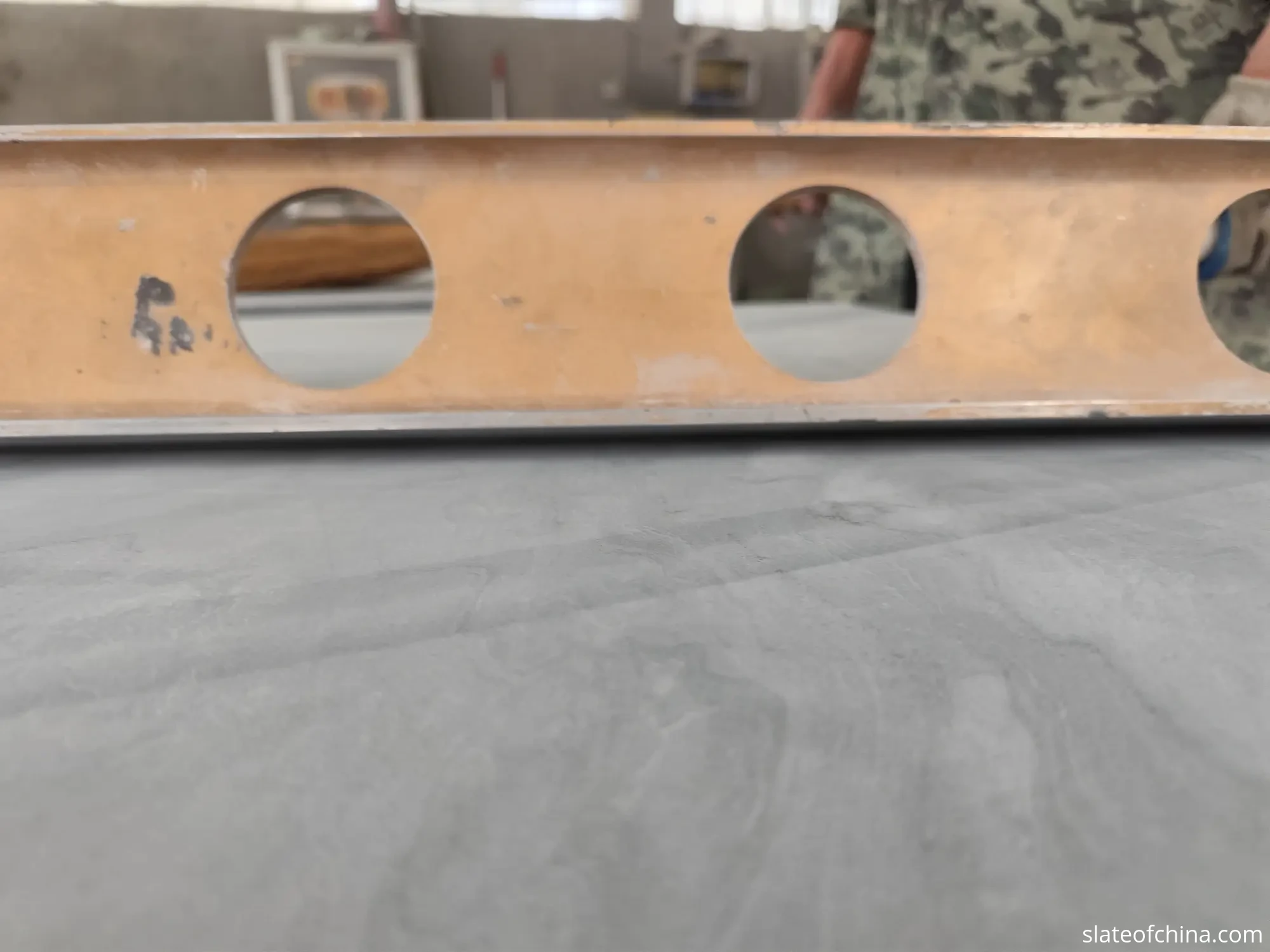
Experienced buyers therefore interrogate the flatness line harder than any other clause in the slate section. Where is the number measured, and with what tool? Is every piece verified, or a sample of the batch? Does the record travel with the shipment or stay in the supplier's drawer? The difference between a commercial and a tournament flatness specification is rarely the number itself — it is whether the number is written down, measured in a named way, and traceable to the individual piece. For a table manufacturer, a bed that misses its tolerance is paid for three times — in extra levelling work on the assembly floor, in installation slots that slip, and in the complaint that eventually names the brand rather than the quarry. Any supplier can say "very flat". A tournament supplier can hand you the sheet of paper that proves it, piece by piece.
"Certified Flat": What the Paperwork Has to Say
Roofing slate buyers can order to EN 12326 or ASTM C406 and receive test certificates against named, published standards. Billiard slate has no equivalent: flatness and tolerance on a billiard bed are set by the table brand's drawing and the buyer's inspection plan, not by a slate standard a third party certifies against. So when a quotation offers certified flat billiard slate, the honest question is not "who certified it?" but "what arrives with it?". In practice, certified means documented — and the document is the deliverable.
With a tournament set, that document package should include five things. A per-piece inspection record — flatness, thickness and machining dimensions for each piece, with the piece identity, method, measured values, date and inspector on it. The drawing revision the set was cut to, so the pockets and holes on your floor match the paper the supplier worked from. Batch and set identifiers that tie the pieces together, because a matched set is a unit, not a pile. A retained reference — a golden sample held against future batches, which is how OEM programs keep the hundredth set behaving like the first, a discipline described in OEM Billiard Slate for Table Manufacturers. And an agreed incoming verification plan, so both sides know before the container is loaded what will be checked on arrival, with what tools, and against which limits.
The answer that should end a shortlist is the cheerful one: "very flat, no problem". The answer that should extend a shortlist sounds like a process — a named tool, a named pattern, a named record. The ten questions that separate a real slate manufacturer from a trading desk have a page of their own in How to Choose a Billiard Slate Manufacturer; the five asks specific to tournament work are at the end of this page.
Machining: The Drawing Is the Specification
On a tournament bed, the drawing is the specification. Pocket openings are the clearest example: the radius and the entry angle have to match the cushion system the table ships with, and those numbers live on the table brand's CAD file, not in a supplier's catalogue. Nominal sizes are where the conversation starts — the piece of information that turns a nominal size into a manufacturable pocket, item by item from playing area to pocket angle, is tabulated in Custom Billiard Slate Manufacturing. American brands add their own layer: a formal drawing approval process before the first production set, walked through in American Pool Table Slate Buying Guide for Manufacturers.
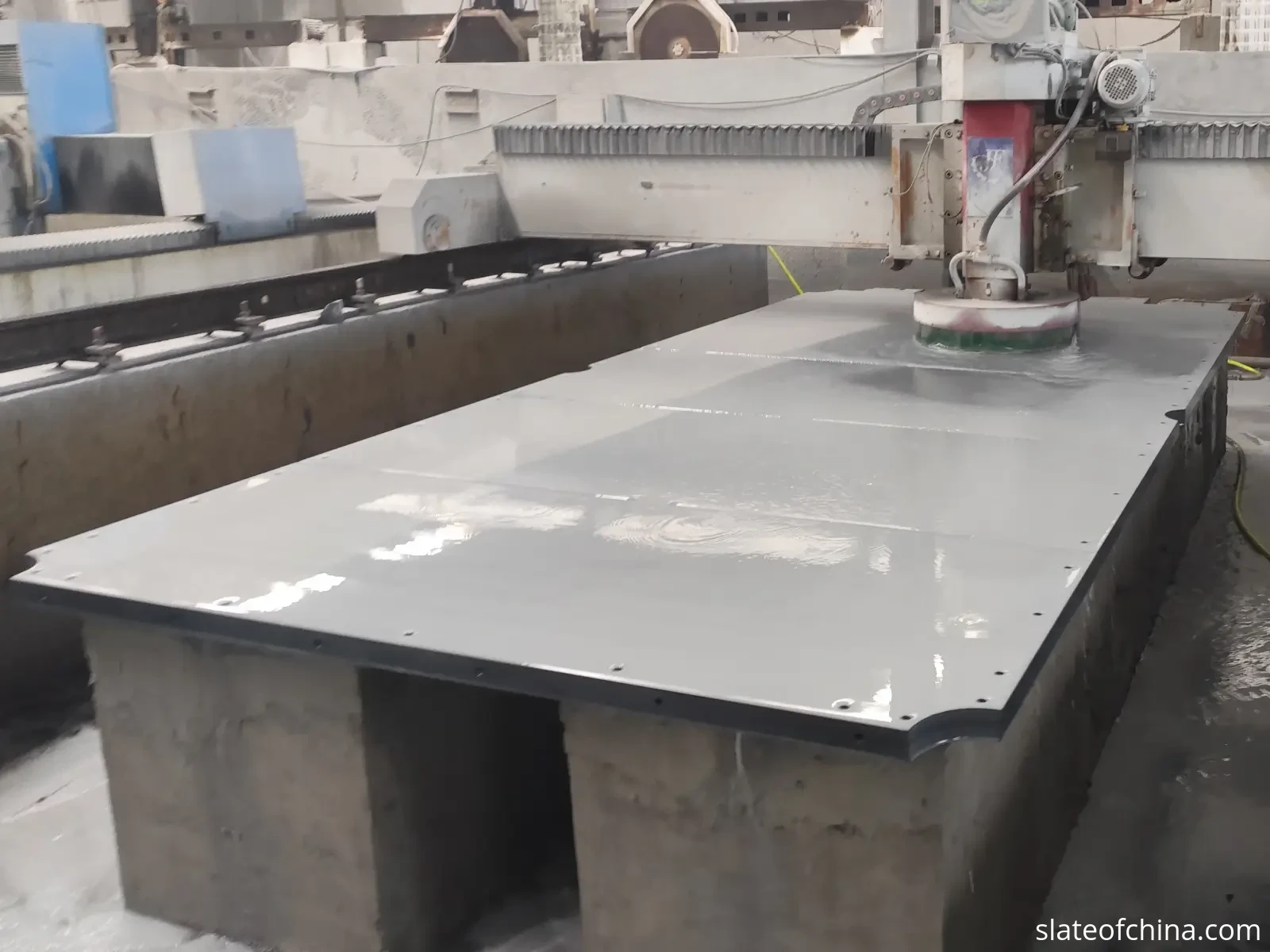
Bolt holes obey the same law. Rail bolts, slate screws, countersinks: every hole position on the drawing is a promise that the bed will drop onto its frame without a drill appearing in the fitter's hand. At commercial volume a misdrilled hole is a rework ticket; at tournament volume it is a set that misses an event date. Precision machined slate for billiard tables is not a premium option at this tier — it is the baseline the rest of the specification assumes. For beds cut to your own drawings rather than standard formats, the machining capability behind it is summarised on the custom CNC billiard slate page.
The last machined features are the ones nobody photographs: the joint faces. Squared, flat, machined as pairs, verified across the seam — because on a multi-piece tournament bed, the joint is where the specification is won or lost.
The Joint Is the Hardest Test
Almost every tournament bed is a multi-piece bed, for a reason no spec sheet can argue away: no doorway in the sport welcomes a 12 ft monolith. A full-size snooker set travels as five pieces of 160–170 kg each, close to 800 kg for the set, and the piece count is set by the table design and the buildings the table must enter — the full economics of one-piece versus multi-piece construction are worked through in 1-Piece vs 3-Piece Pool Table Slate for Manufacturers.
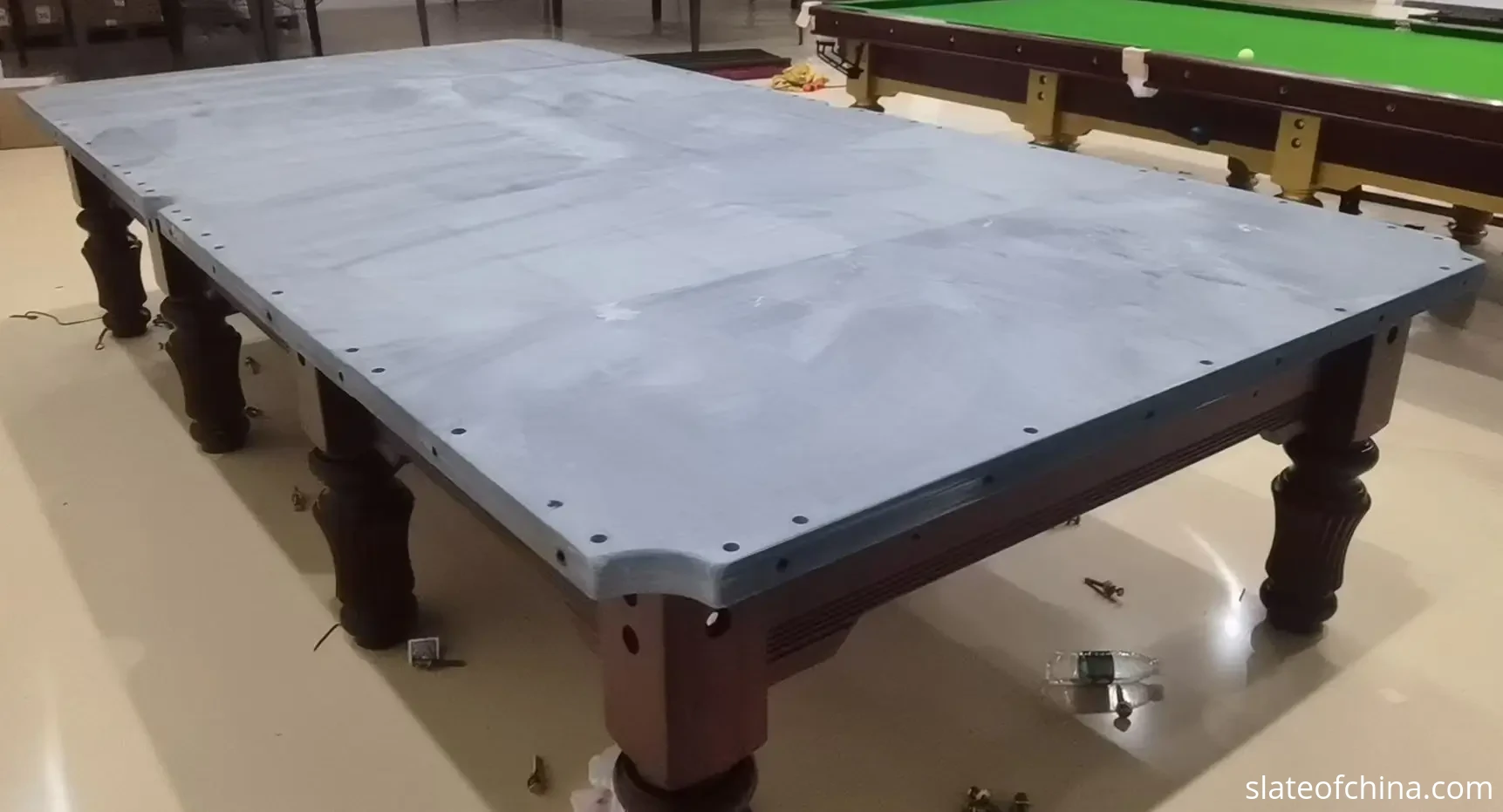
Two disciplines make a joint trustworthy. The first happens at the factory: joint faces are machined as matched pairs, and the pieces of a set are not interchangeable with the pieces of the next set — a bed that left the factory as Set 41 stays Set 41 for the rest of its life. The second happens at installation, and it is where the buyer's specification either pays off or quietly dies. The frame is levelled first. The pieces go down in sequence. The seams are filled with hard wax — the trade's traditional beeswax, still the honest choice — and dressed flat. Then the fitter works a straightedge across every seam before a single length of cloth is glued. The factory's certificate and the fitter's straightedge must agree; when they do not, the argument that follows is about which document misled, and nobody wants that argument during event week.
In our inspection practice the seam neighbourhood is measured hardest of all: the 300 mm either side of every joint, on both pieces, before a set is approved for packing. A bed can hold a beautiful plane across the middle of each piece and still throw a ball at the seam — which is why a tournament flatness clause that ignores the joint zone has inspected the easy four-fifths of the bed and called it the whole.
Snooker, Pool and the Other Tournament Worlds
"Tournament" is not one specification, and treating it as one is how brands end up with the wrong bed at the right price. The professional snooker table slate is the heavyweight of the family: a full-size bed in five pieces at 45 mm, a bed outline in the region of 3658 × 1867 mm, a set weight close to 800 kg — with the smaller 10 ft snooker designs stepping down to 38 mm. Snooker asks the most of the stone because the game asks the most of the table: long distances, tight pockets, and a playing public that blames the cloth, the cushion, the humidity and finally the bed, in that order.
One worked example shows how the four tightened dimensions land on a single product — the specification our production runs most often for the tournament snooker class:
WORKED EXAMPLE — 12 FT TOURNAMENT SNOOKER BED
OUTLINE 3658 × 1867 mm class, confirmed on the approved drawing
CONFIGURATION five pieces, machined and verified as one matched set
THICKNESS 45 mm — the commonly produced specification for this class
SURFACE precision ground; flatness verified per piece against the stated method
MACHINING pockets and holes CNC-cut to the table's drawing revision
JOINTS faces machined as pairs; the seam zone inspected before packing
WEIGHT close to 800 kg the set; single pieces run 160–170 kg
That example is a catalogue format, not a concept — the 12 ft tournament snooker slate runs as a standard product line, and the product page carries the sizes, weights and machining scope.
Tournament pool table slate, by contrast, does not need snooker's mass — a point worth repeating to any buyer who has been told that professional means thick. The common 9 ft professional bed is 25 mm in three pieces, 250–270 kg the set, with 30 mm reserved for premium designs whose frames are engineered to carry it. The discipline is identical to snooker's — written tolerance, approved drawing, per-piece records. The design is simply different, which is why the two games' beds are not interchangeable in either direction, an argument made properly in Pool vs Snooker vs Chinese 8-Ball Slate.
The rest of the tournament world specs along the same spine with different drawings. Chinese 8-ball runs 45 mm beds as its standard order, with the pocket geometry that gives the game its character — see Chinese 8-Ball Table Slate. Carom tables carry association specifications of 45 mm and up, with the pocketless bed and, on some tables, heated-bed provisions of their own — Korean Carom Table Slate covers the most exacting of these. Russian pyramid plays on 45 mm beds cut to its own tight pocket standard — Russian Pyramid Table Slate. One discipline, many drawings: thickness follows the game's table design, and the tier always comes from the tolerance and the records.
Batch Consistency: The Clause Most RFQs Forget
A tender for sixteen tables is not an order for sixteen beds. It is an order for one playing condition, sixteen times — and the day a top seed draws table nine instead of table one is the day the whole order is judged on its most average set. Multi-table event work therefore adds a fifth requirement to the four at the top of this page: batch-to-batch consistency, written into the purchase order rather than assumed from the sample.
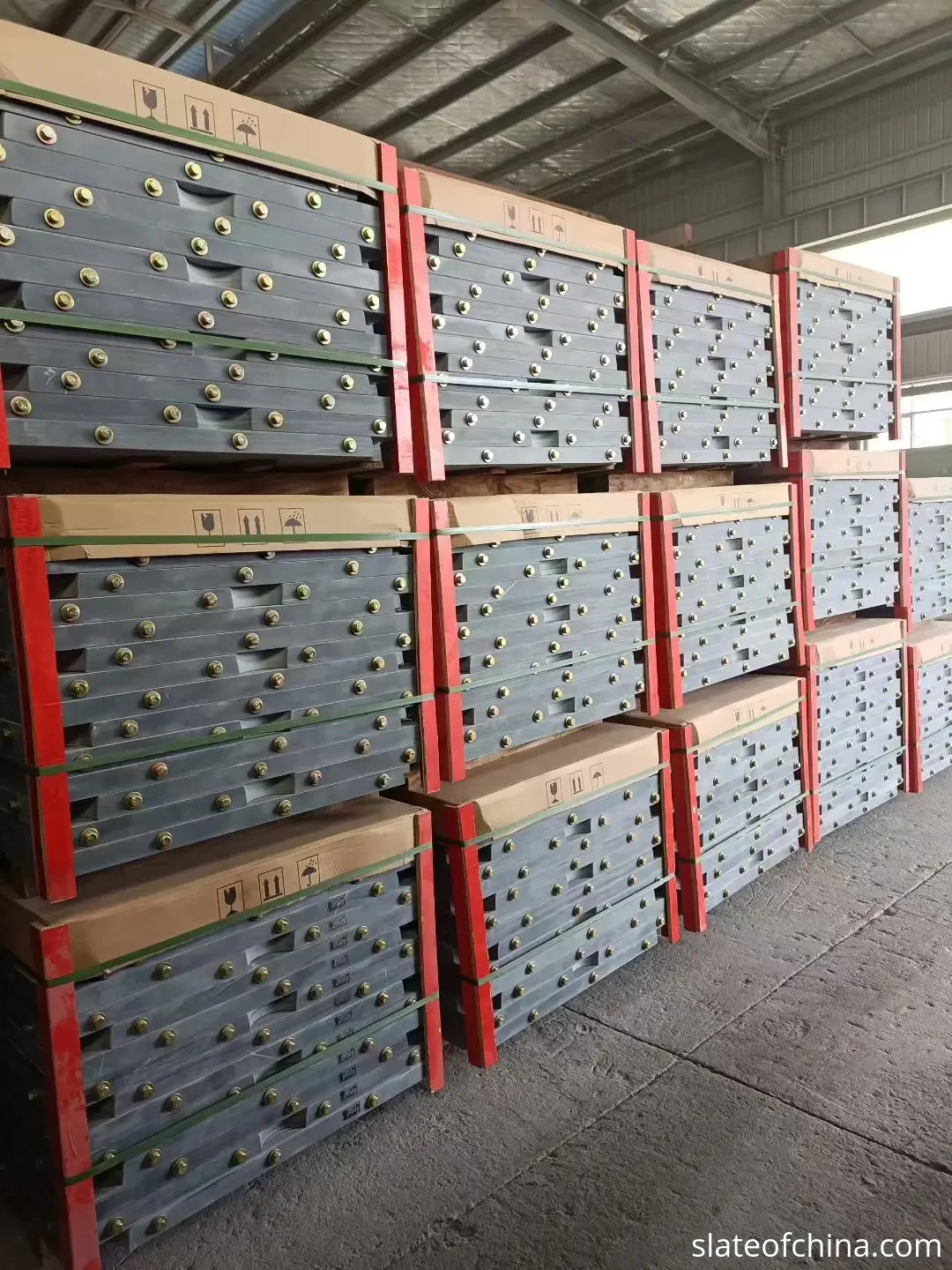
Consistency is manufactured, not hoped for: the same approved drawing at the same revision, the same machining route, the same inspection plan run per batch, and a retained golden reference that keeps batch fifty-one behaving like batch one. That system is described from the supplier side in OEM Billiard Slate for Table Manufacturers; from the buyer side, the clause to write is simply that every batch ships with its own records, cut to the same revision, verified against the same reference.
And order the spare pieces with the set. This is the cheapest line in the RFQ and the one most often left out. A replacement piece cut months later from a different block can stand proud at the seam or sit low under the straightedge — matched at the batch, it drops in. Any manufacturer sourcing billiard slate at event scale eventually learns this, usually the week after the piece they did not order gets cracked in transit.
Verifying the Supplier Before the Stone Is Cut
The full factory audit — the ten questions that separate a real manufacturer from a trading desk — has its own page in How to Choose a Billiard Slate Manufacturer. Assume that audit has been passed. What remains are the five asks that are specific to tournament work, and they can all be made before a single block is sawn:
- A recent per-piece inspection record from a comparable batch. Not a brochure, not a certificate template — an actual record, with piece identities, values and dates on it. What a good one looks like is shown on Billiard Slate Quality & Test Data.
- A written flatness method. The tool, the measurement pattern, and where in the process each piece is checked — stated plainly enough that your own QC could repeat it on arrival.
- First-article approval on your drawing. One set machined, measured and signed off before batch production runs. The first sample is not the product; it is the agreement.
- Drawing revision control. A named revision on every record, and a rule for who approves changes. Tournament tables are engineering products; uncontrolled drawings make them lucky ones.
- An incoming verification plan both sides sign. What is checked on arrival, with which tools, against which limits — agreed before the container is loaded, when everyone is still friends.
Put the same discipline into the RFQ itself, and the specification fits in three lines:
BED natural slate, [thickness] mm, [piece count]-piece, to drawing rev. [revision]
FLATNESS [agreed tolerance], measured [method] at [pattern], verified per piece
RECORDS per-piece inspection record + drawing revision to travel with the shipment
Before You Order: The Tournament Slate Checklist
Run it before the purchase order goes out — the whole page reduces to these eight lines:
- ☑ Slate thickness — confirmed against the table design and the approved drawing
- ☑ Flatness tolerance — written, agreed, and carried into the RFQ
- ☑ Measurement method — tool, pattern and per-piece scope named in the clause
- ☑ CNC hole accuracy — pocket and bolt positions checked against the drawing revision
- ☑ Joint machining — faces machined as matched pairs, seam zone inspected
- ☑ Inspection report — per-piece records travelling with the set, not staying in a drawer
- ☑ Export packing — a packing method designed for heavy slate and the route it travels
- ☑ Export experience — the supplier has shipped this table format to your market before
None of this is expensive to ask, and all of it is expensive to retrofit. A supplier who answers the five asks in writing has already done most of the work of winning the order; a supplier who answers them with adjectives has told you what the word certified on his quotation is worth — which is where this page started.
Frequently Asked Questions
Is there an official standard for tournament billiard slate?
Not the way roofing slate has one. Flatness and tolerance on a billiard bed are not governed by a single published standard that a certificate can be issued against — the working specifications come from table brands and event organisers, and they differ from brand to brand. In practice, professional buyers write their own: an agreed flatness tolerance, a named measurement method, per-piece verification, and records that travel with the shipment.
How thick is the slate on a tournament pool table?
Commonly 25 mm in three pieces on a nine-foot bed — around 250–270 kg per set — with 30 mm appearing in premium tournament designs whose frames are built to carry it. Tournament pool does not demand snooker-scale thickness: the playing discipline is identical, but the table design is different. Thickness follows the table design, never the ambition of the spec sheet.
What does "certified flat" actually mean on a slate quotation?
It should mean documentation, not a stamp. There is no third-party body that certifies billiard slate flatness by name, so in practice "certified" describes the supplier's inspection regime: flatness measured against a stated method, recorded per piece, traceable to a drawing revision and a batch. If a quotation uses the word and cannot produce the record, the word is doing the work the document should have done.
What slate does a professional snooker table use?
A full-size 12 ft table uses a five-piece bed at 45 mm, with a bed outline in the region of 3658 × 1867 mm and a set weight close to 800 kg — single pieces run 160–170 kg. Smaller snooker designs step down: 10 ft tables commonly use 38 mm. The five-piece layout exists because the bed has to reach the room it will play in.
Should tournament slate be one-piece or multi-piece?
That is a design decision, not a quality grade. A nine-foot bed is usually three pieces; a full-size snooker bed is five, because a one-piece 12 ft slab cannot be moved into most buildings. What matters at tournament level is that the joint faces are machined as matched sets and verified across the seams — a well-jointed multi-piece bed plays as one plane.
What should our RFQ say when ordering tournament slate?
Three lines cover it: the bed (natural slate, thickness in millimetres, piece count, to a named drawing revision); the flatness (an agreed tolerance, a named measurement method, verified per piece); and the records (a per-piece inspection record and the drawing revision travelling with the shipment). Add spare pieces cut with the same batch, and the RFQ has done its job.
Related Billiard Slate Guides
Specifying a Professional or Tournament Table?
Send the table type, finished bed dimensions, thickness, piece count and the tolerance-and-records clause you need to hold. We grind, CNC-machine and inspect natural slate beds to your approved drawing, verify per piece, and ship from Jiujiang to table builders in more than 30 countries — confirm the specification with us before the stone is cut, and ask for a recent inspection record with your quotation. Send the drawing itself for a custom CNC quotation, or start with a single sample set to prove the machining — tournament work starts on paper, and so does ours.
Request Tournament Slate Specifications & Quote →
Send Your Drawing for Custom CNC Slate →
Or browse the billiard slate range →
Straight to the beds: pool table slate · snooker, carom & Chinese 8-ball slate · custom CNC billiard slate