
Jiujiang Slate vs Indian Slate
| Factor | Jiujiang Slate | Indian Slate |
|---|---|---|
| Density | 2.7–2.8 g/cm³ (tested) | Varies by quarry, typically 2.6–2.8 |
| Water absorption | 0.1% (EN 12326) | IS 6250 allows up to 2%; actual varies |
| Thickness control | CNC ±0.1 mm, 100% inspected | Often hand-split, wider variation |
| Colour range | Grey, dark grey, black, green | Black, grey, green, purple, gold, multicolour |
| Best for | Large roofing, billiard slate | Decorative cladding, paving, rustic roofing |
| Supply model | Factory-direct, container-scale | Exporters, quarry-dependent |
Two Quotes on a Desk
A distributor in Leeds once showed us two quotations for the same project: 3,000 m² of roofing slate, 500 × 250 mm, 7–9 mm thickness. The Indian quote was 28% cheaper FOB. He asked us why he shouldn't just take the lower number.
We told him the truth: if his project values colour variety and rustic character above dimensional consistency, he should take the Indian slate. If his project needs 3,000 m² of roofing tile that behaves predictably from the first pallet to the last, with documented test data and repeatable specifications, he should look further.
That conversation is why this article exists. Most comparisons of Chinese and Indian slate start and end with price. Price matters — but it is the third or fourth question, not the first. The first question is what the actual slate delivers: density, water absorption, flexural strength, thickness consistency, and supply reliability.
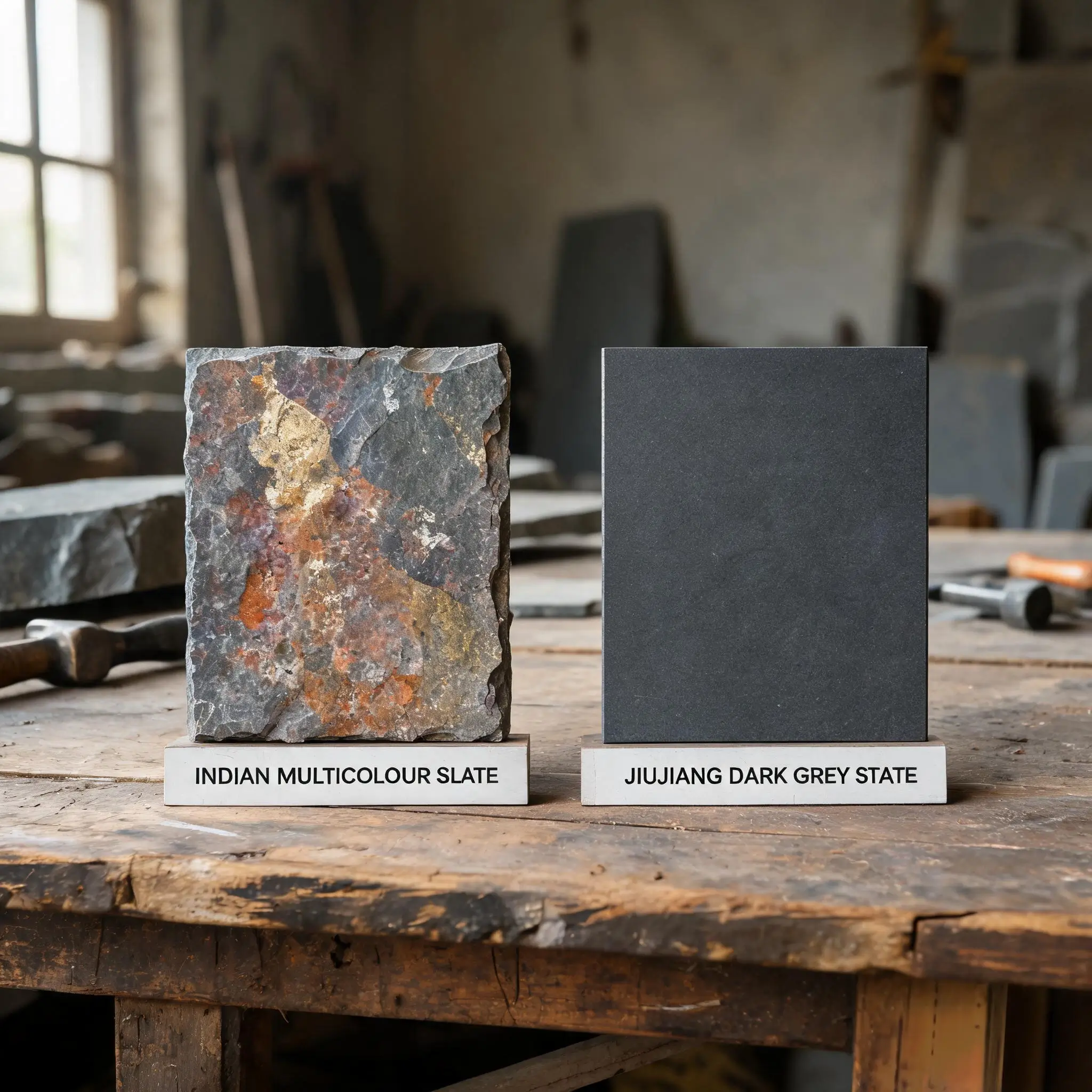
"Indian Slate" Is Not One Stone
Here is the assumption that causes the most trouble: "Indian slate" refers to a single, uniform product. It does not.
India has slate deposits across several geological regions — Rajasthan, Himachal Pradesh, Andhra Pradesh, and others. Government mineral data identifies slate occurrences in multiple states. Himachal slate alone has a long architectural history; geological studies describe it as a Proterozoic rock containing quartz, feldspars, mica and chlorite, with well-developed slaty cleavage.
A Rajasthan multicolour slate and a Himachal grey slate are as different from each other as a Spanish grey is from a Welsh heather-blue. Comparing "China" with "India" is the first approximation, not the last. The real comparison is quarry against quarry, grade against grade, and test report against test report.
Why Indian Slate Wins on Price
Indian slate is genuinely price-competitive, and the reasons are not a secret. India has lower processing costs than Europe or China, abundant labour for hand-splitting, and a quarry infrastructure that produces a wide range of colours at scale.
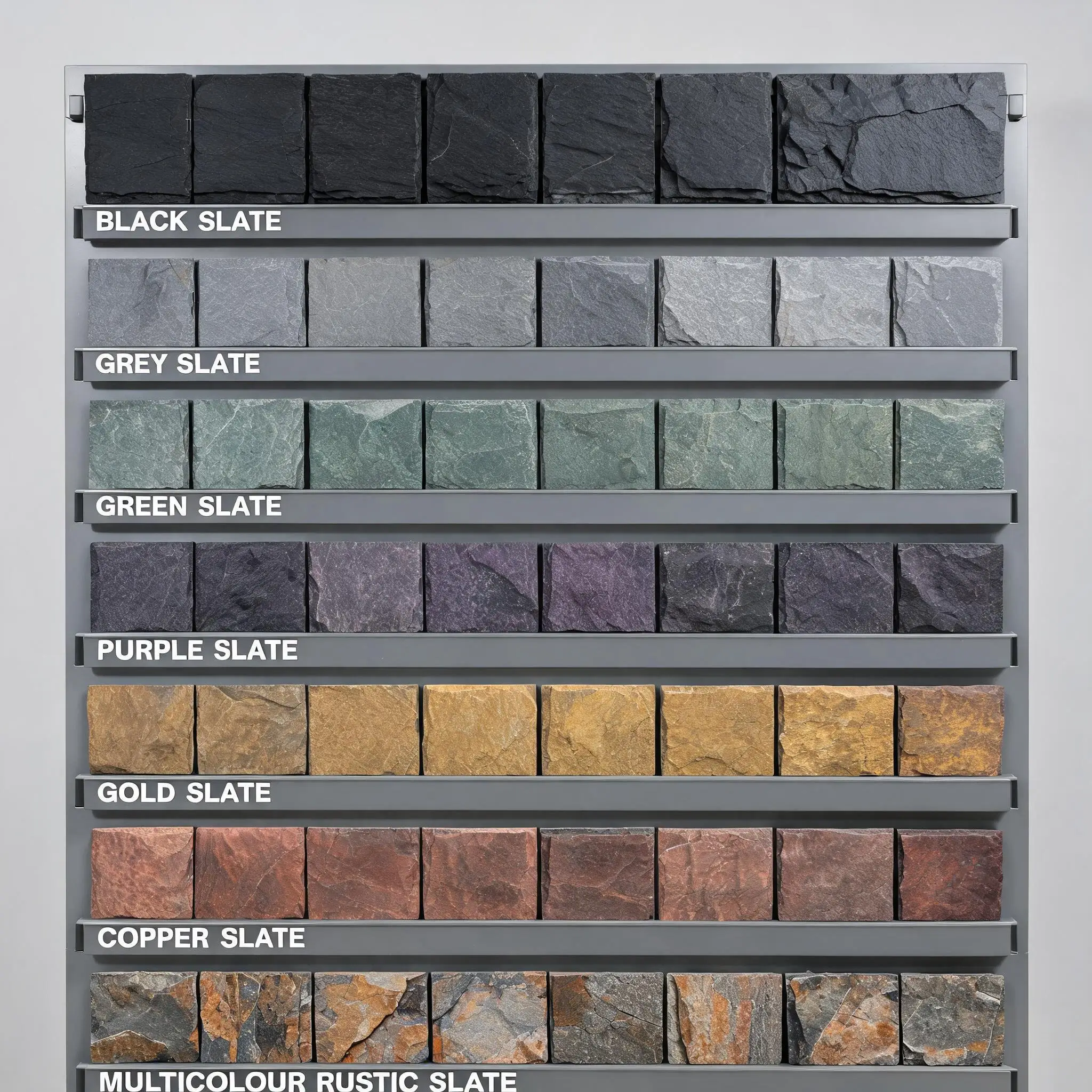
Rajasthan in particular has built a strong export market for decorative slate — wall cladding, paving, flooring, and landscaping stone. Indian exporters offer colours ranging from black and grey to green, purple, gold, copper, and multicolour rustic varieties. For many applications, this natural colour variation is the product's greatest selling point, not a weakness.
If the project calls for natural cleft surfaces, rustic appearance, and strong colour variation — a garden path, a feature wall, a fireplace surround — Indian slate can be the better choice at a better price. The buyer is paying for visual character, not for dimensional uniformity, and that is a legitimate purchasing decision.
Where Jiujiang Slate Wins
Jiujiang slate comes from the Lushan and Xingzi area in Jiangxi Province. The same regional slate industry serves two applications with very different requirements: roofing slate, which needs reliable cleavage and frost resistance, and billiard slate, which needs large blocks machined to ±0.1 mm flatness.
That crossover matters. The CNC equipment that grinds billiard panels to that tolerance also handles roofing tile dimensions. Every piece passes 100% single-piece inspection — thickness, dimensions, surface condition, and flatness. The result is roofing slate with tighter dimensional tolerances than typical hand-split production.
For large roofing projects — 3,000 m² and up — this control is not a luxury. It determines installation speed, breakage rate, and whether the second container matches the first. Read more about what makes Jiujiang slate different.
Density: A Number That Needs Context
Density is usually the first number buyers look at, and it should be. Typical high-quality roofing slate falls in the 2.7–2.9 g/cm³ range. Jiujiang roofing slate tests at 2.7–2.8 g/cm³ — solidly within that band.
But density alone does not tell you whether a slate will last 50 years on a roof. A dense slate with high carbonate content can still weather badly. A slightly less dense slate with excellent cleavage and low water absorption can outperform it. Density needs to be read together with water absorption, flexural strength, mineral composition, and freeze-thaw performance — not as a standalone quality score.
The mistake to avoid: treating density as a ranking. Two slates with similar density can have very different water absorption, and water absorption is the number that better predicts frost resistance and longevity.
Water Absorption: The Figure That Decides Frost Resistance
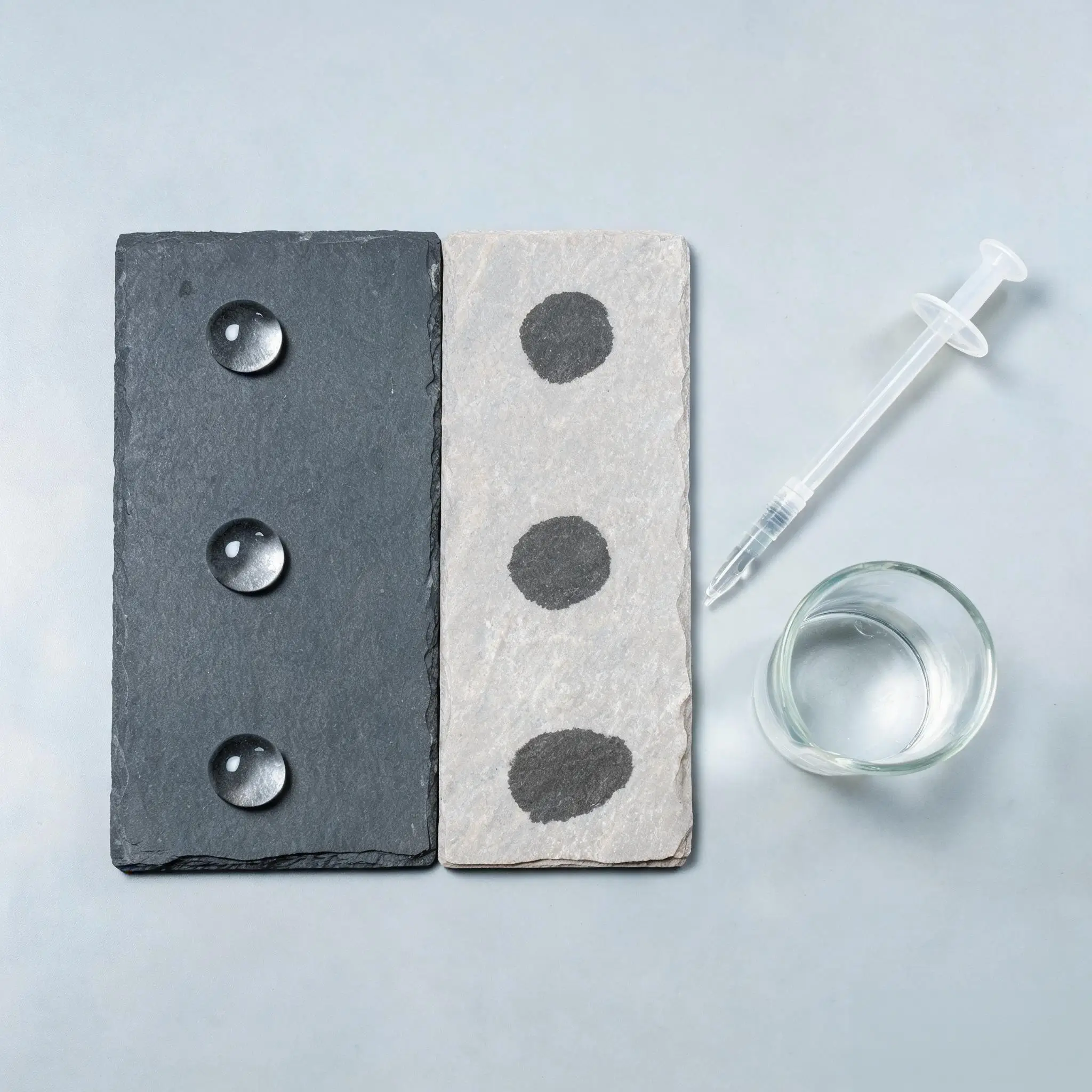
If a buyer can examine only one test result, this is the one. Water enters the stone's pore structure; in cold climates, freezing and thawing cycles stress the material. Low water absorption means less water available for freeze-thaw damage.
India has a formal roofing-slate standard — IS 6250:1981 — which sets a maximum average water absorption of 2% by mass for roofing slate tiles. That standard exists because Indian roofing slate, properly selected, can meet specification requirements. A buyer should ask an Indian supplier for the actual test result of the material being supplied, not just rely on the standard's existence.
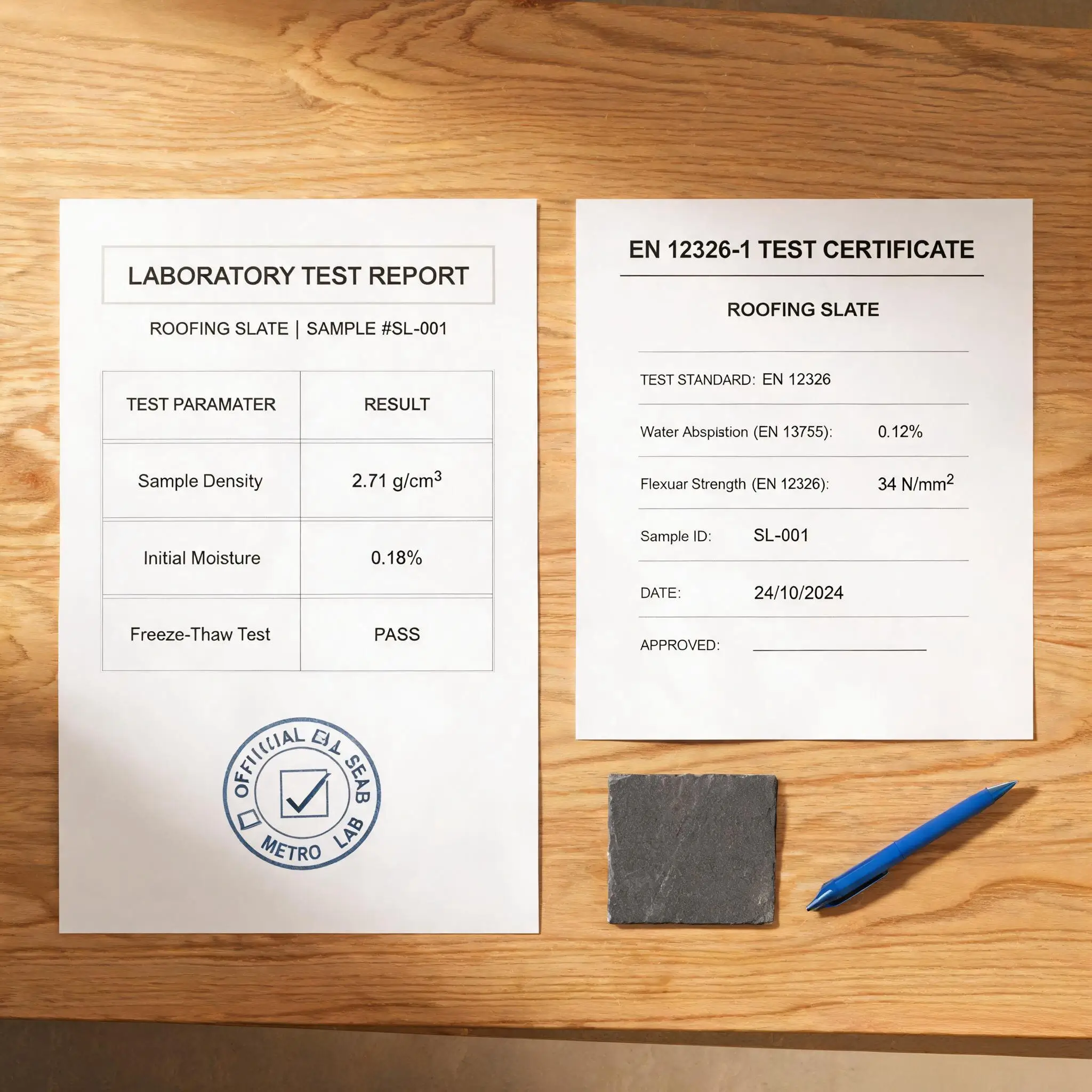
Jiujiang slate has been independently tested at 0.1% water absorption by EN 12326, 0.13% by an American laboratory using ASTM method, and 0.2% by a third lab. All three results are below the EN 12326 A1 threshold of 0.6% by a factor of three to six, and well below the IS 6250 ceiling of 2%. You can see the full published test results here.
Those numbers are not a verdict on Indian slate. They are a starting point for comparison. If an Indian supplier can provide test data showing 0.5% or 0.3% for their specific quarry, that is a good slate. If the only answer is "premium quality" with no report, that is not a specification — it is marketing. Read more about why water absorption decides longevity.
Consistency: What Variation Actually Costs You
Here is the difference that commercial buyers feel most. A shipment can have a good average specification and still create problems.
Imagine ordering 10,000 m² of roofing slate. The question is not only "is the average quality good?" but "how much variation should I expect from one pallet to another?" Thickness variation slows installation. Size variation disrupts laying patterns. Colour variation affects the finished appearance. Different cleavage characteristics can mean different breakage rates.
For rustic projects, this variation is the product's charm. For a large standardised roofing project, it is a cost — in labour, in waste, and in the contractor's patience.
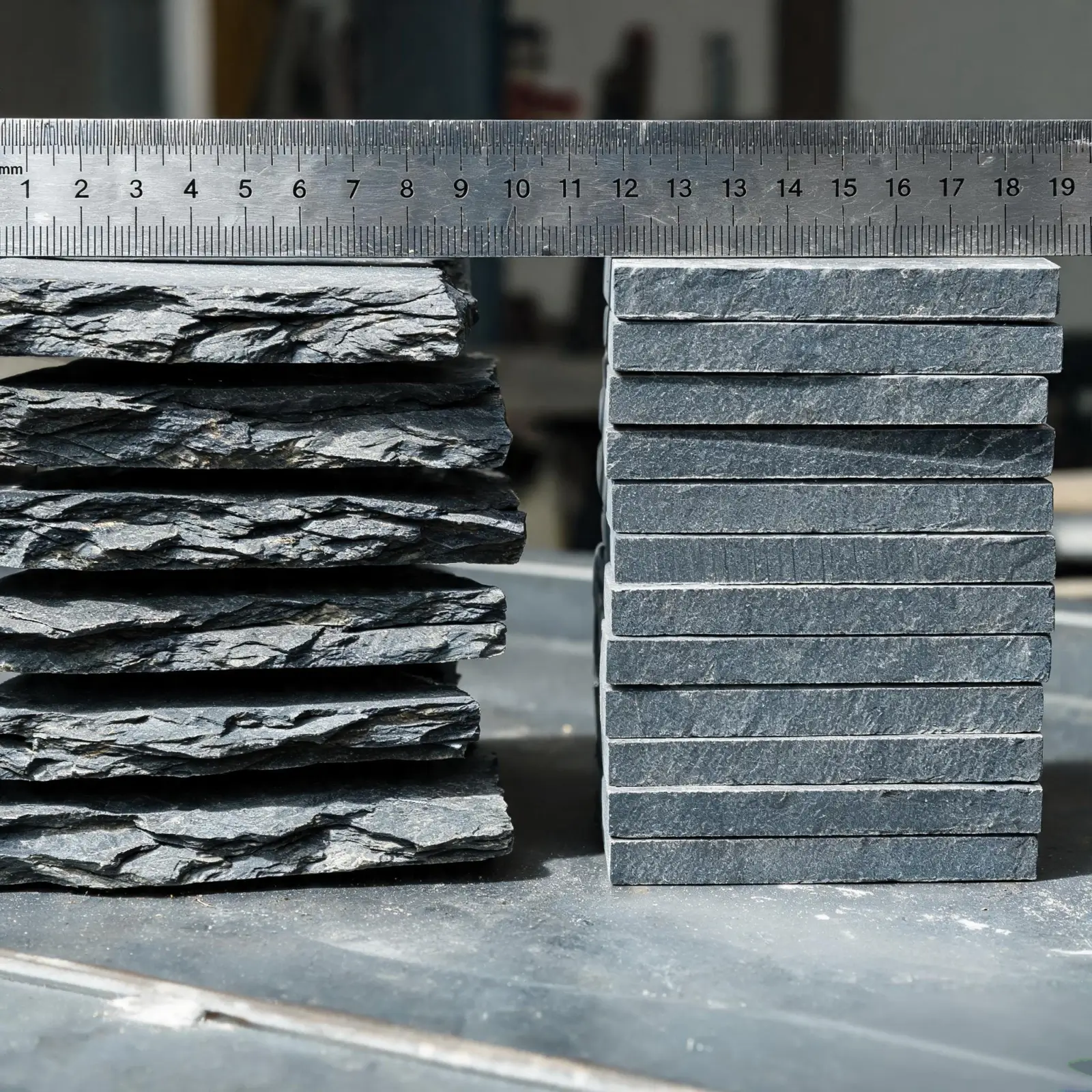
Indian slate is often hand-split and visually sorted. Some Indian exporters specifically market their products as hand-split, and that character is part of the appeal. For a patio or a feature wall, it is exactly what the buyer wants.
Jiujiang's production takes a different path. After splitting, tiles go through sizing, grinding, and inspection. The CNC tolerance that applies to billiard slate — ±0.1 mm — also influences how roofing tile dimensions are controlled. Every piece is measured, not sampled. For a 3,000 m² roofing order, that control translates into fewer broken pieces, faster installation, and a more predictable result.
Indian Slate Is Not "Low Quality"
This needs to be said plainly: describing Indian slate as simply inferior is inaccurate and unprofessional.
Himachal slate has been used on historic buildings for generations. Geological studies describe it as fine-grained with well-developed slaty cleavage, with quartz, feldspars, mica and chlorite as important minerals. Indian government specifications establish requirements for dimensions, water absorption, strength, and workmanship in roofing slate. A well-selected Indian slate from a good quarry is a legitimate building material.
The same principle applies in both directions. A low-grade slate from anywhere — China included — can fail on a demanding project. A high-grade slate from a good Indian quarry can perform well. The country name is not a substitute for a test report.
If you want to see how this works in practice, read our comparison of Jiujiang vs Spanish slate and Jiujiang vs Welsh slate — the same principle applies: compare the specification, not the flag.
Colour: India's Genuine Edge
If colour variety is the primary requirement, Indian slate deserves serious consideration. The range is broad: black, grey, green, purple, gold, copper, rustic multicolour, and autumn tones. Rajasthan's decorative slate industry has developed this colour range into a genuine competitive advantage for architectural and landscaping work.
Jiujiang slate produces grey, dark grey, black, and blue-grey tones depending on the quarry zone. The range is narrower — but that is not a flaw. For a roof where colour consistency matters more than colour variety, a narrower, more controlled range is an advantage.
Two slates can look almost identical and have very different water absorption, density, and freeze-thaw resistance. Never select roofing slate by colour alone. Always evaluate the physical properties of the actual quarry material.
Thickness: Hand-Split Character vs Machine Tolerance
Natural slate is split along cleavage planes, so some variation is unavoidable. The question is how much variation the project can tolerate.
Indian suppliers often emphasise the traditional hand-split character of their slate. A tile specified as "approximately 10–20 mm with natural variation" is a different product from one specified as "7 mm ± 1 mm." Both can be correct for the right project — but they are not interchangeable.
For large roofing projects, the buyer should specify a thickness range and ask whether the supplier can maintain it. The correct question is not "which country has more consistent slate?" but "can this supplier hold the tolerance my project requires?"
That question should be answered with samples, production records, and inspection results — not with marketing language. Jiujiang's production maintains dimensional tolerances through CNC sizing and 100% inspection. An Indian supplier may maintain tolerances through skilled hand-splitting and visual grading. Both can work; the proof is in the delivered product.
Supply Stability: Can They Repeat the First Container?
Price is one component of landed cost. For a large project, the buyer also needs to consider quarry capacity, production capacity, sorting capacity, container loading efficiency, lead time, replacement material, colour matching, and repeat-order consistency.
A low initial price loses its advantage if the second shipment arrives with noticeably different colour or thickness — or if the supplier cannot reproduce the first batch at all.
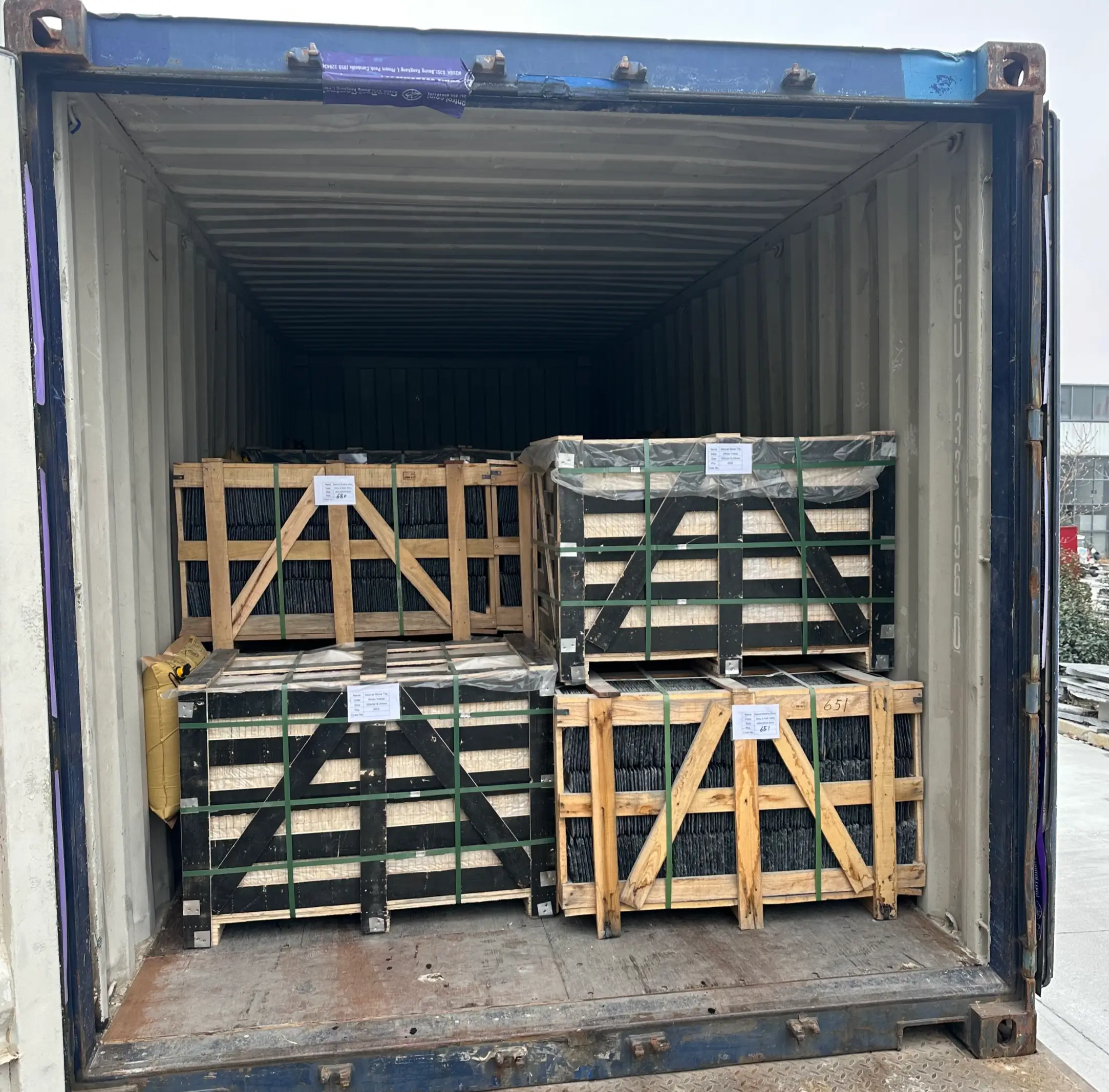
Jiujiang's development as a slate-processing region is tied to its ability to supply both standardised roofing products and high-precision billiard slate from the same industrial base. A factory-direct supply chain — quarry, splitting, machining, inspection, packing, and container loading in one location — gives the buyer more control over repeat orders. A standard 20-foot container holds 1,130–1,450 m² of 7–9 mm roofing slate, loaded and inspected at the factory before the container seals.
For buyers ordering repeatedly, that industrial supply-chain capability can matter more than saving a small percentage on the first quotation.
Landed Cost: Why the Cheapest Quote Rarely Wins
A common mistake: comparing Indian FOB price vs Chinese FOB price and choosing the lower number. A better calculation is:
Landed Cost = Stone Price + Packing + Inland Transport + Ocean Freight + Import Costs + Installation Loss + Breakage/Replacement Cost
For roofing slate, also consider pieces per square metre. A slate that costs slightly more but breaks less and covers more predictably can have a lower project cost than a cheaper slate with higher waste. We break this down in detail in our roofing slate quotation comparison guide.
Side by Side: What the Specifications Show
This table is a starting point, not a verdict. Natural stone varies by quarry — every figure should be verified against the actual test report for the material being supplied.
| Factor | Jiujiang Slate | Indian Slate |
|---|---|---|
| Geological source | Jiangxi, China | Multiple regions: Rajasthan, Himachal, Andhra Pradesh |
| Main roofing colours | Grey, dark grey, black, blue-grey, green | Black, grey, green, purple, gold, copper, multicolour |
| Density (tested) | 2.7–2.8 g/cm³ | Varies by quarry and formation |
| Water absorption | 0.1% (EN 12326), 0.13% (ASTM), 0.2% (third lab) | IS 6250 allows ≤2%; request actual test data |
| Flexural strength | 60 MPa dry / 45 MPa wet | Request test report from supplier |
| Freeze-thaw resistance | 92.7% retention after 120 cycles | Request test report from supplier |
| Thickness control | CNC sized, ±0.1 mm influence, 100% inspected | Often hand-split; varies by quarry and processor |
| Decorative colour range | Narrower, controlled | Particularly broad — India's genuine edge |
| Billiard slate | Major industrial application | Not the main international identity |
| Large-volume supply | Factory production, 1,130–1,450 m² per 20ft | Available, but quarry and supplier dependent |
| Best buying approach | Specify grade + test data + tolerances | Specify quarry + grade + test data + tolerances |
Which Slate for Which Project
For a rustic architectural project where colour variation, natural cleft texture, and visual character are central to the design — Indian slate may be the better choice, and the better value.
For a large roofing project where repeatability, controlled specifications, documented testing, and stable supply are the primary requirements — Jiujiang slate may be more suitable.
For a billiard-table manufacturer, the comparison changes entirely. The requirements for billiard slate — flatness, thickness, machining consistency, and dimensional stability — are fundamentally different from roofing. Indian slate's international identity is not built on billiard applications; Jiujiang's is.
In every case, the buyer should compare the actual material, not the country of origin. Browse our roofing slate products for specifications, or see the all-in-one origin comparison for the complete picture.
How to Compare: Five Questions for Both Suppliers
If you are seriously comparing suppliers, ask both sides the same questions.
1. Physical sample. Do not decide from photographs. Request a physical sample and compare colour, texture, cleavage, thickness, and edge quality in natural daylight.
2. Quarry origin. Which state, district, and quarry? "Indian slate" is too broad — ask which specific quarry. For Chinese slate, ask which quarry and which production line. See what Jiujiang slate actually is.
3. Laboratory data. At minimum: density, water absorption, flexural strength, freeze-thaw resistance, and petrographic information where relevant. Ask what buyers should ask for — and read our guide to reading a slate test report.
4. Production tolerances. Thickness, length, width, squareness, surface condition, and colour grading. The supplier should be able to state these as numbers, not adjectives.
5. Repeat-order samples. If the project needs several containers, ask how the supplier controls colour and specification from one shipment to the next. A factory-direct supplier with 100% inspection and batch records can answer this; a trading desk may not.
The Bottom Line
Indian slate and Jiujiang slate represent two different supply traditions, both legitimate.
Indian slate offers competitive pricing, strong visual character, and an exceptionally broad colour range. India's slate industry spans multiple geological regions, with Himachal Pradesh and Rajasthan among the important sources. For the right project — decorative, rustic, colour-driven — it can be the right answer.
Jiujiang slate is relevant where buyers need natural slate performance combined with industrial processing, documented testing, and repeatable supply. The region's slate industry serves both roofing and billiard applications from the same geological resource, and that crossover gives Jiujiang roofing slate its dimensional consistency. Our flexural strength data and freeze-thaw test results are published for comparison.
The lesson is not that one country produces "good slate" and the other produces "cheap slate." The lesson is: buy the specification, not the country.
A low quotation is attractive. A beautiful colour is attractive. A strong test result is attractive. But for a professional project, the best decision comes from putting price, test data, consistency, quarry origin, tolerances, and supply capability on the same page. That is how Jiujiang slate should be compared with Indian slate — and with Spanish, Welsh, or any other natural roofing slate.
Frequently Asked Questions
Is Indian slate always lower quality than Chinese slate?
No. India has multiple slate-producing regions, a formal roofing-slate standard (IS 6250), and a long architectural history — particularly Himachal slate. A well-selected Indian slate from a good quarry is a legitimate building material. The same is true in reverse: a low-grade slate from China can fail on a demanding project. Compare the specific quarry, test report, and specification — not the country name.
What is the water absorption difference between Jiujiang and Indian slate?
Jiujiang slate has been independently tested at 0.1% water absorption by EN 12326, 0.13% by ASTM method, and 0.2% by a third laboratory — all well below the EN 12326 A1 threshold of 0.6%. Indian Standard IS 6250 allows up to 2% for roofing slate. The actual absorption of Indian slate varies by quarry and should be verified with a test report. The comparison should be made on actual test data from both suppliers, not on national averages.
Can Indian slate be used for roofing in cold climates?
It depends on the specific slate and its water absorption. Indian Standard IS 6250 includes freeze-thaw and durability requirements for roofing slate. If an Indian supplier can provide test data showing low water absorption (ideally below 0.6% for EN 12326 compliance) and adequate freeze-thaw resistance for the specific quarry material, it may be suitable. Always request the actual test report — do not assume compliance from the standard's existence alone.
Why does Jiujiang slate cost more than Indian slate?
The price difference reflects different production models. Indian slate benefits from lower processing costs and hand-split production. Jiujiang slate's cost includes CNC machining, 100% single-piece inspection, and a factory-direct supply chain serving both roofing and billiard industries. The real question is not which is cheaper but which delivers lower landed cost for the specific project — factoring in breakage, installation waste, and repeat-order consistency.
How do I compare Indian and Jiujiang slate suppliers?
Ask both suppliers for the same five things: a physical sample, the quarry origin, laboratory test data (density, water absorption, flexural strength, freeze-thaw), production tolerances (thickness, dimensions, colour grading), and repeat-order samples. Compare the answers side by side. The supplier who provides specific numbers and documented evidence — regardless of country — is the one worth pursuing.
Related Reading
If you are evaluating slate for a commercial roofing or architectural project, we can provide Jiujiang slate samples, project-specific specifications, and test documentation for comparison with Indian or any other origin. You compare the actual slate — not just photographs or marketing claims.
Request Jiujiang Slate Samples →