
Slate Roof Maintenance Checklist
Late October. I am standing at the gate of a converted Victorian school in Hampshire, watching the first serious leaf-fall of the season settle into the valley junctions of its slate roof. Fifteen years of looking after this building and thirty-nine others have taught me that what happens in the next fortnight matters more than anything I do for the rest of the year. Not because slate is fragile — it is not — but because the systems around it are. Gutters choke, valleys dam, water backs up under the tiles, and by February a five-minute clearing job has quietly grown into a four-figure repair.
Nobody warned me about this when I took on my first slate-roofed property. The manufacturer's guide said “inspect annually” and stopped there, as if a roof knows what month it is. What I needed, and what I spent a decade learning the hard way, was not a list of things to check but a calendar — something that told me what to do, when, and why that timing mattered enough to get out of the chair for. So I built one, tested it across forty-odd buildings, refined it through leaks I should have prevented, and this is it: a printable, year-round slate roof maintenance checklist organised by season, written for the people who actually have to live under the roof and keep it dry.

Why a Checklist Beats an Inspection
The distinction matters more than it sounds. An inspection is a snapshot — a professional walks the roof once, takes notes, leaves. A checklist is a rhythm. It says: this week, do this; next month, do that; after the first hard frost, stop touching the roof entirely. The slate itself is the least of your worries. Good roofing slate laid well will outlast you, your children, and probably the building beneath it. What fails first, every single time, is everything around the slate: the gutters that overflow, the flashing that works loose, the valley that fills with wet leaves and freezes, the nail that rusts through twenty years before the tile it holds.
The maintenance guide on this site covers the basics of what to check. This checklist is the when — the seasonal choreography that turns “I should look at the roof” into “I know exactly what to look for this month and why.” How often you should inspect depends on the roof's age, but what you do each visit depends on the season, and getting that wrong is what turns a £40 gutter clear into a £4,000 ceiling repair. If you read nothing else in this guide, read the autumn section. In my experience, nine out of ten preventable slate roof problems start with a blocked gutter that was not cleared at the right time.
Spring (March–May): Clear What Winter Left Behind
Spring is the clearing season. Winter leaves things where it drops them — broken branches in valleys, granular debris in gutters, the occasional tile that cracked in a January frost and has been quietly taking on water since. The ground is your friend now: most spring tasks can be done from a ladder or with binoculars, and the weather is finally warm enough that you are not risking ice or frozen fingers.
Start with the gutters. Every gutter on a slate roof should be cleared in March, regardless of whether you cleared them in November, because winter has a way of depositing the last of the autumn leaf crop plus whatever the wind carried in during the storms. Check the downpipes too — a blocked downpipe is worse than a blocked gutter, because it turns the entire gutter run into a standing pool that backs up under the slates.
Next, walk the property from the ground and look up. You are looking for three things: tiles that have slipped during winter storms, tiles that have cracked at the nail hole — a classic frost-failure pattern where water entered the fixing, froze, and split the stone — and any flashing that has lifted or separated at the chimney or valley junctions. If you see a slipped tile, do not wait. Book a repair now, while contractors have spring availability. By July, the same contractor will be quoting six weeks out.
If you had heavy snow, check the roof valley junctions for impact damage from falling ice or branches. Valleys are where most winter damage hides, because the snow sits there longest and the meltwater runs there last. If you are not sure whether a damp patch is from the slates or the flashing, trace it before the summer heat dries the evidence. Understanding what kills roofing slates will help you tell the difference between a tile that cracked from impact and one that cracked from nail fatigue — the repair is the same, but the prognosis for the rest of the roof is very different.

Summer (June–August): The Calm Before the Work
Summer is when you do the least, and that is the point. Slate roofs are happiest when nobody is on them. The tiles have been there for decades; they do not need your attention in warm weather. What they need is to be left alone.
There are three things I do in summer, and none of them require a ladder. First, I walk around the building from the same spot I always stand at — the gate, the kerb, the garden bench — and I take a photograph on my phone. Same angle, same distance, same time of day if I can manage it. Over five years, those five photographs tell me more than any single inspection. You can see a roof slowly drift: a tile that was flush in 2022 sitting two millimetres proud by 2025, a moss patch that was a smudge last summer now the size of a dinner plate. The annual photo is the closest thing I have to a time-lapse of the roof's ageing, and it costs nothing.
Second, on the next rainy day, I go up to the attic and look for daylight. Not for water — for daylight. Pinholes of light around chimneys and pipe penetrations mean a gap that water will find when the wind drives it. Water stains in an attic are a late signal; daylight is the early one. If the attic is dark and dry, I leave the roof alone for another year.
Third, I make a note of anything I saw in spring that I did not fix — a slipped tile, a lifted flashing — and I make sure it is on the autumn list. Summer is not the time to fix it; summer is the time to remember it needs fixing before winter. Two gutter clears beat one roof inspection, every year, on every building I manage.
Autumn (September–November): The Window That Decides Everything
If you remember one section of this checklist, make it this one. Autumn is the most important maintenance window of the year for a slate roof, and it is a narrow one — roughly two weeks, between the last leaf-fall and the first hard frost.
After the trees have dropped, every gutter, valley, and downpipe on the roof needs to be cleared. Not “checked” — cleared. There is a difference between looking at a gutter and seeing it has some leaves, and actually putting your hand in and pulling them out, because wet leaves compact into a dense mat that water cannot pass through, and that mat freezes into a dam that directs meltwater up under the slates instead of down the downpipe. I have seen a perfectly good slate roof ruined by a single blocked valley that held a mugful of meltwater against the underlayment for three months.
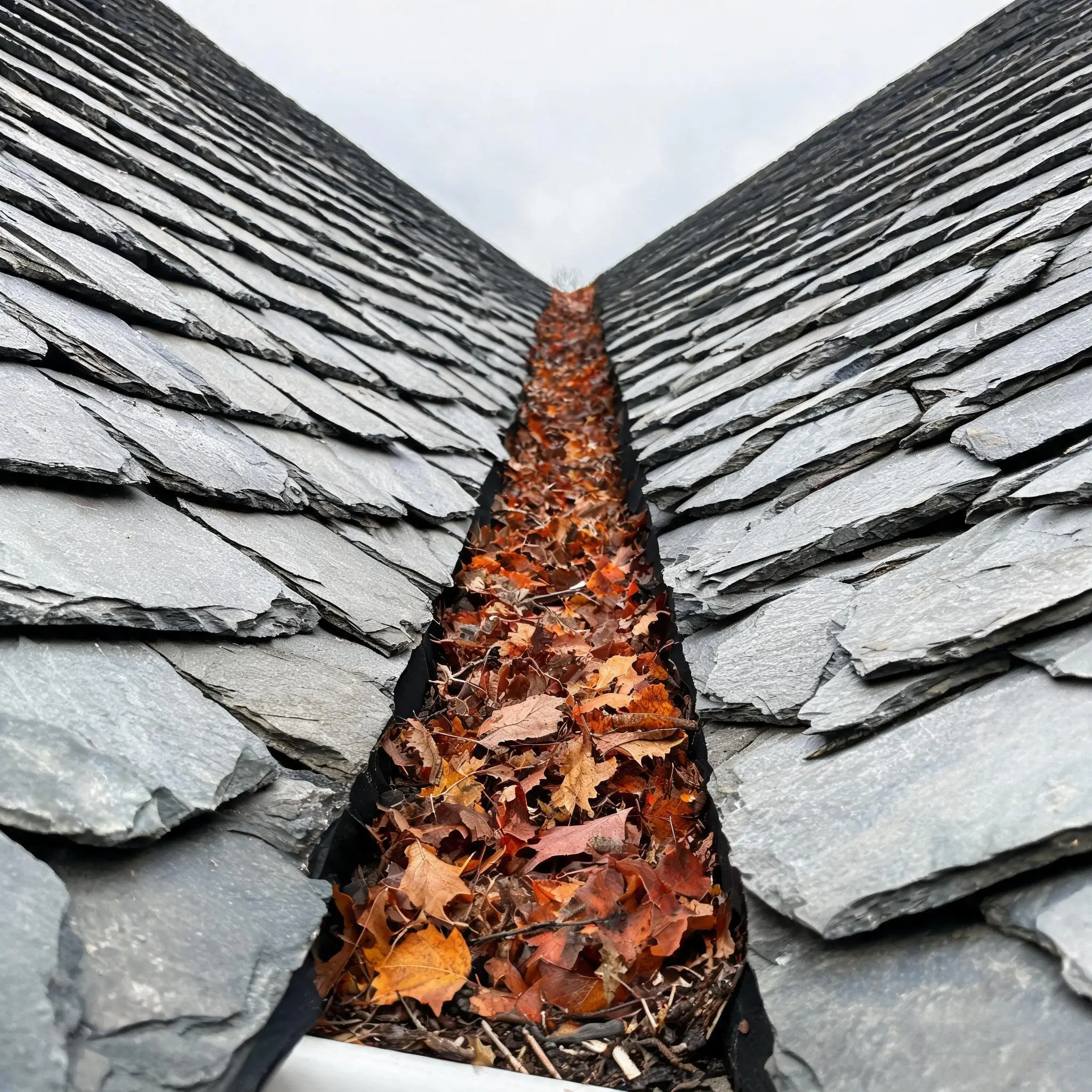
The timing matters because clearing gutters in September is too early — the trees have not finished dropping — and clearing them in December is too late — the first frost has already turned the wet leaf mat into an ice dam. In Hampshire, that window is usually the last week of October and the first week of November. In Yorkshire, it is two weeks earlier. In Devon, two weeks later. You know your trees. Watch them, and clear the day after the last leaf falls.
While you are up there (or your contractor is), check the moss. If moss has grown thick enough to block water flow in the valleys over the summer, remove it now — gently, with a soft brush, never a pressure washer. The moss itself does not eat slate, but the moisture it holds can lift tile edges and freeze in winter, and a frozen moss mat is as effective as a blocked gutter. This is also the time to check whether your fixings are holding up — if you are having tiles re-fixed, use copper or stainless steel, never galvanised. The nail is the component most likely to fail before the slate, and autumn is when you find out which ones are tired.
Winter (December–February): Watch From Below
Winter is for watching, not doing. Unless there is an active leak, no one should be on a slate roof in winter. The tiles are cold, they are more brittle, and a wet slate is a slippery slate. If you have done your autumn work, the roof should look after itself.
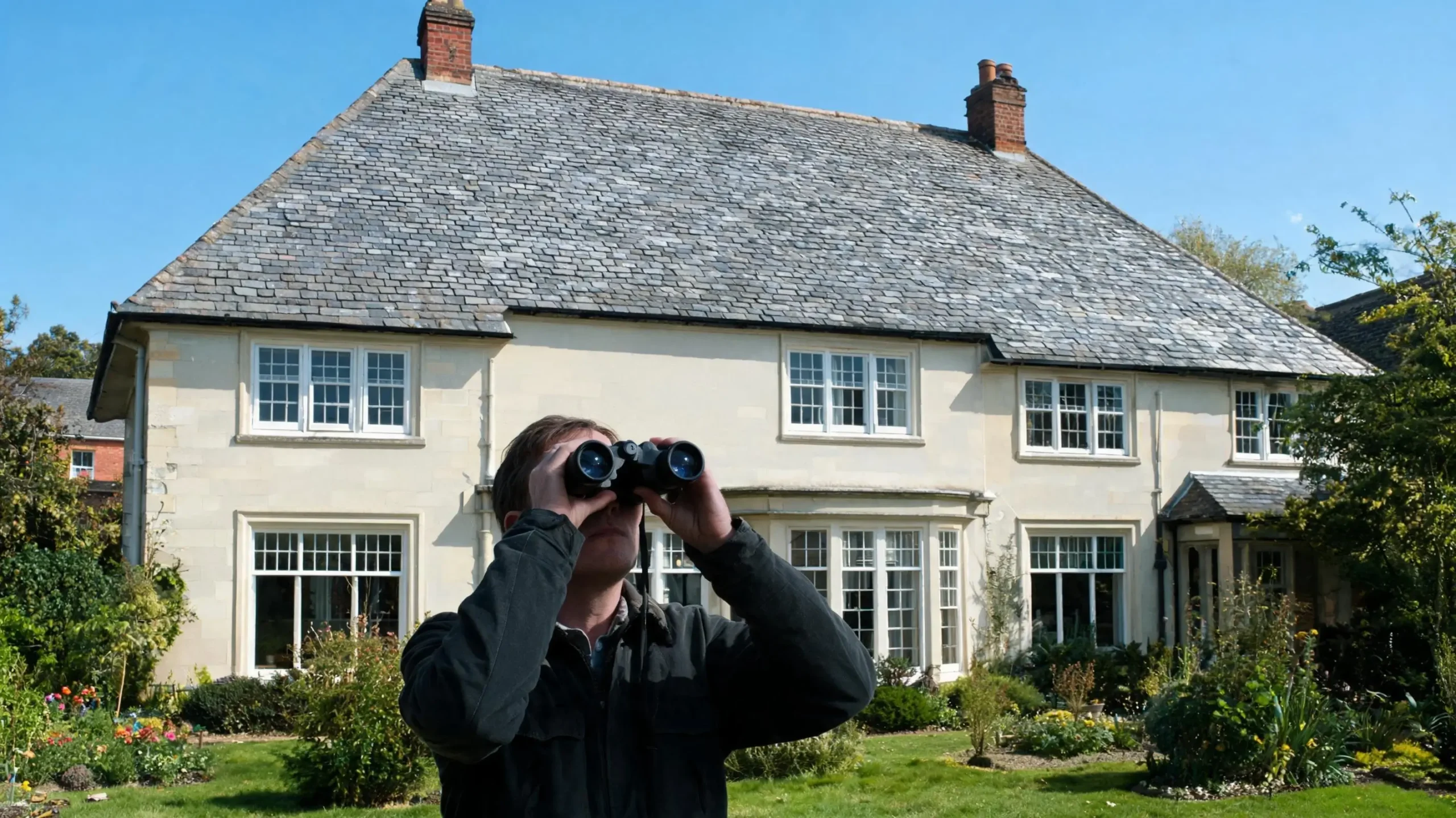
What you do instead is watch from below. After every significant weather event — a storm, a heavy snowfall, a sustained freeze followed by a thaw — do a ground-level check. Binoculars are enough. You are looking for tiles that have slipped during high winds, flashing that has lifted at ridges or hips, ice build-up in gutters or at eaves, and any new dampness in the attic after a thaw.
If you find ice dams at the eaves — icicles forming along the gutter line, water backing up under the slates — the cause is almost always attic heat loss, not the roof itself. The warm air from the house melts snow on the upper roof, the meltwater runs down to the cold eaves, and refreezes. The fix is insulation and ventilation in the attic, not chipping ice off the slate. Never try to break ice off a slate roof — you will crack tiles that would have survived the winter untouched.
The one winter task I do recommend is an attic inspection after the first heavy rain of the season. If the autumn gutter clear was done right, the attic should be bone dry. If it is not, you have a problem that needs attention before the spring repair season — and knowing about it now means you can book a contractor in January rather than discovering it in April when everyone is already booked through summer.
The Year-Round Master Checklist
Here is the full list, collapsed into a single table you can print and pin to the wall. Each row is one task; the frequency column tells you how often; the “why” column tells you what happens if you skip it.
| Season | Task | Frequency | Why It Matters |
|---|---|---|---|
| Spring | Clear gutters and downpipes | Once (March) | Winter debris blocks drainage and backs up under slates |
| Spring | Ground-level visual scan for slipped or cracked tiles | Once (March–April) | Catches winter storm damage before it leaks |
| Spring | Check flashing at chimneys and valleys | Once (March) | Winter wind lifts flashing; flashing fails before slate does |
| Spring | Book any needed repairs | Once (by April) | Contractors fill up by summer; book early |
| Summer | Take annual photo from the same spot | Once (June–July) | Five years of photos reveal slow changes no single visit can |
| Summer | Attic check on a rainy day | Once (July–August) | Daylight gaps and early water stains show before leaks |
| Autumn | Clear all gutters, valleys, and downpipes | Once (after last leaf-fall) | The single most important task of the year — prevents ice dams |
| Autumn | Remove moss if it blocks drainage | Once (October–November) | Wet moss freezes and lifts tile edges |
| Autumn | Check downpipes flow freely | Once (November) | A blocked downpipe turns the whole gutter into a pool |
| Winter | Ground-level check after storms | As needed | High winds slip tiles; early spotting prevents water entry |
| Winter | Attic check after first heavy rain | Once (December–January) | Verifies autumn work held; catches hidden leaks |
| Winter | Check for ice dams at eaves | After freeze-thaw | Signals attic heat loss, not roof failure |
| Winter | Log deferred issues for spring | As needed | Winter reveals what spring needs to fix |
Your Roof Log: The Cheapest Insurance You'll Ever Keep
I keep a simple log for every property: a spreadsheet, one row per visit, with columns for date, weather, what I checked, what I found, what I did, and a photo link. It takes five minutes per visit. Over fifteen years, that log has done three things that no single inspection could have done.
First, it has caught patterns. A valley that needed clearing every autumn but always seemed to have more debris than the others turned out to have a tree branch overhanging it that grew six inches a year. Five years of log entries made that obvious in a way that a single visit never would. The branch was trimmed; the valley stopped blocking. The slate was fine all along.
Second, it has made insurance claims straightforward. When a storm damaged six tiles on one property, the log showed that the roof was inspected the previous month and all tiles were sound — the damage was storm-related, not pre-existing. The claim was paid without question. Without the log, the insurer would have argued wear and tear, and I would have been negotiating with a loss adjuster for six months.
Third, it has increased resale value. A prospective buyer who sees fifteen years of documented maintenance on a slate roof does not negotiate the price down; they pay it, because the roof is the single largest maintenance liability on any building, and a documented roof is a known roof. A roof that gets a log outlasts a roof that gets a phone call.

The Ground Scan: Three Minutes That Save Three Thousand Pounds
If there is one habit I would teach every homeowner with a slate roof, it is the three-minute ground scan. You do not need a ladder, a contractor, or a checklist app. You need to stand at the same spot — your gate, your kerb, your garden path — and look up for three minutes, four times a year. Once each season. That is the entire investment.
The method is simple. Stand where you can see the widest angle of the roof. Start at the ridge — the top line — and let your eye travel down one slope to the gutter. Then do the other slope. Then look at the valleys, the chimneys, the dormer windows if you have them. You are not looking for perfection; you are looking for change. Is there a tile sitting higher than its neighbours? Is there a gap where last year there was none? Is there a dark patch that was not dark last season? Is the moss thicker on the north slope than it was this time last year?
Three minutes, four times a year, and you will catch ninety percent of problems before they become emergencies. The photograph is the fifth scan — once a year, same spot, same angle, and it shows you what your memory cannot: the change that happened so slowly you did not notice it happening.

When to Call a Professional — and When Not To
The line between homeowner maintenance and professional work is simpler than it sounds. If your feet are on the ground, a ladder, or in the attic, it is your call. If your feet are on the slate, it is not.
From the ground or a ladder, you can:
- Clear gutters and downpipes (with a stable ladder and someone footing it)
- Do a visual scan with binoculars
- Take the annual photograph
- Check the attic for daylight, water stains, or damp insulation
- Clear debris from accessible valleys with a soft brush on an extension pole
- Keep the maintenance log
Leave to a professional:
- Walking on the slate for any reason — the risk of cracking tiles underfoot is real
- Replacing broken or slipped slates
- Repairing or replacing flashing
- Any work on ridges, hips, or valleys
- Structural inspection of roof timbers
- Chimney repointing or flashing renewal
I have seen well-meaning homeowners crack perfectly good slates trying to do a “quick repair” from a ladder leaning against the roof edge. The repair then costs ten times what it would have cost to hire a professional, because now you are replacing the tile the homeowner broke plus the tile that was already broken. If you are unsure whether a problem is a repair or a replacement issue, the call to a professional costs nothing; the wrong DIY call can cost a season's maintenance budget. Matching a replacement slate is a skill in itself, and a poorly matched patch is more visible than the original damage ever was.
One final principle that ties the whole calendar together: don't react, rotate. Most slate roof problems are not sudden — they build slowly, season by season, until the day they are not slow anymore. A seasonal checklist turns that slow build into a series of small, predictable, inexpensive interventions. The roof does not need heroics. It needs rhythm. Give it four check-ins a year, one clear gutter in November, one photograph in June, and a log that remembers what your eyes forget, and it will outlast the mortgage.
Frequently Asked Questions
How often should I do a slate roof maintenance check?
A full checklist run-through should happen twice a year — once in spring after winter, and once in autumn after leaf-fall. In addition, do a ground-level visual scan after any major storm and a quick attic check after the first heavy rain of winter. Roofs over 50 years old benefit from an annual professional inspection on top of the homeowner checklist, because nail fatigue and flashing aging accelerate in older roofs and are not always visible from the ground.
Can I do a slate roof maintenance checklist myself?
Most of it, yes. Clearing gutters, visual scans from the ground, attic checks, and keeping a maintenance log are all homeowner tasks. The line is simple: if your feet are on the ground, a ladder, or in the attic, it is your call. If your feet need to be on the slate, call a professional. Walking on a slate roof without training risks cracking tiles that would otherwise have lasted decades, and the cost of the tile you break will always exceed the cost of the contractor you avoided.
What time of year is best for slate roof maintenance?
Autumn is the most critical window — the two weeks between the last leaf-fall and the first hard frost. Clearing gutters and valleys in this window prevents the ice dams and water backup that cause most winter leaks. Spring is the second key season for clearing winter debris and booking repairs before contractors get busy. Summer and winter are primarily for ground-level observation and attic checks — the roof should be left undisturbed in both seasons.
Do I need to walk on the roof for a maintenance check?
No, and in most cases you should not. A thorough maintenance check can be done entirely from the ground, a ladder, and the attic. Binoculars are sufficient for spotting slipped or cracked tiles, and an annual photograph from the same vantage point will reveal slow changes that a single visit would miss. Any task that requires standing on the slate should be left to a professional roofer with the proper equipment, safety harness, and slate-rated crawl boards.
What should be on a printable slate roof maintenance checklist?
At minimum: gutter and downpipe clearing (spring and autumn), valley clearing after leaf-fall, ground-level visual scan for slipped or cracked tiles, flashing inspection at chimneys and penetrations, attic check for daylight and water stains, moss inspection and removal if blocking drainage, and a maintenance log entry with date and photographs. The checklist should be organised by season, because timing matters as much as the task itself — clearing a gutter in September is wasted effort if the trees drop in November.
How do I keep a slate roof maintenance log?
A simple spreadsheet or notebook with one row per visit: date, weather, what you checked, what you found, what you did, and a photo. Take the photo from the same spot each year. Over five years, the log will reveal patterns — a slow-drifting tile, a moss patch growing year by year, a valley that always fills faster than the others — that no single inspection can. The log also supports insurance claims and adds documented value at resale, because a roof with a maintenance history sells for more than a roof without one.
New Slate? Ask for the Numbers That Matter
A maintenance checklist keeps your roof alive for decades. The test data on your new slate decides whether those decades are 80 or 150. EN 12326 / ASTM C406 results, CNC precision, and 100% individual inspection come standard with every order.