
Pocket Opening Machining: How Billiard Slate Pocket Cuts Are CNC-Machined to the Correct Radius and Depth
What This Page Covers
- Radius — the curved transition from cushion line to pocket mouth. The drawing decides; the stone obeys.
- Depth — whether the opening is a through-cut or a recessed shelf. Not every pocket goes all the way through.
- Position — where the pocket centre sits relative to the playing surface. A few millimetres changes the cushion geometry.
- Corner vs Side — six pockets, but not six identical cuts. Different angles, different shapes.
- Brand Specification — every table brand has its own pocket drawing. There is no universal "standard pocket."
- Inspection — how a machined pocket is verified against the drawing. Template, calliper, and a record that travels with the crate.
Zoom in on the corner of a billiard table drawing and you will find something that looks like a handful of numbers arranged around a curved gap. R12.5. Depth 8.0. Centre 1270. To the table manufacturer, these are annotations on a CAD file. To the slate factory, each one is a translation task: a dimension that lives on paper until a cutting tool carries it into the stone.
The pocket opening is where the drawing meets the stone. It is not the largest feature on a billiard slate panel, and it is not the most material-intensive to machine, but it is the feature that has to match the table design most precisely. A slate can be flat, accurately sized and properly ground, and still fail at assembly if the pocket openings are wrong.
This page is about how that translation works — how a pocket opening annotation on a drawing becomes a machined feature on a finished slate, and what an OEM buyer or table manufacturer needs to confirm before the cutting tool starts moving.
What the Drawing Asks
A pocket opening is not a hole. It is an interface — the place where the slate, the cushion system, the pocket liner or iron, and the leather pocket all have to work together. The drawing does not just say "cut a hole here." It specifies a geometry that makes that interface possible.
Depending on the table design, a pocket drawing may call out:
- Opening width — the clear distance between the two cushion noses at the pocket mouth
- Opening length — how far the opening extends into the slate from the cushion line
- Corner radius — the curved transition from the straight cushion run to the pocket mouth
- Depth or recess — whether the opening is a through-cut, a stepped recess, or a partial-depth pocket
- Pocket centre position — where the opening sits relative to the playing surface and the slate edge
- Corner geometry — whether the corner opening is a 45-degree diagonal cut, a radiused curve, or a compound shape
- Side pocket geometry — which may differ from the corner pocket in width, angle and depth
- Machined recesses or reliefs — pockets for hardware, liners, or pocket-iron clearance
None of these dimensions is arbitrary. Each one exists because the cushion profile, the pocket hardware and the table frame require it. When we machine a pocket opening, we are not choosing the geometry — we are reading it from the drawing and cutting it into the stone.
The most useful thing a buyer can send us is not a description like "standard pool table pocket" but the drawing itself, or an approved sample that carries the geometry. The page on CNC pocket cuts and drawing confirmation covers the confirmation process in detail; this page covers what happens to the geometry once the drawing is approved.
How the Radius Is Cut
Radius is the dimension that buyers ask about most — and the one most often misunderstood.
A pocket opening is not defined by its width alone. The transition between the straight cushion line and the curved pocket mouth is a radius, and different radius values produce visibly and functionally different pocket shapes. Two openings with the same width but different radii are not the same pocket. The radius is one of the geometric factors that influences how the cushion nose transitions into the pocket opening and how the finished pocket accepts the ball — alongside the cushion profile, the pocket facing angle, the cushion rubber and the overall table construction.
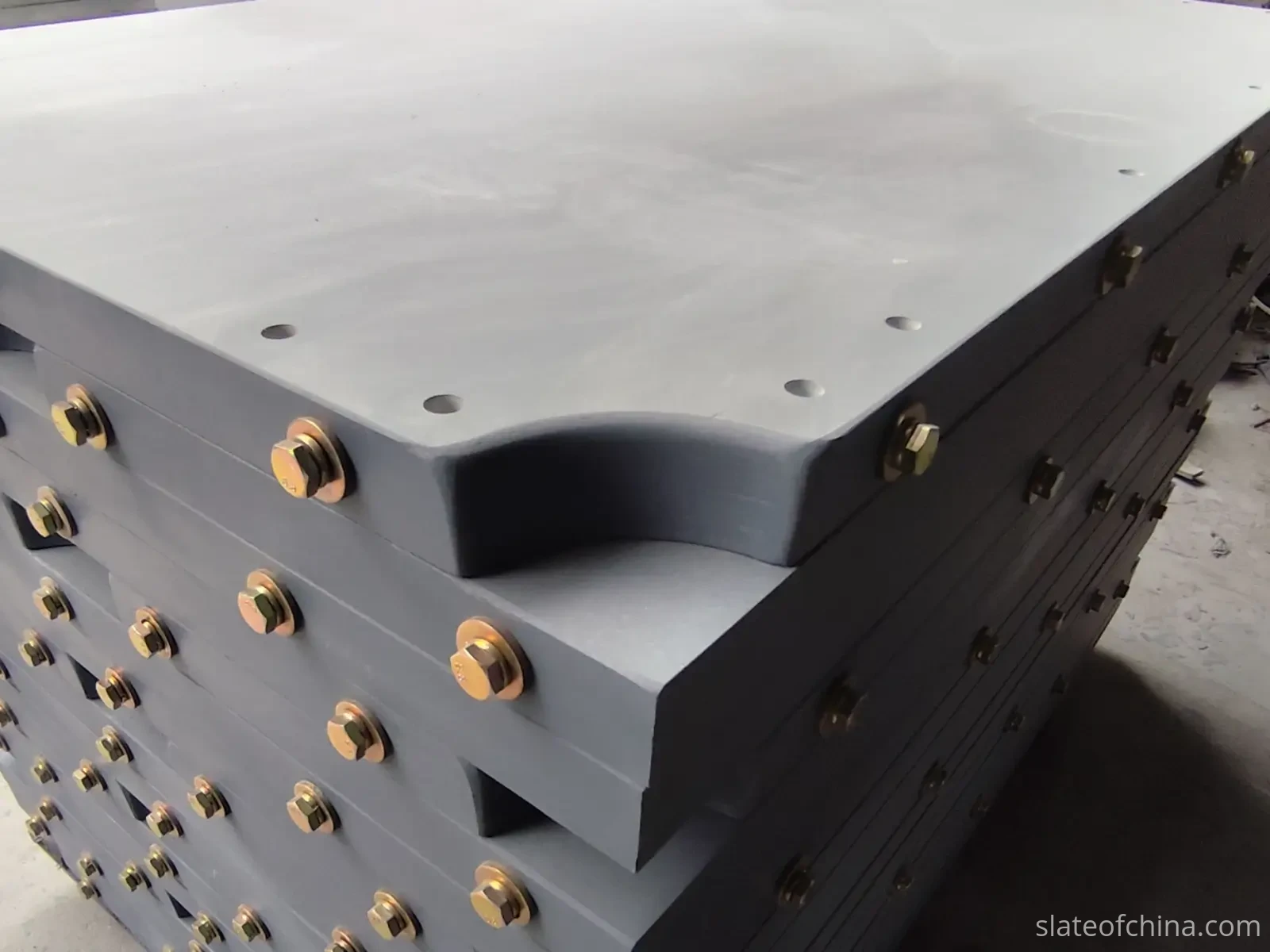
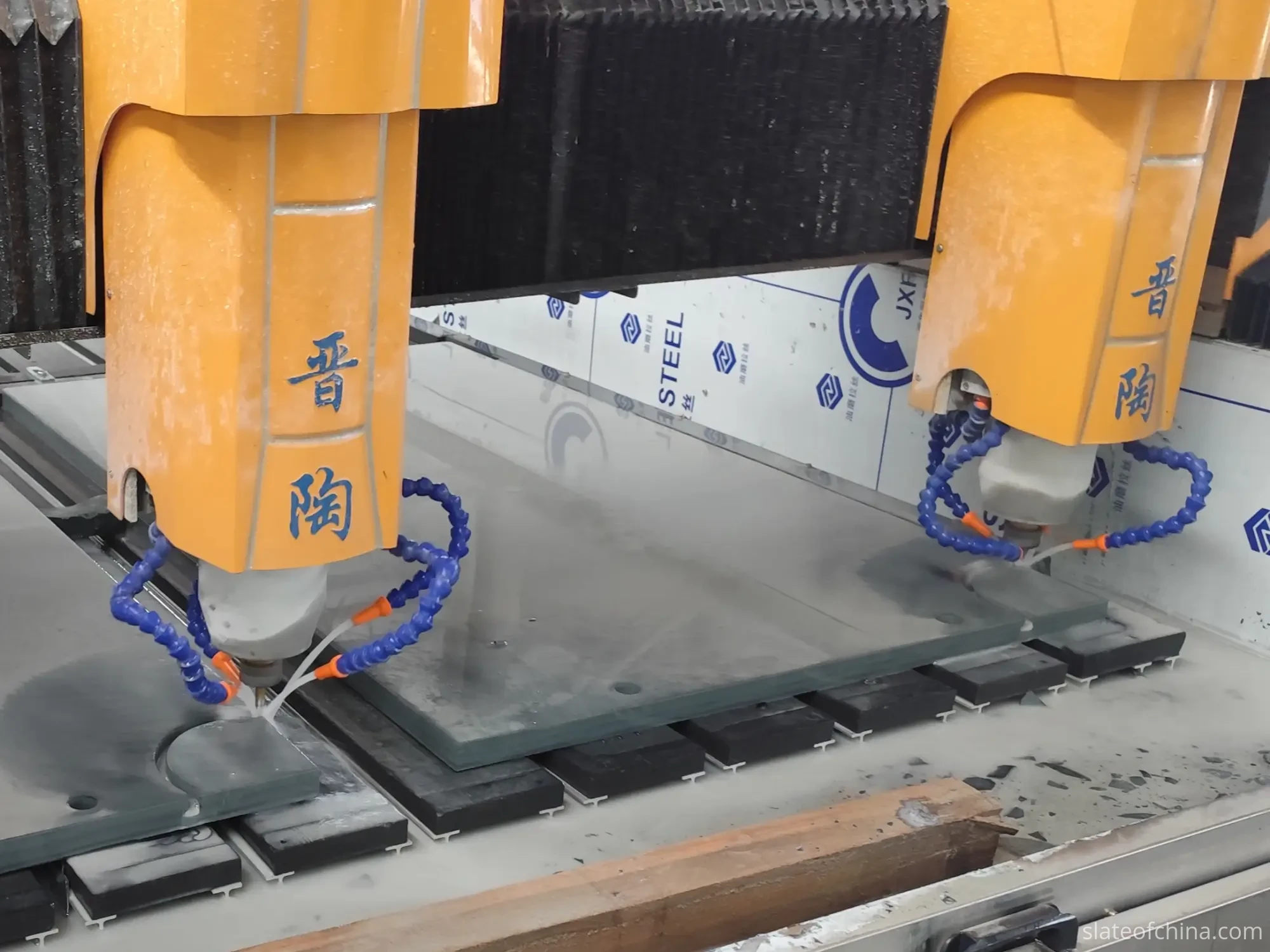
In our production process, the radius is cut by a profiling tool that follows a CNC path. The tool does not "round the corner" in the way a hand grinder would — it traces a mathematically defined arc that the CAM programme has calculated from the drawing. The radius is not rounding; it is geometry. A drawing that says R12.5 produces a 12.5-millimetre arc, and a drawing that says R15 produces a different one. The machine does not guess between them.
This is why specifying "round the corner" is not enough. The drawing should state the actual radius value, and the CNC programme should carry that value into the tool path. When a buyer asks whether we can cut "a standard radius," the honest answer is that there is no standard radius — there is the radius on your drawing, and we cut that one.
How Deep Is Deep Enough
Pocket depth is the dimension most often overlooked — and the one that causes the most assembly problems when it is wrong.
Not every pocket opening is a through-cut. Depending on the table construction, the slate may require machining to a specific depth rather than cutting all the way through the panel. Two common situations illustrate this:
A recessed shelf — some table designs require a stepped recess around the pocket area to seat a pocket liner, a pocket iron, or a sub-frame component. The recess has a controlled depth and a controlled width, and the remaining slate below the recess is part of the structural panel. The depth of the recess is determined by the pocket hardware, the liner thickness and the table frame design.
A through-opening — other designs require a clean opening that goes all the way through the slate, so that the ball can drop into the pocket net or chute below. In this case, depth is not a variable — the cut goes through the full thickness of the panel. What matters here is the edge condition of the through-cut: clean, without excessive chipping, and positioned so the pocket hardware sits correctly.
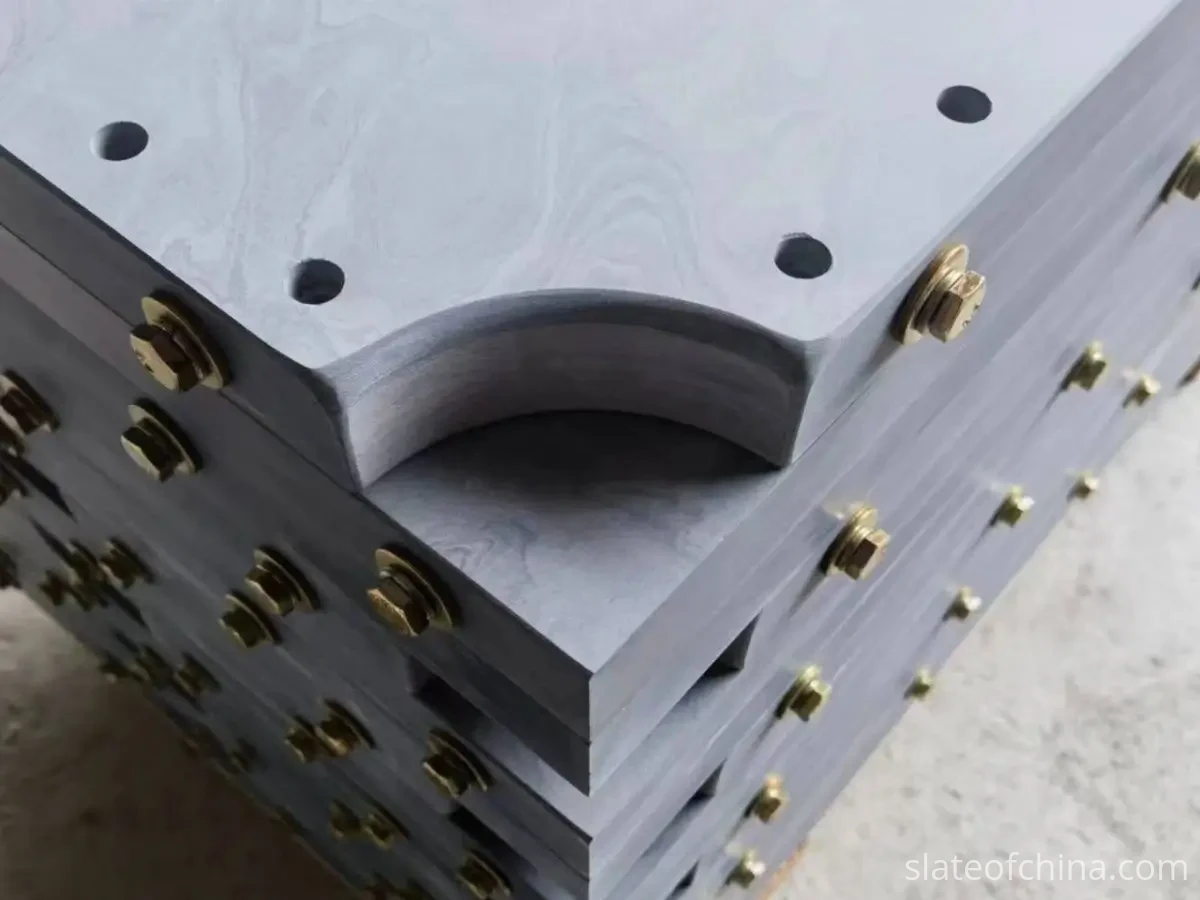
The correct depth is confirmed against the complete table assembly, not assumed. A slate manufacturer should not apply a single pocket depth to every table, because different table brands use different pocket hardware, different liner designs and different frame constructions. The depth on the drawing — or on the approved sample — is the only reliable reference.
Position: Where the Pocket Sits
Pocket position is the dimension that ties the opening to everything else on the slate: the playing surface, the slate edge, the cushion line and the joint positions on a multi-piece set.
A pocket opening that is correctly shaped but incorrectly positioned is still wrong. If the pocket centre is a few millimetres off, the cushion nose may not meet the slate at the right point, the ball entry geometry changes, and the pocket assembly may not fit. On a three-piece set, position also has to be coordinated with the joint line — a corner pocket may span a joint, and the two halves have to align.
In our production process, the CNC programme controls position from the same reference points that were used to machine the panel outline and the joint edges. The pocket centre, the opening width and the radius are all located relative to a single coordinate system, so that the pocket sits where the drawing says it should — not where an operator estimates by eye.
For a multi-piece set, the position is programmed once and applied to each piece in the set. This is what keeps the pocket geometry consistent from piece to piece: the CNC programme is the memory, and it does not drift between panels the way a manual layout can.
Corner Pockets and Side Pockets Are Not the Same Cut
A standard pool table has six pockets: four corner pockets and two side pockets. It is tempting to think of these as six identical openings, but the geometry is usually not the same.
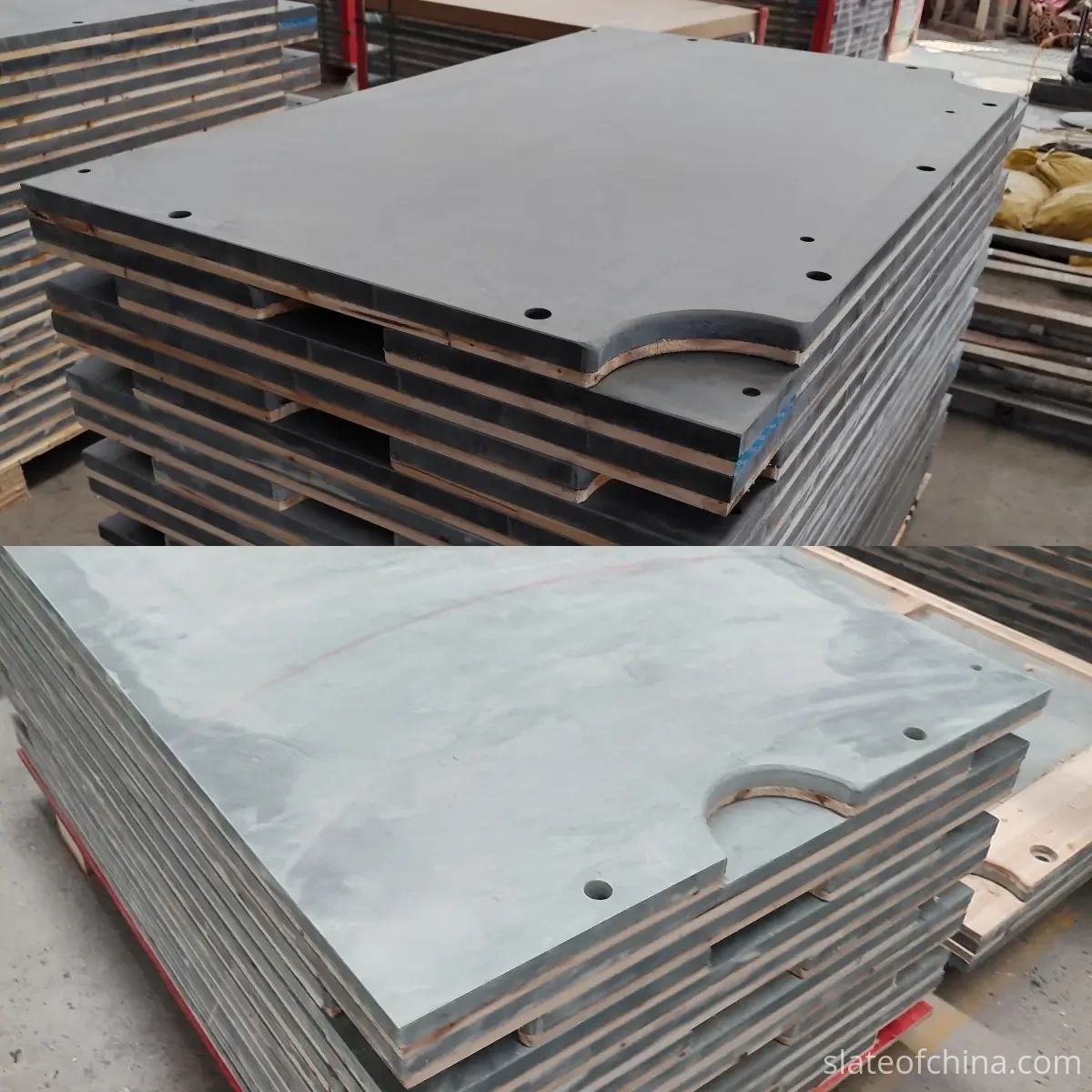
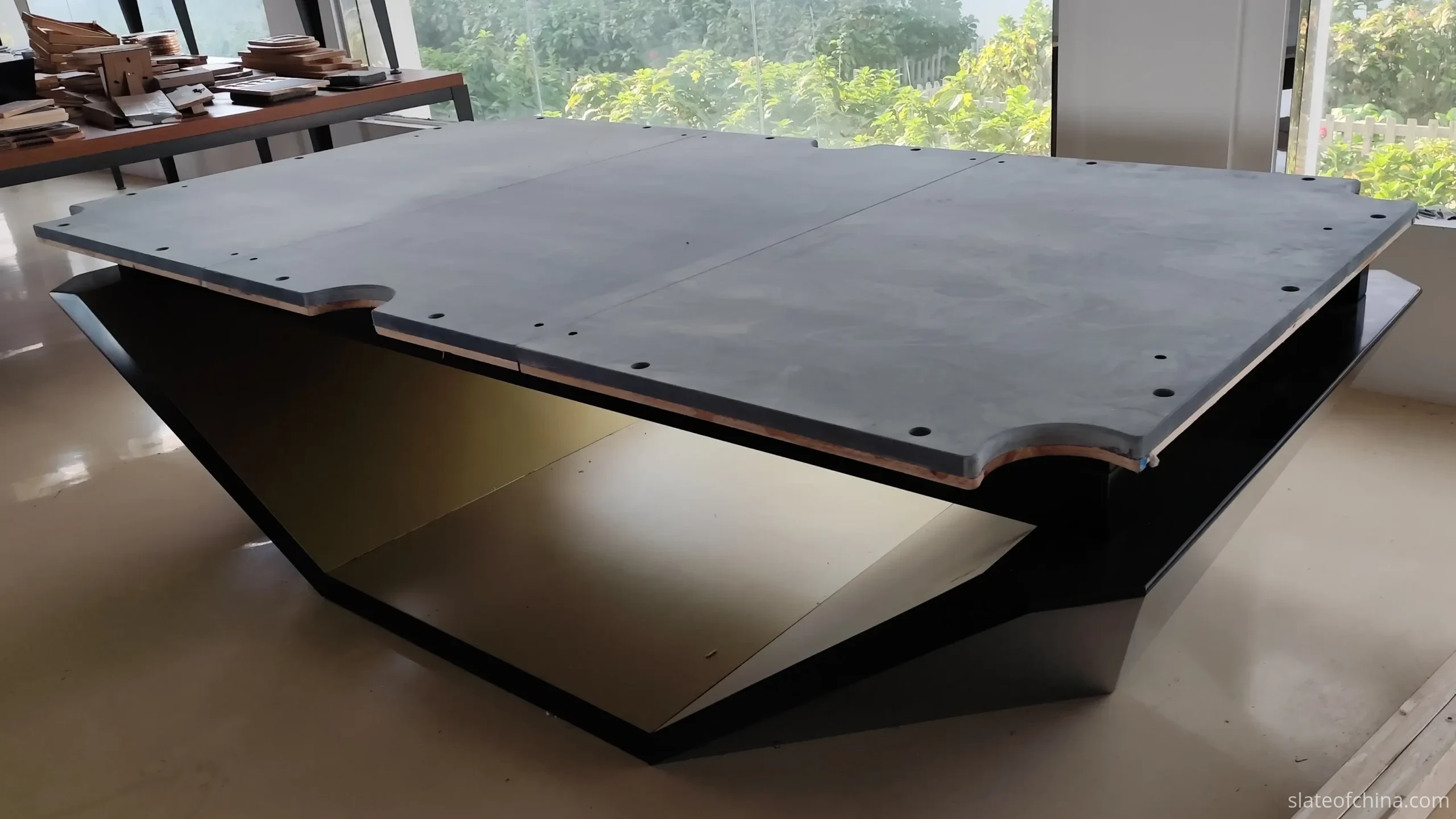
Corner pockets sit at the intersection of two cushion runs, typically at a 45-degree angle to the cushion lines. The opening geometry has to accommodate two cushions meeting at a corner, and the radius transitions from both directions. Side pockets sit mid-table, where a single cushion run is interrupted by an opening that is typically wider than a corner pocket and may have a different radius and depth.
What this means in practice is that a six-pocket slate normally requires separate machining geometry for corner and side pockets, although the exact CNC programming method depends on the machine and production system — a single programme may contain both toolpaths, or a master programme may call sub-routines for each pocket type. What matters is that the geometry for each pocket type is defined and executed according to its own specification, not copied six times from a single shape.
For a buyer, the practical implication is that a drawing should specify the geometry of each pocket type, not just "six pockets." A drawing that says "cut six standard pockets" is leaving the geometry to the factory's interpretation — and different factories will interpret it differently.
Pocket Opening Is Not the Same as Finished Pocket Size
Buyers sometimes use "pocket opening" and "pocket size" as if they meant the same thing. On a billiard table, they do not. Understanding the difference matters when you are specifying slate, because the dimension you machine into the stone is not the dimension the ball sees at play.
The pocket opening is the geometry cut into the slate — the width, length, radius, depth and position defined on the drawing. The finished pocket size is what the ball actually encounters on the assembled table, which is set by the interaction of several components:
- The slate opening — what is machined into the stone
- The cushion nose — where the cushion rubber terminates at the pocket mouth, which partially narrows the gap the ball can enter
- The pocket facing — the angle and thickness of the cushion facing material at the pocket entrance
- The pocket liner or iron — hardware that shapes the pocket throat and ball path below the slate
- The leather pocket — which may further constrain how the ball drops
The opening machined into the slate should not automatically be treated as the final playing pocket size. Two tables with the same slate opening can play differently if the cushion profile, the facing angle or the pocket hardware differ. This is why a slate supplier machines to the drawing — the drawing encodes the geometry that, together with the cushion system, produces the intended pocket. The slate does not decide the pocket size on its own; it provides the opening that the rest of the table design completes.
For a buyer, the practical implication is this: if you want a tighter or looser pocket, the first question is not "can you cut the opening bigger or smaller" but "what does my table design require." The slate opening is one input into a finished pocket that is the result of the complete table assembly. Changing the opening without changing the cushion and pocket system is not a reliable way to change how the table plays.
Brand Specification: The Drawing Is the Brand
Different table brands use different pocket geometries. This is not a preference or a style choice — it is an engineering specification. The pocket opening has to match the cushion profile, the pocket hardware and the frame design that a particular table brand uses, and those components vary from brand to brand.
There is no universal "standard pool table pocket." Two 9-foot tables from different manufacturers may use different pocket widths, different radii, different depths and different side-pocket geometries. A slate that fits one table brand will not necessarily fit another, even when the overall slate dimensions are the same.
This is why the drawing is the brand. When an OEM buyer sends us a drawing, the drawing encodes the brand's engineering decisions — the cushion profile, the pocket hardware, the frame design — in a form that the CNC programme can execute. We do not substitute "standard" dimensions for the drawing's dimensions, because the drawing's dimensions are the ones that make the table work.
For repeat orders, the approved drawing — and the approved sample that was machined from it — become the reference for every subsequent batch. The CNC programme is stored, the sample is retained, and the next set is machined to the same programme. This is how pocket geometry stays consistent across production runs without relying on an operator's memory.
| What the Buyer Sends | What the Factory Translates | What the Slate Receives |
|---|---|---|
| CAD drawing with pocket dimensions, radius, depth and position | CAM programme converting drawing annotations into tool paths | Machined pocket opening matching the drawing geometry |
| Approved sample or physical template | Reverse-engineered drawing or template-matched programme | Pocket opening matching the sample geometry |
| Table model name only (no drawing) | Not sufficient for production — geometry cannot be assumed | Production cannot start until geometry is confirmed |
The third row of this table is the one that causes the most delays. A table model name is a label, not a geometry. When a buyer sends only a model name, we have to go back and ask for the drawing, the sample, or the template — because machining a pocket opening without an approved geometry is not production, it is guessing.
What Happens When There Is No Drawing
This is common with older table designs, with tables that are being reproduced from an existing sample, or with buyers who have a table but no formal CAD file. There are three ways to establish the required pocket geometry without a drawing, and each one has a different level of reliability.
Existing Slate Sample
An existing slate can be measured and used as a reference. This is the most direct route — the sample is the geometry, and the CNC programme can be built from a careful measurement of the sample's pocket openings. The limitation is that the sample has to be in good enough condition to measure accurately, and the measurement has to capture the radius, the depth and the position, not just the opening width.
Physical Template
A customer-approved template — a cut-out that matches the pocket shape — can define the opening geometry when a drawing is not available. The template is placed against the machined opening to confirm the match. This works well for radius and shape, but it does not capture depth or position on its own; those still have to be specified or measured from the table.
Reverse Engineering
For some OEM projects, an existing table or slate can be measured to create a new technical drawing. This is the most thorough route, but it takes the longest. The resulting drawing should be approved by the customer before mass production begins — a reverse-engineered drawing is a proposal, not a decision, until the customer signs off on it.
In all three cases, the principle is the same: the geometry has to come from somewhere. It cannot be invented. The page on drawing confirmation covers this process in more detail.
How a Machined Pocket Is Inspected
Machining is one half of the process. The other half is confirming that the machined pocket matches the drawing. A pocket that looks right under factory lighting is not the same as a pocket that meets the specification — and the difference is what inspection is for.
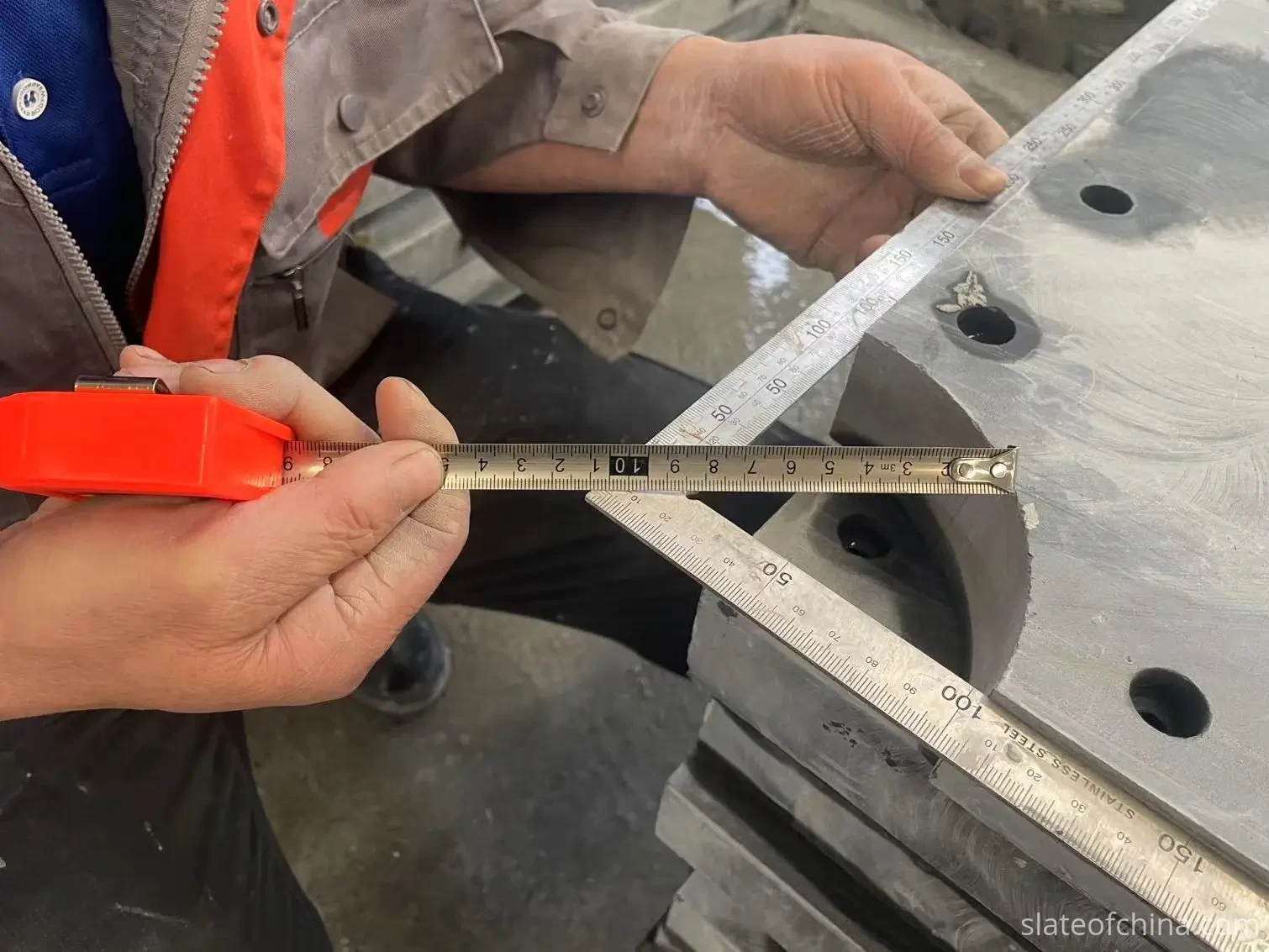
A typical pocket opening inspection covers five things:
- Opening dimensions — the width and length of the pocket opening are checked against the approved drawing or sample.
- Radius — the curved section is checked against the required radius, using a template, a radius gauge, or a coordinate measurement if the programme provides one.
- Position — the pocket centre and opening position are checked relative to the slate reference dimensions and, on a multi-piece set, to the joint positions.
- Depth — where a controlled depth is required, the machined depth is checked against the drawing. For through-openings, the edge condition is checked instead.
- Edge condition — the machined edge is inspected for excessive chipping, cracks, tool marks, or damage around the opening that could affect assembly or play.
For a multi-piece set, the corresponding pocket openings on each piece are checked for consistency. If a corner pocket spans a joint line, the two halves are checked together — the assembled pocket has to be one shape, not two halves that almost meet.
The inspection scope — whether every piece is checked or a sampling plan is used — is agreed in the order, in the same way as the rest of the quality control scope. A pocket that passes inspection carries the geometry that was on the drawing, and the geometry that the table brand needs.
What a Buyer Should Send Before Machining Begins
The most useful information a buyer can send is not "9 ft pool table slate with six pockets." It is the set of dimensions that lets the factory reproduce the intended geometry. Ideally, this includes:
- Table size and playing area dimensions
- Overall slate dimensions and thickness
- Pocket opening dimensions for each pocket type (corner and side)
- Pocket radius for each pocket type
- Pocket depth, where a controlled depth is required
- Pocket centre locations relative to the slate reference
- Corner and side pocket geometry — not assumed to be identical
- Cushion or pocket component requirements, if the pocket hardware affects the opening geometry
- CAD drawing or technical drawing
- Approved sample or template, if a drawing is not available
- Multi-piece configuration and joint positions, if the set is not one piece
For OEM production, a CAD drawing is the most reliable reference. For reproduction of an existing table, an approved sample or template can establish the geometry. In either case, the geometry has to be confirmed before machining — not after.
The full information checklist for custom production — including sizes, thicknesses, piece count and machining requirements — is covered in the billiard slate technical specifications page and the OEM manufacturing process guide.
Pocket Machining Is Part of the Complete Slate Specification
A precisely machined pocket opening cannot compensate for poor flatness, incorrect dimensions, or an incompatible cushion system. The pocket opening is one of several specifications that have to work together:
Slate thickness + dimensions + flatness + surface finish + pocket geometry + joint machining + cushion interface
Each of these is covered in its own page — surface grinding for flatness, joint alignment for multi-piece sets, quality and test data for the numbers. Pocket machining is the step where the drawing's geometry becomes a physical feature on the stone, but it is only one step in a chain. The goal is not a perfectly machined pocket on a wrong slate — it is a complete slate assembly that works with the customer's table design.
Frequently Asked Questions
What is billiard slate pocket opening machining?
It is the CNC machining process used to create and finish the pocket openings in a billiard or pool table slate, according to the dimensions, radius, depth and position specified in the table manufacturer's drawing. The pocket opening is not a simple hole — it is an interface between the slate, the cushion system and the pocket hardware, and each dimension on the drawing has to be translated into the stone.
Are all pool table pocket openings the same?
No. Corner pockets and side pockets may have different geometries — different widths, angles, radii and depths — and different table brands use different pocket specifications. There is no universal "standard pool table pocket." The geometry comes from the table manufacturer's drawing, and a slate that fits one brand will not necessarily fit another.
Does the pocket radius affect the table?
Yes. The radius is the curved transition from the straight cushion line to the pocket mouth, and it affects the pocket shape, the cushion nose termination and the ball entry geometry. Two openings with the same width but different radii are not the same pocket. The radius should be specified on the drawing, not left to interpretation.
How is pocket depth determined?
Pocket depth depends on the table construction. Some designs require a recessed shelf to seat pocket hardware or a liner; others require a clean through-opening so the ball can drop below. The depth is determined by the pocket hardware, the liner design and the table frame — not by a single standard that works for every table. The drawing or approved sample is the reference.
Can you machine pocket openings without a CAD drawing?
Yes, but the geometry still has to come from somewhere. An existing slate sample can be measured and used as a reference, a physical template can define the opening shape, or an existing table can be reverse-engineered to produce a new drawing. In all cases, the geometry has to be confirmed before mass production. A table model name alone is not enough — the pocket geometry cannot be assumed.
How do you keep pocket openings consistent across a multi-piece set?
The CNC programme is the memory. The pocket geometry is programmed once from the approved drawing, and the same programme is applied to each piece in the set. Position is controlled from the same reference points used for the panel outline and joint edges, so the pocket sits in the same place on every piece. For a pocket that spans a joint line, the two halves are machined to the same programme and checked together after assembly.
Can the same slate work for different table brands?
Not necessarily. Even when the overall slate dimensions are the same, the pocket geometry — width, radius, depth, position, corner-vs-side shape — may differ between brands. A slate is brand-specific when it comes to pocket machining. The drawing for one brand cannot be used for another without confirmation, and the pocket hardware has to be compatible with the opening geometry.
Related Reading
Send Us Your Pocket Drawing or Sample — We Will Confirm the Machining
If you are sourcing billiard slate with custom pocket openings, send us your table drawing, an approved sample, or a physical template. Before production, we can review:
- ✓Pocket opening width
- ✓Corner and side pocket radius
- ✓Pocket depth and recess requirements
- ✓Corner vs side pocket geometry
- ✓Pocket position relative to the playing surface
- ✓Slate thickness and multi-piece configuration
We can confirm whether the drawing provides enough information for CNC machining — and flag any geometry that needs clarification before the cutting tool moves. Start the conversation here.