
How to Choose a Billiard Slate Manufacturer
During a video call with a billiard slate supplier in China, the sales manager panned the camera across the production floor — shelves of finished product, a packing area, a forklift. What the camera did not show was a CNC machine, a calibration table, or an inspection bench.
The company's website said manufacturer. Their business license said manufacturer. But the question was not what the paperwork said. It was what the floor looked like.
Choosing a billiard slate manufacturer is not about finding the lowest price per set. It is about understanding who actually cuts, machines, inspects, and packs your slate — and whether they can do it again six months from now. A polished website does not prove production. A trading company is not automatically a bad partner. What matters is knowing who controls the process, and what they can prove.
This guide goes beyond ten questions. It gives you a 5-step verification process, a claims-vs-evidence checklist, seven quick tests, ten red flags, and a 100-point scorecard — everything a pool table manufacturer, distributor, or importer needs to evaluate a billiard slate supplier before the first container.
Before placing a serious order, send your potential supplier these ten questions:
- Can you show me your actual billiard slate production?
- Which processes do you control in-house?
- Can you produce my exact slate dimensions?
- How do you control slate thickness and flatness?
- Do you understand CNC machining for billiard slate?
- Can you provide a sample before mass production?
- Can you maintain consistent quality from one container to the next?
- How do you pack billiard slate for export?
- Who will handle problems if something goes wrong?
- Can you support long-term B2B supply?
Do not judge suppliers only by whether they answer yes. Judge them by how specifically they answer. A production-oriented supplier should be able to provide details, photographs, drawings, measurements, and practical explanations — not just reassurances.
1. Can You Show Me Your Actual Billiard Slate Production?
Do not start with a company profile or a product catalog. Ask for recent production photos or a short video showing the actual manufacturing process.
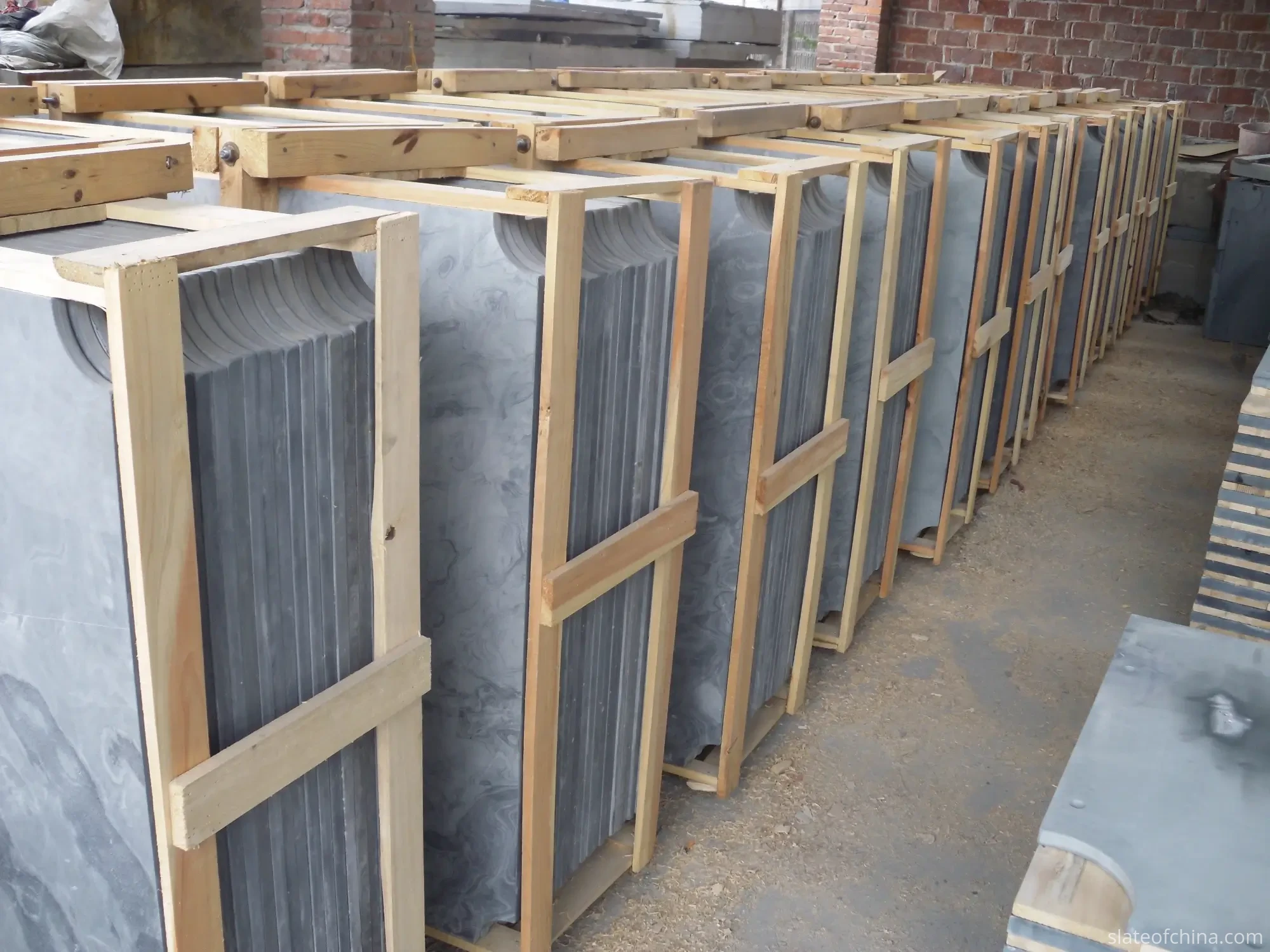
A real manufacturer should be able to show several stages: raw slate blocks or slabs, primary cutting, thickness calibration, CNC machining, table-bed cutting, pocket machining, edge finishing, flatness inspection, thickness measurement, and packing. They do not need to show all of them in a single video — but they should be able to explain what happens at each stage and provide evidence on request.
A supplier who sends only product photographs — beautiful, well-lit, but showing nothing of how the product was made — has answered the question without answering it. Product photos prove that someone, somewhere, made billiard slate. They do not prove that this supplier made it.
2. Which Processes Do You Control In-House?
The word factory means different things in the stone trade. Some companies own the complete production line from raw block to finished package. Others have a stone-processing facility but outsource CNC machining. Some purchase semi-finished slate and handle only export sales and packing.
None of these models is automatically wrong. A supplier with outsourced CNC can still deliver excellent product if they control the specification and accept responsibility for the result. What matters is that you know exactly which parts of the process your supplier controls — and which parts depend on someone else.
| Production stage | What to ask |
|---|---|
| Raw slate selection | Where does the raw slate come from? |
| Cutting | Is primary cutting done in-house? |
| Thickness calibration | What equipment is used? |
| CNC machining | In-house or outsourced? |
| Pocket machining | Who performs it? |
| Flatness inspection | Who checks it and how? |
| Packing | Factory or third-party warehouse? |
| Loading | Who supervises container loading? |
If a supplier cannot tell you who machines the pockets, they may be an excellent sourcing partner — but they are not the manufacturer. Know the difference before you order a full container.
3. Can You Produce My Exact Slate Dimensions?
A quote request that reads "9 ft pool slate, please quote" contains four words. It should contain a drawing.
Billiard slate specifications vary considerably between table types and manufacturers. A 9 ft pool table, a 12 ft snooker table, a Chinese 8-ball table, and a Korean carom table all require different dimensions, thicknesses, pocket layouts, and machining details. Even within the same category — say, 9 ft pool — one buyer may need 2718 × 1448 × 25 mm while another requires a completely different size. "9 ft pool slate" is not a specification. It is a category.
Instead of asking "Do you manufacture billiard slate?", ask: "Can you manufacture this exact drawing and tolerance?" Then send your technical drawing. A serious manufacturer should be able to review the overall dimensions, thickness, number of pieces, playing-area dimensions, pocket locations, bolt holes, cut-outs, edge profiles, and packaging requirements — and tell you whether they can produce it, what issues to watch for, and what it will cost.
The drawing is almost always more important than the product name. For a deeper look at what a complete specification includes, see our billiard slate technical specifications reference page.
4. How Do You Control Slate Thickness and Flatness?
Billiard slate is the playing surface of the table. Thickness consistency and flatness are not cosmetic details — they determine whether the table plays true. This is one of the most important technical questions, and the one that most clearly separates a manufacturer from a reseller.
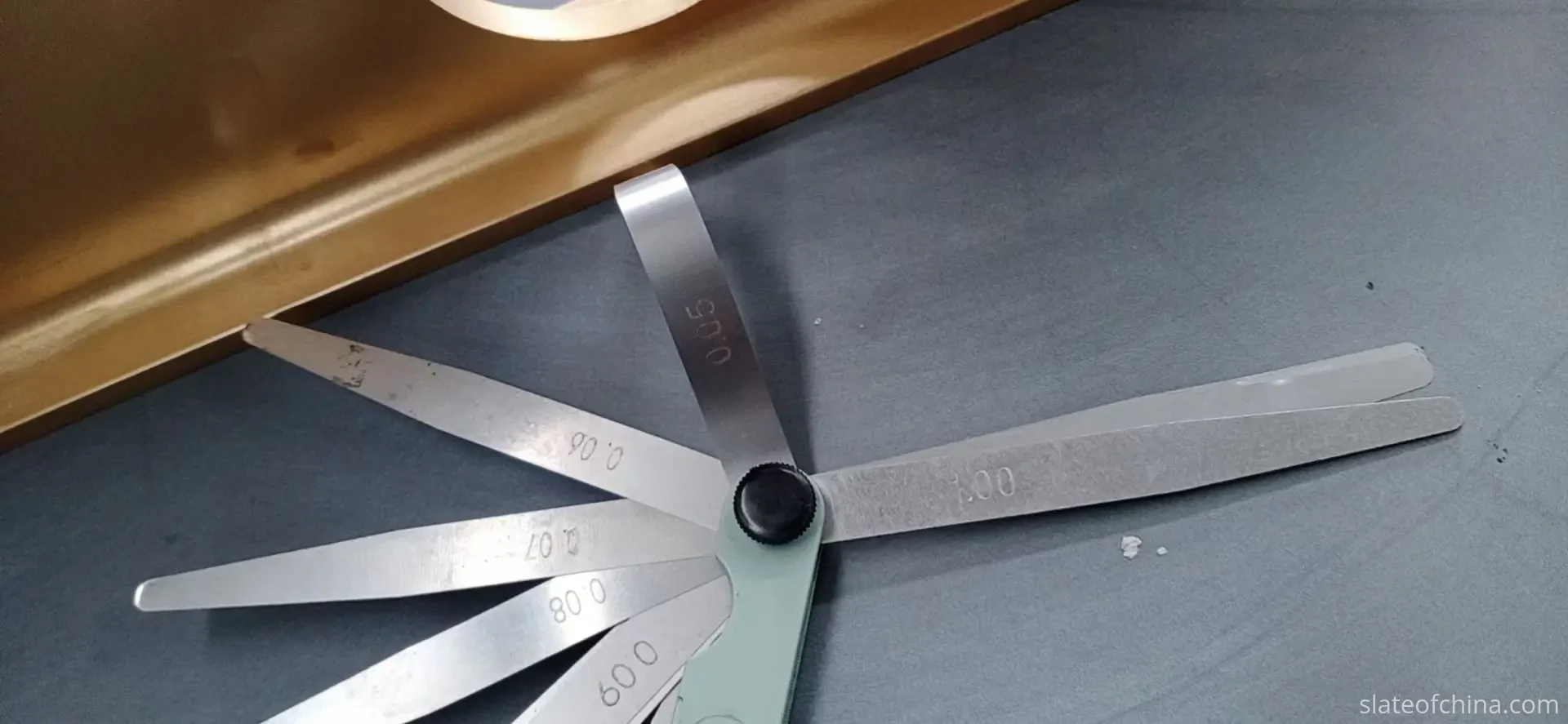
Ask the supplier: What is the nominal thickness? What thickness tolerance can you work to? How is thickness measured — at how many points per piece, and with what tool? How is flatness checked? At what stage is inspection performed? Are the results recorded? Can you provide QC records with an order?
A supplier who answers "Our slate is very flat" has answered nothing. A supplier who says "We check thickness at multiple points per piece with a calibrated gauge, record the readings on a batch sheet, and can provide those records with your shipment" has answered everything.
Do not accept a tolerance number simply because a supplier puts it on a website. Ask how the tolerance is measured, where it is measured, how often it is recorded, and whether the same method is used for every shipment. For a detailed look at measurement methods and actual QC records, see our billiard slate quality and test data page.
5. Do You Understand CNC Machining for Billiard Slate?
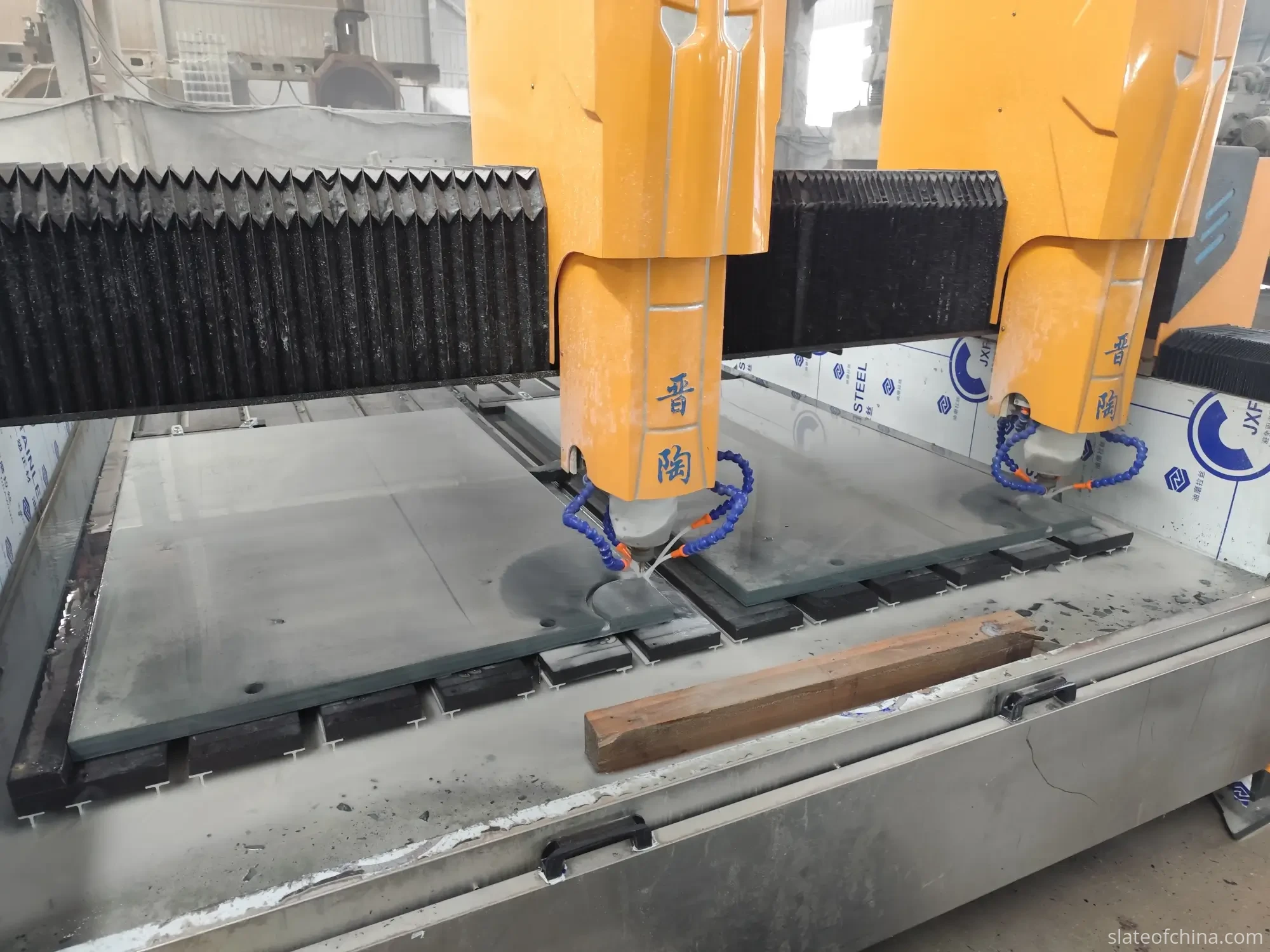
Billiard slate is not simply a piece of stone cut to size. Most table designs require CNC machining for pocket openings, bolt holes, corner cuts, cushion grooves, and table-specific cut-outs. A supplier who understands stone cutting but has never machined a billiard slate pocket is not the right partner for an OEM order.
Some suppliers claim CNC capability but show photos of a bridge saw cutting straight lines. A bridge saw is a useful piece of equipment. It is not a CNC machining centre. A bridge saw cuts straight lines; a CNC machine follows a programmed tool path to create curved pockets, angled holes, and recessed profiles to the tolerance your table design requires.
Instead of asking "Do you have CNC?", ask: "Can you show me examples of billiard slate you have CNC-machined for pool tables, snooker tables, or Chinese 8-ball tables?" Even better, provide your own CAD drawing. A capable supplier should be able to discuss the drawing with your technical team, identify potential production issues, and suggest adjustments before machining begins. For an overview of different table types and their machining requirements, see types of billiard slate.
6. Can You Provide a Sample Before Mass Production?
A sample is the simplest way to reduce risk before a large order. For large billiard slate components, sending a complete production set may not always be practical — but a supplier should be able to provide machined sample pieces, CNC test pieces, edge samples, or pocket samples that demonstrate their capability.
The purpose of a sample is not simply to check the colour of the stone. A serious sample evaluation checks whether the supplier can reproduce your technical requirements: the right dimensions, the right thickness, the right edge profile, the right pocket geometry. For OEM customers, establish a written approval process: drawing, then sample, then written approval, then mass production, then final inspection. Each step creates a record that both parties can refer back to if production does not match the approved sample.
For more on how samples and specifications flow into purchasing, see billiard slate buying guide.
7. Can You Maintain Consistent Quality From One Container to the Next?
A supplier may produce an excellent first order. The harder question is whether they can produce the same quality six months later.
If you are building your own pool table brand, your customers do not want one shipment to fit perfectly while the next requires adjustment during assembly. Repeatability is a manufacturer's real test — not the ability to make one good set, but the ability to make the same specification repeatedly.
Suppliers who source from different quarry sections between orders may deliver slightly different colour, density, or dimensional stability. Ask about raw material consistency, dimensional repeatability, and how the supplier handles raw-material changes between orders. The answer tells you whether the supplier thinks in terms of individual orders or long-term production.
8. How Do You Pack Billiard Slate for Export?
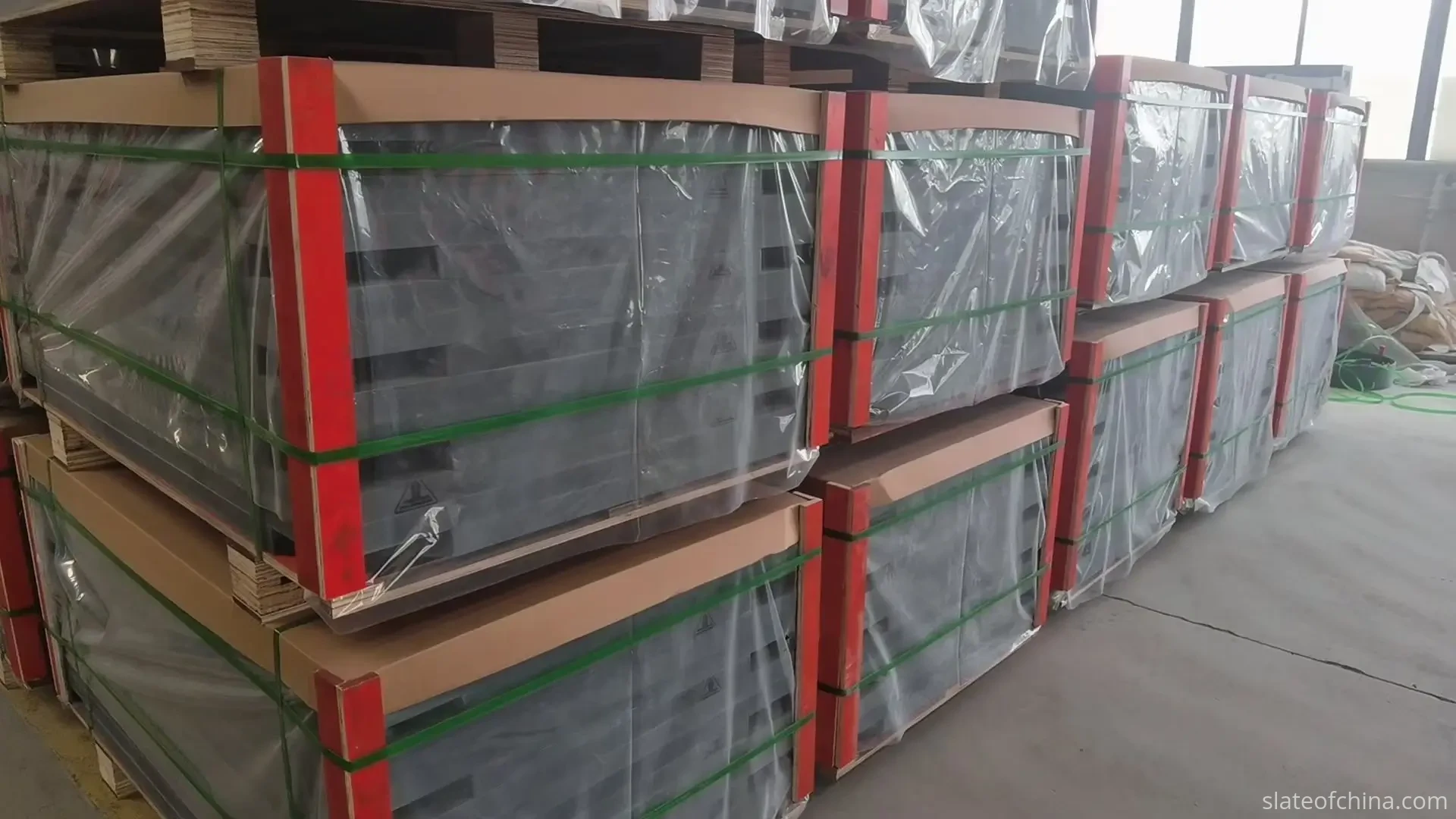
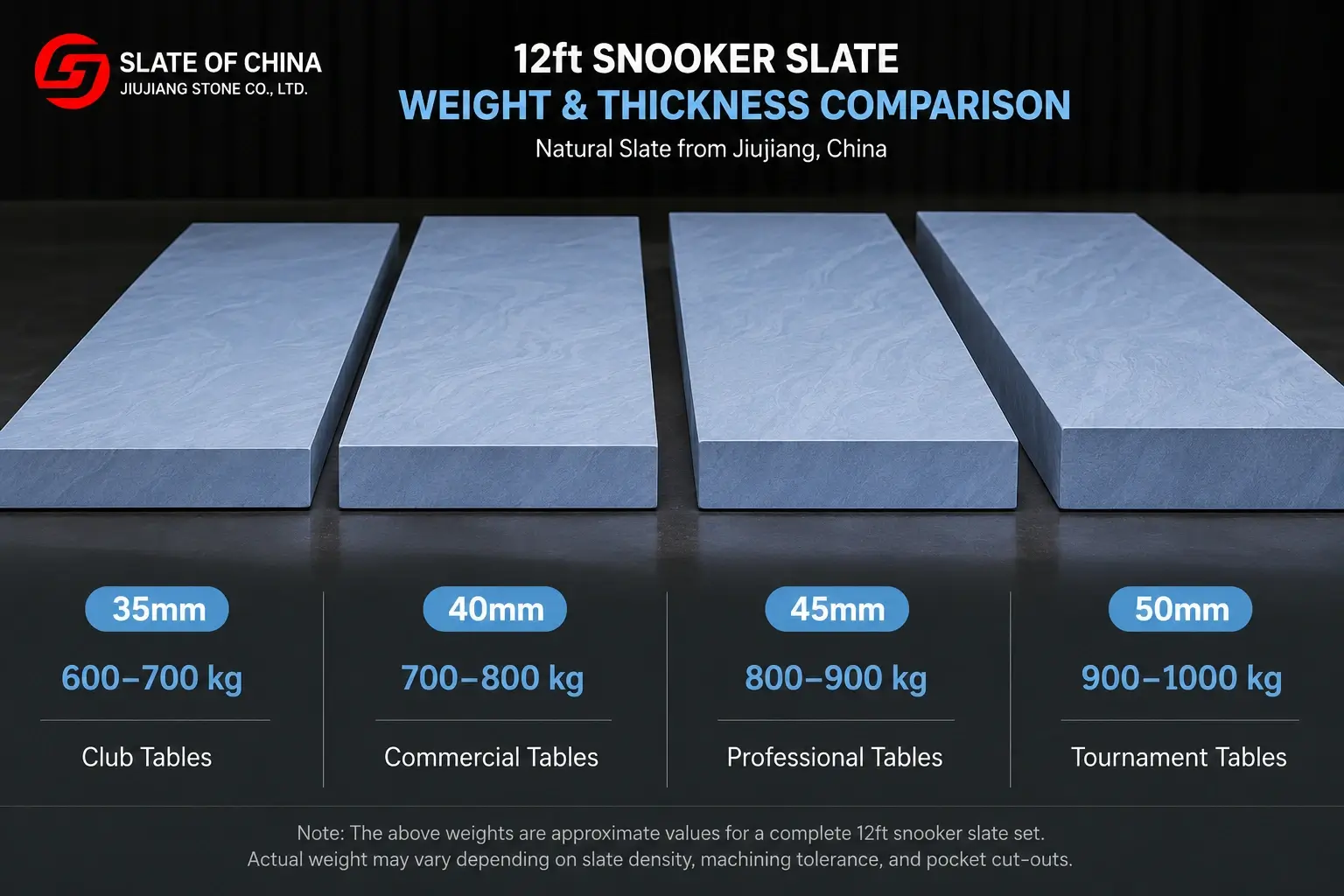
A billiard slate set is heavy, fragile, and expensive to move. A 9 ft pool set weighs roughly 250–270 kg. A 12 ft snooker set can exceed 800 kg. Poor packing can turn a technically perfect order into a costly problem before it reaches your warehouse.
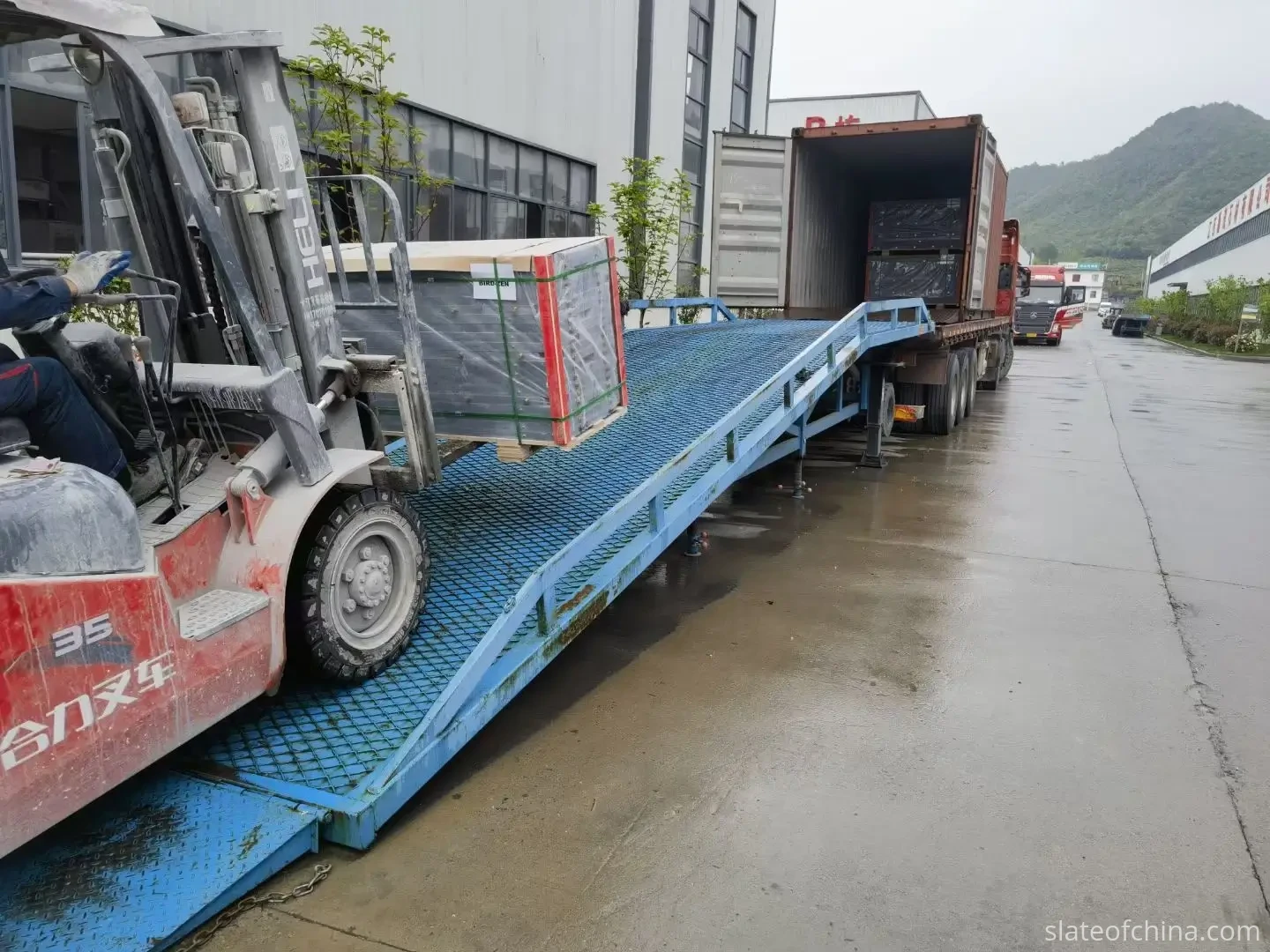
Ask the supplier to show you actual export packing — not a stock photo. Billiard slate is normally packed on wood-framed pallets: a wooden base and frame around the stack, strapping to hold the load together, and separation between pieces so machined edges do not touch. Look for corner reinforcement, separation of machined edges, moisture protection where appropriate, and reinforcement where the package takes weight.
Then ask one more question: "Can you show me photos of your last container loading?" Loading photos tell you whether the supplier supervises the process, whether packages are braced and secured inside the container, and whether the loading is done at the factory or at a third-party warehouse. Our factory is in Lushan, forty minutes from Jiujiang port. We bring empty containers to the factory, load them ourselves, and send them back to the port — no transloading, no extra hands between the package and the container.
For the full shipping process, see billiard slate import guide.
9. Who Will Handle Problems If Something Goes Wrong?
This question is often overlooked before the first order — and it is the one that matters most when something goes wrong. Imagine a container arrives and you discover broken pieces, incorrect dimensions, wrong thickness, or CNC errors. Who makes the decision? The sales representative? A manager at a trading company? The factory production team?
Before placing a large order, ask: "What is your procedure if a piece arrives damaged or does not meet the approved specification?" A professional supplier should be willing to discuss this before there is a problem. If the answer is "Don't worry, it won't happen" — that is not a procedure. A real procedure includes how damage is documented, how claims are evaluated, what the options are (replacement, credit, or adjustment on the next order), and what timeline to expect.
10. Can You Support Long-Term B2B Supply?
If you are a pool table manufacturer, distributor, or importer, you are not just buying slate — you are building a supply chain. Over time you may need repeat orders, different table sizes, custom dimensions, OEM production, mixed container loading, quality documentation, and replacement pieces.
Ask the supplier: "If our annual demand increases, how will you support us?" A useful answer should cover production capacity, lead time, raw-material availability, packaging flexibility, inspection planning, and shipment scheduling. A supplier who can only talk about today's price is not a long-term partner.
Factory, Trading Company, or Factory-Backed Exporter?
The question is not simply who sells the slate. The question is who controls the specification, production, QC, and responsibility. In the billiard slate trade, there are three common supply models — and the differences matter.
A factory owns the production equipment, employs the operators, and controls the process from raw block to finished package. It gives you direct technical control and may offer better pricing for large volumes, but communication can be slower and minimum quantities higher.
A trading company does not own production. It buys from factories and handles export sales, documentation, and logistics. A good trading company can provide better communication, consolidated sourcing, export experience, and lower minimum quantities. The risk is when a trading company presents itself as a manufacturer or cannot answer technical questions about the process.
A factory-backed exporter sits between the two: it has a direct, long-standing relationship with a specific factory — sometimes an affiliated entity — and can connect you with the production team for technical discussions while handling export logistics professionally. This model can combine the technical access of a factory with the communication efficiency of a trading company.
None of these models is automatically right or wrong. What matters is transparency: know who actually produces the slate, who is responsible for quality, and who handles problems when they arise. For more, see billiard slate buying guide and our manufacturer page.
How to Verify a Billiard Slate Manufacturer: An 8-Step Process
Ten questions tell you what to ask. A verification process tells you what to do — from first contact to first container. Work through these eight steps in order. Each step is a gate: do not move to the next until the previous one is confirmed in writing.
| Step | What happens | What to verify / request |
|---|---|---|
| 1. Company | Verify the registered entity, factory address, and export history | Business license copy, factory address with Google Maps pin, list of export markets |
| 2. Production | Verify that CNC, grinding, inspection, and packing are on the same site | Live video call during production hours, recent photos of each stage |
| 3. Drawing & Specification | Send your technical drawing; supplier confirms in writing or flags issues | Written confirmation of dimensions, thickness, pocket layout, bolt holes, tolerances |
| 4. Sample / First Article | Supplier machines a sample piece to your drawing | Measure dimensions, thickness, flatness, hole positions, pocket geometry against drawing |
| 5. Pre-Production Approval | You give written approval of the sample — it becomes the production standard | Keep the approved sample; the mass order must match it |
| 6. Mass Production | Production begins based on the approved sample | Request mid-production photos; ask about any raw-material changes |
| 7. Final QC | Inspection per the agreed plan (scope agreed per order) | QC records: thickness readings, flatness checks, dimensional verification |
| 8. Packing & Loading | Slate packed on wood-framed pallets, container loaded at factory | Photos of packed pallets, loading photos, signed packing list, container number |
The cost of catching a problem at Step 4 is a sample piece. The cost of catching the same problem at Step 8 is a container of slate and a customer who cannot assemble their tables.
Claims vs Evidence: What Should a Supplier Prove?
Every supplier makes claims. The question is whether they can back them up. Use this table to convert common claims into evidence requests.
| Supplier says… | Ask for evidence |
|---|---|
| "We are a factory" | Live factory video showing machines, not just a showroom |
| "We have CNC" | Video of a CNC machine machining a billiard slate pocket, not a bridge saw |
| "Our slate is very flat" | Flatness measurement method and sample QC records |
| "We have strict QC" | Actual QC checklist used for your product, not a generic brochure |
| "We export worldwide" | Recent packing and loading photos with a date stamp |
| "We can make custom slate" | Your drawing confirmed in writing, plus a machined sample |
| "We have stable quality" | Samples or records from two different production batches |
| "We can handle large orders" | Production schedule and capacity explanation for your volume |
| "We make OEM products" | Previous OEM production examples and private-label references |
| "We use good slate" | Raw material source and selection criteria |
| "We have many customers" | Long-term repeat-order evidence, not just a list of country names |
The goal is not to doubt every word a supplier says. It is to shift the conversation from claims to evidence. A supplier who is comfortable providing evidence is almost always easier to work with than one who is not.
7 Quick Tests That Expose a Weak Supplier
These tests are not designed to catch fraud. They are designed to measure a supplier's production transparency — how quickly and specifically they respond when asked for something real. Send any of these by email or chat and watch how long the answer takes and how specific it is.
Test 1. "Please show me today's production floor — a live video or a photo taken today."
A supplier close to the floor can do this in hours. A trading desk may need days to source it.
Test 2. "Can you place a piece of paper with my company name and today's date next to the slate and send a photo?"
This verifies that the photos are current and taken for you, not downloaded from a catalog.
Test 3. "Show me your flatness inspection method — not the result, the method."
A manufacturer should be able to describe the tool, the measurement points, and the acceptance criteria. A reseller can only repeat the result.
Test 4. "Can you machine this CAD drawing?" (attach your actual drawing)
A capable supplier responds with technical feedback. A weak supplier responds with a price.
Test 5. "Show me a previous shipment packed for export — photos from the last month."
This verifies that the supplier actually packs and ships billiard slate, not just quotes it.
Test 6. "What happens if three pieces arrive damaged — what is the procedure?"
A professional supplier has a process. A weak supplier says "don't worry."
Test 7. "Can you produce the same specification again six months later — and how do you ensure consistency?"
The answer reveals whether the supplier thinks in terms of orders or production systems.
10 Red Flags When Sourcing Billiard Slate from China
Any one of these signals does not automatically disqualify a supplier. But if you see three or more, the risk of a specification problem on your first order rises sharply.
1. Only showroom photos, no production floor — no evidence of where the slate is actually made.
2. Cannot show today's production — only stock images or catalog downloads.
3. "All sizes available" but cannot confirm from a CAD drawing — a category, not a specification.
4. Cannot explain flatness inspection beyond "very flat" — no method, no tool, no record.
5. "We have CNC" but only shows a bridge saw cutting straight lines.
6. No sample approval process — wants to go straight to a full container order.
7. No documented pre-shipment inspection — no QC records provided before loading.
8. Cannot explain who actually produces the slate — especially common with trading companies that present themselves as factories.
9. No clear damage or claim procedure — only "don't worry, it won't happen."
10. Cannot reproduce the same specification across batches — first container good, second container different.
Billiard Slate Manufacturer Verification Scorecard
Use this 100-point scorecard to compare suppliers side by side. Score each item from 0 to the maximum shown. This is not a certification system — it is a structured way to record your evaluation so that you can compare three or five suppliers using the same yardstick.
| Category | Item | Max |
|---|---|---|
| A. Factory Reality (20) | Production evidence (video or recent photos) | 6 |
| Factory address verifiable | 4 | |
| In-house process control (which steps are owned) | 6 | |
| Container loading done at factory | 4 | |
| B. Technical Capability (25) | Drawing-based production confirmed | 6 |
| CNC machining evidence (not bridge saw) | 6 | |
| Can discuss CAD drawing technically | 5 | |
| Pocket machining examples shown | 4 | |
| Edge profiling capability | 4 | |
| C. Quality Control (20) | Flatness inspection method explained | 6 |
| Thickness measurement method explained | 5 | |
| QC records available with shipment | 5 | |
| Sample approval process structured | 4 | |
| D. Export & Packing (15) | Actual export packing photos shown | 6 |
| Recent container loading photos | 5 | |
| Export documentation experience | 4 | |
| E. Long-Term Supply (20) | Repeat production evidence (batch consistency) | 6 |
| Problem-handling procedure (not just "don't worry") | 5 | |
| Capacity and lead-time discussion | 5 | |
| Raw-material sourcing and consistency plan | 4 |
| Score | Interpretation |
|---|---|
| 90–100 | Strong candidate — proceed to sample and trial order. |
| 75–89 | Worth sampling — verify weak areas before a large order. |
| 60–74 | Verify carefully — high risk of specification problems. |
| Below 60 | High supplier risk — do not select based on price alone. |
The Real Cost of Choosing the Wrong Supplier
Price matters. But the cheapest quotation is not necessarily the lowest-cost solution. Consider the full cost: slate price, plus machining, plus packing, plus freight, plus breakage, plus inspection, plus rework, plus installation problems, plus replacement, plus delays. A supplier that is slightly more expensive but provides consistent dimensions, reliable CNC, stronger packing, and fewer damaged pieces may ultimately be cheaper.
For a table manufacturer, one incorrectly machined set can create costs far beyond the difference between two quotations. If the bolt holes are wrong, the table cannot be assembled. If the pockets are the wrong size, the cushions do not fit. If the thickness varies, the playing surface is not level. None of these problems appear on the quotation.
Before you compare prices, compare what each supplier can actually prove. A real billiard slate manufacturer should be able to talk about more than stone — they should understand dimensions, thickness, flatness, CNC machining, inspection, packing, and repeat production, and they should be willing to show evidence. For a deeper look, start with complete guide to billiard slate or explore the billiard slate hub.
Frequently Asked Questions
How do I verify a billiard slate manufacturer in China without visiting the factory?
Ask for a live video call during production hours and request that the camera pans across the actual workshop — not just the showroom. Look for CNC machines, calibration tables, inspection benches, and packing stations. Then ask for recent production photos with a date stamp or a piece of paper showing your company name placed next to the slate. The speed of the response is less important than whether the supplier can provide specific, current, and consistent evidence when you ask for it. A real factory may need a day to arrange a video during production hours; a trading desk may respond instantly but struggle to show the same level of detail across multiple requests.
How do I know if a billiard slate supplier is a factory or a trading company?
Ask directly which production processes they control in-house. A factory should be able to tell you where the slate is cut, who machines the pockets, who inspects flatness, and who packs the order. A trading company that is transparent about its role — and can connect you with the factory for technical discussions — can still be a viable partner. The risk is a supplier that presents itself as a manufacturer but cannot answer production questions.
What should I ask a billiard slate manufacturer before placing an order?
Start with ten questions: production evidence, in-house process control, custom dimension capability, thickness and flatness control, CNC machining experience, sample availability, batch-to-batch consistency, export packing, problem-handling procedure, and long-term supply capability. Do not judge suppliers by whether they answer yes — judge them by how specifically they answer, and whether they can provide evidence.
How do I check billiard slate quality before shipment?
Request a pre-shipment inspection per the agreed plan. Ask for thickness measurement records, flatness inspection results, dimensional verification against your drawing, and photos of the packed pallets before loading. If you have a third-party inspector, provide them with your specification and the approved sample so they can compare the production order against the standard you agreed on.
What should be included in a billiard slate specification?
At minimum: overall dimensions, thickness, number of pieces, playing-area dimensions, pocket locations and openings, bolt hole positions, cut-outs, edge profiles, and packaging requirements. A product name like '9 ft pool slate' is a category, not a specification. Send a technical drawing — the drawing is almost always more important than the product name. See our billiard slate technical specifications page for a complete reference.
Should I buy billiard slate directly from a factory or a trading company?
It depends on your needs. A factory gives you direct technical control and may offer better pricing for large volumes. A trading company may provide better communication, consolidated sourcing, lower minimum quantities, and export experience. The key is transparency: know who actually produces the slate, who is responsible for quality, and who handles problems when they arise. For technically demanding custom slate, direct factory access is usually preferable.
How do I order custom CNC billiard slate from a manufacturer?
Send your CAD drawing with all dimensions, tolerances, pocket layouts, bolt holes, and edge profiles. Ask the supplier to confirm in writing that they can produce it, and to flag any potential production issues. Request a machined sample piece before mass production. Once the sample is approved in writing, it becomes the production standard — the mass order must match it. Expect eight to twelve weeks from drawing approval to loading for a custom CNC order.
What should I check before importing billiard slate from China?
Verify the supplier's export experience, packing standards, and documentation process. Request a commercial invoice template, packing list format, and certificate of origin sample. Confirm that loading is done at the factory or a supervised warehouse. Check that the packing uses wood-framed pallets with separation between pieces. For the full process, see our billiard slate import guide.
Related Reading
Send us your drawing. We will tell you what we can produce, how we inspect it, and how we pack it — before you compare prices.
Start a Production Consultation Browse Billiard Slate Products