

Reading Time: 15–18 minutes
Updated: June 2026
Author
Engineering Team of Slate of China
Reviewed by our Quality Inspection Team.
Billiard Slate Flatness Guide
Learn how billiard slate flatness affects ball roll, playing accuracy, speed consistency, and tournament performance. Explore flatness standards, tolerances, testing methods, and expert guidance for pool and snooker slate.
“A billiard table is only as accurate as the flatness of its slate.”
Even the finest cloth, cushions, and balls cannot compensate for an uneven playing surface.
Whether you manufacture billiard tables, distribute slate, or simply want the best playing experience, slate flatness is one of the most critical factors affecting table performance.
A perfectly flat billiard slate ensures that every ball rolls naturally, maintains consistent speed, responds accurately off the cushions, and delivers the level of precision expected from professional pool and snooker tables. Even a slight deviation in surface flatness can influence shot accuracy, ball control, and overall playing quality.
Unlike slate thickness or weight, flatness directly affects how the playing surface performs after installation. This is why tournament table manufacturers, professional installers, and experienced table builders place such importance on precision-ground slate with strict flatness control.
In this guide, you’ll learn everything you need to know about billiard slate flatness, including:
- What slate flatness actually means
- Why flatness is critical for pool and snooker tables
- Typical flatness standards and tolerances
- How flatness is measured and inspected
- Common causes of flatness problems
- How proper installation helps maintain a perfectly flat playing surface
Whether you’re purchasing slate for a home table or sourcing professional tournament slate, understanding flatness will help you choose a more reliable, longer-lasting, and higher-performing product.
Table of Contents
Why Flatness Matters
🎱 Smooth & True Ball Roll
A perfectly flat slate allows billiard balls to roll naturally without drifting or unexpected deviation.
⚡ Consistent Playing Speed
Uniform surface accuracy ensures predictable ball speed across every area of the table.
🎯 Shot Accuracy
Professional-level flatness minimizes errors during long-distance and precision shots.
🏆 Tournament Performance
High-quality slate provides the playing consistency required for professional competition and commercial tables.
Discover how slate flatness is measured, controlled, and maintained throughout manufacturing, transportation, and installation.
What Is Billiard Slate Flatness?
Billiard slate flatness refers to how closely the entire playing surface conforms to a single, perfectly even geometric plane. It is one of the most important quality indicators for pool table and snooker table slate because it directly influences ball roll, playing accuracy, and overall table performance.
A high-quality slate should maintain consistent flatness across its entire surface—from edge to edge and from corner to corner. Even very small deviations can cause balls to drift, change speed, or react unpredictably during play.
Flatness is often confused with surface smoothness or polishing, but these are completely different characteristics. Understanding the difference helps buyers evaluate slate quality more accurately.
Surface Smoothness
A slate surface can feel smooth to the touch while still containing slight high or low areas. Smoothness describes the texture of the surface—not its geometric accuracy.
Surface Polish
Polishing improves the appearance and finish of the slate but does not guarantee a perfectly flat playing surface. A polished slate may still have measurable flatness deviations.
Table Level
Levelness refers to whether an installed billiard table is perfectly horizontal. A table can be level while the slate itself is not perfectly flat, and a perfectly flat slate can perform poorly if installed on an uneven frame.
Thickness
Slate thickness affects rigidity and structural stability, while flatness determines the accuracy of the playing surface. A thicker slate is not automatically flatter than a thinner one.
Flatness measures precision. Thickness provides support. They serve different purposes.
What Flatness Actually Means
True billiard slate flatness means that every point on the playing surface lies within a specified flatness tolerance relative to the same geometric plane.
Rather than describing how shiny or smooth the slate appears, flatness measures the maximum allowable deviation across the entire playing surface. For professional pool and snooker tables, this deviation is typically controlled within extremely small tolerances to ensure consistent ball movement and reliable playing performance.
The flatter the slate, the more accurately the balls roll, especially during long-distance shots and precision play.
Key Takeaway
Flatness is a measurement of geometric accuracy—not surface finish, polishing quality, or table level. For professional billiard tables, precise slate flatness is essential for consistent ball roll, accurate shots, and tournament-level playing performance.
Buyer Tip
When comparing billiard slate from different suppliers, don’t assume that a smooth or polished surface guarantees excellent playing performance. Always ask for the manufacturer’s flatness tolerance, inspection method, and quality control process. These factors provide a much better indication of slate accuracy than appearance alone.
Why Flatness Matters
The flatness of a billiard slate directly affects every aspect of table performance. Even a slight variation in the playing surface can influence ball movement, shot accuracy, and overall playing consistency.
Whether the table is used for home recreation, commercial venues, or professional tournaments, precisely ground billiard slate provides a smoother playing experience and more predictable ball behavior. This is why slate flatness is considered one of the most important quality indicators for both pool table slate and snooker slate.
🎱 True Ball Roll
Perfectly flat slate allows balls to roll exactly as intended.
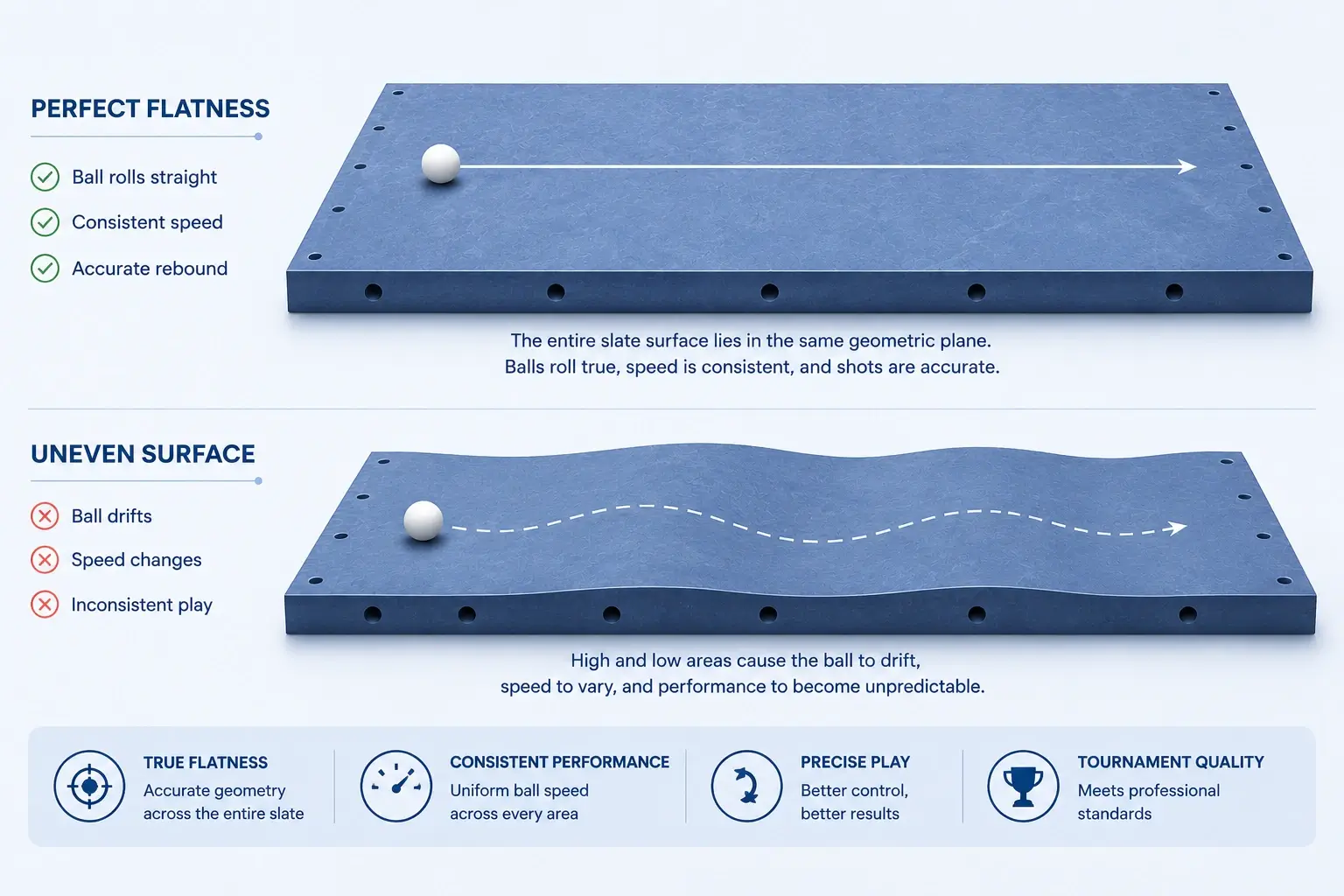
On a flat playing surface, balls travel in a straight line without drifting or changing direction unexpectedly. Even minor surface deviations can cause slow-moving balls to veer off course, reducing shot accuracy and player confidence.
Why it matters:
- Straight ball roll
- Predictable shot direction
- Better playing experience
⚡ Consistent Ball Speed
Uniform flatness ensures the same rolling speed across the entire table.
If one area of the slate is slightly higher or lower than another, the ball may accelerate, slow down, or lose momentum unexpectedly. Professional players rely on consistent speed to judge every shot accurately.
Benefits include:
- Uniform ball speed
- Reliable cue control
- Consistent table response
🎯 Accurate Cushion Response
Flat slate keeps the cushion system working as designed.
The slate supports the table frame and cushions. Uneven slate can slightly alter the relationship between the playing surface and cushion rails, resulting in inconsistent rebound angles and less predictable bank shots.
Result:
- Consistent rebound angles
- Better bank shots
- Improved positional play
🏆 Precision for Tournament Play
Professional competitions demand exceptional slate flatness.
Tournament-level pool and snooker tables require extremely tight flatness tolerances to deliver identical playing conditions across the entire surface. Precision-ground natural slate provides the consistency needed for high-level competition.
Ideal for:
- Professional tournaments
- Commercial billiard clubs
- Premium home tables
- Table manufacturers
Why It Matters
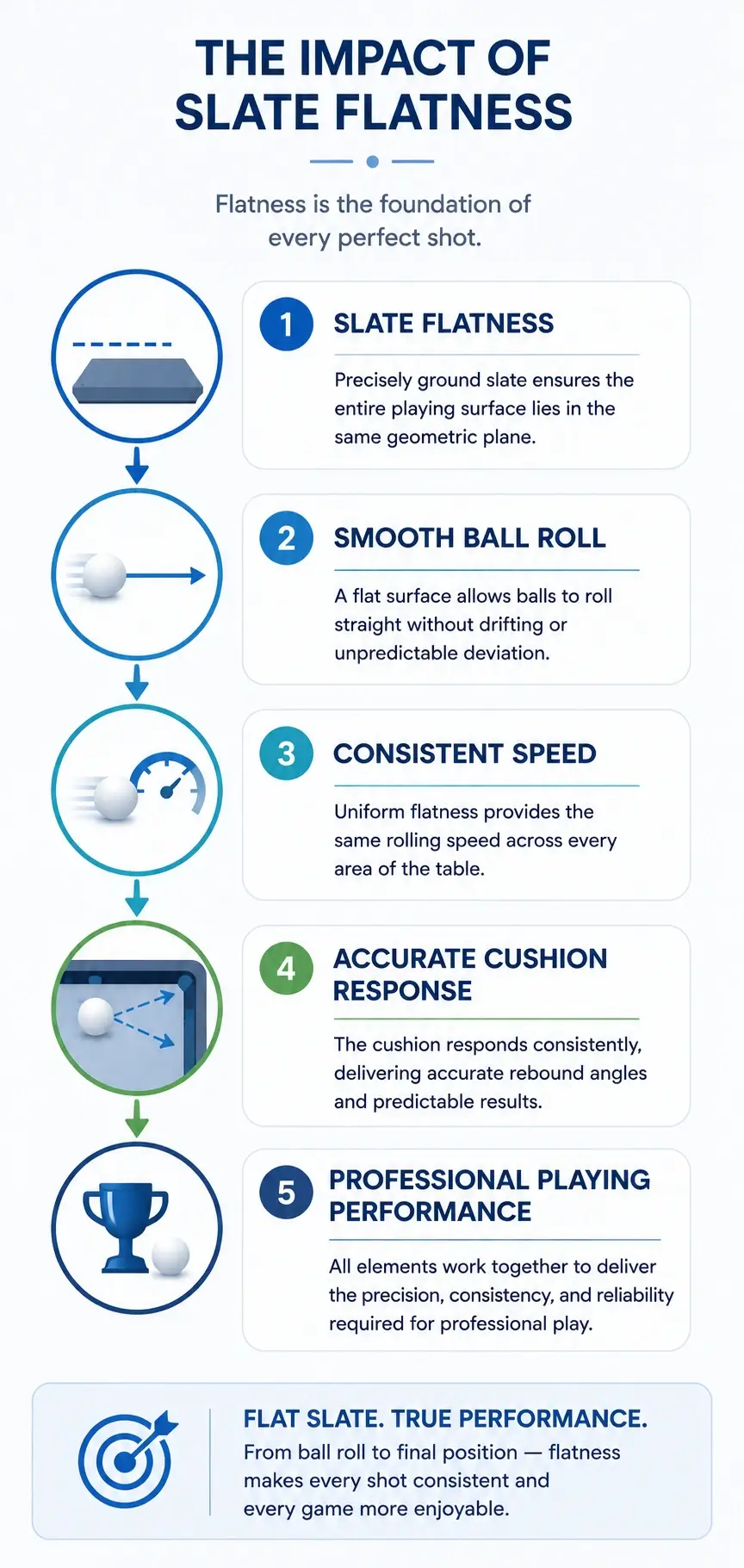
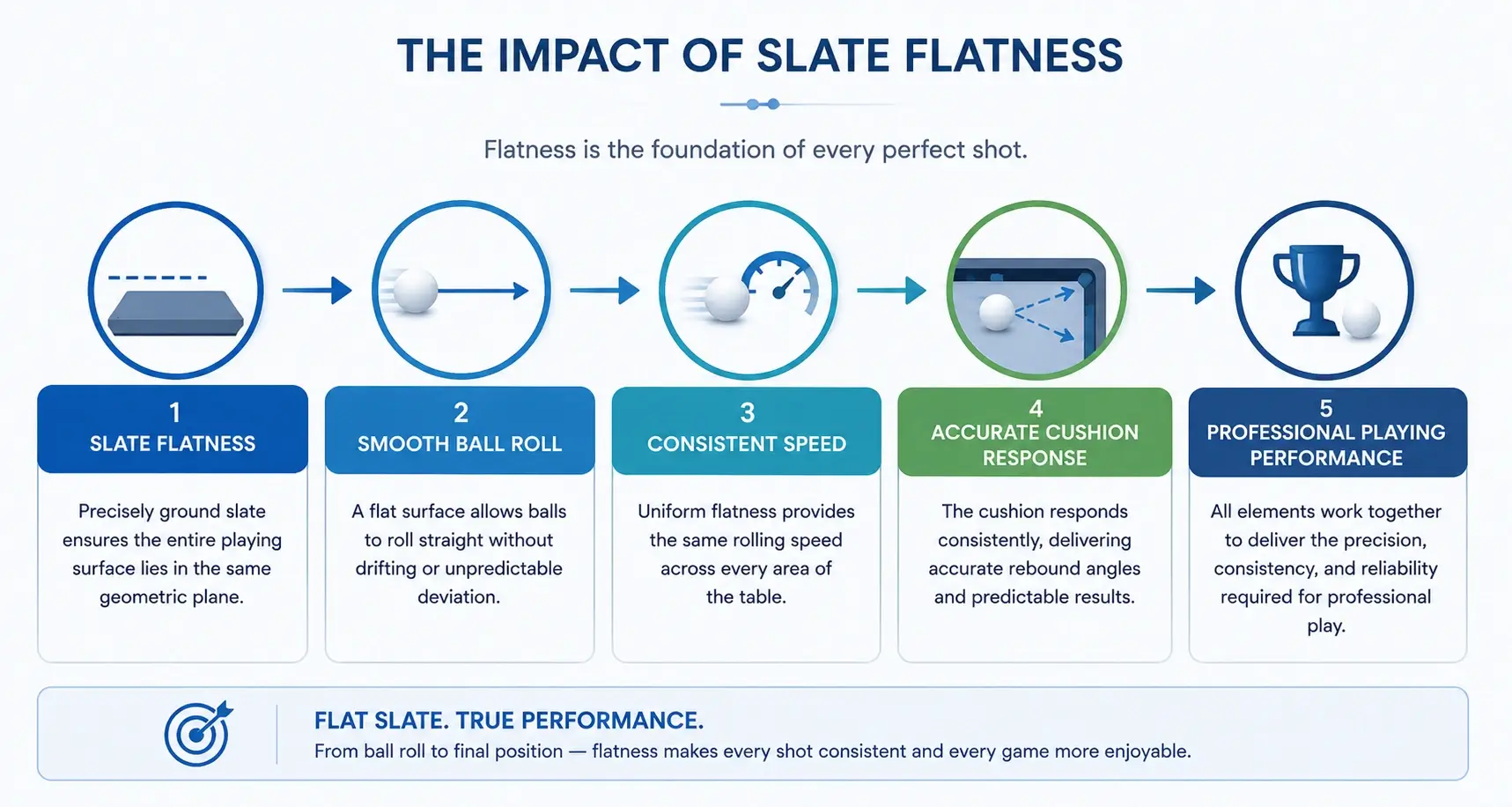
Slate flatness is not simply a manufacturing specification—it is the foundation of playing performance. A flatter slate delivers straighter ball roll, more consistent speed, accurate cushion response, and the precision required for professional pool and snooker tables.
Buyer Tip
When comparing billiard slate suppliers, don’t focus only on thickness or price. Ask about the manufacturer’s flatness tolerance, inspection methods, and grinding accuracy. These factors have a far greater impact on long-term table performance than appearance alone.
Flatness vs Levelness
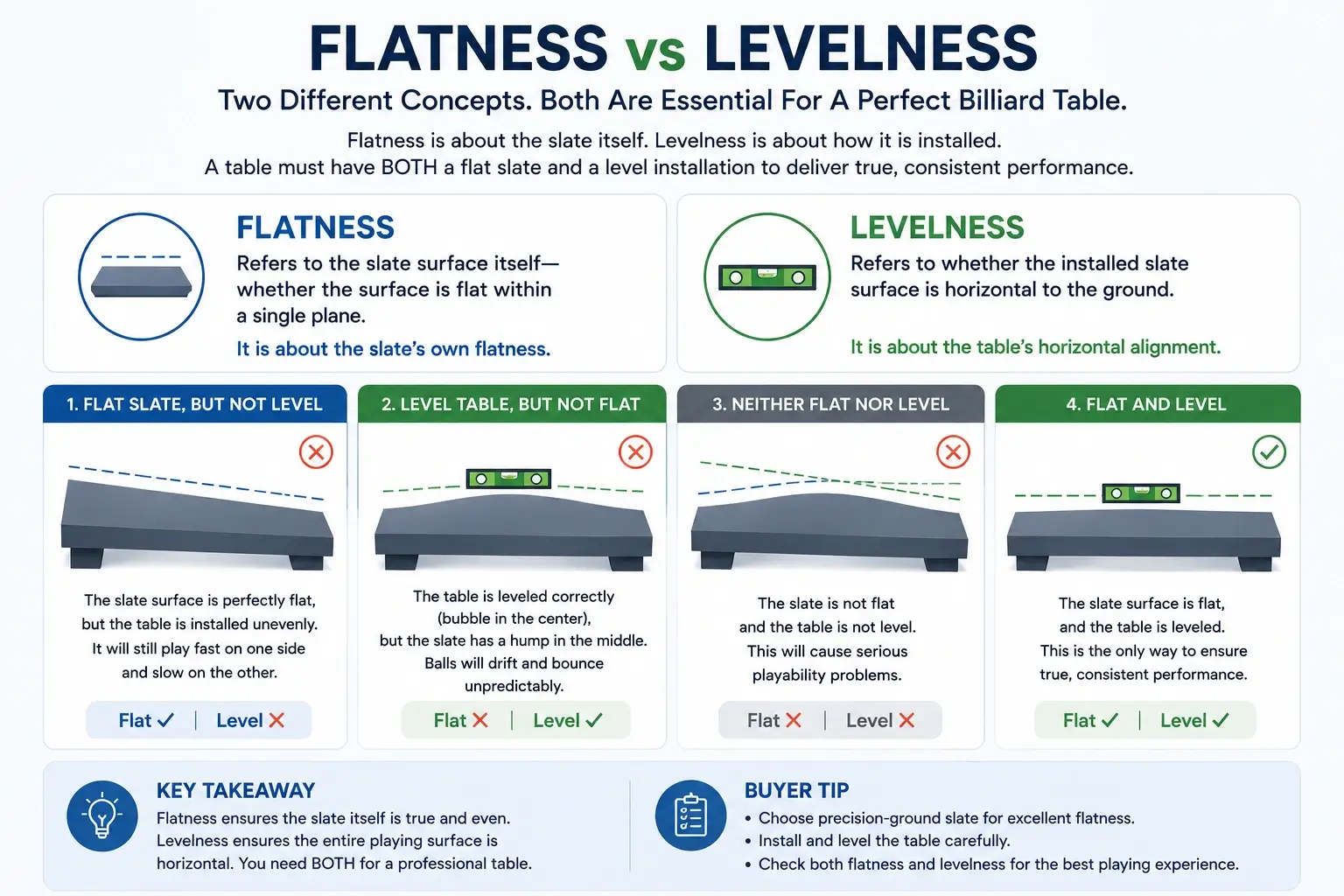
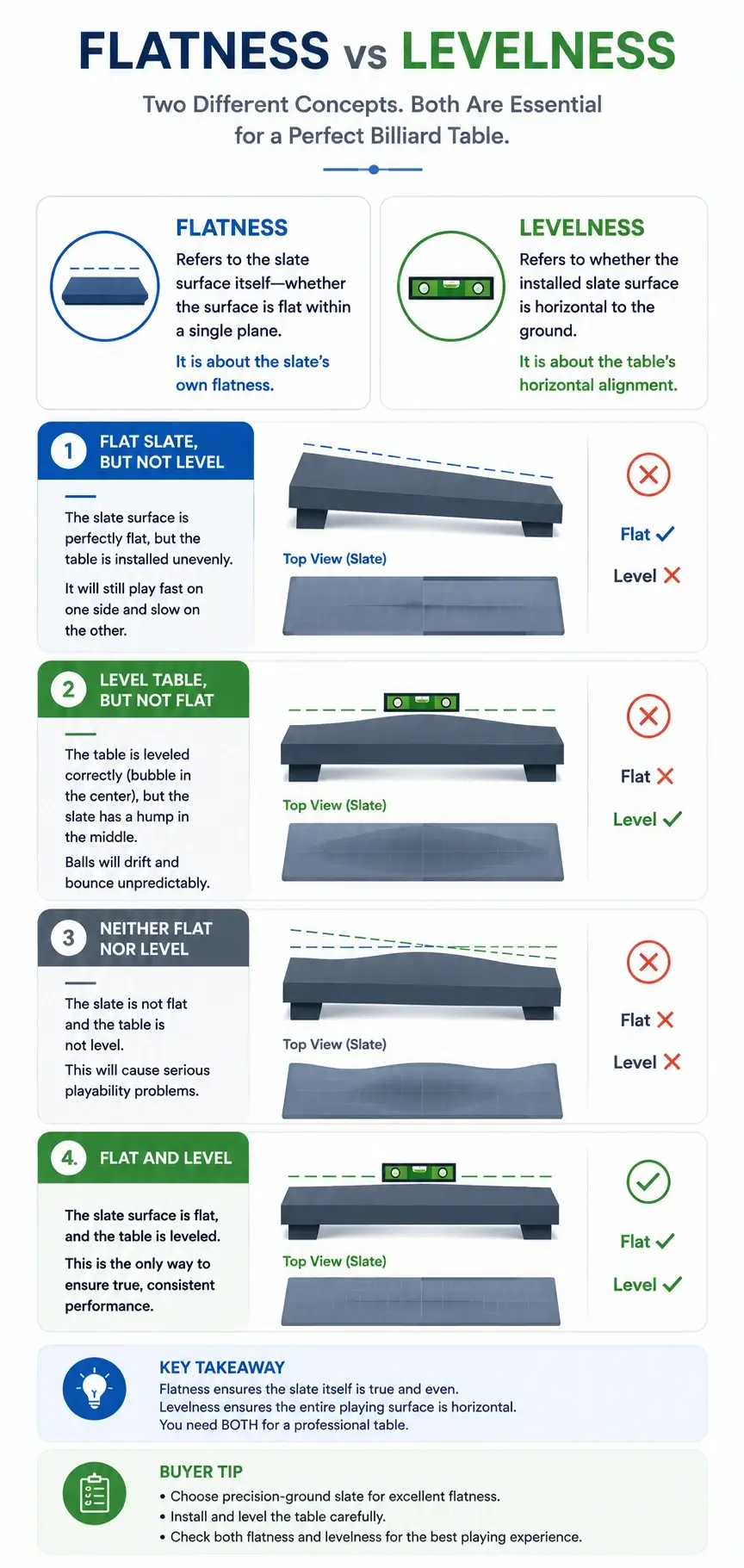
Many people use the terms flatness and levelness interchangeably, but they describe two different aspects of billiard table performance.
Flatness refers to the accuracy of the slate surface itself, while levelness describes whether the installed table is perfectly horizontal. A professional billiard table requires both a precision-ground flat slate and a properly leveled installation to deliver true ball roll and consistent playing performance.
Two Different Concepts
Flatness
Flatness measures whether the slate surface lies within a single geometric plane. It is a manufacturing characteristic that depends on the quality of the slate and the precision of the grinding process.
A flat slate ensures:
- Straight ball roll
- Consistent playing speed
- Accurate shot performance
- Professional playing quality
Levelness
Levelness describes whether the entire billiard table is perfectly horizontal after installation. It depends on proper assembly, frame support, leg adjustment, and floor conditions rather than the slate itself.
Correct levelness helps maintain:
- Uniform ball movement
- Consistent table balance
- Reliable tournament conditions
Practical Examples
Example 1
Flat Slate, But Not Level
A perfectly flat slate can still perform poorly if the table is installed on an uneven frame or floor. In this case, balls naturally roll toward the lower side of the table even though the slate surface itself is perfectly flat.
Example 2
Level Table, But Not Flat
A spirit level may indicate that the table is perfectly horizontal, yet the slate surface can still contain high or low spots caused by poor machining or damage. Balls may drift, change speed, or deviate during long shots despite the table being level.
Example 3
Flat and Level
The best playing performance is achieved only when the slate is precision-ground and the installed table is accurately leveled.
This combination delivers:
- True ball roll
- Consistent speed
- Accurate rebounds
- Professional playing conditions
Key Takeaway
Flatness is a property of the slate. Levelness is a property of the installed table. One cannot replace the other. For professional pool and snooker tables, both are equally essential.
Buyer Tip
When purchasing billiard slate, verify the manufacturer’s flatness tolerance. During installation, use professional leveling procedures to ensure the completed table performs as intended. Excellent slate cannot compensate for poor installation, and perfect leveling cannot correct an uneven slate.
Typical Industry Flatness Recommendations
Different billiard table manufacturers, slate suppliers, and tournament organizations may specify different flatness tolerances depending on table type, playing requirements, and production standards.
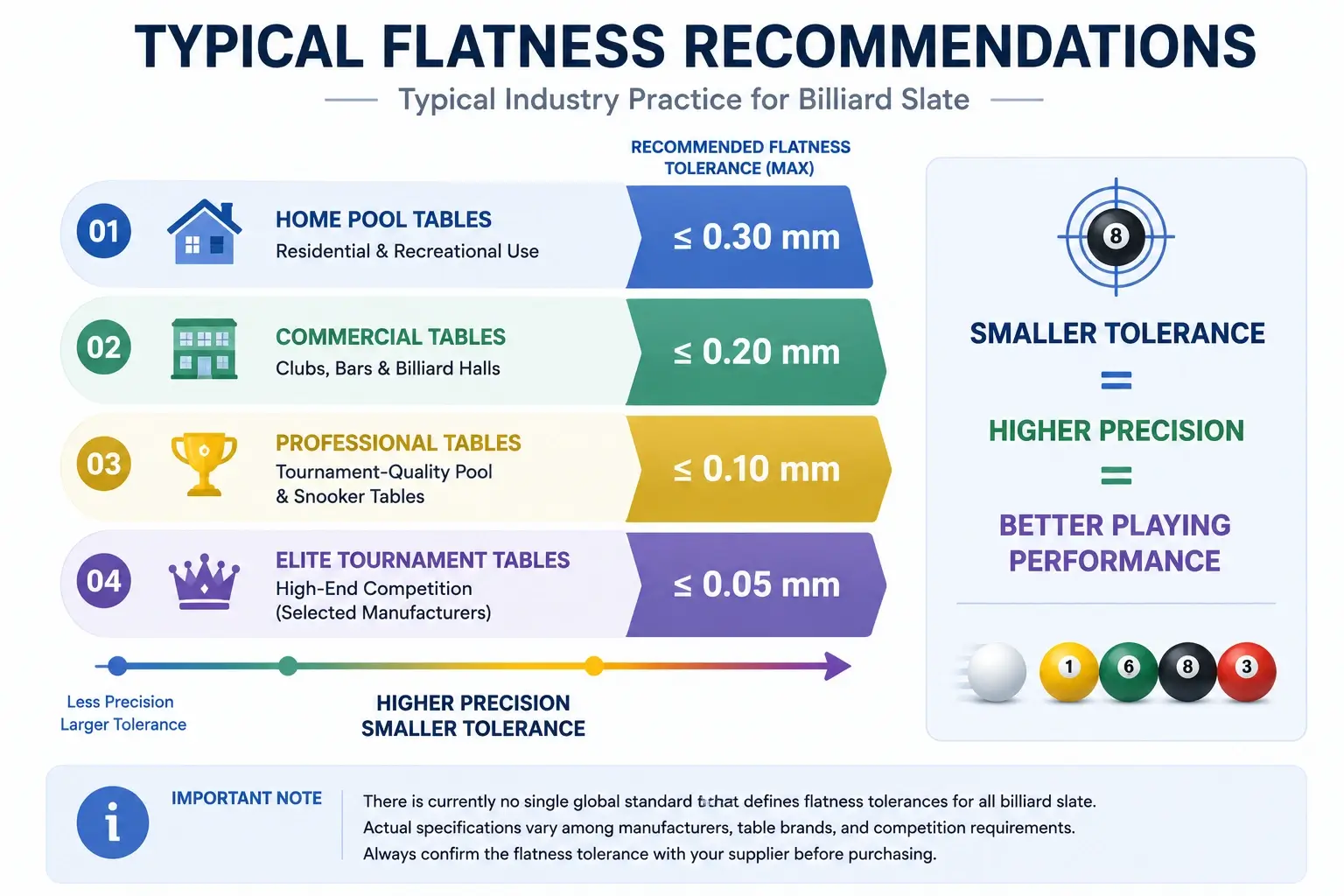
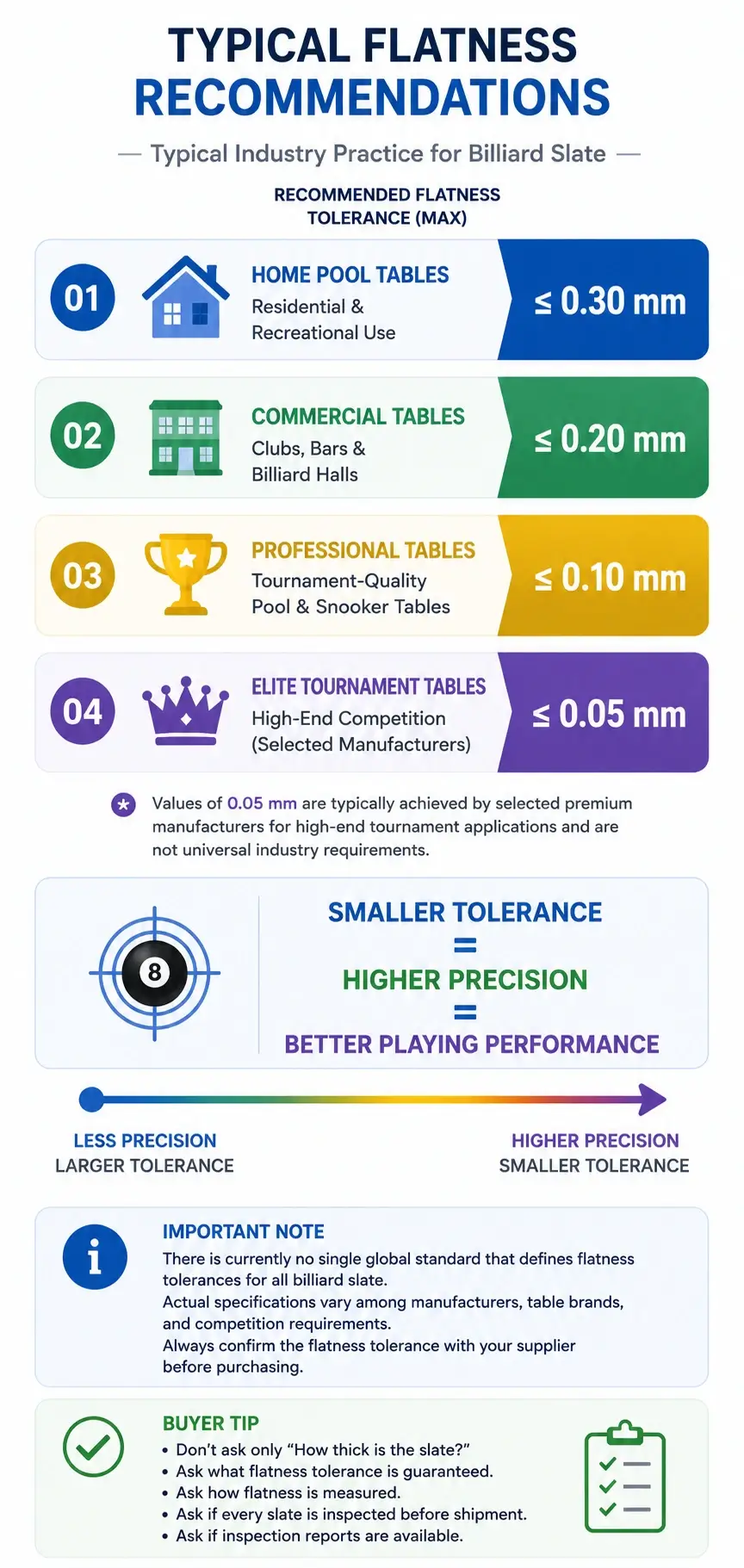
The values below represent typical industry practice rather than mandatory international standards. They provide a useful reference when comparing pool table slate and snooker slate for different applications.
| Table Application | Typical Flatness Tolerance | Typical Use |
|---|---|---|
| Home Pool Tables | ≤ 0.30 mm | Residential and recreational use |
| Commercial Tables | ≤ 0.20 mm | Clubs, bars, billiard halls |
| Professional Tables | ≤ 0.10 mm | Tournament-quality pool & snooker |
| Elite Tournament Tables | ≤ 0.05 mm* | High-end competition (selected manufacturers) |
Values of 0.05 mm are typically achieved only by selected premium manufacturers for high-end tournament applications and are not universal industry requirements.
How to Interpret These Values
A smaller flatness tolerance means the slate surface deviates less from a perfect geometric plane.
For example:
- 0.30 mm is generally suitable for home billiard tables.
- 0.20 mm provides better consistency for commercial environments with frequent use.
- 0.10 mm is commonly associated with professional-quality tables that require highly accurate ball roll and shot consistency.
- 0.05 mm represents an exceptionally high level of manufacturing precision and is typically reserved for premium tournament-grade slate.
Important
There is currently no single global standard that defines flatness tolerances for all billiard slate. Actual specifications vary among manufacturers, table brands, and competition requirements. Always confirm the flatness tolerance with your supplier before purchasing.
Buyer Tip
When comparing slate suppliers, don’t ask only “How thick is the slate?”
Also ask:
- What flatness tolerance is guaranteed?
- How is flatness measured?
- Is every slate inspected before shipment?
- Are inspection reports available?
These questions provide a much better indication of manufacturing quality than thickness alone.
What Causes Slate to Lose Flatness?
Although natural slate is one of the most stable materials used for billiard tables, its flatness can still be affected if it is improperly processed, handled, stored, transported, or installed.
Maintaining excellent billiard slate flatness requires strict quality control throughout the entire production and delivery process—not just precision grinding. Understanding the most common causes of flatness loss helps buyers evaluate suppliers more effectively and protect the long-term performance of their billiard tables.
Common Causes of Flatness Loss


Natural Stone Stress
Slate is a natural metamorphic stone formed under immense geological pressure over millions of years. Although premium slate is carefully selected and stress-relieved during processing, some internal stresses may still be released over time if inferior raw materials are used.
Potential effects:
- Slight warping
- Internal deformation
- Reduced long-term stability
Poor Machining
Flatness depends heavily on machining accuracy. Inaccurate sawing, uneven grinding, worn equipment, or insufficient quality control can leave high and low spots across the playing surface.
Common machining problems include:
- Uneven surface grinding
- Excessive tolerance
- Inconsistent surface accuracy
Uneven Drying
If moisture is not properly controlled during production or storage, different areas of the slate may expand or contract unevenly. Although high-quality billiard slate is highly stable, poor drying practices can increase the risk of distortion.
Possible results:
- Local deformation
- Surface stress
- Reduced dimensional stability
Incorrect Storage
Proper storage is essential before installation.
Slate stored on uneven supports, standing on edge for extended periods, or stacked without adequate support may gradually lose its original flatness.
Recommended storage practices include:
- Store horizontally
- Support the entire surface evenly
- Keep the environment dry and stable
Shipping Impact
Long-distance transportation exposes slate to vibration, shock, and repeated loading. Poor packaging or inadequate protection can damage edges or introduce stresses that affect surface accuracy.
Professional packaging helps minimize:
- Impact damage
- Hidden deformation
- Edge chipping
- Transportation stress
Bad Installation
Even a precision-ground slate cannot deliver optimal performance if installed incorrectly.
Improper frame alignment, insufficient support, poor shimming, or uneven tightening of fasteners may introduce stress into the slate and affect the playing surface.
Professional installation should always include:
- Proper frame leveling
- Even support
- Correct shimming
- Accurate seam adjustment
Key Takeaway
Flatness is influenced by every stage of the slate’s journey—from quarry selection and precision machining to storage, shipping, and final installation. Consistent quality control throughout the entire process is essential for maintaining professional playing performance. tables, both are equally essential.
Buyer Tip
When evaluating a billiard slate supplier, ask how they control flatness before, during, and after production. A reliable manufacturer should be able to explain their machining process, storage practices, packaging methods, and inspection procedures—not just the final flatness tolerance.
Continue Exploring Our Billiard Slate Guides
Whether you’re selecting a slate supplier, comparing specifications, or learning about manufacturing and installation, our expert guides provide practical insights to help you choose the right billiard slate with confidence.
Related Guides
- ➜ Billiard Slate Manufacturing Process
Learn how premium slate is cut, calibrated, and precision-ground for professional performance. - ➜ Quality Inspection & Flatness Control
Discover the inspection methods and quality standards used to verify slate flatness. - ➜ Billiard Slate Packing & Shipping Guide
See how secure export packaging protects slate during global transportation. - ➜ Billiard Slate Installation Guide
Follow best practices for installation to preserve slate flatness and ensure accurate ball roll.
The Lifecycle of Slate Flatness
Maintaining excellent billiard slate flatness is not achieved through precision grinding alone. It requires strict quality control at every stage—from raw material selection to professional installation. The following process illustrates how each step contributes to long-term slate accuracy and playing performance.


🏆 Perfect Playing Performance
How Flatness Is Measured
The flatness of a billiard slate cannot be judged by visual inspection alone. Even a surface that appears perfectly smooth may contain slight deviations that affect ball roll, speed consistency, and playing accuracy.
Professional manufacturers use specialized measuring tools to verify billiard slate flatness throughout the production process. Depending on the required precision, different inspection methods are used—from traditional straightedges and feeler gauges to advanced laser systems and Coordinate Measuring Machines (CMM).
Understanding these measurement methods helps buyers evaluate a supplier’s quality control capabilities and choose slate that meets their performance requirements.
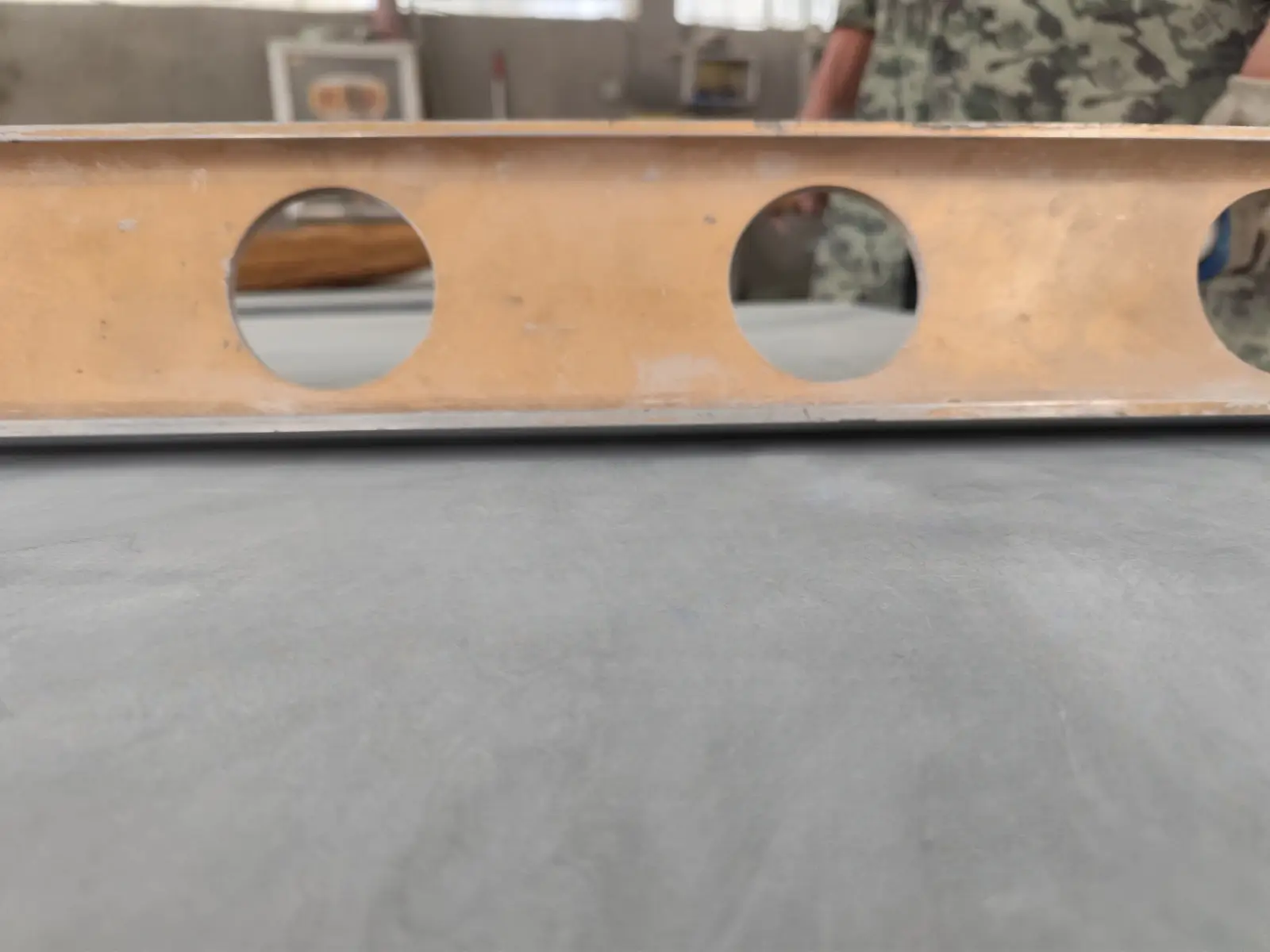
1. Precision Straightedge
What It Is
A precision straightedge is one of the most widely used tools for checking slate flatness. A certified straightedge is placed across different sections of the slate surface to identify any gaps between the tool and the stone.
Advantages
- Fast and reliable
- Suitable for large slate surfaces
- Widely used in manufacturing and quality inspection
- Easy to combine with feeler gauges
Best For
Routine flatness inspection during production.
2. Feeler Gauge
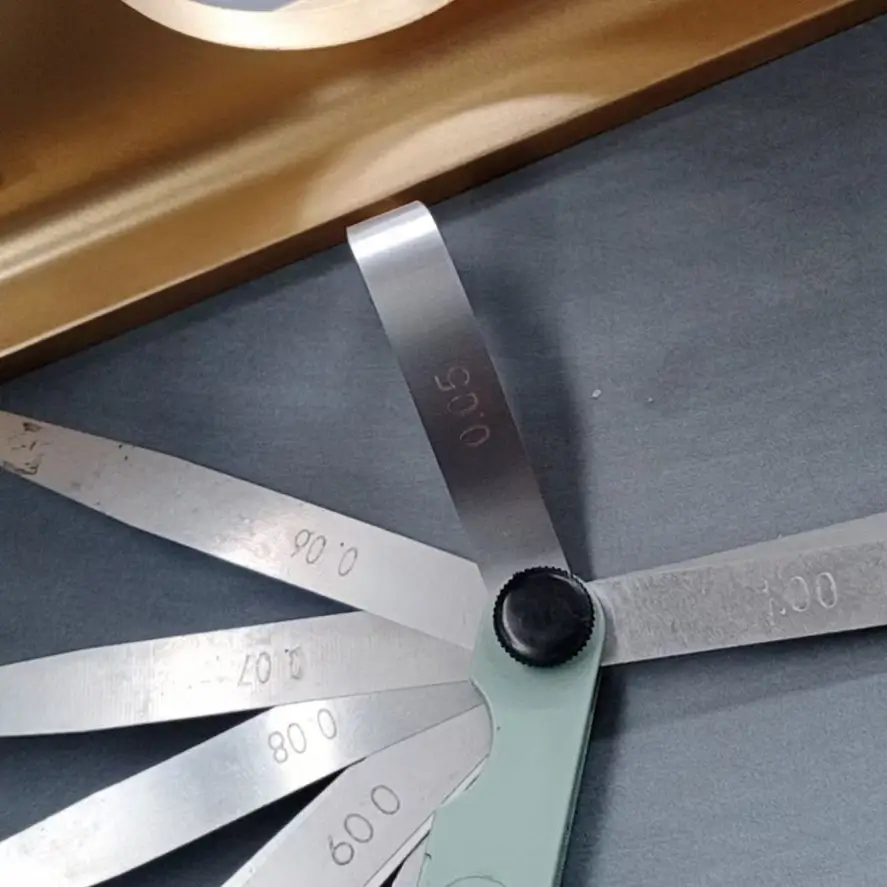
What It Is
A feeler gauge consists of precision metal blades with known thicknesses. When used together with a straightedge, it measures the maximum gap between the slate surface and the reference plane.
Advantages
- High measurement accuracy
- Simple and cost-effective
- Ideal for checking local flatness deviations
Best For
Measuring flatness tolerance in millimeters.
3. Precision Level
What It Is
A precision level (or digital level) is primarily used to verify whether the installed slate is level. While it is not a direct flatness measurement tool, it helps distinguish flatness from levelness during installation.
Advantages
- Confirms proper table leveling
- Essential during installation
- Improves overall playing accuracy
Important Note
A slate can be perfectly flat but still be installed out of level. Both flatness and levelness are necessary for optimal playing performance.

4. Laser Measurement
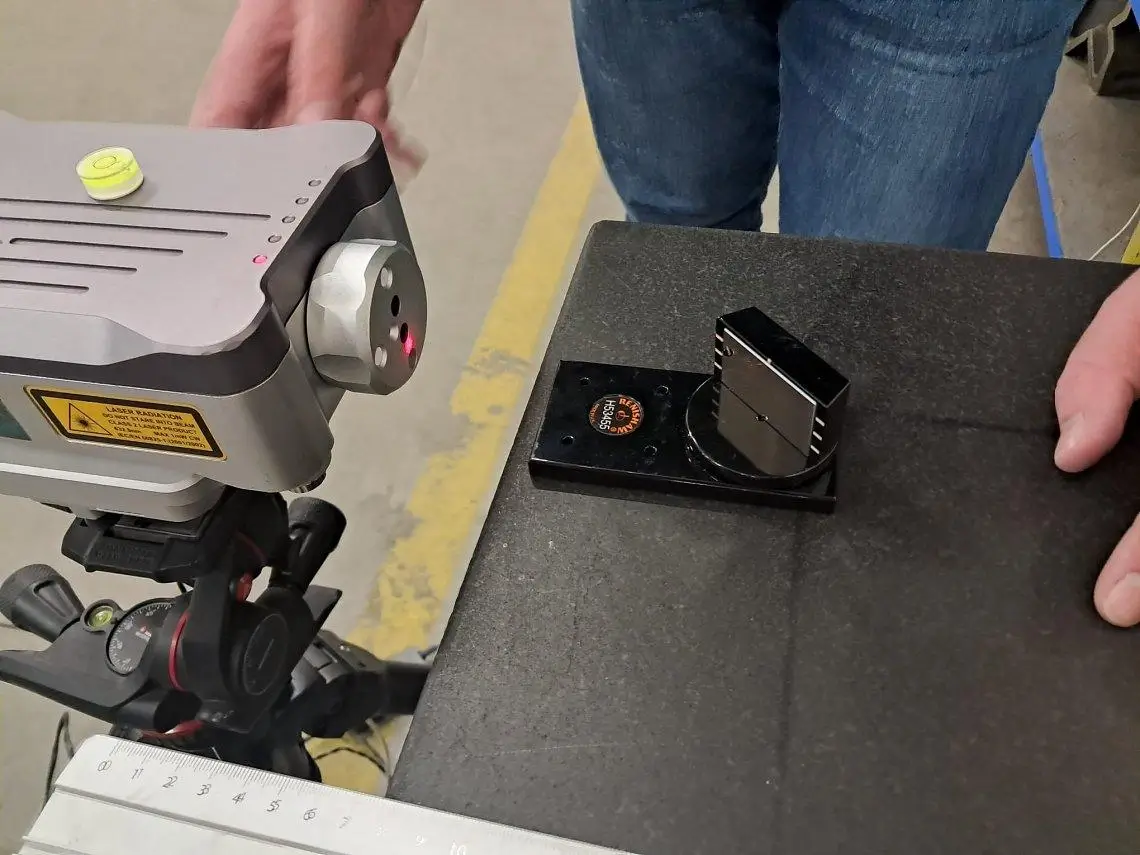
What It Is
Laser measurement systems scan the entire slate surface without physical contact, generating a high-resolution digital profile of the playing surface.
Advantages
- Non-contact measurement
- Extremely fast
- Measures the entire surface
- Produces detailed inspection reports
Best For
High-end manufacturers and precision quality control.
5. Coordinate Measuring Machine (CMM)
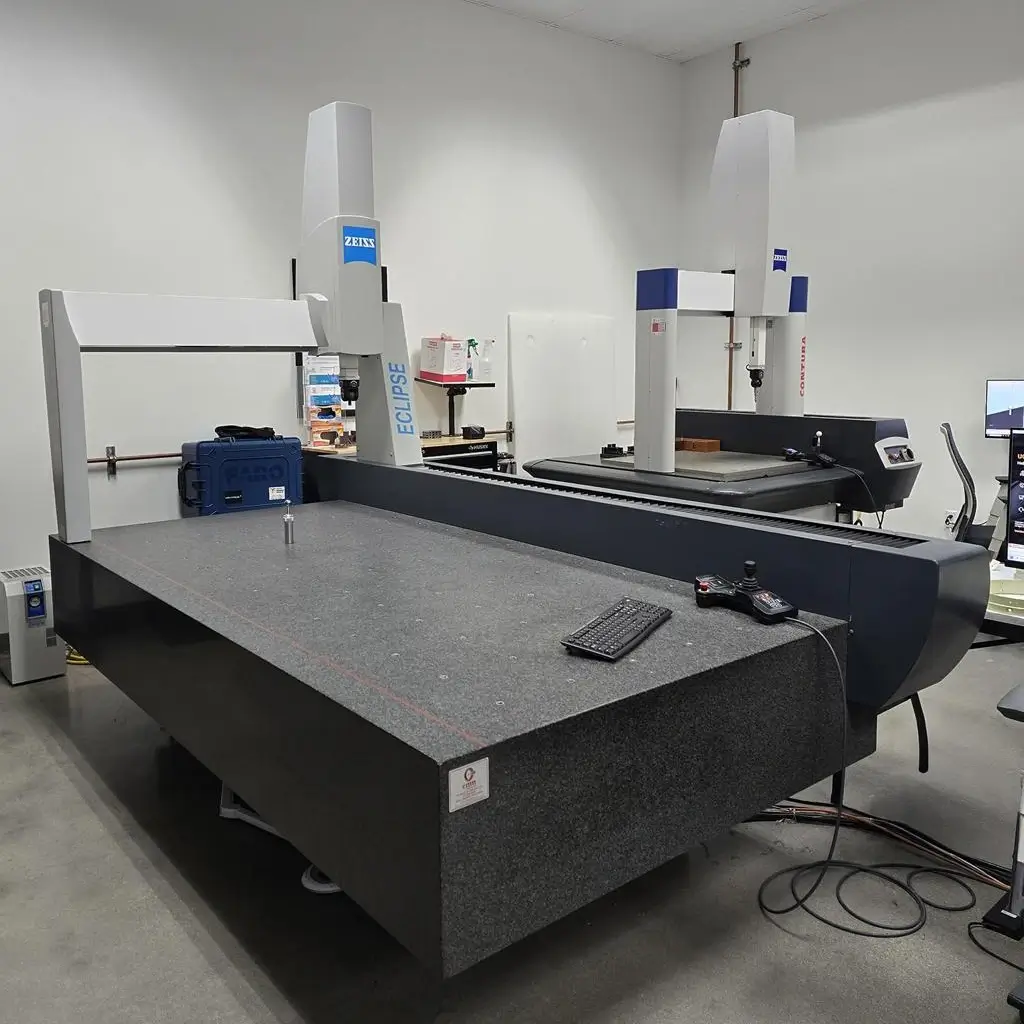
What It Is
A Coordinate Measuring Machine (CMM) uses precision probes or optical sensors to measure the exact three-dimensional coordinates of multiple points across the slate surface.
It provides one of the highest levels of measurement accuracy available in industrial metrology.
Advantages
- Extremely high precision
- Digital measurement records
- Suitable for research and premium production
- Excellent repeatability
Best For
Elite tournament slate and advanced quality verification.
Comparison Table
| Measurement Method | Typical Accuracy | Speed | Typical Use |
|---|---|---|---|
| Precision Straightedge | High | Fast | Routine flatness inspection |
| Feeler Gauge | Very High | Fast | Gap and tolerance measurement |
| Precision Level | High | Fast | Installation and leveling |
| Laser Measurement | Extremely High | Very Fast | Full surface scanning |
| CMM | Highest | Moderate | Laboratory and premium quality control |
| Method | Typical Use | Precision |
|---|---|---|
| Precision Straightedge | Routine inspection | ★★★★☆ |
| Feeler Gauge | Gap verification | ★★★★★ |
| Laser Measurement | Full-surface scanning | ★★★★★ |
| Coordinate Measuring Machine (CMM) | Premium laboratory verification | ⭐⭐⭐⭐⭐ |
Buyer Tip
When selecting a billiard slate supplier, ask how flatness is measured rather than simply requesting a tolerance value. A reliable manufacturer should be able to explain the inspection methods, measuring equipment, and quality control procedures used to verify every slate before shipment.
Key Takeaway
Professional flatness inspection combines multiple measurement methods rather than relying on a single tool. Straightedges and feeler gauges remain the industry standard for routine inspection, while laser systems and CMM technology provide advanced verification for premium billiard slate.

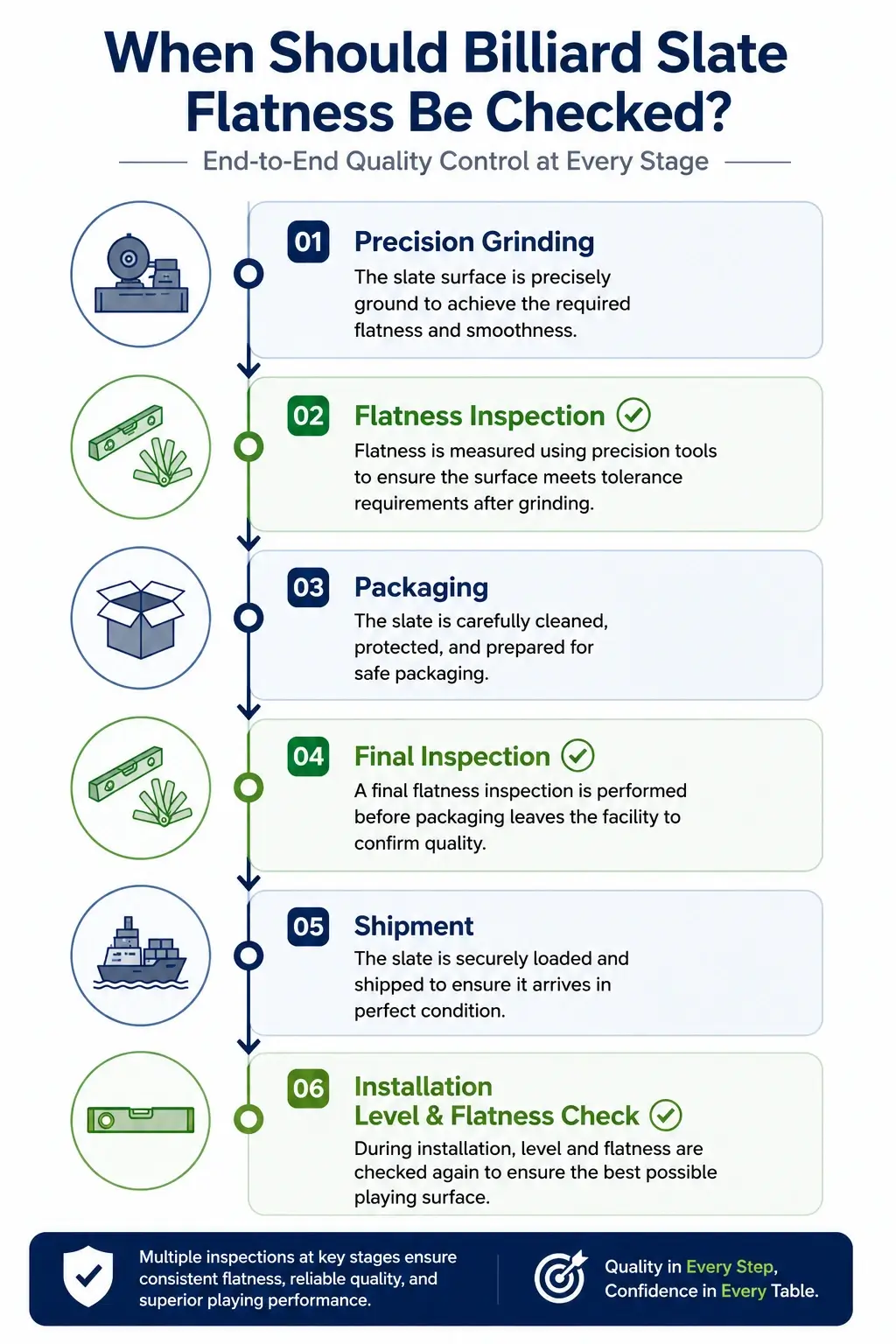
How Often Should Slate Flatness Be Checked?
Maintaining excellent billiard slate flatness is not a one-time inspection—it is a continuous quality control process throughout manufacturing, packaging, shipping, and installation. Repeated flatness verification helps ensure that every slate delivers reliable playing performance when it reaches the customer.
Professional manufacturers typically inspect slate flatness at multiple stages to detect potential deviations early and maintain consistent quality from production to final installation.
Recommended Inspection Timeline
| Production Stage | Why Flatness Is Checked |
|---|---|
| After Precision Grinding | Confirms that the slate surface meets the required flatness tolerance immediately after machining. |
| Before Packaging | Verifies that no damage or deformation has occurred during handling and preparation for packing. |
| Before Shipment | Performs a final quality inspection to ensure the slate is ready for international transportation. |
| During Installation | Confirms that the installed slate remains properly aligned and provides the best possible playing surface. |
Why Multiple Inspections Matter
Each inspection serves a different purpose. Measuring flatness only once during production is not enough, as handling, storage, transportation, or installation may affect the final playing surface. By checking flatness at multiple stages, manufacturers can identify potential issues early and deliver a consistently accurate billiard slate.
This end-to-end quality control process helps minimize installation adjustments, reduces customer complaints, and ensures long-term playing performance.
Buyer Tip
When comparing suppliers, ask when they inspect slate flatness—not just how they measure it. Manufacturers that perform flatness inspections throughout production and before shipment typically maintain more consistent product quality and reduce the risk of installation issues.
Key Takeaway
Flatness inspection is most effective when it is integrated into the entire production process. Regular verification after machining, before packaging, before shipment, and during installation helps ensure that every billiard slate delivers consistent accuracy, durability, and professional playing performance.
Flatness Tolerance Explained
When discussing billiard slate flatness, manufacturers often refer to values such as 0.30 mm, 0.20 mm, or 0.10 mm. But what do these numbers actually mean?
A flatness tolerance defines the maximum allowable deviation between the slate surface and a perfectly flat reference plane. The smaller the tolerance, the flatter the slate, resulting in more accurate ball roll, consistent speed, and better overall playing performance.
Understanding flatness tolerance helps buyers compare product quality and choose the right slate for home tables, commercial venues, or professional tournaments.

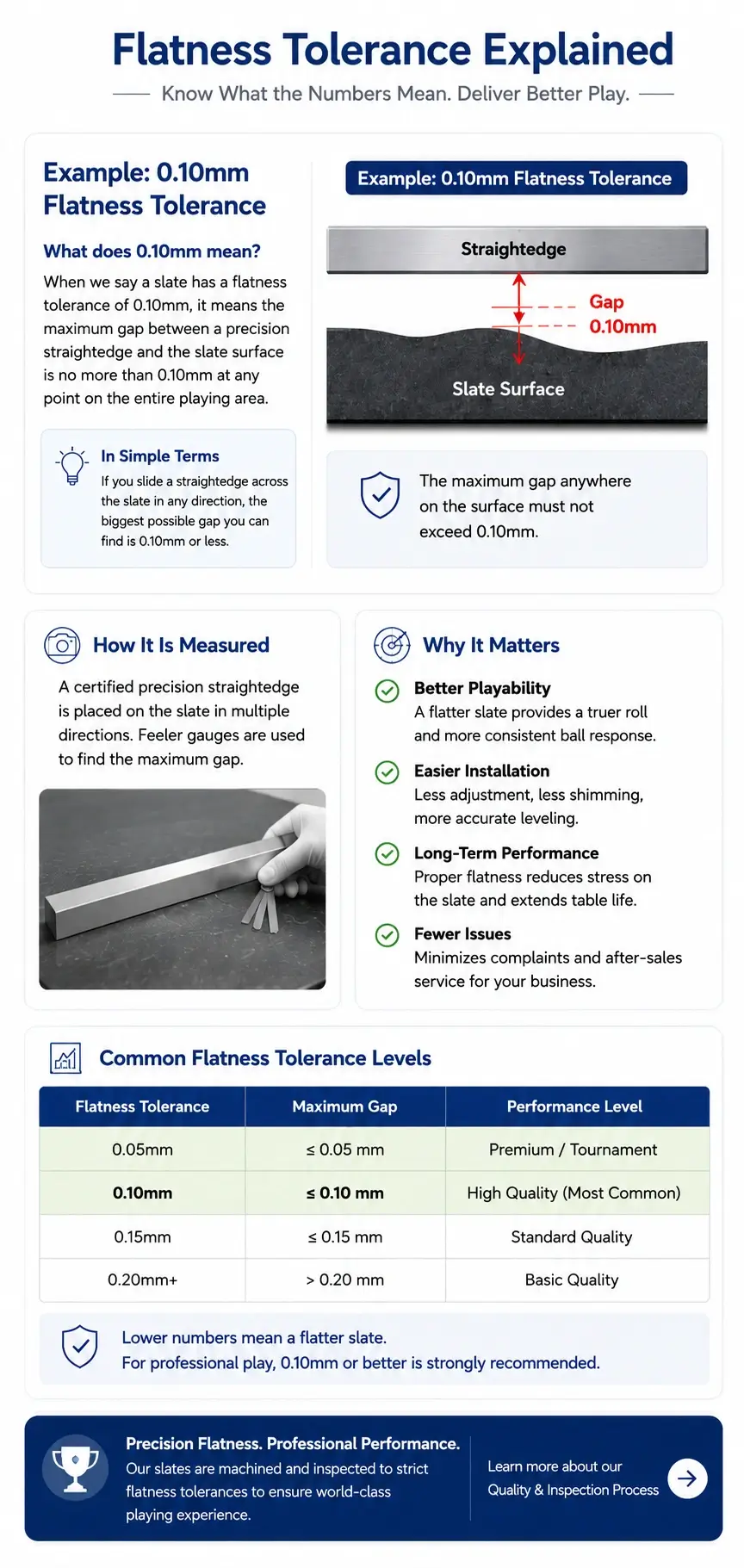
What Does 0.10 mm Flatness Mean?
A 0.10 mm flatness tolerance means that when a certified precision straightedge is placed anywhere on the slate surface, the maximum gap between the straightedge and the slate must not exceed 0.10 mm.
In other words, no point on the playing surface should deviate from the reference plane by more than 0.10 mm.
This small tolerance ensures a smooth, predictable playing surface where balls roll accurately without being affected by uneven areas.
Simply put: If the largest gap measured anywhere on the slate is 0.10 mm or less, the slate meets a 0.10 mm flatness tolerance.
Why Smaller Flatness Tolerances Matter
A lower flatness tolerance directly improves the playing experience by reducing surface deviations that can influence ball movement.
Benefits of tighter flatness tolerances include:
- Straighter ball roll with fewer unexpected deviations
- More consistent ball speed across the entire table
- More accurate cushion response during bank shots
- Improved precision for long-distance shots
- Easier installation with fewer adjustments required
- Greater consistency for professional and tournament-level play
Typical Flatness Tolerance Levels
| Flatness Tolerance | Typical Application | Playing Performance |
|---|---|---|
| ≤ 0.30 mm | Home billiard tables | Suitable for casual recreational play |
| ≤ 0.20 mm | Commercial pool tables | Improved consistency for frequent use |
| ≤ 0.10 mm | Professional tables | Excellent accuracy and tournament-quality performance |
| ≤ 0.05 mm | Elite competition tables | Maximum precision for the highest-level events |
Note: These values represent typical industry practice. Actual flatness tolerances may vary depending on the manufacturer, production process, and customer requirements.
Buyer Tip
Don’t compare billiard slate by thickness alone. Always ask about the flatness tolerance and how it is verified. A manufacturer that provides measurable flatness data and documented inspection procedures is generally more reliable than one that simply claims its slate is “perfectly flat.”
Key Takeaway
Flatness tolerance is one of the most important indicators of billiard slate quality. Lower tolerance values mean a flatter playing surface, more predictable ball movement, and a better overall playing experience. For most professional pool and snooker tables, a flatness tolerance of ≤ 0.10 mm is widely regarded as a high-quality benchmark.
Learn More About Billiard Slate Quality
To better understand how flatness is achieved and maintained throughout the manufacturing process, explore these related guides:
- → Billiard Slate Tolerance Guide – Learn how flatness, thickness, and dimensional tolerances affect slate quality.
- → Quality Inspection & Flatness Control – Discover the inspection procedures and equipment used to verify slate accuracy.
- → How Flatness Is Measured – Explore the tools and methods used to measure slate flatness.
- → Billiard Slate Installation Guide – See how proper installation helps preserve slate flatness and playing performance.
From Raw Slate to Final Approval
chieving excellent billiard slate flatness requires much more than precision grinding. Every slate passes through multiple manufacturing and inspection stages to ensure that the final playing surface meets the required flatness tolerance before shipment.
Rather than relying on a single inspection, professional manufacturers integrate quality control throughout the production process. This systematic workflow helps detect potential deviations early, minimize production defects, and ensure consistent playing performance.

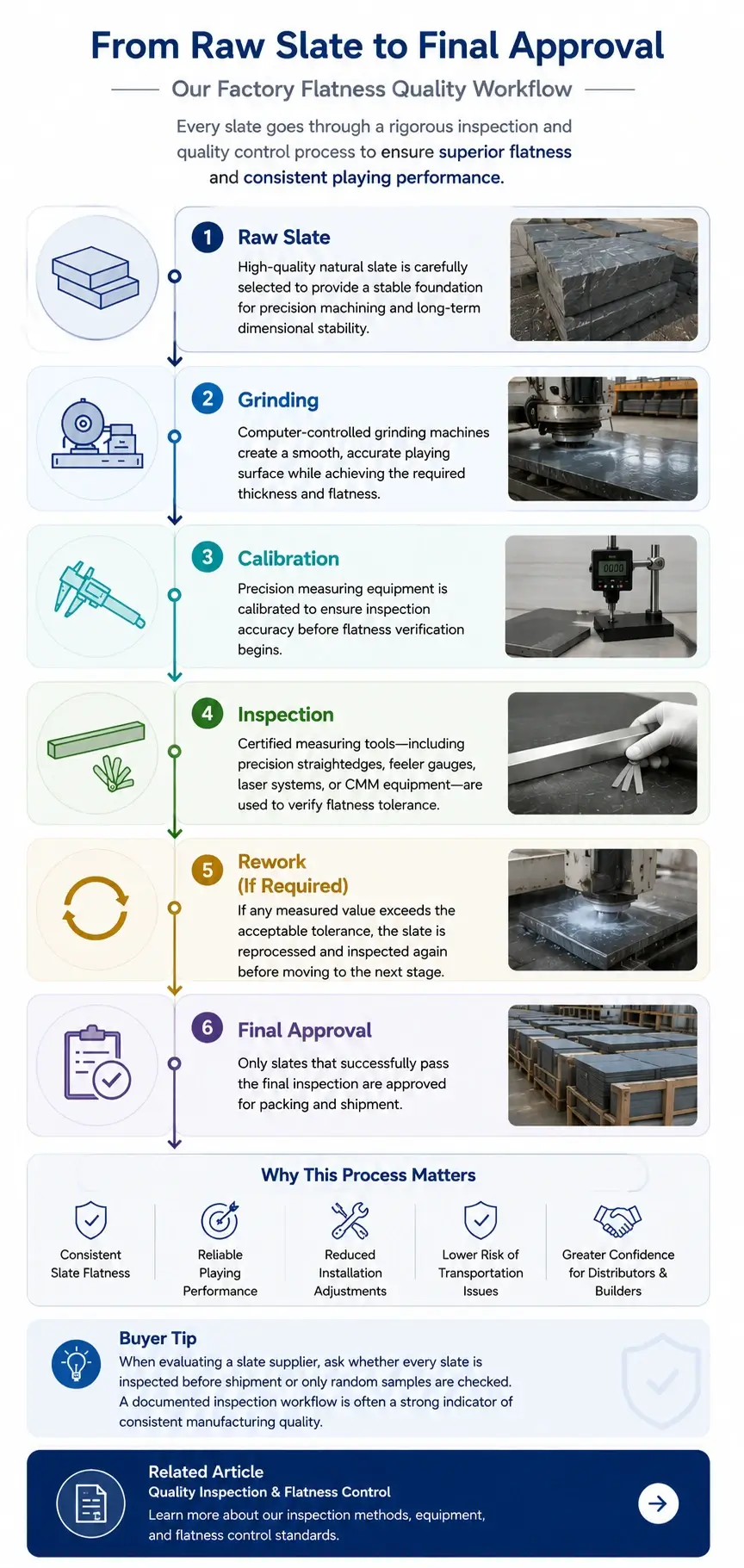
Raw Slate Selection
High-quality natural slate is carefully selected to provide a stable foundation for precision machining and long-term dimensional stability.
Precision Grinding
Computer-controlled grinding machines create a smooth, accurate playing surface while achieving the required thickness and flatness.
Calibration
Precision measuring equipment is calibrated to ensure inspection accuracy before flatness verification begins.
Flatness Inspection
Certified measuring tools—including precision straightedges, feeler gauges, laser systems, or CMM equipment—are used to verify that the slate meets the specified flatness tolerance.
Rework (If Required)
If any measured value exceeds the acceptable tolerance, the slate is reprocessed and inspected again before moving to the next stage.
Final Approval
Only slates that successfully pass the final inspection are approved for packing and shipment.
Why This Process Matters
A structured factory inspection workflow helps ensure:
- Consistent billiard slate flatness
- Reliable playing performance
- Reduced installation adjustments
- Lower risk of transportation issues
- Greater confidence for distributors and table manufacturers
Buyer Tip
When evaluating a slate supplier, ask whether every slate is inspected before shipment or only random samples are checked. A documented inspection workflow is often a strong indicator of consistent manufacturing quality.
Key Takeaway
Professional manufacturers treat flatness inspection as an ongoing quality control process rather than a single measurement. By combining precision machining, calibrated inspection equipment, and final verification, they ensure that every approved slate is ready for reliable, long-term playing performance.
Continue Exploring
- → Billiard Slate Manufacturing Process – Learn how natural slate is cut, ground, and machined into a precision playing surface.
- → Quality Inspection & Flatness Control – Discover the inspection methods used to verify slate accuracy.
- → Billiard Slate Packing & Shipping Guide – See how professional packing helps protect flatness during transportation.
- → Billiard Slate Installation Guide – Learn how proper installation preserves factory-tested flatness.
Flatness During Installation
Even the highest-quality billiard slate can lose its factory-tested flatness if it is installed incorrectly. While manufacturers ensure that each slate meets strict flatness tolerances before shipment, the final playing surface also depends on proper installation.
Factors such as joint filling, frame support, bolt tightening, and shimming all play an important role in preserving slate flatness and achieving professional playing performance.
Proper installation ensures that the factory precision built into the slate is fully maintained after assembly.
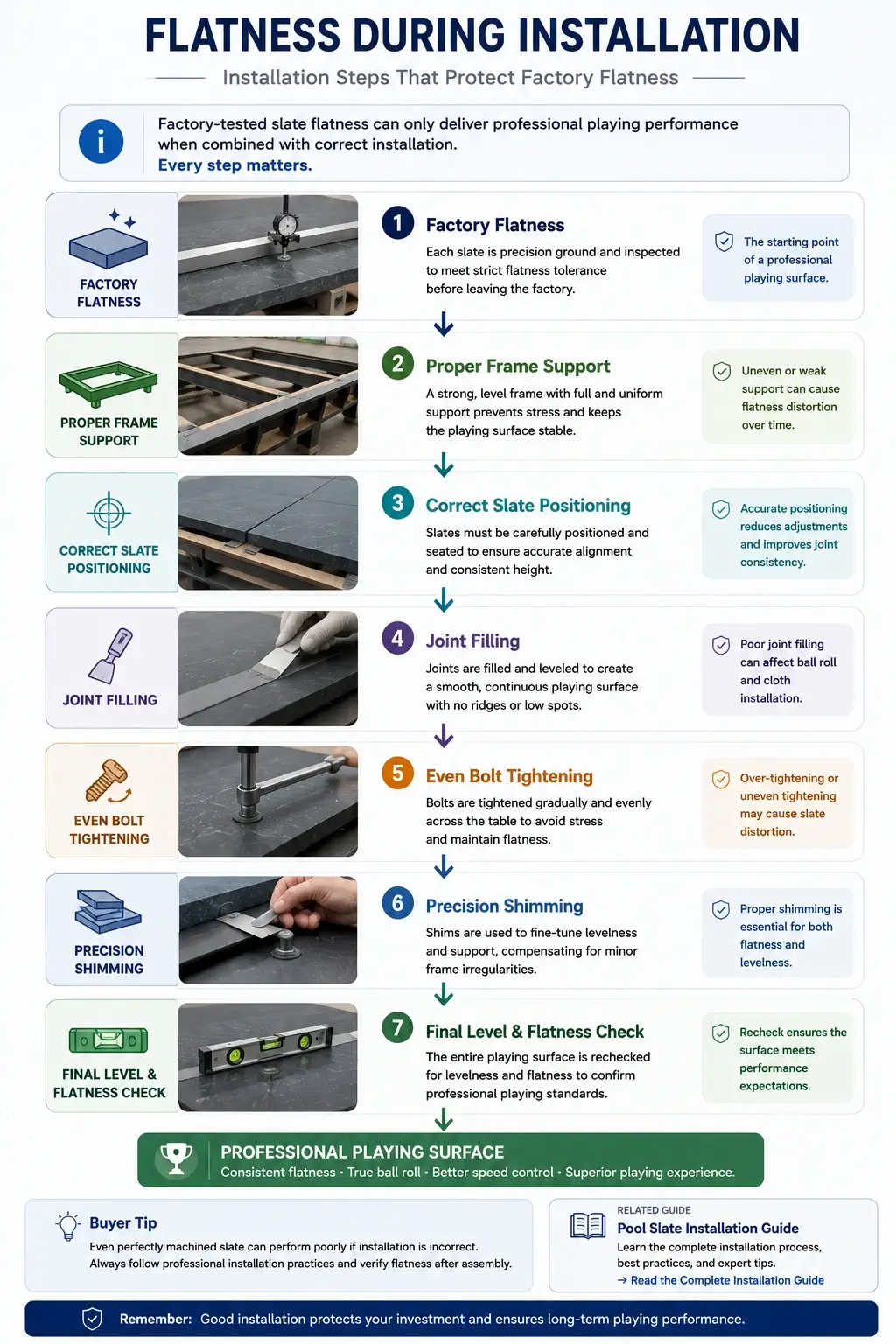
Key Installation Factors That Affect Slate Flatness
Joint Filling
The joints between multiple slate pieces should be carefully aligned and filled to create a smooth, continuous playing surface.
Improper joint filling may leave visible ridges or low spots, affecting ball roll and cloth installation.
Frame Support
A strong, properly assembled table frame provides uniform support beneath the slate.
Insufficient or uneven support can introduce stress that changes the effective flatness of the playing surface over time.
Bolt Tightening
Slate bolts should be tightened gradually and evenly.
Over-tightening or tightening one area before others may create localized distortion or uneven pressure across the slate.
Shimming
Precision shims are used to compensate for minor frame irregularities and help maintain both levelness and flatness during installation.
Proper shimming is essential for achieving a professional-quality playing surface.
Common Installation Mistakes
Even accurately manufactured slate can develop performance issues if installation is rushed or performed incorrectly.
Some of the most common mistakes include:
- Uneven frame assembly
- Incorrect shim placement
- Over-tightened slate bolts
- Poorly finished slate joints
- Failure to recheck flatness after assembly
Avoiding these issues helps preserve the original factory flatness and ensures consistent playing performance.
Why Installation Matters
Factory inspection guarantees the quality of the slate itself, but installation determines how that quality is translated into real-world performance.
Professional installation helps maintain:
- Accurate ball roll
- Consistent playing speed
- Smooth transitions across slate joints
- Reliable cushion response
- Long-term dimensional stability
Buyer Tip
When purchasing premium billiard slate, ask your supplier whether they provide installation recommendations or technical guidance. Even perfectly machined slate requires correct installation to achieve its full playing potential.
Key Takeaway
Factory-tested flatness can only deliver professional playing performance when combined with correct installation. Careful joint filling, proper frame support, balanced bolt tightening, and precision shimming all help preserve the slate’s original accuracy.
Related Guide
Billiard Slate Installation Guide
Learn the complete installation process, including frame preparation, slate positioning, leveling, joint filling, shimming, and final adjustments for professional playing performance.
Flatness After Shipping
A properly manufactured billiard slate does not normally lose its factory-tested flatness during transportation. Natural slate is a rigid material with excellent dimensional stability.
However, improper handling, inadequate support, or severe impact during shipping may damage the slate or create conditions that affect its final installation and playing performance.
Careful packaging, secure transportation, and proper unloading are essential for preserving the precision achieved during manufacturing.


Factors That May Affect Flatness After Shipping
Improper Support
If the slate is not evenly supported during storage or transportation, excessive stress may be concentrated in specific areas.
Proper support helps prevent unnecessary loading on the slate and reduces the risk of damage.
Impact During Transportation
Dropping the crate or exposing it to severe impacts can damage slate edges or corners.
Although the flatness of the stone itself is generally not altered, damaged edges may affect joint alignment during installation.
Long-Term Concentrated Loading
Placing heavy objects on top of a packed slate for extended periods may increase localized stress on the packaging and support structure.
Professional packing minimizes this risk by distributing weight evenly.
Possible Consequences
Improper transportation or handling may result in:
- Minor edge or corner damage
- Micro-cracks caused by severe impact
- Increased installation adjustments
- Joint alignment difficulties
- Reduced overall playing accuracy if damage is not repaired
Best Practices After Delivery
To protect factory-tested flatness, we recommend:
- Inspect the crate immediately after delivery.
- Check for visible edge or corner damage before unpacking.
- Store the slate on a flat, fully supported surface.
- Avoid stacking heavy objects on the crate.
- Verify slate condition before installation.
These simple precautions help preserve the slate’s original precision until installation.
Buyer Tip
Flatness problems are often caused by improper handling rather than the manufacturing process. Choosing a supplier that uses professional export packaging and secure support systems can significantly reduce the risk of transportation-related damage.
Key Takeaway
Transportation does not normally change the flatness of natural slate. However, improper support, heavy impacts, or poor handling can damage the slate and affect installation quality. Professional packing, careful shipping, and proper storage are essential for preserving factory-tested flatness.
Related Guide
Billiard Slate Packing & Shipping Guide
Discover how professional export packaging, reinforced crates, proper support systems, and safe transportation practices help protect billiard slate during international shipping.
Common Flatness Problems
Even a high-quality billiard slate may appear to have flatness problems if it is installed incorrectly or supported unevenly. In most cases, the slate itself is not defective—the issue is caused by installation, frame alignment, or handling.
Understanding the most common slate flatness problems, their causes, and the appropriate solutions helps installers, table manufacturers, and buyers quickly identify issues and restore optimal playing performance.
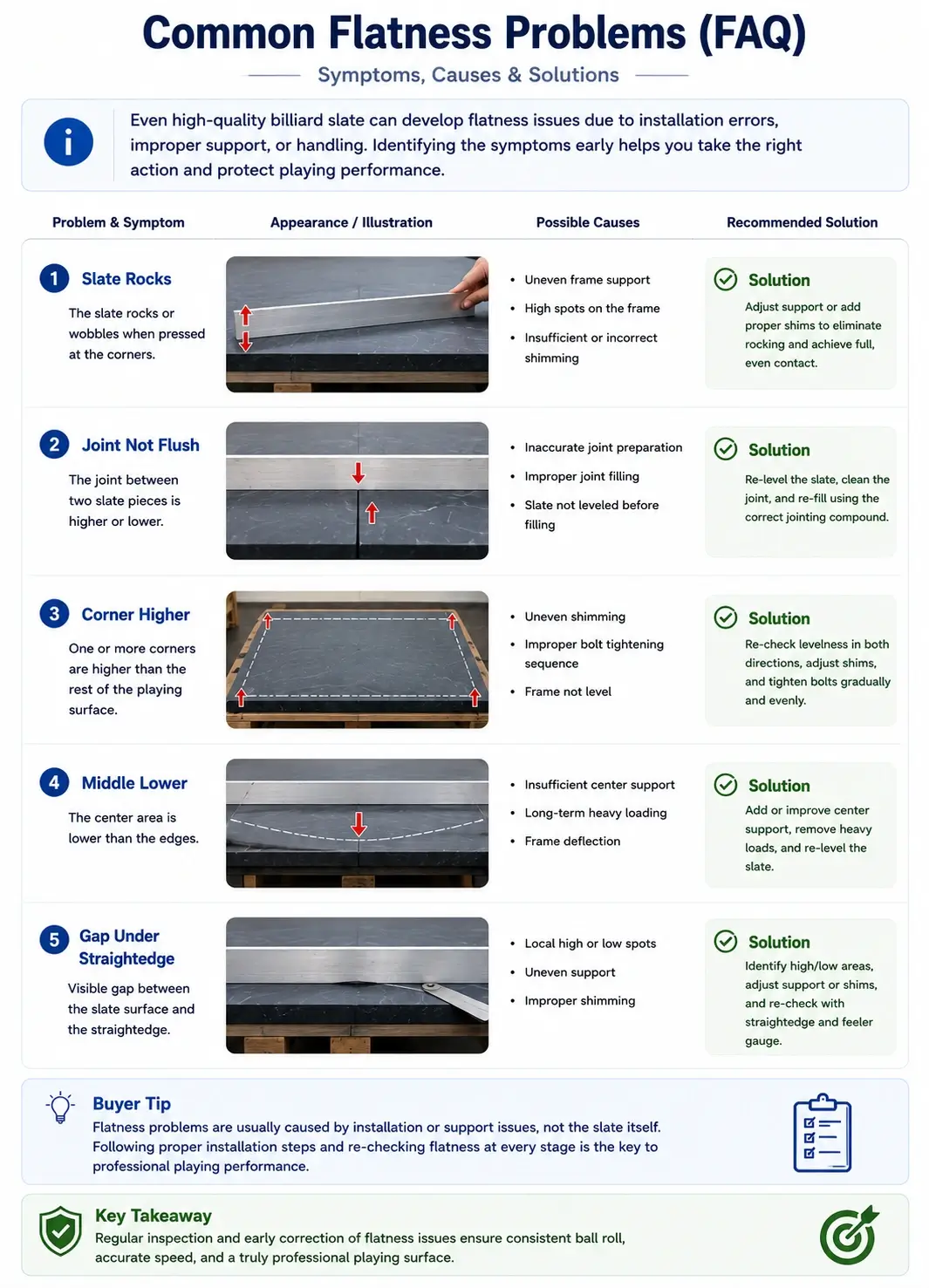
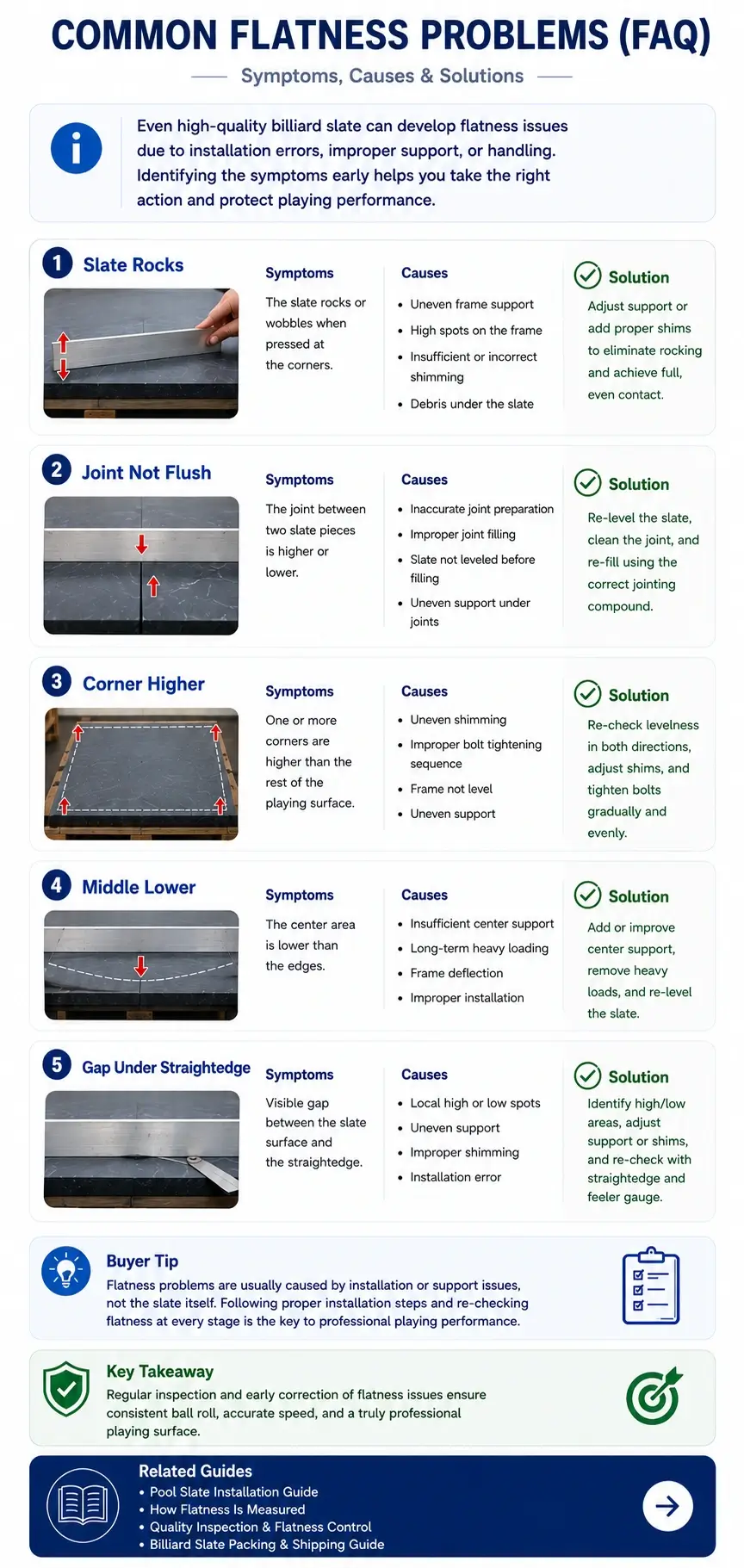
1. Why Does the Slate Rock?
Symptoms
The slate moves or rocks slightly when pressure is applied to one or more corners.
Possible Causes
- Uneven frame support
- High spots on the table frame
- Incorrect or insufficient shimming
- Debris trapped beneath the slate
Recommended Solution
Inspect the frame for uneven support, remove any debris, and use precision shims to achieve full contact between the slate and the frame before tightening the bolts.
2. Why Are the Slate Joints Not Flush?
Symptoms
Adjacent slate pieces are not perfectly level, creating a visible or noticeable ridge at the joint.
Possible Causes
- Poor slate alignment
- Incorrect joint filling
- Uneven support beneath adjoining slate sections
- Improper bolt tightening sequence
Recommended Solution
Re-align the slate sections, adjust support where necessary, and refill the joints after confirming that the surfaces are level.
3. Why Is One Corner Higher Than the Others?
Symptoms
One or more corners sit noticeably higher than the surrounding playing surface.
Possible Causes
- Uneven frame assembly
- Incorrect shim placement
- Uneven bolt tightening
- Table frame not level
Recommended Solution
Recheck the frame level, adjust shims gradually, and tighten slate bolts evenly following the recommended installation sequence.
4. Why Is the Center Lower Than the Edges?
Symptoms
The straightedge reveals a slight dip in the center of the slate while the edges remain in contact.
Possible Causes
- Insufficient center support
- Long-term concentrated loading
- Frame deflection
- Improper installation
Recommended Solution
Inspect the center support structure, add or adjust support where required, and verify flatness again using a precision straightedge and feeler gauge.
5. Why Is There a Gap Under the Straightedge?
Symptoms
A visible gap appears between the precision straightedge and the slate surface during flatness inspection.
Possible Causes
- Local high or low spots
- Uneven support
- Installation error
- Incorrect shimming
Recommended Solution
Determine whether the gap is caused by the slate or the installation. Check support points, re-level the frame if necessary, and repeat the flatness measurement.
Most Flatness Problems Are Installation-Related
It is important to remember that many apparent billiard slate flatness issues are not caused by manufacturing defects. Problems such as uneven support, improper shimming, incorrect bolt tightening, or poor joint finishing are far more common than actual defects in the slate itself.
A systematic inspection of the frame, support structure, and installation process can usually identify and resolve the issue before the table is put into service.
Buyer Tip
If a newly installed billiard table shows inconsistent ball roll, inspect the installation before assuming the slate is defective. In many cases, proper leveling, support adjustment, or joint correction restores the original factory-tested flatness.
Key Takeaway
Most flatness problems can be corrected without replacing the slate. Proper diagnosis, careful installation, and accurate flatness verification help ensure a stable playing surface, consistent ball roll, and long-term performance.
Related Guides
Continue learning with these detailed technical resources:
- Billiard Slate Installation Guide – Learn how correct installation preserves slate flatness and playing accuracy.
- How Flatness Is Measured – Explore the tools and methods used to verify slate surface accuracy.
- Quality Inspection & Flatness Control – Discover how manufacturers inspect and control flatness throughout production.
- Billiard Slate Packing & Shipping Guide – See how proper packaging and transportation help protect slate before installation.
Buyer's Flatness Inspection Checklist
Before accepting a shipment, buyers should verify that the billiard slate meets the agreed flatness requirements. A simple inspection using basic measuring tools can quickly identify potential installation issues or transportation damage.
The following checklist outlines the standard steps commonly used to evaluate billiard slate flatness before installation.
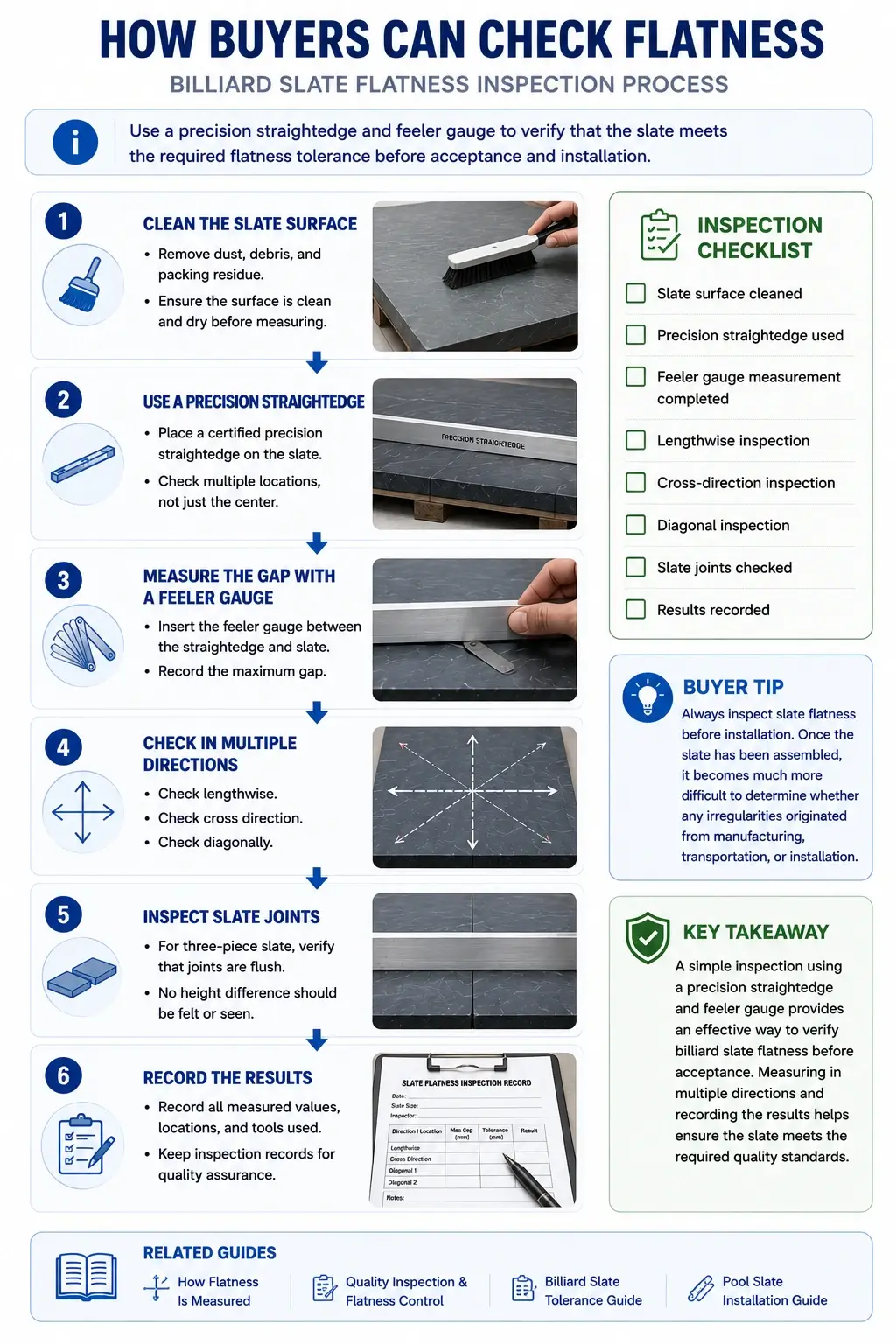
Step 1 — Clean the Slate Surface
Remove dust, packing residue, or loose particles from the slate before taking any measurements.
Even small debris can create false readings and affect the accuracy of the inspection.
Step 2 — Use a Precision Straightedge
Place a certified precision straightedge across the slate surface.
Check multiple locations instead of measuring only the center.
The straightedge provides a reliable reference plane for evaluating surface flatness.
Step 3 — Measure the Gap with a Feeler Gauge
Insert a feeler gauge between the straightedge and the slate surface.
Record the maximum gap observed at each measuring position.
Compare the measured value with the specified flatness tolerance.
Step 4 — Check in Multiple Directions
Flatness should be inspected from different orientations, including:
- Lengthwise
- Widthwise
- Cross direction
- Diagonal direction
Checking multiple directions helps identify localized high or low spots that may not appear in a single measurement.
Step 5 — Inspect Slate Joints
For three-piece billiard slate, verify that adjacent slate sections are flush and that no noticeable height difference exists at the joints.
Joint accuracy is just as important as the flatness of each individual slate piece.
Step 6 — Record the Inspection Results
Document:
- Maximum measured gap
- Measurement locations
- Measuring tools used
- Inspection date
- Inspector’s name (optional)
Maintaining inspection records helps verify product quality and simplifies future technical communication if needed.
Recommended Inspection Checklist
| ✔ | Inspection Item |
|---|---|
| □ | Slate surface cleaned |
| □ | Precision straightedge used |
| □ | Feeler gauge measurement completed |
| □ | Lengthwise inspection |
| □ | Cross-direction inspection |
| □ | Diagonal inspection |
| □ | Slate joints checked |
| □ | Results recorded |
Buyer Tip
Always inspect slate flatness before installation. Once the slate has been assembled, it becomes much more difficult to determine whether any irregularities originated from manufacturing, transportation, or installation.
Key Takeaway
A simple inspection using a precision straightedge and feeler gauge provides an effective way to verify billiard slate flatness before acceptance. Measuring in multiple directions and documenting the results helps ensure that the slate meets the required quality standards.
Continue Learning
- How Flatness Is Measured – Learn the professional methods used to inspect billiard slate flatness.
- Quality Inspection & Flatness Control – Discover how manufacturers verify flatness before shipment.
- Billiard Slate Tolerance Guide – Understand acceptable flatness and dimensional tolerances.
- Billiard Slate Installation Guide – Learn how proper installation preserves factory-tested flatness.
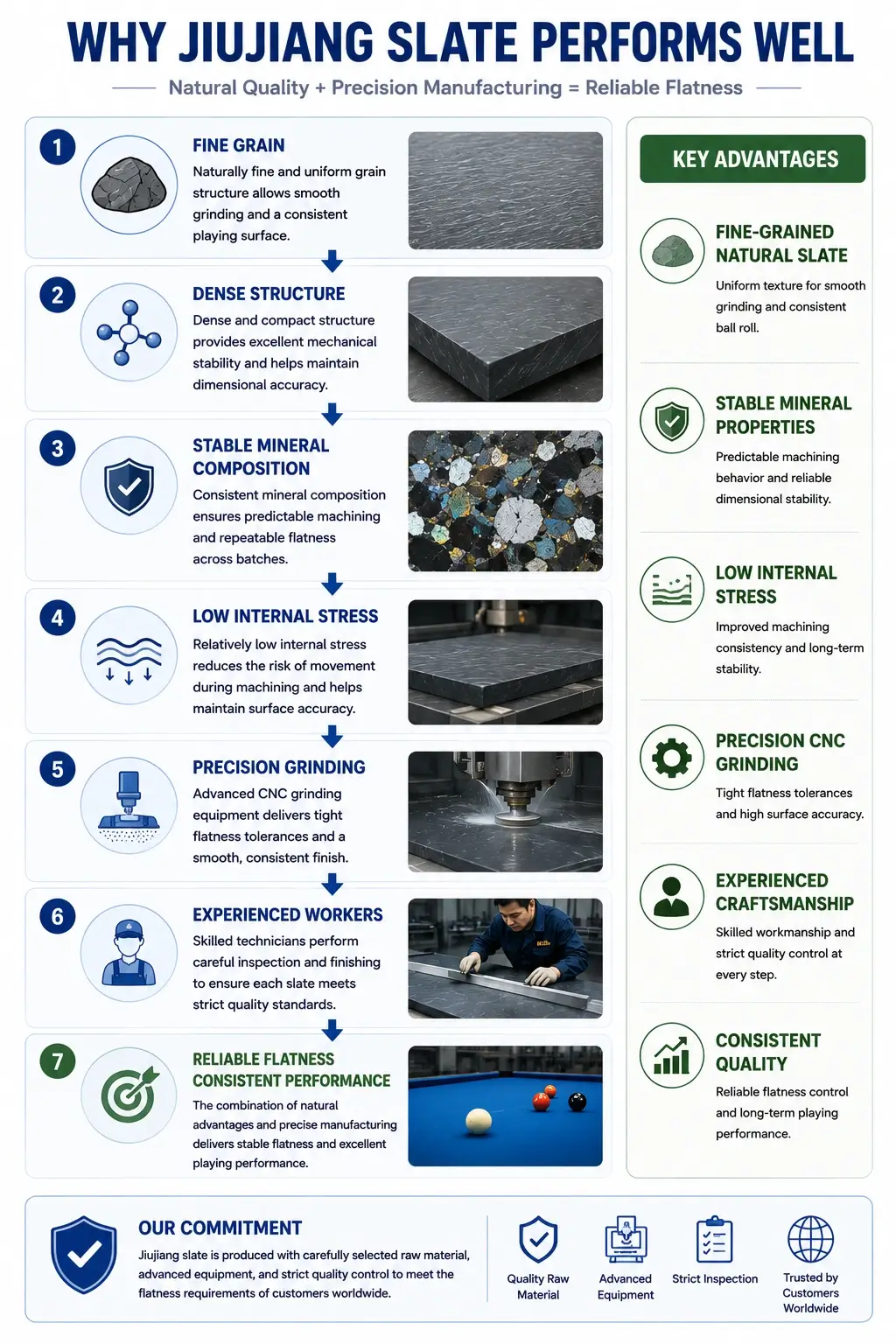
Why Jiujiang Slate Performs Well
The long-term flatness of a billiard slate depends not only on precision grinding but also on the natural characteristics of the stone itself. Material quality, mineral stability, machining accuracy, and manufacturing experience all contribute to the final playing performance.
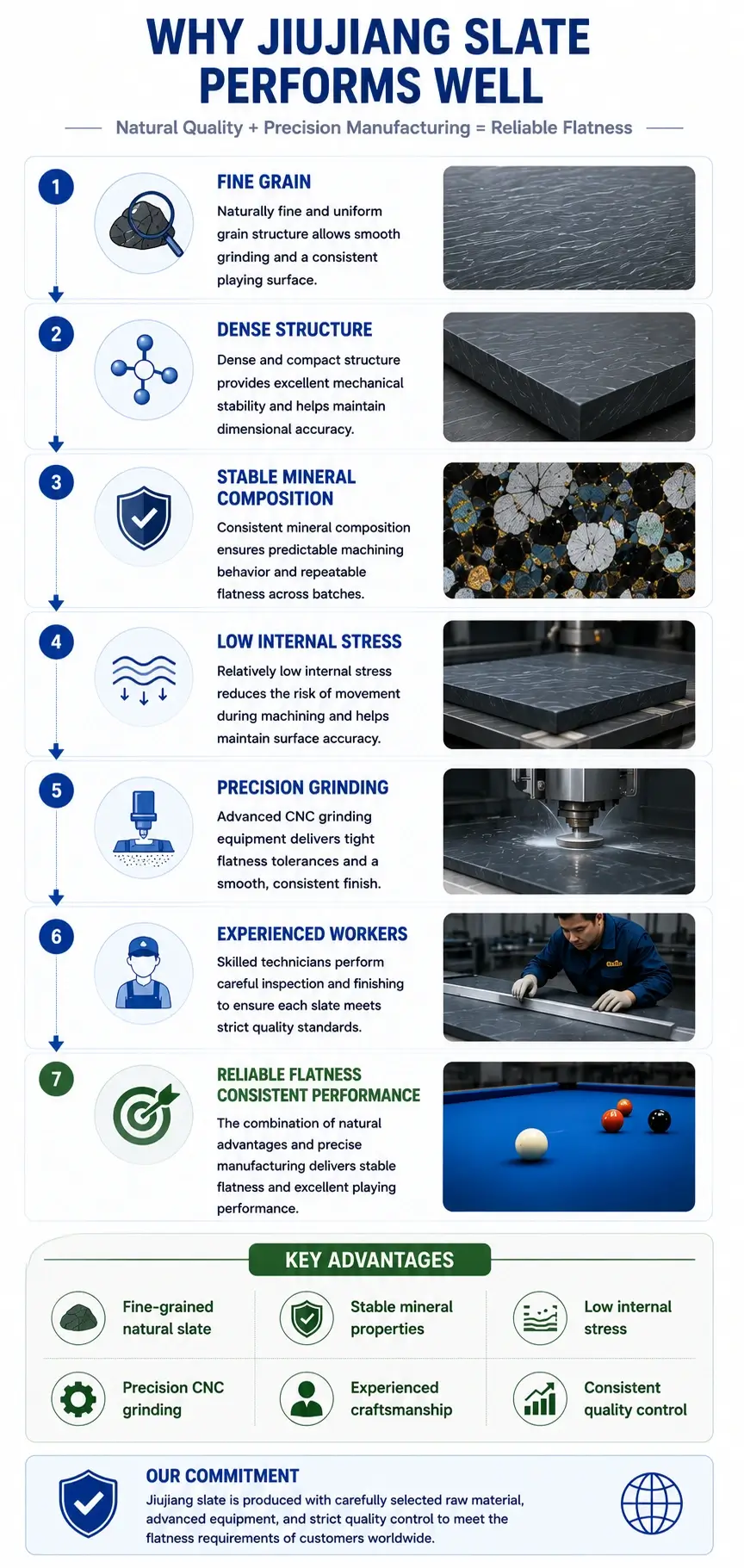
Jiujiang slate has been widely used in the billiard industry for decades because of its fine-grained structure, dimensional stability, and suitability for precision machining. When combined with strict quality control, these characteristics help produce billiard slate that meets demanding flatness requirements for home, commercial, and professional tables.
What Contributes to Stable Flatness?
Fine-Grained Structure
Jiujiang slate features a naturally fine and uniform grain, making it easier to achieve a smooth, consistent playing surface during precision grinding.
The uniform texture also helps reduce localized surface variations that may affect ball roll.
Dense Mineral Structure
A dense and compact stone structure provides excellent mechanical stability and helps maintain dimensional accuracy throughout machining, transportation, and installation.
This contributes to long-term flatness under normal operating conditions.
Stable Mineral Composition
Consistent mineral composition allows the slate to respond more predictably during cutting, grinding, and finishing.
This helps manufacturers achieve repeatable flatness tolerances across production batches.
Low Internal Stress
Natural slate with relatively low internal stress is less likely to experience unwanted movement during machining.
This improves manufacturing consistency and helps maintain surface accuracy after precision grinding.
Precision Grinding
Modern CNC grinding equipment and precision machining techniques allow each slate surface to be processed to tight flatness tolerances suitable for demanding billiard applications.
Experienced Craftsmanship
In addition to advanced equipment, experienced technicians play an important role in final inspection, surface finishing, and quality verification.
Careful workmanship helps ensure that each slate meets the required quality standards before shipment.
Why Material and Manufacturing Work Together
High-quality natural slate alone does not guarantee excellent flatness. Likewise, advanced machinery cannot compensate for poor raw material.
Consistent flatness is achieved through the combination of:
- Carefully selected natural slate
- Stable mineral characteristics
- Precision machining
- Accurate flatness inspection
- Experienced manufacturing personnel
- Comprehensive quality control
Each stage contributes to the overall accuracy and long-term performance of the finished billiard slate.
Buyer Tip
When comparing billiard slate suppliers, consider both the quality of the raw slate and the manufacturer’s production capabilities. Reliable flatness is the result of suitable material, precision machining, and consistent quality control—not any single factor alone.
Key Takeaway
Stable flatness begins with the right natural slate and is maintained through precision machining, careful inspection, and experienced manufacturing. The combination of material quality and process control helps deliver consistent playing performance and reliable long-term dimensional stability.
Continue exploring the complete billiard slate knowledge base:
- Billiard Slate Manufacturing Process – See how raw slate is transformed into a precision playing surface.
- Quality Inspection & Flatness Control – Learn how flatness is verified before shipment.
- How Flatness Is Measured – Discover the tools and methods used to inspect slate accuracy.
- Packing & Shipping Guide – Understand how professional packaging protects slate during transportation.
Frequently Asked Questions (FAQs)
Conclusion
The performance of a billiard table begins with the quality of its slate. Achieving and maintaining excellent billiard slate flatness requires more than precision grinding—it depends on the entire manufacturing and quality control process.
From selecting high-quality natural slate to careful machining, rigorous inspection, professional installation, and secure transportation, every step contributes to a stable, accurate, and reliable playing surface.
Whether you are a table manufacturer, distributor, or professional installer, understanding flatness standards and inspection methods helps ensure long-term playing performance and customer satisfaction.
Need Professional Billiard Slate?
✔ Tournament Slate
✔ Pool Slate
✔ Snooker Slate
✔ OEM Manufacturing
✔ Export Worldwide
Key Takeaway
High-quality billiard slate relies on a complete quality system:
- ✔ Premium natural slate with fine-grained, stable mineral composition
- ✔ Precision grinding for accurate surface flatness
- ✔ Strict quality inspection using professional measuring equipment
- ✔ Proper installation to preserve factory-tested flatness
- ✔ Careful packaging and transportation to protect the slate before installation
Ready to Source High-Quality Billiard Slate?
If you are looking for precision-machined billiard slate with reliable flatness control, our team is here to help. We provide professional manufacturing, comprehensive quality inspection, and export packaging to support distributors, table manufacturers, and OEM partners worldwide.
→ Contact Us for Technical Support or a Free Quote
Continue Exploring Our Billiard Slate Resources
- Billiard Slate Manufacturing Process – Learn how premium billiard slate is manufactured from raw stone to finished product.
- Quality Inspection & Flatness Control – Discover how flatness is measured and verified before shipment.
- Billiard Slate Installation Guide – Understand how correct installation preserves factory-tested flatness.
- Billiard Slate Packing & Shipping Guide – See how professional packaging protects slate during international transport.
- Billiard Slate Tolerance Guide – Learn the difference between flatness, thickness, and dimensional tolerances.
- Pool Slate Thickness Guide – Compare slate thickness options for home, commercial, and tournament tables.
Trusted by
Pool Table Manufacturers
Distributors
OEM Brands
Worldwide