
Billiard Slate Project Gallery: Real Orders, Factory Scenes & Packed Containers
Real orders, factory scenes and packed containers — visual proof of what we ship.
The most useful photograph I ever took at this factory was one I nearly didn't take.
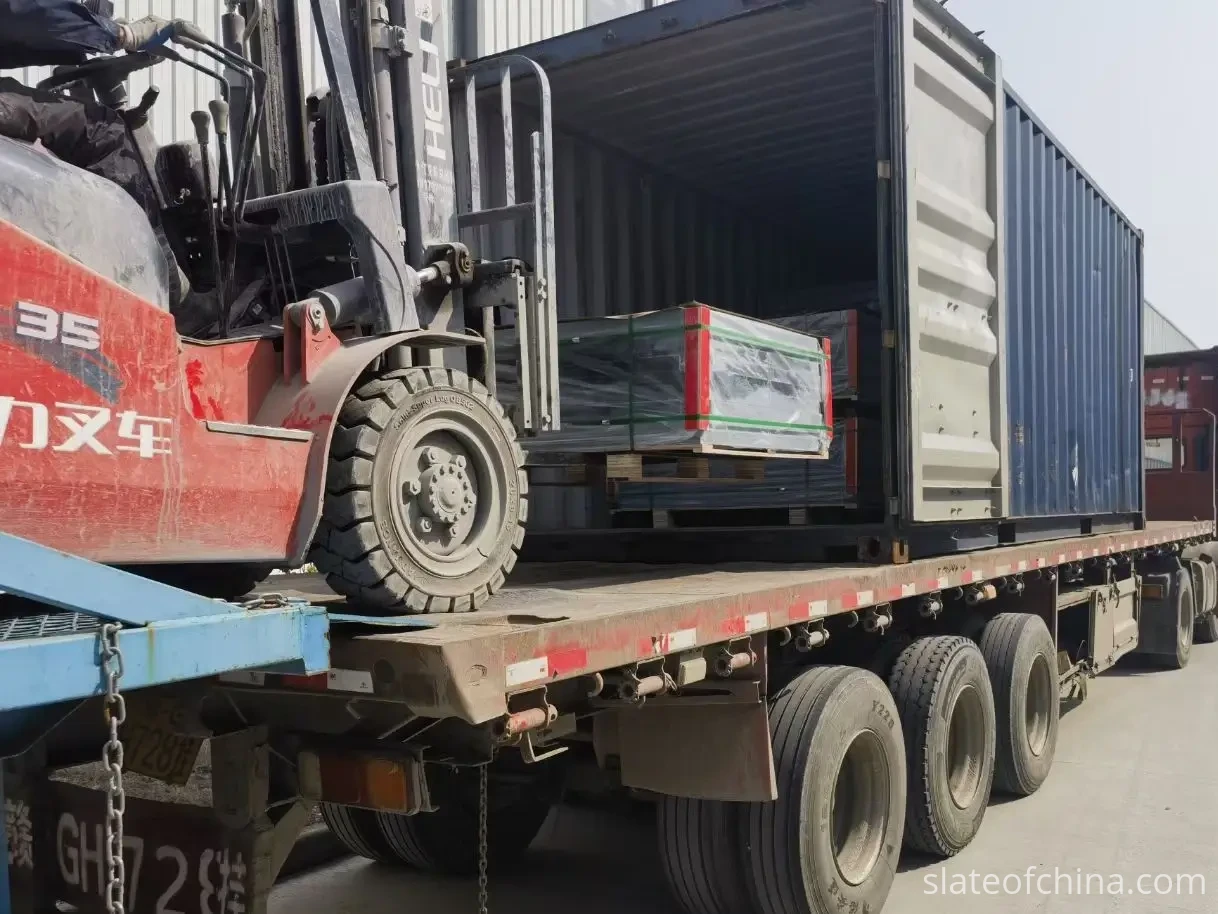
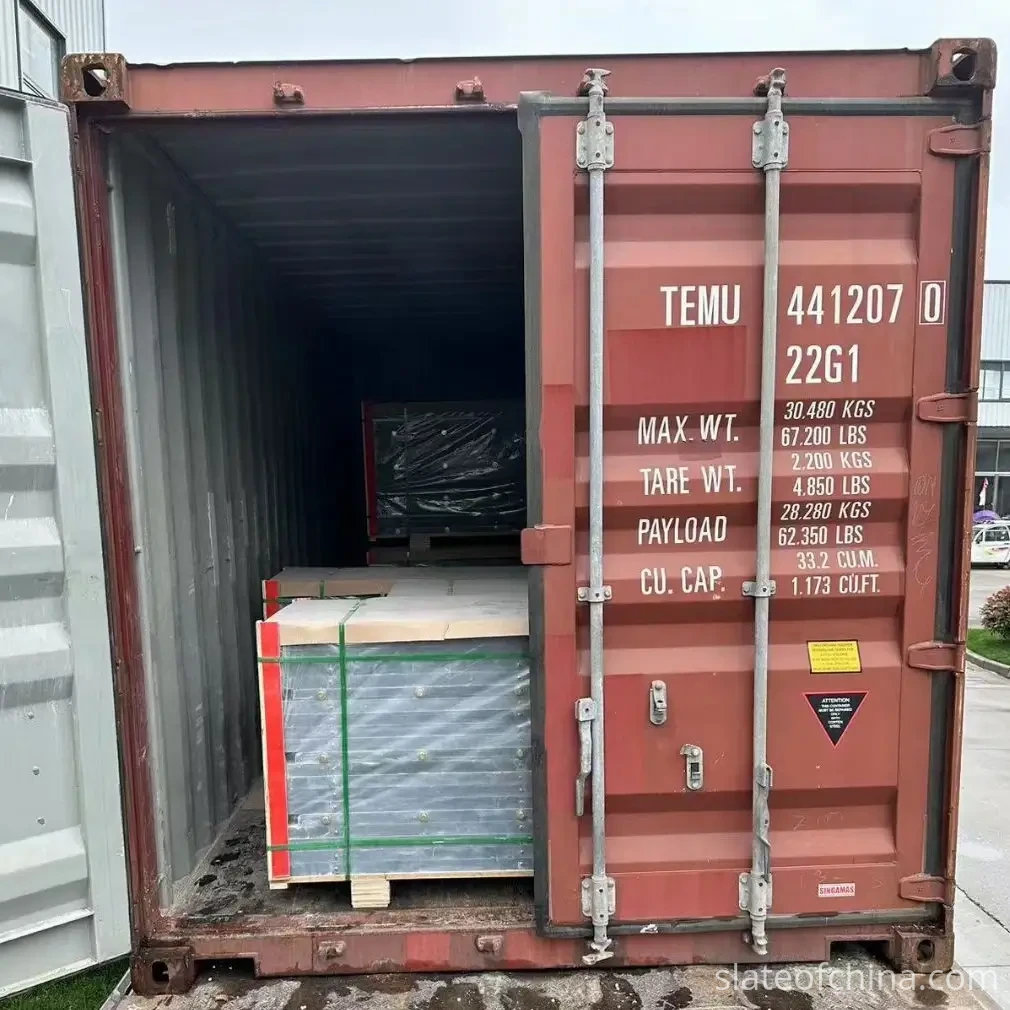
It was a Tuesday afternoon. A 20 ft container of pool slate — pallets strapped, papers stamped — was ready for a table builder in the UK. The driver was waiting, keys in hand. Before he pulled out, I climbed onto the loading dock, framed the container number into the shot, and took one last photo of the closed doors with the seal in place.
The customer replied within the hour with one question: "Is this my container?" And I could answer with something better than reassurance — a photograph with the container number in it, the seal recorded, the loading documented before departure. That was the day I understood what a project gallery is for. It is not decoration. It is answers, photographed.
I've spent years as the person behind the camera at a slate factory in Jiujiang — the one who photographs finished sets, machining scenes, pallets and loaded containers, and sends them to table manufacturers, OEM brands and importers in 30+ countries. Whether you are comparing a billiard slate manufacturer for your first order or a snooker slate supplier for your tenth, this page collects the photographs, and this article explains how to read them: what a photo can prove, what it can support, and what no photo can ever prove on its own.
Quick Answer — how to read this gallery
- A photo proves what is inside the frame: a finished set in its full configuration, a strapped pallet, a loaded container with the seal on.
- A photo supports a claim — in-house machining, flatness within your specification — when you follow up with the right question: the drawing, the inspection record, a live video call.
- A photo never proves, by itself, that every order ships the same way, or that a surface is flat to a number. That is what documents and inspections are for.
A photograph is an answer. Know which question it answers.
Evidence, Not Decoration: What a Gallery Is For
Every buyer who has shortlisted three slate suppliers on a spreadsheet knows the moment: three websites, three galleries, forty similar photographs. How do you read them?
Treat each photograph as an answer to one question. A finished-set photo answers does this supplier make this configuration? A machining photo answers does this process exist here? A container photo answers has this supplier actually shipped? If you know which question a photo answers, you know what to ask next.
Three questions cover most visits to a gallery:
- What has this factory actually made — finished sets, piece counts, pocket layouts?
- How is it made — which processes appear on the shop floor, in what order?
- How does it leave — packing, pallets, container loading, documents?
There is one rule that separates useful galleries from decoration, and it is the same rule that separates honest suppliers from confident ones: a photograph proves presence, not process, and configuration, not accuracy. A machining photo shows a machine cutting stone; it does not show your tolerance. A pallet photo shows one pallet built one way; it does not show that every order leaves the same way. Suppliers who say this in plain writing tend to be the ones whose photographs hold up under follow-up questions — and, frankly, the ones worth asking follow-up questions of.
One habit worth adopting as you read: prefer sequences over singles. One photograph can come from anywhere. A sequence cannot. When the same order appears across the saw, the machining centre, the inspection table and the container — same slabs, same light, same packaging — you are looking at evidence. When a gallery is a pile of unrelated beauties, you are looking at a mood board.
Finished Sets: The Photograph That Confirms Configuration
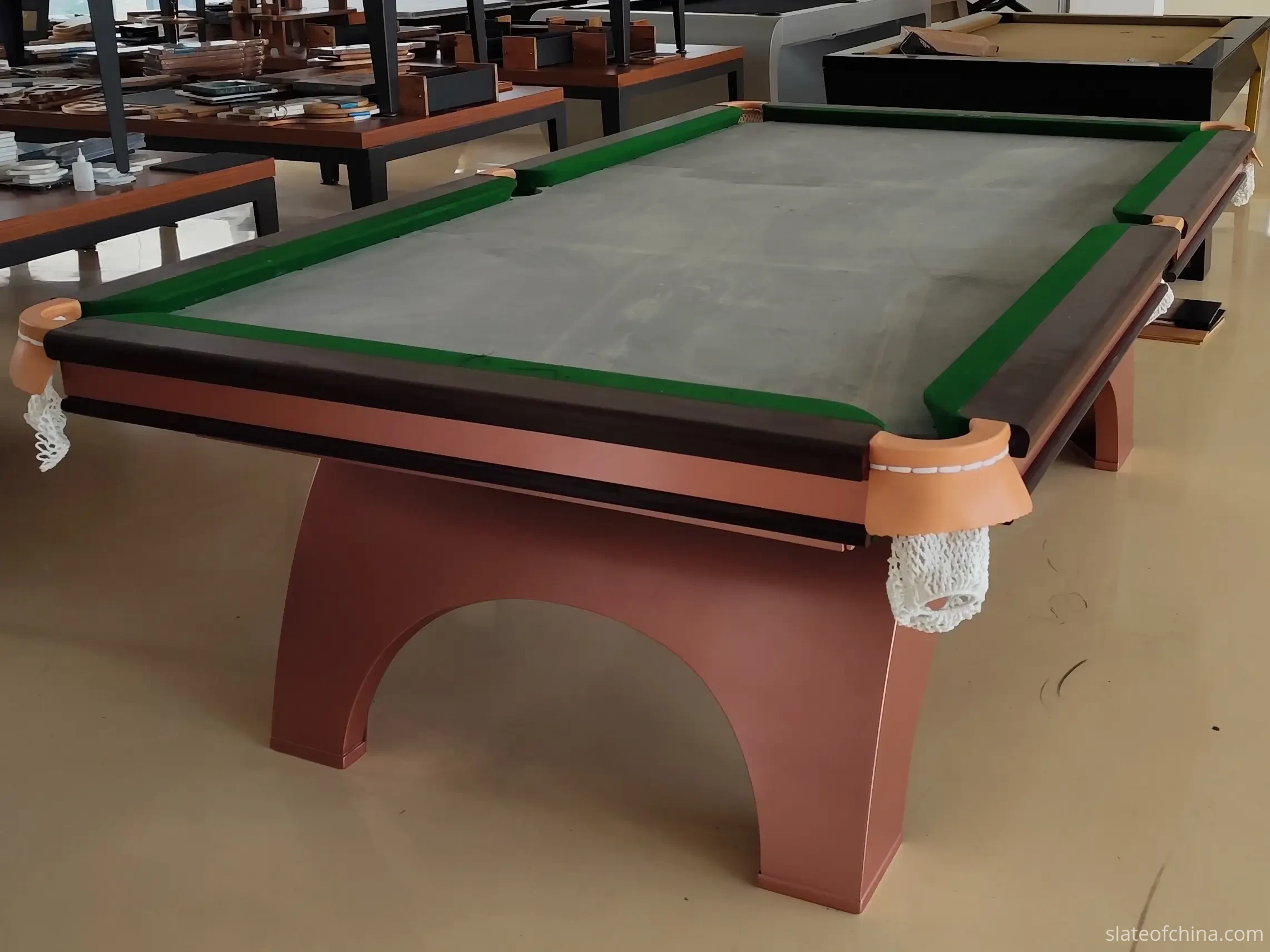
The first group in our gallery is finished slate sets — the last photographs taken before packing begins. For a table manufacturer, this is the most information-dense photo a supplier can offer, because it shows configuration: how many pieces, which layout, where the pockets and mounting holes sit.
When you look at finished-set photographs, four checks earn their time:
- The complete set, not a single slab. A three-piece pool bed photographed as a full, joined surface tells you the factory is willing to show the whole product; a lone panel tells you nothing about the joints.
- Piece count and layout against your table. A 12 ft snooker bed, for instance, is commonly a five-piece set with a nominal overall size around 3658 × 1867 mm at a nominal 45 mm thickness — figures worth treating as indicative until confirmed against your approved drawing. Different table types follow different piece layouts, from one-piece pool beds to five-piece snooker beds.
- Pocket and hole positions relative to the drawing. Photographs confirm the openings exist and sit where the eye expects; the drawing is what your approval actually hangs on.
- Edge condition in close view. Breakouts at machined edges and corner chips live in these photographs if you enlarge them — which is exactly why we leave the camera on the slowest, least glamorous setting for them.
A small habit from this side of the camera: when a customer asks for a finished-set photo, we lay the set out as a full bed — joints aligned — rather than photographing the stack on the pallet. It costs twenty minutes at the end of a shift. It saves a week of emails.
Factory Scenes: Reading a Billiard Table Slate Factory
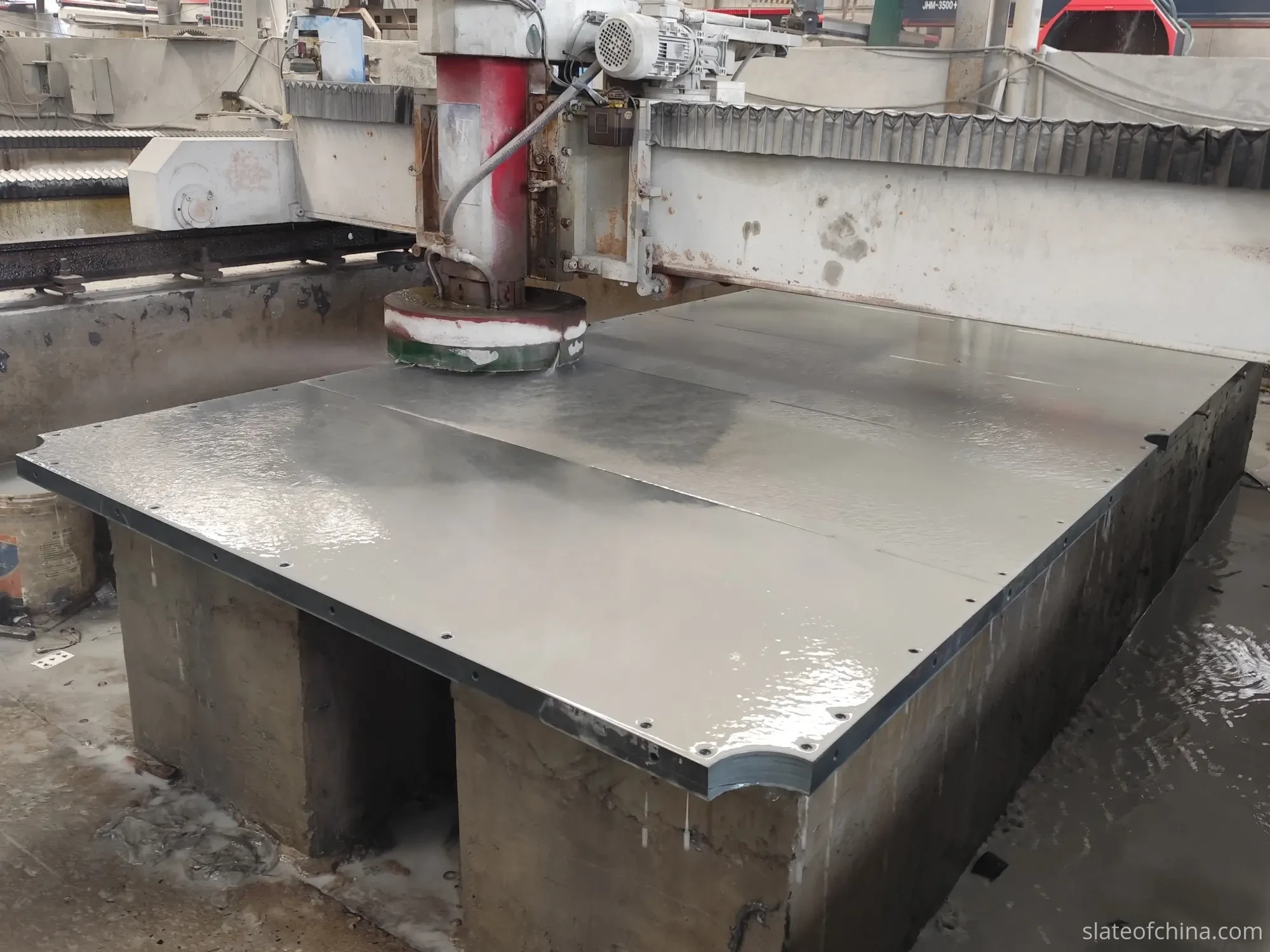
The second group is the workshop itself: cutting, machining, measuring, sorting. These photographs answer a different question — not what does the supplier sell? but does the billiard table slate factory do the work?
Read them with three checks:
- Is the machine working on the product you are buying? A saw cutting a slab, a machining centre drilling a bed panel, a straightedge crossing a finished surface — the equipment and the product should share the frame. A gallery full of gleaming machines and no stone is a showroom, not a workshop.
- Do the scenes connect into a process? Our billiard slate production process photographs follow one material from block through cutting, machining, grinding and inspection to the finished bed — the same material, the same order. Scenes that connect tell you the factory runs a line, not a photo collection.
- Do the scenes look lived-in rather than staged? Working workshops are messy: coolant, dust, a pallet half-built, a drawing taped to the machine guard. A suspiciously clean, cinematic factory shot is often a stock image wearing a logo.
One honest caution: not every photograph proves the process is performed in-house. If dedicated CNC capacity matters to your order, say so and ask for confirmation — a photograph of your own panel mid-machining, or a short video of the process running on your order. Factories that do the work can usually produce this within the production schedule. Factories that can't will explain why not, and that answer is itself evidence. The step-by-step process pages describe each stage in detail: how billiard slate is manufactured and what CNC machining controls on a bed.
The Machining Photo and the Drawing Behind It
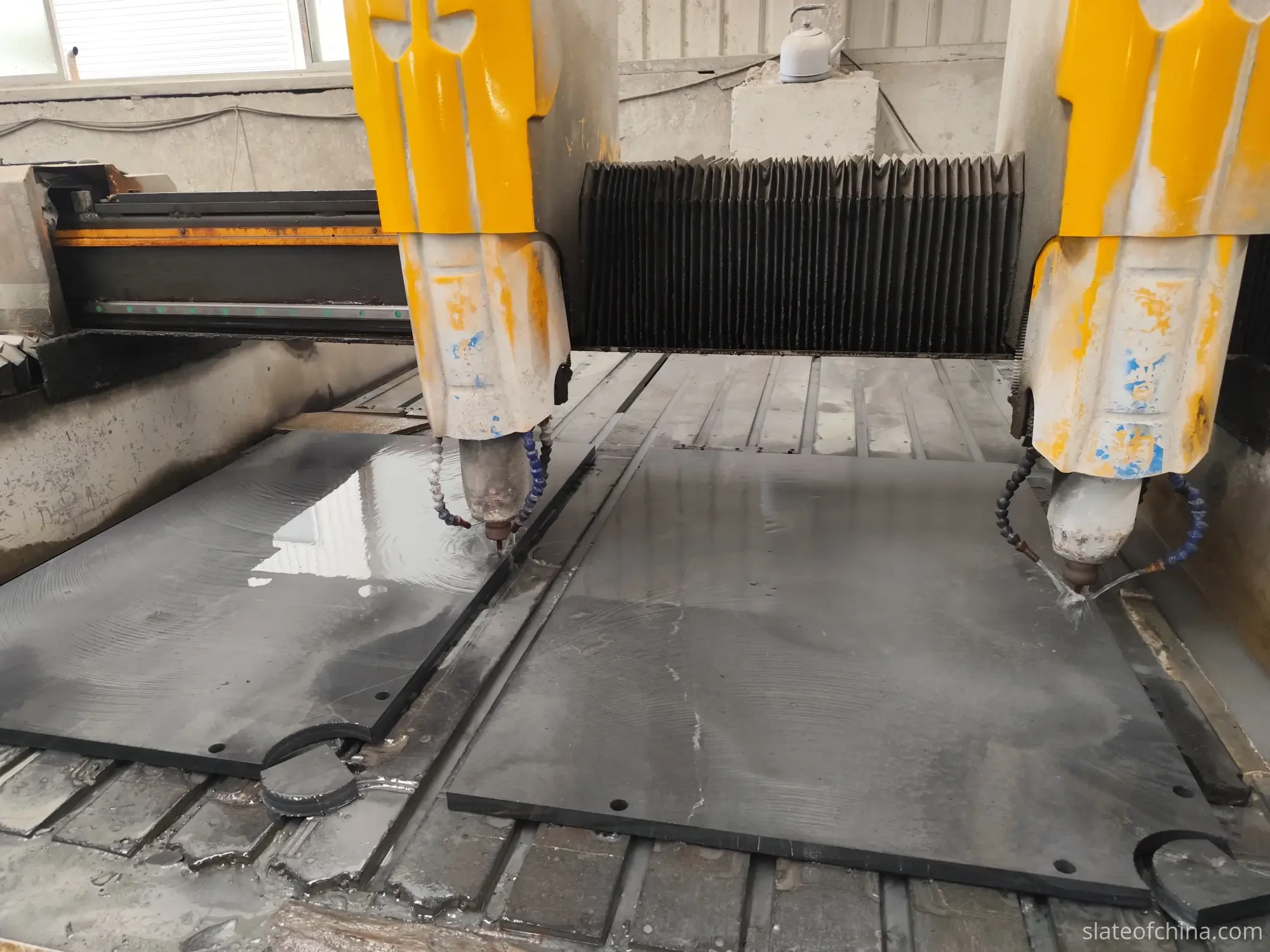
Machining photographs are the most requested shots we take — pocket openings, countersunk mounting holes, joint faces. OEM buyers care about these more than anything else in the gallery, because machining is where an order either fits the table or becomes expensive gravel.
Two reading rules make machining photos useful.
First: a dimension without a scale in the frame is a sentence, not a measurement. We put the tape measure or caliper into the shot precisely because it turns a claim into a checkable fact. When a supplier photographs a hole pattern "at about the right spacing", ask for the same shot with a scale in frame — you and the factory should be looking at the same number, not the same impression.
Second: a machining photo tells you the feature exists. The drawing tells you where, how large, and to what standard the factory has agreed to work. That division of labour is why photographs and drawings travel as a pair — the photo is the visual confirmation, the drawing is the contract. The review process that turns your CAD into an approved production drawing is described in How to Confirm a Billiard Slate Drawing, and the pocket-specific confirmation workflow in CNC Pocket Cuts and Drawing Confirmation.
For buyers who need numbers, the records behind the photographs are a separate document. How thickness and dimensions are measured and logged at our factory — the step that turns photographs into data — is written up in Thickness and Dimensional Inspection. Photographs show the measurement happening; the records show what it found.
Export Packaging in Pictures: Pallets, Crates and the A-Frame
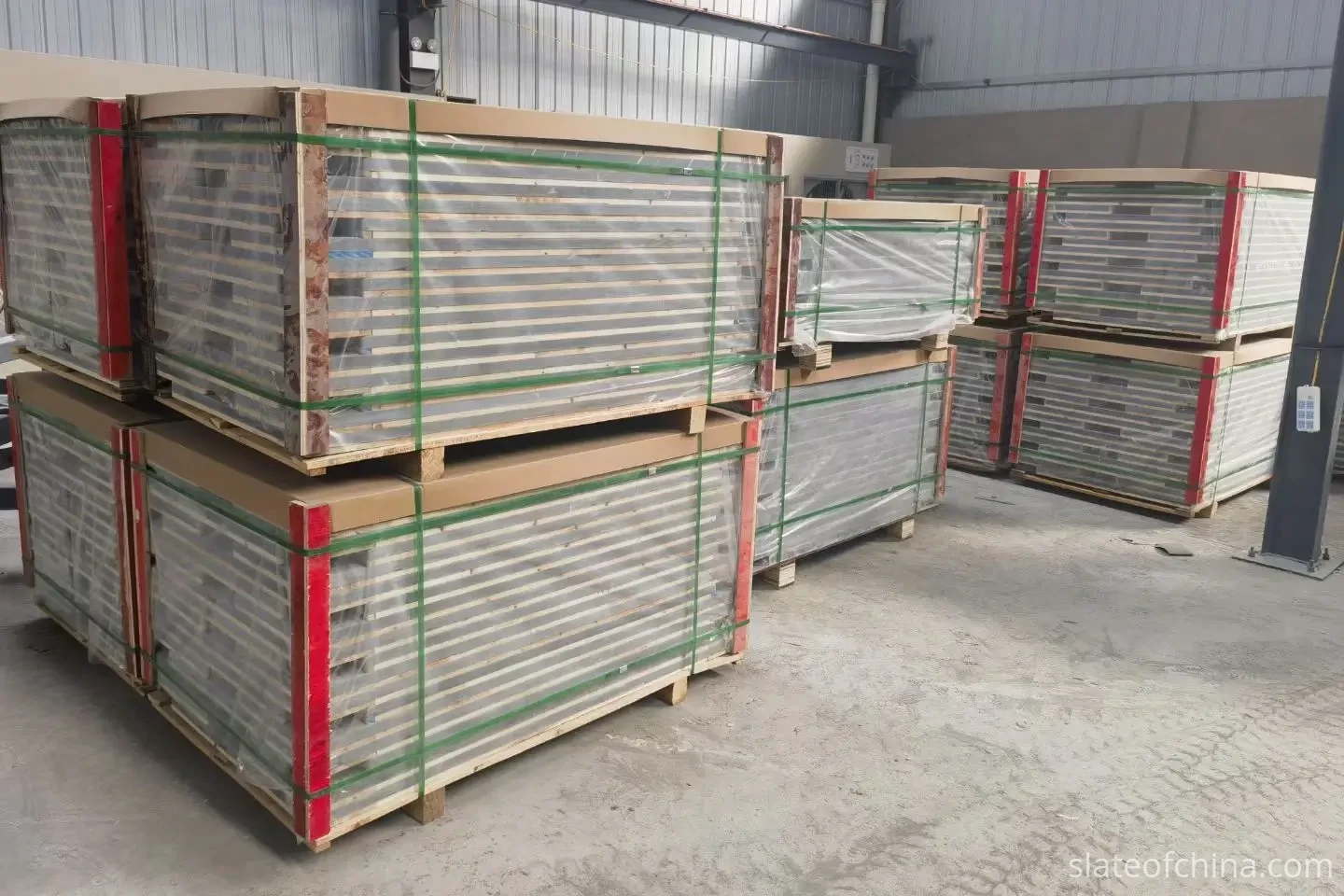
The third group of photographs follows the slate into its travelling clothes. For overseas buyers these may be the most valuable photos of all, because slate is heavy, rigid and unforgiving: edges chip, corners fracture, and a badly restrained pallet can turn a container of good stone into an insurance claim.
The packing photographs you should expect depend on how the shipment travels:
| Shipment type | Typical packing | What the photo should show |
|---|---|---|
| Full container load (FCL) | Slabs usually stacked flat on wooden pallets with protective interlayers, then strapped | Pallet structure, interlayers between slabs, strapping, corner protection |
| Less than container load (LCL) | Strengthened wooden crates when a shared container calls for more protection | Crate frame, internal bracing, protection at exposed edges |
| Oversized single slabs (around 2 m × 1 m) | A-frame crates, panels resting on edge | A-frame support points, restraint method, edge padding |
Packing photographs follow the same evidence rules as machining photos — they show one order packed one way. What matters for your order is the written packing standard behind the picture: interlayer material, corner protection, timber treatment, restraint points. A supplier who can send you a short written standard alongside the photographs is a supplier whose packing photos will match your shipment rather than merely decorate it.
None of this eliminates transit risk — no packing can. Correct internal support, careful handling at both ends and proper cargo securing remain the real protection; the photographs let you verify the first link in that chain. The complete method is documented in the Billiard Slate Packing & Shipping Guide and Export Wooden Crate Packing.
Container Loading: The Last Photograph Before the Voyage
The final group of photographs is taken from inside a steel box. Container-loading photos are, in my experience, the least requested and most useful pictures in any gallery — they are the last record of your goods before the voyage.
Our loading photographs follow a routine born from that Tuesday afternoon years ago — three shots per container:
- The container number and seal, photographed before loading begins, so the shipment has a name and a face.
- The loaded interior — pallets seated, gaps blocked, restraints in place — the frame that answers how was my order arranged?
- The closed doors with the seal on — the frame that answers did it leave complete and sealed?
The loading itself matters as much as the photograph. Slate rides flat and low; heavy pallets go in first and are blocked against movement; the last metres of space are filled so nothing can shift. When the truck pulls out of our yard near Lushan, it faces roughly forty minutes of road to the river port at Jiujiang before the ocean leg begins — and the packing has to be built for every kilometre of it. Billiard slate container loading, stacking patterns and weight distribution are covered in detail in the container loading guide, and ports, documents and terms in the Billiard Slate Shipping Guide.
A buyer reading container photographs should check what the photographer checks: that the pallets are seated, the restraints are real, and the container number is legible. If any of the three is missing, the photo is atmosphere. If all three are present, you are looking at the last honest picture of your order.
The Five-Question Test for Any Supplier's Gallery
Whether the gallery belongs to us or to anyone else, the same reading method applies. Here is the table I would use to read any billiard slate manufacturer's project photographs — ours included:
| What you see | What it can show | What to ask next |
|---|---|---|
| Finished sets | Configuration, piece count, edge condition | "Send the specification and packing list for this order." |
| Machining scenes | Which processes exist in the workshop | "Was this operation done in-house? On which machine?" |
| Dimension photos | A measurement taken with a scale in the frame | "What do your inspection records show for this feature?" |
| Packing photos | How goods are prepared for export | "Send your written packing standard." |
| Container photos | A real order that actually shipped | "Container number, seal photo and packing list, please." |
Then apply the simplest test of all: how the supplier answers the follow-up. A gallery narrows a shortlist; the answers cut it. The questions worth asking before committing to any factory — ten of them — are collected in How to Choose a Billiard Slate Manufacturer. Photographs are the first filter; those questions are the second.
For OEM and Wholesale Buyers: The Photos That Matter Most
If you build tables under your own brand, four kinds of photographs carry more weight than everything else in the gallery:
- The first-article photograph — your first approved panel, shot against the drawing before the batch runs. It proves the translation from drawing to stone.
- The batch-consistency photograph — panels from the middle of a run, photographed side by side, showing that the thirtieth set looks like the first. This is the picture that protects a brand, because a table company's reputation rides on the worst slate in the batch, not the best.
- The packing-detail photograph — interlayers, corner protection and crate bracing as built for your order, not for the camera.
- The loading photograph — your container, your seal, your record.
OEM orders live and die on repeatability, and photographs are the cheapest repeatability audit there is. If you are earlier in the process — still assembling specifications — the custom-production information form and the OEM supply pages describe what to prepare before the first photograph is ever taken. Custom slate manufacturing follows the same logic for non-standard sizes and pocket layouts.
And if the order is still at the "what would this cost" stage, the five pieces of information that get you a fast, usable quotation are listed in How to Request a Billiard Slate Quotation.
Inside the Slate of China Gallery
So what will you actually find in our gallery? Three groups of photographs, all taken on real orders:
- Finished slate sets — pool, snooker and Chinese 8-ball configurations as they leave the inspection area, from one-piece beds to five-piece snooker sets.
- Factory scenes — cutting, CNC machining, measurement and inspection as the orders run.
- Export preparation — pallets, crates and container loading, recorded before departure.
Two commitments we make about these photographs: they are photographed on our own orders in Jiujiang, and when you need a photograph the gallery does not show, you can ask for it. We shoot to order — a specific step, a specific angle, a specific moment in your production. It costs us minutes. It has saved more than one shipment from a misunderstanding.
When the photographs have done their work, the specifications live in one place: the billiard slate product pages list sizes, thicknesses and machining options for every table type we supply — the place to go when the eyes have finished and the spreadsheet begins.
Reading a Project Gallery: Questions Buyers Ask
Why do container-loading photos need the container number in the shot?
Because a loading photo's job is to connect a photograph to a shipment. The container number and seal turn "a container of slate, somewhere" into "this container, this order, photographed before departure" — the single detail that makes a loading photo evidence rather than atmosphere.
Can I ask a factory to photograph specific steps of my own order?
Yes — and a reasonable request deserves a reasonable answer. Ask for the steps that matter most to your order: the machining of your pocket layout, the first-article panel, the packing as built, the loading. Factories that do the work can usually photograph it within the production schedule, and the ones that hesitate are telling you something worth knowing.
Do factory photos prove that the slate is flat?
No. A photograph can show a straightedge resting on a surface, but flatness is a measured property recorded in inspection records — not something a camera can verify. If flatness matters to your order, ask how it is measured and what the records show. How our factory measures and documents flatness is described on the quality inspection pages.
Why do suppliers put a tape measure in dimension photographs?
Because a scale in the frame turns a claim into a checkable fact. Without a reference, a photograph can make one thickness look like another; with the tape in frame, you and the supplier are looking at the same number rather than the same impression.
Can a video call replace visiting the factory in person?
It narrows the gap but does not close it. A live video call can walk you through the workshop in real time and answer questions a still photograph cannot; an in-person visit remains the strongest verification for large or long-term supply commitments. Many buyers combine the two: video for the shortlist, a visit before the first big order.
Why don't you show customer names with every gallery order?
Because commercial agreements belong to the customers. What we can show is the order itself — table type, configuration, packing and loading — and customers who are happy to be named usually tell us. We ask before publishing anything, and the photographs still carry the evidence: configuration, packing method, loading record.
Can I request photographs that are not shown in the gallery?
Yes. We shoot to order: specific steps, specific angles, specific moments. If a photograph would settle a question in your sourcing decision, ask for it — it is the cheapest verification available to either side.
Related Reading
Ready to See Your Own Order in These Photographs?
Every photograph on this page was taken on a real order for a real table builder. The next set in the gallery could be yours. Send us your table size, slate drawing and order quantity — we will review your requirements and reply with the machining, packing and loading arrangements for your order.