
The Slate Industry of Jiangxi
PROVINCE
Jiangxi — the province where the geological resource sits
PREFECTURE
Jiujiang — the prefecture-level city and commercial centre
COUNTY
Lushan (formerly Xingzi) — the regional centre of the slate-producing and processing cluster
QUARRY
Yajishan, Dongsheng Dawa — named mining areas in the official plan
PRODUCT
Roofing slate, billiard slate, architectural slate
Four geographic levels, one supply chain. Each name tells you something different about where the slate comes from.
An international buyer searching for slate from China will encounter at least five names: Jiangxi slate, Jiujiang slate, Lushan slate, Xingzi slate, and the broad label Chinese slate. These names do not describe five different stones. In most cases, they refer to different geographic levels of the same regional supply chain.
What makes this more than a naming puzzle is the geological and industrial base behind it. Official mineral-resource planning documents from the Lushan City government identify decorative slate as one of the area's important mineral resources. By the end of 2020, the documented retained resource volume stood at 17.102 million cubic metres. The same plan names specific slate mining areas, including Yajishan and Dongsheng Dawa.
This is not a factory's marketing claim. It is a government mineral-resource assessment — and it is the starting point for understanding why so many slate suppliers are concentrated in one relatively small area of Jiangxi, and how stone from that area reaches construction and sporting-goods markets across the world.
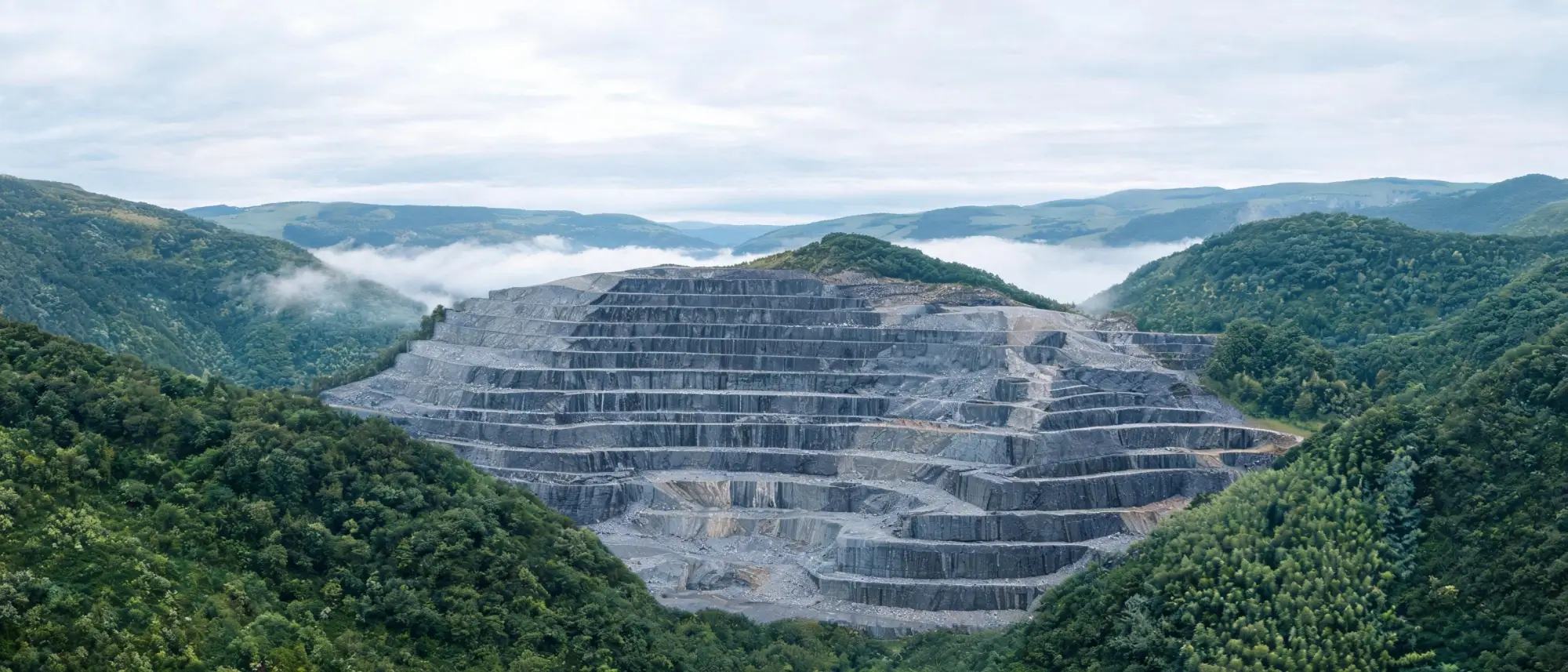
Where the Slate Industry Actually Sits
Jiangxi is a large province in southeastern China, but the slate industry relevant to international buyers is not spread evenly across it. The producing area centres on Jiujiang City and, more specifically, on Lushan — the county-level city where the quarries and processing facilities are located.
The Lushan mountain region rises sharply from the plains near Poyang Lake, China's largest freshwater lake. The slate deposits sit in the foothills to the south of the mountain, in the towns around what was historically called Xingzi County. In 2016, Xingzi County was administratively restructured and became Lushan City. The administrative name changed, while the established slate-producing areas remained in the same broader region.
This geographic concentration matters because natural slate is not a manufactured material that can be produced anywhere with the right equipment. The industry exists where the geology placed it. Quarries open where the rock is. Processing factories grow up around the quarries. Exporters settle where the factories are. The entire chain is anchored to a specific piece of geology.
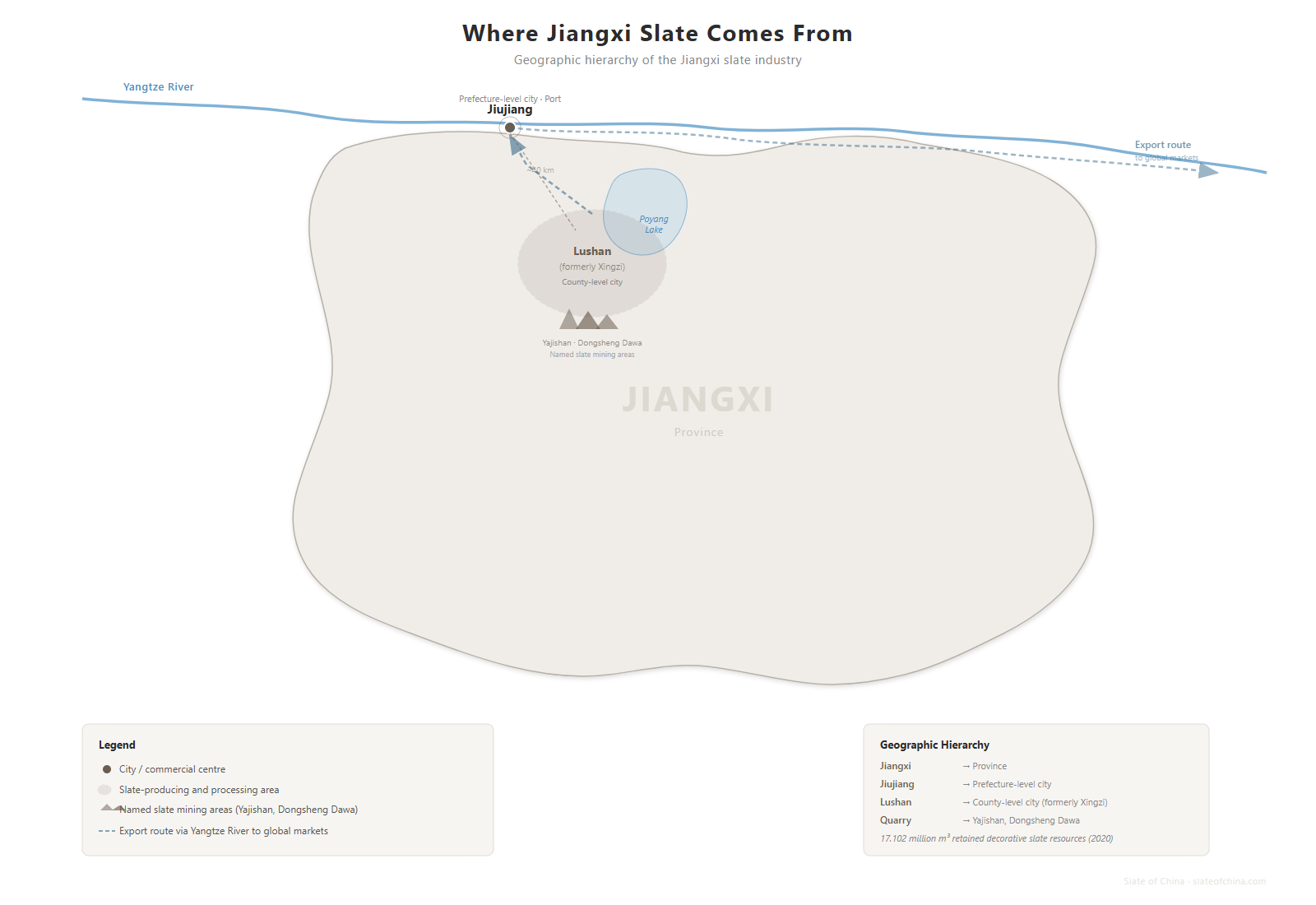
Understanding the Names: Four Geographic Levels
The naming hierarchy is straightforward once it is laid out, but confusing for a buyer encountering it for the first time. A company advertising "Jiangxi slate" may be operating in the Jiujiang/Lushan production area. Another may use "Xingzi slate" because of the historical name of the region. These are not different stones — they are different geographic levels of the same supply chain.
JIANGXI
The province — the widest geographic label
↓ JIUJIANG
The prefecture-level city — port and commercial centre
↓ LUSHAN (formerly Xingzi)
The county-level city — the regional centre of the producing area
↓ SLATE-PRODUCING AREA
Yajishan, Dongsheng Dawa — named mining areas
The practical implication: a buyer comparing two suppliers — one calling its material "Jiangxi slate" and another calling theirs "Xingzi slate" — may be looking at stone from the same producing area. The relevant question is not which name is correct. It is: where was the stone actually quarried, and where was it processed?
For a detailed examination of the four names and the 2016 administrative change, see Lushan, Xingzi and the Slate Belt of Jiangxi. For a buyer-facing address map, Where Is Jiujiang Slate From? traces the supply chain from invoice address to quarry.
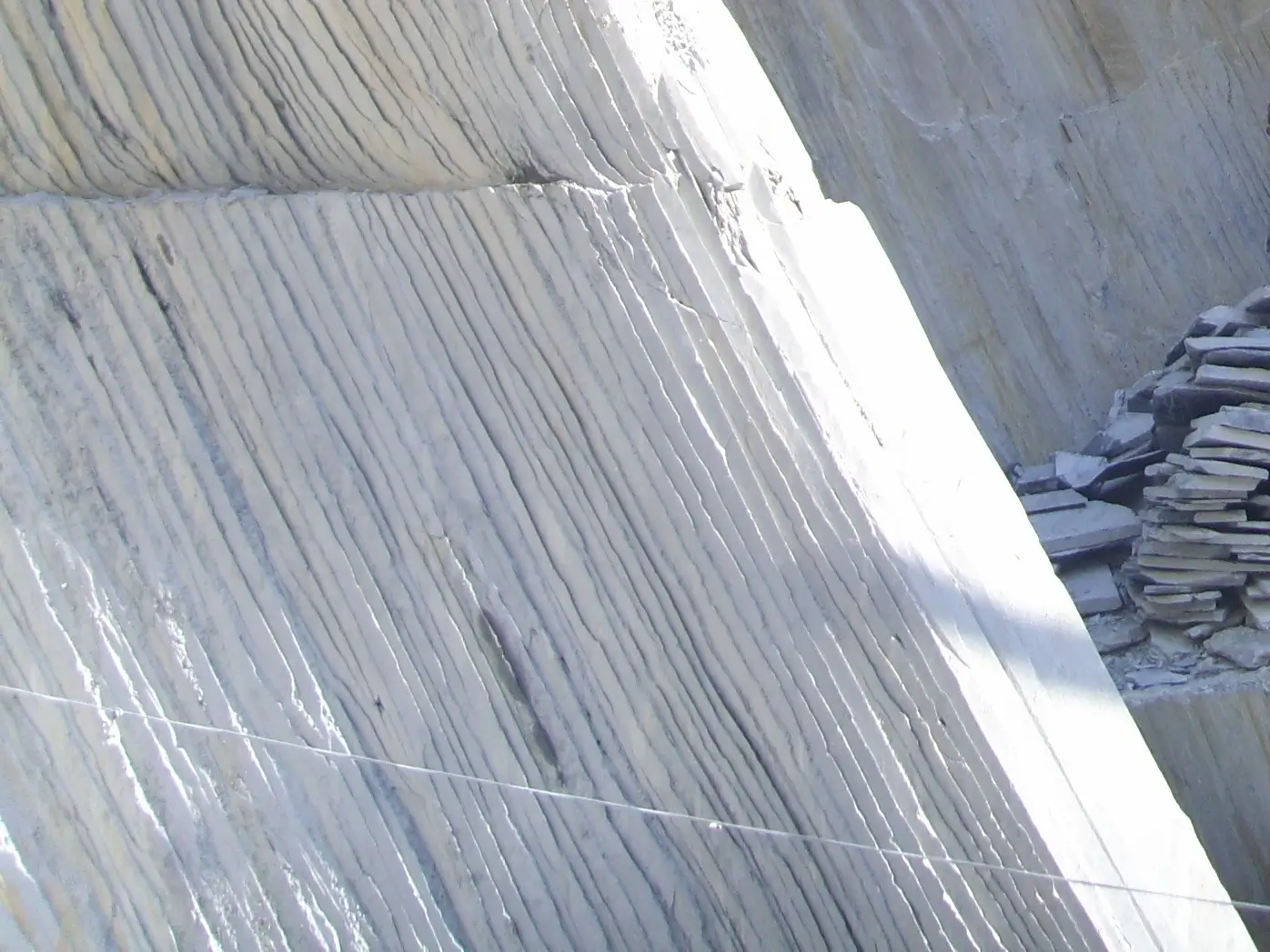
Lushan: The Geological and Industrial Base
The connection between Lushan and slate is not a recent marketing story. The Lushan City Mineral Resources Master Plan (2021–2025) identifies decorative slate as one of the area's advantageous mineral resources. By the end of 2020, the plan documented 17.102 million cubic metres of retained resources for decorative slate. The same document identifies two named slate mining areas: Yajishan and Dongsheng Dawa, both designated as decorative slate planning blocks.
This places the Jiangxi slate industry on a different footing from a supplier who simply claims "we have good stone." There is a documented geological resource, assessed and recorded by a government body, with specific named mining areas. The industry sits on a recognised mineral deposit with a measured volume and a planning framework.
For a deeper geological analysis, see The Geology of Jiujiang Slate. For data on quarry reserves and licensing, Jiujiang Slate Resources and Quarry Reserves covers the due-diligence side.
Jiangxi Slate Is Not One Uniform Deposit
Jiangxi is a province, not a single slate deposit. The Jiujiang/Lushan area is one important slate-producing region, but buyers should not assume that every product marketed as "Jiangxi slate" comes from the same quarry or geological source.
Other areas within Jiangxi also produce stone. Yushan, in Shangrao to the east, is a separate stone-producing cluster known for billiard slate. Material from Yushan and material from Lushan may both carry a "Jiangxi" label, but they come from different geological formations and different supply chains.
Even within the Jiujiang/Lushan producing area, natural stone varies. Different quarry locations, different benches within the same quarry, different blocks, and different processing methods can produce differences in colour, grain, cleft, density, absorption, strength, and weathering behaviour. Two companies may both advertise "Jiangxi Natural Slate" — that does not prove they are selling identical material. The quarry source and actual specification still need to be confirmed.
The correct purchasing decision depends on the final application, not the geographic name alone. Physical samples and production approval before a large order are the only way to confirm that the material matches the specification.
Supply Chain at a Glance
The full chain from quarry to international market can be summarised in a single flow:
Slate-bearing area
↓
Quarry — raw block extraction
↓
Primary processing — sorting, splitting, cutting
↓
Factory processing — roofing / billiard / architectural
↓
Inspection — dimensions, thickness, appearance
↓
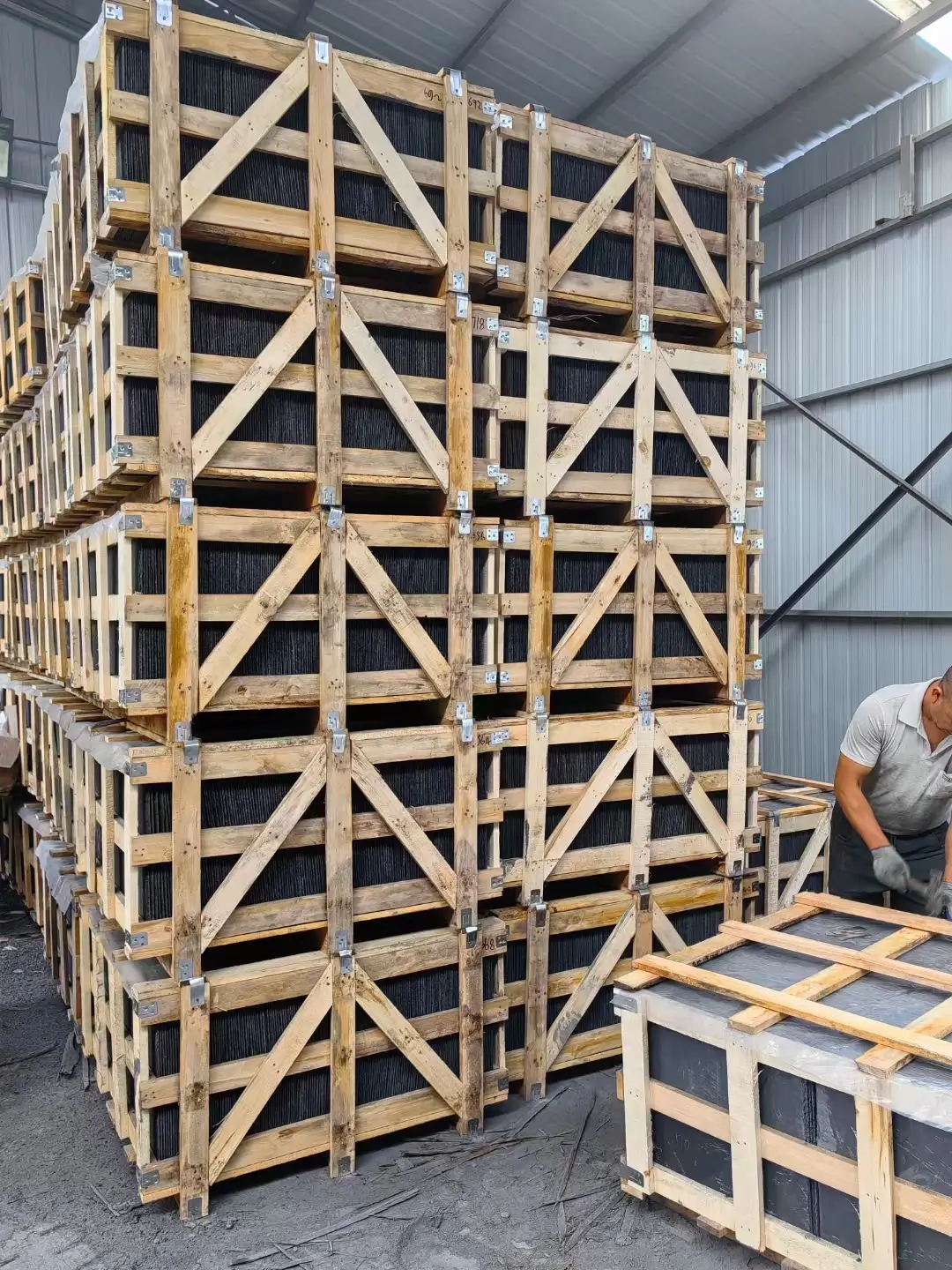
Export packing — crates for ocean transit
↓
Transport to an export port — with Jiujiang and other regional logistics routes used according to destination and shipping arrangements
↓
Ocean freight
↓
Importer / distributor / manufacturer
Each stage requires different knowledge and equipment. A quarry alone does not create an international slate industry — what turns a geological deposit into a regional supply chain is the accumulation of specialised businesses around the resource. For a detailed explanation of how the Jiujiang supply chain operates, including the three production routes and who controls what at each stage, see The Jiujiang Slate Industry: How It Actually Works.
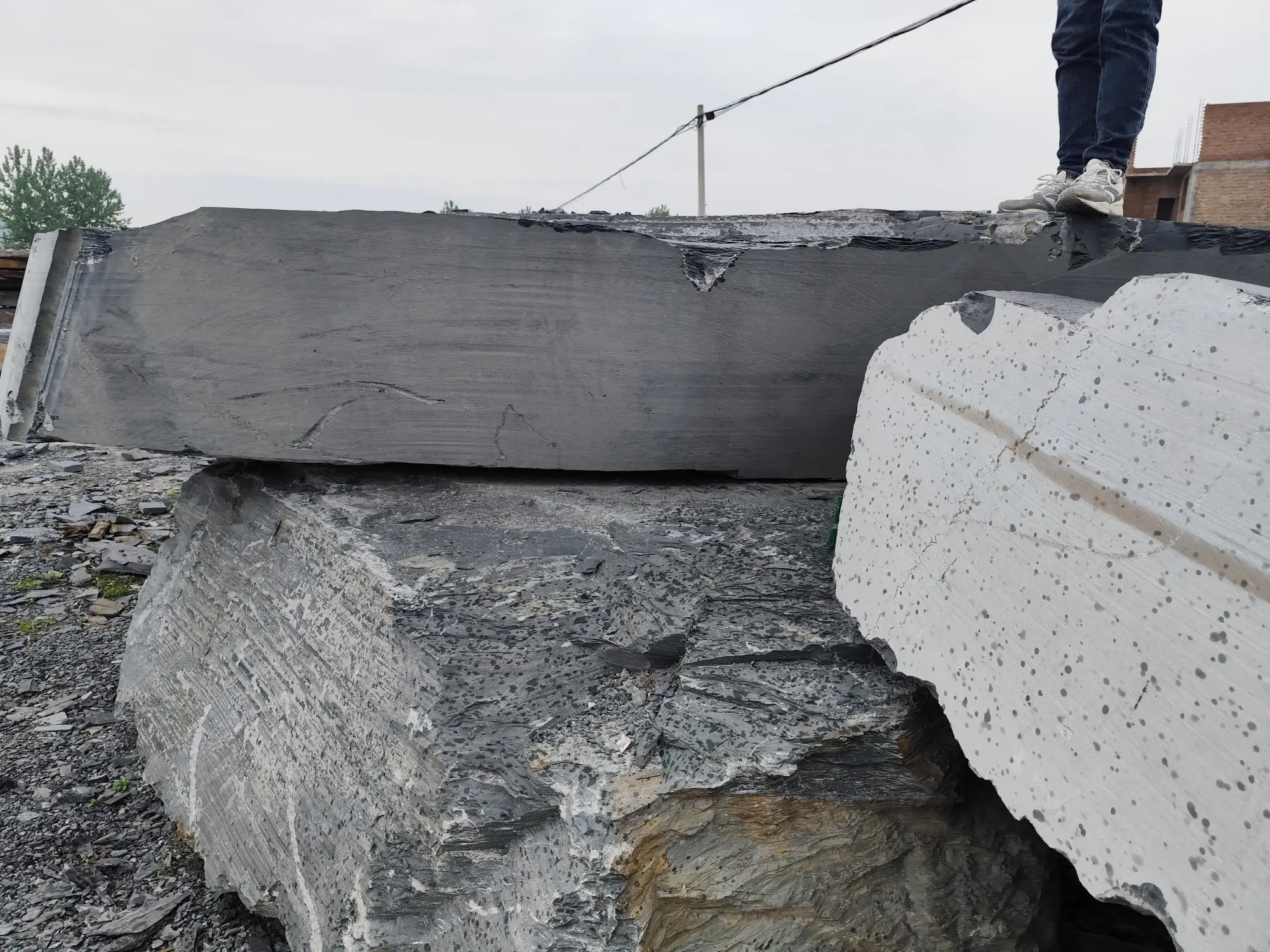
A Regional Industrial Cluster
A buyer searching for slate suppliers in Jiangxi will notice that many companies list addresses in or around Jiujiang, Lushan, or the former Xingzi area. There is a straightforward industrial explanation: once quarry resources and processing skills concentrate in one area, businesses benefit from proximity to each other.
Jiujiang's slate industry is better understood as a regional industrial cluster than as a collection of independent factories. A factory can source raw material from nearby quarries or long-term quarry partners. Processing workers can move between companies, spreading skills. Specialised equipment suppliers and maintenance services can develop locally. Export businesses become familiar with overseas customers and shipping procedures. Transport companies optimise routes between the production area and the port.
This can create a reinforcing industrial cluster: more production supports specialised suppliers, services and skills, while established suppliers and infrastructure make the area more attractive for further processing and trade. What is difficult to reproduce is not only the quarry resource. It is the local combination of skilled workers, processing equipment, quarry relationships, packaging experience and export know-how built up over time.
Two Product Lines, One Producing Region
One distinctive characteristic of the Jiangxi slate industry is that the same general producing region serves two very different international markets, through completely different processing chains.
| Raw material | Processing | Main market |
|---|---|---|
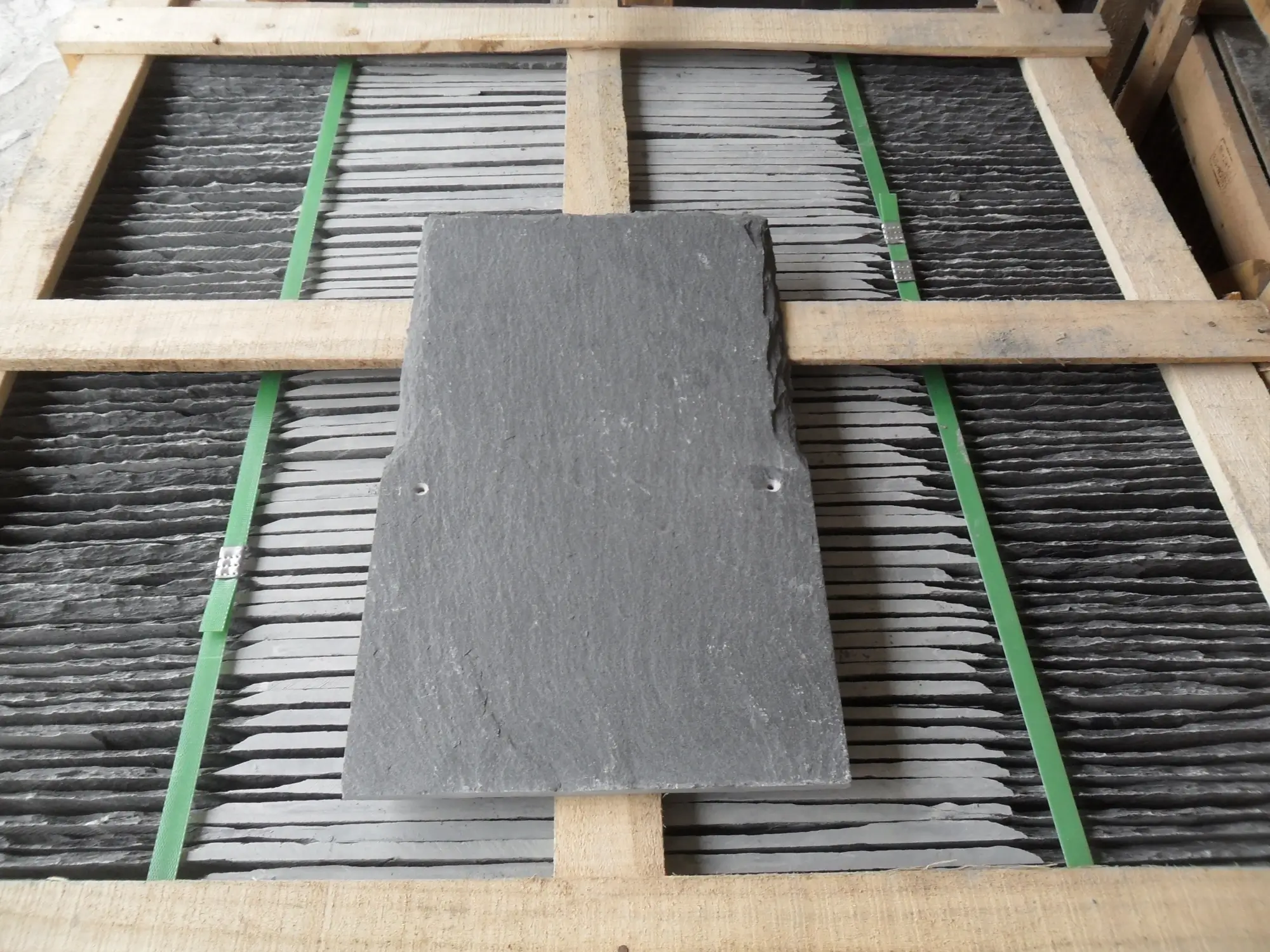
| Suitable slate blocks | Splitting, trimming, sizing | Roofing |
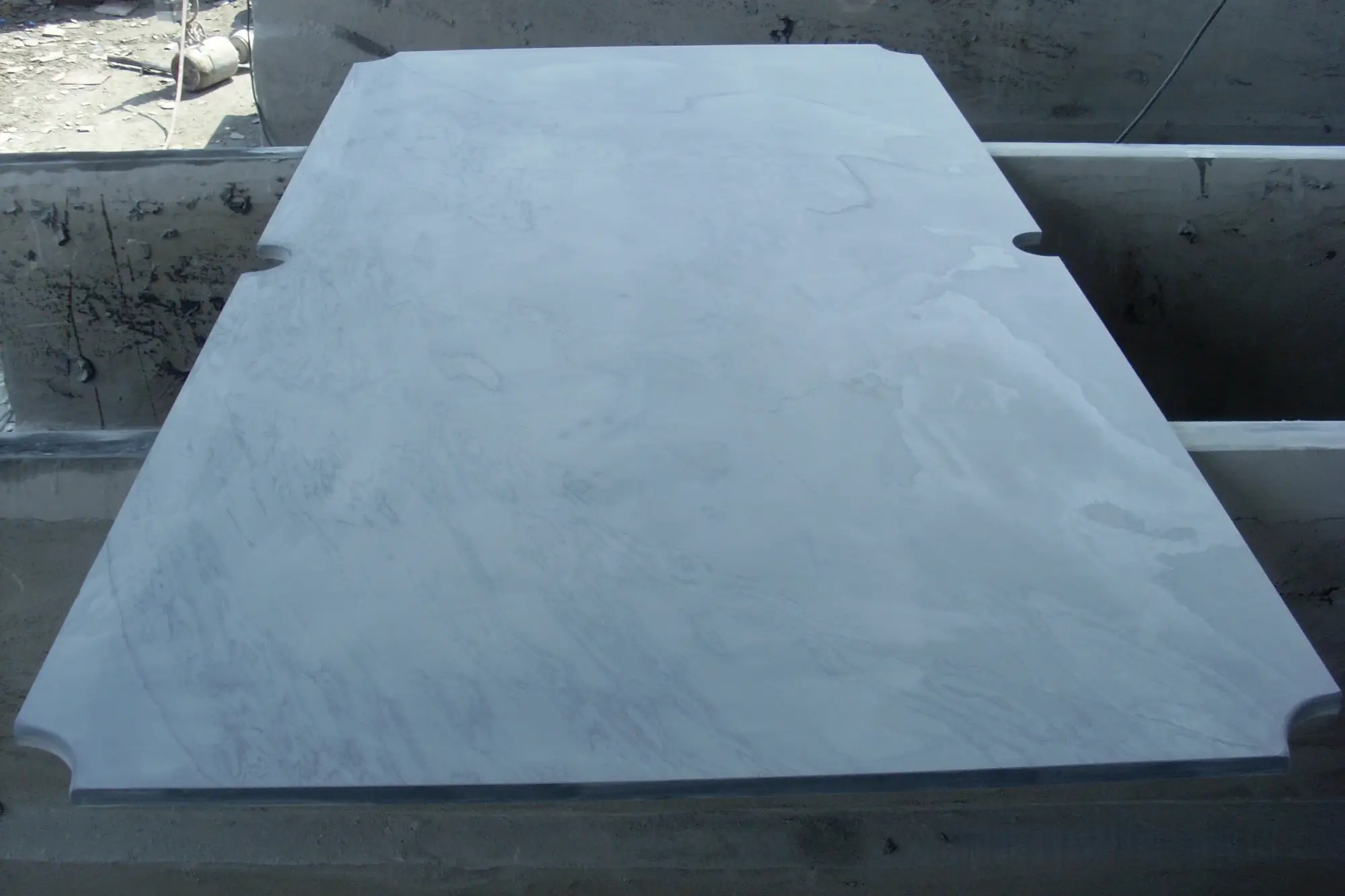
| Large, stable blocks | Cutting, grinding, CNC machining | Billiard / snooker tables |
| Other suitable material | Cutting, surface finishing | Architectural / landscaping |
The words "slate quarry" and "billiard slate manufacturer" describe different points in the same supply chain. A quarry supplies the raw material; a manufacturer turns that material into a precision component through a completely different process. For a detailed comparison of the two product lines, see What Makes Jiujiang Slate Different?
Factory, Quarry and Trading Company: Not the Same Business
A supplier's address tells only part of the story. A quarry, a processing factory, and an export trading company are not necessarily the same business. One company may operate its own quarry. Another may purchase blocks from several local quarries. A third may be primarily a processing factory. A fourth may function mainly as a trading company, coordinating between multiple factories and overseas buyers.
None of these structures automatically determines quality. What matters is traceability — the buyer's ability to connect the finished product back to its source. A well-organised trading company with strong factory partners and rigorous inspection may deliver more consistent quality than a factory that controls its own quarry but has weak quality control. For a detailed framework on evaluating these structures, see How to Source Jiujiang Slate Directly.
What This Means for an International Buyer
If you are sourcing slate from Jiangxi, the following five questions are more useful than asking whether a company calls itself a "factory" or a "quarry."
1. Where was the stone quarried? Can the supplier name the quarry or mining area, or only the province?
2. Where was it processed? Is processing done in-house or subcontracted? Can you visit the facility?
3. Is the test report linked to the actual material? Are laboratory reports available for the production batch, not generic data from an unrelated source?
4. Can the supplier maintain the same source for repeat orders? How is batch-to-batch variation controlled?
5. Who is actually responsible for export and quality control? Is inspection documented, and can a third party be present if required?
For a full procurement framework, the How to Source Roofing Slate from China guide covers each step in depth. For supplier verification, How to Verify a Jiujiang Slate Supplier provides a practical checklist.
The Bigger Picture
Jiangxi's slate industry is best understood as a regional network rather than a single quarry or factory. At its centre is the slate-producing area around Jiujiang and Lushan, with the historical Xingzi name still appearing in older records. Around the natural resource — documented at 17.102 million cubic metres of retained decorative slate, with named mining areas including Yajishan and Dongsheng Dawa — has grown an ecosystem of quarrying, processing, inspection, packaging, logistics, and export businesses.
For international buyers, understanding this geography makes it easier to evaluate suppliers, compare quotations, and trace the material behind the product. A buyer who works down through the geographic hierarchy — from China to Jiangxi to Jiujiang to Lushan to the quarry source to the finished product specification — gathers more useful information at each level. The further the chain can be traced, the more confidently the slate can be purchased.
Frequently Asked Questions
Where is Jiangxi slate produced?
The slate industry relevant to international buyers is concentrated around Jiujiang City and Lushan in Jiangxi Province. Lushan's official mineral-resource planning documents identify decorative slate as one of the area's important mineral resources, with 17.102 million cubic metres of retained resources documented by the end of 2020.
Is Lushan slate the same as Xingzi slate?
Lushan and Xingzi refer to the same broader geographic area in this context, but they are not interchangeable names for every individual quarry or deposit. Xingzi was the former county name; Lushan City was established in 2016. Older trade records, company registrations, and international websites may use "Xingzi" while newer addresses use "Lushan." Buyers should still confirm the actual quarry source.
Is Jiujiang slate the same as Jiangxi slate?
Not exactly as geographic terms. Jiangxi is the province; Jiujiang is a prefecture-level city within Jiangxi where the slate industry is concentrated. In international trade, the terms often overlap because the most important producing area sits around Jiujiang and Lushan. But "Jiangxi slate" is the wider label, and not all Jiangxi slate comes from the same quarry or geological source.
Does all Chinese slate come from Jiangxi?
No. China has slate resources and stone-processing industries in several regions. "Chinese slate" is a much broader description than "Jiangxi slate." Even within Jiangxi, the Jiujiang/Lushan area is one important producing region, but other areas such as Yushan in Shangrao also produce stone. For a technical purchasing decision, the quarry source and product specification matter more than the geographic label.
How do I find a reliable Jiangxi slate supplier?
Start by identifying the actual quarry source and processing location, not just the company address. Ask where the stone was quarried, where it was processed, whether test reports are linked to the actual material, and whether the supplier can maintain the same source for repeat orders. Request a physical sample and relevant test documents before placing a large order.
Why do some suppliers use the name "Xingzi Slate"?
Xingzi is the historical administrative name associated with the Lushan area. The county was restructured into Lushan City in 2016, but older company registrations, trade listings, and international websites may continue to use the former name. A supplier using "Xingzi slate" is likely referring to the same geographic producing area as one using "Lushan slate."
Continue Reading
Researching slate from Jiangxi? Start with the quarry source, material specification, and test documentation. Contact us if you need help tracing a Jiujiang slate source.