
How to Source Roofing Slate from China: Seven Checkpoints Before the Container Unloads
Most buyers open the conversation with the same question: "What's your price for roofing slate?" I don't hold it against them. A container of natural slate is a serious purchase, and price is the first thing anyone wants to know.
But after more than a decade of loading slate at our mill in Jiujiang and sending it to buyers in thirty-odd countries, I've noticed something. The buyers who finish happy are rarely the ones who started with price. They're the ones who started with a map. They knew which order to do things in, and by the time the container reached their port, the expensive mistakes had already been filtered out — back when they cost nothing to fix.
This article is that map. It's not about which slate to choose — that's covered in the buying guide — it's about the process of buying it from a country you've maybe never visited, from a supplier you've never met, and making sure what you ordered is what lands on your truck. I've put it in seven checkpoints, in the order they actually happen.
The short map first. Sourcing roofing slate from China works if you walk these seven steps in this order:
- Fix the specification before you contact anyone.
- Know whether you're talking to a factory or a trader.
- Judge on test reports — the right ones, read correctly.
- Get physical samples and read what they tell you.
- Put every number in the contract, in writing.
- Check the production while it's happening.
- Protect the packing; the voyage is where containers go wrong.
Skip any of these and you're not saving time — you're betting the container against a stranger's word. I've seen it work out. I've also seen it not.
Checkpoint 1 — Fix the specification before you write to anyone
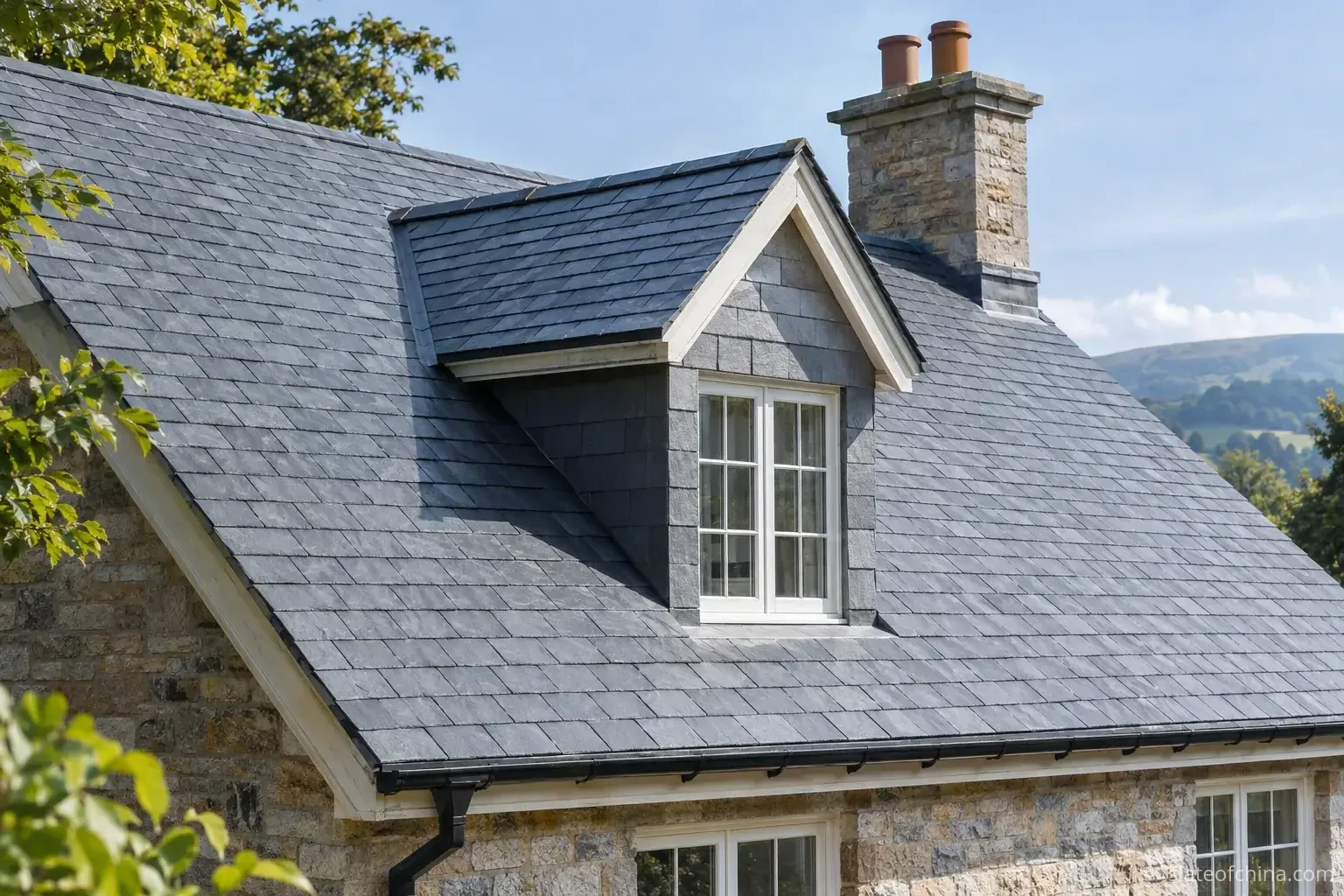
The single biggest source of disappointment in Chinese slate orders isn't bad stone. It's a vague inquiry. "We need grey roofing slate" means different things to a supplier in Jiangxi than it did in your head — grey in our quarry is not the grey your architect imagined, and if you don't say it, nobody has told us to make it right.
Before the first email, decide at least five things: the size (500×250 mm is the British workhorse; 600×300 mm reads more modern), the thickness (4.5 to 6 mm for most roofs; 7 mm and up when the client wants weight), the color family, the grade or standard you'll hold them to, and the quantity in square metres, not pieces. If you can't specify those yet, you're not ready to source — you're ready to research, which is the cheap part of the process.
Quantity deserves its own warning. Slate is quoted per square metre but packed in pieces, and a small arithmetic error at the enquiry stage becomes a very large problem at the port. Use the slates-per-square-metre guide to convert, add 5-10% for cutting and breakage, and write the final number into the enquiry. If your calculation doesn't fit a full container, say so — half-loads exist, and an honest supplier will tell you when they cost more than they save.
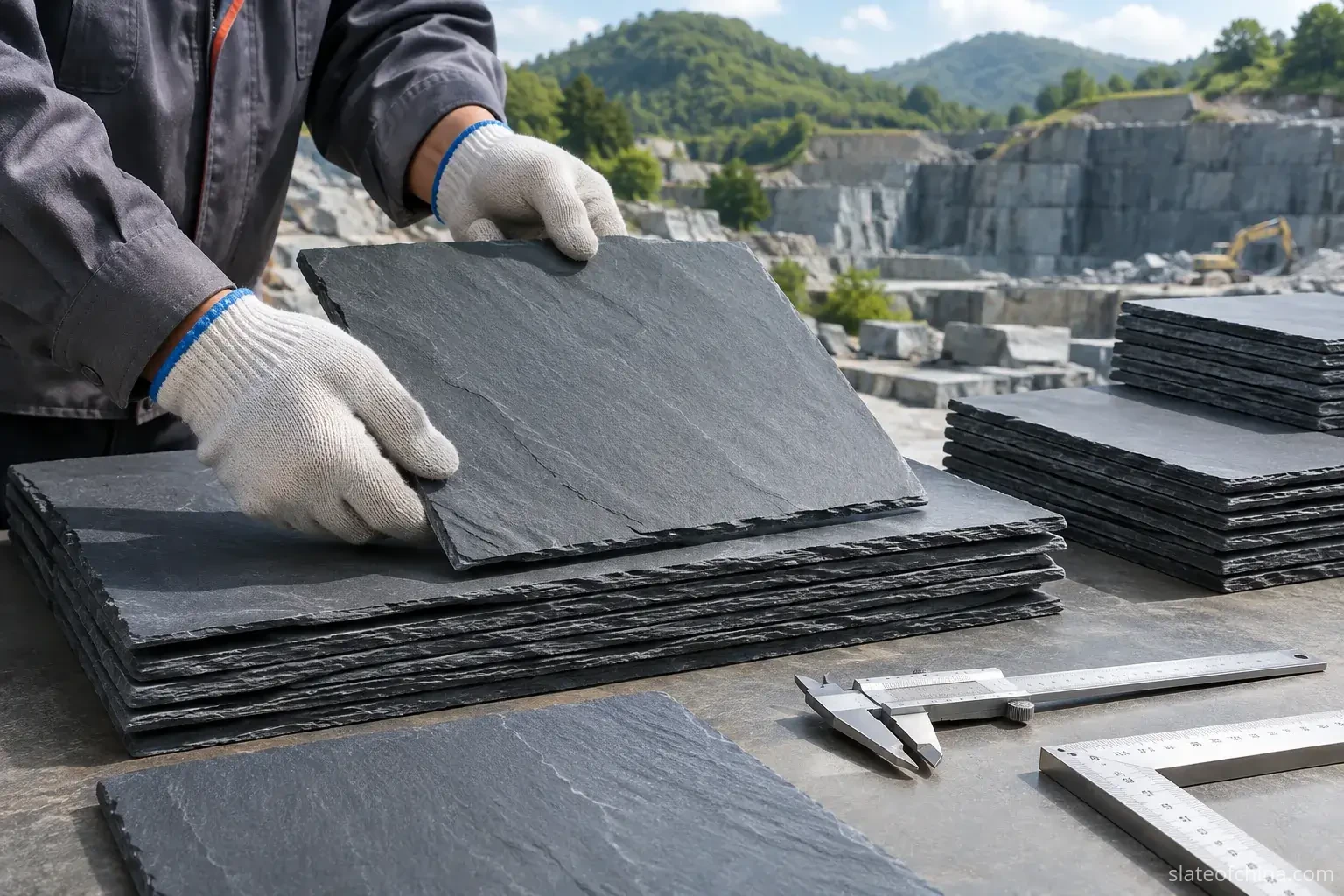
To make the specification concrete, send the supplier a structured enquiry. A copy-ready RFQ template makes it harder to skip a field and easier for the supplier to price you accurately:
RFQ template — copy this into your first email
Subject: RFQ — Natural Roofing Slate

1. Slate type / colour: (e.g. blue-grey, rustic, graded)
2. Size: L x W x T (e.g. 500 x 250 x 5 mm)
3. Edge / hole finish required: (e.g. dressed edge, two nail holes)
4. Quantity: square metres and pieces
5. Destination port and Incoterm: (e.g. FOB Shanghai / CIF Rotterdam)
6. Standard to be met: EN 12326 or ASTM C406
7. Test reports required: water absorption, flexural, freeze-thaw
8. Sample before order: yes / no
9. Packing preference: wooden crates / iron-strapped
Checkpoint 2 — Know who you're actually talking to
In China, "slate supplier" can mean three different companies. The factory that cuts and sorts the stone. The trading company that buys from several factories and sells on. And the general trading outfit that handles a hundred products, slate being just one line item in a long catalogue. All three can ship you roofing slate. Only one of them you'd bet a roof on without checking.
Here's how to tell them apart from a distance:
- Ask for the business license (营业执照). A genuine manufacturer has a 经营范围 (business scope) that includes stone or slate production. You can ask them to read the company name, or cross-check it online against the national enterprise registry.
- Ask where the quarry is. A factory can usually name its quarry, the region, even the layer. A trader often knows the province and stops there.
- Ask for a video of the workshop — today. Not a brochure video. A ten-second clip shot on their own phone, showing their own production line. A genuine factory can produce that in an afternoon. A paper company can't.
- Watch the range. If the same person offers roofing slate, terrazzo tiles, kitchen countertops and garden benches at the same email address, you're talking to a trader. That's not a crime — but it changes what you're buying and what you should verify.
I'll say the honest thing about traders here, because too many articles pretend they don't exist. For small orders — a few thousand square metres or less — a good trading company can be exactly right. They aggregate, they handle the paperwork, they speak your language better, and they know which factory in their network suits your job. The mistake isn't buying from a trader; it's buying from a trader while believing you're buying from a factory, and skipping the verification that applies to whichever one you're dealing with.
Checkpoint 3 — Require test data you can actually read
Every Chinese slate supplier will tell you their product is good. The word that separates professional exporters from the rest is not "quality" — it's "traceability."
When you ask for test reports, you want two things kept separate:
- Type-test reports, read for the right facts. A type test describes the material itself. Ask for a report that clearly identifies the tested slate material, the applicable standard, the testing laboratory, and the report date. EN 12326 is the standard for Europe; ASTM C406 for North America — and they are two separate systems with different scope and test items, not interchangeable. The details of each standard live in the EN 12326 and ASTM C406 guides. The items that matter for your climate — water absorption, flexural strength, freeze–thaw behaviour — are usually the ones to ask for, but which ones are measured and how depends on the standard you specify. Our own figures live on the test results page.
- Order batch traceability. For a production order, ask the supplier to provide batch identification and traceability records that link the material you receive to the specification you approved. A type report proves the material class; the batch record proves this order. Anyone can circulate a PDF of someone else's test — so keep the two linked, and ask to see where the report names the supplier.
You'll find a full walk-through of how to read one of these documents in the test report guide. In the sourcing stage, what matters is the discipline: you ask for the report before you commit to the price, not after you've paid. That single habit saves more containers than any negotiation tactic.
Checkpoint 4 — Samples: the interview that answers you
A slate sample is not just a chip of stone. It's a mini-interview with the supplier — and it talks more honestly than the sales chat.
When you order samples, do this:
- Order the actual size you plan to buy. Not a "sample tile" the salesperson picked. Your size, your thickness, your edge profile.
- Ask for two or three pieces of the same spec. A single piece hides the colour variation between them, and the variation is half of the real product. Hold two together in daylight: if you'd hesitate, imagine your roof.
- Check the details, not just the beauty. Look at the cut edge, the drilled holes, the squareness of corners. Use the quality evaluation guide as your checklist, and keep the defects guide next to it for the flaws people miss.
- Time them. How long from enquiry to sample arrival? How did they pack the three pieces? Was there a packing note, a photo of the batch, a message with tracking? That response quality is a preview of the response you'll get when something is wrong with the container — and something is sometimes wrong.
And keep the samples. Keep them in a box marked "sealed sample", with the date and the supplier's name. When the full shipment arrives months later, the sealed sample is the reference you hold against the phrase "the colour must have shifted in production." A competent factory will match the sealed sample; the whole point of taking it is that both sides now know what the other side agreed to.
Checkpoint 5 — Put every number in the contract
Chinese slate contracts are rarely full of surprises when the details are written down. The surprises come from what was never written down. In English, "we agree on this, you'll be fine" sounds reassuring. In Chinese business culture, the written word — the contract — is the only thing that travels. So write these numbers into yours:
- The unit of measurement. Slate gets quoted per square metre, per piece, or per tonne depending on who's quoting. A trader quoting per tonne and a factory quoting per m² cannot be compared in your head. Force everyone into one unit, and state the packing count per crate.
- The tolerances, and what they apply to. A CNC-cut straight edge holds about ±0.1 mm in the machining pass; hand-dressed edges carry a wider tolerance. State which faces the tolerance applies to — machined edge or thickness — and how it's verified, rather than quoting one number for everything.
- The incoterm and what's inside it. FOB Shanghai? CIF Rotterdam? Use the Incoterms 2020 wording, and write down exactly what each price includes — factory to port, trucking, port charges, document fees, internal handling, and who carries the insurance and when the risk transfers. "FOB" alone has ended more friendships than any other word in stone trading.
- Breakage limits — agreed, not assumed. Agree on the acceptable damage limits, the inspection procedure and the claim responsibilities before shipment. Proper export packing is expected to minimize breakage, and any damaged slates should be documented on arrival. Don't accept a fixed damage percentage as routine.
- The schedule and the payment. A common structure for a first order is 30% deposit and 70% before shipping (or at sight of the loaded container), with the balance after production but before the container leaves. Be careful with any supplier who insists on 100% in advance on the first order — that's not a Chinese tradition; it's a premium on trust you shouldn't have to pay.
- The penalty for being late. A delivery date that nobody commits to is not a date. Write the week; write who pays the extra port fees if it slips.
If all this feels heavy, that's because it's supposed to be. A container of slate is ten to twenty tons of stone. The 15 minutes you spend writing "what if" into a contract is the cheapest insurance in the industry.
Checkpoint 6 — Don't wait for the container to find out what you bought
Production takes weeks. The good news: production happens in front of cameras and in front of checklists, and you should use both.
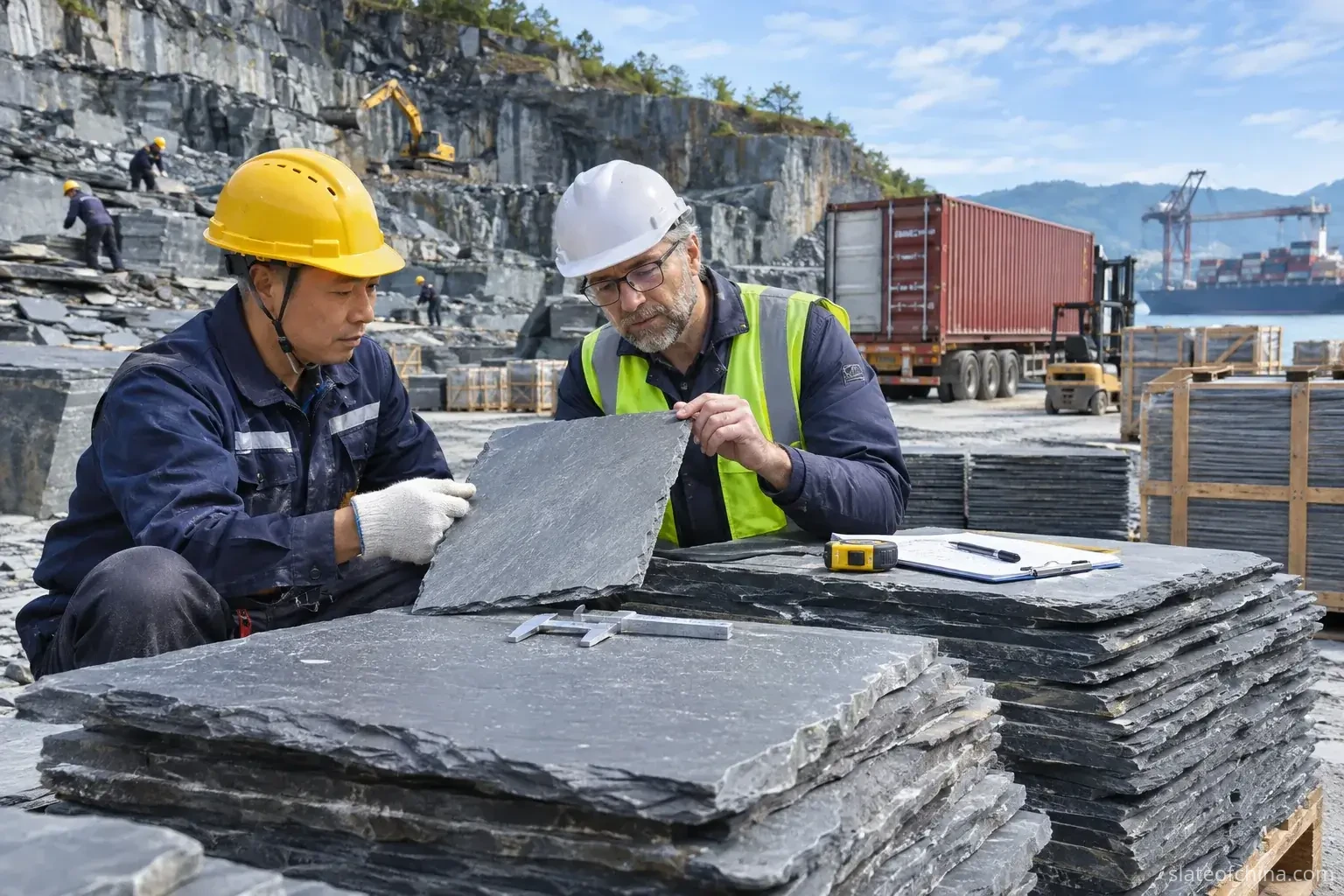
On a serious order, agree with the supplier at the start that you want periodic evidence — photographs at each stage (cutting, sorting, packing), or a short video when they ask you to confirm a decision. The most important habit of all: set the inspection point before the container is sealed. You have options:
- Video inspection. With the batch number visible, sample tiles to the camera, corners and edges included. Cheap and surprisingly thorough for the checking they allow.
- Third-party inspection. SGS, CCIC, Bureau Veritas — they'll do a pre-shipment inspection against your specification and report with photos. This is the standard way to buy from a distance, and it costs less than the anxiety it removes.
- Go yourself. If the order is big enough (a few full containers), the flight is cheaper than the anxiety it removes. Reading the factory quality control guide before you go turns a tour into an inspection.
We run 100% tile-by-tile inspection on our own slate before it's packed — every piece, not a spot check. Not every factory does that, and you don't need every factory to. You need a way to see what you're getting, and an agreement about what happens if the batch differs from the sealed sample. Written. Before shipping.
Checkpoint 7 — Protect the packing; the ship is where it goes wrong
A slate roof fails in three ways: bad stone, bad installation, and bad arrival. The first two you've already covered in checkpoints 3 and 6. The third is packing — and it's the checkpoint that buyers most often forget, because it's the last thing you think about.
Ask the supplier to describe the packing in the contract, the way they described the price: the type of crate (wooden, iron-strapped), the interleaving between tiles (foam or cardboard), the corner protection, the moisture protection, and the loading plan into the container. Roofing slate is heavy and brittle; it will arrive fine if it's packed dry and square, and it will arrive chipped if it's packed to fit the weight of the container.
On moisture, keep two things separate. The slate's water absorption is a material property (ours runs around 0.2% in the lab — a measured performance figure, not a packing claim). The moisture control at packing is about keeping the pallets and crates dry so the slate doesn't sweat in transit. Ask the supplier which they mean, and ask for their packing standard. And when the container lands, do the arrival check before it leaves the port, not a week after. The inspection checklist walks you through the sequence; the short version is: check the exterior condition against the packing list, open and check the batch numbers, photograph anything that looks off, and make the damage claim within the agreed window — insurance doesn't wait for the roof to be installed.
And if this is your first order: whatever you're thinking of skipping, skip the packing. You can argue with a factory about colour, you can argue with them about thickness, but you can't argue with a cracked tile — and if a cracked tile got there, it's not the tile's fault, it's the packing's.
Quick answers for slate buyers
How do I find reliable roofing slate suppliers in China?
Start with the specification, not the supplier list: size, thickness, colour, grade, quantity. Then shortlist candidates, verify who is a factory and who is a trader (business license, quarry location, a same-day video of the workshop), ask for a dated test report against EN 12326 or ASTM C406, and order physical samples. The reliable ones survive that chain; the others filter themselves out.
Is it better to buy from a Chinese slate factory or a trading company?
For full containers and repeat supply, a direct factory relationship usually wins on price and consistency. For smaller orders, a trading company can be more flexible and easier to work with. The risk is not which type you choose, it's choosing without knowing: verify which one you're actually dealing with, and apply the same verification process (samples, test reports, batch checks) either way.
How do I verify a Chinese roofing slate factory is real?
Ask for the business license and check the registered company name, ask where the quarry is and which layer they work, and request a video shot the same day showing their own workshop and stone. Cross-check the company name against the public registry, and — for the surest answer — have the factory video-call you from the workshop or pay a third-party inspection visit.
What test reports should I require when buying roofing slate from China?
At minimum: the standard that applies to your market (EN 12326 or ASTM C406), the tested items that matter for your climate — water absorption, flexural strength, freeze-thaw — with a dated report that names the tested slate material, the testing laboratory and the supplier. For a production order, also ask for batch traceability linking the shipped material to the approved specification. Our own figures live on the test results page.
How much deposit should I pay on a first order?
A normal structure is 30% deposit with the order and 70% before the container leaves the factory, after your production inspection — or at export documentation if the payment term allows. On a first order, treat a demand for 100% payment in advance as a red flag: it shifts the whole delivery onto your trust, and you have a contract for the opposite.
Can I buy roofing slate from China without visiting the factory?
Yes — most buyers never visit. The work is to replace the visit with evidence: physical samples you keep as a sealed reference, batch-linked test reports, periodic production videos, a pre-shipment inspection by a third party, and a packing plan written into the contract. Distance doesn't have to mean blind if the checklist is done in order.
Source Natural Roofing Slate Directly from Jiujiang, China
We're a Jiujiang slate mill exporting roofing slate to thirty-nine countries, with EN and ASTM test data on paper, CNC-cut edges, 100% tile-by-tile inspection and controlled packing. Send us your size, thickness, colour and quantity, and we'll send back the spec sheet, real samples, the test report, the packing plan and a clear FOB or CIF quote — so you can compare us against the rest.