
Why Roofing Buyers Choose Jiujiang Slate
Jiujiang slate interests roofing buyers because it combines natural colour diversity (black, dark grey, silver grey, green and rusty tones), workable cleavage for thin roofing production, documented EN 12326 test performance (water absorption below 0.2%, freeze-thaw retention above 90%), export-scale supply capacity to 30+ countries, and container economics that work when you calculate landed cost rather than FOB price. No single factor makes it "the right choice." Together, they put it on the shortlist — and the rest depends on the specific quarry, the specific factory, and the specific test report.
A roofing buyer's decision about slate origin is not about finding "the best slate in the world." I've imported natural slate for over fifteen years, and I can tell you that no serious buyer makes their decision that way.
The decision is about whether a particular stone can be supplied in the colour your architect specified, split to a thickness your roofers can handle, survive the climate where the building stands, and arrive in consistent quality from one container to the next — at a landed cost that makes sense on the spreadsheet.
That's a longer list than "best slate." But it's the list that actually matters when you're writing the purchase order.
This is what I look at when I evaluate Jiujiang slate as a sourcing option — not as a seller, but as someone who has bought, imported and distributed natural roofing slate across multiple markets.
Panel 01 — Colour: More Than "Grey Slate"
Roofing projects rarely need a single generic "Chinese slate." Different quarries and geological layers produce different natural colours, and Jiujiang-area slate covers a range that includes black, dark grey, silver grey, rusty tones and various green shades.
Black and charcoal slate are the most widely specified colours for contemporary and traditional roofs. They work well when the architect wants a restrained appearance and are relatively easy to combine with other exterior materials. Grey and silver grey provide a softer look while keeping the natural cleft texture. Green and mixed-colour deposits are useful for restoration work or projects where the buyer wants a less uniform appearance.
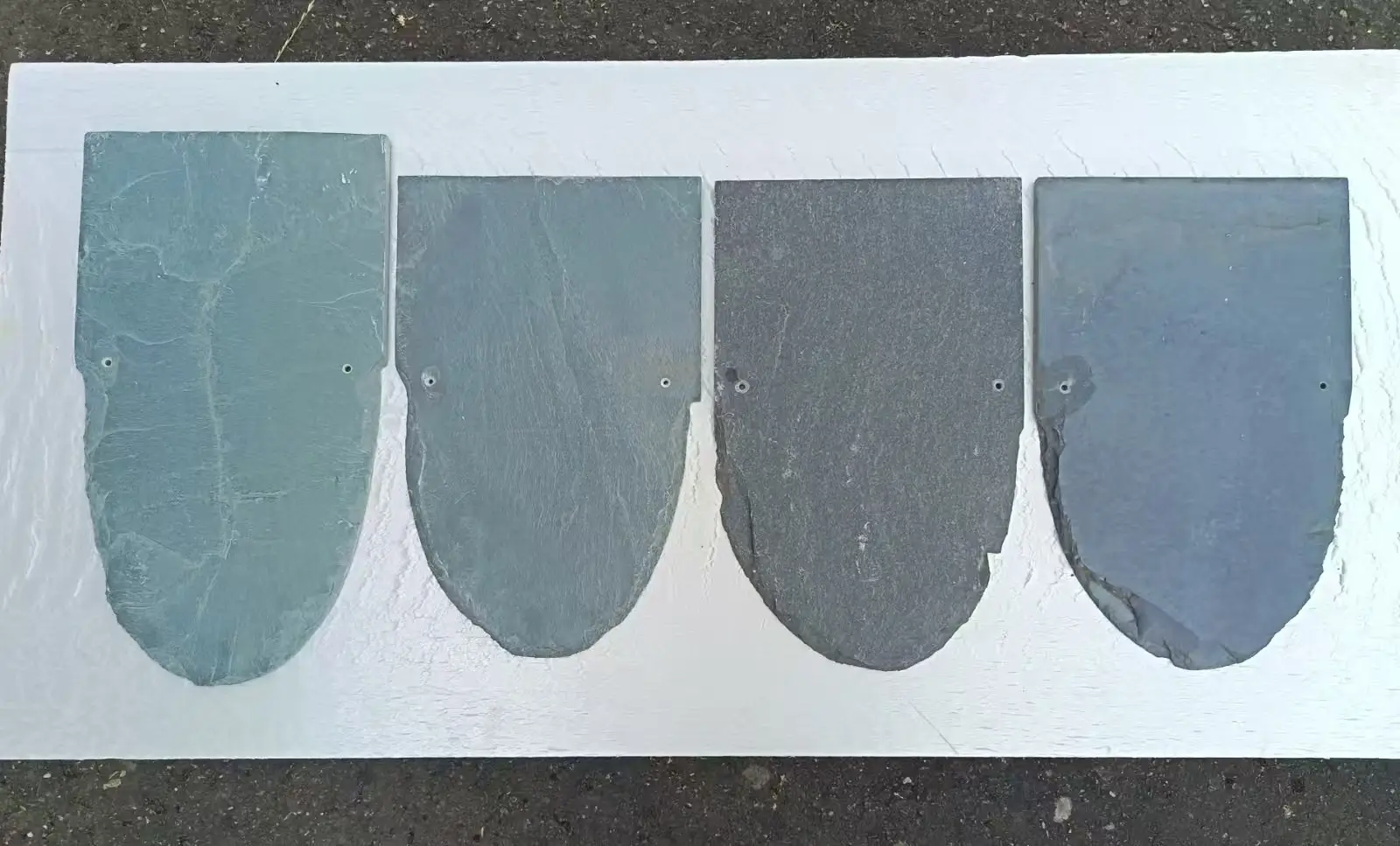
But here is what I've learned from specifying slate on actual projects: colour should always be judged from production samples, never from a supplier's colour chart alone. Natural stone is not manufactured paint. Colour varies between quarry layers, blocks and production batches.
A serious buyer should specify:
- acceptable colour range
- acceptable variation between pieces
- surface texture
- presence or absence of rust marks
- sample approval procedure
- whether mixed colours are permitted
At our factory, we grade roofing slate into A, B and C colour batches before packing. The batch letter appears on the quotation, the packing list and the crate label — three places, same letter, so the buyer can trace what arrived back to what was approved. That turns "colour" from a subjective discussion into a purchasing specification.
Panel 02 — Splitting: The Characteristic Buyers Don't See in a Lab Report
One of the most important properties of roofing slate is something a buyer never sees in a laboratory report: how the stone actually splits.
Natural slate has a strong cleavage structure. When the geology is suitable — and the Lushan area is associated with fine-grained slate and good natural cleavage — experienced workers can split quarry blocks into thin roofing pieces with useful thickness consistency.
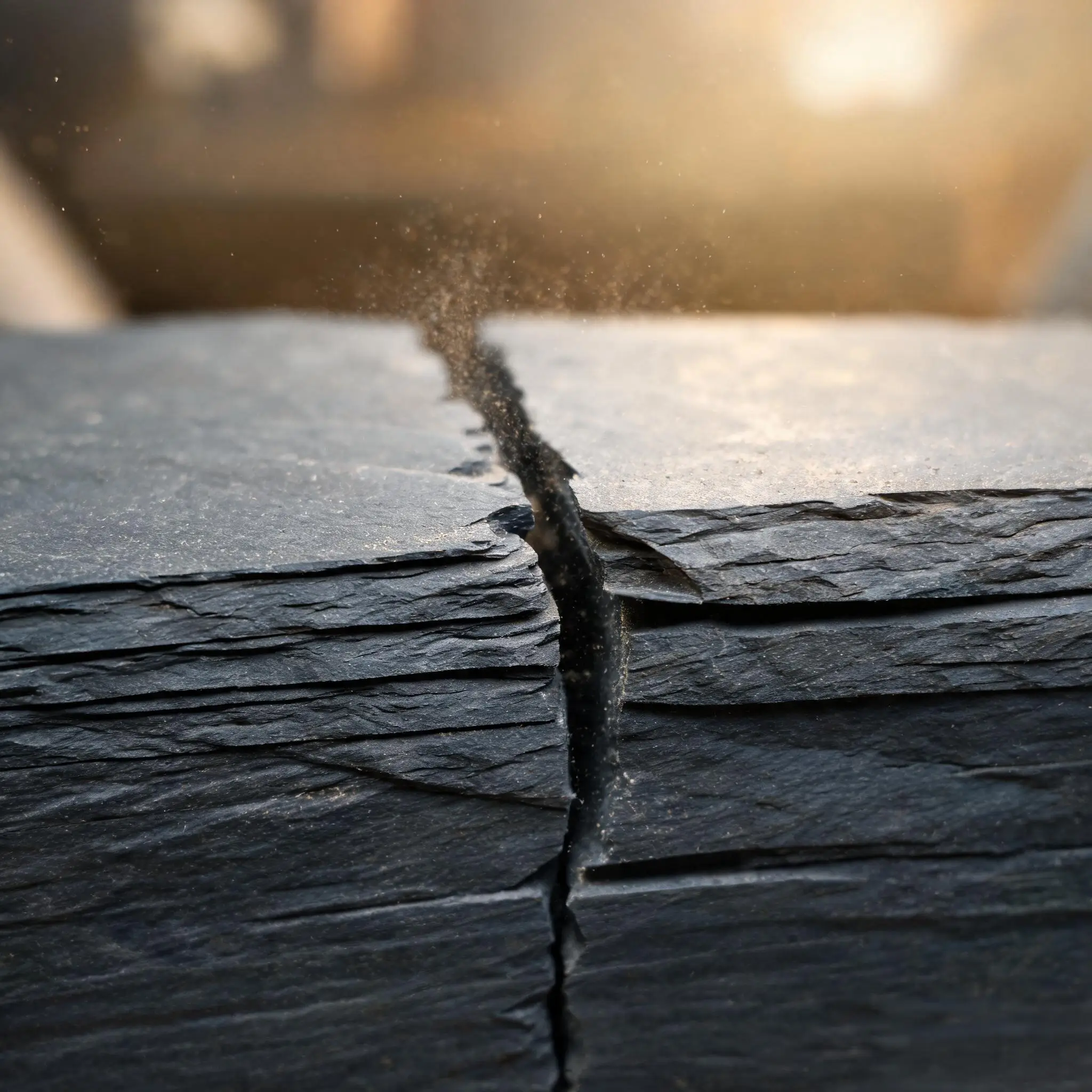
Good splitting affects everything downstream: usable yield from the quarry block (a block that splits cleanly gives you more sellable slate per tonne of raw stone), thickness consistency (which affects installation speed and waste), dressing and sizing, breakage during production and packing, installation efficiency on site, waste percentage, and final price per usable square metre.
This is why two stones that both carry the name "slate" can behave very differently when split. I've seen cheap slate that looked perfect in a showroom but splintered unpredictably on the roof — costing the contractor more in waste and labour than the price saving ever covered.
A buyer should ask to see more than one finished sample. Useful evaluation means several pieces from the same production batch, thickness measurements across different areas of each piece, visual inspection of the cleft surface, edge condition after splitting, and breakage rate during packing and handling. For larger projects, production samples are far more informative than a single showroom piece.
Panel 03 — Testing: Numbers That Outlast Marketing Claims
A natural roofing slate is an exterior building material. It will face rain, snow, repeated freezing and thawing, strong sunlight, wind and temperature changes. For this reason, roofing buyers should not choose slate by appearance or price alone.
Testing gives you a more objective basis.
Our Jiujiang/Lushan roofing slate has been tested under EN 12326-related requirements. I'll give you the actual numbers — not rounded marketing figures, but what three independent labs have reported:
- Water absorption: 0.1% (a Norwegian client's comparison report), 0.13% (a US laboratory), 0.2% (some domestic test reports). Three labs, three standards, same answer: well below the EN A1 limit of 0.6%. The variation between 0.1% and 0.2% is normal — it reflects batch differences and the fact that EN (48-hour soaking) and ASTM (boiling water) methods produce slightly different numbers.
- Flexural strength: 60 MPa dry, 45 MPa wet. The wet-to-dry retention rate of 75% matters more than the absolute dry number — it tells you how much strength the slate keeps after water has entered its structure.
- Freeze-thaw: 92.7% strength retention after cycling (156 MPa down to 144.7 MPa). No visible damage.

For a buyer in Scandinavia, Northern Europe, Canada or any frost-exposed market, these numbers can matter more than a small difference in purchase price. Low water absorption means less water enters the stone, which means less ice expansion inside the structure when winter comes. You can read more about why this matters in our detailed articles on water absorption, flexural strength and freeze-thaw resistance.
But the actual test report should always be examined — not just the supplier's summary. Ask for the laboratory name, test date, sample identification, quarry or material origin, test standard used, individual test results (not just pass/fail), classification, and the original report where appropriate.
A supplier who can provide traceable documentation gives you a much better basis for evaluation. We keep every test report on file with a batch number, so the report describes a specific stone from a specific day — not an eternal property of the entire region. If you want to know exactly what to request, our buyer's guide to slate testing documentation walks through it step by step.
Panel 04 — Production Capacity: More Than a Sample
A roofing project can require hundreds or thousands of square metres. This changes the purchasing question fundamentally.
The buyer is no longer asking "Does this piece look good?" The more important question is "Can the supplier produce the same specification repeatedly?"
Jiujiang has developed a complete slate-processing industry — quarrying, splitting, sizing, finishing, packing and export. The region's slate industry also serves the billiard-table trade, which has created substantial local expertise in selecting and processing high-precision stone. The CNC tolerance standards that billiard slate demands — flatness within ±0.1mm — and the 100% piece-by-piece inspection that both product lines share, carry over into roofing production. When a factory routinely machines slate to precision measured in hundredths of a millimetre, its approach to roofing slate thickness tends to be disciplined in ways that a roofing-only operation may not achieve.
For roofing buyers, an established supply chain helps with repeat orders (same colour, same thickness, same grade), larger quantities (a single project can need multiple containers), multiple standard sizes, colour matching across shipments, production scheduling, replacement quantities, container loading and export documentation.
We've exported to over 30 countries, which means the documentation, packing standards and loading procedures are not experiments — they're routines. You can see the full inspection process in our 100% inspection guide.
But the key point is supplier selection. Not every quarry or factory in a large producing region will offer the same material or quality control. A producing region gives you options; it doesn't guarantee quality. That's why I always tell buyers: the region gets you to the shortlist; the specific factory gets you the order.
Panel 05 — Container Economics: Landed Cost, Not FOB Price
Natural roofing slate is heavy. For international buyers, the purchase price of the stone is only one part of the landed cost. The real calculation looks like this:
Landed Cost = Slate Price + Packing + Inland Transport + Ocean Freight + Insurance + Import Costs + Local Delivery
This is why container-scale purchasing matters. A supplier may quote an attractive price per square metre, but the buyer should also calculate square metres per container, number of pieces, average weight per square metre, packing method, breakage allowance, container loading efficiency, freight cost and destination-port charges.
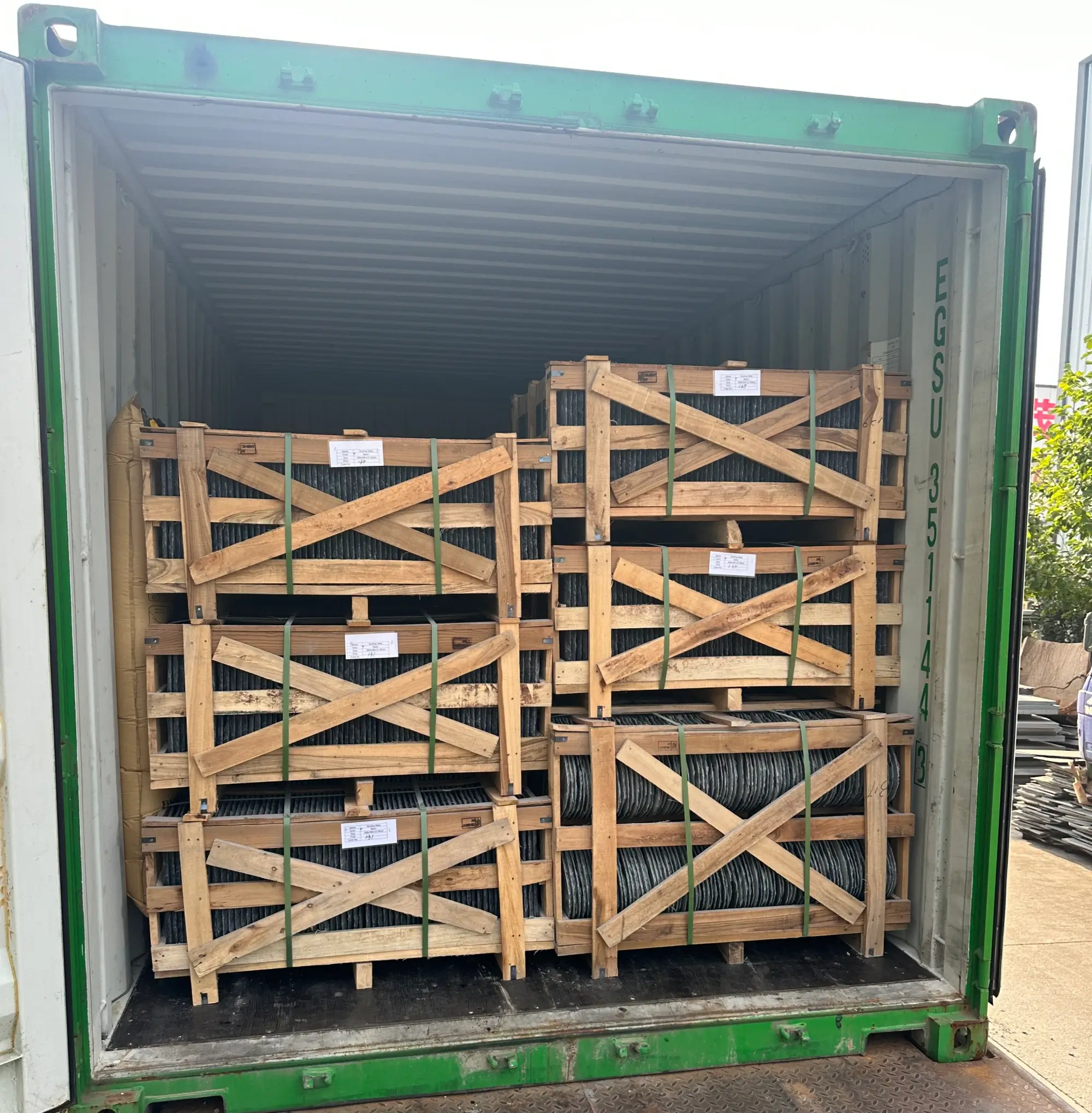
Here is what the numbers look like for Jiujiang roofing slate in a standard 20-foot container: approximately 1,130 to 1,450 square metres of 7-9mm slate. The density formula is straightforward — slate weighs about 2.7 tonnes per cubic metre, and each millimetre of thickness adds 2.7 kg per square metre. At 7-9mm, that is 19-24 kg per square metre, and a 20-foot container's working load of about 27.5 tonnes is the ceiling. Weight, not volume, is the constraint.
Packing matters too. We ship roofing slate in wooden crates, not on pallets. Crates protect the slate better during ocean transport — breakage rates of 1-3% are normal for crate-packed containers, compared to 3-5% for pallet shipments. That difference shows up directly in your usable material count.
Compare usable material, not just FOB price. Suppose Supplier A offers a lower price per square metre but has a higher percentage of rejected or broken pieces. Supplier B offers a somewhat higher price but supplies more consistent thickness and fewer unusable pieces. The correct comparison is not "Supplier A is cheaper." It is: what is the cost of acceptable, installable roofing slate delivered to the project?
A very cheap slate may not remain cheap after breakage, sorting and installation are taken into account. If you want to see how to compare quotations systematically, our roofing slate quotation comparison guide breaks it down line by line.
Panel 06 — Batch Consistency: Repeat Supply Without Surprises
Roofing projects rarely end with the first container. A distributor may need the same product again six months later. A contractor may need additional material during installation. A building owner may need replacement pieces years later.
Supply continuity matters.
For repeat buyers, I recommend keeping a record of the quarry source, slate colour (and colour grade — A, B or C), thickness, dimensions, production grade, approved sample (sealed, signed and dated), test documentation (with batch number), packing method, and container loading records.
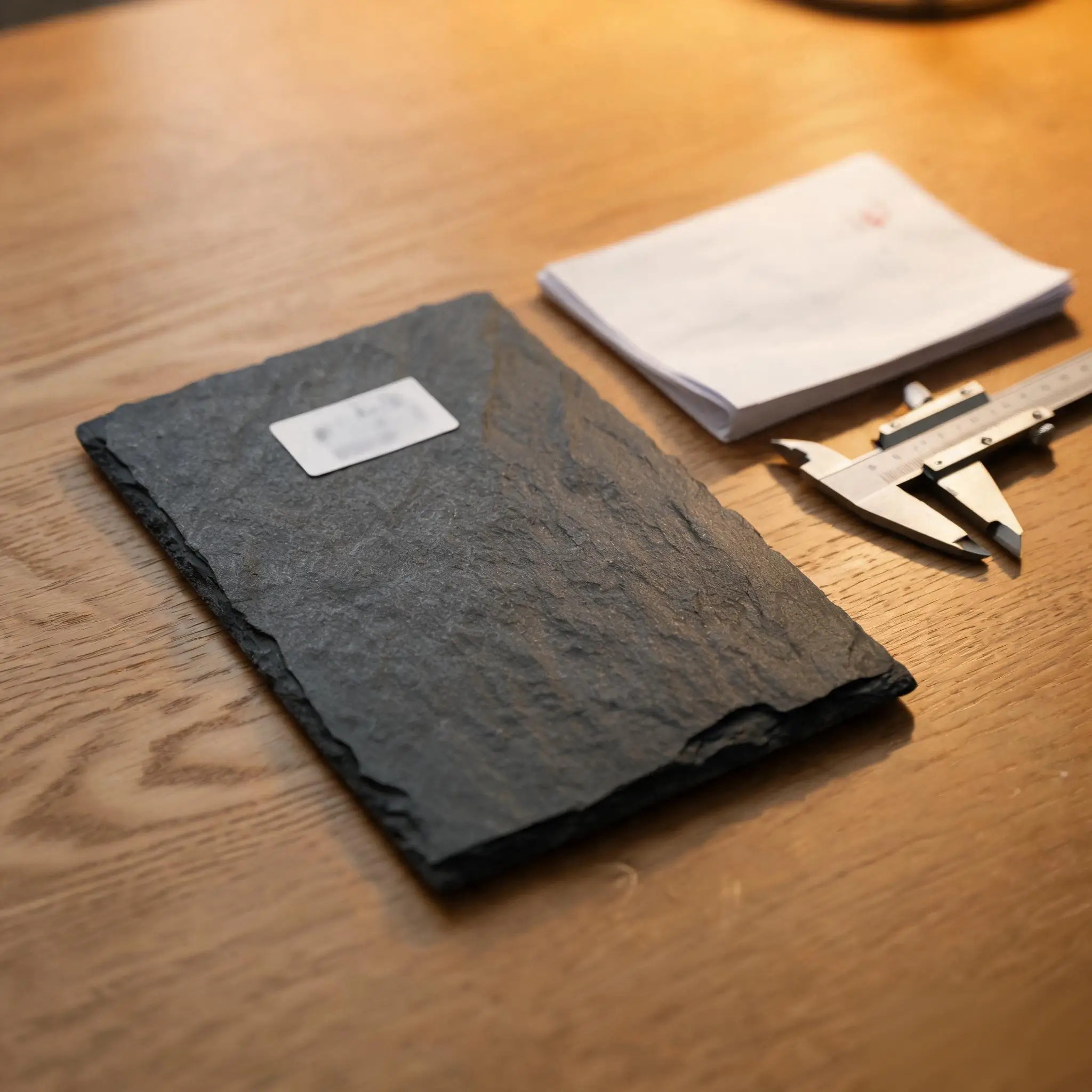
This creates a reference specification for future orders. Instead of asking for "the same black slate as last time" — which any supplier can interpret differently — the buyer refers to an approved specification and sample. That is much safer.
The batch number is the key. At our factory, the batch number encodes the quarry face, the production date and the inspector. It appears on the quotation, the packing list and the crate label. If a buyer needs to reorder, we pull the batch record and produce against the same reference. If the geological layer has shifted slightly between productions, the sealed sample and the batch record tell us exactly what to match.
If you are setting up a sample approval process for the first time, our sample approval guide walks through the six steps from requesting samples to sealing the reference.
Panel 07 — Natural Variation: Manage It, Don't Hide It
One of the misunderstandings about natural slate is the expectation that every piece should look identical. That is not how natural stone works.
Some variation in colour, texture, cleavage and thickness is normal. The objective of quality control is not to eliminate all natural variation — it is to keep the variation within an agreed and usable range.
For example, a buyer might approve: "Dark grey to charcoal grey, natural cleft surface, occasional minor colour variation permitted, no excessive oxidation or structural defects."
That specification is much more useful than simply writing "grey slate." It gives the supplier a clear standard to produce against, and it gives the buyer a clear standard to inspect against on arrival.
The same principle applies to green, rusty and mixed-colour products. A good supplier should be able to explain what variation is natural for the particular quarry and what variation would be considered a defect.
If a supplier tells you their slate has "no variation at all," that is not a quality claim — it is either a misrepresentation or a sign they do not understand natural stone.
Panel 08 — Not the Only Choice: The Right Question
Choosing Jiujiang slate does not mean ignoring other origins. Spanish, Welsh, Indian and other Chinese slate-producing regions can all offer different combinations of colour, geology, thickness, appearance, price and supply.
The right question is not "Which country produces the best slate?" It is: "Which slate meets the technical, visual and commercial requirements of this project?"
For one project, heritage appearance may dominate. For another, the buyer may prioritise a particular black or green colour. For another, EN 12326 test performance and long-term supply may be the most important considerations. For a distributor, container economics and repeat availability may be decisive.
Jiujiang becomes particularly interesting when the buyer wants to combine natural colour choice, workable roofing slate, documented performance and production economics in one sourcing decision. But the final call should always be based on the specific slate being offered — not simply on the name "Jiujiang."
If you want to see how Jiujiang compares origin by origin, we have written detailed comparisons with Spanish, Welsh and Indian slate. The conclusion in all of them is the same: compare the slate, not the flag.
Panel 09 — What to Check Before Ordering
Before placing a container order, I recommend checking at least these points:
| Category | What to check |
|---|---|
| Material | Quarry origin, naturally cleft, available colours, expected variation |
| Dimensions | Length × width, thickness range, dimensional tolerance, standard or custom sizes |
| Performance | Water absorption, flexural strength (dry and wet), freeze-thaw results, test standard used |
| Production | Splitting method, thickness control, defect removal, batch inspection process |
| Export | Square metres per container, gross and net weight, packing method, breakage protection, loading photos, shipping port, estimated lead time |
| Commercial | Price per square metre, MOQ, sample cost, production lead time, payment terms, repeat-order conditions |
These questions turn a general quotation into a meaningful supplier comparison. If you are new to sourcing roofing slate from China, our step-by-step sourcing guide covers the full process from first email to container loading.
Before the First Container
The safest approach is simple: sample first, test where necessary, approve the specification, then order the container.
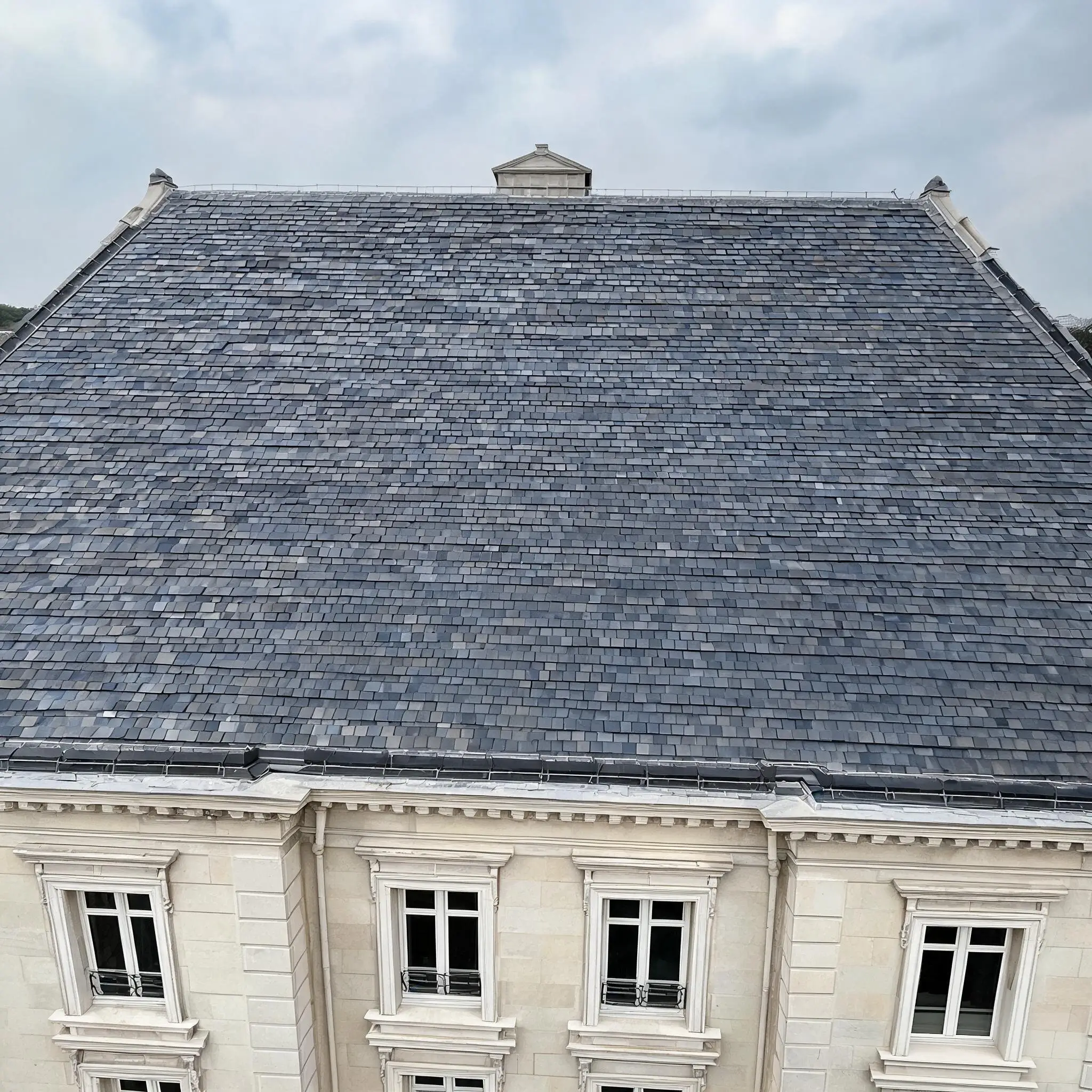
For a serious roofing project, keep an approved physical sample together with the agreed specification and test documentation. The first container should be produced against that reference.
This creates a clear link: quarry → production batch → approved sample → container → project.
That traceability becomes increasingly important when the buyer expects repeat orders. Six months from now, you won't remember exactly what "the good batch" looked like — but the sealed sample and the batch number will. And if you want to know what makes Jiujiang slate measurably different from other options, our detailed comparison of four testable differences is a good place to start.
Frequently Asked Questions
Why do roofing buyers choose Jiujiang slate over other Chinese slate regions?
Jiujiang combines natural colour diversity, workable cleavage for thin roofing production, documented EN 12326 test performance, and export-scale supply capacity to over 30 countries. The region's dual production of roofing and billiard slate has built precision-processing expertise that carries over into roofing quality control. But not all slate from the Jiujiang region is the same — the specific quarry, factory and test report determine quality, not the regional name alone.
How consistent is the colour of Jiujiang roofing slate from one container to the next?
Colour consistency depends on the factory's grading system. We grade roofing slate into A, B and C colour batches, with the batch letter appearing on the quotation, packing list and crate label. For repeat orders, a sealed sample and batch number allow the factory to produce against the same colour reference. Some natural variation between containers is normal for natural stone — the grading system keeps it within an agreed range.
What test data should I ask for before buying Jiujiang roofing slate?
Ask for the original laboratory report covering water absorption (EN 12326 or ASTM C406), flexural strength (dry and wet values), and freeze-thaw cycling results. The report should include the laboratory name, test date, sample identification, quarry origin, test standard, and individual test results — not just a pass or fail summary. Jiujiang slate has been tested at water absorption below 0.2%, flexural strength of 60 MPa dry and 45 MPa wet, and freeze-thaw retention of 92.7%.
How many square metres of roofing slate fit in a 20-foot container?
A 20-foot container typically holds 1,130 to 1,450 square metres of 7-9mm roofing slate, limited by weight (approximately 27.5 tonnes working load) rather than volume. The density formula is: each millimetre of thickness adds 2.7 kg per square metre. Thinner slate (5-6mm) allows more square metres per container; thicker slate (9-11mm) allows fewer.
Is Jiujiang slate suitable for cold climates with freeze-thaw cycles?
Yes. Jiujiang slate has been tested with freeze-thaw cycling and shows 92.7% strength retention after cycling, with no visible damage. Water absorption below 0.2% means very little water enters the stone structure, reducing the risk of ice expansion damage. The material has been exported to Scandinavian and Northern European markets where freeze-thaw resistance is a critical selection criterion.
What should I do before placing my first container order of Jiujiang slate?
Request production samples (not showroom pieces), ask for the original test report with batch identification, approve a sealed reference sample with the agreed specification, and confirm packing method, container loading capacity and breakage allowance. The first container should be produced against the approved reference. Keep the sealed sample and test documentation on file for future repeat orders.
Related Reading
Need a Jiujiang Roofing Slate Sample?
Tell us your required colour, size, thickness, quantity, destination country or port, and applicable standard.
We can provide a roofing slate sample, production specifications, packing information and available test documentation for evaluation before a container order.
From quarry selection to container loading, the goal is simple: supply the slate you approved — not merely slate with the same name. Contact us to request a sample.