
How Jiujiang Slate Is Quarried: Wire Saws, Block Selection and the 80/20 Rule
Quick Answer: Every block of Jiujiang slate that leaves this quarry passes through seven phases in a working day. I read the rock face before the machines start, mark where the wire saw will cut, watch the diamond wire eat through the stone, break the block free along its natural cleavage, move it to the storage yard, and then make the call that matters most — roofing or billiard. Roughly 80% goes to roof tiles. 20%, the soundest and largest blocks, goes to table slate. That selection happens here at the quarry, not at the factory. Here is how the day runs.
Phase 01 Reading the Rock Face → Phase 02 Marking the Cut → Phase 03 The Wire Saw → Phase 04 Freeing the Block → Phase 05 The Storage Yard → Phase 06 The 80/20 Rule → Phase 07 What the Quarry Leaves Behind
Phase 01: Reading the Rock Face
The quarry is quietest at five in the morning. No wire saw humming through rock, no front loader backing up to the face, no water pump gurgling through the settling pools. Just the mountain, and me walking along the bench, reading the rock before the day begins.
I have been doing this for over twenty years. Reading a slate face is not something you learn from a manual. You learn it by walking the same bench, season after season, watching how the rock changes — where the layers tighten, where they open up, where a vein of pyrite runs through like a golden thread, where a hidden fracture waits to ruin a block.
The quarry face is a cross-section of geological time. Each visible layer on that face is 20 to 50 millimetres of natural slate — your future roofing tile or billiard panel, still locked in the mountain. When I look at the face, I am looking at hundreds of future products, and my job is to figure out which ones are worth cutting.
Three things I check every morning:
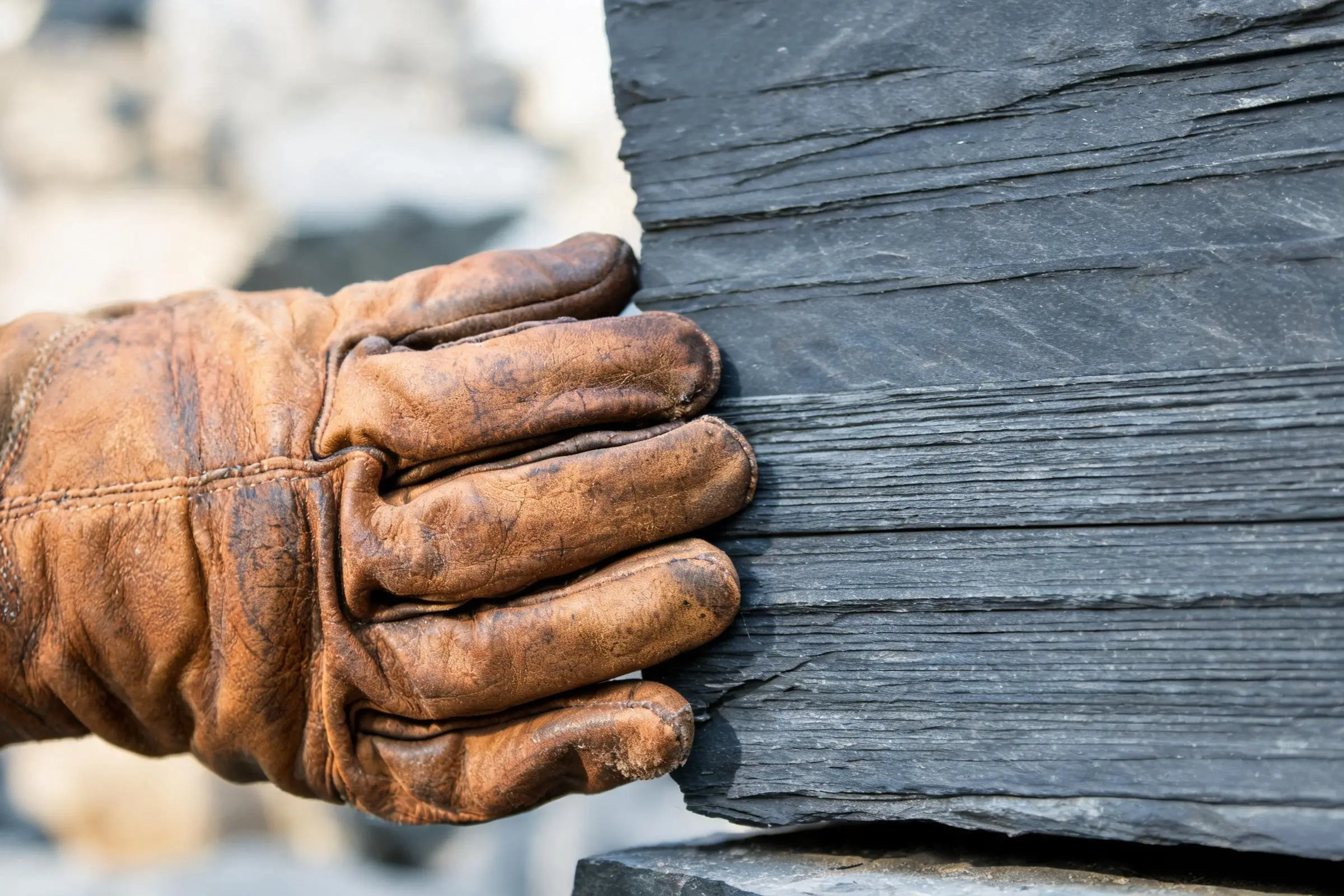
First, cleavage direction. Slate splits along one plane — that is what makes it slate. I run a gloved hand across the face, feeling the grain. The cleavage plane should run flat and even, parallel to the bedding. If it angles or curves, the block will split crooked, and crooked splits mean wasted stone.
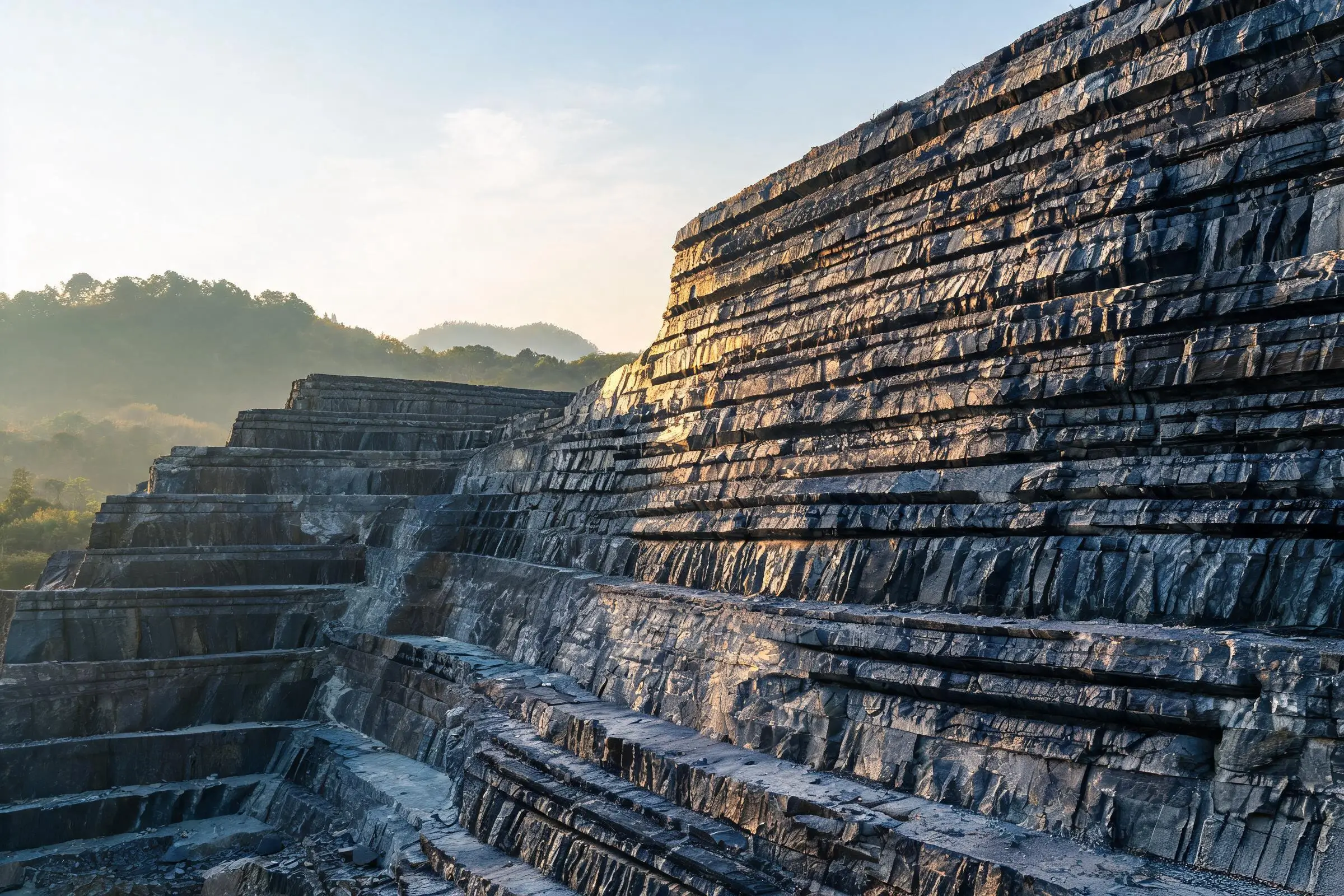
Second, layer consistency. I count the layers in a metre of face. If they are even — each one 30 to 40 millimetres — that is a good sign. The block will split predictably into tiles of consistent thickness. If the layers vary wildly, some 20mm, some 60mm, that block goes to products where thickness variation matters less.
Third, fractures. A fracture is a crack that runs through the rock but does not follow the cleavage plane. It can be caused by tectonic stress, weathering, or even the vibration from last week's cutting. I look for dark lines crossing the face at angles to the bedding. One fracture in the wrong place can turn a 25-tonne block into scrap.
There is a sound test I do as well. I tap the face with a small hammer — a sound block rings back, a fractured block gives a dull thud. After twenty years, my ears know the difference between "this block is solid" and "this block has a secret."
Phase 02: Marking the Cut
Once I have read the face, I know which section to cut. The next step is the most low-tech part of the whole operation: I take a piece of chalk and draw a line on the rock.
That chalk line is where the wire saw will go. It is the single most important mark in the quarrying process. A wrong cut wastes a block that took hundreds of millions of years to form. A right cut gives you 60 to 80 square metres of finished slate.
I mark the vertical cuts first. These follow the cleavage plane — the natural direction the slate wants to split. Then I mark the horizontal cut at the bottom, which will separate the block from the bench.
Block dimensions vary, but a typical block is 2 to 3 metres long, 1 to 1.5 metres wide, and 1 to 1.5 metres deep. For billiard-grade blocks, I need at least 2.4 metres in one dimension — that is the length of a 9-foot pool table bed. If the face cannot give me that length in a clean section, I do not mark it for billiard. I mark it for roofing, where size requirements are more flexible.
The chalk marks include a number. That number stays with the block from the quarry face to the storage yard to the factory. If a customer ever asks where their slate came from, I can point to the section of face and the date we cut it.
Phase 03: The Wire Saw
The wire saw is the workhorse of modern slate quarrying. If you have never seen one, picture a steel cable about 5 millimetres thick, threaded with diamond beads every 20 millimetres. The cable loops through a pulley system and runs continuously, pulling itself through the rock like a never-ending chain saw — but slower, and far cleaner.
Before the wire saw, quarries used drilling and wedging for every cut — slower, rougher, more wasteful. The wire saw changed that. It cuts a clean, straight face with minimal kerf — the slot left by the cut is only about 10 millimetres wide. Less stone turned to dust, and a smoother face for the next cut.
Water sprays continuously at the cut point. This does two things: it cools the diamond beads so they do not overheat, and it suppresses the fine slate dust that would otherwise fill the air. The water runs down the face, collects in a channel at the bottom of the bench, and drains to a settling pool. We reuse that water the next day.
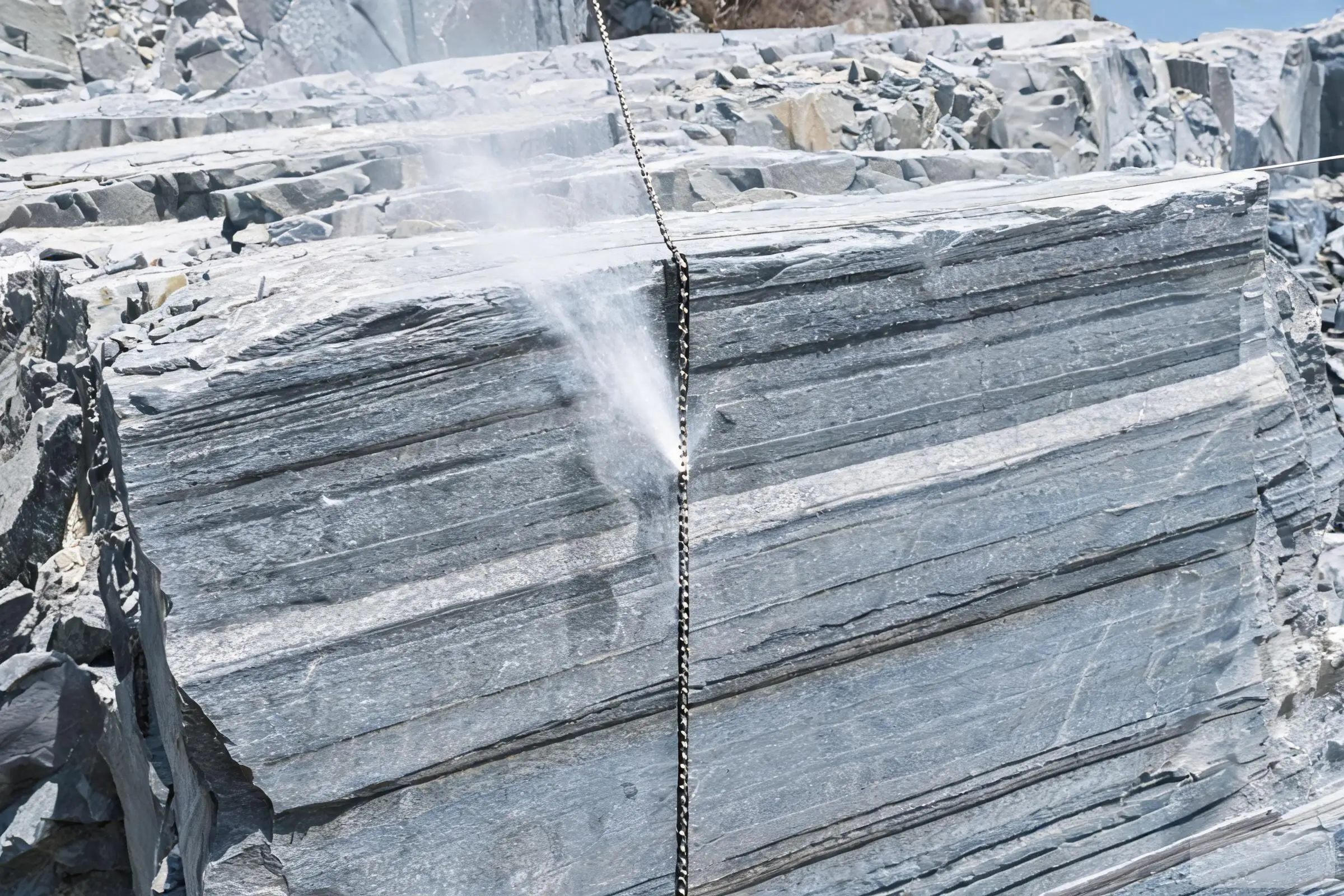
How fast does it cut? Through Jiujiang slate — which is dense, at about 2.7 to 2.8 grams per cubic centimetre — the wire saw moves at roughly 1 to 2 square metres per hour. A full block cut, with three faces to cut through, takes 4 to 8 hours. That sounds slow, but the alternative — drilling hundreds of holes and driving wedges by hand — takes twice as long and wastes more stone.
I run two wire saws on most days. While one is cutting on the upper bench, the other is set up on the lower bench. By the time the first block is ready to break free, the second saw is halfway through its cut. That is how we keep the day moving.
Phase 04: Freeing the Block
After the wire saw has cut three sides — two vertical, one horizontal — the block is still attached at the back. This is the moment that tells me whether I read the face correctly.
We drill a line of holes along the back of the block, about 200 millimetres apart. Into each hole we drive a hydraulic wedge — a flat steel blade that the pump expands with up to 50 tonnes of force. The wedges press outward, and the block separates along its natural cleavage.
When the break is clean, the block comes away in one piece with a smooth back face. That is the sound I listen for: a deep, even crack that runs the full length of the block. It sounds like the mountain is opening a door.
When the break is ragged — when the crack veers off, or the block splits into two pieces — that means there was a hidden fracture I did not see. It happens. No one reads a rock face perfectly every time. A ragged break does not necessarily mean the stone is wasted, but it does mean the block drops a grade. A block marked for billiard might end up as roofing, and a block marked for roofing might end up as paving.
The block, now free, weighs 15 to 30 tonnes. Too heavy for a man, exactly right for the front loader. The technical side of block extraction — drilling patterns, wedge angles, controlled break direction — deserves its own article, and I will walk through those details separately. For now, the block is out, and the day moves on.
Phase 05: The Storage Yard
The front loader picks up the block and carries it down the ramp to the storage yard — a flat area at the base of the quarry, open to the sky. This is the transition point. Everything that happened above was quarry work. Everything that happens from here is factory work.
In the yard, blocks are sorted by size, colour, and the quality grade I assigned at the face. Each block sits on wooden spacers to keep it off the ground — moisture from the soil can stain the underside. The chalk number from the face is still visible, and I add a second mark: R for roofing, B for billiard, P for paving.
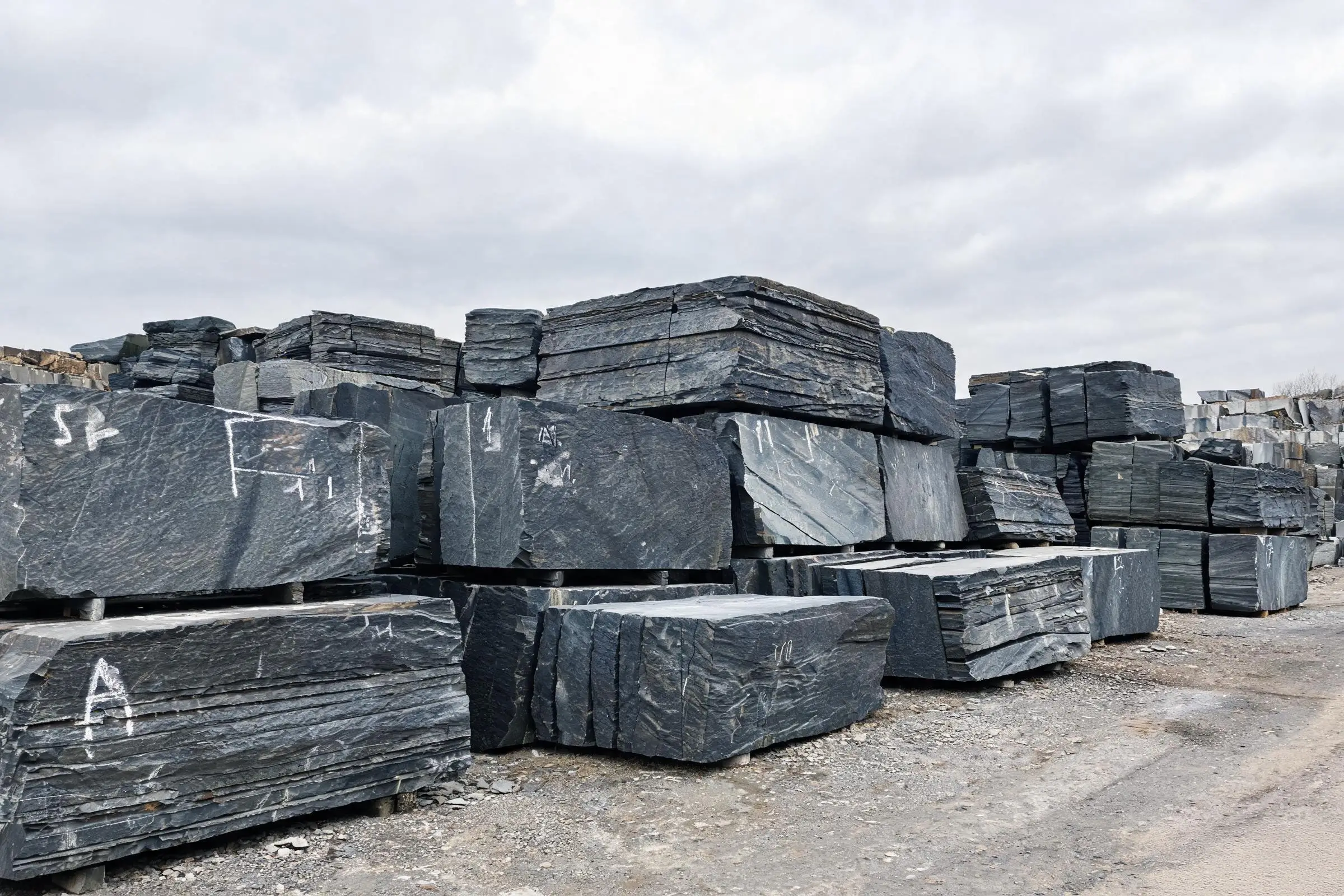
The yard is also where buyers see the stone for the first time. When a customer visits — and over the years we have regularly hosted overseas buyers who fly into Nanchang and drive the short distance to our factory in Lushan City — the storage yard is where we start the tour. Standing in front of a 25-tonne block that came out of the mountain yesterday is a different experience from looking at a product page on a website. You can see the layers, feel the weight, tap the face and hear it ring.
From the yard, the blocks go to the factory. That is where the hand-splitting, surface grinding, CNC machining, and inspection happen — each of those is a separate story. The quarry is where the stone is born; the factory is where it is shaped.
Phase 06: The 80/20 Rule
This is the phase where I make the call that matters most: roofing or billiard.
Roughly 80% of the blocks that come out of this quarry go to roofing slate. The remaining 20% — the soundest, largest, cleanest blocks — qualify for billiard table slate. That ratio is not a policy I set. It is what the geology gives us.
What makes a billiard block? Four things:
Size. A billiard block needs at least 2.4 metres in one dimension — the length of a 9-foot pool table bed. A 12-foot snooker table needs 3.6 metres. Most blocks from the quarry are 2 to 3 metres long, so size alone eliminates a significant portion.
Uniformity. No colour banding, no clusters of pyrite, no visible inclusions. A roofing tile can have character — a streak of green, a fleck of gold pyrite, a slight variation in shade. On a roof, that is natural beauty. On a billiard table, it is a distraction. The billiard block has to look like one piece of stone, end to end.
Soundness. No hidden fractures. I test every billiard candidate with the knock test — a solid ring means the block is sound; a dull thud means there is a crack somewhere inside. I also look at the break face from Phase 04: if the back came away clean, the block is likely sound throughout. If the break was ragged, the block goes to roofing, not billiard.
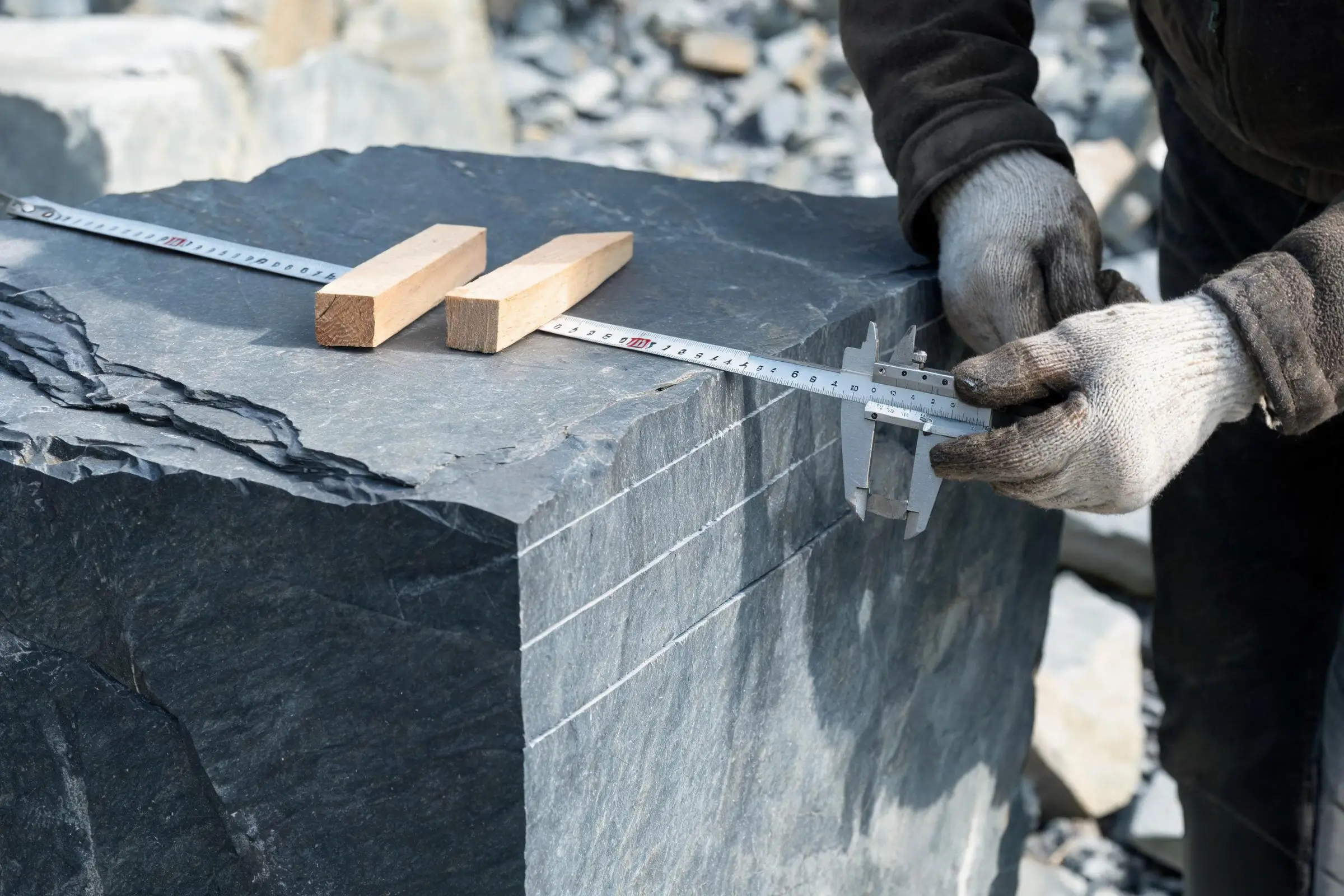
Density. The block has to be consistently dense — no soft spots, no porous zones. Jiujiang slate runs 2.7 to 2.8 g/cm³, but even within that range, a block with variable density will machine unevenly. For billiard slate, where CNC machining holds tight tolerances, density consistency is not a luxury. It is a requirement.
The 80/20 ratio is what the slate belt around Lushan gives us. Some days it is closer to 90/10. The stone does not read our production plan — it has its own rules, and my job is to listen to them.
The blocks that do not make billiard grade are not "rejects." Roofing slate is the primary product of this quarry — it is what most of our customers buy, and it is what the world knows Jiujiang slate for. A roofing block has its own criteria: it must split cleanly into thin tiles, resist frost, and hold its dimensions. Different product, different standard, same quarry, same rock. The difference is not in the stone — it is in what we ask the stone to do.
Phase 07: What the Quarry Leaves Behind
By late afternoon, the blocks are in the yard, the wire saws are shut down, and the water pumps go quiet. What is left is the quarry itself.
We work in benches. Each bench is 3 to 5 metres high, with an access ramp for machinery. When we finish one bench — cutting it back, extracting the blocks, moving them to the yard — we drop down to the next level and start again. The bench method is not just about efficiency. It is about safety, and about what happens to the quarry after the stone is gone.
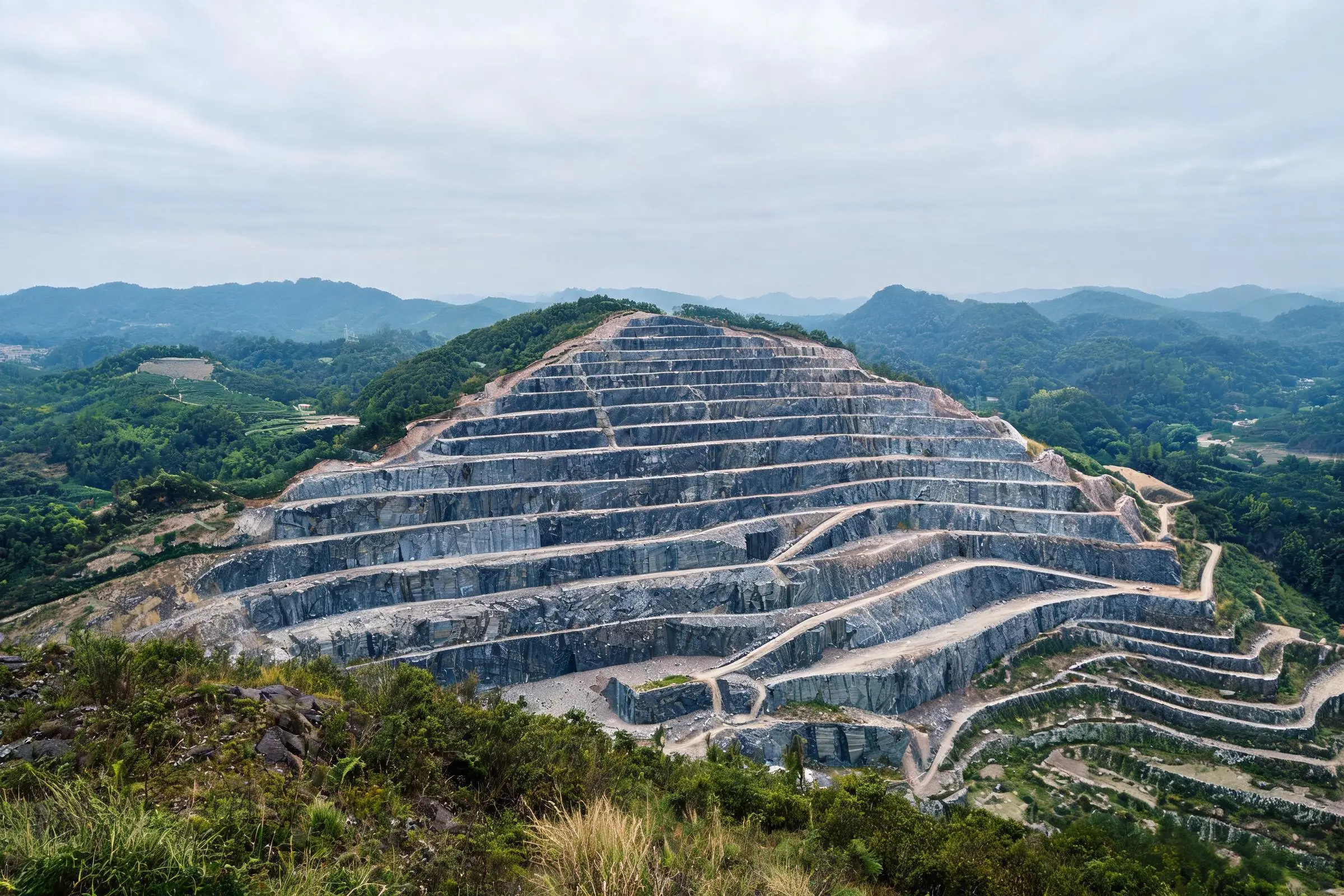
The water from the cutting process drains to settling pools at the base of the quarry. The slate dust settles to the bottom, and the clean water gets pumped back up for the next day's cutting. We do not draw fresh water for every cut — the recycling system handles most of what we need. Quarry sustainability is a subject that deserves more than a paragraph, and we cover it in detail elsewhere.
The face I read this morning will be different next year. The bench I am working now will be cut back another few metres. A new bench will open below. That is the nature of extraction — the mountain changes. But the method stays the same: read, mark, cut, break, move, select.
If you want to understand what happens after the blocks leave this yard — the hand-splitting that turns a block into tiles, the surface grinding that makes it flat, the CNC machining that cuts a billiard bed to tolerance, the inspection that checks every piece — those are the next chapters of the story. The quarry is where it starts, but it is not where it ends.
See the full process from quarry block to finished product →
FAQ: Quarrying Jiujiang Slate
Why use a wire saw instead of explosives?
Explosives shatter the rock. Slate depends on clean cleavage — if you blast it, you fracture the very planes that make it valuable. The wire saw cuts through the stone without vibration, leaving the cleavage intact. You get more usable blocks from the same amount of rock, and the blocks you do get are sounder.
How long does it take to extract one block?
The wire saw runs for 4 to 8 hours to cut three faces of a typical block. Drilling and wedging the back takes another hour. Moving the block to the yard takes 20 minutes with the front loader. From marking to yard, a single block is about a day's work — though we run multiple cuts in parallel to keep production steady.
Can any slate quarry produce billiard-grade blocks?
No. Billiard slate requires blocks of at least 2.4 metres in one dimension, with uniform density, no fractures, and no colour banding. Many slate deposits produce good roofing stone but cannot yield blocks large enough or clean enough for table slate. The Jiujiang belt is unusual in that it serves both industries from the same rock — but even here, only about 20% of blocks qualify.
What happens to blocks that fail the selection?
Blocks that do not meet roofing or billiard standards go to lower-grade products: paving slabs, wall cladding, landscape stone, and sometimes crushed aggregate. Very little is truly wasted — the stone just gets sorted into different products based on what it can do. A block too fractured for a roof tile might still make an excellent garden stepping stone.
How is the quarry managed for sustainability?
We use the bench method, cutting in stepped terraces rather than a single deep pit. This allows for easier rehabilitation when a bench is exhausted. Water from cutting is recycled through settling pools. We discuss quarry sustainability — waste management, water use, and quarry restoration — in more detail in a dedicated article.
Can I visit the quarry?
Over the years we have regularly hosted overseas buyers who want to see the stone at its source. The route is straightforward: fly into Nanchang, then drive to Lushan City where our factory and quarry access are. Contact us to arrange a visit — seeing the quarry face and the storage yard in person tells you more about the stone than any website can.
Related Reading
See the stone at its source.
Visit our quarry and factory in Lushan City, Jiangxi — fly into Nanchang, drive to the mountain, stand in front of a 25-tonne block that came out of the rock face this morning.