
How Slate Blocks Are Extracted: Drilling, Wedging and the Wire Saw Method
| Method | Best For | Kerf / Waste | Speed |
|---|---|---|---|
| Wire saw | Vertical and horizontal cuts on the bench face | ~10 mm kerf — minimal waste | 1–2 m²/hour per saw |
| Drill & wedge | Breaking the back face where the saw cannot reach | No kerf — breaks along cleavage | 1–2 hours per block |
| Combination | Large or billiard-grade blocks | Saw on 3 sides, wedge the 4th | 4–8 hours total |
A slate block is not pried out of the mountain. It is released. The rock has a natural plane of weakness — the cleavage — and every extraction method is designed to work with that plane, not against it. You cut the sides, you break the back, and the block comes away because the stone was always willing to separate there. The skill is in knowing where to cut, where to break, and how to control the direction of that release.
This article covers the technical side of block extraction — the three methods used on the bench face, the drilling patterns, the wedge mechanics, and what the break tells you about the block inside. If you want the full day-at-the-quarry story, that is a separate article. This one is the engineering manual.
Creating the Free Face
Before any block can be extracted, you need a free face — an exposed vertical surface of rock with open space in front of it. Without a free face, there is nowhere for the block to move when it breaks. The block would be pressed against the mountain on all sides, and no amount of wedging would release it.
In a bench quarry, the free face is created by the bench itself. Each bench is 3 to 5 metres high, cut into the hillside in stepped terraces. The front of the bench is the free face. The top is open sky. The two sides may be open (if previous blocks have already been removed) or may need to be cut. The back is always attached — and that is the face you will eventually break.
If you are opening a new section of bench, the first cut creates the free face. This is done with the wire saw, running a vertical cut through the full height of the bench. Once that cut is made, you have a slab of rock with three sides still attached: top, back, and one side. The next step is to free the remaining sides and break the back.
The Wire Saw
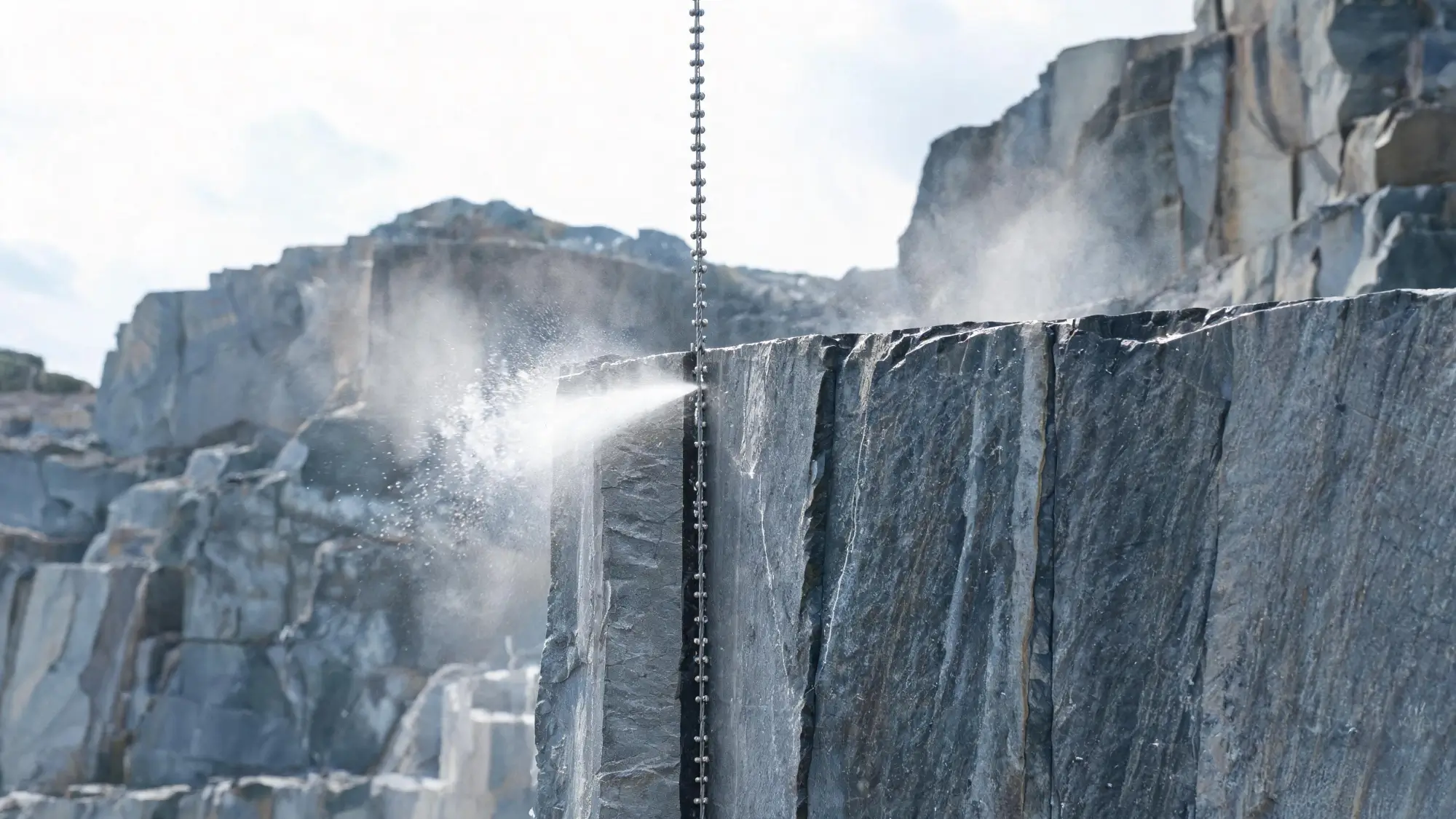
The wire saw is the primary cutting tool in modern slate quarrying. It is not a saw in the woodworking sense — there are no teeth. It is a continuous steel cable, about 5 millimetres in diameter, threaded with cylindrical diamond beads spaced every 20 to 30 millimetres along its length. The cable runs in a loop through a pulley system driven by an electric motor, and the diamond beads do the cutting by grinding through the stone as the cable moves at about 25 to 30 metres per second.
Three things make the wire saw the right tool for slate:
Precision. The kerf — the width of the cut slot — is only about 10 millimetres. Compare that to blasting, which shatters a zone 200 to 300 millimetres wide on either side of the hole. Less stone becomes dust, and the cut face is smooth enough to serve as the free face for the next block.
No vibration. Slate's value depends on its cleavage plane being intact. Explosives and impact tools send shock waves through the rock that can open micro-fractures along the cleavage. The wire saw cuts by abrasion — no impact, no vibration, no damage to the surrounding rock. The geology that took hundreds of millions of years to form stays where it is.
Flexibility. The cable can follow any line — vertical, horizontal, even curved if needed. You are not limited to straight cuts from a rigid frame. You thread the cable through a pilot hole and let it follow the line you chalked on the face.
The trade-off is speed. Through Jiujiang slate, which runs 2.7 to 2.8 g/cm³, the wire saw advances at roughly 1 to 2 square metres of cut surface per hour. A single block typically requires three cuts — two vertical sides and one horizontal bottom — totalling 8 to 20 square metres of cut surface. That is 4 to 8 hours of saw time per block.
Water is sprayed continuously at the cut point. The water cools the diamond beads (which would overheat and fail without it) and suppresses the fine slate dust that would otherwise become airborne. The water drains to the base of the bench, flows to a settling pool, and is pumped back for the next day. Roughly 80 percent of the cutting water is recovered in this loop.
Drilling the Wedge Line
The wire saw cannot cut the back of the block — the face still attached to the mountain. There is no way to thread the cable behind the block without cutting an access slot first, which wastes more stone than it saves. So the back is broken, not cut. And the break is controlled by drilling.
Along the back face of the block, you drill a line of holes. These holes define where the break will run. The principle is simple: slate breaks along its cleavage plane, and if you give it a line of weakness to follow, it will follow that line rather than wandering off into the block.
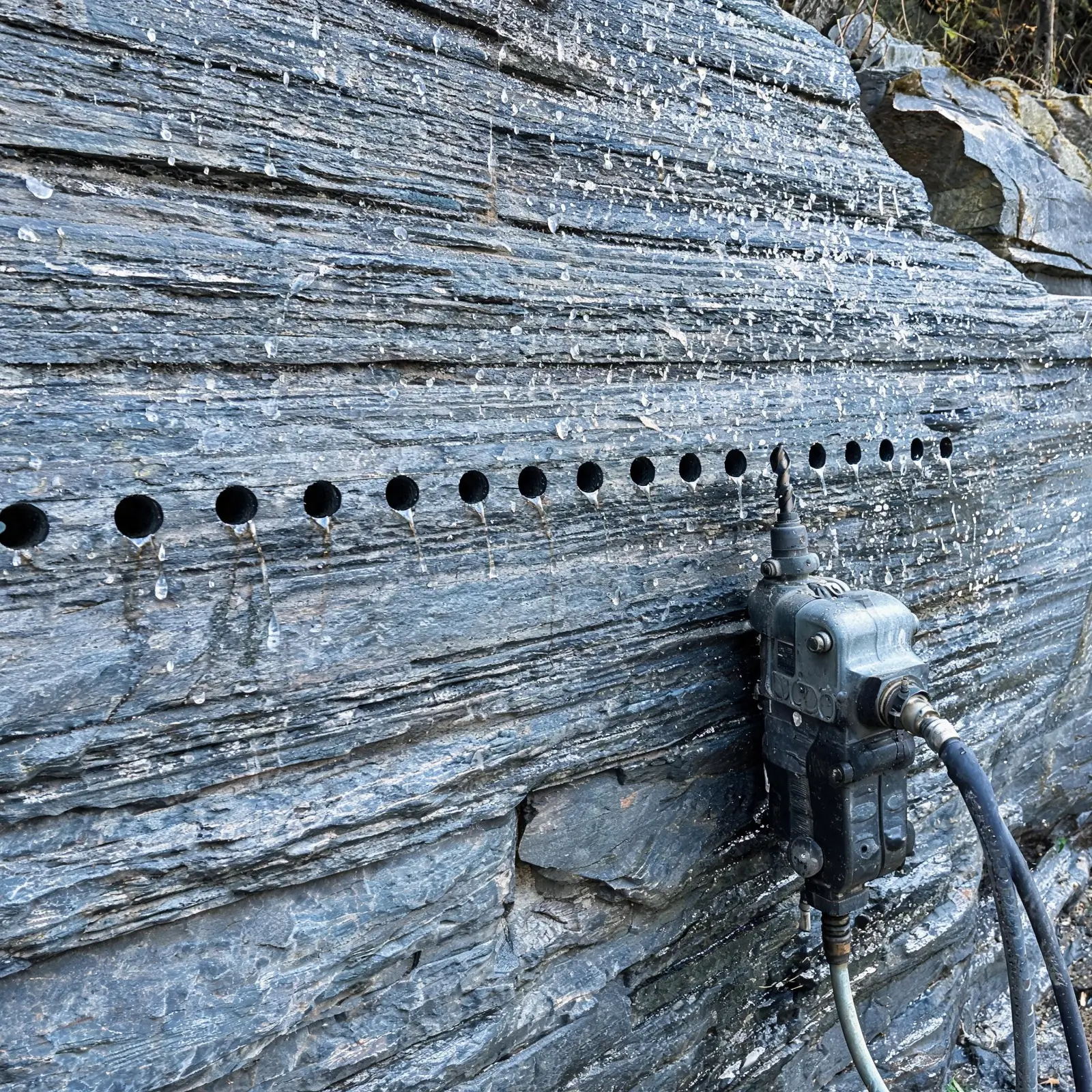
The drilling parameters that matter:
Hole spacing. Typically 150 to 250 millimetres between centres. Closer spacing gives a more controlled break because the stress between holes is more evenly distributed. For billiard-grade blocks, use the tighter end of the range — 150 to 180 mm. For roofing blocks, 200 to 250 mm is sufficient, because a slightly less precise break does not affect roofing performance.
Hole diameter. 32 to 40 millimetres. The hole must be wide enough to accept the hydraulic wedge assembly, but not so wide that it weakens the block unnecessarily. A 38 mm hole is the most common size.
Hole depth. Drilled through the full thickness of the block — 1 to 1.5 metres in a typical bench. If the hole does not go all the way through, the break may stop short, leaving a stub of rock attached at the bottom.
Hole alignment. All holes must be in the same plane, parallel to the cleavage direction. If one hole angles off, the break will follow the misaligned hole and the back face will be ragged. A drilling jig — a simple steel frame that guides the drill — keeps the holes in line.
Wedging the Break
Once the holes are drilled, the block is ready to be broken free. This is done with hydraulic wedges — flat steel blades that are inserted into each hole and then expanded by a hydraulic pump.
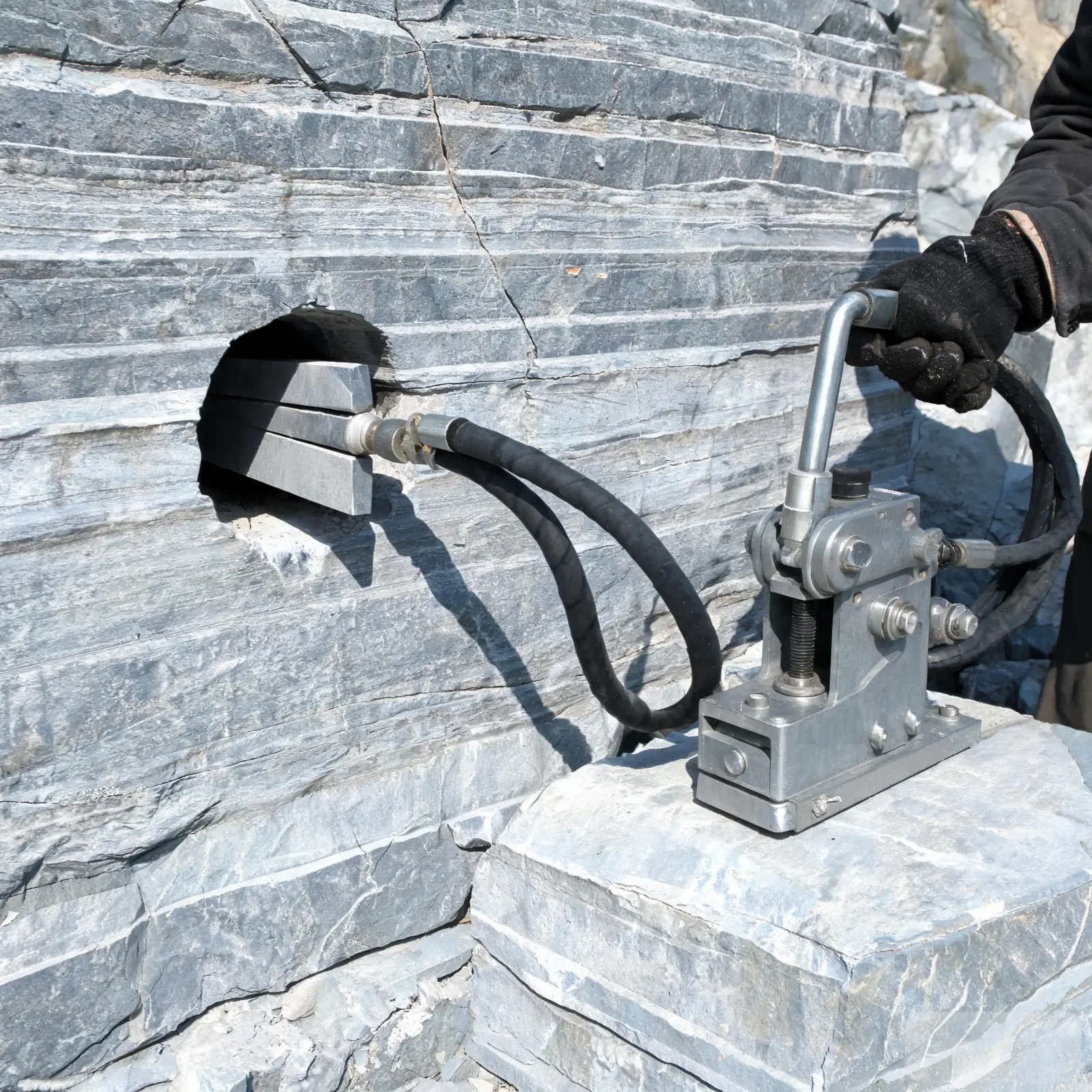
The mechanics are straightforward: the wedge assembly consists of two outer feathers (static steel strips) and one inner feather (the expanding element). When the pump pressurises the system, the inner feather pushes the outer feathers apart, exerting lateral force on the walls of the hole. Each wedge generates 30 to 50 tonnes of expansion force. That force is directed perpendicular to the hole axis — which, if the holes are drilled along the cleavage plane, means the force pushes the block directly along its natural line of weakness.
The sequence matters. You do not pressurise all wedges at once. You start from one end and work along the line, bringing each wedge to partial pressure before moving to the next. This lets the crack initiate at the first hole and propagate along the line. By the time you reach the last hole, the block is usually already separating.
You hear it before you see it. A deep, even crack — not a sharp snap — running the length of the block. That sound means the break is following the cleavage. A sharp, irregular cracking sound means the break is crossing layers, which means the back face will be ragged and the block may have lost a grade.
The whole wedging sequence takes 30 to 60 minutes for a typical block. The pump runs for most of that time at low pressure — 5 to 10 tonnes per hole — building up gradually. The last few minutes, when the crack is propagating, are where the force goes up and the sound tells you what is happening.
FAQ: Block Extraction Methods
Why not just use explosives to break the block free?
Explosives send shock waves through the surrounding rock. In slate, those shock waves open micro-fractures along the cleavage plane — the very plane that gives the stone its value. A block broken free by blasting may look fine on the surface, but the internal damage shows up months later when the block is being split into tiles or machined on a CNC bed. The wire saw and hydraulic wedge method produces blocks with intact internal structure.
What is the difference between a clean break and a ragged break?
A clean break follows the cleavage plane exactly — the back face of the block is smooth and even, with no step-outs or cross-layer fractures. A ragged break deviates from the cleavage, creating a rough surface with chunks missing or layers crossed. A clean break means the block is sound and the cleavage is uniform. A ragged break means there was a hidden fracture, a vein, or a change in grain direction that pulled the crack off course. Ragged breaks drop a block's grade.
How many blocks can be extracted in a day?
With two wire saws running in parallel, a typical quarry extracts 2 to 4 blocks per day. Each saw handles one block at a time, and the cutting phase (4 to 8 hours) is the bottleneck. Drilling and wedging the back takes another 1 to 2 hours but can overlap with the next block's saw setup. Block size also affects the count — a large billiard-grade block may take the full day, while smaller roofing blocks can be cut two per saw.
Reading the Break
When the block separates, the break face tells you what is inside the block. This is the moment of truth — everything before it was preparation, and everything after it is processing. What the break looks like determines what the block becomes.
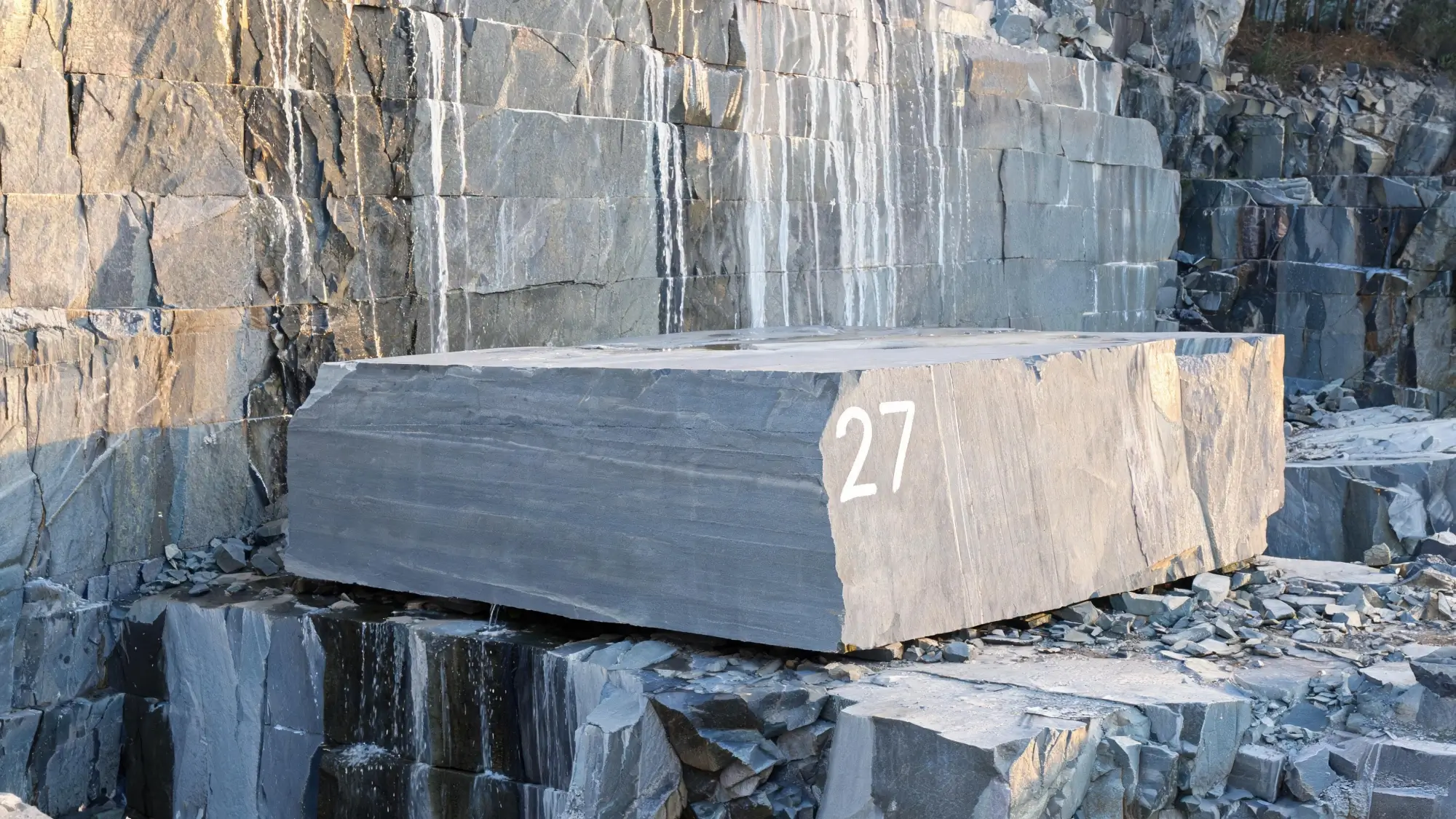
Three types of break, and what each one means:
Clean break. The back face is smooth, flat, and follows the cleavage plane from top to bottom without deviation. The surface may show faint layering lines but no cross-fractures. This is the ideal result. The block is sound, the cleavage is uniform, and the block keeps its assigned grade — roofing stays roofing, billiard stays billiard. This is what you aim for on every cut, and what you get on about 70 percent of attempts with good face reading and proper drilling.
Step break. The break follows the cleavage for most of its length but steps sideways at one or two points, creating small terraces on the back face. This usually means there was a minor variation in grain direction or a thin vein that deflected the crack. The block is still usable, but it drops a grade. A block marked for billiard becomes roofing. A block marked for roofing becomes paving or cladding. The lost material is the stepped section — it has to be trimmed off before processing.
Split break. The block breaks into two or more pieces. This is the worst outcome. It means there was a hidden fracture running through the block that the wedge line could not override. The pieces may still be usable for smaller products — tiles, paving, crafts — but the block as a single entity is gone. Split breaks happen when the face reading missed a fracture, or when the cleavage plane changes direction within the block. Experienced quarry foremen can usually prevent this by tapping the face and listening before drilling, but no one catches every hidden crack.
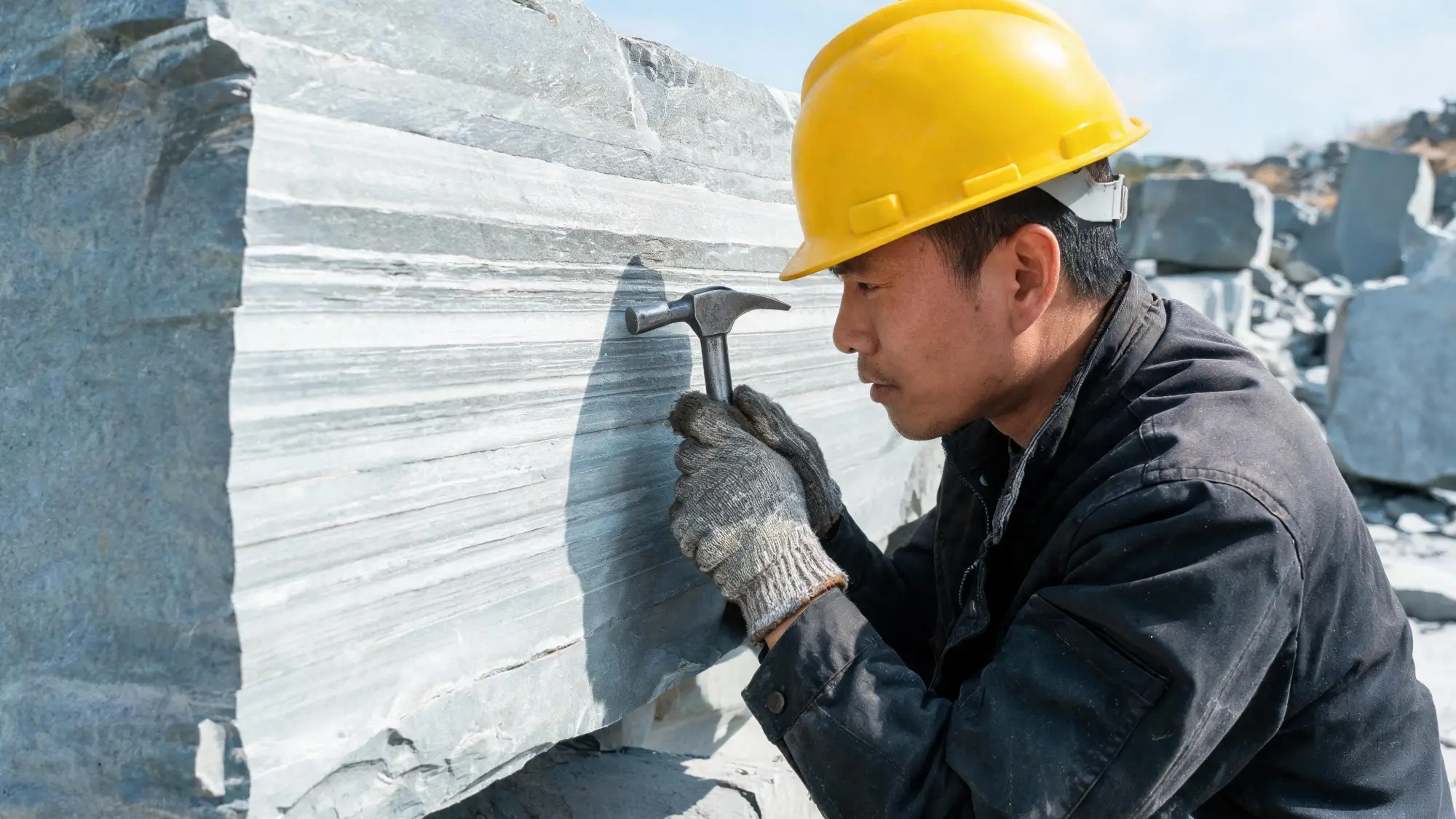
The sound test confirms what the break face shows. You tap the block with a small hammer — a solid ring means the stone is sound and dense, a dull thud means there is a fracture or a soft zone inside. After the break, this test is about verifying what the face already told you. Before the break, it is about predicting it.
Moving the Block
A block that has broken free weighs 15 to 30 tonnes. It sits on the bench, 3 to 5 metres above the quarry floor, and it needs to get to the storage yard. This is where the front loader takes over.
The loader's rated capacity must exceed the block weight by at least 20 percent. A 30-tonne block requires a loader rated for at least 36 tonnes. This is not a suggestion — a loader operating near its limit on a quarry bench with a ramp is a safety risk. The bench edge can crumble under uneven loading, and the ramp grade affects stability. Most Jiujiang quarries use loaders in the 40 to 50 tonne class, which gives comfortable margin for the full range of block sizes.
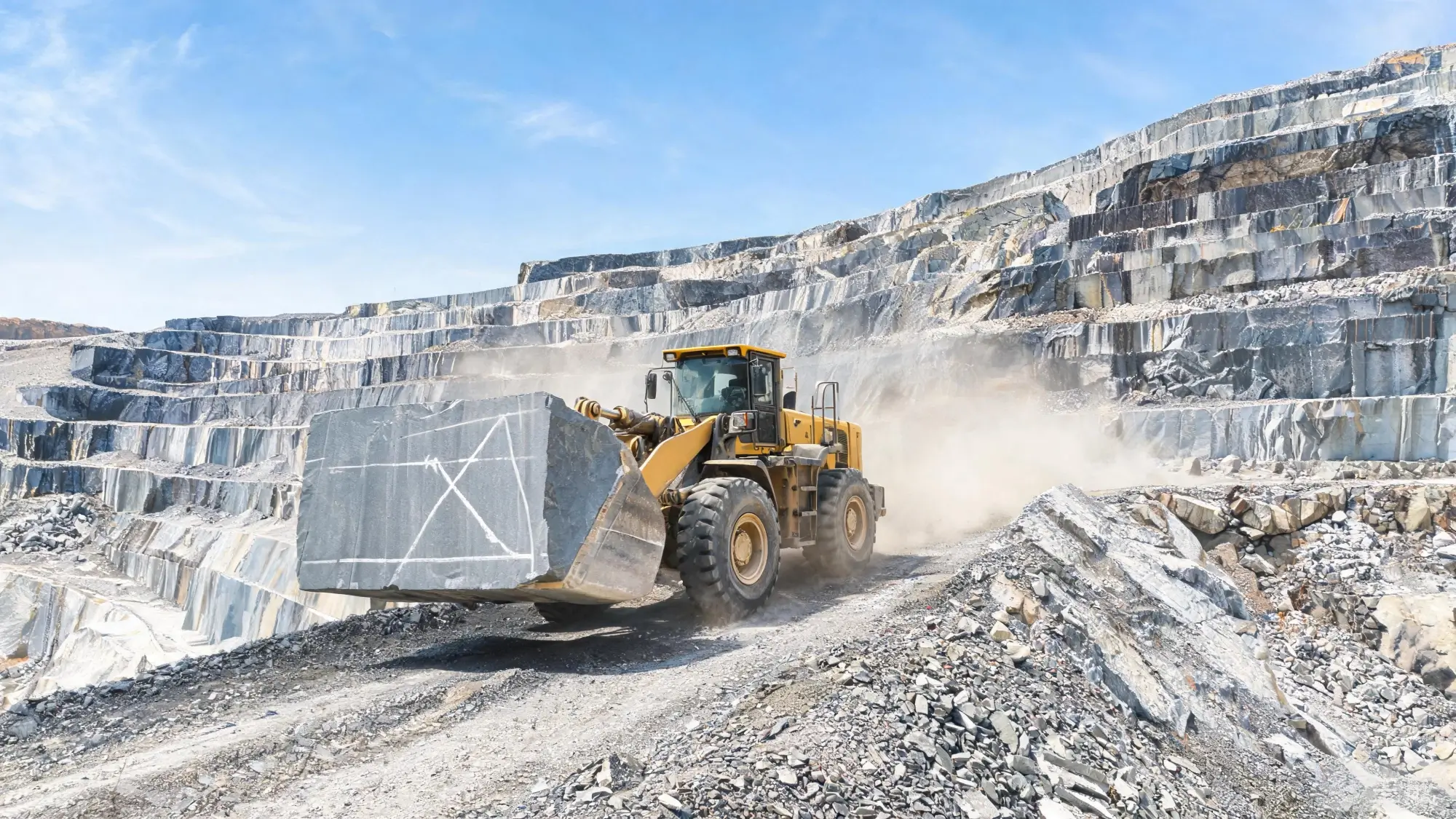
The block is lifted with chains or a specialised stone clamp. The operator lifts it clear of the bench, turns, and drives down the ramp to the storage yard. The whole move takes 15 to 20 minutes. In the yard, the block is placed on wooden spacers — direct ground contact can stain the underside and trap moisture that affects the surface layer.
From this point, the block is quarry output. Everything that follows — the hand-splitting into tiles, the surface grinding for billiard panels, the CNC machining, the 100 percent inspection — happens in the factory. The extraction is done.
When Methods Combine
Most blocks are extracted with a combination of wire saw and drill-and-wedge. The saw cuts the three accessible faces (two vertical sides and the horizontal bottom). The wedge breaks the fourth face (the back, still attached to the mountain). This is the standard method, and it works for the majority of blocks.
But there are cases where one method alone is sufficient, or where the combination changes:
Small blocks for roofing can sometimes be freed entirely by drilling and wedging, if the face is already exposed on three sides from previous cuts. This is faster — no saw setup — but the break is less controlled, so it is only used for blocks where precision is not critical.
Large billiard-grade blocks may use the wire saw on all four faces. The saw is threaded through a pilot hole drilled horizontally behind the block, then run along the back face. This eliminates the risk of a ragged break on the most valuable blocks, but it adds several hours to the cut time and requires precise pilot-hole drilling.
Irregular blocks with complex shapes or unusual cleavage angles may use a chain saw — a handheld gas saw with a diamond chain — for the initial shaping, followed by wedging. This is rare but useful when the bench geometry does not allow a wire saw setup.
The method chosen for each block depends on the block's intended product, its size, the bench geometry, and the foreman's reading of the face. There is no single correct way to extract a block — there is the way that gives you the best block for the least waste and the lowest risk of a split break.
FAQ: More on Block Extraction
How deep can the wire saw cut in a single pass?
The wire saw can cut to a depth of about 2.5 metres in a single setup. For bench heights of 3 to 5 metres, the cut is made in two passes — the upper section first, then the lower section after repositioning the pulley system. The cut depth is limited by the cable length and the pulley geometry, not by the saw motor. Longer cables allow deeper cuts but reduce cutting speed because more cable weight means more friction.
What happens if the block breaks unevenly during wedging?
If the break starts to deviate — you hear irregular cracking or see the block shifting unevenly — the standard response is to stop pressurising the wedge where the deviation is occurring and move to the next hole. This lets the crack find its own path along the cleavage rather than forcing it. If the block has already started to split into pieces, there is no way to reverse it. The pieces are assessed individually and routed to the appropriate product line.
Is the drill-and-wedge method still used without the wire saw?
Yes, in small quarries or for repair and maintenance work where setting up a wire saw is not practical. A skilled crew can extract blocks using only drilling and wedging, but the blocks are less consistent in size and the break quality is lower. For commercial production — especially for export-grade blocks — the wire saw is the standard. The drill-and-wedge method is a complement, not a replacement.
How much water does the wire saw use?
The wire saw uses approximately 200 litres of water per cubic metre of stone cut. In a typical day, two saws running for 8 hours will use about 4,000 litres. Of that, roughly 80 percent is recovered through the settling pool system and reused the next day. Fresh water is added only to make up for evaporation and the water that remains in the slate dust settled at the bottom of the pool.
Can a split-break block still be used for billiard slate?
No. A block that has broken into pieces has lost its structural continuity. Even if the individual pieces are large enough, the internal stress released during the split means the stone is no longer dimensionally stable enough for CNC machining to ±0.1 mm tolerance. Split-break pieces go to roofing, paving, or smaller products depending on their size and condition.
How do you choose the wedge spacing for a specific block?
The spacing depends on the block's intended grade and the cleavage quality. For billiard-grade blocks, use 150 to 180 mm spacing — tighter holes give a more controlled break with less risk of step-outs. For roofing-grade blocks, 200 to 250 mm is sufficient because the break precision does not affect the final product. If the face reading shows any irregularity — colour banding, visible veins, or a change in grain — tighten the spacing regardless of grade to keep the break on line.
Related Reading
Want to see extraction in person?
The technical details make more sense when you stand on the bench and watch the wire saw cut. Visit our quarry and factory in Lushan City — fly into Nanchang, drive to the mountain, see a 25-tonne block come off the face.