
Slate Roof vs. Asphalt Shingles: A 75-Year Cost Comparison
I've spent thirty years advising homeowners, architects and estate managers on roofing decisions. In that time I've never seen someone regret choosing slate. I've seen plenty regret choosing asphalt twice.
Here's the thing: when people compare slate and asphalt, they compare the wrong number. They look at the quote on the desk — £40 per square metre for asphalt, £100 for slate — and pick the smaller number. That's like comparing the purchase price of a car but ignoring fuel, servicing and the fact one car lasts fifteen years and the other lasts a hundred.
So let me lay it out the way I lay it out for clients: as a ledger. Not a spec sheet. A ledger.
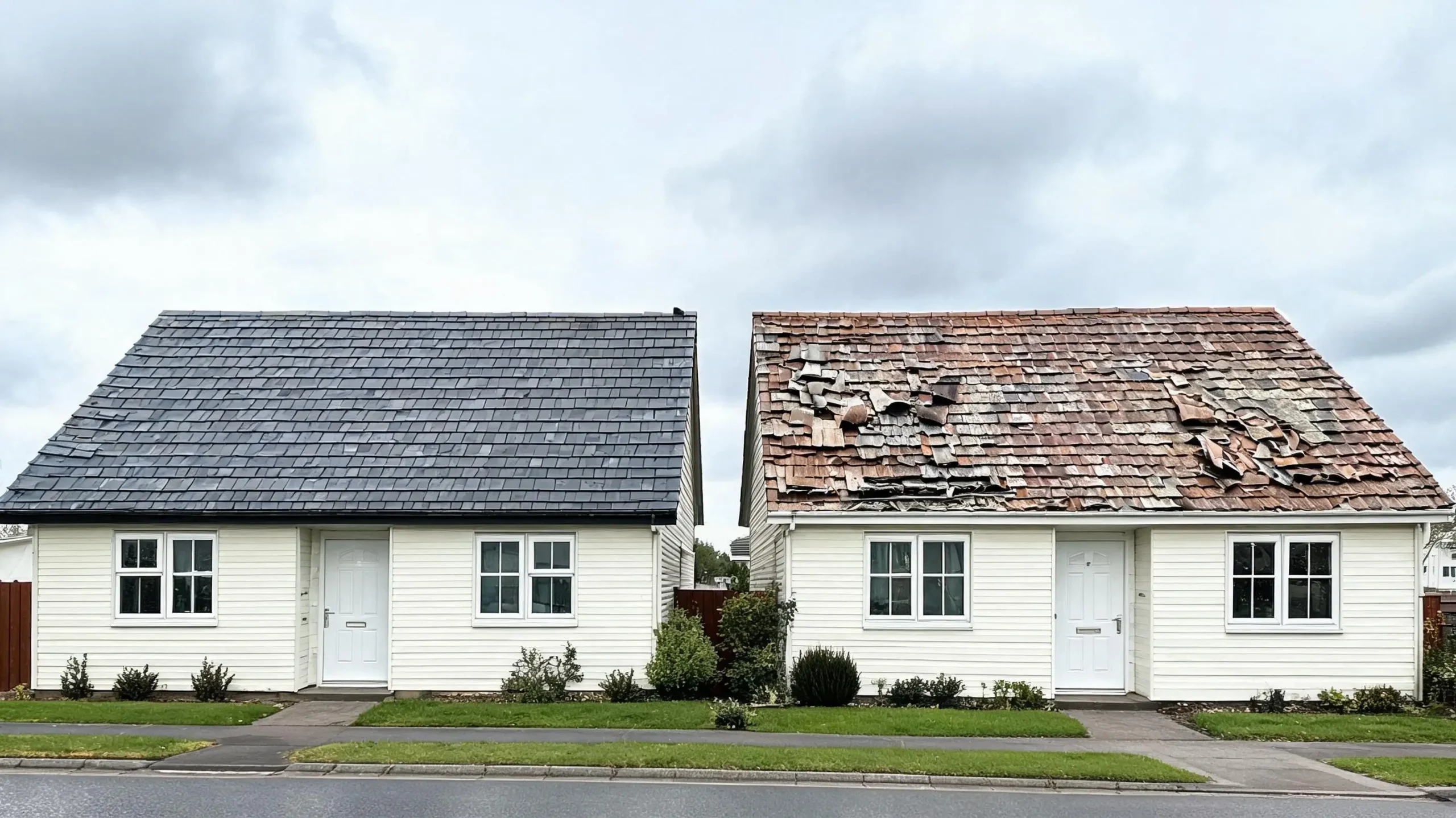
The 75-Year Ledger: Why the Cheapest Roof Isn't
Most roofs outlast the people who buy them — or they should. When I run the numbers for a client, I use 75 years because that's a realistic ownership horizon for a building: you might own it for 25, the next family for 25, and the third family reaps the benefit or pays the bill.
Here's what the ledger looks like for a 200 m² roof:
| Year | Asphalt Event | Asphalt Cost | Slate Event | Slate Cost |
|---|---|---|---|---|
| 0 | Install | £12,000 | Install | £24,000 |
| 8 | Minor repairs | £800 | — | £0 |
| 15–18 | Full replacement #1 | £14,000 | Inspection | £300 |
| 25 | Minor repairs | £1,200 | — | £0 |
| 33–35 | Full replacement #2 | £16,500 | Inspection | £300 |
| 50–53 | Full replacement #3 | £19,000 | Replace flashing | £2,500 |
| 65 | Repairs + patching | £2,000 | — | £0 |
| 75 total | £65,500 | £27,100 |
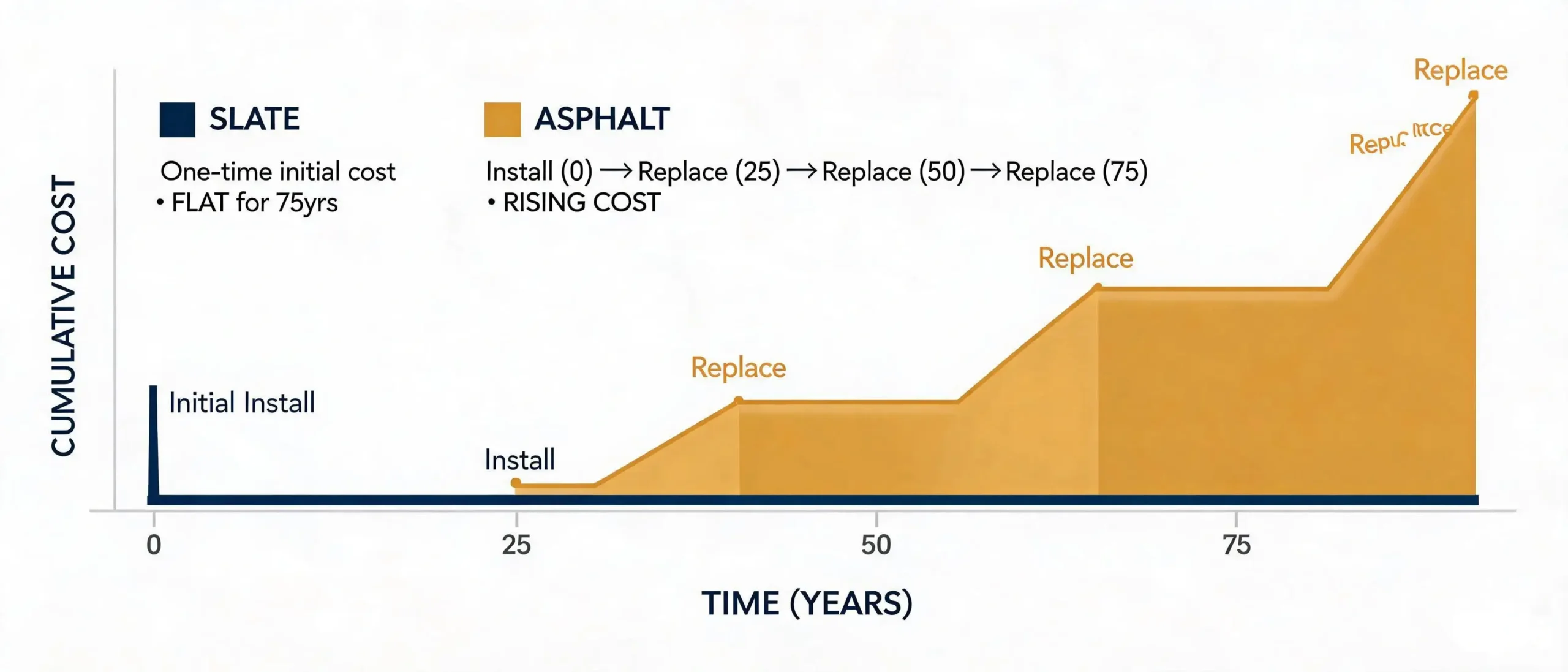
The numbers are illustrative — every roof is different — but the shape of the curve is not. Asphalt has a sawtooth pattern: install, deteriorate, replace, repeat. Slate has a flat line after day one.
I tell clients this: asphalt's most expensive day is installation day. Slate's most expensive day is also installation day. The difference is slate has only one expensive day.
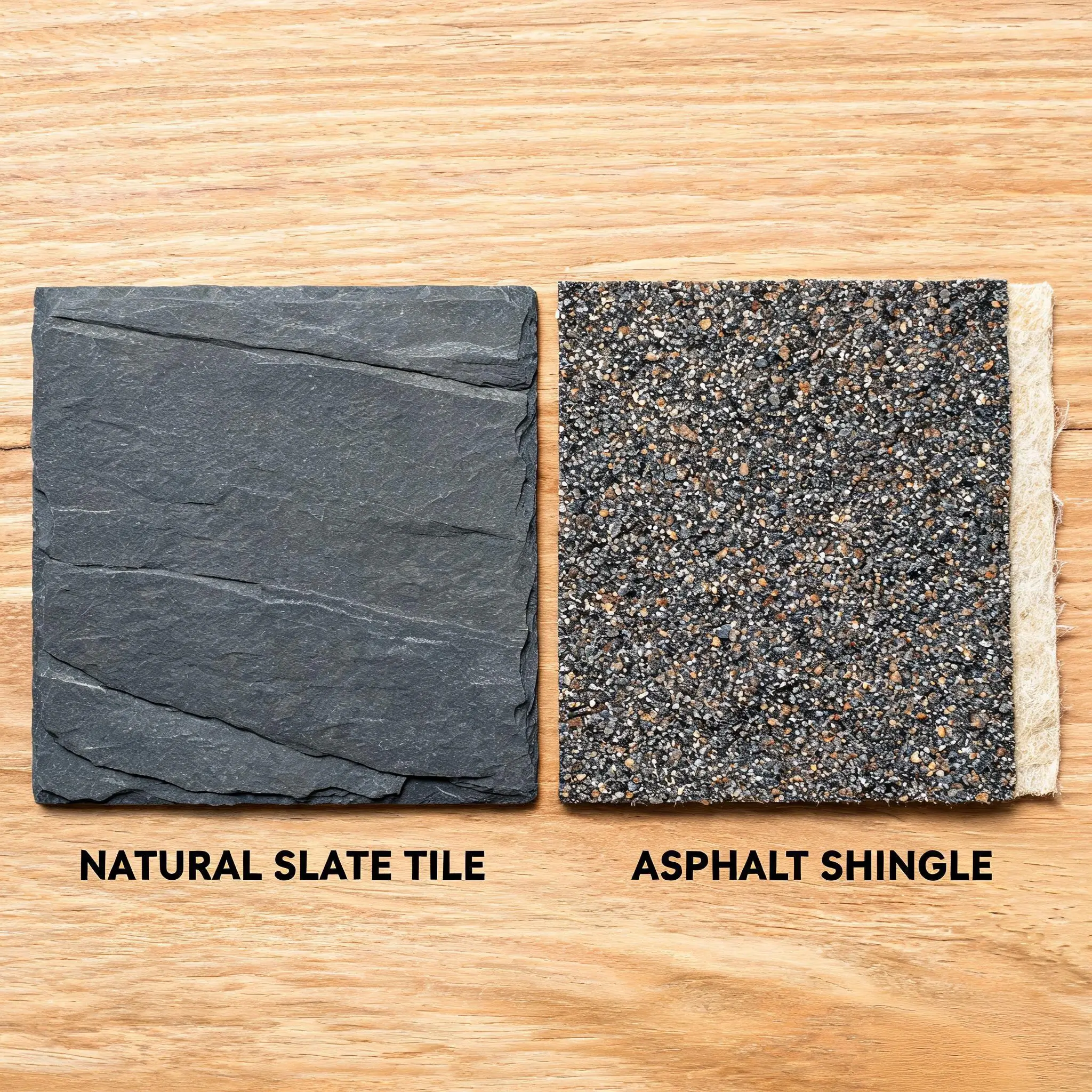
What You're Actually Buying: Stone vs Petroleum Felt
Let's be clear about what these two materials are, because the price difference makes more sense when you know what's in your hand.
Natural slate is a metamorphic rock. It was formed over 300 million years from volcanic ash and clay compressed under tectonic pressure until the minerals recrystallised into a dense, fissile stone. You split it with a chisel and it comes apart in flat sheets. It's stone. It's inert. It doesn't burn, doesn't melt, doesn't curl and doesn't leach. Our Lushan slate has a water absorption rate of 0.2% — meaning if you leave a slate tile in a bucket of water for 48 hours, it gains almost no weight. That number matters more than any other single property for roof longevity, and I'll come back to it.
Asphalt shingles are a composite: a fibreglass mat soaked in bitumen (a petroleum by-product), coated with mineral granules for UV protection. The bitumen gives them waterproofing. The granules give them colour and slow down the sun's damage. But bitumen is an organic compound. It oxidises. It gets brittle in cold, soft in heat. The granules fall off over time. The mat cracks. Fifteen to twenty years in, the shingle has lost its flexibility and the roof needs replacing.
One is a rock that has already survived 300 million years of weather. The other is a petroleum product designed to survive 15–20 years of weather. The price gap is not arbitrary — it reflects what each material actually is.
Lifespan: The Number That Changes Everything
I'm going to give you the honest range for both, because anyone who gives you a single number is selling something.
Asphalt shingles: 15–20 years for standard three-tab, 20–25 years for architectural (laminated) shingles, 25–30 years for premium architectural under ideal conditions. But "ideal conditions" means moderate climate, correct installation, good ventilation and no severe storms. In practice, most asphalt roofs in the UK and northern Europe need replacement at 18–20 years. In hot climates with intense UV exposure, it can be 12–15.
Natural slate: 100–150 years for quality slate. The key word is "quality" — slate from a properly tested source (EN 12326 or ASTM C406 grade S1) will outlast the building. I've inspected slate roofs in Wales that were installed in the 1890s and are still weathertight. Our Jiujiang slate test results show 0.2% water absorption and zero weight loss after 120 freeze-thaw cycles — those are the numbers that predict century-scale durability.
Here's a perspective I give clients: if you install slate today, the roof will likely outlive your mortgage, your ownership, and possibly your grandchildren's ownership. If you install asphalt, you'll replace it before your mortgage is paid off.
Cost Over Time: The Hidden Bills
The upfront number is easy to compare. The hidden costs are what catch people. Let me break down what actually happens over 75 years.
Asphalt hidden costs:
- Each replacement costs more than the last. Inflation, labour rates and disposal fees rise. The £12,000 roof you install today will cost £16,000–19,000 to replace in 20 years, even before you account for the tear-off and disposal of the old roof.
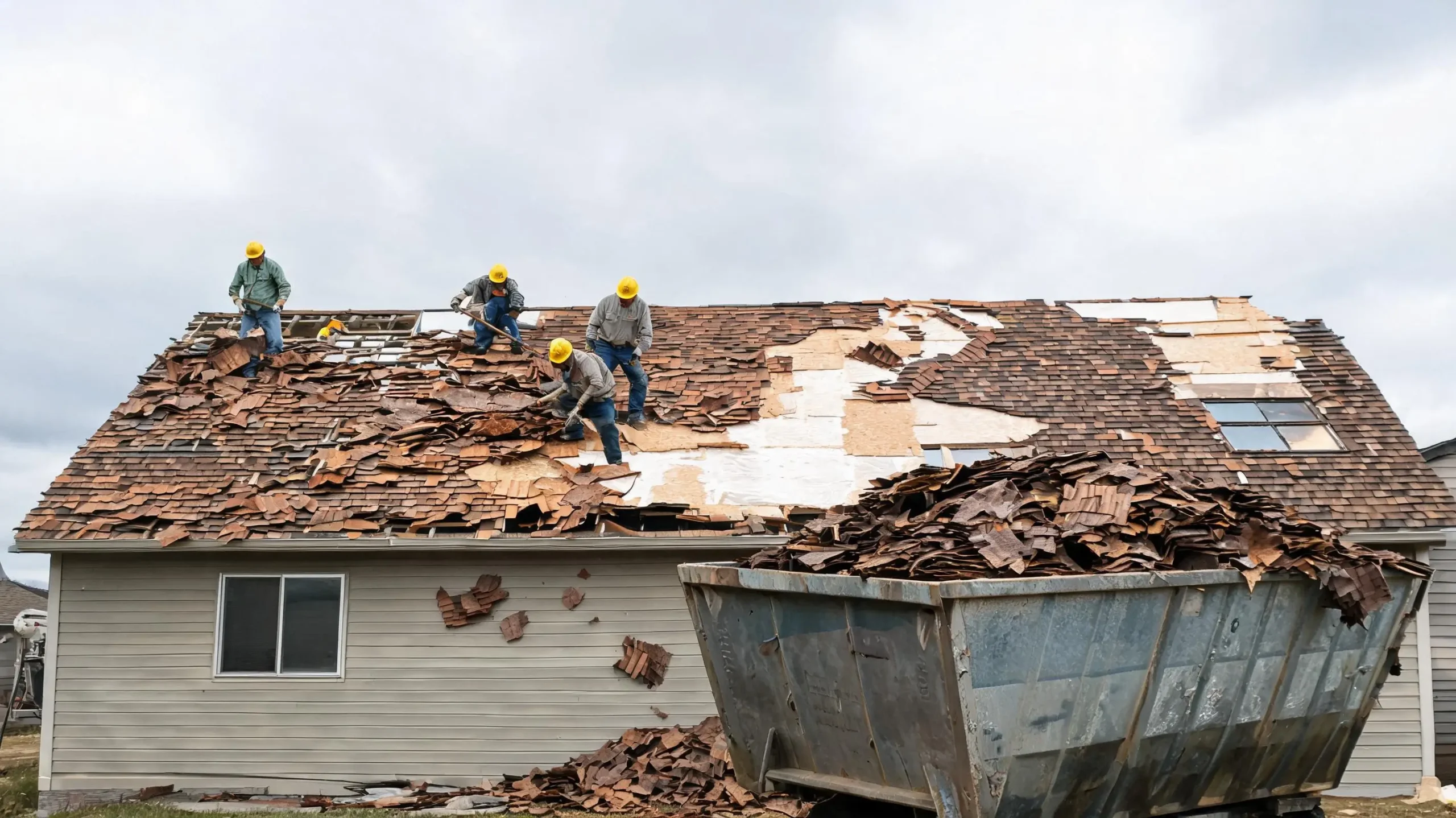
- Tear-off and disposal. Every replacement means stripping 2–3 tonnes of old shingles off your roof and taking them to landfill. In the UK, asphalt shingle disposal costs £200–400 per skip. You'll pay this three times.
- Labour is 2–3× material cost. Asphalt shingle material is cheap; the installation labour is not. Each replacement pays the full labour cost again — scaffolding, stripping, underlayment, new shingles, ridge caps, cleanup.
- Repairs between replacements. Asphalt roofs develop lifted edges, lost granules and cracked seals. Typical repair bills: £500–1,200 per incident, usually starting at year 8–10.
Slate hidden costs:
- Structural check. Slate is heavier — 19–24 kg/m² for 7–9mm slate vs 10–13 kg/m² for asphalt. Most structures can handle it, but a structural surveyor should confirm. Budget £200–400 for this check. You can read more about slate weight and structural requirements in our dedicated guide.
- Flashing replacement at year 50. The metal flashings (valleys, chimneys, junctions) will need replacing around year 50, even though the slate is fine. Budget £2,000–3,000. This is the single largest maintenance cost in a slate roof's life — and it's still less than one asphalt replacement.
- Occasional tile replacement. A slipped or cracked tile costs £150–300 to replace, including labour. Over 75 years, expect 5–10 such repairs. Total: £1,000–3,000.
The pattern is clear: asphalt has small bills that accumulate into large ones. Slate has one large bill and then near-zero for decades.
Weather Performance: Hail, Wind, Fire
This is where the materials diverge most sharply, and where I've seen the most expensive asphalt roof failures.
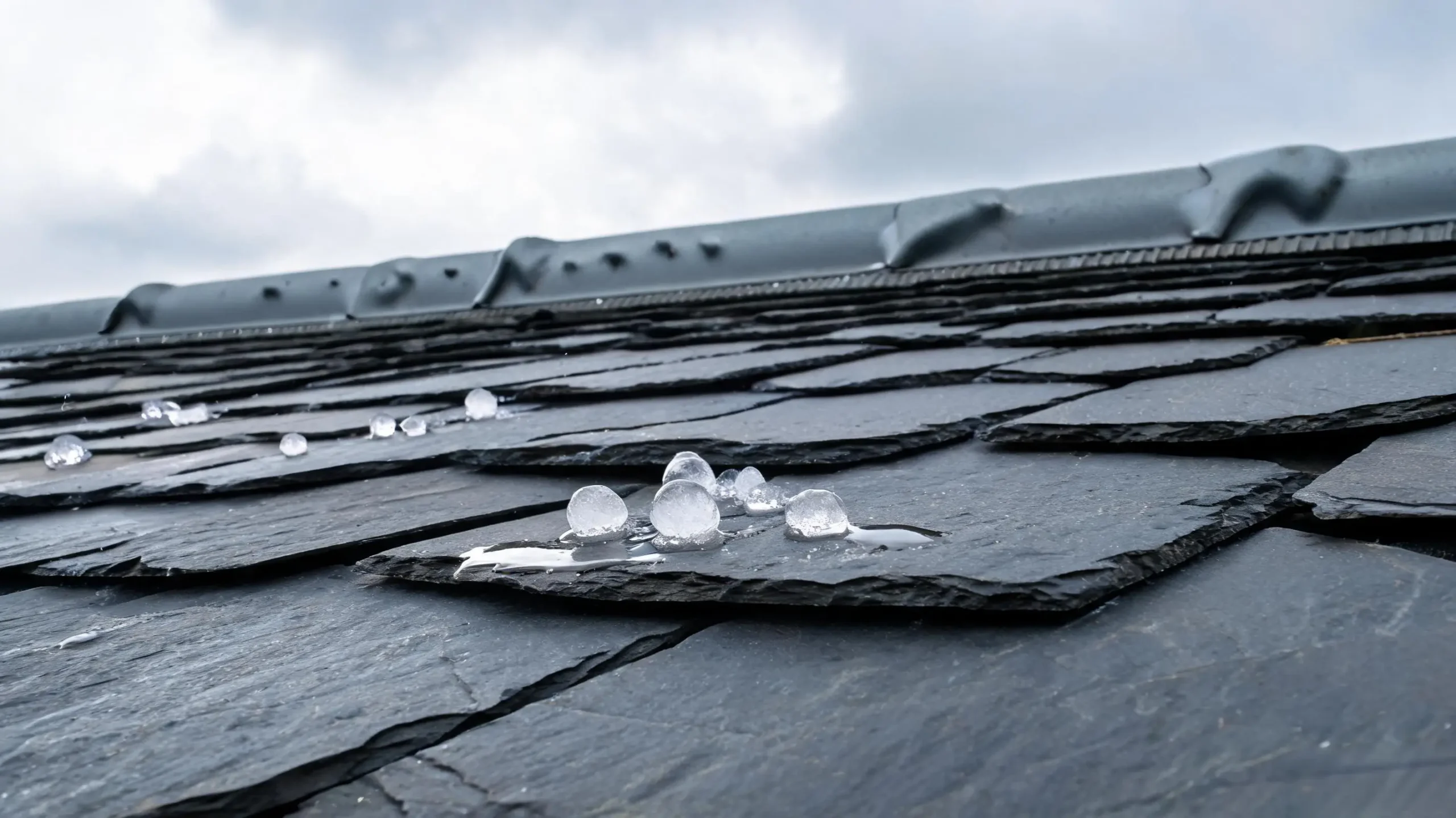
Hail: Asphalt shingles are rated Class 1–4 for impact resistance, but even Class 4 shingles can bruise and lose granules after hail larger than 20mm. Once the granules are gone, the bitumen is exposed to UV and the shingle starts dying. I've seen entire estates of asphalt roofs written off after one hailstorm — the damage isn't always visible from the ground, but the insurer's adjuster finds it. Slate? Hail bounces off. I've inspected slate roofs after hailstorms that destroyed every asphalt roof in the same village. Not a scratch.
Wind: Standard asphalt shingles are rated for 60–110 mph (95–175 km/h) wind uplift. Premium architectural shingles go to 130 mph. But these are lab ratings — in the real world, poorly installed shingles lift and tear at much lower speeds. Slate fixed with copper nails or hooks holds in 150+ km/h winds. The wind performance of slate is a function of the fixing method, not the material alone — but the material's rigidity means wind can't peel it.
Fire: Asphalt shingles have a Class A fire rating — but that means they resist external flame for a defined period, not that they don't burn. Bitumen is a petroleum product; given enough heat, it will burn. Slate is non-combustible. It doesn't burn. It doesn't melt. It doesn't emit toxic fumes. For properties in wildfire-prone areas, this is not a minor advantage.
Weight and Structure: The One Honest Hurdle
I'm not going to pretend slate has no drawbacks. It does, and the biggest one is weight.
A typical 7–9mm slate roof weighs 19–24 kg/m². An asphalt shingle roof weighs 10–13 kg/m². For a 200 m² roof, that's the difference between 2,400 kg and 4,800 kg of roofing material sitting on your walls. It's real, and it matters.
But here's what I've found in practice: most buildings built before 1950 are already structured for slate or clay tile loads. Victorian, Edwardian and earlier buildings were designed for heavy roofs. Modern timber-frame buildings are the ones that need a structural check. If you're building new, your architect will specify the trusses to carry the load — it's a small premium on the structural package, not a deal-breaker.
For a retrofit on a lightweight structure, you have two options: upgrade the roof structure (adding £15–30 per m² to the project) or use thinner slate (5–6mm, which brings the weight down to 13–16 kg/m²). We produce slate as thin as 5mm specifically for weight-sensitive projects.
The weight question is the right question to ask. It's also usually the last serious objection, because once you've confirmed the structure can take it, every other comparison favours slate.
Appearance and Ageing: Gets Better vs Gets Tired
This is subjective, but I've watched enough roofs age to tell you what happens.
Asphalt shingles look good for the first 3–5 years. Then the granules start wearing, the colour fades, edges curl, and black streaks of algae appear (especially on north-facing slopes). By year 10, an asphalt roof looks tired. By year 15, it looks like it needs replacing — because it does. There's a reason estate agents photograph houses from angles that avoid the roof when the shingles are old.
Slate ages differently. Natural slate doesn't fade — the colour is in the mineral, not a coating. The surface may develop a slight patina from decades of weather, but that patina is what people pay extra for on period properties. A 50-year-old slate roof looks distinguished. A 50-year-old asphalt roof doesn't exist — it was replaced at year 20.
The natural colour range of slate — black, grey, green, purple, rust — is geological, not manufactured. It doesn't wash out. The colour you see on day one is the colour your grandchildren will see.
Maintenance: Replace vs Repair
Asphalt roofs are maintainable but not repairable in the long term. You can patch a lifted shingle, seal a leak, replace a damaged section. But the underlying material is deteriorating everywhere, uniformly. Patching buys time; it doesn't reverse ageing.
Slate roofs are repairable indefinitely. If a tile breaks, you replace that tile. If flashing fails, you replace the flashing. The rest of the roof is untouched. Our slate roof repair guide walks through the process — it takes a competent roofer about 20 minutes per tile. The slate around the repair is as good as the day it was installed.
This is the fundamental maintenance difference: asphalt degrades as a system, slate degrades as individual tiles. You don't replace a slate roof because it's old. You replace individual slates because they were damaged by impact or poor installation. The rest of the roof is structurally identical to the day it went on.
Resale Value: What the Surveyor Sees
I work with estate agents and surveyors regularly. Here's what I've learned about how roofs affect property value.
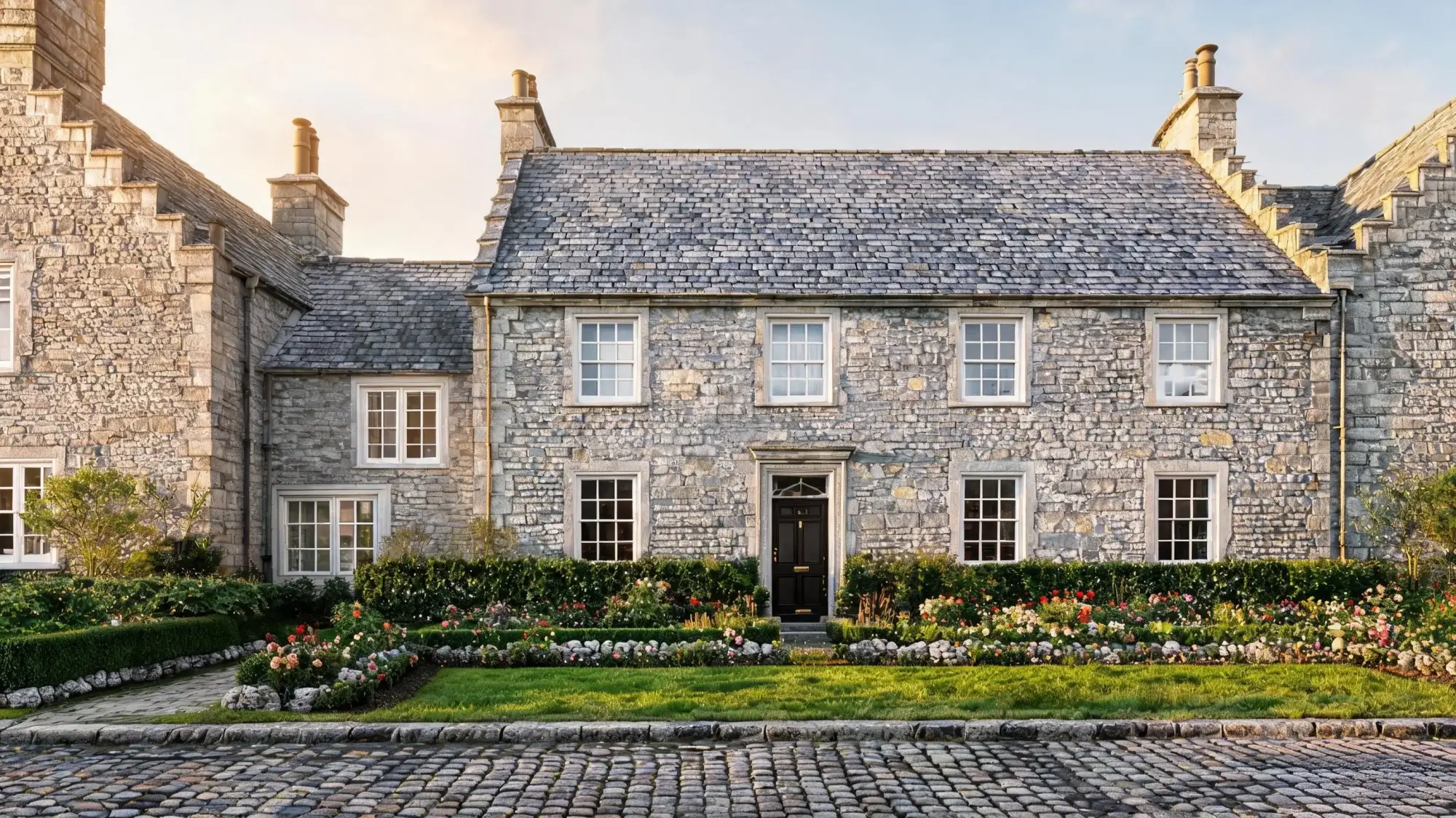
A slate roof is a signal. When a surveyor or a buyer sees a slate roof, the signal is: this building was built (or renovated) with quality materials by someone who cared. It's the same signal as solid oak doors or original sash windows — it tells a story about the whole building's quality.
An asphalt roof is neutral. It doesn't hurt, it doesn't help. But an old asphalt roof hurts — a buyer's surveyor will flag a 15-year-old asphalt roof as "approaching end of life" and the buyer will either walk or use it as a negotiating chip to drop the price.
I've seen properties with slate roofs command 5–10% premium over comparable properties with asphalt roofs in the same area. That premium isn't just about the roof — it's about what the roof implies about the rest of the building. But the implication is usually correct, because people who install slate tend to maintain other parts of the building to the same standard.
For heritage properties and conservation areas, slate is often required by the local authority. An asphalt roof in a slate-roofed street sticks out — and not in a good way.
Environmental Cost: Dug vs Distilled
I mention this because more clients ask about it every year, and the answer isn't what most people expect.
Asphalt shingles: Made from petroleum bitumen. Each replacement sends 2–3 tonnes of non-recyclable waste to landfill. Over 75 years, that's 6–9 tonnes of petroleum-based waste from one roof. Some shingles can be recycled into road asphalt, but the recycling rate is low — under 10% in most markets.
Natural slate: Quarried from the ground, split by hand or machine, cut to size. No firing, no chemical processing, no petroleum. At end of life (which may be 150 years away), slate is inert stone — it can be reused as roofing slate, used as hardcore, or left in the ground with zero environmental harm. Our slate production process uses only mechanical energy — splitting, cutting, sorting. No kilns, no chemical treatment.
The carbon footprint of slate is primarily from quarrying and shipping. A 20ft container of our slate travels from Jiujiang to Europe — but that single shipment provides a roof for 100+ years. An asphalt roof requires no transoceanic shipping, but it requires petroleum extraction, refining, manufacturing and three replacements. The lifetime comparison is not as close as asphalt manufacturers suggest.
When Asphalt Makes Sense
I'm an advocate for slate, but I'm not a zealot. There are situations where asphalt is the right answer, and I tell clients so.
- Budget-constrained projects. If the money isn't there, it isn't there. A £12,000 asphalt roof that keeps the rain out is better than no roof. Don't go into debt for slate.
- Short ownership horizon. If you're flipping a property in 2–3 years, you won't see the ROI on slate. The next owner will, but that's their gain, not yours. Asphalt is the rational choice for short holds.
- Lightweight structures. If the roof structure can't carry slate and you can't afford to upgrade it, asphalt is the practical answer.
- Very low-pitch roofs. Slate needs a minimum pitch (usually 20–25°). Below that, asphalt shingles or membrane roofing are the options. See our guide on minimum roof pitch for slate.
- Temporary buildings or extensions. A garage, shed or temporary structure that won't last 20 years doesn't need a 100-year roof.
When Slate Makes Sense
- Long-term ownership. If you plan to own the building for 20+ years, slate is already cheaper by year 20.
- Heritage and conservation properties. Slate is often required, and it preserves the architectural character.
- High-wind or hail-prone areas. Slate's weather resistance is dramatically superior.
- Properties where resale value matters. Slate is a positive signal to buyers and surveyors.
- Environmentally conscious projects. Slate has a fraction of asphalt's lifetime environmental impact.
- Insurance-sensitive properties. Many insurers offer lower premiums for slate roofs because they don't burn and don't fail in storms.
The Decision Framework
If you've read this far, you're probably leaning toward slate and want to know if it works for your specific project. Here's the framework I use with clients.
| Question | If Yes → Slate | If No → Asphalt |
|---|---|---|
| Will you own the building 20+ years? | ROI kicks in by year 20 | Short hold, asphalt is rational |
| Can the structure carry 20 kg/m²? | Most pre-1950 buildings can | Use thin slate or asphalt |
| Is the roof pitch above 20°? | Slate works | Asphalt or membrane needed |
| Is it a heritage/conservation area? | Slate required | Asphalt acceptable |
| Hail or high-wind exposure? | Slate dramatically superior | Asphalt OK with upgrading |
| Budget under £15k for 200 m²? | Not feasible for full slate | Asphalt is the answer |
If you answered "yes" to three or more of the slate columns, the math almost always works in slate's favour. If you answered "no" to three or more, asphalt is honest and practical. Neither choice is wrong — but only one choice is still standing in 75 years.
If you want to run the numbers for your specific project — your roof area, your pitch, your climate — send us the details. We'll give you a material specification, a price indication, and an honest assessment of whether slate is the right call for your building. We produce EN 12326 / ASTM C406 tested roofing slate from our Jiujiang factory, with CNC-processed tolerances of ±0.2mm and 100% individual tile inspection. We export to 30+ countries and we're happy to send physical samples so you can judge the material yourself before deciding.
You can also browse our roofing slate products to see sizes, thicknesses and colour options.
Frequently Asked Questions
Is a slate roof worth the extra cost over asphalt shingles?
Over a 75-year period, yes. Slate costs 2–3× more upfront but requires zero full replacements, while asphalt needs 3 replacements in the same period. By year 20, slate's cumulative cost is already lower. By year 75, slate costs roughly 40% of what asphalt costs over the same period. The break-even point is typically 18–22 years.
Do slate roofs get lower insurance premiums than asphalt?
Often, yes. Slate is non-combustible, impact-resistant and doesn't fail in high winds when properly fixed. Many insurers in the UK and Europe offer reduced premiums for slate roofs, particularly in hail-prone or wildfire-risk areas. Check with your insurer — the savings can be 10–20% on the buildings portion of your policy.
Does a slate roof increase property value compared to asphalt?
Slate is a positive signal to surveyors and buyers. It implies quality construction throughout. In practice, properties with slate roofs in slate-roofed areas command 5–10% price premiums over comparable asphalt-roofed properties. In conservation areas, slate may be required by the local authority, making it essential rather than optional.
Can my roof structure support slate instead of asphalt?
Most buildings built before 1950 are already structured for slate or clay tile loads. Modern timber-frame buildings need a structural check — budget £200–400 for a surveyor. If the structure is lightweight, you can either upgrade the trusses (£15–30/m²) or use thinner 5–6mm slate (13–16 kg/m²), which is close to asphalt weight.
When is asphalt actually the better choice over slate?
Asphalt makes sense for short ownership horizons (under 10 years), budget-constrained projects (under £15k for a 200 m² roof), very low-pitch roofs (below 20°), temporary structures, or buildings where the structure genuinely can't be upgraded. It's an honest, practical material for those situations. The mistake is choosing asphalt for a long-term home and being surprised by the replacement bill at year 18.
What happens to old asphalt shingles when they're replaced?
In most markets, over 90% of torn-off asphalt shingles go to landfill. A 200 m² asphalt roof produces 2–3 tonnes of petroleum-based waste per replacement. Over 75 years, that's 6–9 tonnes from one roof. Some regions have shingle recycling programmes (converting old shingles to road asphalt), but uptake is low. Slate, by contrast, can be reused as roofing slate or left as inert stone with zero environmental harm.
Run the Numbers for Your Project
The 75-year ledger tells the story, but your project has its own numbers. Send us your roof area, pitch and location — we'll send back a material specification, a price indication, and an honest assessment of whether slate is the right call.
Request a quote and samples → | Browse roofing slate products