
Common Roofing Slate Defects: A Field Guide to Cracks, Pyrite and Delamination
Quick answer — how a slate works decides: a mark is a defect when it changes the stone's strength or its future on the roof, not when it simply looks unusual. A shallow parting line that follows the cleavage is usually harmless. A crack that opens, enters from a free edge, or shows on both faces is not — whatever direction it runs. A flaking edge is a reject. Pyrite and pale carbonate bands are judged from the test report and the stone's mineral character, not from counting specks by eye. And a tap with a trowel handle is a screening check, not a verdict.
Part of the Roofing Slate Guide's Quality, Testing & Standards section. This page is the "what's on the stone" companion to our delivery inspection checklist, and the surface-level side of the carbonate story. If you have ever held a tile, squinted at a mark, and wondered whether it is a problem or just a rock being a rock, this is the page.
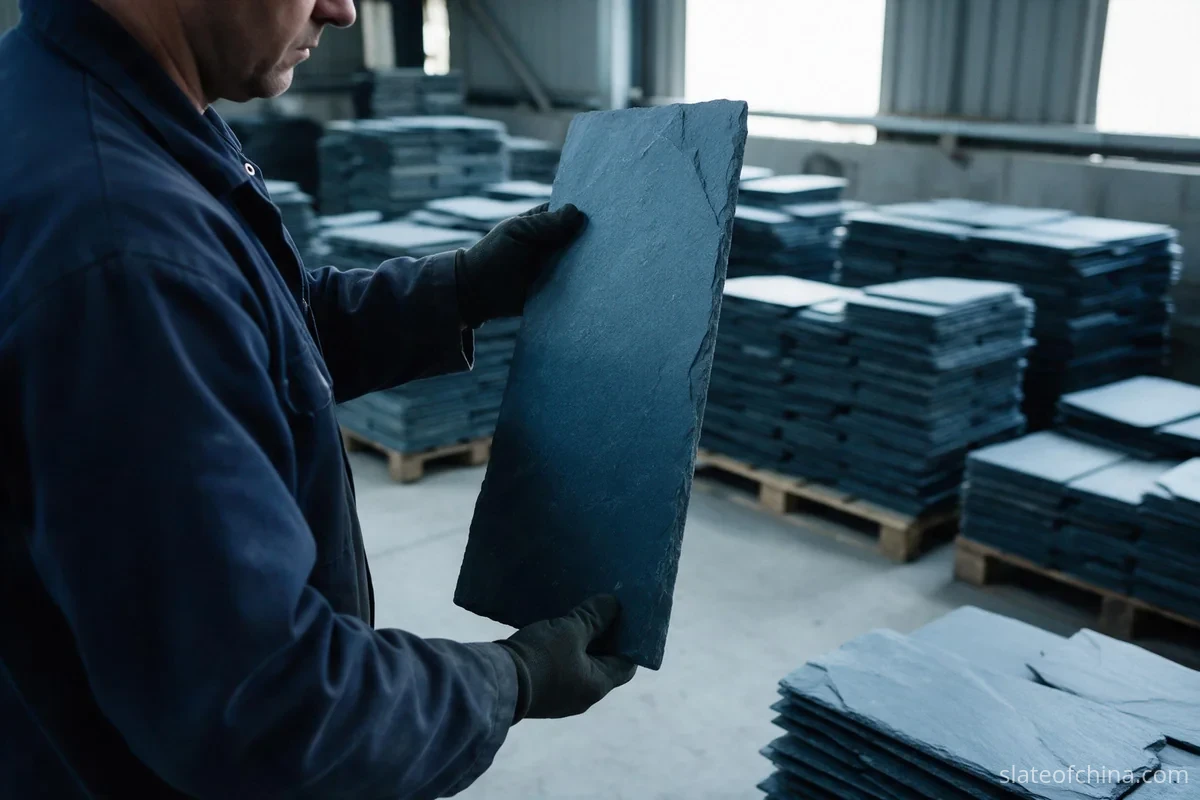
In a slate works, "defect" is not a description. It is a decision at the sorting bench — the moment a benchman looks at a tile and chooses the crate or the reject pallet. Thousands of those decisions, repeated, are what a buyer receives. Most disagreements about "defective slate" are really disagreements about where that line was drawn, and about whether it was drawn the same way on both sides of the contract.
The five families below cover most of what shows up in a roofing slate consignment: cracks, delamination, pyrite, carbonate bands and edge damage. A sixth category only appears after a winter on the roof, which is why it gets its own section. For each one, the useful questions are the same: what is it, why is it there, what does it change, and what can a buyer reasonably do about it at inspection.
One caution before the list. Nearly every mark on a natural slate is, in some sense, natural — the stone formed it, or the split revealed it. Naturalness is not the question. The question is whether the mark changes strength, water resistance or service life. A photograph cannot answer that on its own; an agreed specification, a retained sample and a test report can.
The three questions that decide most calls
Defect names are useful for conversation and less useful for decisions. In practice, three questions sort almost every mark you will meet.
- Is it in the stone, or on it? A mark on the face often comes from handling, transport or the surface of the cleft, and it usually behaves like a surface feature: it stays cosmetic. A mark inside the stone was there when the rock formed, and it behaves differently once the tile is on a roof and working under load, wind and water.
- Does it change the structure, or only the appearance? Roofing slate has a cleavage — the plane along which it splits into sheets. A hairline that follows that plane may be only a parting line, skin deep. A fracture is a different thing: it cuts the stone's internal structure, it often opens slightly, it can be felt with a fingernail, and it may be visible on the reverse face. The trade shorthand "along the grain / across the grain" is a useful first look, but it is not a rule that decides acceptance by itself. What decides is whether the stone is broken through.
- What does a tap tell you — and what else does the tile show? A light tap with a trowel handle or a small hammer will make a sound tile ring and a broken one thud, and it is worth doing on every tile you sample. The sound is affected by tile size, thickness, how the tile is held, what it is resting on, and where you strike it, so treat a dull note as a reason to look closer at that tile rather than as proof about a consignment. Sound supports the eye; it does not replace it, and it does not replace the laboratory tests named in the specification. The terminology page defines cleavage, grain and cleft if you want the vocabulary first.
Defect #1: Cracks — direction helps, but it does not decide
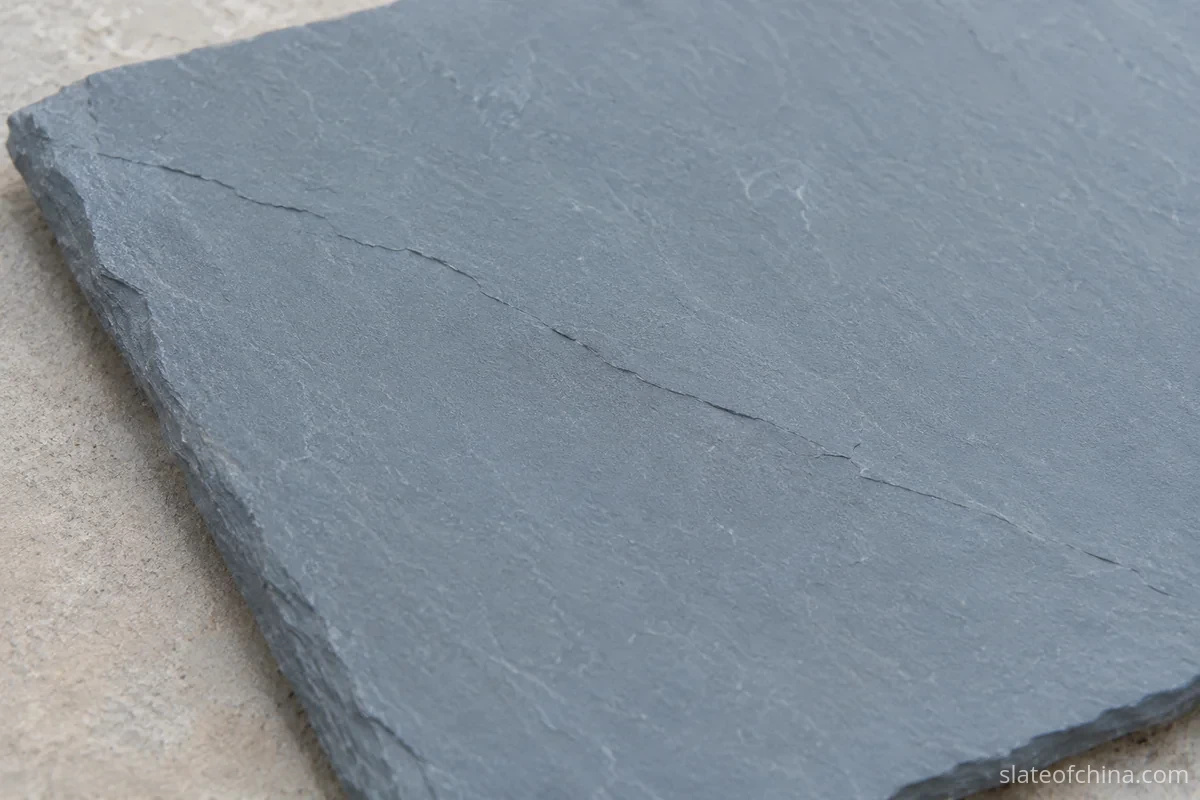
A crack exists when the stone has separated along a plane that is not its cleavage. That distinction matters, because slate is a stone that is supposed to have planes. It was mud, compressed and heated until it could be split into sheets, and those sheets separate along the cleavage. A line on the face that runs parallel to the split may simply be where the stone would have parted anyway.
What makes a crack a defect is not its direction but its depth and continuity. Four checks, done together, separate the two cases:
- The nail test. Run a thumbnail across the line. A parting line lies in the surface and the nail passes over it. A fracture has an edge and the nail catches.
- The opening. A fracture is usually slightly open, and the two sides no longer sit perfectly level. A parting line does not displace the face.
- The reverse face. Turn the tile over. A line that appears in the same place on both faces is a through-crack, whichever way it runs.
- The origin. A line that starts at a free edge and runs into the tile is behaving like a fracture from fixing, handling or impact. A line that sits entirely within the face and parallel to the cleavage is more likely a parting feature.
The working rule is therefore narrower than the folk version. Reject any crack that runs through the tile, opens, or enters from a free edge. Accept a shallow surface parting line — if it does not catch, does not appear on the reverse, and the agreed specification allows it — and record how many tiles carry one. What a buyer should not do is accept a tile because the line "runs the right way". A through-crack that happens to be parallel to the cleavage is still a through-crack, and water and frost will find it from the exposed edge.
There is also the crack you cannot see. An internal fracture with no surface expression will not show on a photograph, which is why the tap, the wet face and the edge check belong in the same routine. A sample cut from a broken tile tells you more than any single image.
Defect #2: Delamination — a structural defect, not a surface mark
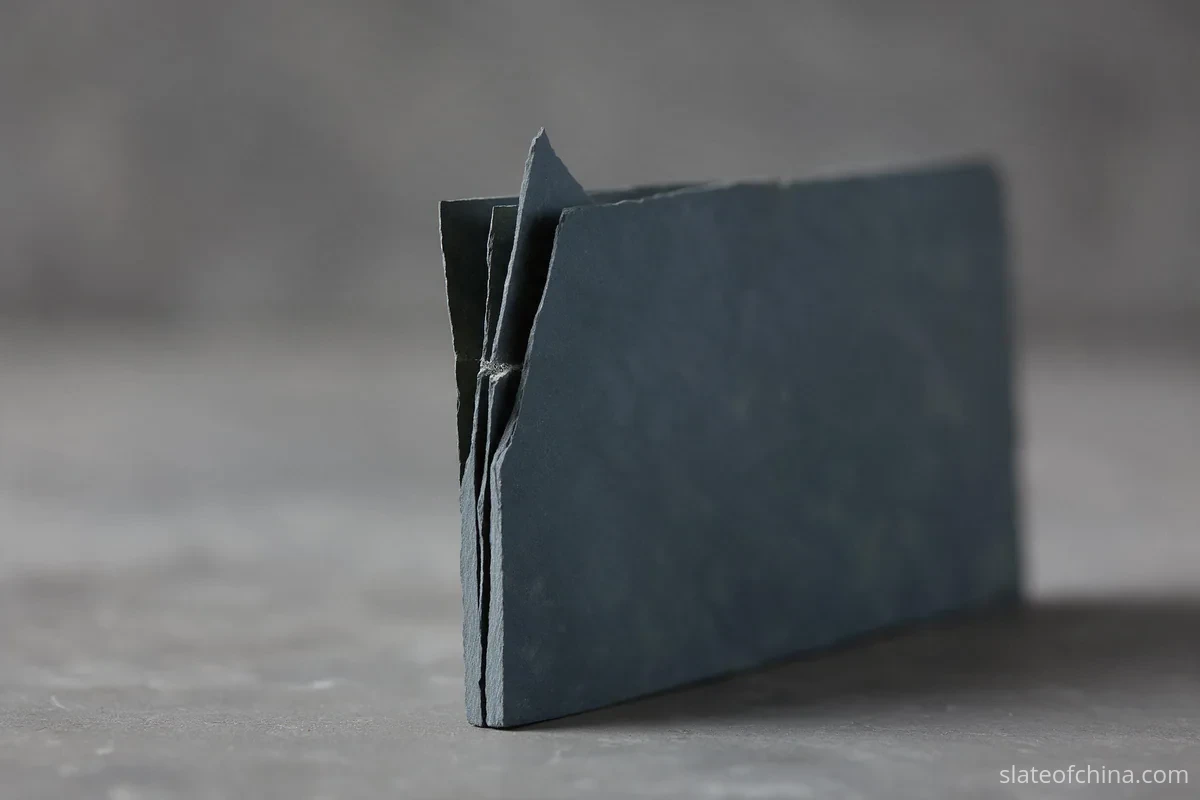
Delamination is the separation of the layers within a single tile. This is different from cleavage, which is the property that lets a block be split into tiles in the first place. Cleavage is how the slate was made; delamination is the tile coming apart after it was made, along a plane inside its own thickness.
At the bench it looks like a flaking or crumbly edge, a powdery pale line running along the split edge, a corner lifting like the pages of a book, or a thickness that tapers where it should be constant. Tap it and the note is dull, because the stone has stopped being one piece and become several thin ones resting on each other.
The cause is usually in the rock rather than in the handling: a clay-rich band, a plane where the cleavage is irregular, or a zone near the edge of a block where the split did not run clean. Once a tile is on a roof, water entering that edge and freezing can widen the separation over many seasons, which is why a marginal tile can look acceptable at packing and poor after ten winters.
The consequence is structural. A delaminated tile has lost section, and section is strength. It is also a path for water, and a wet, laminated edge is exactly where frost does its most efficient work. In our experience at the bench, edge flaking is one of the most frequent reasons a tile that passed a quick visual look gets pulled before packing — not because the face was wrong, but because the edge was already opening.
The decision here is the least negotiable on this page: delamination is a reject. It cannot be dried, pressed or glued back into a sound tile, and it does not stop. When a sample tile shows it, the useful next step is not to argue about that tile but to look at the same position in the crates around it, because the cause is usually in the block, not in one tile.
Defect #3: Pyrite — count less, character more
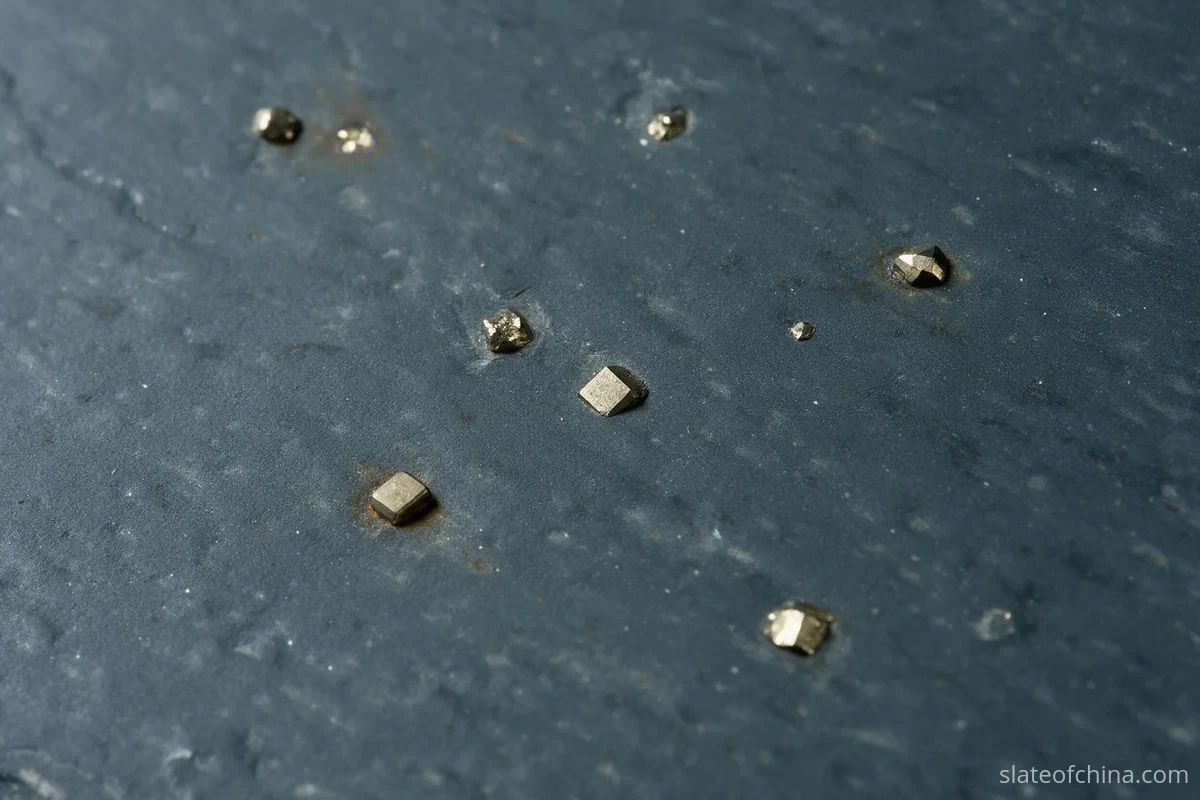
Pyrite is iron sulphide, and in slate it appears as small brassy or golden grains embedded in the stone. It is common enough that a quarry with none of it is unusual, and a few fine specks are not, by themselves, a reason to reject a consignment.
What makes pyrite worth watching is what it does when it oxidises. Exposed to air and moisture, iron sulphide breaks down into iron oxide and sulphuric acid. The products take up more space than the original grain, so the surface around it lifts and pits; and the acid attacks carbonate minerals in the same stone, which is a small, self-inflicted acid attack inside the tile. Where the pyrite sits on a cleavage plane rather than on the face, the expansion can work the layers apart from within — a delamination with no visible surface crack.
Risk is therefore a function of several things acting together, not of a count:
- Character and size of the grains. Fine, widely scattered grains locked in the matrix behave differently from coarse, clustered crystals sitting on a plane.
- Position. Grains on a cleavage plane or near a free edge have a shorter route to cause separation than grains buried in sound stone.
- The rest of the chemistry. Sulphur and iron on one line, carbonate on another. High sulphur with high carbonate is the combination to question hardest, because the acid produced has something to attack.
- Exposure. A wet, polluted or coastal roof gives oxidation more to work with than a dry sheltered one.
This is why the standards ask for declared numbers rather than visible impressions. EN 12326-1, the product specification for slate used in discontinuous roofing and cladding, requires the producer to declare chemical and mineralogical composition — including the carbonate-, sulphur- and iron-related figures — and EN 12326-2 sets out the test methods. In North America, where an acid-weathering result is required, a treatment such as ASTM C217 immerses slate in acid and measures the mass lost. Read the declared rows, the methods and any limits from the edition of the standard cited on the report itself, not from a supplier's summary.
For our own stone, the published report shows water absorption of around 0.2% and low declared sulphur and iron for the Lushan material; the exact figures and the method sit on the report, and the report is the thing to read. None of these rows predicts service life on its own. A low absorption figure describes how the stone takes up water; it does not describe how a roof will perform in twenty years. That depends on the whole set — chemistry, frost resistance, fixing, pitch and ventilation.
Defect #4: Carbonate ribbons — the pale band that is not decoration
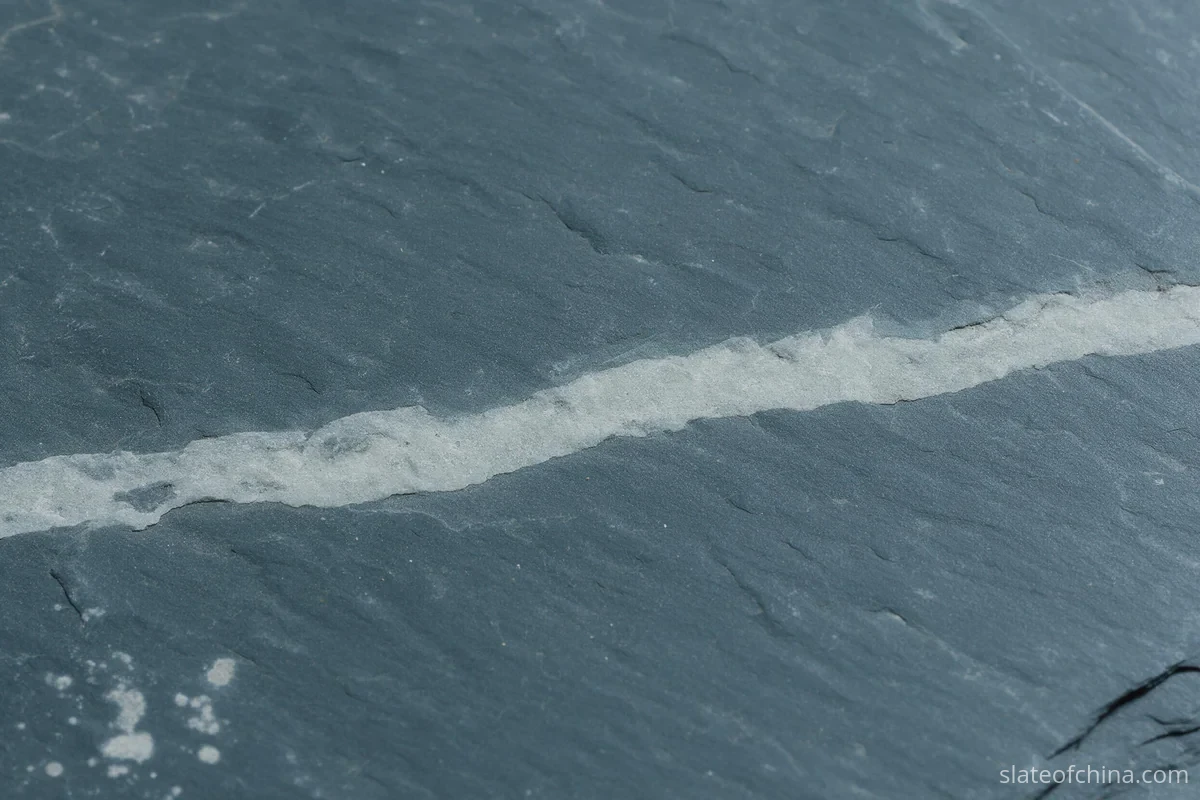
A carbonate ribbon is a vein of calcium carbonate folded into the rock during its formation. It reads as a pale, often grey-white band running through the tile, sometimes with soft, slightly blurred edges, and it usually crosses the full width rather than sitting in one spot. On a fresh split it can look almost decorative, which is exactly why it gets missed.
The problem is chemistry. Carbonate dissolves in weakly acidic water, and rainwater is weakly acidic almost everywhere, more so in industrial and coastal settings. The band erodes faster than the surrounding slate, so a roof that has been up for a decade or two shows it as a shallow groove; eventually the tile thins along that line, and the edge of the tile is the first place to go.
The distinction that matters at inspection is a band versus a mark. A continuous band that follows the bedding across the tile, with soft edges and a chalky, slightly softer surface, is the one to question. Isolated pale specks, a patch of pale mineral, a light grain in one corner — those are ordinary in natural slate and are not, on their own, a defect.
Field screening exists but has limits. A drop of dilute acid on a clean spot will fizz where reactive carbonate is present, and that is a useful ten-second indication for a buyer holding a suspicious tile. It is not a measurement: how strongly it reacts depends on the mineral, the grain size and the surface. Nor is a soft, soapy feel under the thumb a reliable identification, which is why we do not use it. The number that counts is the carbonate content — reported as CaO or as carbonate in the declared composition — and, where it is run, the acid-weathering result. Confirm a suspected band with the laboratory before rejecting a consignment on one tile; our carbonate explainer covers the chemistry and the report rows in detail.
For reference on our own material, the Lushan report shows CaO around 0.56% — a low figure, and one of the reasons the edges hold up. As always, read the row and the method on the certificate rather than the adjective in a brochure.
Defect #5: Edge chips — and the ones that are really handling
A chipped edge is a broken edge: a corner knocked off, a flake missing from a long side, a fresh pale scar where the break is new. It is not the same as a delaminated edge, which is a split rather than a break, and the difference is worth learning because the two behave differently. A chip usually stays where it is. A delaminated edge keeps opening.
Most chips are logistics. One corner off one tile in a crate is an accident in transit or at the dock. Chips in the same position on many tiles, or a run of chipped edges along one face of a bundle, point to packing, strapping or handling rather than to the stone — and that is a conversation with the supplier and the carrier, not a geological verdict. The delivery checklist covers where in the unloading sequence to photograph it so the evidence still holds a week later.
At inspection, the useful record is a count rather than an adjective: how many tiles per crate, in which position, with a photograph that includes the crate number. Compare the count with the breakage allowance agreed in the contract, because that allowance — not a general rule of thumb — is what decides whether a claim stands.
The defect that appears after a winter
There is a category of failure that is not visible in the crate and is not a factory defect in the ordinary sense: the mark that appears after the first hard winter. A tile leaves the quarry sound, gets wet, ships across an ocean in a container, is stacked in a yard and gets wet again. If it carries a hidden hairline, a soft band or a small separation at the edge, that water finds it. The first frost expands what is inside the line and turns it into an open crack.
On a roof, this often shows as a run of tiles on one slope — commonly the colder, wetter, less sunlit one — looking more cracked than the rest a few seasons in. It is worth being precise about cause here, because "the slate was bad" is only one of several explanations. Pitch, ventilation, underlay condition, fixing method and the volume of water the roof actually sees all take part.
What a buyer can control is the stone's side of the equation. Water absorption describes how readily the tile takes up water, and freeze–thaw testing describes what happens to the stone when that water freezes. For context, ASTM C406 sorts roofing slate into S1, S2 and S3 grades by water absorption limits of 0.25%, 0.36% and 0.45% respectively, with each grade carrying its own minimum breaking load. A low-absorption, freeze–thaw-clean slate reduces the risk of a hairline becoming a crack. It does not remove the risk, and it does not guarantee a roof; it simply removes one common cause.
The marks that are not defects
Before the reject pile grows, it is worth naming what belongs on the roof:
- The natural cleft surface. The split face, with its slight irregularity and faint ridging, is the slate's normal face. It is what gives natural slate its depth, and it is not a flaw to be sanded out.
- Isolated pale specks and light grain. Small mineral inclusions, a pale grain of clay, a faint iron stain — ordinary in a natural product, and ordinary in the quantities that matter.
- A shallow parting line along the cleavage. Common, usually skin deep, and acceptable within an agreed allowance when it does not catch or run through.
- Tile-to-tile variation in tone. A natural roof varies. If uniformity is the requirement, the specification should say so before production, because no quarry can promise a single tone across a roof.
The word to hold on to is proportion. One pale mark or one fine pyrite speck is a natural product doing what natural products do. A face of coarse sparkle with rust staining, a carbonate band and an opening edge is a different conversation, and it is a conversation about the batch. The line between the two belongs in the purchase specification, agreed in writing, before the first block is split — not in an argument at the destination port.
The bench card: accept, hold, reject
This is the part worth printing and pinning where tiles are checked. It is a working summary, not a substitute for the specification or the test report.
| You see… | Call it… | What to do… |
|---|---|---|
| A shallow line along the cleavage, no nail catch, one face only, within the agreed allowance. | Parting line, not a crack. | Accept, and record the count. |
| A line that opens, catches a thumbnail, appears on both faces, or enters from a free edge. | Crack. | Reject the tile. Check its neighbours and the crate position. |
| An edge that flakes, a powdery line in the split edge, a corner lifting into layers. | Delamination. | Reject. Inspect the same position in adjacent crates. |
| A few fine, scattered pyrite grains, no staining. | Normal inclusion. | Accept, and note the density. |
| Coarse or clustered pyrite, rust staining spreading from grains. | Pyrite risk. | Hold. Ask for the declared sulphur and iron rows, and the method. |
| A continuous pale band across the tile, soft edges, chalky surface. | Possible carbonate ribbon. | Hold. Acid screen, then carbonate content from the laboratory. |
| Isolated pale speckles, a pale grain, a light patch. | Natural mark. | Accept. This is what natural slate looks like. |
| A dull note when tapped, with nothing visible on the face. | Possible hidden fracture or separation. | Inspect further — reverse face, edge, wet surface. Do not decide on the sound alone. |
| A fresh break at a corner, one or two tiles per crate, no pattern. | Handling damage. | Record and photograph with the crate number, against the agreed allowance. |
Two habits make the card work. Look at both faces and the edges, not just the face that will be seen on the roof — the reverse is where a through-crack declares itself. And wet a few faces: water darkens the stone and makes pale bands, soft edges and surface porosity easier to read than a dry inspection does. The roof will be wet more often than it will be dry, so inspecting it wet is closer to how it will live.
How to inspect roofing slate before shipment
Most of the cost of a defect is decided before the container leaves. A short, disciplined procedure at the factory is worth more than any amount of argument at the destination, and it does not require a laboratory on site — only a specification, a sample, a tape and a camera.
- Agree the acceptance criteria in writing. Which marks are allowed, in what quantity; the thickness tolerance; the breakage allowance; who inspects, and to which standard. Without this, every later disagreement is an opinion against an opinion.
- Sample across the consignment, not from one crate. Pull tiles from the top, middle and bottom of different crates and different pallets. Defects cluster by block and by position in the stack, and a single crate tells you about that crate.
- Check both faces and all four edges of every sampled tile. Face, reverse, split edge. This is where cracks that run through, delamination and edge damage are actually found.
- Measure thickness and check the nominal size. A caliper across the edge, several tiles per crate, compared with the dimension ordered; the size and headlap tables give the reference dimensions for the common specifications.
- Tap and listen — as a screen. Mark the dull ones and inspect them further. Do not accept or reject a consignment on sound alone.
- Wet a few faces. Pale carbonate bands, soft edges and surface condition read more clearly on a wet tile.
- Record, photograph, retain. Counts per defect type, photographs with the crate number in frame, and a sealed sample kept from the inspected lot. The record is what makes a claim possible and a good supplier comfortable.
- Read the test report before you read the price. The declared chemistry and the freeze–thaw and absorption results describe the material; our test-report walk-through decodes each row, and the published results show what the rows look like on our own stone.
The aim is not a consignment with no marks. In a natural stone, that consignment does not exist, and a supplier who promises it is describing a different product. The aim is a consignment whose marks have been seen, classified and accepted against criteria both sides signed — so that the roof is judged on how it performs, not on how a photograph looked.
Why the sorting bench matters more than the quarry
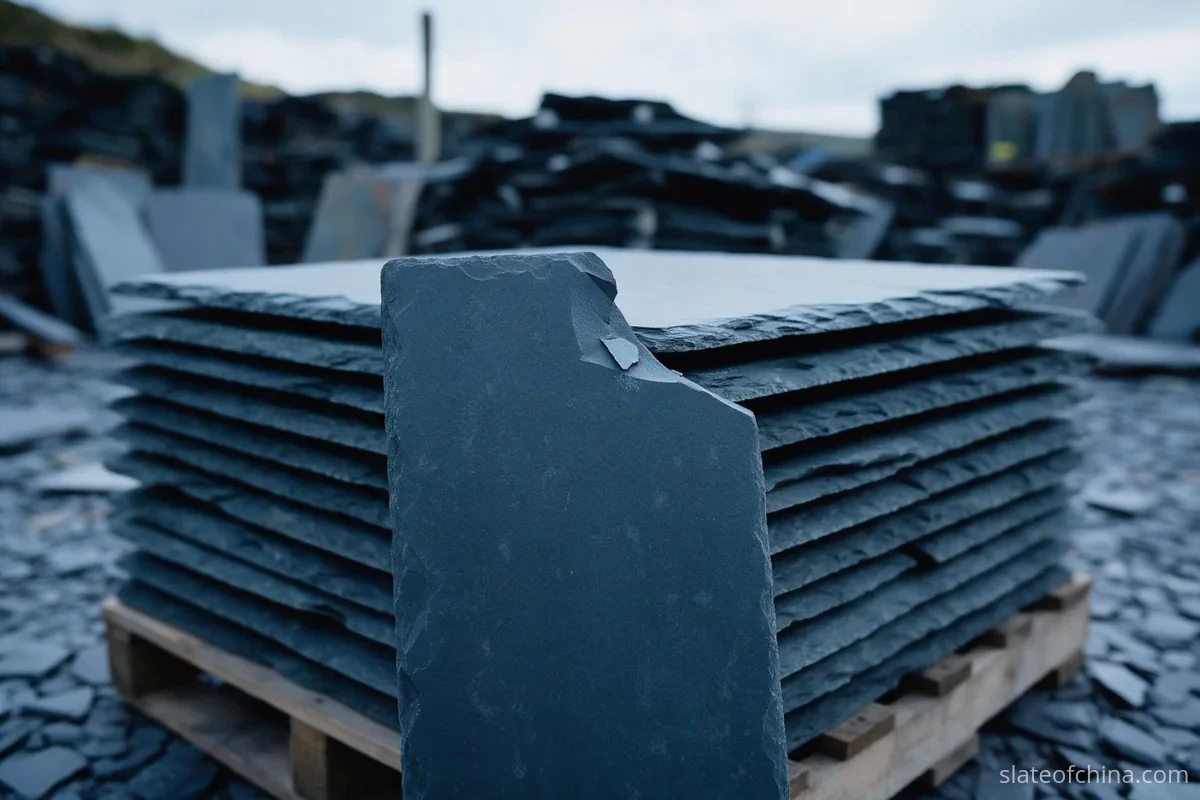
A quarry produces blocks. A factory produces a delivery. The gap between the two is the sorting bench, and that is where the defects on this page are either removed or shipped. A supplier that sorts has a written standard for what it calls a tile, a reject pallet that is actually used, a record of why tiles were pulled, and a reject rate it is willing to state.
That is also the most useful question a buyer can ask. "What is your reject rate at the bench, and what are the top three reasons?" A supplier who can answer has a process. A supplier who cannot has a quarry and a shipping department, and the sorting will happen on your roof instead.
Every tile we ship is graded by hand at the bench before packing, and the reasons for rejection are recorded by batch. If you want the numbers behind that — the chemistry, the absorption, the freeze–thaw results — they are in the test results, and we will send the report before any discussion of price.
Frequently asked questions
Is a crack in roofing slate always a defect?
No, but the direction of the line is not what settles it. A shallow parting line that follows the cleavage, does not catch a fingernail and appears on one face only is usually harmless and can be accepted within the agreed allowance. A crack that opens, that you can feel, that shows on the reverse face or that enters from a free edge is a real defect, whichever way it runs, because it goes through the stone and will grow under load, wind and frost.
What causes white marks on slate roofing?
Two different things, and they are judged differently. A continuous pale band with soft edges and a chalky surface is likely a carbonate ribbon — a limestone vein that erodes faster than the surrounding slate in weakly acidic rain. Isolated pale specks, a pale grain or a light patch are usually harmless mineral colouring. A drop of dilute acid will fizz on reactive carbonate as a quick screen, but the figure that counts is the carbonate content on the test report; a feel test with water is not reliable.
Are pyrite spots a reason to reject roofing slate?
Not by count alone. A few fine, scattered pyrite grains are common in natural slate and are not in themselves a reason to reject. Risk depends on how coarse and how concentrated the grains are, whether they sit on a cleavage plane, and how the rest of the chemistry looks: pyrite oxidises to iron oxide and sulphuric acid, which attacks carbonate in the same stone. Coarse clusters, rust staining, or high sulphur together with high carbonate are the cases to question, and the declared sulphur and iron rows on the EN 12326-1 report are where to look.
What does a delaminated slate look like?
A flaking or crumbly edge, a powdery pale line inside the split edge, a corner that lifts into layers like the pages of a book, or a thickness that tapers where it should be even. It usually taps with a dull note rather than a ring, though the sound depends on size, thickness and how the tile is held. Delamination means the layers of one tile are separating and the tile has lost section, so it is a reject rather than a "watch it".
Can a slate roof defect be repaired?
A broken or delaminated tile is replaced, not repaired — slate does not fuse back together. A few isolated tiles are a straightforward replacement if matching slate is available. If a whole slope or a whole batch is failing, the honest answer is usually a re-roof, and the useful question shifts to why the batch passed the bench in the first place.
Related Reading
Sorted at the bench, so the defects stay in our yard
Every tile is graded by hand before packing, and the reject reasons are recorded by batch — delamination, carbonate bands and pyrite risk are handled on the sorting bench, not on your roof. See the test results, browse the roofing slate range, or ask for samples and the report before you buy.