
How to Handle and Move Billiard Slate
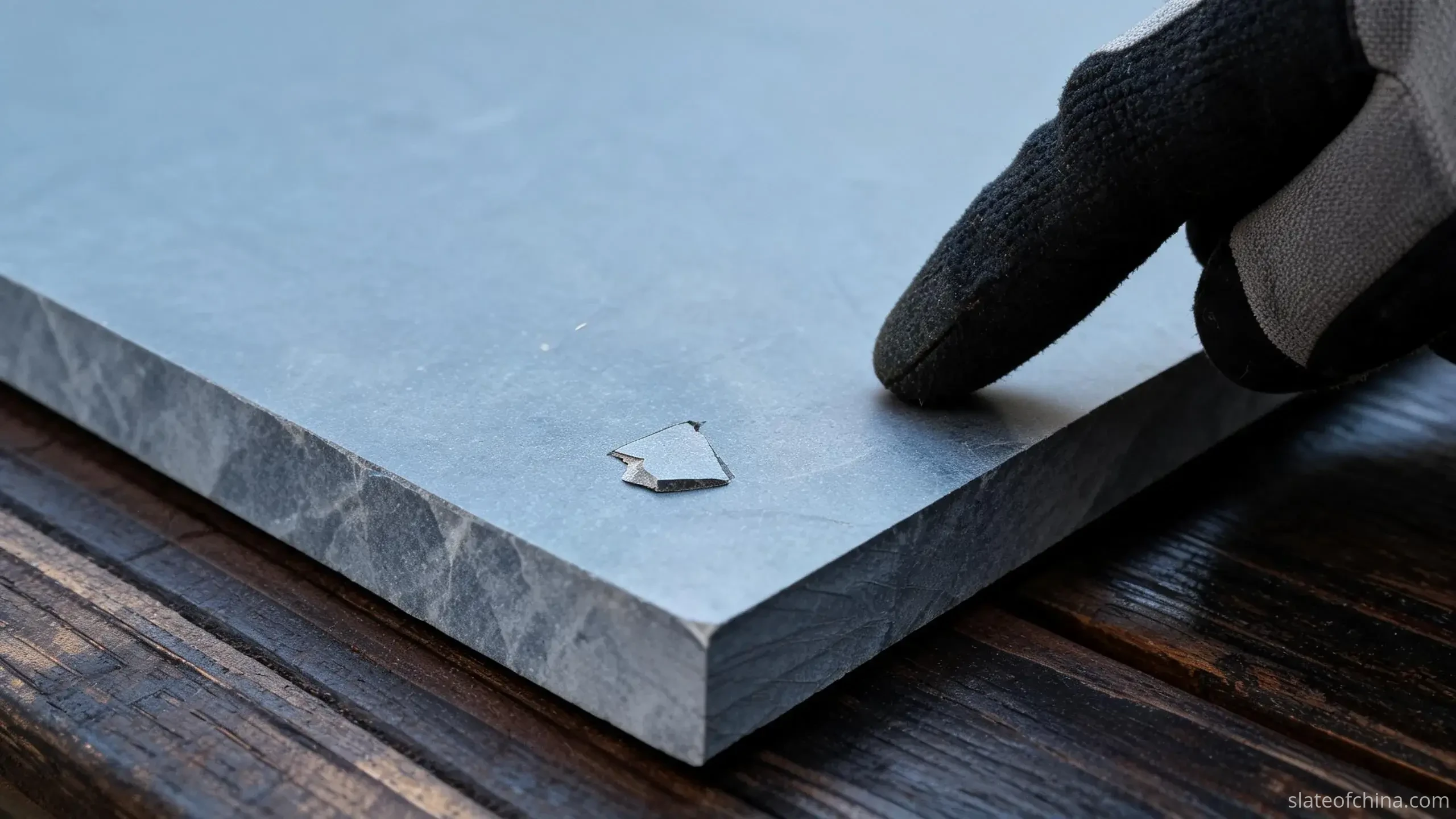
A billiard slate panel survives the quarry, the saw, the grinding bed and the CNC machine. Then it meets a doorway, a forklift fork, or a pair of hands in a hurry — and loses.
We work around slate every day in Jiujiang, and the small reject tray beside the packing bench tells the same story year after year: most of those broken corners did not fail because the stone was weak. They were chipped because somebody lifted from a corner, set the panel down on an edge, or dragged it half a metre to save thirty seconds.
This guide is about those moments — the physical moves between the factory and the table frame. It covers how to lift billiard table slate, how to move pool table slate through buildings and trucks, how forklifts and A-frames should touch it, and how billiard slate storage should be set up so the panels do not arrive at their own installation already damaged. The export packing that protects panels at sea is covered in our export packing guide, and who carries the cost when freight goes wrong is covered in the billiard slate shipping guide.
The short version: a full-size billiard slate panel is not a one-person lift. Support it along its length, not at a corner. Pad the edges before they meet anything harder than foam. Do not drag it, do not let it pivot in mid-air, and give it a level, evenly supported surface to rest on at every stage. Slate seldom fails under its own weight — it fails at a point of impact, a twist, or a concentrated load. Every rule in this guide removes one of those three.
Know the Actual Weight Before Moving Billiard Slate
Weight decides the method before anything else does. Slate runs about 2.7 tonnes per cubic metre, which is why a block that two people once flipped casually at the quarry becomes a completely different object after it has been cut thin, ground flat and drilled.
As typical examples — real weights depend on the exact dimensions, thickness and piece count of your table:
| Panel (typical example) | What it typically weighs | What that means for handling |
|---|---|---|
| 7 ft pool set, 3 pieces, 19 mm | about 130–140 kg for the set | Two-person handling may be suitable for individual sections only when the actual weight, grip and route permit safe handling; assess each section separately. |
| 8 ft pool set, 3 pieces, 19–25 mm | about 160–210 kg for the set | Use a suitable handling method for each section. Mechanical assistance is preferred whenever manual handling cannot be performed safely. |
| 9 ft pool set, 3 pieces, 25 mm | about 250–270 kg for the set, 80–90 kg a section | Confirm the weight of each section. Use mechanical handling where necessary; do not assume a team lift is safe based on table size alone. |
| 12 ft snooker set, 5 pieces, 45 mm | about 800 kg for the set, 160–170 kg a section | Use appropriately rated mechanical handling equipment for these heavy sections, with suitable supports and restraints. |
| Single large panel, about 200 × 100 cm, 45 mm | about 240 kg | handled mechanically on a purpose-built A-frame or other rated equipment |
These figures are approximate planning estimates based on nominal dimensions and slate density. Actual net weights vary with the finished dimensions, pocket cuts, mounting holes and machining details. Confirm the weight of each panel and the complete set before selecting lifting equipment.
The point of the table is not the numbers — it is what they do to the plan. Take the 9 ft row as a theoretical example: the same table may produce three sections of around 80–90 kg each, or, in one-piece form, a single slab of around 250–270 kg — figures calculated from nominal dimensions, not fixed weights for every 9 ft slate — and a one-piece slab no team of people should attempt to carry. The piece count changes the handling problem completely (see one-piece vs three-piece for manufacturers), and so does thickness: a 45 mm snooker section handles nothing like a 19 mm pool section.
For full specification tables by table size and thickness, see our billiard slate technical specifications page.
One more thing weight does: it lies. A panel lying flat on a pallet looks inert and cooperative. Tilt it, and the whole mass swings above your hands on a thin edge with no grip. The danger in handling slate is not that it is heavier than expected — it is that it is heavier than it looks at exactly the moment it starts to move.
A Full Panel Is Not a One-Person Lift
In our packing area the rule is simple: if a panel needs more than a steady two-person grip, it goes on a machine — pallet, forklift or A-frame — before it goes anywhere near a doorway. There is no status in a solo lift of a hundred-plus kilograms of stone with a machined edge in each hand.
The problem is not only weight. It is control. A single carrier cannot see around the panel, cannot manage a door, and cannot set the panel down evenly — and it is almost always the setting-down that does the damage, not the carrying. The panel does not have to be dropped from height. Slipping out of a grip for the last ten centimetres and striking the edge of a pallet is enough.
Small sections on small tables are lighter, and a strong, trained person can move one across a clear floor. Even then, a second pair of hands is worth having: the second person is there for control at the doorway and at the set-down, not for strength. For full-size billiard slate, choose the handling method according to the actual panel weight, dimensions, grip points, route and site conditions. Do not assume that two or three people can safely lift a panel simply because they can physically raise it. Use appropriately rated mechanical equipment whenever manual handling cannot be performed safely.
And the failure is never only the stone. Fingers under an edge, feet in the set-down zone, backs compensating for a load that has started to tilt — the injuries in stone handling tend to follow solo lifts that seemed fine at first.
Lift It by the Long Edges, Not the Corners
How you lift billiard table slate matters as much as who lifts it. Hands go on the two long edges, spread along the length — never at the corners. A corner grip concentrates the load on the weakest geometry of the panel, and it puts your fingers in the crush zone the moment the panel settles.
A few habits carry most of the value:
- Lift with your legs, panel close to the body. A stone held at arm's length is a stone you are already losing. If the panel cannot be controlled without straining or twisting, switch to mechanical handling — correct posture is not a substitute for the right method.
- Keep the panel roughly horizontal during the lift. Vertical carries have their place — through doorways, on A-frames — but a panel twisted or tilted in open air is a panel under bending stress it was never machined for.
- Move on a command. One person calls the lift, the walk, the stop and the set-down. Everyone moves on the caller's word, not on the first pair of reflexes.
- Gloves, dry hands, no dust or oil on the grip edge. Wipe the edge if the panel has been sitting in a stack.
- Set down onto prepared supports — battens, foam, a clean pallet deck — never onto bare concrete "just for a second".
Workshops that move stone all day take it further: the heaviest panels leave the machine and the bench on equipment, not on backs — suction-pad lifters, pallet jacks, forklifts, or the A-frame. For heavy panels, use a handling device designed for the actual slate dimensions and weight. Vacuum lifters, lifting frames and other specialized equipment must be suitable for the surface condition and rated load. Do not choose a lifting point based on the assumption that one face or edge is always the strongest.
The principle underneath all of it: a thin, wide panel is strong when the support under it is continuous, and weak when it is not. Support it along its length and it behaves like stone. Support it at two corners and you are asking a brittle plate to act like a plank. It will not.
Walk the Route Before You Lift
Carrying damage tends to happen in the last three metres — doorways, thresholds, corners — rather than on the long open stretch. So walk the route first, without the panel, and do the arithmetic while your hands are still free:
- Measure the narrowest door and the tightest corner. For a big panel, measure the diagonal too — a 2.5-metre panel carried flat needs a much wider world than the same panel carried on edge.
- Look down: cables, thresholds, ramps, loose floor coverings, wet patches. Each one is a two-person incident waiting for a schedule.
- Decide where the panel will actually rest at the end. "Somewhere over there" is how panels end up leaning on things that were never meant to hold them.
- Clear the route of other people, or lock the door you just came through. A door swinging into a carried panel is a classic.
When the route is genuinely narrow, the answer is usually to turn the panel on edge and carry it vertically — one person at each end of the long edge, corner protectors on, moving slowly. Carried this way, the panel's long axis stands vertical, its width fits through doors its length would not, and the panel is supported along its length rather than bent across it. It is also, not by coincidence, how the biggest panels travel on A-frames — the next stop.
Two non-negotiable habits for hand carrying. First, do not pivot the panel in mid-air: set it down, re-grip, lift again. It costs a minute and saves a joint edge. Second, never let the carriers walk blind — if the panel blocks their view, the caller walks ahead or behind and guides them by voice.
Forklifts: Lift the Pallet, Not the Stone
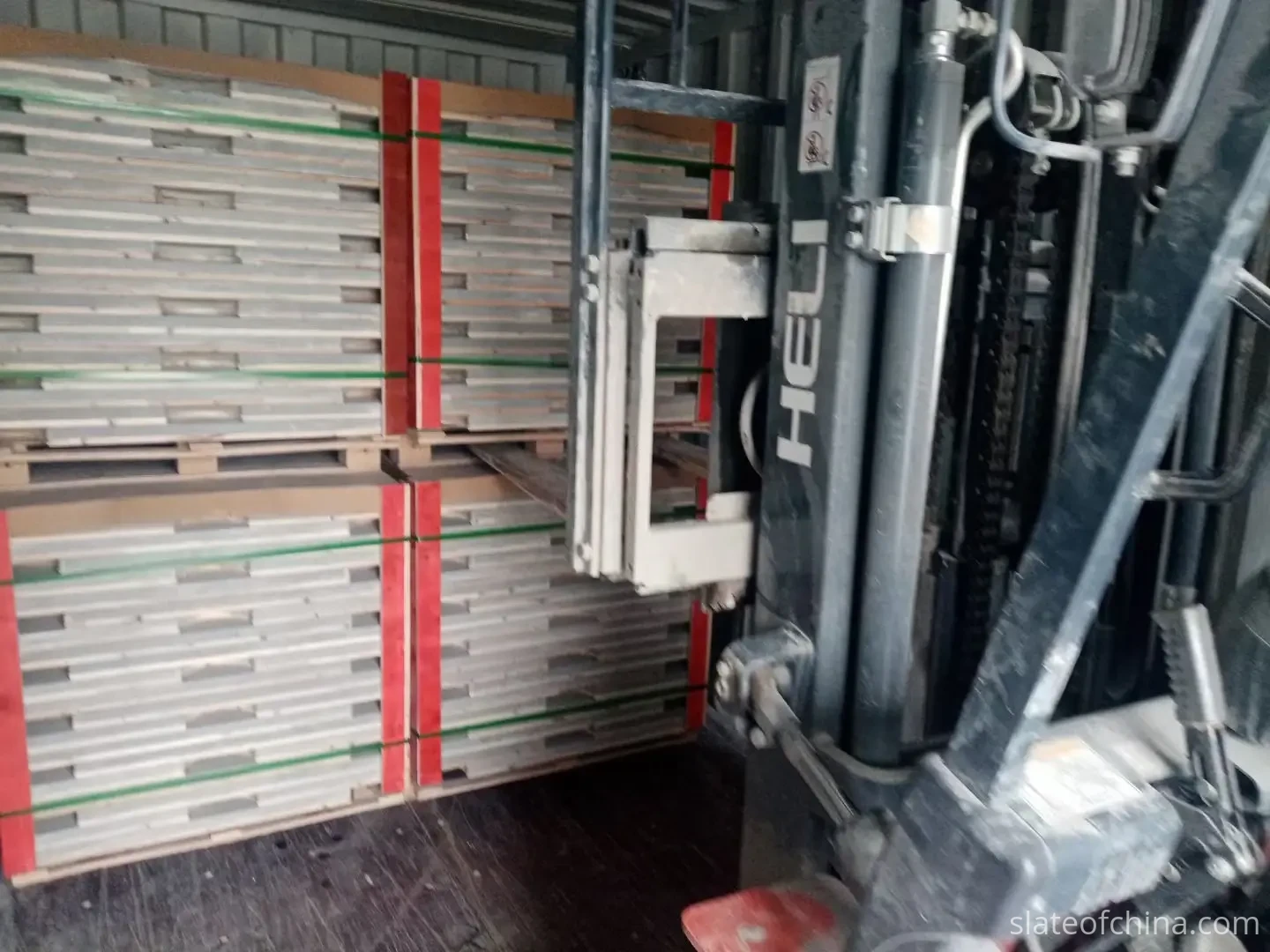
A forklift is the right tool for palletized slate and the wrong tool for a bare panel. The section title is literal: the forks carry the pallet, and the pallet carries the stone. Steel fork tips meeting a slate edge is the most self-inflicted chip we see in yards — sooner or later the fork finds the edge, and the edge loses.
Before the forks go in:
- Check the pallet. Split deckboards, crushed blocks, a pallet that has already been dropped — the load will settle, tilt or drop through exactly where the pallet is weak.
- Insert the forks fully under, spread to the pallet pockets. Half-in forks tip the pallet onto a diagonal and the panels walk against each other.
- Keep the load centred and low — a few centimetres off the ground is high enough.
- Tilt back, travel slowly, and slow right down over thresholds and ramp edges. A hard jolt at a ramp lip is a concentrated impact delivered to every panel on the pallet at once.
- Do not steer with the load. If a pallet needs a centimetre of adjustment, set it down, fix the approach, lift again. Pushing panels square with fork tips is how corners disappear.
And do not lift a bare panel directly on the forks. Two lines of steel under a thin plate is not support — it is a bending test with the stone as the loser. Panels that are not on a pallet belong on equipment made for them — a padded A-frame, a suction lifter, a proper stone cart — or they stay where they are until they are.
For how panels are built up into pallets, A-frames and crates for export — and which packing suits which shipment — see the export packing guide.
A-Frames: Safe Support for Upright Slate Handling
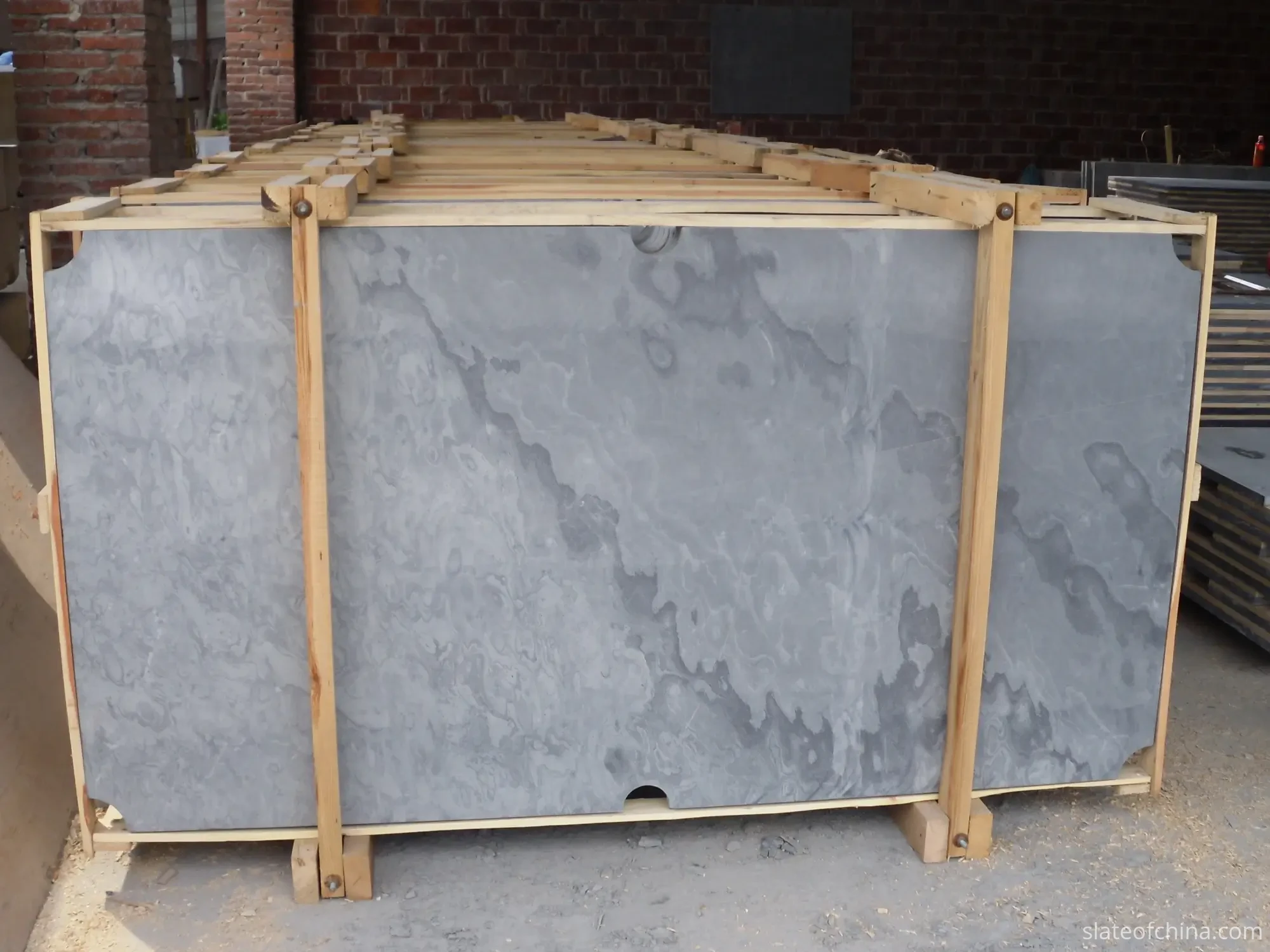
A properly designed, padded A-frame can be a practical solution for moving or storing large billiard slate panels in an upright position. It can reduce the need to carry a long panel horizontally through narrow doorways, and it can provide controlled support during factory handling.
However, upright handling is not automatically safer than horizontal handling. The correct orientation depends on the panel dimensions, thickness, support design, restraint method and lifting equipment. The A-frame must be rated for the load, and the panel must be secured against sliding or tipping. Never assume that a panel is safe simply because it is resting against a frame.
An A-frame only works when it is built for the job. Check five things before any panel leans on one:
- Padding on every contact rail — rubber, carpet or dense foam over wood. Bare steel or bare wood against a machined edge is a chip on a timer.
- Both long edges supported — the bottom edge seated, the upper edge against the padded backrest. A panel touching the frame at one point is not "stored upright"; it is balanced.
- A strap around the middle, snug but not crushing. A strap is there to stop a slide, not to bend the panel into the frame.
- Feet that cannot walk. On a smooth floor, chock the frame — or accept that the whole arrangement will move when you least want it to.
- One panel per face. Two panels sharing a lean means the back panel's corner is a permanent threat to the front panel's face.
Upright on a padded A-frame is also how large panels wait between stages — after grinding, after machining, before loading. Which makes it the bridge into the next subject: storage.
Protect the Corners and the Machined Edges
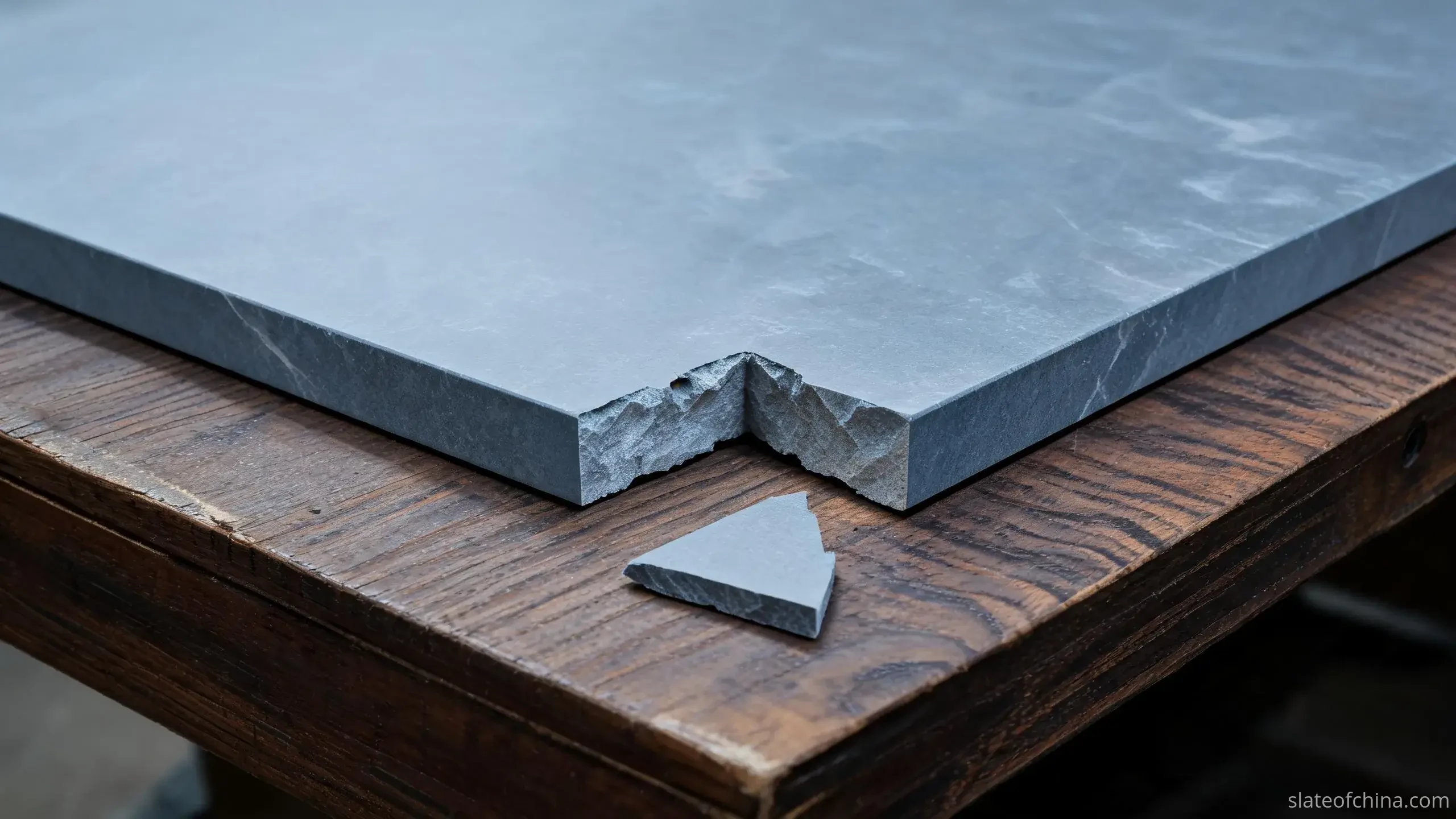
Here is the uncomfortable physics of slate handling in one sentence: the middle of a properly supported panel spreads a load across its whole area, while an edge or corner takes the same blow through a few millimetres of stone. That is why a panel can carry hundreds of kilograms spread across its face — and lose a corner to a light tap against a bench.
On billiard slate the stakes are higher still, because the edges are not just edges. The joint faces are the most precisely machined surfaces on the panel — the whole purpose of edge and joint machining is that three pieces meet along those faces as one continuous surface. A chip on a joint edge is not cosmetic: it can hold up the assembly of the entire set. Pocket openings and mounting holes are cut to your table's drawing (pocket opening machining, CNC drilling and mounting holes), and damage around a machined opening can make a panel unusable on the table it was made for — even when the panel itself is unbroken.
So two rules for the machined areas. First: machined openings are not handholds. A pocket cut-out or a countersunk bolt hole concentrates stress in the thinnest geometry on the panel — lifting the full weight through one is asking the stone to fail along its weakest line, and it puts your fingers exactly where the panel will trap them. Second: padding goes on before the panel meets anything. Foam corner protectors on the corners, EPE foam or rubber strip along the long edges, wooden separator battens between stacked panels, and a soft layer between the panel and every surface it waits on.
What actually chips panels, roughly in the order we see it: setting the panel down on an unpadded pallet edge or bench corner; sliding it — even a short drag across concrete; forklift contact; letting two panels knock together in a stack or a truck; strapping over an unprotected edge and giving the ratchet handle "just one more click". For how a handling chip differs from a natural surface mark — and what a factory rejects for — see common billiard slate defects.
Storage: Flat, Upright, and What Ruins Both
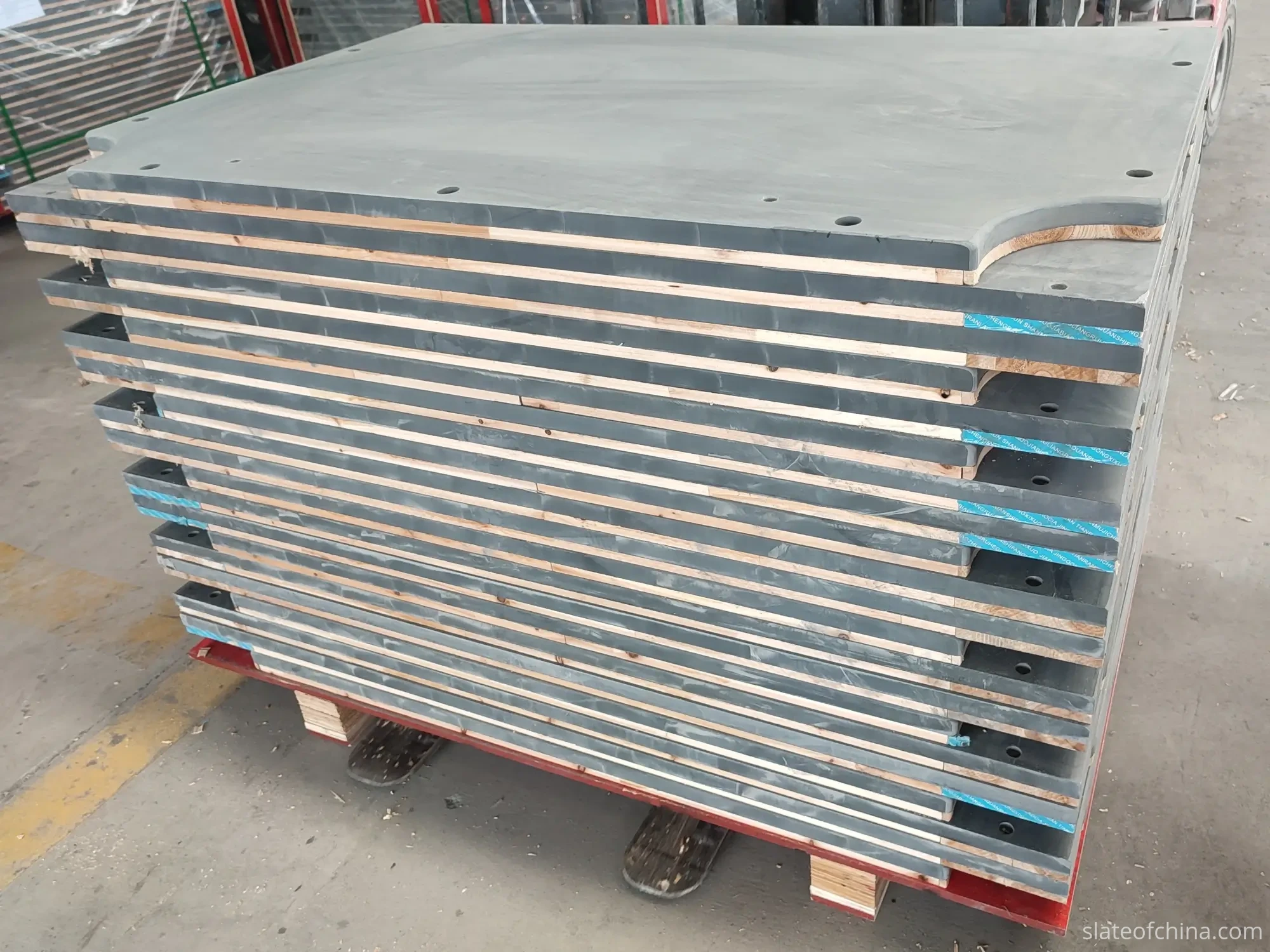
Panels spend more time standing still than moving, and storage is where damage accumulates quietly — no single event, just weeks of a stack settling onto the wrong support. Both classic orientations work. What fails is the improvised middle ground.
| Flat (stacked) | Upright (rack or A-frame) | |
|---|---|---|
| Support it needs | A level floor plus at least three battens, aligned vertically through the whole stack; separators between panels so stone never grinds stone | A proper padded rack or A-frame: both long edges supported, mid strap, chocked feet |
| How it fails | Support points drift out of line — the lowest panel ends up carrying the stack on two points and a corner | Tipping — usually from an improvised lean: a wall, a doorframe, another panel |
| Watch for | Floor strength: a few 45 mm sections concentrate serious weight on three battens; keep stacks low enough to unbuild safely | Both edges in contact, strap snug — no "just for now" leaning anywhere in the plan |
| Best suited for | Complete sets in transit, warehouse stacks, order picking | Large single panels, doorway moves, truck loading bays |
The flat side has one law: support points align. If a separator sits out of line with the batten below it, the load path bends at that point, and the bottom panel — the one nobody can see — carries the punishment. Build the stack on a pallet or on battens laid out once, keep the separators in the same positions all the way up, put corner protectors on the bottom panel, park nothing heavy on top, and keep the stack low enough that you can unbuild it one panel at a time without first moving three others.
The upright side has one law too: a wall is not a rack. A heavy panel leaning free against a wall is waiting for a passer-by, a draught, or its own feet to slide — and a falling hundred-kilo panel is a genuinely dangerous object, not just an expensive one. Upright means a frame built for it, both edges supported, strapped. Nothing else counts.
Either way, keep the storage area dry, clean and level. The stone tolerates cold and damp far better than the timber under it does, but grit under a panel makes it rock, a wet floor makes pallets skate, and a floor that is not level turns every stack into a slow experiment.
Frequently Asked Questions
How heavy is a single billiard slate panel?
It depends on the table size, thickness and how many pieces the set is cut into. As typical examples, a section of a nine-foot three-piece set at 25 mm weighs around 80–90 kg, a section of a twelve-foot snooker set at 45 mm weighs roughly 160–170 kg, and large single panels around 200 × 100 cm at 45 mm weigh close to 240 kg. Always confirm the actual weight of your panels with the supplier before planning any manual lift.
Can one person lift a billiard slate panel?
For full-size panels, it is not recommended. The combination of weight, thin edges and limited grip makes a single-person lift difficult to control — and it is usually the moment of setting down that causes the damage. Sections on small tables are lighter, but a second pair of hands is still worth having: the second person is there for control at the doorway and at the set-down, not just for strength.
What is the safest way to move pool table slate?
Use enough people or the right machine for the weight, keep the panel supported along its length, pad the corners and machined edges, and plan the whole route before lifting — doors, turns, steps, and exactly where the panel will finally rest. Mechanical handling or a coordinated team lift with edge protection is safer than an improvised solo carry for anything beyond a small section.
Should billiard slate be stored flat or vertically?
Both work when the support is designed for it. Flat storage needs a level floor, at least three support battens aligned vertically through the stack, and separators so that stone never grinds against stone. Vertical storage needs a proper rack or padded A-frame, with both long edges supported and a strap to stop tipping. What fails is the improvised middle ground: a panel leaning against a wall, or stacked on random blocks.
How do you transport pool table slate in a car or van?
Before transporting pool table slate, confirm the vehicle's payload capacity, load-floor strength, support arrangement and available loading equipment. The slate must be supported by a suitable load-bearing structure and secured against sliding, tipping and impact. Do not assume that a standard car, pickup bed or van is suitable simply because the panel fits inside. Large or heavy panels may require a commercial vehicle, a suitable lifting device and a purpose-designed support system. The appropriate transport orientation depends on the panel dimensions and the handling equipment available.
How do you prevent billiard slate from cracking when moving?
You cannot make stone unbreakable, but nearly all moving damage comes from five things you can control: uneven support, impact, twisting, unprotected edges, and improvisation. Support the panel along its length, never drop or drag it, do not let it pivot in mid-air, pad the corners and machined edges, and use equipment rated for the weight. Handle the panel the way it was machined: supported, level, and slow at the corners.
Do the pieces of a three-piece set need to go back in the same positions?
Yes. A multi-piece set is machined and matched as a set — the joint faces are worked so the pieces meet level in their intended positions. If you are dismantling a table, mark each panel and its orientation before it leaves the frame, and rebuild in the same arrangement. Putting two good panels in swapped positions can turn them into one visible joint line.
From the Container to the Table Frame
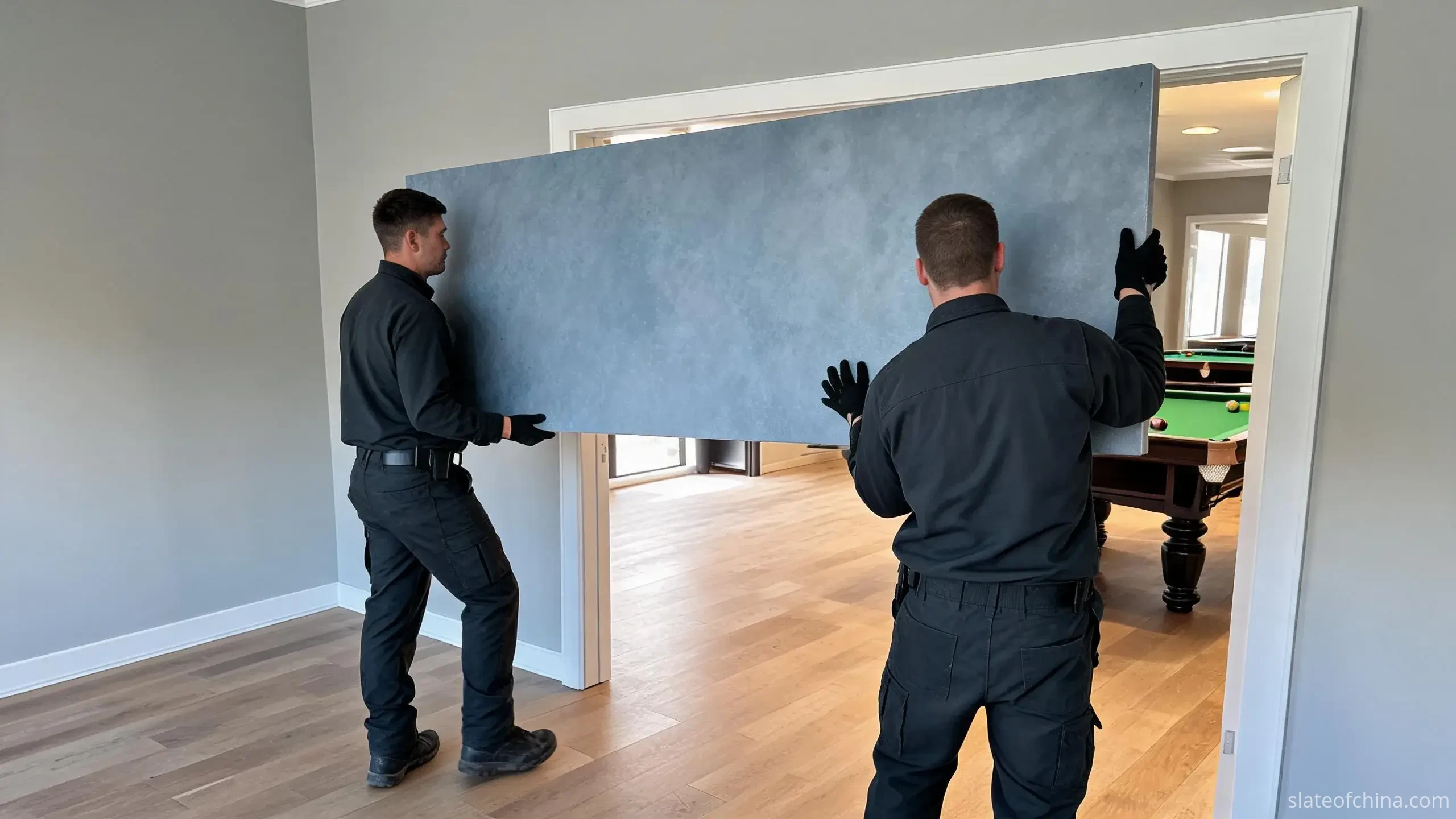
The risk does not end at delivery — it changes shape. Between your truck and the table frame, every transfer is a fresh chance for a corner to find the one unpadded object in the room. Work the sequence in order.
Plan the unload before opening anything. Equipment present, route cleared, destination floor prepared. A crate opened in a yard with no lifting plan turns into improvisation within minutes — and improvisation with a hundred-kilo stone is exactly what this guide is against. Keep the packaging on until the panel is as close to its destination as it can get; the foam and the timber are doing their job right up to the last moment.
Photograph before you unpack. If a crate shows impact marks, a shifted load, or water staining, photograph it before opening — and photograph the panels as they come out. Claims are decided by the "before" photo. The full arrival sequence, the claim window and the evidence chain are covered in the billiard slate shipping guide.
Inspect, then move. Corners, long edges, joint faces, machined openings — walk the panel before it travels through your building. On a commercial delivery, the flatness check at arrival has its own procedure: see how to check billiard slate flatness on incoming inspection.
Keep the set in order. A multi-piece set was machined and matched as a set — the joint faces were worked so the pieces meet level in their intended positions (slate joint alignment). If you are dismantling an existing table, mark each panel and its orientation before it leaves the frame, and rebuild in the same arrangement.
Carry on edge, pad everything, lower together. Through the room: panel on edge, one carrier at each end of the long edge, corner protectors protecting the room as much as the panel. Onto the frame: check the frame bed for grit and trims, lower the panel together, and never let the last centimetre be a drop. Levelling the set is its own discipline — but it starts with an undamaged panel placed the way it left the factory.
And if the reason you are moving slate is that a panel did not survive — replacement panels can be matched to an existing table by measuring the old slate and its hole pattern. See replacement slate for existing billiard tables, or browse billiard slate products for standard sizes.
The Sixty-Second Check Before Every Move
Before any panel leaves a safe position — bench, pallet, crate or stack — run four questions. Sixty seconds, and most handling mistakes get caught before they turn into damage:
People. Enough hands for this weight? One person calling the moves? Does everyone know where the panel is going, and what it will rest on when it gets there?
Equipment. Pallet or crate sound? Forks rated and fully under? Straps, foam and corner protectors at the panel — not back in the store?
Route. Doors measured? Floor level, clear and dry? No thresholds, cables, or stairs still waiting for a plan?
Panel. Supported along its length? Corners and machined edges padded? Strapped or crated until the last possible moment?
Four yeses, then lift. Most of the pieces in our reject tray got there on a day when one of the four was a maybe.
The Mistakes We Keep Seeing
The hero lift. One person, one 80 kg section, one doorway. The panel is fine for the first half of the journey, and the doorway is where the second half goes wrong.
Dragging to save thirty seconds. Concrete grinds. A dragged panel does not always chip — but when it does, you do not get to choose where.
Fingers under the edge. The set-down is a crush zone, and the panel does not have to break to ruin the day. Guide the edge with a gloved hand on top of the stone, never underneath it.
The improvised lean. "Just for now" is the most expensive phrase in storage. A wall, a doorframe, a neighbouring panel — none of them is a rack, and the falling event happens without warning.
Opening the crate in the yard. Packaging off, forklift gone, panel twenty metres from where it is needed. Every metre after that is hand-carried improvisation that the crate was specifically built to prevent.
Stacking on random blocks. One brick, an offcut, a folded sack. The stack settles overnight onto whatever is tallest, and the lowest panel carries the point load until it stops carrying it.
Handling Is Part of the Quality
A billiard slate panel passes through more hands than machines: selection, cutting, grinding, CNC machining, inspection, packing, loading, shipping, unloading, moving, installation. The first half of that chain decides how good the stone is. The second half decides how much of that goodness survives to the table.
That is why, when we talk to buyers, questions about handling are as revealing as questions about tolerances. A supplier who can describe — unprompted — how panels are lifted, padded, stacked and secured is a supplier who has actually watched their panels leave. The same goes in reverse: if you are sourcing slate, ask how it will be packed and handled at your end, and build the answer into your warehouse plan before the container is booked, not after it lands.
Slate is not delicate. It is exacting. It takes a quarry, a saw and a CNC bed in stride, and it loses corners to doorways and shortcuts. Handle every panel the way the machine handled it — supported, level, and slow at the corners — and it will play as flat as the day it left the grinder.
Moving slate into your project?
If you are replacing a panel, matching a new set to an existing table, or planning a first order — send us the table type, playing size, slate thickness, number of pieces and your machining drawing. We will confirm the specification, the packing, and how the load should be handled at your end.
Ask about handling for your order · Browse billiard slate products