
Replacement Slate for Existing Billiard Tables
A replacement slate is ordered from the old bed — the drawing the table still carries — not from the size on the brochure.
Replacing pool table slate requires more than matching the table’s advertised size. The new slate must match the existing bed’s dimensions, thickness, pocket geometry, seams and mounting holes.
Take the rails off an old billiard table, lift the bed clear, and turn one of the pieces over. Face-down on a pair of sawhorses, a slate that has carried thirty years of play shows a side no player ever sees: a row of countersunk bolt holes drilled in a pattern that means nothing until the rails stand on it, a shallow recess machined where a frame member passes, a clean step cut around each pocket mouth. Somebody drew all of that once. The drawing is almost certainly gone. The stone still has it.
Replacing the slate in an existing pool, snooker or carom table sounds like a catalogue purchase — find the size, order the bed, drop it in. In practice it is closer to surveying. The old bed is the only surviving copy of a production drawing, and a replacement order is the job of recovering that drawing well enough for a manufacturer to cut stone against it. This page walks through the recovery: what to measure, which numbers actually decide whether the new bed fits, what to photograph, what to send with the inquiry, and what a supplier’s “drop-in” promise is honestly worth. Whether you are a table maker servicing an install, a dealer reconditioning stock, or a club with a cracked bed, the routine is the same.
The Drawing You Lost
Every slate bed begins life as a production drawing: outline, thickness, seam lines, pocket geometry, hole pattern, the recesses on the underside. The drawing lives with the table maker. Twenty or thirty years on, the maker may be gone, absorbed, or simply no longer stocking parts for a model it stopped building. What survives is the bed itself — a complete copy of that drawing, cut in stone, minus the paper. Most replacement inquiries that reach our desk involve tables in exactly this state, which is why replacement work is a drafting job before it is a machining job.
This is also why the most common replacement inquiry is the least quotable one. “Please quote a slate for a 9 ft pool table.” We could fill a folder with emails like that. A standard 9 ft bed is a real product and it suits plenty of tables — but whether it suits this table is a different question, and the label answers nothing. Two tables sold under the same size label can differ in outline, thickness, piece count, seam position, pocket geometry and hole pattern. The label tells you what the table was sold as. The bed tells you what has to arrive.
So the working rule for any replacement project is the one this whole page hangs on: treat the old slate as the reference document, not a size to copy — and measure the bed you have, not the table you were told you have. One boundary worth drawing early: if there is no existing bed to measure — the table is new and the slate has never existed — that is not a replacement at all. It is a custom project, and we walk that route separately in Custom Billiard Slate Manufacturing. If you are not even sure what kind of bed your table carries, the identification keys are in Types of Billiard Slate.
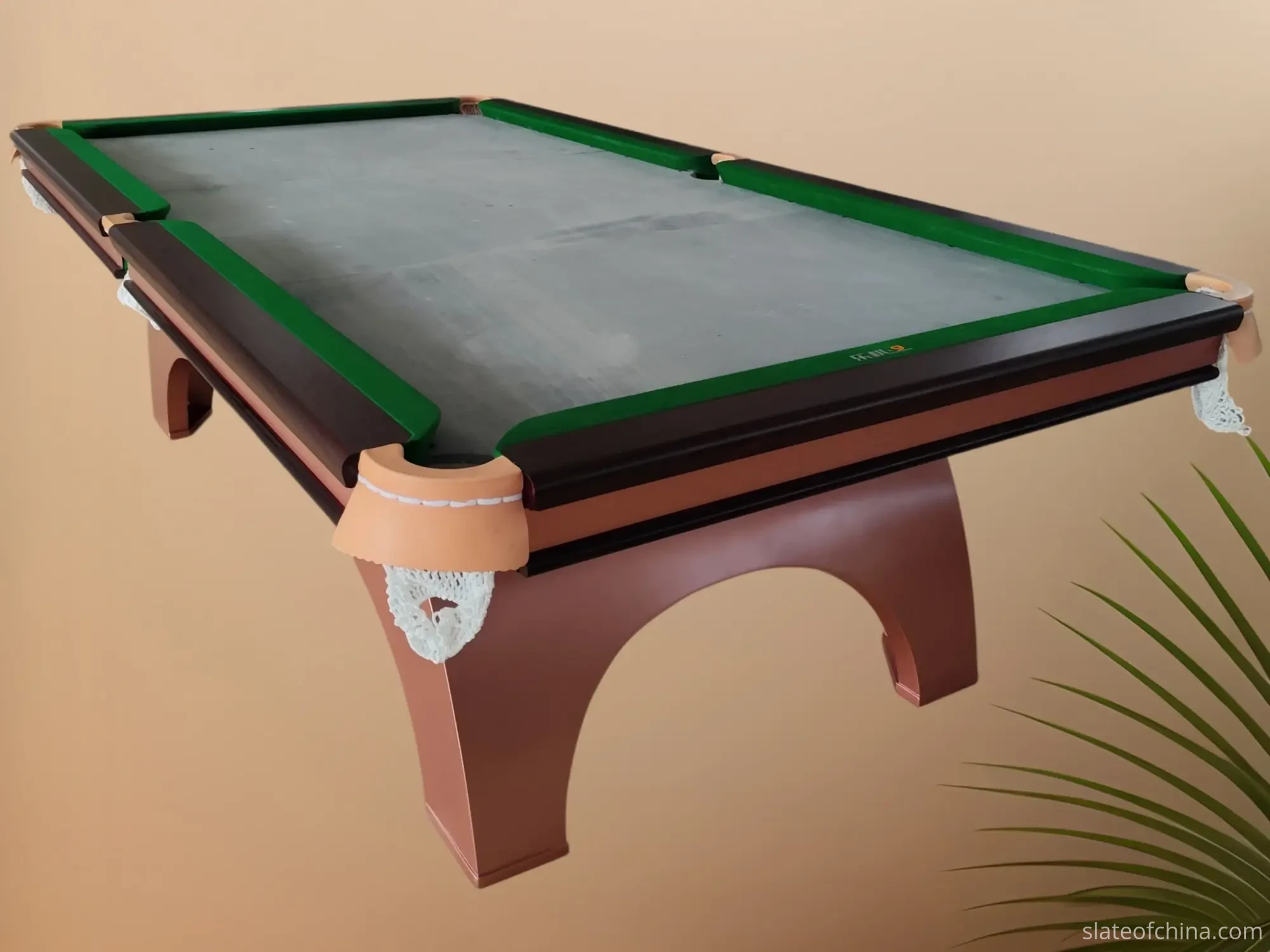
First, Ask Whether the Table Deserves a New Bed
Beds get replaced for concrete reasons: a crack from a bad lift during a house move; a chip broken out of a pocket mouth; a warp from years on an uneven floor or a damp storeroom; a previous repair that drilled or filled where it should not have; a table being brought up to a playing standard the old bed no longer meets. Slate itself does not normally wear from ball play; the cloth and other table components wear much faster. When a bed is genuinely damaged, though, replacing it is worth doing properly.
Before any measuring starts, put a straightedge on the rest of the table. A new bed cannot straighten a twisted cabinet, stiffen a tired frame, or true rails that have warped with it. If the cabinet is square, the frame flat and strong, the rails and pockets reusable — the table deserves the new bed. If the structure is failing, the honest sequence is frame first, bed second: a good slate laid on a bad frame just moves the problem under the cloth. The wider decision path — whether this table is worth re-bedding at all — is laid out in How to Choose Billiard Slate.
One more check while you are there: read whatever the table tells you about itself. A maker’s plate, a model name, a serial number — all of it is supporting evidence, and occasionally it is gold, because a maker still holding the original drawings can save a whole day of measuring. None of it replaces measurement. Production runs change, tables get modified in service, and “the same model” across twenty years is not always the same bed. Treat the badge as a lead and the bed as the fact.
Three Numbers That Are Not One Number
Casual language calls three different measurements “the size of the table”, and a replacement order has to keep them apart. The playing area is the rectangle the ball actually uses, measured cushion nose to cushion nose. The slate outline is the rectangle cut in stone — what the bed physically is. The cabinet size is the outside of the table: furniture, not specification. On a common 9 ft pool table the playing area measures 2540 × 1270 mm while the slate outline runs about 2718 × 1448 mm. Both numbers are correct. Neither is the other.
For a replacement, the outline is the number that matters, because it is the one the factory cuts — measure it off the old bed directly. Record the playing area as well, nose to nose with the rails on, because the manufacturer uses it as a cross-check on pocket positions. The cabinet size goes on the record as a note, nothing more. If the vocabulary starts blurring, the glossary of billiard slate terms keeps the three straight.
Recovering the Geometry, Layer by Layer
What follows is the measuring routine. It needs no exotic equipment — a steel tape, a straightedge, a caliper where you have one, a notepad and a camera. What it needs instead is discipline: every dimension taken at least twice, every reading written down exactly as measured, and anything you cannot verify marked TBC rather than guessed. Work with the rails off wherever possible. The rail system hides half the bed’s interfaces.
The outline
Measure the maximum length and width of every piece, to the millimetre. Do not average odd corners away: where a pocket mouth or a notched corner changes the shape, sketch the piece and dimension the irregularity instead of forcing one number across it. A flat floor and a tape laid along the edge — not stretched over the piece — keeps the readings honest.
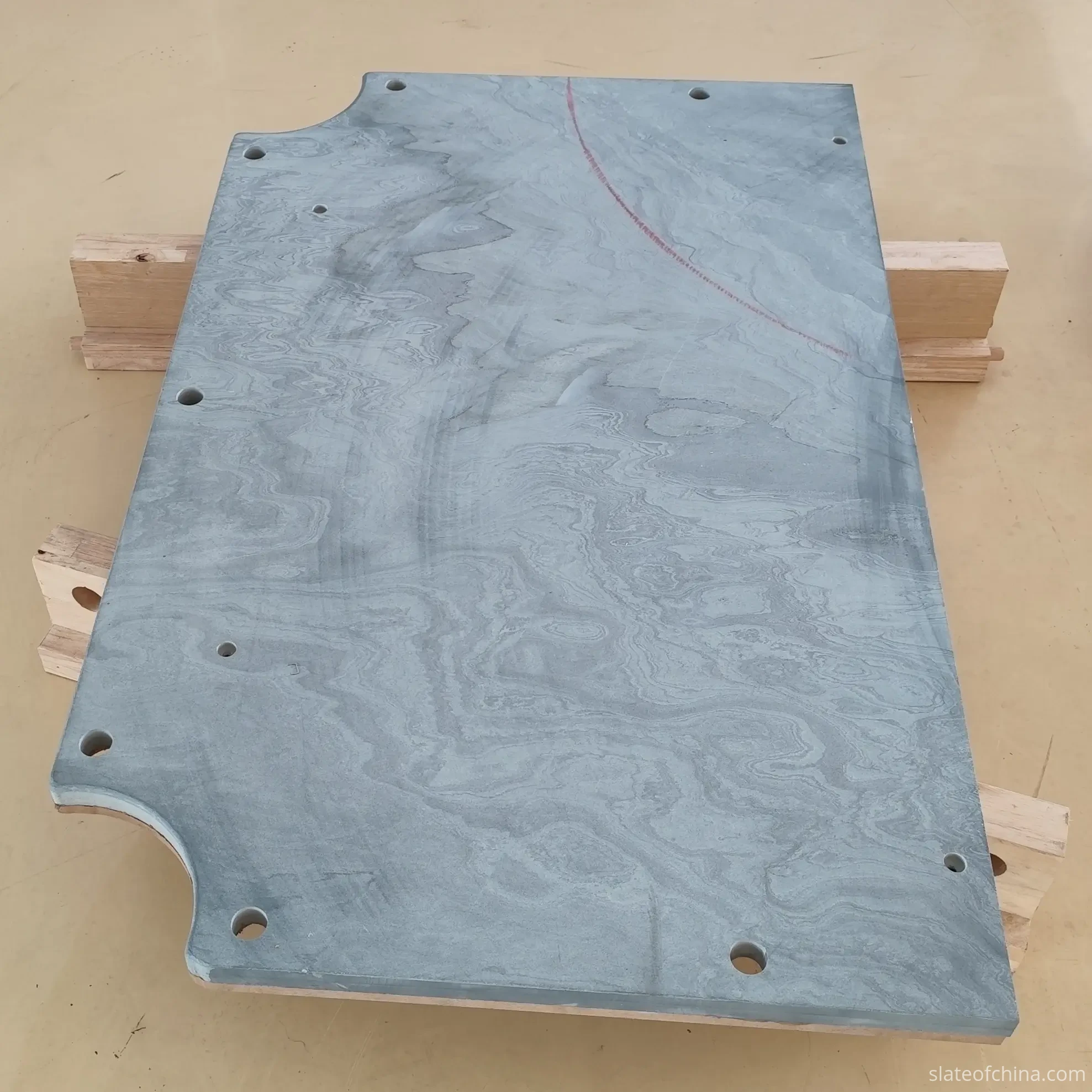
The thickness
Measure the edge in several places — four corners plus the midpoint of each long edge is a sensible pattern — and record the value that repeats, not the single lowest or highest reading. Thickness on a replacement is a match-the-original number: rails sit on it, cushion height is derived from it, pocket depth assumes it, and on many tables the frame carries a recess sized to it. Slate beds commonly run from 19 mm on small pool tables through 25 mm on 9 ft pool beds to 45 mm and beyond on full-size snooker tables. What thickness actually does to the playing system — rigidity, support, deflection — is a subject of its own, unpacked in How Slate Thickness Affects Table Performance. For a replacement the operative sentence is shorter: the table was designed around the old number, so the old number is the specification.
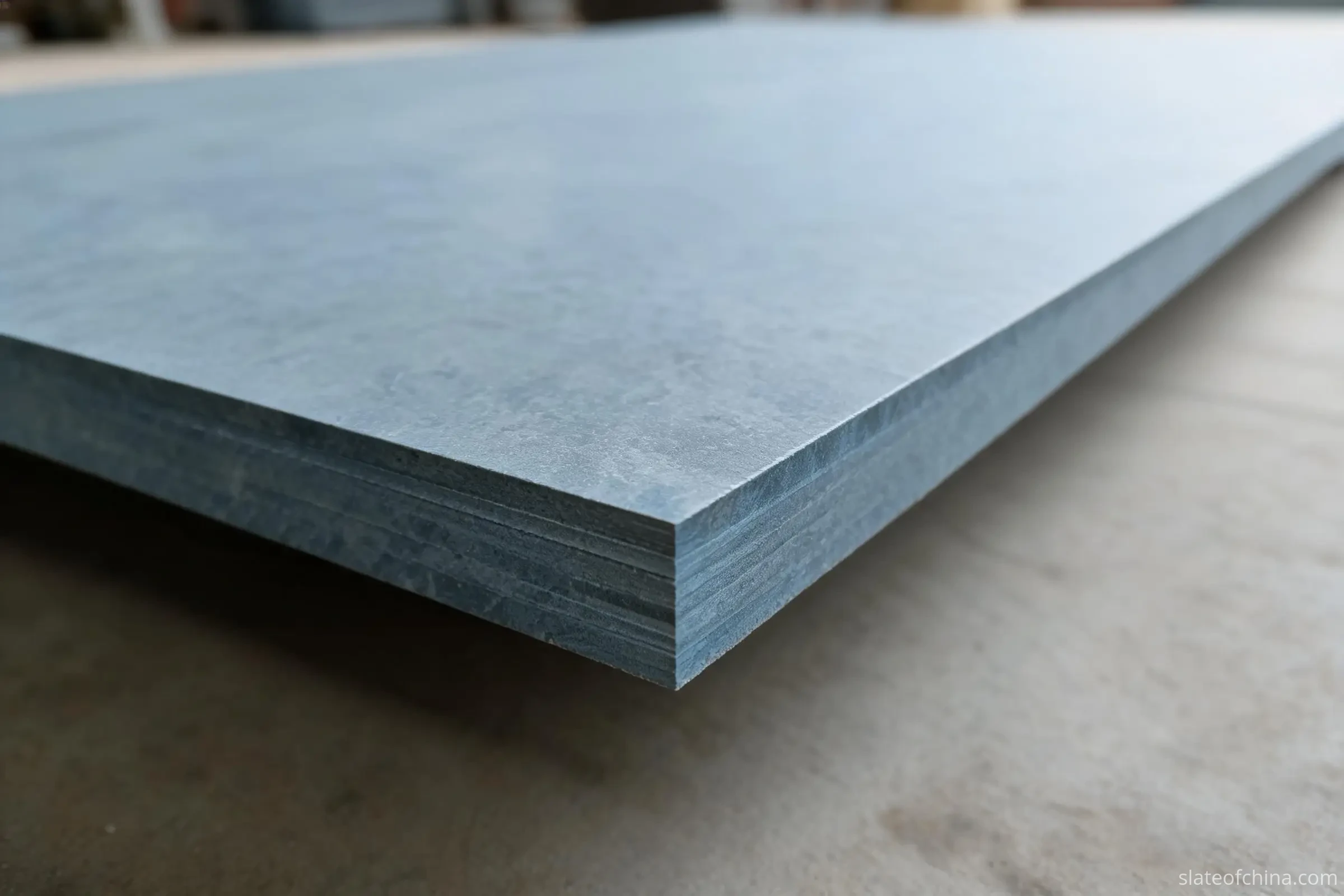
The pieces and the seams
Count the pieces, then measure each one. End and centre sections of a multi-piece bed are not always identical, and some beds mix piece widths around the pocket mouths. Record where the seams run and the width of each piece at the seam line. If only one piece of the set is damaged, this layer stops being routine and becomes the whole job — see One Piece or the Whole Set below. How piece count interacts with machining, joint design and shipping is unpacked in one-piece vs three-piece slate.
The pockets
Not every bed carries pockets — a carom bed is a plain rectangle — but wherever an opening exists it is machined geometry, not a style. On a six-pocket pool or snooker bed that means six openings. For every one, measure the width where the mouth opens, the shape of the cut — a clean arc on many modern beds, straight cuts meeting at an angle on older ones — and the distance of each opening from the slate edges. Photograph every cutout from above and from underneath; the underside of a pocket mouth carries structure the top cannot show. Whatever you do, do not assume the openings follow today’s nominal pocket standards. A table of a certain age carries the pocket geometry of its own decade.
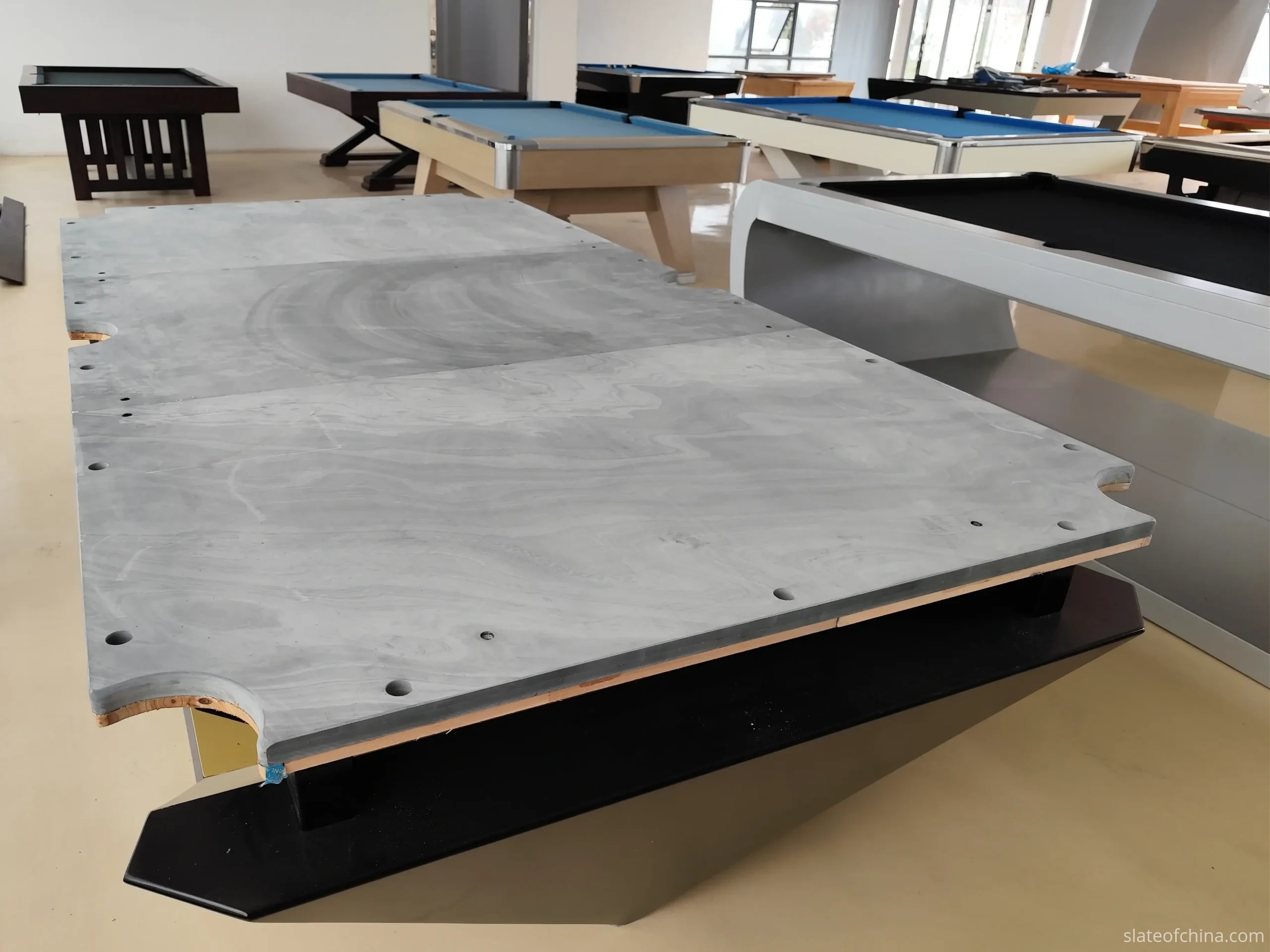
The bolt holes
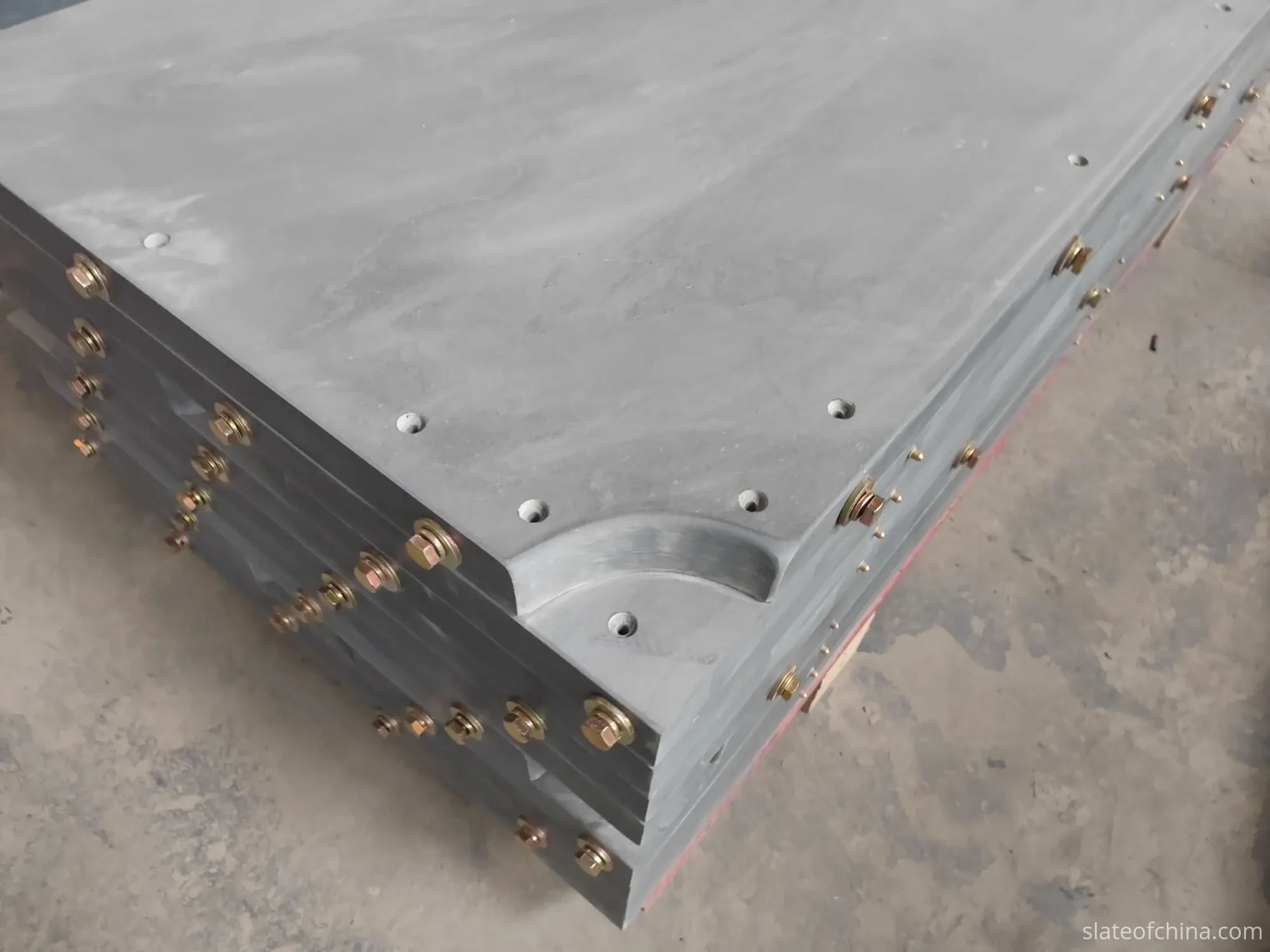
This is the layer where “same size” beds fail. For every hole, record the diameter, the depth, whether it is countersunk or plain, and the position of its centre measured from two reference edges — one long, one short. Hole-to-hole distances along each rail line complete the pattern, and a one-page sketch of hole centres is worth more than a paragraph of prose. Where you can tell what each hole is for, note it — slate-to-frame screws, rail bolts, leveling hardware — because position matters most where the rail bolts pass.
More than one inquiry has reached our desk after a “same size” bed was bought elsewhere: outline right, thickness right, hole pattern offset by something like 15 mm. The rails went down; the bolt holes lined up with nothing. The bed went back, and the table waited months for a part it could not use. The pattern, not the outline, is usually what makes a replacement fit.
The underside
Turn a piece over — carefully; this is a two-person job for large panels — and photograph the whole face, then close-ups of anything machined into it: recesses where frame members pass, steps, pads, cutouts, the pocket structures underneath. The underside is where two visually identical beds differ most, and it is invisible in every photograph taken from above. Rake a light at a low angle across it; shallow machining shows up in the shadows better than under a flash.
The Record That Turns Measurements Into an Order
Collected properly, the layers above collapse onto a single sheet — the recovered drawing, in words. This is what a manufacturer can actually quote from, and it takes less time to fill in than the emails it replaces.
| Item | What to write |
|---|---|
| Table type | pool, snooker, carom or other — and the playing standard if it matters |
| Maker, model, age | whatever the badge, plate or paperwork says |
| Slate outline | length × width of every piece, in mm |
| Pieces & seams | how many pieces, where the seams run, width at each seam |
| Thickness | the repeating edge value, in mm |
| Playing area | nose to nose, length × width |
| Pocket openings | width and shape of each opening, with distances from the edges |
| Bolt holes | diameter, depth, countersink, centre positions from two reference edges |
| Underside features | recesses, steps, cutouts — sketched and photographed |
| Surface specification | flatness tolerance and measuring method, agreed with the supplier |
| Photographs | top, underside, every pocket mouth, every hole cluster, whole table |
| Known history | repairs, modifications, previous replacement attempts |
A worked example of how little space a usable record takes: “9 ft pool table, maker unknown, circa 1990s; 3 pieces, 2718 × 1448 mm assembled; 25 mm; playing area 2540 × 1270 mm; pockets and holes per attached sketch and photographs; TBC — hole diameters, underside photographs to follow.” That paragraph plus six photographs is enough for a first feasibility answer, and the two TBC items tell the factory exactly what to ask for next.
On TBC, a small discipline that saves whole projects: marked unknowns get measured before the order. Guessed numbers get cut into stone. Measure a damaged piece with suspicion, too — a crack distorts edges, a broken corner removes a reference. Where one piece is gone or unreliable, take the geometry from its undamaged siblings and from the frame: on a three-piece bed, the two survivors between them carry the full outline, the seam line and most of the hole pattern.
Photographs earn their place on the record: a whole-table shot with the rails on; the bed stripped; top and underside of at least one piece; each pocket mouth; each hole cluster; anything that looks unusual. A photograph with the tape lying beside the feature beats a photograph alone — and beats a number without a photograph.
The surface row is the one buyers most often leave blank. “As flat as the old one” is not a specification; a flatness tolerance, the measuring length it applies over, and the method — that trio is. Why the measuring length belongs in the same sentence is explained in How Slate Flatness Affects Ball Roll, and what a factory can honestly verify before packing is set out on our quality and test data page.
And the old bed itself? It does not need to travel. International freight for a fragile stone panel of this class costs more than the measuring routine, and a proper record carries the same information. A full-size template of one piece — hardboard or ply scribed and cut to the bed — is worth considering only for genuinely odd geometry: heavy modifications, unrepeatable pocket shapes, a bed that resists every attempt at measurement.
One Piece or the Whole Set
Often the damage is one piece of three — a corner piece cracked on a house move, a centre piece chipped at a seam. Replacing a single piece is a normal, everyday order. What changes is the reference document: now the drawing has to be recovered not only from the damaged piece but from the two survivors it will bolt to.
The new piece must match the set, not just the nominal design — thickness at the seam faces, hole pattern where it meets the rails, pocket geometry if it carries a pocket mouth, edge profile where the seams close. A piece a few millimetres out at a seam line produces a bed that cannot be assembled flat, and a joint is not a boundary of the playing surface; it is part of it. Send measurements of the undamaged neighbours along with the damaged piece, because every dimension taken on a survivor is a dimension the new piece can be checked against before it ships.
Then ask the honest question: is one new piece beside two thirty-year-old pieces the right repair? On a bed being re-clothed anyway, or where the survivors are themselves tired, replacing the complete set removes the matching risk in one move. Where the survivors are sound and the budget is fixed, a matched single piece is a reasonable order — we cut both kinds — but the trade-off belongs to whoever owns the table, stated plainly: a mixed-age set is only as flat as its oldest seam.
What a True Drop-In Fit Really Means
“Drop-in replacement” gets used loosely in this trade, so here is the honest version. A true drop-in bed is one whose critical interfaces — outline, thickness, pocket geometry, hole pattern, seam positions — were matched to the old bed at the factory, so that installation is normal fitting work: positioning the pieces, shimming, leveling, filling and dressing the seams, a final surface check. The geometry arrives solved. The work still happens.
What drop-in does not mean is zero work. Every slate bed, factory-fresh or replacement, is leveled on assembly — that is the nature of a precision surface sitting on a timber structure. A supplier who promises a drop-in fit from a table’s size label alone is promising something they cannot know. The promise you can hold a factory to is different, and better: a production drawing rebuilt from your recovered record, sent for your approval before a wheel touches stone. Approve the drawing, and the drop-in takes care of itself. Skip it, and no size label will save the installation.
Standard Slate, Custom Replacement, and the Bill
Two kinds of order sit behind the same word “slate”, and they are worth telling apart before money changes hands.
| A standard bed | A replacement bed | |
|---|---|---|
| What you start from | a specification: “9 ft, 25 mm, three-piece” | an existing bed: measured, sketched, photographed |
| What the factory works to | its own standard drawing | a drawing recovered from your record |
| Where it can go wrong | if the table was not built to that standard | wherever a layer of the record is missing or guessed |
| Best used for | new builds and tables built to standard specifications | older, discontinued, imported or modified tables |
Most replacement inquiries sit in the right-hand column — makers who still stock the part rarely end up in this conversation at all. For those tables the production route is custom machining: outline, pockets and holes cut to the recovered drawing, edges machined, the surface finished to the agreed tolerance. What that project looks like from first sketch to delivery — drawing confirmation, sampling, MOQ — is laid out in the custom manufacturing guide linked above, and the product itself is on our custom pool table slate page.
Cost follows the same logic: a replacement is machining, not shopping. Size, thickness, piece count, pocket work, hole drilling, the tolerance and inspection level you write, packing and the destination — each is a line in the price. A fully machined replacement costs more than a standard bed of the same nominal size, because on a replacement the machining is the product. Compare delivered prices, not slate prices; freight and packing are real lines on a heavy, edge-vulnerable cargo. One honest check is worth running on any quote: as a reference, a typical 9 ft, 25 mm three-piece slate set may weigh around 250–270 kg, depending on its finished dimensions and material density. If a quote’s freight weight reads dramatically lighter, the question is not “what a bargain” but “what material is this bed?”
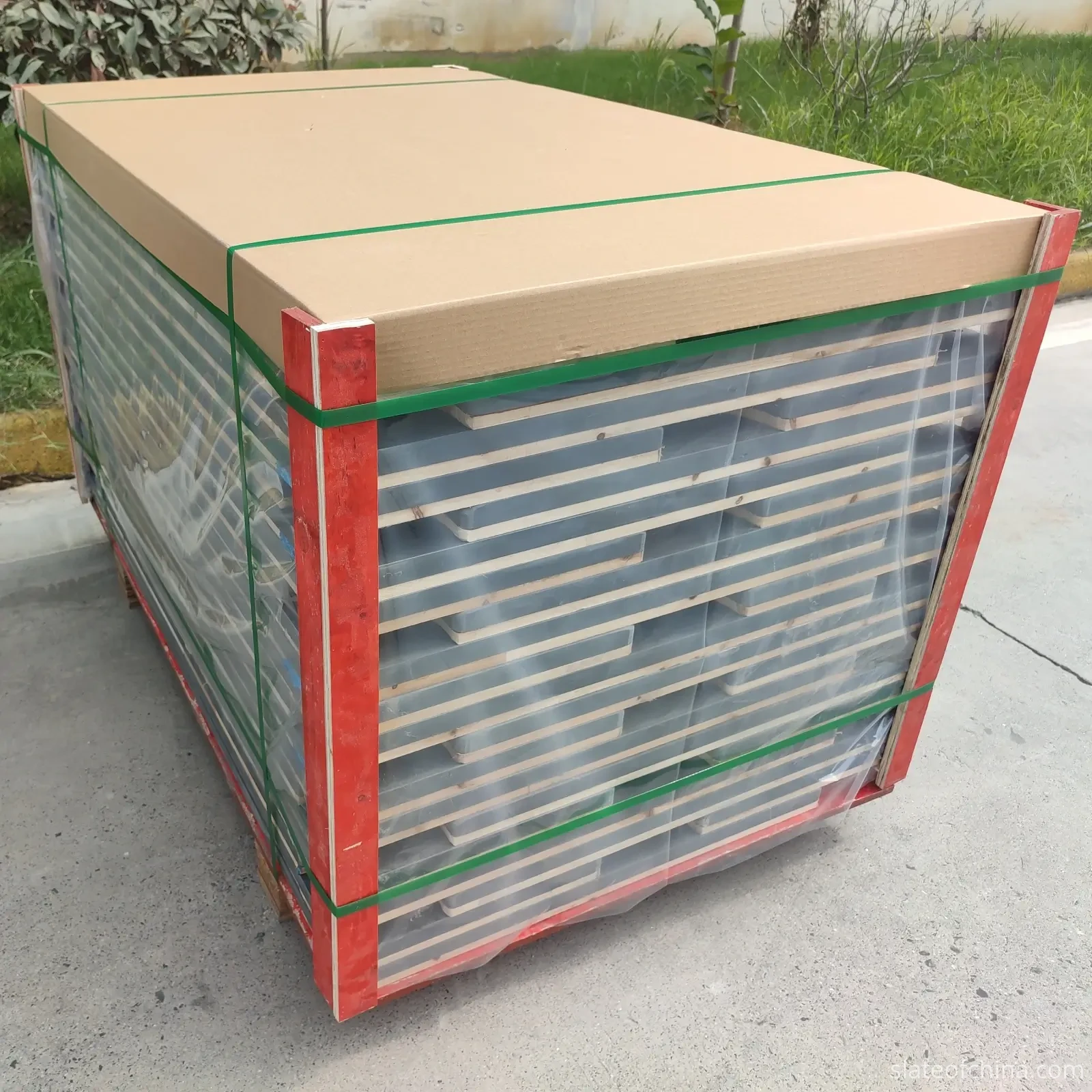
A replacement set travels like any slate we export: flat on a heat-treated wood-framed pallet to the ISPM 15 standard, protective interleaving between the panels and over the set, corner protection, strapping and wrap. Corners and edges are the vulnerable zones — the same zones you spent the afternoon measuring — so ask how the set will be packed before comparing prices, and ask for photographs of the packed set before it leaves the factory. The loading logic for full-container shipments is on our container loading guide; the wider sourcing checklist lives in the billiard slate buying guide.
The Order That Works, Step by Step
For teams that want the whole path in one place, this is the sequence a smooth replacement follows — the same order we run when the record arrives complete:
- Identify the table. Maker, model, age, photographs with the rails on.
- Judge the table. Cabinet, frame, rails, pockets. Replace the bed only if the structure deserves it.
- Strip and photograph. Rails off, the bed photographed in place before anything is lifted.
- Measure. The six geometry layers, every dimension taken twice, written exactly as measured.
- Photograph again. Top, underside, every pocket mouth, every hole cluster, the whole table.
- Build the record. One sheet, one sketch, the TBCs marked rather than guessed.
- Send it with real questions. Can you match the hole pattern and the pockets? Can you work from a sketch? What flatness tolerance and method will you hold? How will the set be packed? The answers separate a factory that does this work from a supplier that resells standard sizes.
- Approve the production drawing. The recovered drawing, redrawn by the manufacturer and confirmed by you before machining. OEM buyers call the approved reference the golden sample — approved drawing, physical sample, revision record — and replacement work already has one: your old bed. The discipline around it is described in OEM Billiard Slate for Table Manufacturers.
- Receive and verify. On arrival, before installation: dimensions against the drawing, thickness, hole pattern, machining, surface. What a proper check looks like, parameter by parameter, is on our quality and test data page.
Frequently Asked Questions
Can I replace just one damaged piece of my slate set?
Often, yes — but the new piece has to match the surviving pieces as well as the drawing: thickness at the seam faces, hole pattern, and pocket geometry where it carries a pocket mouth. Measure the undamaged neighbours too, and ask the manufacturer to check the new piece against the set before it ships.
Can I replace the slate on an existing pool table with a standard-size bed?
Sometimes, if the table was built around a standard specification. But two tables sold under the same size label can differ in outline, thickness, piece count, hole pattern and pocket geometry. The test is the old bed itself: if its measurements match a standard spec, a standard slate can work; if they do not, order to the recovered dimensions.
Should I ship my old slate to the manufacturer?
Rarely. A properly measured record with photographs carries the same information at a fraction of the cost and risk. A full-size template of one piece is worth considering only for unusual or heavily modified tables; shipping the stone itself internationally is expensive, fragile and usually unnecessary.
Can a factory match my bolt holes from photographs alone?
Photographs alone are not enough for positions — a lens distorts distances, and hole patterns are exactly the kind of fine geometry that distortion ruins. Photographs confirm what the holes look like; the tape provides the numbers. Send diameters, depths and centre positions measured from two reference edges, plus the close-up photographs.
Should I order a thicker replacement slate than the original?
For an existing table, matching the original is the safer choice. The rails, cushion height, pocket drop and frame recess were all designed around the original thickness, and changing it can create fit problems that no amount of leveling solves. Thicker slate is a design decision for a new table, not an upgrade for an old one.
What does “drop-in replacement” actually mean?
Honestly: a bed whose critical interfaces — outline, thickness, pockets, holes, seams — were matched to the old one at the factory, so installation is normal fitting work: positioning, shimming, leveling, seam filling and a final surface check. It does not mean zero work; every slate bed is leveled on assembly.
How much does replacement pool table slate cost?
It depends on the bed: size, thickness, piece count, pocket and hole machining, the tolerance and inspection level written into the order, packing and destination. A fully machined replacement costs more than a standard bed of the same nominal size, because on a replacement the machining is the product. Compare delivered prices, not slate prices.
Related Reading
Replacing a bed? Send the table, not just the size.
Send photographs of the old bed — top and underside — together with the measurements you already have, and we will tell you what still needs measuring before anything is cut. We produce replacement and custom slate to approved drawings, check each set piece by piece before packing, and ship on heat-treated wood-framed pallets to 30+ countries. Show us the bed you are replacing, or browse our billiard slate range.