
How Slate Flatness Affects Ball Roll
Flatness is the shape of the surface, not the direction the table points. A 1 mm dip in billiard slate is not a cosmetic detail — it is a slope the ball has to cross, and on a slow roll it crosses it visibly.
Dip — a shallow low area; a slow ball tends to drift toward it. High spot — a raised patch; the ball is nudged away as it passes. Twist — two regions leaning opposite ways; the line corrects and re-corrects.
When a ball curls on a billiard table, the suspects come out in a familiar order. The cloth. The player's stroke. The floor. The slate's own surface geometry is usually the last one anyone checks — which is unfortunate, because it is the only one of the four the ball actually touches.
A table can read perfectly level on every spirit gauge and still hide a shallow valley in the middle of the bed. Level describes which way the table points. Flatness describes the shape of the surface inside it. This article is about the second one: how slate flatness turns into ball roll, why one millimetre is enough to matter, and what tolerance a buyer can put on paper to keep the surface honest.
The Geography Under the Cloth
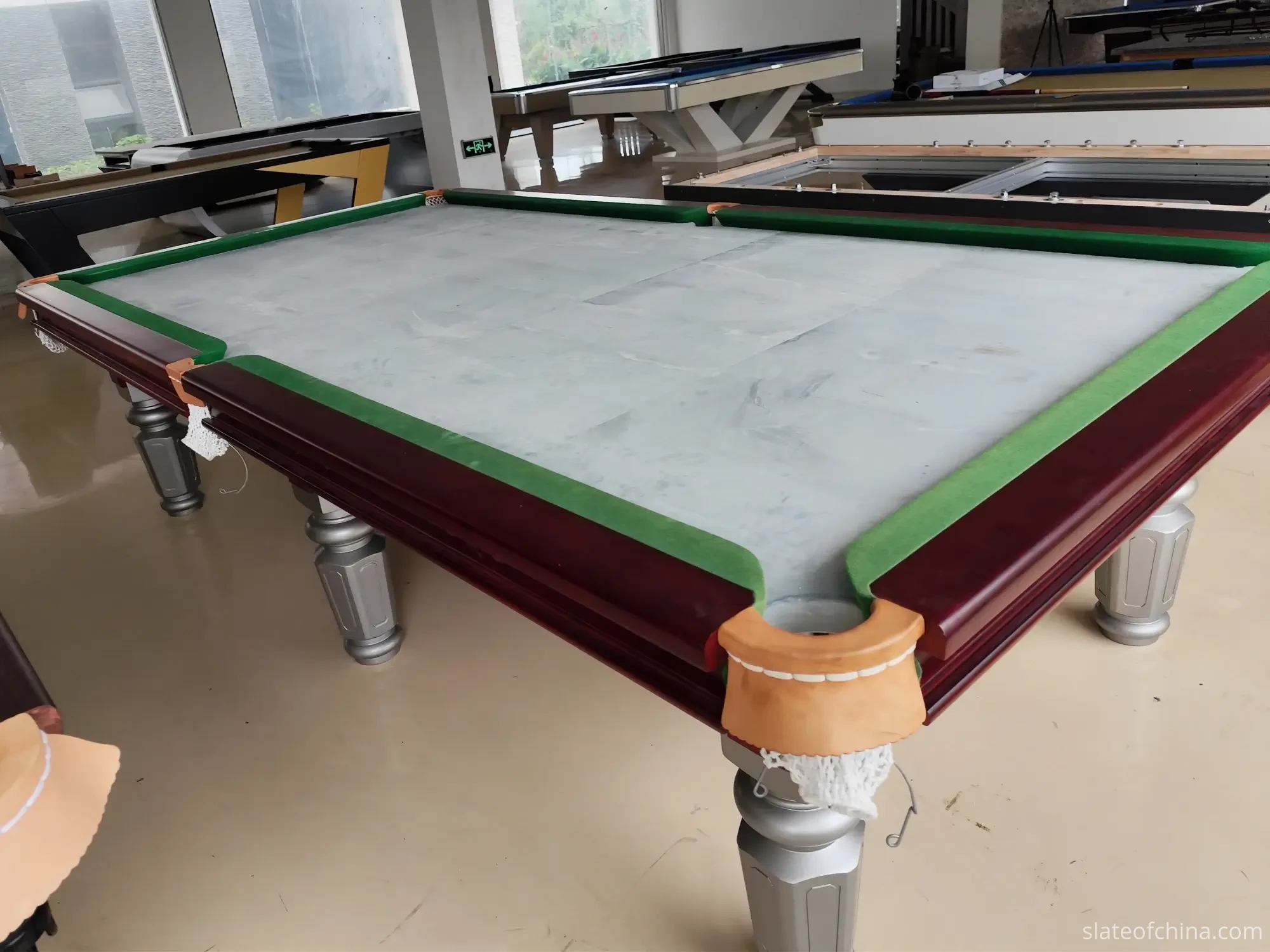
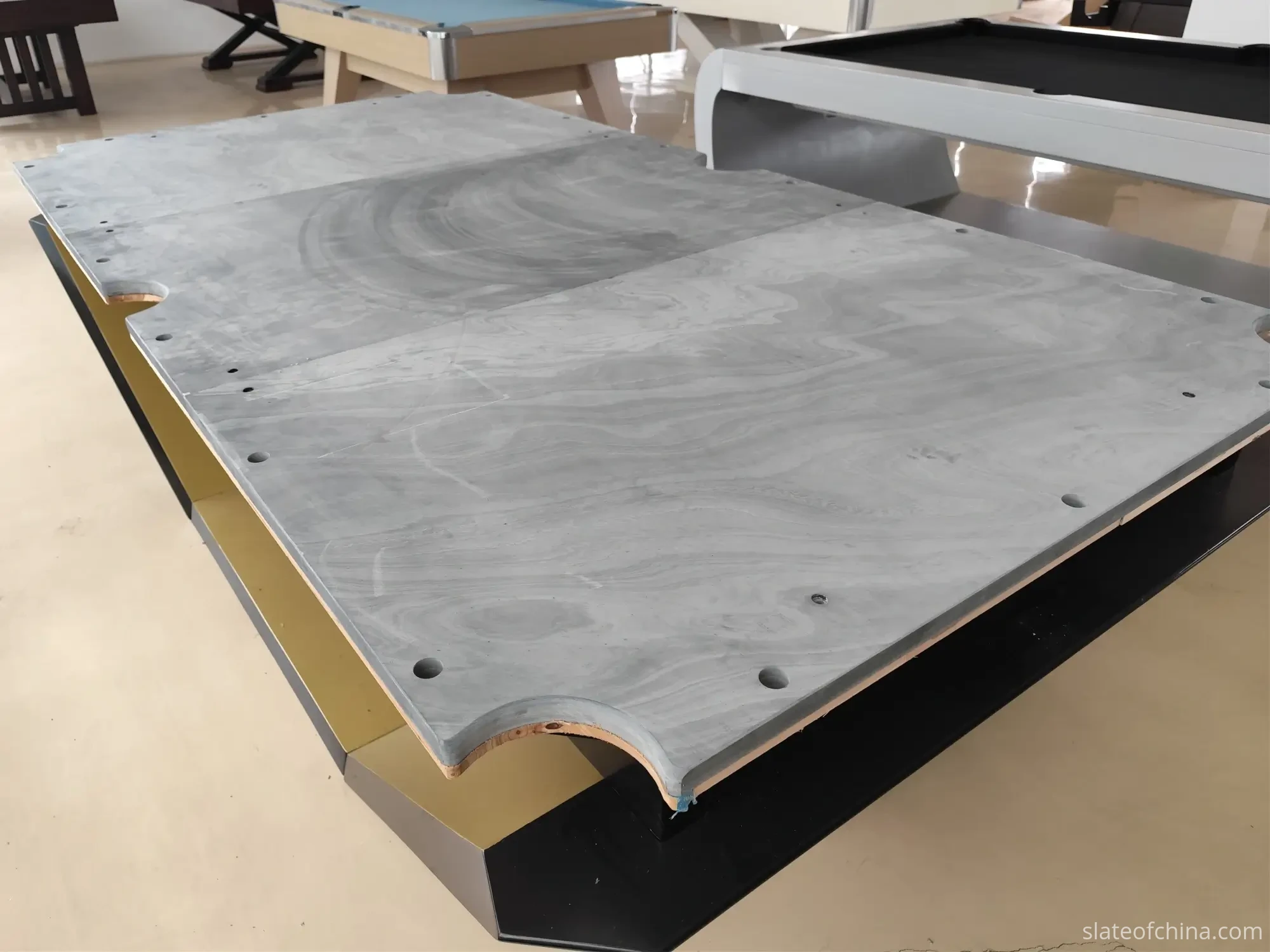
Stand at one end of an unclad billiard bed and let your eye drop down the length of the slate. What looks like a single green plane after the cloth goes on is, before the cloth, a finished stone surface with its own geography. There are valleys where the cutter took a fraction too much, ridges where it took a fraction too little, a gentle bow from one end to the other, and a step — sometimes only a few tenths of a millimetre — where two pieces of a multi-piece set meet. None of this is visible once the cloth is stretched. All of it is still there.
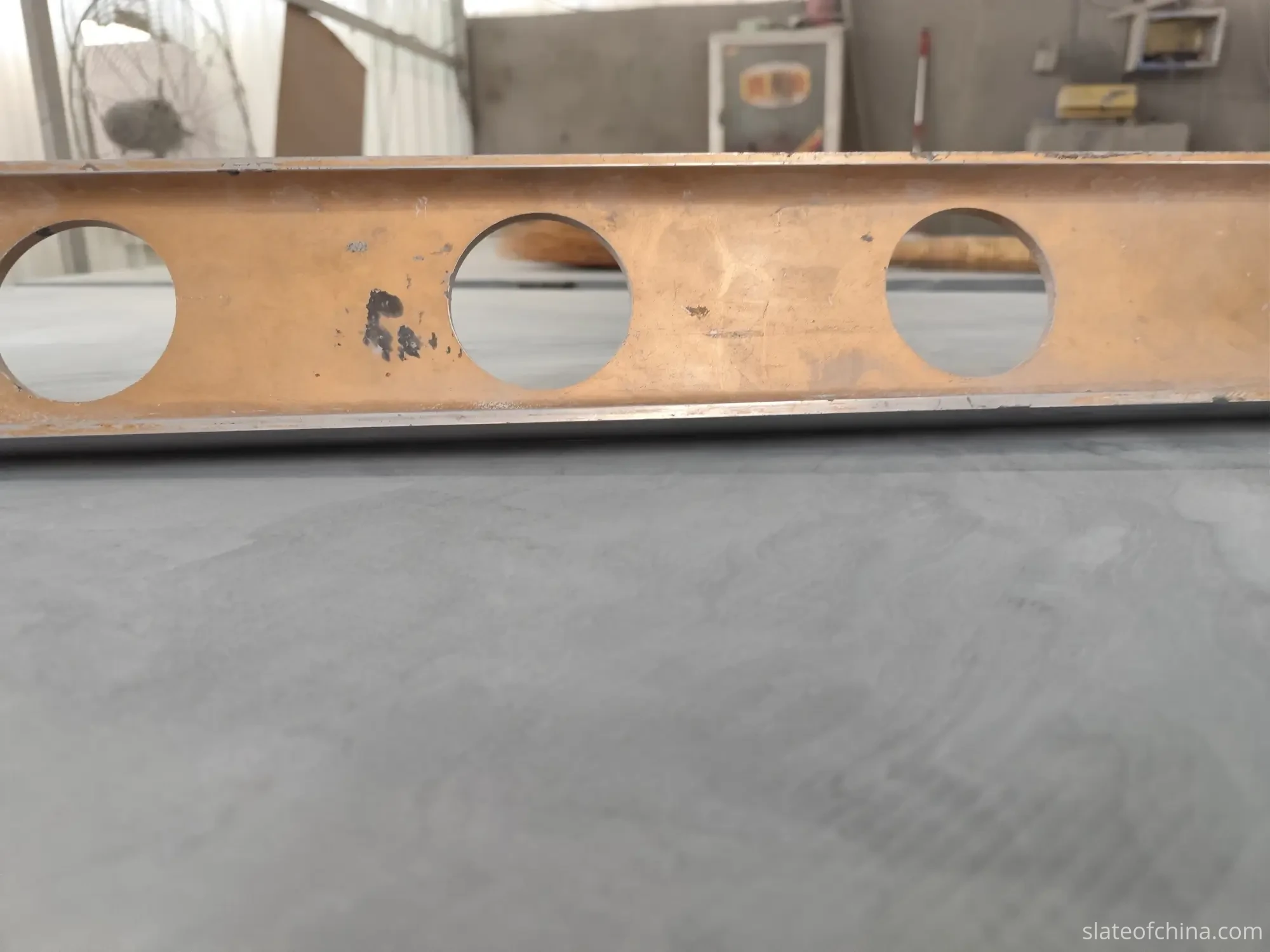
The first thing to separate is level from flat. They answer different questions. Level asks: is the whole table tilted? You can fix level with shims under the legs. Flat asks: ignoring which way the table points, is the surface itself a true plane? A table can be dead level at all four corners and still have a 1 mm bowl in the centre. Shimming the legs will not reach that bowl. The legs lift the frame; the bowl is in the stone.
This is why asking a supplier “is your slate level?” is the wrong question. The right one is: what flatness tolerance does the finished bed hold, over what measuring length, and how do you verify it? For pool, snooker, carom and every other precision table, that question belongs in the same breath as slate thickness, density and machining quality — because it is the one that decides what the ball actually does.
Why One Millimetre Is a Slope, Not a Number
“One millimetre” sounds small because it is small — for a wall, a floor, a worktop. For a precision playing surface the unit is misleading. What matters is not the depth of a deviation but the slope it creates, and slope is depth divided by the distance over which that depth changes.
Take a 1 mm dip spread evenly across 500 mm of bed. That is 1 ÷ 500, or 0.002 — a 0.2 % grade over that section. Compress the same 1 mm into 100 mm and the grade becomes 1 %. Stretch it across the full 1 000 mm length of a small table and it falls to 0.1 %. Same number on the inspection sheet, three different surfaces.
The honest caveat is that none of these grades predicts a fixed deflection in centimetres. The actual path of a ball depends on its speed, the cloth, the contact patch, the shape of the deviation, how far the ball travels across it, and the table's construction. A broad gentle 1 mm valley and a sharp 1 mm ridge are not the same problem, even though the inspection number reads the same. What the arithmetic does show is why 1 mm cannot be dismissed by its size alone: on a precision bed, one millimetre is always a slope somewhere. The question is how steep, how wide, and how close to the line a slow ball has to travel.
Four Landforms, Four Ball Behaviours
Buyers tend to fixate on dips. The surface has at least four landforms, and each one talks to the ball differently.
| Landform | What it is | How a slow ball reads it |
|---|---|---|
| Dip | a shallow low area | tends to drift in, then change line as it climbs out |
| High spot | a raised patch | is nudged away as it climbs over |
| Twist | two regions leaning opposite ways | wanders; the line corrects and re-corrects |
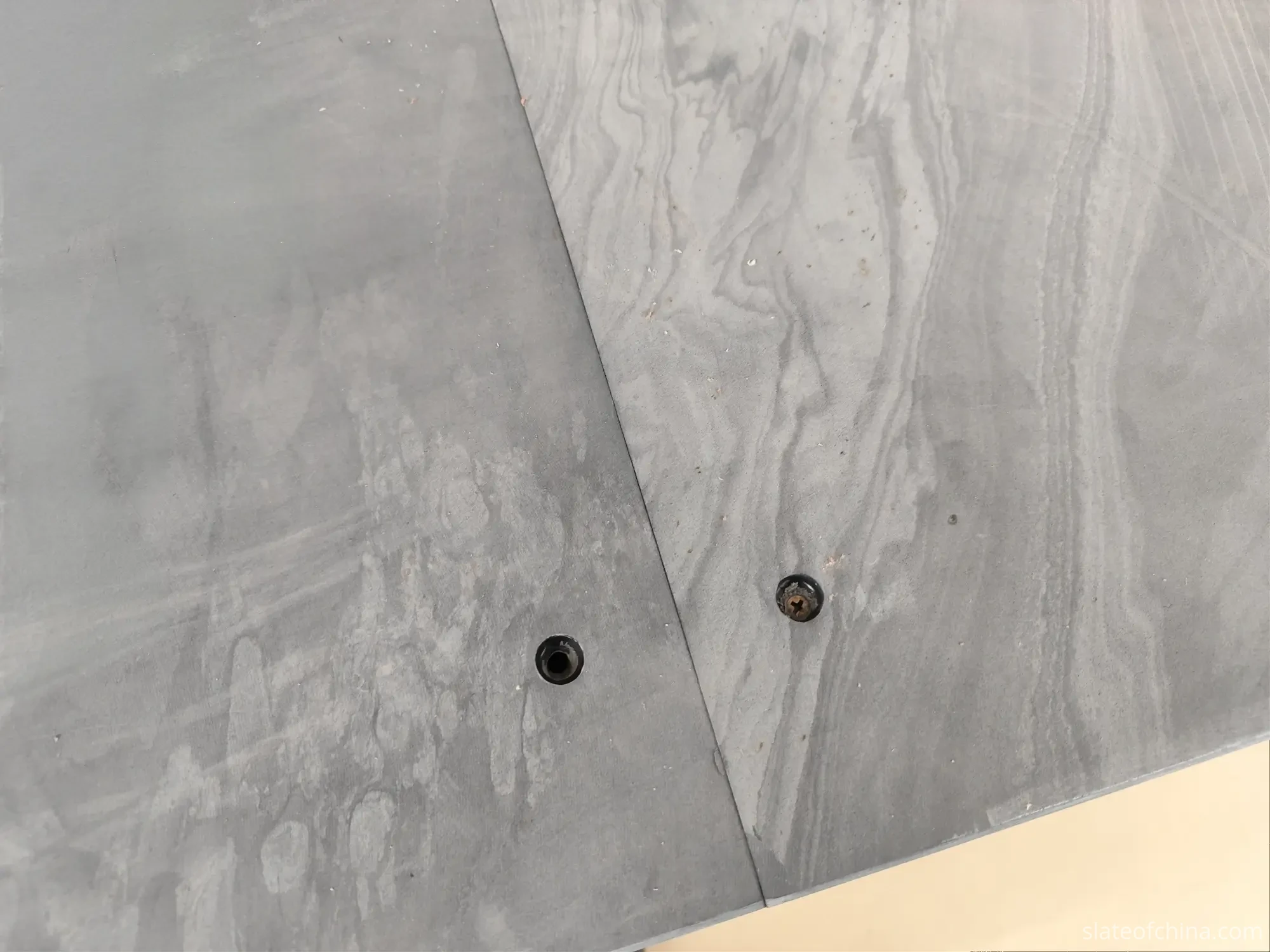
| Joint ridge / step | a height difference at a seam | can take a small kick crossing the joint line |
A high spot is not the opposite of a dip in the way a player feels it — both bend the ball, just in opposite directions, and a sharp transition of either kind is harder on the line than a gradual one twice the size. That is the reason a single flatness number on a spec sheet, without a description of the shape, never tells the whole story. “Flatness tolerance: 1 mm” is a useful line, but a serious buyer will keep reading to ask over what length it was measured, where the points were taken, and whether the value is peak-to-valley or deviation from a reference plane.
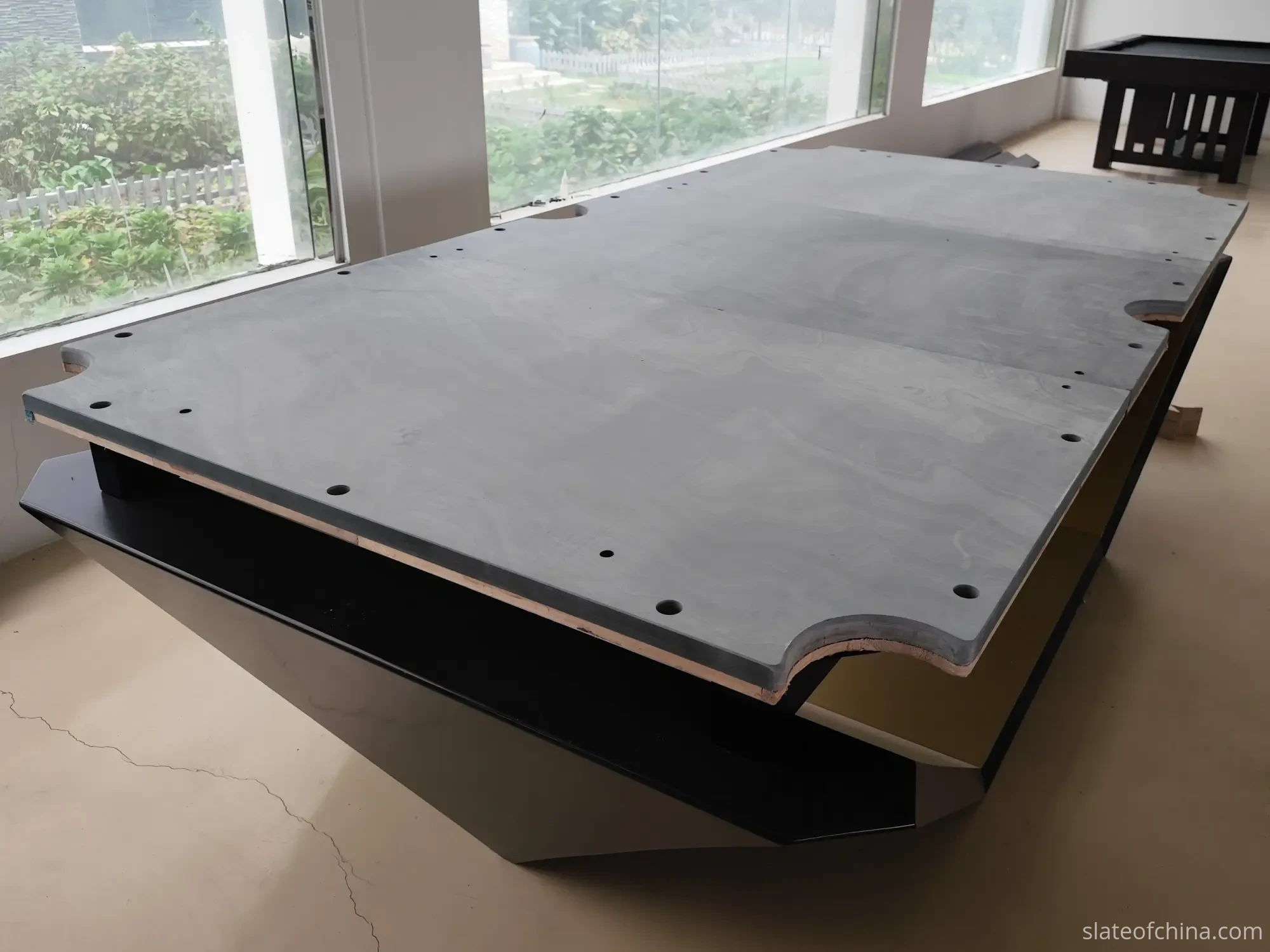
Joints deserve a special mention because they are the one landform a multi-piece set always has. Three pieces of slate, machined individually, can each be flat and still produce a small step where they meet — from uneven support, an edge that is not quite true, or movement during installation. A ball travelling wholly inside one slab never sees the joint; a ball crossing it does. The transition is part of the playing surface, and on a five-piece snooker bed it is part of the surface four times over. We machine and match multi-piece sets as one bed for this reason; how piece count and joint design interact with cost, machining and shipping is covered in our guide to one-piece vs three-piece slate for manufacturers.
Speed Decides How Much the Terrain Shows
A fast ball and a slow ball read the same surface differently. A ball struck hard crosses a shallow grade before it has time to show — the curve is there, it is just below what anyone calls a miss. A ball rolling slowly spends more time on the same grade, so the same geography shows up as a visible drift.
This is why flatness problems surface most often on the kind of shots players value precisely: the long slow roll into a pocket, the gentle positional shot that has to die in a small zone, the straight long-pot where the ball has to travel the full length of the bed. The surface was always this shape. The shot made it visible. A table that plays fine at break-off speed can still curl a stop shot three rails later, and the cloth is often blamed first — sometimes fairly, because cloth condition, tension and wear all play their part — but the stone underneath can be the real source, and the cloth is only reporting what it finds.
Thickness Is Not the Fix
It is tempting to solve flatness by ordering thicker slate. It does not work that way. Thickness and flatness are independent specifications. A 25 mm slab and a 45 mm slab can both be machined flat, and either can be machined poorly. Thickness buys stiffness, weight and resistance to bending under load — useful properties, but not the same property as a true plane. How thickness actually feeds into table performance — rigidity, support, deflection — is a separate question we unpack in How Slate Thickness Affects Table Performance. For flatness, the spec that matters is the surface tolerance and how it was measured, not the depth of the stone.
Two Numbers That Look Alike and Are Not
A flatness number without a measuring length is not really a specification — it is an adjective. Two suppliers can both write “flatness: 1 mm” on a quote and mean different surfaces. The first may have measured over the full 1 000 mm length of the bed; the second over a 300 mm straightedge laid anywhere on the surface. The same one-millimetre figure, read against two different rulers, describes two very different tables.
This is why a professional buyer does not stop at the number. The flatness clause worth writing has four parts: the tolerance value, the measuring length it applies over, the method and instrument used, and the acceptance pattern — every piece, sampling, or a grid of points. A full tournament-grade clause goes further still and asks for an inspection record to travel with the order; we walk through that specification in our guide to choosing slate for professional and tournament tables. For everyday sourcing the first four parts are the minimum that lets two quotes be compared honestly.
Pool vs Snooker: Same Geography, Different Scale
Flatness matters on every billiard table, but the scale of the problem changes with the bed. A 7 ft or 9 ft pool bed is a single, manageable piece of geometry; a full-size 12 ft snooker bed is a five-piece set nearly four metres long, and every landform above has more room to live in. The longer the bed, the longer a slow ball's path, and the more distance over which a small grade can show. Multi-piece alignment also becomes harder as the pieces grow — a small step on a 9 ft set is a fitter's annoyance; the same step on a 12 ft five-piece set can sit on a seam that runs the whole width of the playing area. For the full comparison of pool and snooker slate — size, thickness, piece count and why snooker is always thicker — see our pool slate vs snooker slate guide.
Where the Terrain Changes After the Factory
A bed can leave the factory inside its flatness tolerance and arrive on a table with a different shape. The playing surface is the end of a chain: slate machining, slate support, frame assembly, joint mating, leveling, cloth installation. Any link can introduce a deviation of its own. A frame that is not adequately supported under the centre of a long bed can sag under the weight of the stone; a joint pulled together with too much force can bow the edges; cloth stretched tighter on one side can pull a thin slab. The geometry that ships is not always the geometry that plays.
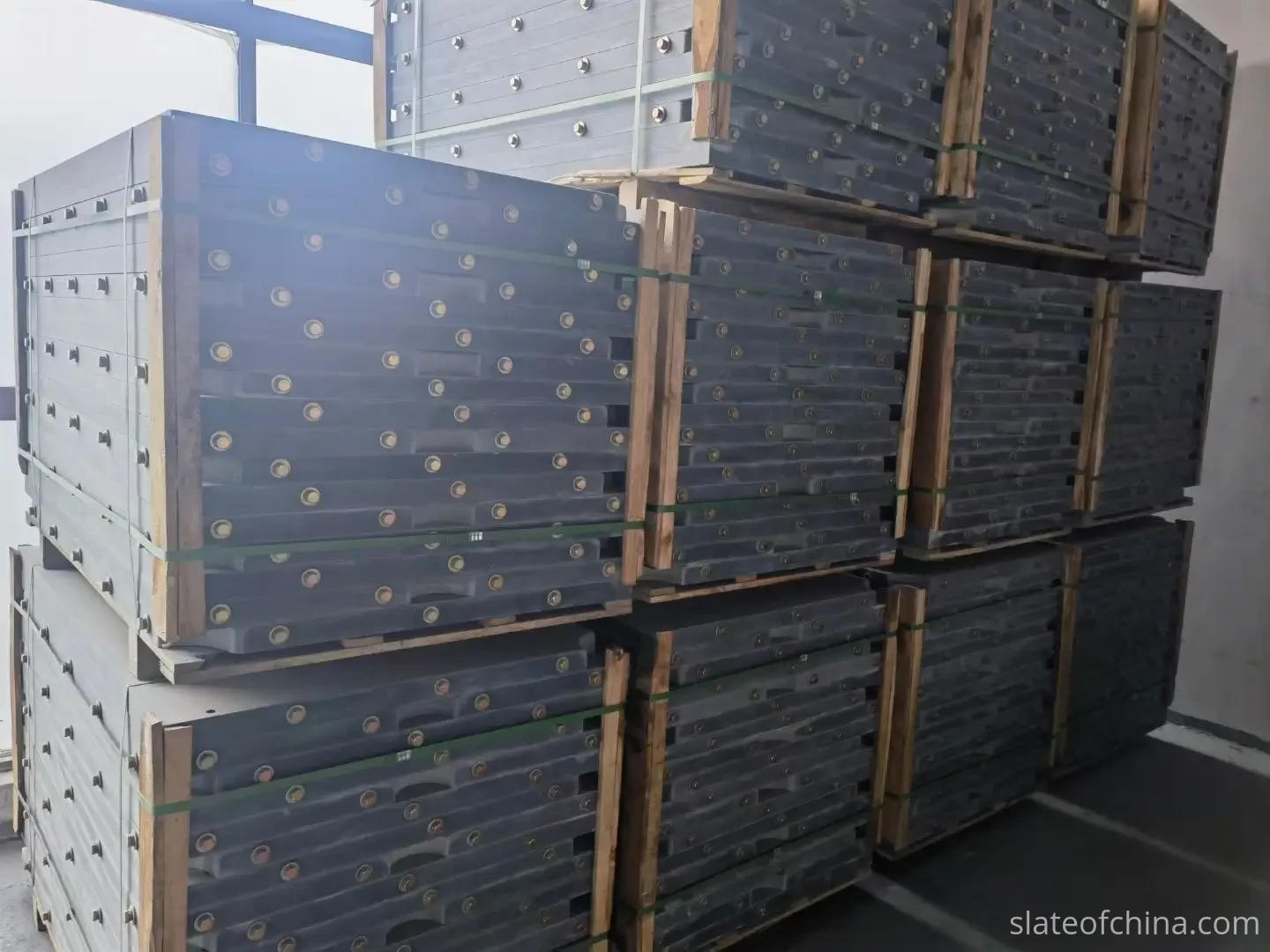
This is why flatness and installation have to be treated as one system, not two. Factory inspection tells you what the stone was; final leveling and a check on the assembled bed tell you what it is. Our quality and test data page describes how each set is checked before packing; the buyer's decision path through specs, samples and installation is laid out in How to Choose Billiard Slate.
The Flatness Clause a Buyer Should Write
The way to make flatness manageable is to put it on paper before the order, not argue about it after the container arrives. A flatness clause a manufacturer can actually work to has five elements:
| Element | What to write |
|---|---|
| Surface flatness tolerance | ≤ X mm |
| Measuring length | over Y mm (reference length) |
| Measurement method | instrument and procedure |
| Inspection pattern | every piece / sampling / grid |
| Joint tolerance | ≤ Z mm across assembled seams |
The number X alone is not the specification — the other four rows are what make it comparable between suppliers and verifiable on arrival. A buyer who writes only “flatness: 1 mm” has written an adjective; a buyer who writes all five rows has written a clause.
For recreational tables a buyer may accept a looser tolerance; for commercial tables a tighter one; for tournament tables a clause with an inspection record attached. The level is set by the table being built, not by a universal number — and the safest spec is the one the supplier can show evidence of holding, not the one that simply reads best on a quote. The full slate specification — thickness, tolerance, dimensions, machining and surface — is set out on our technical specifications page; a broader set of buyer questions lives in our billiard slate FAQ.
Frequently Asked Questions
How flat should billiard slate be?
There is no single universal number. The right flatness tolerance depends on the table type, playing standard and bed size, and it has to be written together with the measuring length and method — a number alone is not a specification.
Can 1 mm of slate deviation really affect ball roll?
It can. One millimetre is a slope, not just a depth, and its effect depends on where it sits, how gradually it changes, how wide an area it covers, and how slow the ball is travelling across it. A 1 mm dip should be evaluated in context, not dismissed by its size.
Will leveling the table fix an uneven slate?
Leveling corrects the orientation of the whole table; it does not remove a local dip, high spot or twist that is built into the stone. Level and flatness are different problems needing different fixes.
Is thicker slate automatically flatter?
No. Thickness and flatness are independent specs. A thicker slab can be machined well or poorly, the same as a thinner one. Thickness buys stiffness; flatness is a property of the finished surface.
Why does a flatness number need a measuring length?
Because the same 1 mm value read over 300 mm describes a much steeper surface than 1 mm read over 1 000 mm. Without the measuring length, two suppliers' flatness figures cannot be compared honestly.
How should I ask a slate manufacturer about flatness?
Ask for the finished-surface flatness tolerance, the measuring length it applies over, the measurement method, the inspection pattern (every piece or sampling), and whether an inspection record can travel with the order. These answers say more than “yes, our slate is flat.”
Related Reading
Need billiard slate that holds its flatness on paper and on the table?
Send us the table size, thickness requirement and the flatness tolerance you need to hold — and ask for the measuring method and inspection record that come with it. We machine and match every set as one bed, check each piece before packing, and ship to 30+ countries. Tell us what you're building, or browse our billiard slate range.