
Pool Slate vs Snooker Slate: Why Snooker Beds Run Nearly Twice as Thick
Quick answer: Pool slate and snooker slate can come from the same natural stone, but they are engineered for different tables. Pool slate is commonly thinner, while full-size snooker slate is substantially thicker and heavier. The two should not be treated as interchangeable.
| Pool Slate | Snooker Slate | |
|---|---|---|
| Typical thickness | 19–25 mm | 35–50 mm |
| Common configuration | 3-piece | 5-piece |
| Main reason for the difference | Smaller table, lighter structure | Larger playing surface, higher structural demand |
Can one slate do both jobs? Usually, no — the full substitution verdict is in its own section below.
General manufacturing ranges, not universal standards — the table manufacturer's drawing is the specification.
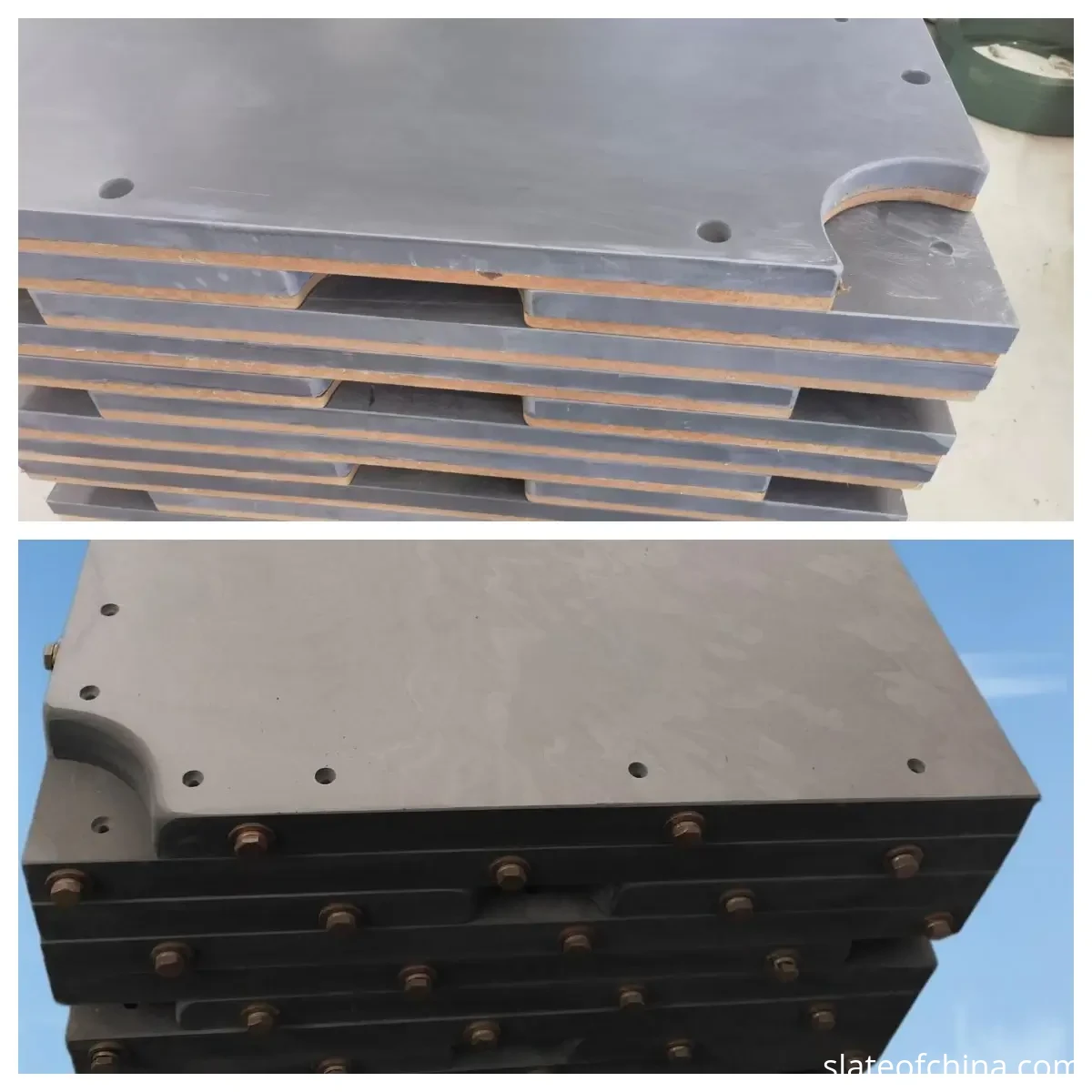
Walk into a slate dispatch yard when a 9 ft pool set and a 12 ft snooker set are leaving in the same week, and the difference becomes obvious before any drawing is opened: seen edge-on, the pool panels stand at about 25 mm; the snooker panels at about 45 mm. Same quarry, same saw line, same inspectors — and nearly twice the stone on one of them. The thickness gap is not a quality decision and not a tradition for its own sake. It is the answer to a structural question the two tables ask in different sizes, and the rest of this page is that answer — plus the sourcing decisions that fall out of it.
The Stone Is the Same. The Specification Is Not.
Natural billiard slate is selected for a small set of properties: flatness, structural stability, fine and consistent grain, low water absorption, the ability to hold a machined surface, and resistance to cracking during processing and use. A good billiard slate manufacturer may use similar raw slate for both pool and snooker applications. The finished product, though, is a different animal: a 12 ft snooker table can call for several large panels at about 45 mm; a 9 ft pool table commonly uses three panels at about 25 mm. The difference between pool slate and snooker slate is a specification difference, not a material difference — a distinction that matters the moment you compare quotations from two suppliers.
In this Guide, the pages split the work. Billiard Slate Technical Specifications is where you look numbers up; Types of Billiard Slate is how you recognise what is in front of you; this page is where you find out why the two beds diverge, whether one can stand in for the other, and how to judge what a quotation is really offering. The full three-way comparison with Chinese 8-ball — including pocket geometry and hole patterns — stays on the key differences page. For the material basics, start with What Is Billiard Slate.
Why Is Snooker Slate Thicker Than Pool Slate?
Start with the concept that does the most work here — the one I reach for first whenever a buyer asks why the snooker order carries so much more stone: thickness is about stiffness, not simply strength. The snooker bed is not thick because a thin panel would crack — a 25 mm panel holds its own on a pool table for decades. It is thick because a bed has to resist bending between supports, and bending resistance in a flat slab rises very fast with thickness. For a plate of the same material and span, stiffness increases so quickly with thickness that adding millimetres is the most effective way to keep a large surface from deflecting. That single fact drives almost every number in this comparison.
Now the two playing surfaces. A 9 ft pool bed carries a playing area of about 2540 × 1270 mm — roughly 3.2 m². A full-size 12 ft snooker bed carries about 3569 × 1778 mm — roughly 6.3 m², just under double. The long dimension grows by a factor of about 1.4 (3569 / 2540), and more of that span sits further from the nearest frame support. On a full-size snooker table, a large share of the bed's stiffness has to come from the stone itself rather than the frame underneath it.
In that drawing, the solid line is the finished slate outline — about 2718 × 1448 mm assembled for the 9 ft pool bed, about 3658 × 1867 mm for the five-piece snooker bed — and the dashed line is the playing area, which sits roughly 90 mm inside the outline on each axis. That gap is the cushion nose and the frame allowance, and it is why the two figures both appear in quotations.
Thickness buys stiffness, and stiffness buys nothing without span. The bending stiffness of a slab of a given width scales with the cube of its thickness. Move from 25 mm to 45 mm and the thickness ratio is 1.8 — and 1.8 cubed is about 5.8. Per unit of span, the snooker panel is getting on for six times stiffer in bending than the pool panel, before any other difference enters the picture.
That is the cube law going one way. Span pushes the other way: under its own weight, a slab sags between supports at a rate that grows very quickly with the span and falls quickly with thickness. A simplified structural model — a strip of stone on two supports — helps explain why full-size snooker beds become much thicker as the span increases. It is useful for understanding the trend, but it is not a substitute for the table manufacturer's engineering drawing.
That trend, not any single calculation, is why real 12 ft snooker beds run 35–50 mm, with 45 mm the workhorse in our production. Real table frames are smarter than any simple model: cross-members sit closer together on a pool bed, the bed is clamped to the frame rather than simply resting on it, and the five-piece snooker layout changes the per-panel spans. The drawing, not arithmetic, is what decides the number.
The thickness-by-thickness verdict — 25, 45 or 50, and which one to actually order — is a separate question with its own page. What that thickness then does to ball speed and bounce on the cloth is, again, a different question, with its own page as well.
Can You Use Pool Slate on a Snooker Table?
Generally, no — and the reason is not that pool slate is a lower grade of stone. In most cases it is the same rock. The reason is that a finished bed is one component in an engineered system: its thickness, its dimensions, its pocket geometry, its bolt-hole pattern, its joint layout, its rail height and its support structure are all drawn around one specific table. Change the bed and you have changed the geometry of everything bolted to it.
Two emails land again and again, and both get the same answer. The first reads, more or less: Can you make the 12 ft snooker set in 25 mm? It saves nearly half the freight. The freight saving is real. The table is not. A 25 mm panel cannot carry the 1.4× span without sagging, the joint engagement depth at 25 mm is not enough for the levelling hardware the frame was drawn around, and the cushion nose height, rail height and bolt lengths all assume 45 mm stock. The pocket and bolt machining does not have the material it needs. What arrives is a lighter box of stone that is no longer a snooker table.
The second reads: Can you make the pool set in 45 mm — for better quality? The cabinet, the rail height, the bolt length and the support spacing on a 9 ft pool table are all drawn around 25 mm. Adding 20 mm of stone adds weight the room floor and the cabinet were not drawn for, without play benefit on a span that 25 mm already covers. The machining positions assume 25 mm stock. The table does not play "better"; it plays the same on a heavier, more expensive bed that no longer matches its own drawing.
The same logic runs in reverse — a thick snooker panel will not turn a pool table into a premium table either; it just mismatches the cabinet. The full interchangeability verdict across pool, snooker and Chinese 8-ball, including pocket geometry and mounting-hole patterns, is on the key differences page. Replacement slate for an existing table follows its own route — measuring the old bed — and is on the replacement slate page.
What the Two Markets Actually Order
The pool side
Pool table slate comes in several thicknesses depending on the cabinet design. The common specifications in our production are 19, 22 and 25 mm. The thinner 19 mm shows up on lighter 7 ft and 8 ft cabinets where the whole table has to stay friendly to home floors and residential staircases; 22 mm and 25 mm appear as cabinet designs get more commercial. On some tournament-grade pool designs the drawing calls for more — up to 30 or 38 mm — because that particular cabinet was engineered for it, not because somebody wanted a "better" number.
A real inquiry reads something like:
9 ft pool table slate, 2718 × 1448 × 25 mm, 3-piece set, CNC machined to drawing.
That line, finished, lands at about 250–270 kg per set — three panels of roughly 80–90 kg each. The per-grade breakdown of what each pool thickness is for, size by size, is on the pool table slate thickness guide.
The snooker side
Snooker slate is generally much thicker. The specifications we actually manufacture include 35, 40, 45 and 50 mm on 12 ft designs, with 45 mm the one most commonly produced in our shop. A common finished configuration reads:
12 ft snooker slate, 3658 × 1867 × 45 mm assembled outline, 5-piece set, CNC machined to drawing.
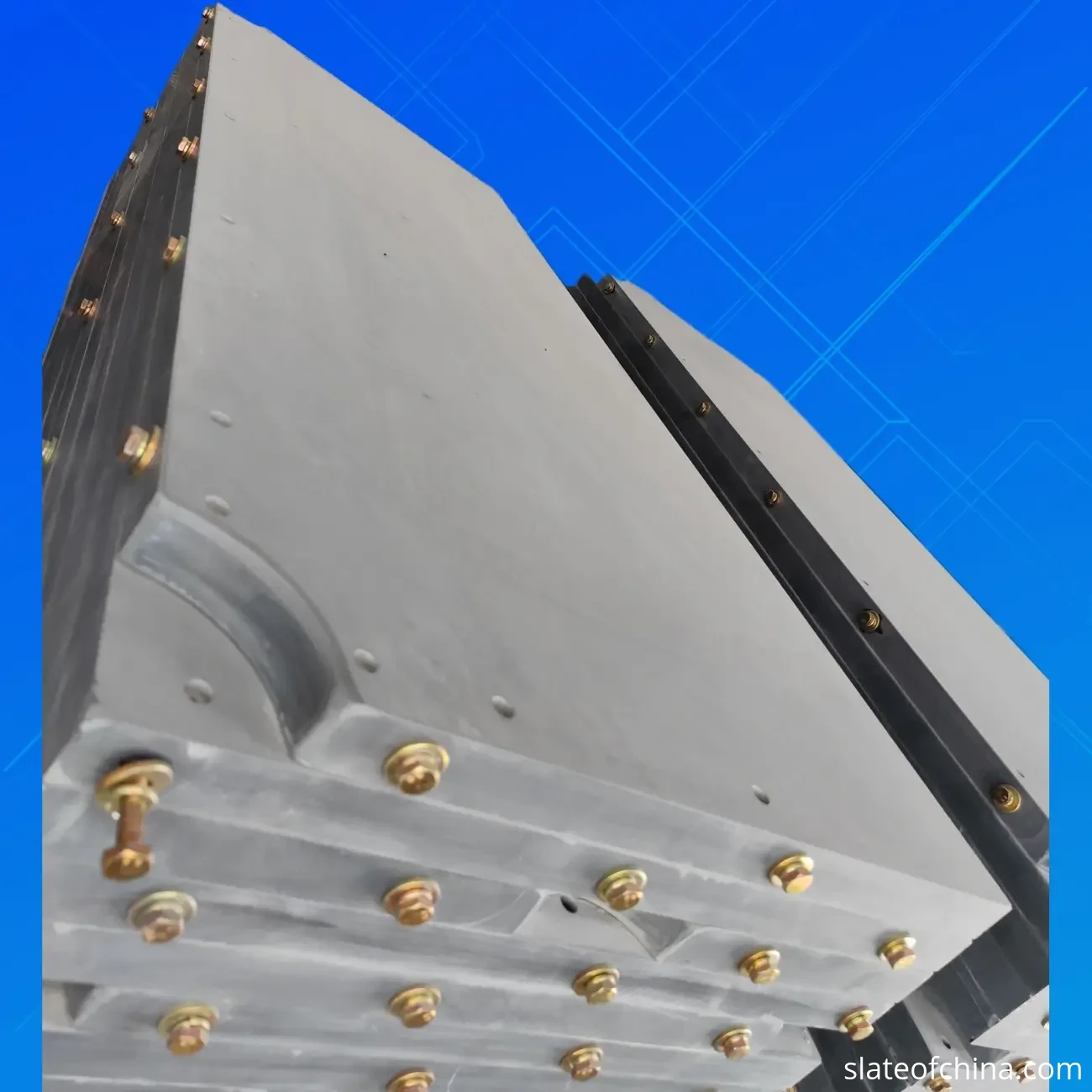
The exact dimensions vary with the table manufacturer, the playing-area design, the cushion system and the construction method. Some 12 ft designs are drawn lighter, at 35 mm; 50 mm appears on tournament-class builds; smaller 10 ft snooker tables commonly run 38 mm, the same logic scaled down. None of these are quality grades — they are drawing decisions. The grade-by-grade breakdown of snooker thickness, including the 45 mm versus 50 mm debate, is on the snooker slate thickness guide and the 45 mm vs 50 mm page.
So why does 45 mm dominate? Because many traditional and professional-style 12 ft table designs are engineered around a 45 mm bed. The frame, the leveling system and the cushion assembly are all drawn assuming that thickness. Replace a 45 mm bed with a 35 mm bed on the same cabinet and the geometry of the whole table moves — rail height, bolt length, cushion nose height. Slate thickness should be treated as a design specification, not simply a quality ranking.
Thicker Is Not a Higher Grade
A 45 mm slate is not automatically a higher-quality version of a 25 mm slate. The two are designed for different table structures.
This is the distinction that catches buyers out. A 50 mm slate is not automatically better than a 25 mm slate, and a 45 mm snooker bed is not a "higher grade" of the same product as a 25 mm pool bed. The thickness has to match the application. A 25 mm bed can be entirely right for a 9 ft pool table; a 45 mm bed can be entirely right for a 12 ft snooker table; a 50 mm slab can be the wrong answer on a table that was drawn around thinner stock.
Here is the honest wrinkle that proves the point. The standard commercial ranges the two markets actually order barely overlap: pool 19–25 mm, snooker 35–50 mm. But where premium pool designs go to 30 or 38 mm, a tournament pool bed can be thicker than a 35 mm snooker bed. A 38 mm pool bed is not a "better" slate than a 45 mm snooker bed, and a 35 mm snooker bed is not a "lesser" one than a 25 mm pool bed. Each is the answer to its own table's drawing. Thickness tracks the span and the engineering, not the prestige of the game.
Other factors matter as much as the thickness number: the flatness of the finished playing surface, the thickness tolerance the panels actually hold, how accurately a multi-piece set fits together, the surface finish, the machining accuracy of pocket cuts and bolt holes, and the structural consistency of the stone. For professional and tournament sourcing, the better question is whether the slate meets the drawing — and that question, with the four things tournament spec tightens, is on Choosing Slate for Professional & Tournament Tables.
Where Thickness Turns Into Freight
Why is a snooker bed so heavy? Because thickness turns into stone, and stone turns into freight. The arithmetic is straightforward. For the same footprint, moving from 25 mm to 45 mm is 1.8 times the stone, and the 12 ft snooker bed covers about 1.7 times the outline area of the 9 ft pool bed (6.83 m² against 3.93 m²). Multiply the two ratios and a 9 ft set's roughly 260 kg scales to the same neighbourhood. A typical finished 12 ft, 45 mm five-piece set can approach 800 kg, although the actual weight varies with the slate outline, machining and stone density. Per panel, that is roughly 160–170 kg for snooker against 80–90 kg for pool — about twice the weight per piece.
Downstream, that weight decides four things: how many sets fit in a container, how the export packing has to be engineered, what lifting equipment the installation crew needs, and what the table frame and the room floor have to carry. A 160–170 kg panel does not travel by hand. For manufacturers importing billiard slate from China, snooker slate weight — per panel and per set — should be confirmed before ordering, particularly for large sets. A quotation worth comparing should include the estimated weight per panel, weight per set, sets per container, packaging weight and total shipment weight. The packing and loading detail is on the packing and shipping page, and the broader import paperwork on the import guide.
Why a 12 ft Bed Travels in Five Pieces
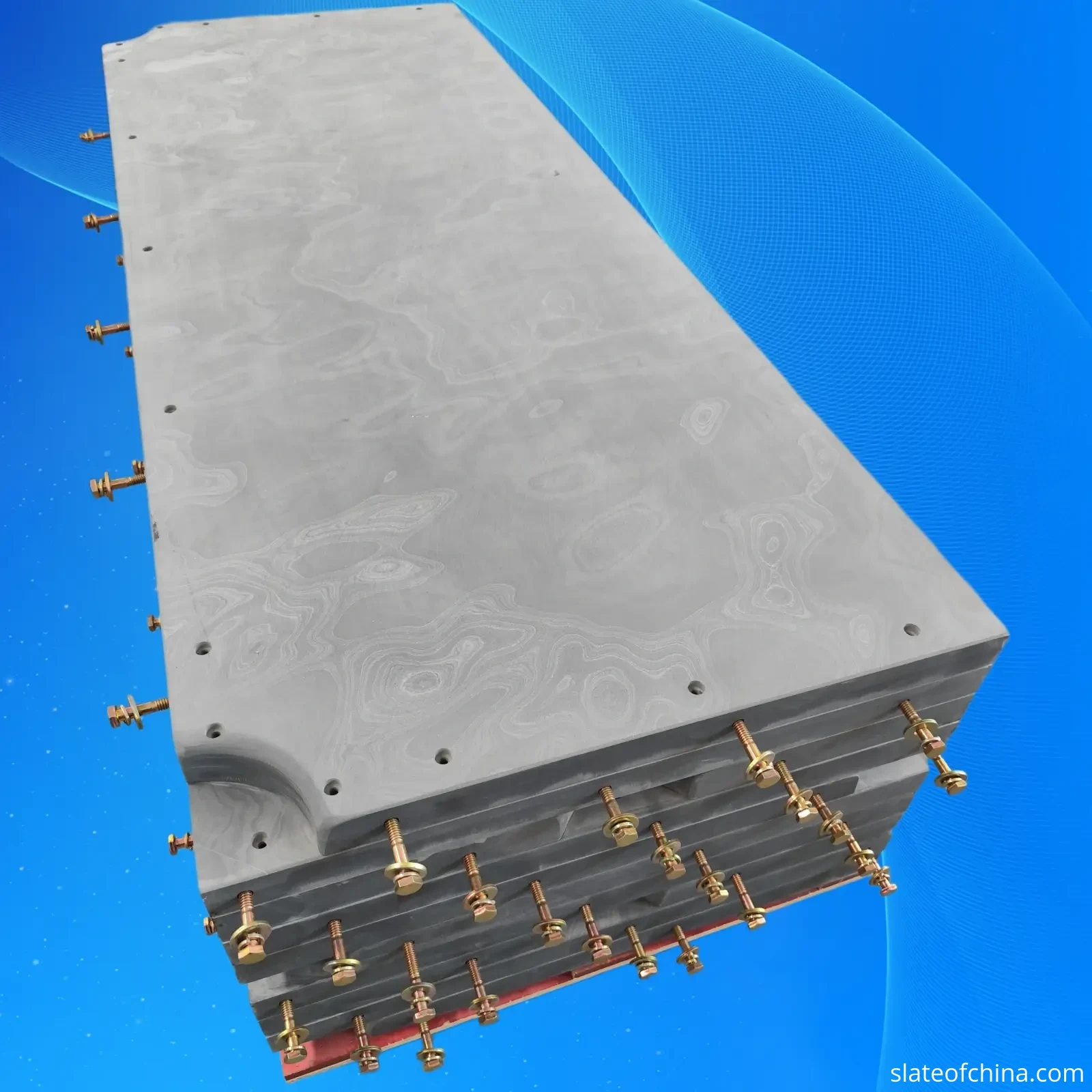
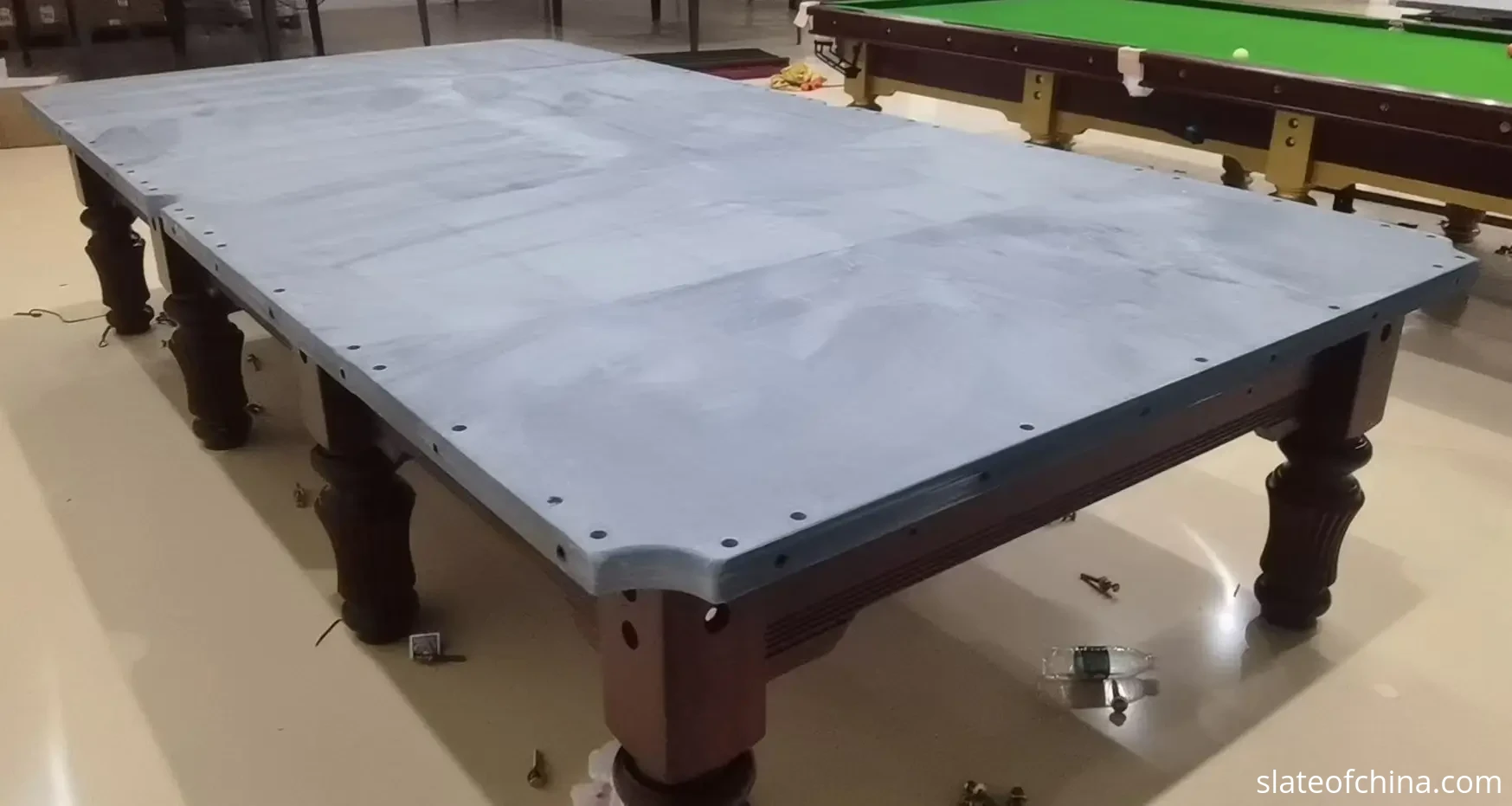
Large snooker tables usually use several slate panels rather than one enormous slab. A 12 ft snooker set in our production is commonly five pieces. Five-piece construction is not a universal rule for every 12 ft table; it is a practical configuration used by many traditional designs. There are four honest reasons.
Transportation. One giant slab of 6.8 m² would be extremely difficult to manufacture, ship and install. Handling. Five panels of 160–170 kg can be moved with appropriate lifting equipment by a professional crew; one monolithic 800 kg slab cannot. Production. Large natural slate slabs have geological limits — dividing the playing surface into several panels makes production practical and reduces the risk that a single bed-defining feature sits in a problematic part of the block. Installation. The panels can be positioned and levelled individually before being joined into one continuous surface.
The key issue is not the number of pieces. The question is how accurately the pieces fit together after installation. A multi-piece bed depends heavily on the joint machining, the flatness of each panel, and the installation itself. Thicker panels also provide more material for certain joint, pocket and mounting features, depending on the table design — part of the reason a thin snooker bed would struggle at the seams even if the span problem were solved. The 1-piece vs 3-piece question on the pool side — and the manufacturer's cost view of yield, warehousing and assembly — is on 1-Piece vs 3-Piece Pool Table Slate and the manufacturer's version. Joint quality itself is covered on the slate joint alignment page.
Frequently Asked Questions
Can pool slate be used on a snooker table?
Generally, no — and not because pool slate is a lower grade of stone. A full-size snooker bed is one component of an engineered system: its thickness, dimensions, pocket geometry, bolt-hole pattern, joint layout, rail height and support structure are drawn around one specific table. Installing a pool panel on a snooker cabinet changes the geometry of the whole table. Replacement slate should be ordered against the original table drawing.
Why is snooker slate thicker than pool slate?
Because the 12 ft snooker bed spans about 1.4× the length and roughly double the area of a 9 ft pool bed, and a large share of its stiffness has to come from the stone. Bending stiffness rises strongly with the cube of thickness, so thickness is the most effective lever over a large span. Real 12 ft snooker beds land at 35–50 mm, with 45 mm the common specification in our production — a drawing decision, not a universal rule.
Is 45 mm slate better than 25 mm slate?
No. A 45 mm slate is not automatically a higher-quality version of a 25 mm slate — the two are designed for different table structures. A 25 mm pool bed is fully professional when it is what the drawing calls for, and a thicker panel on a cabinet drawn around thinner stock creates problems instead of quality. Thickness matches the table; it does not rank the stone.
How much heavier is a 12 ft snooker slate set than a 9 ft pool set?
Roughly three times. A typical finished 12 ft snooker set at 45 mm can approach 800 kg, although the actual weight varies with the slate outline, machining and stone density; a finished 9 ft pool set at 25 mm lands at about 250–270 kg. Per panel that is about 160–170 kg against 80–90 kg. The snooker set covers about 1.7× the outline area at 1.8× the thickness, which is the whole arithmetic behind the weight gap. Confirm total shipment weight before ordering, particularly for large snooker sets.
Can a slate manufacturer make both pool and snooker slate?
Yes. The raw material can be similar or identical — the finished products require different drawings, panel sizes, piece counts and machining. A manufacturer set up for OEM billiard slate production routinely machines both on the same CNC line; what changes is the specification package behind each bed, not the stone.
How to Order Either Bed Without a Rework Cycle
The easiest way to order either bed is to start with the table, not the stone. The two inquiries we need to see look different, but they answer the same checklist.
If you manufacture pool tables, tell the supplier: table size, playing area, slate thickness, number of pieces, required panel dimensions, the machining drawing, the flatness and thickness tolerances you need, and the quantity. A complete line reads like 9 ft pool table slate, 2718 × 1448 × 25 mm, 3-piece, CNC machined to drawing.
If you manufacture snooker tables, tell the supplier: 10 ft or 12 ft table size, playing-area dimensions, slate thickness, number of panels, individual panel dimensions if the set is split, pocket layout, the hole drawing, required tolerances, and packaging requirements. A complete line reads like 12 ft snooker slate, 3658 × 1867 × 45 mm assembled outline, 5-piece set, CNC machined according to the approved drawing.
Before placing either order, it is worth asking the supplier four pointed things: what thickness they recommend for your table design and why (do not accept a generic "thicker is better"), the actual finished thickness tolerance they hold, the flatness tolerance they can provide, and the weight per panel. The full supplier-evaluation question set — ten questions, with the evidence to ask for behind each — is on How to Choose a Billiard Slate Manufacturer, and the decision path through table type, size, thickness, piece layout and budget is on How to Choose Billiard Slate. If your drawing is non-standard, custom billiard slate machining is the route — the detail is on the Custom Machining from Customer Drawings page.
The Order That Works, and the Order That Fails
There is no single "best billiard slate thickness" for every table. A 7 ft pool table, a 9 ft pool table and a 12 ft snooker table have very different structural requirements, and the correct specification depends on the complete table design. The order in which you specify the bed decides whether the rest of the numbers line up.
Pool slate is commonly around 19–25 mm, while snooker slate generally runs 35–50 mm, with 45 mm the workhorse for 12 ft designs. Thickness alone does not determine quality. For OEM and professional applications, the better question is whether the slate meets the exact dimensions, thickness, flatness, machining and structural requirements of the table — and that is the specification that matters. The most expensive mistake is not paying too much per square metre; it is ordering slate that does not fit the table.
If you are sourcing billiard slate for a pool or snooker table, send the table drawing, the playing-area dimensions and the required thickness to the manufacturer. A supplier experienced in OEM billiard slate production can then confirm the panel dimensions, the machining and the estimated weight before production.
Related Reading
Need a Pool or Snooker Slate Specification Checked?
Send your table drawing or specification. We can review the dimensions, the thickness, the panel configuration and the machining requirements before quoting — so the bed that arrives is the bed the table was drawn around.
Check My Slate Specification → Custom CNC Machining Billiard Slate Category
Slate of China — natural billiard slate manufacturer in China, exporting to 30+ countries.