
What Is Billiard Slate? Complete Guide to Pool Table Slate for Professional Tables
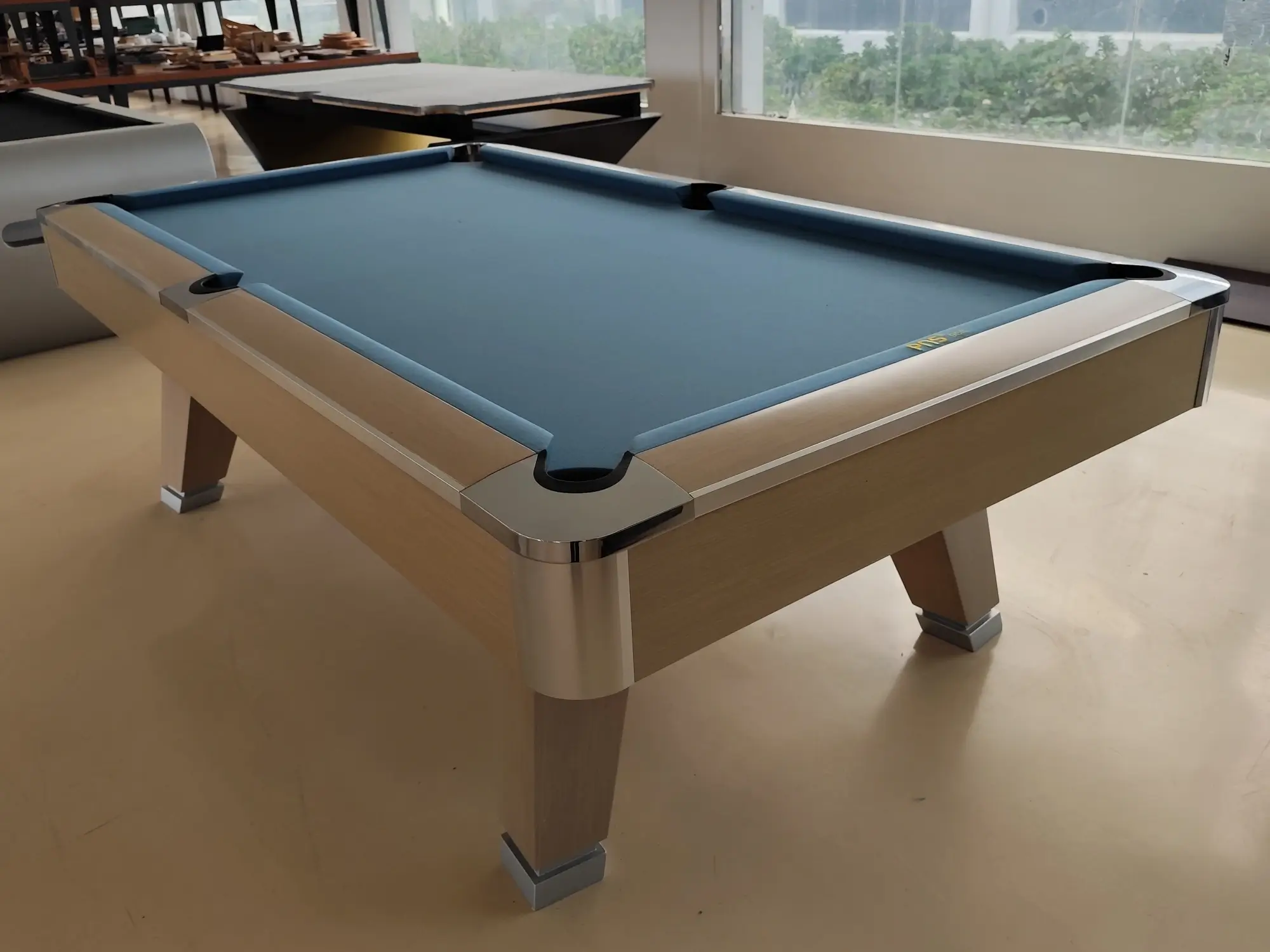
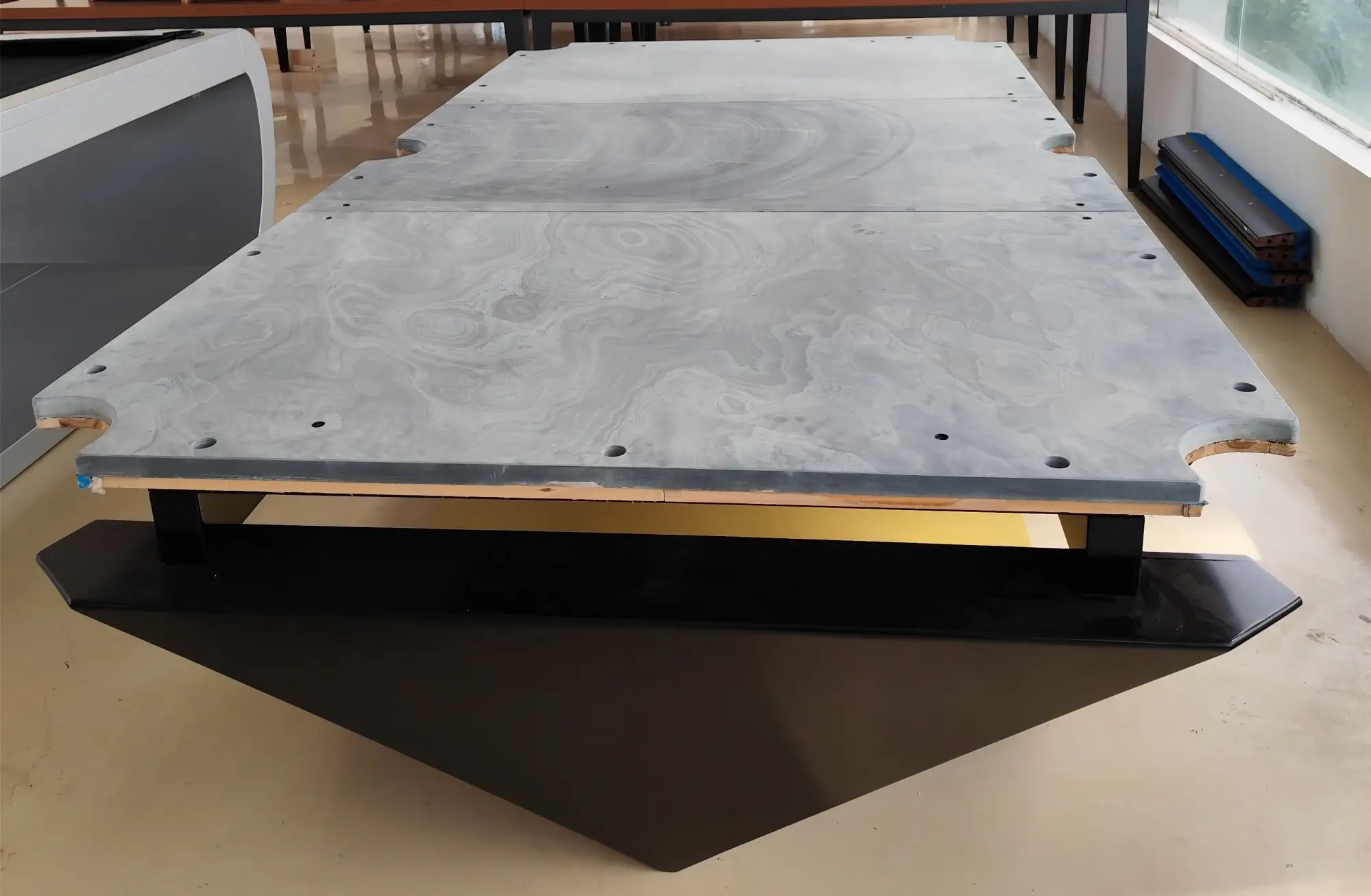
Take one common professional pool table. Lift off the cloth and the cushions, and the bed you are looking at is three pieces of grey stone, 25 mm thick, weighing a little over 250 kilograms, machined flat, typically to within a tenth of a millimetre. That object — a nine-foot pool table bed — is billiard slate. It is a natural stone, but in this job it is not really a building material. It is a precision component of the table, and everything about it has to be specified, machined and inspected as one.
This guide is a reference, not a story. Use it to look up what billiard slate is, how it differs from ordinary slate, what the thicknesses and piece counts actually mean, how a panel is made, what tolerances to agree on, and what to check before you pay. Where a topic deserves its own page — the full production journey, the physics of the stone, supplier evaluation, an order from drawing to container — this guide links out to it rather than repeating it. The practical side lives in the rest of the Billiard Slate Guide.
Billiard slate is the natural stone bed fitted beneath the cloth of pool, snooker and carom tables — selected and machined so that its surface stays flat and dimensionally stable enough for play.
At a glance:
— Thickness commonly 19–45 mm; 45 mm is the most requested specification for 12 ft snooker.
— Built as 1, 3 or 5 pieces; most export pool tables use a 3-piece bed.
— Flatness after CNC machining typically within ±0.1 mm — but the acceptance tolerance should be agreed before production, not assumed.
Slate Under the Cloth
Billiard slate is a natural slate — a fine-grained metamorphic rock — that has been selected and processed specifically to serve as the playing bed of a billiard table. The cloth is what the balls roll on; the stone is what keeps that rolling true for decades.
Why stone at all, under cloth? A pool or snooker table is a heavy, rigid structure whose only job is to keep one surface perfectly flat for the life of the table. Wood and composites warp; metal resonates; synthetic boards change dimension with humidity. A correctly selected and machined slate is far less susceptible to these problems and provides the rigid, stable playing bed that the table requires. It is dense, rigid, dimensionally stable and — critically — it can be ground and machined to a controlled thickness and a very flat plane.
The catch is in that word "correctly". A good geological material does not automatically become a good billiard slate. The block has to qualify, and the finished pieces have to be cut, calibrated, ground and machined. The slate you buy is the result of both the rock and the processing — and most of what follows in this guide is about how to tell them apart.
Not Every Slate Qualifies
Roofing slate, flooring slate, wall cladding and billiard slate can all come from the same geological family, and sometimes from the same quarry. They are not the same product. Each application asks something different of the stone, and a slate that performs beautifully on a roof can be useless under a billiard cloth.
| Application | What the job demands of the stone |
|---|---|
| Roofing slate | Weather resistance, water absorption, splitting behaviour, durability, appearance |
| Flooring slate | Wear resistance, thickness, surface finish, appearance |
| Wall cladding | Appearance, thickness, fixing method |
| Billiard slate | Flatness, thickness consistency, machining accuracy, dimensional stability |
At the quarry, the call is made early. Only a portion of quarry blocks may be suitable for billiard panels; the rest can be directed to other slate products depending on block quality and dimensions. "From the same quarry" is therefore not a guarantee of "fit for a table". A buyer should evaluate the specific material and the specific machining process, not the origin alone.
What the Table Demands of the Stone
Strip the question back to what a table bed has to do, and the demands on the stone read like a short list: rigidity, so the bed does not flex under its own weight or the frame's clamping; dimensional stability, so the surface that was flat on day one is still flat in year ten; a hard, durable surface that does not wear through the cloth; and machinability, so the stone will accept a very flat ground face and the precise cuts the table design needs.
None of these is optional, and none comes for free with "natural slate". Rigidity and stability come from the right density and mineral structure; machinability comes from a fine, even grain that takes a ground surface without chipping or tearing.
Two cautions belong here. A fine, even grain helps with controlled grinding and finishing, but it is not a guarantee on its own — final playing performance also depends on the machining, the installation and levelling, and the table's construction. And density, the figure buyers quote most often, is a material characteristic rather than a quality verdict: block integrity, internal defects, dimensional stability, machining accuracy and flatness all have to be read together.
Why a given slate delivers the full set is a question of geology — and that physics is covered in depth on Why Jiujiang Slate Works for Billiard Tables. This guide takes those properties as given and concentrates on what a buyer does with them.
One, Three or Five Pieces
A billiard bed is rarely a single stone. It is built from a set of panels that are machined to match and joined on the frame during installation. How many panels depends on the table.
One-piece beds exist — a single slab forms the whole playing surface. The appeal is obvious: no joints, no seam to fill. The cost is also obvious: a one-piece bed for a large table is extremely heavy, hard to ship and hard to install. They are usually reserved for smaller tables or tables that will not move.
Three-piece beds are widely used for pool tables — particularly for export and professional table production. Three panels are heavy enough to be rigid but light enough to handle, ship and level on site. The joints are machined to match and sit flush; with the cloth on, a well-matched three-piece bed is effectively one surface.
Five-piece beds are common on 12 ft snooker tables, where the playing area is large enough that even a three-piece split makes each panel unwieldy. Five pieces spread the weight and the handling.
One thing worth saying plainly: piece count is a structural choice, not a quality grade. A well-machined three-piece bed is not "less than" a five-piece bed — it is simply the bed a given table was designed for. Piece count and slate quality are two separate questions.
Thickness from 19 mm to 45 mm
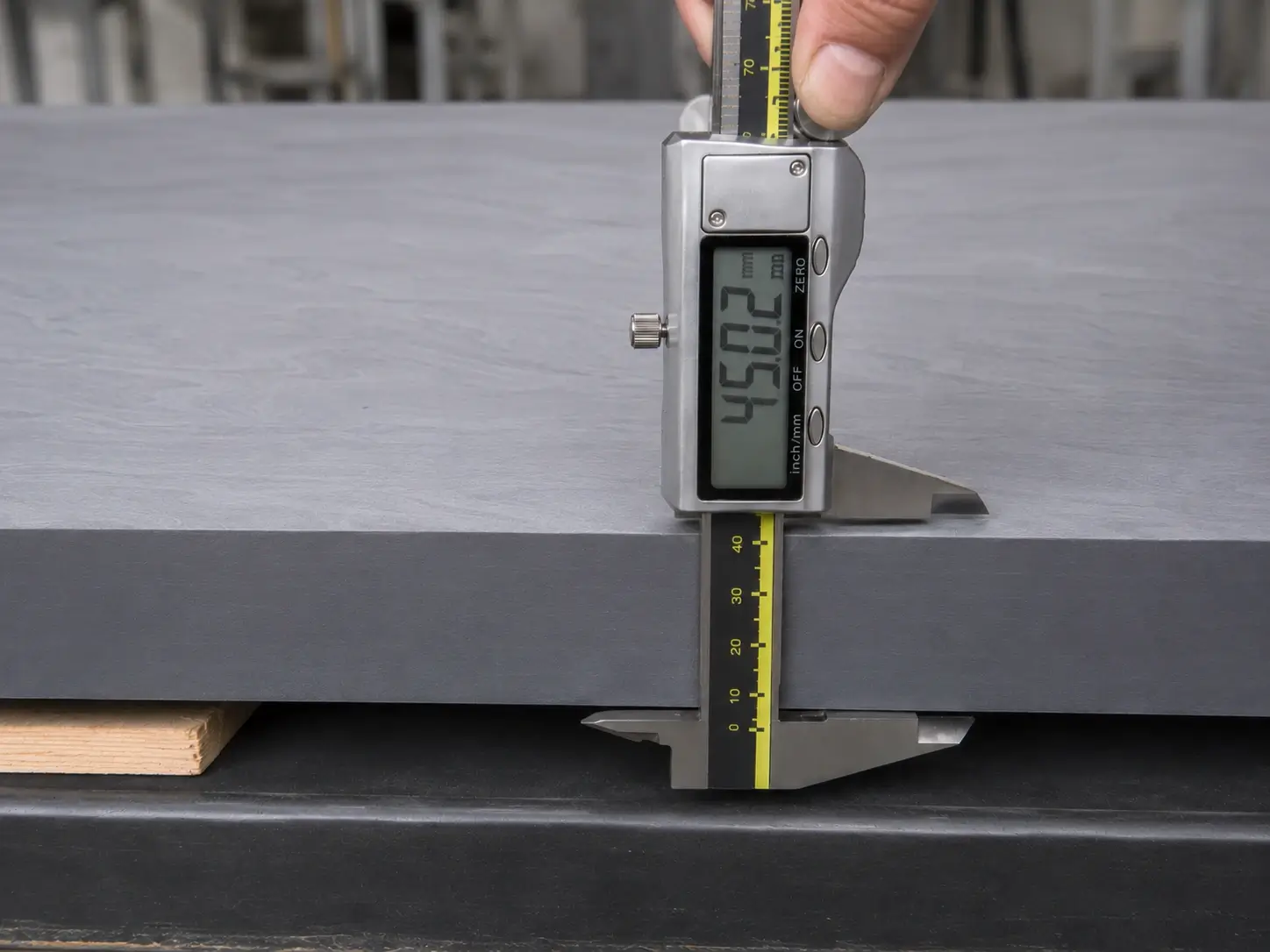
Slate thickness follows the table. A bed has to be thick enough to stay rigid over its span without sagging, and thick enough to take the frame's clamping and the fixing screws — but not so thick that the table becomes impossible to move. There is no single thickness that fits every table, which is why thickness is a specification, not a default.
| Table / application | Common slate thickness |
|---|---|
| 7 ft pool | 19–25 mm |
| 8 ft pool | 19–25 mm |
| 9 ft professional pool | around 25 mm |
| 10 ft pool | around 25 mm, or per table design |
| 10 ft snooker | around 38 mm |
| 12 ft snooker | around 45 mm |
| Custom tables | per manufacturer drawing |
Typical commercial configurations, not universal industry standards.
The commonly used 45 mm specification for 12 ft snooker reflects the need for a rigid, stable bed across a large playing area. Other thicknesses are also used for particular table designs, so the manufacturer's engineering specification should always take priority over the usual number. The extra thickness also brings extra weight, as a later section shows.
For OEM and replacement orders the table drawing is what matters, not the table "size". Two suppliers quoting "25 mm billiard slate" can be quoting the same thickness for beds with completely different outline dimensions, hole patterns and machining. Specify from the drawing.
From 7 ft Pool to 12 ft Snooker
Pool, snooker and carom tables come in standardised playing sizes — 7, 8, 9 and 10 ft for pool, 10 and 12 ft for snooker. What those numbers describe is the nominal table size, and the slate outline that covers the playing area is not always the same number.
A useful way to keep the chain straight: table size → playing area → slate outline → finished machined dimensions. These are four measurements, and only the first is the "size" most people quote. The slate outline has to cover the playing area plus the rail allowance; the finished machined dimensions are what the drawing actually calls for after pockets, edges and holes are cut. Two "9 ft" tables from different manufacturers can therefore take slates with different outlines.
At the large end, a 12 ft snooker table is one of the biggest beds commonly produced. A typical configuration is five pieces at 45 mm, around 3658 × 1867 mm in outline. Other configurations exist — different thicknesses, different joint positions, different pocket layouts — so "12 ft snooker slate" is a starting phrase, not a specification. When ordering one, confirm the playing area, the finished outline, the number of pieces, the thickness, the joint locations, the pocket positions, the rail mounting dimensions, the screw-hole locations, the machining drawing, the flatness requirement and the packing method. A drawing is worth more than the phrase "12 ft snooker slate".
The Weight of a Slate Bed
Slate is dense stone — around 2,700 kg per cubic metre — so a billiard bed adds up quickly. The theoretical weight is simply volume times density:
Weight ≈ length × width × thickness × density (all in metres)
That formula is why a small change in thickness changes the bed a lot. A panel at 25 mm weighs about a third more than the same panel at 19 mm, with no change in footprint. At typical slate densities, a square metre of 45 mm slate weighs roughly 120–125 kilograms before machining. A typical 9 ft three-piece bed at 25 mm can weigh a little over 250 kg, depending on its dimensions and slate density; a 12 ft five-piece bed at 45 mm is several times that.
Weight is not a side note. It shapes the table design, the installation, the factory handling, the container loading, the shipping cost and the on-site assembly. For an international order it is worth asking for the piece weight and the total shipment weight before production, so the crate count, the container plan and the unloading at the other end can be planned against real numbers, not guesses.
From Block to Machined Panel
The full production chain is its own subject — followed step by step in From Quarry to Billiard Slate: The Panel Journey and gate by gate in How Billiard Slate Is Mined and Processed. In outline, a billiard panel moves through:
Quarry block → block selection → cutting to slab → thickness calibration → grinding → CNC machining → inspection → export packing
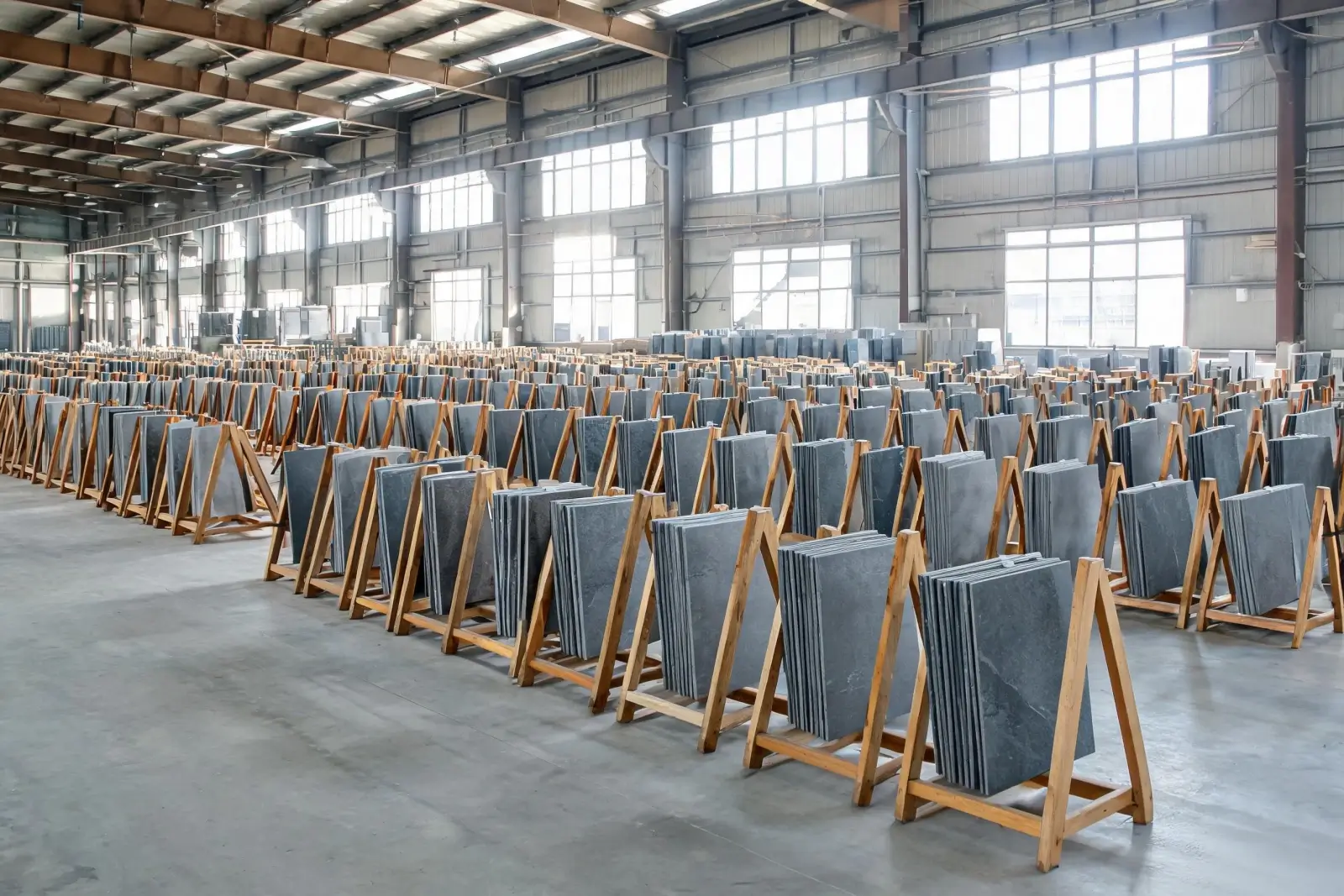
Two things about that chain matter to a buyer. First, precision is added in the workshop, not found in the ground — the same block can leave the quarry as a roofing tile or a billiard panel depending on what happens next. Second, the stages feed each other: a slab that is not calibrated to a consistent thickness cannot be ground flat, and a panel that is not ground flat cannot be CNC-machined to tolerance. Each stage is the floor for the next.
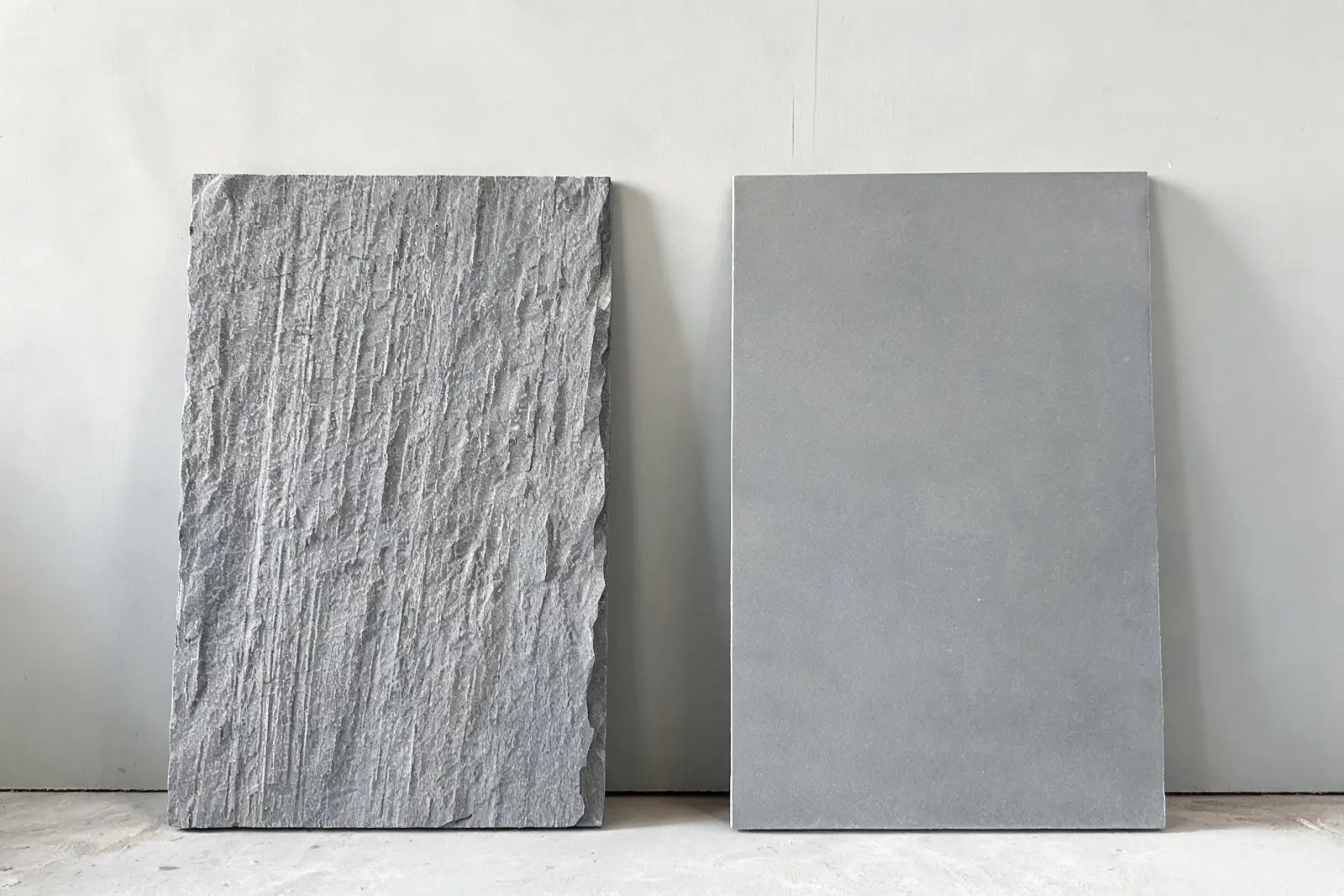
The surface you ultimately care about is the ground one. A rough sawn face is grey and coarse; the same stone, after grinding and CNC machining, is a fine, even, flat plane that the cloth will lie on without telegraphing any unevenness through. The difference between those two surfaces is the whole of the workshop's work.
Flatness and Tolerances
Flatness is the property buyers most often quote and most often misunderstand. The finished bed has to be flat enough that a ball rolling across it does not deviate — but "flat enough" is a tolerance, and a tolerance only means something once you say how it is measured and where.
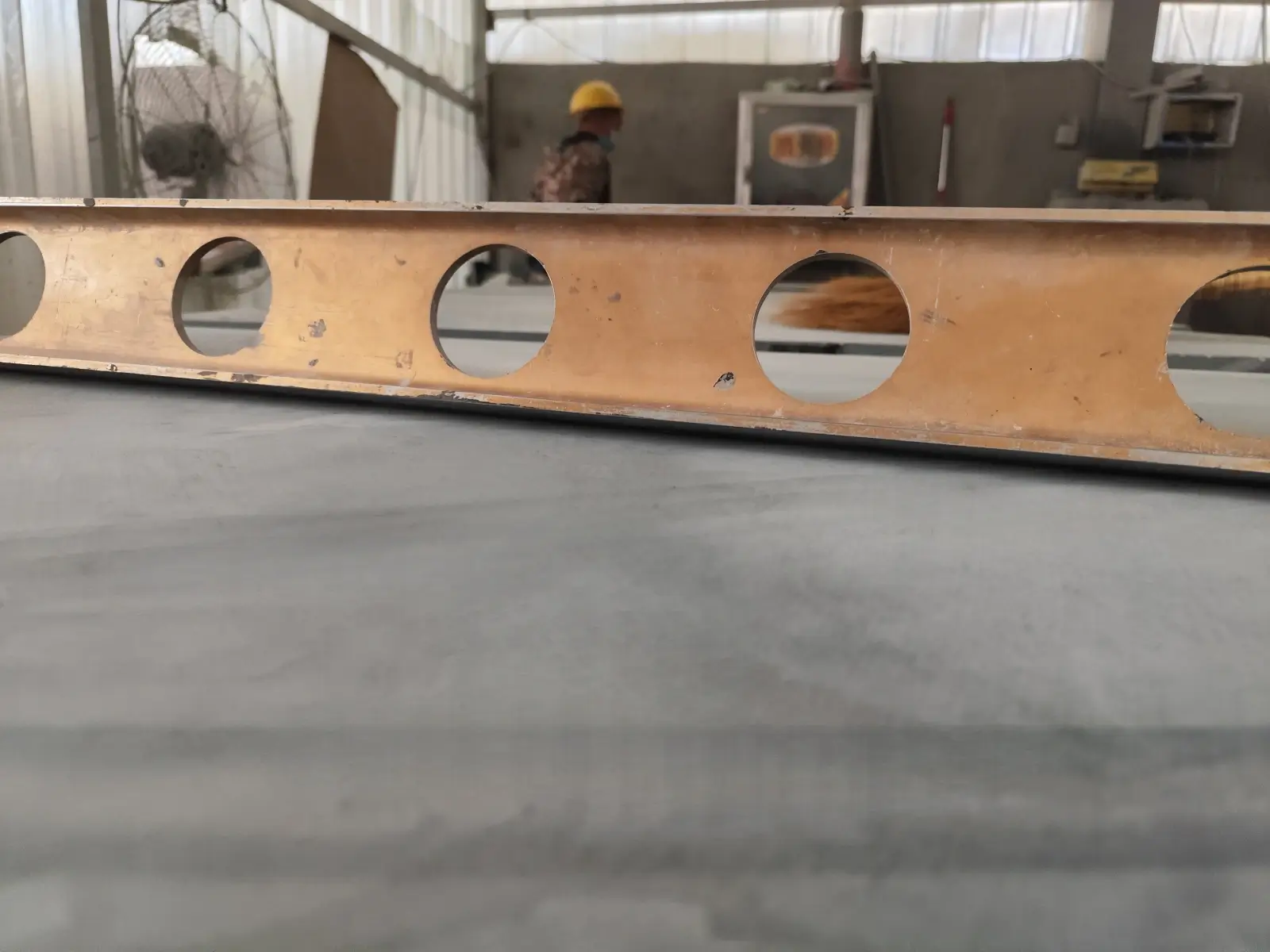
Be cautious of any universal claim such as "all professional billiard slate must be ±0.1 mm". That figure is a real one — in our shop, a CNC-machined panel is held to a flatness within about ±0.1 mm, and the joints of a matched set are brought to within about 0.05 mm of each other. But whether ±0.1 mm is the right acceptance number for your order depends on the table design, the slate dimensions, the machining method, the measurement location and whether the tolerance is being applied to thickness, overall flatness or a local reading. One universal number never fits every table.
The practical rule is simple: agree the inspection tolerance before production, in writing, with the supplier — including what is measured, where, and with what. A tolerance agreed after the panels are made is not a specification; it is an argument. How flatness is actually measured — straightedges, feeler gauges, dial indicators, calibration logs — is a subject of its own, covered in Jiujiang Slate Flatness and Dimensional Stability.
What to Check Before You Pay
A buyer should not stop at the look of the stone. A useful inspection runs across six areas. In our shop every panel is checked individually before it goes in a crate — the same checklist, applied by the buyer or an inspector, is what tells you whether what arrives is what was specified.
| Area | What to verify |
|---|---|
| Material | Quarry source and material consistency; slate suited to the table; no visible cracks; no significant internal defects |
| Dimensions | Length, width, thickness, diagonals, machined features, hole positions against the drawing |
| Flatness | Overall flatness, local surface condition, measurement method, acceptance tolerance |
| Machining | Pocket dimensions, joint fit, edge machining, screw holes, rail mounting areas, CNC accuracy |
| Surface | Grinding quality, smoothness, chips or impact marks |
| Weight | Per-piece weight and total shipment weight against the plan |
| Packing | Edge protection, internal support, separation between pieces, impact protection, container loading |
| Sample | Approved sample, drawing and written specification in place before mass production |
The inspection standard should be fixed before production, especially for OEM orders, and the buyer should ask how each line above is actually measured in the factory — not just whether it is "checked".
Price, Samples and Questions Worth Asking
Does more expensive slate mean better slate? Not necessarily. The cost of a billiard panel is driven by raw block availability, the dimensions, the thickness, the piece count, the CNC work, the inspection level, the packing, the order quantity, any special drawings and the export freight. Two suppliers quoting "25 mm billiard slate" can be quoting two completely different products behind the same words. The only honest comparison is between complete specifications — material, machining, tolerance, inspection and packing — not between two prices per square metre.
For a new supplier, a sample is the cheapest insurance in the trade. Before a production order, confirm the material appearance, the thickness, the surface finish, the machining quality, the dimensions, the joint configuration, the pocket geometry, the hole positions and the packing on a real piece — not a photograph. For a custom bed, the approved sample, the drawing and the written specification then become the basis for the order.
A supplier worth buying from will answer questions in specific technical terms, not just "high quality". Worth asking, before an order:
- Where does the slate come from, and is it selected for billiard use?
- What thicknesses and piece configurations can you supply, and what are the standard and maximum dimensions?
- Can you machine to our CAD drawings?
- How do you control thickness, and how do you measure flatness?
- What inspection tolerance do you use, and can you show photos or video during production?
- How is the slate packed for export, and what is the weight per piece and the estimated total shipment weight?
- Can you supply private-label or OEM slate, and what information do you need from us to start?
The deeper version of this conversation — what table manufacturers actually evaluate before approving a supplier — is on Why Billiard Table Builders Source from Jiujiang. To see the slate itself, the range is at our billiard slate catalogue.
Chinese Slate and the Jiujiang Question
Yes — Chinese slate is used for billiard tables. China has several slate-producing regions and processing centres capable of supplying table-grade stone. "Chinese slate", though, is not one material. Different regions differ in geology, colour, block size, density, cleavage and processing capability, so a buyer should evaluate the specific quarry source and the specific factory, not the country label.
Jiujiang and the surrounding Lushan–Xingzi area in Jiangxi is one of those regions — established slate ground with quarries, processing yards, CNC capability and export experience. For a billiard buyer the useful questions about Jiujiang are not "is it from Jiujiang?" but the same questions that apply anywhere: which quarry, which factory, what dimensions and thickness can it produce consistently, can it machine to the table drawings, and what inspection and packing does it use. Direct contact with the quarry and processing side is what turns those questions into answers — which is why the Jiujiang Slate Guide exists as a separate, deeper reference on the origin.
Put end to end, a billiard bed travels: quarry → block selection → cutting → calibration → grinding → CNC machining → inspection → export packing → table factory → assembly → cloth → finished table. Followed as a real order, that chain has its own milestones — from the drawing that starts it to the container that ships it — on From Jiujiang Quarry to Billiard Table.
Which is the one idea worth taking away from this guide. Billiard slate is not a stone product you buy by the square metre. It is a precision component of a table, and a successful order is the coordination of raw material, dimensions, thickness, machining, inspection, packing and table design together. A supplier may have good stone and limited CNC. Another may have advanced CNC and inconsistent blocks. The job of a buyer is to read the whole chain, not one link in it.
Frequently Asked Questions
What is billiard slate made of?
Billiard slate is made from natural slate — a fine-grained metamorphic rock — selected and processed specifically for use as a billiard-table playing bed.
Is billiard slate the same as roofing slate?
No. Both can be natural slate, sometimes from the same quarry, but their selection and processing are different. Roofing slate is judged on weathering and splitting; billiard slate is judged on flatness, thickness consistency, machining accuracy and dimensional stability.
What thickness is billiard slate?
Common commercial thicknesses are approximately 19, 22, 25, 35, 38 and 45 mm. The correct thickness depends on the table design and the manufacturer's specification — there is no single thickness for every table.
How thick is 12 ft snooker slate?
45 mm in a five-piece configuration is one of the most commonly requested specifications for 12 ft professional snooker slate. Other thicknesses and configurations are also used depending on the table design.
How many pieces does a pool table use?
Three-piece slate is widely used for most pool tables. One-piece beds exist, usually for smaller or non-moving tables, but three-piece is the norm for shipping and on-site levelling.
Is thicker billiard slate always better?
Not necessarily. Thickness has to match the table's structural design and span. A thicker slate also adds weight — which affects handling, shipping and installation — so "thicker" is not automatically "better", it is just a different specification.
Can billiard slate be CNC machined?
Yes. Billiard slate is CNC machined for pockets, joints, edges, screw holes and rail mounting features according to the table manufacturer's drawings. CNC machining is what turns a ground slab into a table component.
How do I buy billiard slate from China?
Start by defining the table size, the slate dimensions, the thickness, the piece count, the machining requirements and the inspection tolerance. Then request samples, drawings, production photos or video, and export-packing and weight details from qualified suppliers, and compare complete specifications — not just the price per square metre.
Related Billiard Slate Guides
Billiard Slate for Your Tables
Billiard slate is a precision component, not a catalogue product. If you build or import tables, send the drawing, the table size, the thickness, the piece count and the quantity — we will quote the material, the machining, the inspection and the export packing that fit your tables. Slate of China, Jiujiang, Jiangxi; natural slate shipped to 30+ countries.