
Jiujiang Slate vs Spanish, Welsh and Indian Slate
The all-in-one comparison for importers choosing between four major natural slate origins
Quick Answer: Four slate origins — Jiujiang (China), Spanish, Welsh and Indian — each serve different project priorities. The table below is your starting point. The detailed head-to-head comparisons linked throughout this guide take each pairing deeper.
| Factor | Jiujiang, China | Spanish Slate | Welsh Slate | Indian Slate |
|---|---|---|---|---|
| Main region | Jiangxi Province (Lushan–Xingzi area) | North-west Spain (Galicia and others) | North Wales, UK | Rajasthan, Himachal Pradesh and others |
| Typical uses | Roofing, billiard slate, cladding | Roofing (primary market) | Roofing (heritage), architectural | Roofing, flooring, cladding, landscaping |
| Colour range | Black, dark grey, selected green | Grey, blue-grey, black | Blue-grey, heather blue, dark blue-grey | Black, grey, green, purple, copper, multicolour |
| Market position | Competitive / mid-range (grade-dependent) | Broad: commercial to premium | Premium / heritage | Competitive, colour-driven |
| Test documentation | EN 12326 available for qualifying products | Widely tested for EU roofing market | Strong established certification base | EN 12326 + IS 6250 for suitable products |
| Supply flexibility | High — manufacturing scale | High — established export | Limited — tied to specific quarries | High — multiple producing regions |
| Best-fit project | Competitive supply, custom specs, billiard tables | European-style roofing | Heritage, premium architecture | Colour-driven architecture, landscaping |
| Key consideration | Quarry and supplier verification | Grade and quarry selection | Premium price and availability | Product-by-product quality variation |
This table compares typical market characteristics, not every slate from every quarry. A slate should ultimately be judged by its specific quarry, product grade, test results and production controls — not by country name alone.
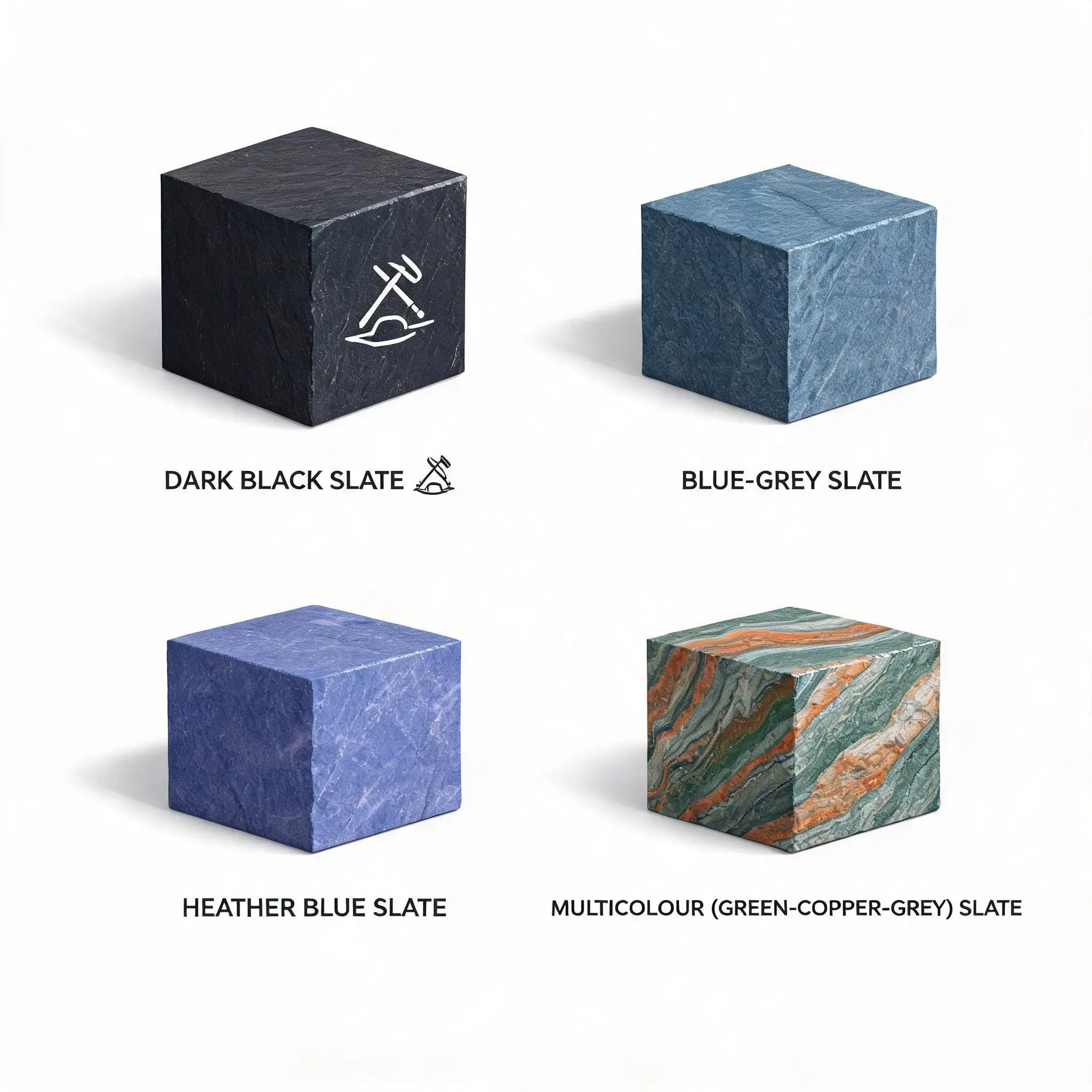
Four Origins, Four Supply Logics
When sourcing natural slate internationally, the origin matters — but it should never be the only thing you compare.
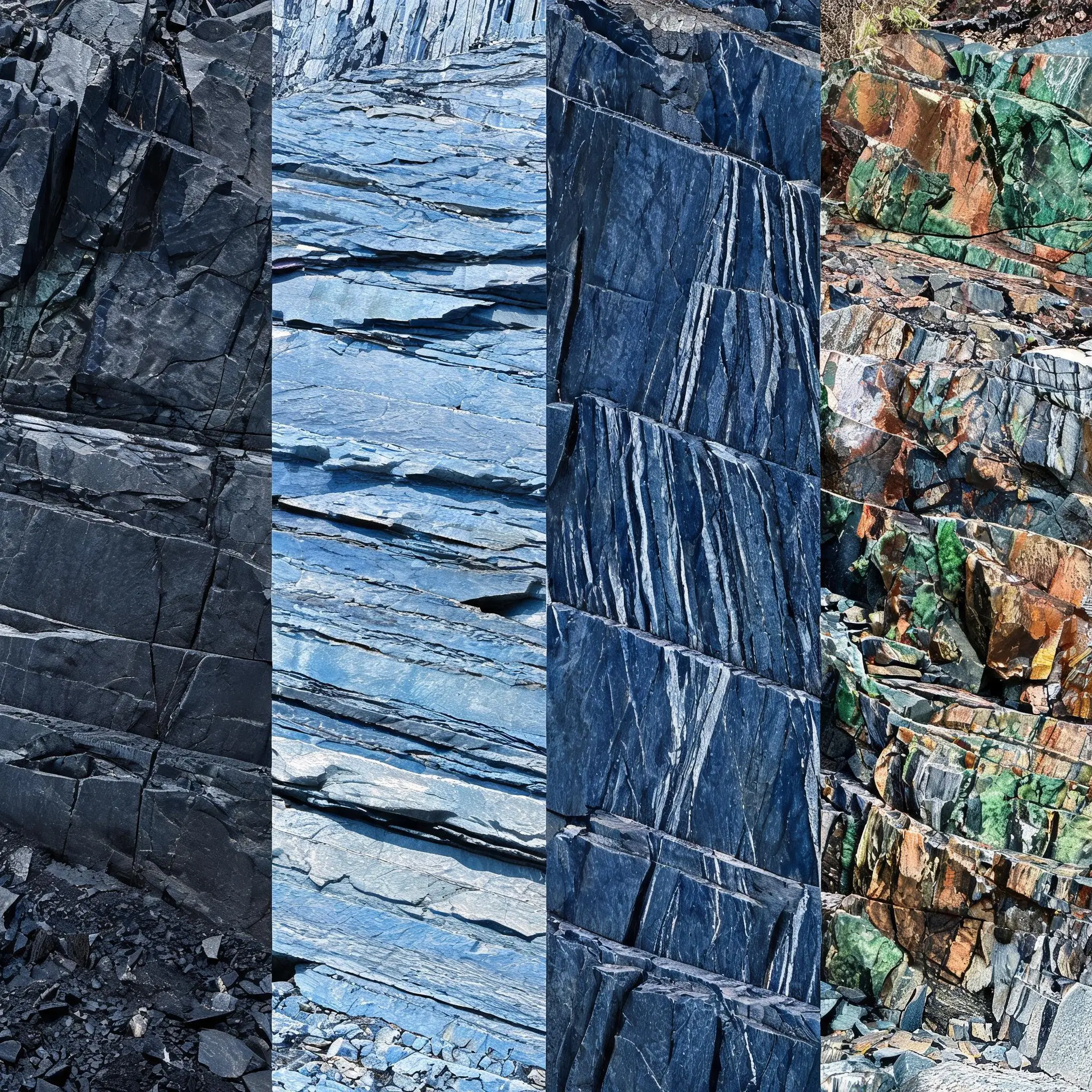
Spanish slate, Welsh slate, Indian slate and Jiujiang slate come from different geological regions and have developed different strengths in the international market. They differ in colour, texture, splitting characteristics, dimensional consistency, testing infrastructure, production scale and price.
For an importer, the real question is not which country produces the best slate. It is: which origin best fits the project, specification, appearance, budget and supply requirements.
This guide is the overview. For each pairing, we have a dedicated head-to-head comparison that goes deeper:
- Jiujiang Slate vs Spanish Slate — manufacturing flexibility vs established European roofing supply
- Jiujiang Slate vs Welsh Slate — competitive supply vs heritage provenance and premium positioning
- Jiujiang Slate vs Indian Slate — roofing and billiard focus vs colour diversity and architectural range
- Jiujiang Slate vs Other Chinese Slate Regions — how to verify origin within China and spot re-labelled stone
The focus here is primarily on natural roofing slate, because this is where origin, geological properties and EN 12326 performance become especially important. Some Indian and Jiujiang products are also widely used for flooring, cladding, paving and — uniquely for Jiujiang — billiard table slate.
Jiujiang Slate — Manufacturing Scale Meets Dual Expertise
Jiujiang, in Jiangxi Province, is one of China's important natural slate-producing regions. The wider Lushan–Xingzi area has developed a substantial slate-processing industry supplying both domestic and international markets.
One unusual characteristic: slate from the same broader geological area serves two technically demanding industries — natural roofing slate and billiard table slate. The requirements are very different. Roofing slate needs good cleavage, durability, suitable thickness and weather resistance. Billiard slate requires exceptional flatness, dimensional control, stability and machining accuracy — typically held to CNC tolerances of ±0.1 mm.
That combination has encouraged the development of specialised quarrying, splitting, cutting and 100% individual inspection capabilities in the region.
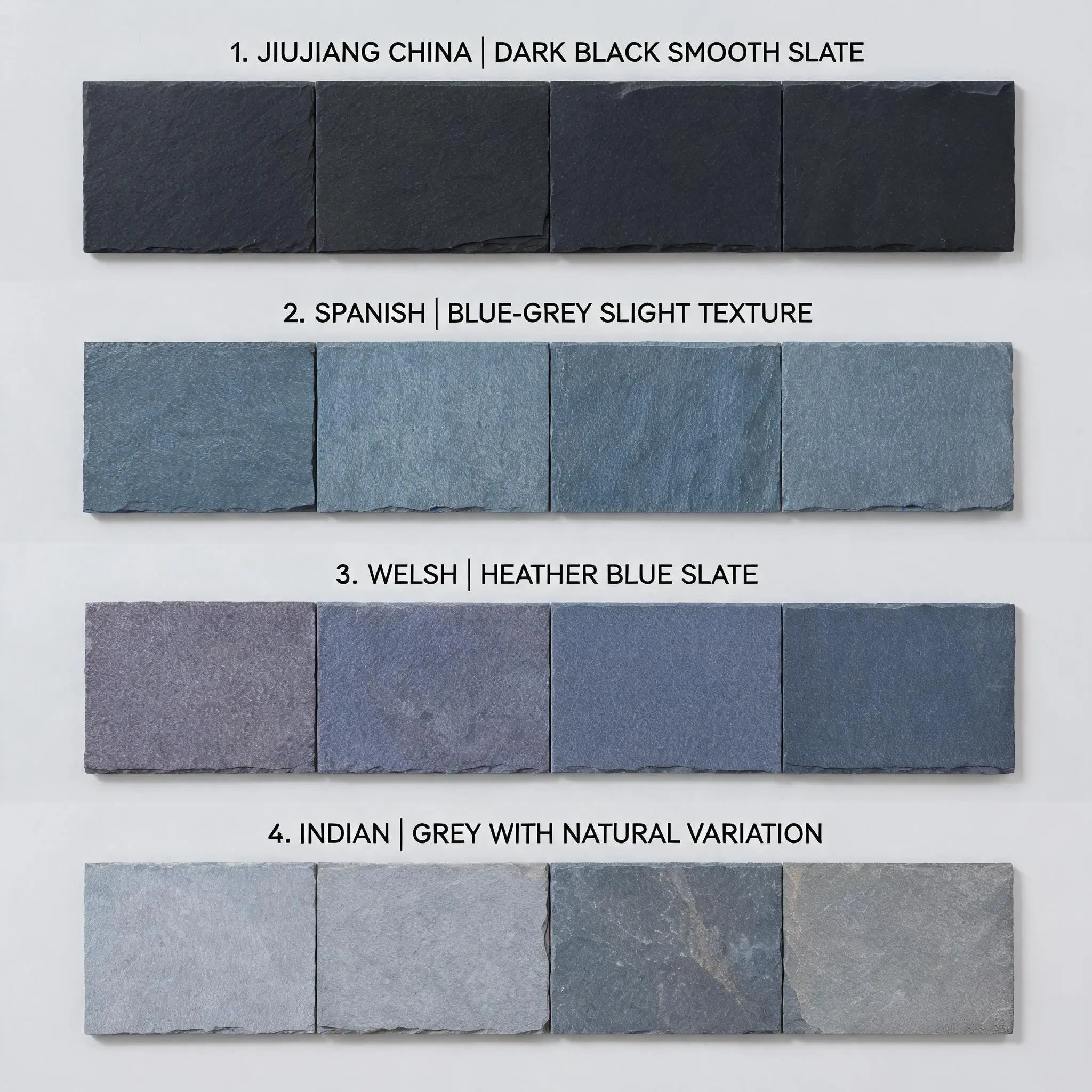
What makes Jiujiang interesting for importers:
- Manufacturing flexibility. China's large stone-processing infrastructure gives Jiujiang suppliers flexibility in dimensions, thickness, edge finishing, surface selection, packaging and container loading. For buyers ordering significant quantities, manufacturing efficiency can be as important as the geological quality of the raw stone.
- Supply scale. A buyer can source different slate formats from the same regional production network rather than depending on one specialised quarry product. A standard 20ft container typically holds 1,130–1,450 m² of 7–9 mm roofing slate, depending on thickness and packing density.
- Dual roofing + billiard expertise. The region is internationally associated with both roofing slate and billiard table slate — a combination that is geologically unusual and technically demanding.
- Competitive landed cost. Jiujiang slate is generally positioned below premium Welsh slate in price, while the actual cost depends heavily on grade, thickness, dimensions, processing, packaging, quantity and destination.
The important comparison is therefore not "China vs Spain" but: specific Jiujiang grade + specification + test data + FOB price + freight versus the equivalent product from another origin.
What to check: Do not buy Chinese slate simply because it is inexpensive. Ask for quarry or production origin, current test documentation (water absorption, flexural strength, freeze-thaw performance), thickness range, dimensional tolerances, colour sorting, packing method, inspection procedure and actual production photographs. EN 12326 is particularly relevant when the slate will be used for European roofing projects.
For the full head-to-head, see Jiujiang Slate vs Spanish Slate and What Makes Jiujiang Slate Different.
Spanish Slate — The Established European Roofing Supply
Spain is one of the world's most important natural roofing-slate sources, particularly in north-western Spain. Spanish slate has become deeply established in the European roofing market and is widely recognised by importers, distributors, roofers and architects.
A major advantage of Spanish slate is not simply the stone itself, but the maturity of the export and roofing supply chain. Many established Spanish roofing products are tested and marketed against European standards, with EN 12326 compliance widely documented.
Typical strengths: established roofing market familiarity, wide commercial availability across grades and sizes, strong European specification compatibility, and competitive positioning as an alternative to premium Welsh slate while still providing a traditional European roofing appearance.
What to watch: "Spanish slate" does not describe one single stone. Spain has numerous slate-producing areas and quarry products. Two products both labelled "Spanish slate" can differ in colour, pyrite content, cleavage, thickness, strength, water absorption, freeze-thaw performance, grading and expected service life. Always compare the quarry and test report — not just the country name.
For the full head-to-head, see Jiujiang Slate vs Spanish Slate.
Welsh Slate — Heritage, Provenance and Premium Positioning
Welsh slate occupies a different position in the market. The name is strongly associated with heritage, architectural tradition and premium natural roofing. Major Welsh slate products include slate from quarries such as Penrhyn (Heather Blue), Ffestiniog (Blue Grey) and Cwt-y-Bugail (Dark Blue Grey) — each with its own distinctive colour and physical characteristics.
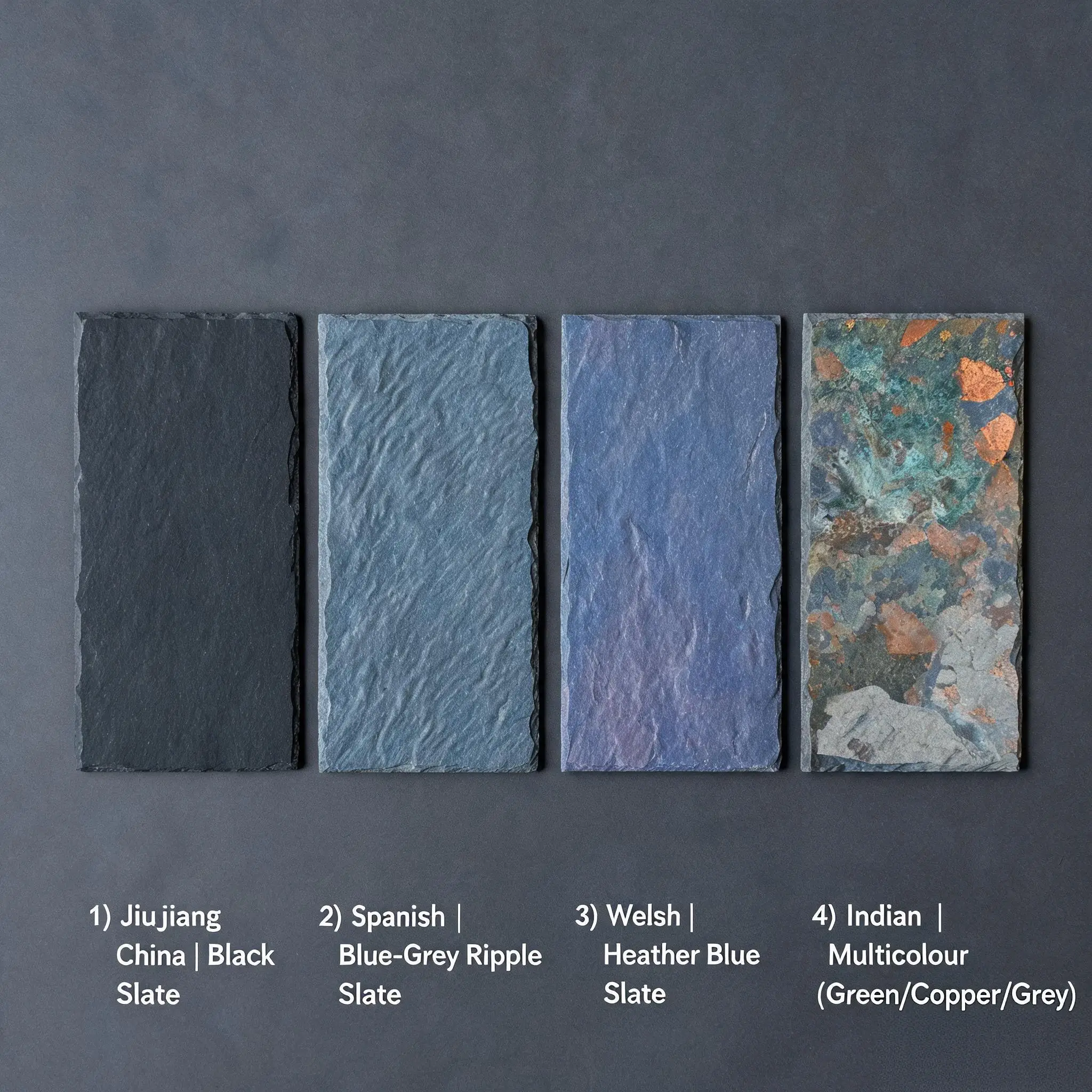
Typical strengths:
- Heritage value. Welsh slate has been used on buildings in Britain for centuries — particularly relevant for heritage restoration, conservation projects, historic buildings and premium residential architecture where provenance is part of the specification.
- Distinctive appearance. Individual quarry products have their own characteristic colour, texture and cleavage. Welsh Slate's published technical data reports water absorption below 0.3% for Ffestiniog and flexural strength values such as 52.9 MPa (wet) and 75.4 MPa (dry) for Penrhyn.
- Established grades. Ffestiniog roofing slate is offered in several thickness grades — Capital (approximately 5.5 mm), County (7 mm) and Celtic (9 mm) — with specified standard sizes.
- Premium positioning. Welsh slate is generally purchased as a combination of stone + provenance + appearance + heritage + performance, not simply as a commodity roofing material.
The trade-off: The same characteristics that make Welsh slate attractive can make it less suitable for a price-sensitive project. Production capacity is tied to specific historic quarries and their individual geological resources. If a project requires very large volumes, aggressive pricing, highly customised specifications or frequent changes in size or thickness, the procurement model is different from buying a premium heritage product.
For the full head-to-head, see Jiujiang Slate vs Welsh Slate.
Indian Slate — Colour Diversity and Architectural Range
India has a large and diverse natural-slate industry. Slate resources occur in several parts of India, including Rajasthan, Haryana, Himachal Pradesh and Andhra Pradesh. Unlike Welsh slate, which is strongly associated with a relatively small group of famous quarry products, Indian slate is better understood as a large family of different regional stones.
India's biggest advantage: colour. Indian slate can offer a much wider visual palette than the traditional blue-grey roofing slate associated with Britain and Spain. Depending on the quarry and product, buyers may find black, grey, green, purple, copper, gold and multicolour varieties. This makes Indian slate particularly interesting for wall cladding, landscaping, flooring, decorative stone, feature walls and architectural projects.
Typical strengths: colour diversity (the easiest way to distinguish Indian slate from many traditional European roofing slates), competitive processing and export pricing, and a large product range covering roofing, flooring, wall cladding, paving, fireplaces and landscaping.
The important caution: Indian slate should not be treated as one standardised material. The geological origin and application can vary significantly from one product to another. For a roofing project, the buyer should ask for the actual technical data of the proposed product — water absorption, flexural strength, freeze-thaw resistance, thickness, dimensional consistency, cleavage quality and durability testing. India also has its own roofing-slate standard, IS 6250. For projects exposed to severe frost, freeze-thaw data is especially critical.
For the full head-to-head, see Jiujiang Slate vs Indian Slate.
The Comparison That Actually Matters: Quarry vs Quarry, Test vs Test
Country of origin is useful for narrowing the field. It is not a substitute for testing.
A buyer comparing four origins should ideally put the actual test reports side by side. EN 12326 is particularly useful because it provides a common framework for evaluating natural roofing slate — covering dimensional characteristics, water absorption, flexural strength and freeze-thaw performance.
| Property | Why it matters | What the buyer should request |
|---|---|---|
| Water absorption | Indicates how much water the slate can take up — critical for freeze-thaw survival | Actual laboratory result (EN 12326 or ASTM) |
| Flexural strength | Resistance to bending and breakage under wind, snow and foot traffic | Test value in N/mm² (dry and wet) |
| Freeze-thaw resistance | Critical in cold climates — determines whether the slate will survive repeated freezing | Number of cycles and/or classification |
| Carbonate content | Important for durability — high carbonate content increases weathering risk | Laboratory result (% CaO or equivalent) |
| Pyrite / iron sulphide | Can affect appearance and long-term behaviour if it oxidises | Petrographic or chemical information where available |
| Thickness & tolerance | Influences weight, installation and dimensional consistency | Specified range and measured tolerance |
| Flatness | Important for laying quality and appearance | Supplier QC data or sample inspection |
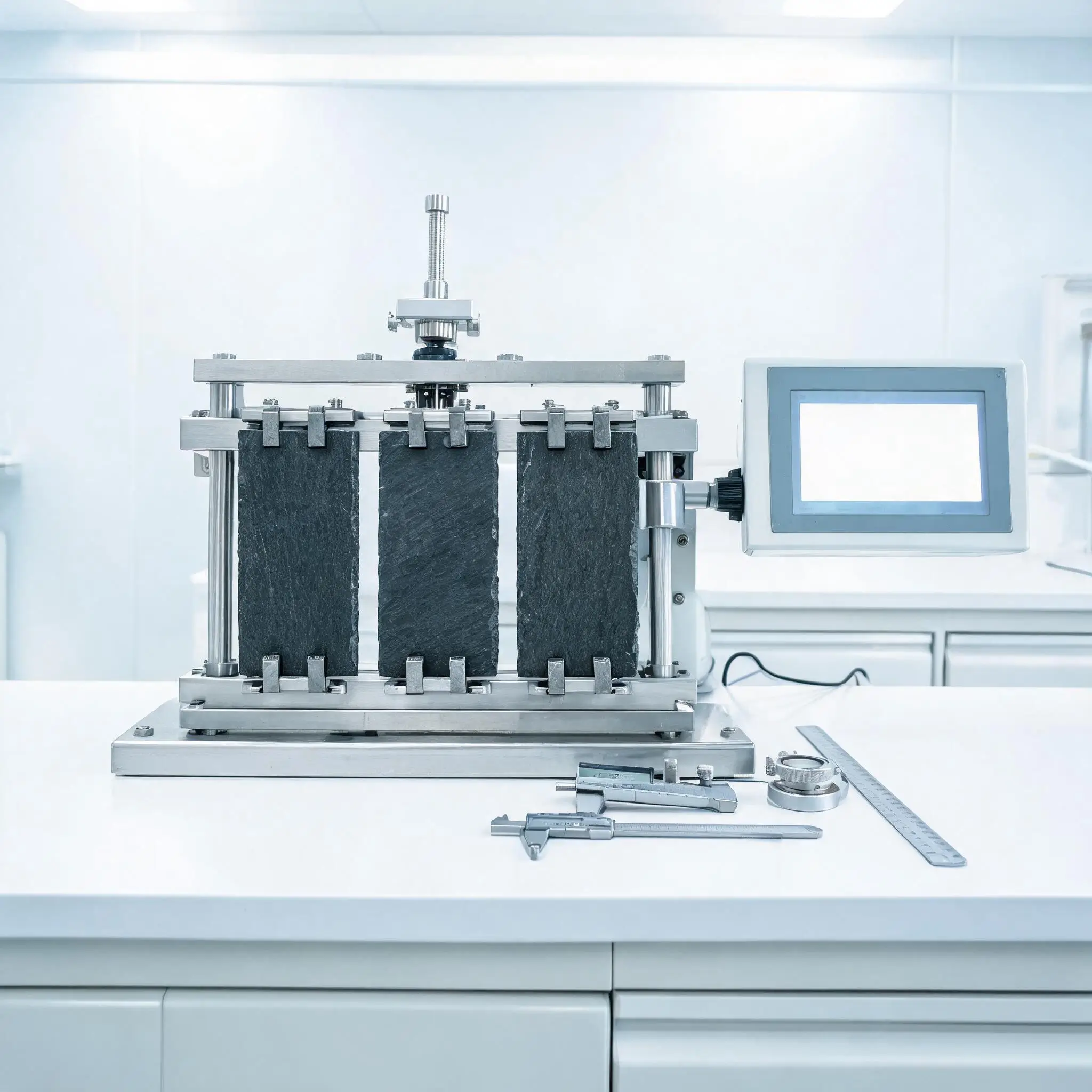
To illustrate with real numbers: Jiujiang slate test reports show water absorption values of 0.1%, 0.13% and 0.2% from three different testing rounds — the variation reflects batch differences and the fact that EN (48-hour soak) and ASTM (boiling water) methods produce slightly different numbers on the same stone. The flexural strength is 60 MPa dry and 45 MPa wet (75% retention). Freeze-thaw testing shows 92.7% strength retention after cycling (156 → 144.7 MPa).
Welsh Slate's published data reports Ffestiniog water absorption below 0.3% and Penrhyn flexural strength of 52.9/75.4 MPa (wet/dry). These are not competing claims — they are the same kind of data that lets a buyer compare like with like.
For guidance on reading these reports, see How to Read a Slate Test Report and our Jiujiang Slate Test Results page.
Price: Why Country Averages Mislead Buyers
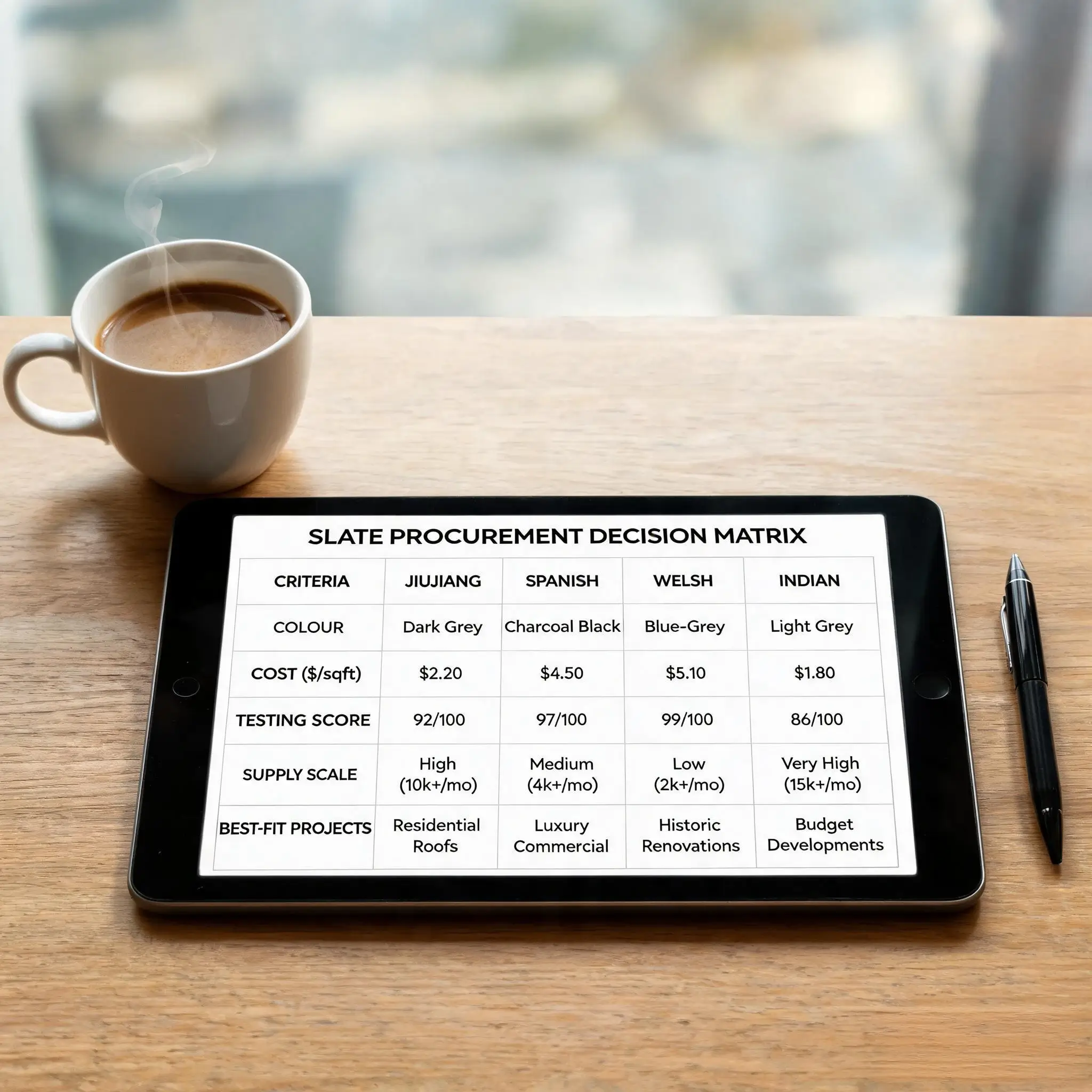
It is tempting to rank the four origins from cheapest to most expensive. That can be misleading.
The actual export price depends on quarry, grade, colour, size, thickness, processing, sorting, packaging, order quantity, container utilisation, destination port, freight rates and certification requirements. A premium Spanish slate and a commercial Spanish slate can have very different prices — the same is true for Chinese, Indian and Welsh slate.
Instead of asking "which country has the cheapest slate?", a professional importer should ask: "What is the cost of a compliant product meeting my exact specification?" This produces a much more meaningful comparison.
Logistics also matter. Jiujiang benefits from proximity to Jiujiang Port on the Yangtze River — the factory-to-port drive is roughly 40 minutes, and the Yangtze connects directly to Shanghai for ocean transhipment. Inland Chinese slate regions face longer road hauls to the same ports. This is a real cost difference that a country-level price average will never capture.
The Relabelled Slate Problem
Natural slate is sold internationally through many layers: quarry → processor → exporter → trader → importer → distributor. By the time the material reaches the final market, the original quarry name may have disappeared. A product may simply be labelled "Chinese Slate", "Spanish Slate", "European Slate" or just "Natural Slate".
That is not enough information for a professional buyer. Before placing an order, ask:
- Where was the raw stone quarried? (Not: where was it processed?)
- What is the quarry or geological origin?
- Where was it split and processed?
- Is the test report for this actual slate — or a generic certificate?
- Does the colour in the test sample match the production material?
- Can the supplier provide production photographs or quarry photographs?
- Can the supplier provide a current sample from the proposed production batch?
This is especially important when comparing Chinese slate products sold under different regional names. For a full guide to verifying origin within China — including how to spot re-labelled stone — see Jiujiang Slate vs Other Chinese Slate Regions.
The Importer's Decision Framework
Instead of asking which origin is "best", divide your buying decision into priorities. The matrix below is a starting point — not a ranking.
| Buyer priority | Origin(s) worth investigating | What to verify |
|---|---|---|
| Premium heritage project | Welsh | Quarry provenance, colour, certification, availability |
| European-style roofing | Spanish / Welsh / Jiujiang / Indian | EN 12326 performance and project specification |
| Competitive roofing cost | Jiujiang / Spanish / Indian | Full landed cost and test data |
| Large-volume supply | Jiujiang / Spanish / Indian | Production capacity and repeat-batch consistency |
| Distinctive blue-grey heritage appearance | Welsh / Spanish | Exact quarry and sample |
| Wide colour range | Indian / selected Chinese products | Batch consistency and weathering behaviour |
| Customised dimensions | Jiujiang / Indian / Spanish suppliers | Factory capability and tolerances |
| Billiard table slate | Jiujiang | Flatness, thickness, machining and stability |
| Cold-climate roofing | All qualifying suppliers | Freeze-thaw and water-absorption results |
If your project is a billiard table, the comparison changes completely. Jiujiang has a particularly strong position because the region is deeply involved in billiard table slate production as well as roofing slate. The requirements — flatness, thickness, dimensional accuracy, joint preparation, machining, stability, inspection — are completely different from roofing. A roofing-slate comparison should not be used to judge billiard slate.
What to Ask Before Buying From Any Origin
Whether the slate comes from China, Spain, Wales or India, a professional importer should ask for the same basic information.
Quarry: Where exactly is the quarry? Is the material from the stated quarry? Can the quarry source be documented?
Technical data: Water absorption? Flexural strength (dry and wet)? Freeze-thaw performance? Carbonate content? Other durability tests?
Production: How is the slate split? How is thickness controlled? How are colours sorted? What are the dimensional tolerances? How is defective material removed?
Quality control: Is every batch inspected? Are samples retained? Is inspection performed before packing? Can the supplier provide photographs or videos of actual production?
Export: Packing method? Pieces per crate? Crates per container? Container loading plan? Replacement policy for breakage or non-conforming material?
Before placing a container order, ask for these 10 items:
- Exact quarry origin
- Product grade
- Representative production sample
- Current laboratory test report (with batch number)
- Water absorption value
- Flexural strength value (dry and wet)
- Freeze-thaw performance (where applicable)
- Size and thickness tolerances
- Packing and container loading details
- Photos or video of the actual production
If a supplier cannot provide these basic details, the problem is not necessarily the country of origin. The problem is that you do not yet know exactly what stone you are buying.
Frequently Asked Questions
Which slate origin offers the best value for money?
There is no universal answer, because "value" depends on what you are buying. A competitive Jiujiang roofing slate with EN 12326 test data and 0.1% water absorption may offer excellent value for a large commercial roof. A premium Welsh slate from Penrhyn may offer excellent value for a heritage restoration where provenance matters. The right approach is to define your specification first, then compare landed costs for compliant products from each origin — not to start with a country and assume it will be cheap or expensive.
Can I mix slate from different origins on the same roof?
It is technically possible but rarely advisable. Different origins produce slate with different colour tones, thickness profiles, surface textures and weathering characteristics. Even if both pass EN 12326, mixing Welsh heather blue with Spanish blue-grey on the same slope will create visible patching that becomes more pronounced as the slate weathers. If you need to supplement an existing roof, match the original quarry and grade as closely as possible — or accept that the repair patch will be visible.
How do I verify that my "Jiujiang slate" is actually from Jiujiang?
Ask for the quarry location (not just the factory address), a production video taken on the same day as your enquiry, and a test report with a batch number that matches the quotation. Jiujiang slate comes from the Lushan-Xingzi area in Jiangxi Province — if the quarry address is in a different province, the stone may be re-labelled. For a full verification guide, see our Jiujiang vs Other Chinese Slate Regions article, which walks through the eight-step origin verification process.
What is the single most important test result to compare across origins?
Water absorption. It is the property that most directly predicts freeze-thaw survival, long-term weathering behaviour and dimensional stability. A slate with water absorption below 0.3% (EN 12326 Class A1) will generally outperform a slate at 0.6% or above in any climate with frost. But do not stop at one number — flexural strength (dry and wet) and freeze-thaw cycling results together give you the full picture.
Is Welsh slate always better than Chinese slate?
No. "Welsh slate" and "Chinese slate" are country labels, not quality grades. A premium Welsh Penrhyn slate with heather blue colour and documented heritage provenance is a different product from a commercial Chinese roofing slate — but they serve different markets and different specifications. The correct comparison is: Welsh Grade A roofing slate at a specified size and thickness versus a Jiujiang Grade A roofing slate at the same specification, with test reports side by side. Sometimes the premium origin wins on provenance and appearance; sometimes the competitive origin wins on landed cost and supply flexibility. Compare the slate, not the flag.
How do I compare slate prices from different countries fairly?
Normalise everything to the same basis before comparing. Same Incoterm (FOB or CIF), same currency, same unit (per m² or per piece), same thickness, same size, same grade, same packing method, and same order quantity. A price per m² for 7 mm slate is not comparable to a price per m² for 9 mm slate — the thicker slate uses more raw material and weighs more. A FOB price is not comparable to a CIF price without adding freight and insurance. Only when the specifications are identical does the price comparison become commercially useful.
Related Reading
Need Help Comparing Actual Samples?
If you are comparing Jiujiang, Spanish, Welsh or Indian slate for a commercial project, send us the size, thickness, colour, annual quantity, destination country and required standard.
We can help you compare the technical specification and sourcing options on a like-for-like basis.
Natural slate should be bought by evidence, not by labels.
Send Us Your Specification