
Jiujiang Slate Hardness: What Mohs 3–4 Actually Means on the Bench, the Machine and the Roof
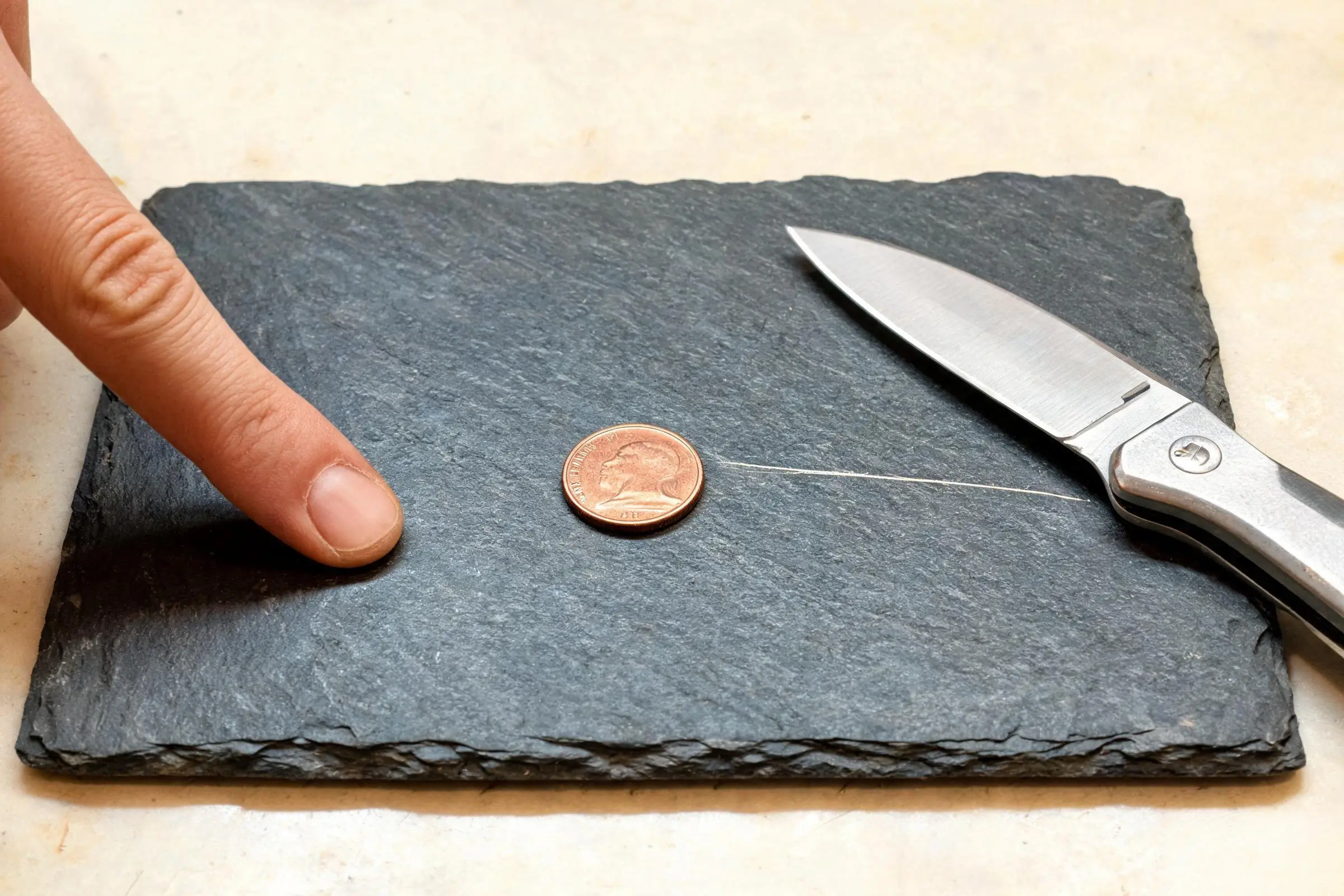
Pick up a piece of slate. Put your thumbnail against the cleft face and drag it across. Nothing happens — your nail slides off, leaving no mark. Now try the edge of a copper coin. Press hard and draw it across the surface. A faint grey streak, maybe. Try a steel pocket-knife blade. That leaves a scratch — a thin, silvery line you can feel with your fingertip.
Congratulations. You've just run a Mohs hardness test with three objects from your pocket. The slate resisted your fingernail (Mohs 2.5), barely noticed the coin (Mohs 3), and yielded to the steel blade (Mohs 5.5). That places it in the Mohs 3–4 band — and everything about Jiujiang slate, from how it splits to how it machines to how long it survives on a roof, starts with that narrow range.
I've been splitting, cutting and inspecting this stone for over forty years. Hardness is the first thing my hands know about a piece of slate — before density, before absorption, before any number on a test report. It tells me whether the block in front of me will split clean or crumble at the chisel edge. It tells my CNC operator whether today's panel will hold ±0.1 mm or drift to ±0.3 by the third cut. It tells the roofer whether the tile he's nailing will still have its cleft face after fifty winters or whether the surface will go smooth and greasy before the mortgage is paid off.
This page is my workshop log on hardness. I'm going to answer five questions that every buyer, every architect and every slater eventually asks — and that most hardness pages never bother to answer because they stop at "Mohs 3-4" and move on as if the number explains itself. It doesn't. The number is the beginning of the story, not the end.
Quick Answer:
Jiujiang slate hardness: Mohs 3–4 (resists fingernail, contests copper coin, yields to steel blade). Laboratory: 278 kg/mm² Knoop, 88.6 HB Brinell.
What sets it: muscovite/sericite (Mohs 2.5–3) + quartz (Mohs 7) interlocked — SiO₂ 66.46% anchors the ceiling, Al₂O₃ 15.81% sets the cleavage floor.
Why it matters: hard enough to resist decades of weather abrasion, soft enough to split by hand and machine precisely — the window that makes slate slate.
Tool cost vs granite: roughly one quarter the diamond tool wear per finished surface at the same tolerance.
Part of the Jiujiang Slate Guide. If you've read our properties overview, hardness was one specimen on that dissection table. Here, it gets the whole bench to itself.
Question One — Where Does the Number Come From?
Most people meet the Mohs scale in school and forget it by lunch. I use it every day in the workshop, so let me explain it the way I explain it to a new apprentice who's never held a chisel.
Friedrich Mohs was a German mineralogist who, in 1812, ranked ten minerals by whether one could scratch another. Talc is 1 — your fingernail scratches it easily. Gypsum is 2. Calcite is 3 — a copper coin scratches it. Fluorite is 4. Apatite is 5 — a steel knife barely scratches it. Orthoclase is 6. Quartz is 7 — it scratches glass. Topaz is 8. Corundum is 9. Diamond is 10. The scale is ordinal, not linear — the absolute hardness gap between 9 and 10 is far larger than between 1 and 2 — but for field work, the ranking is what matters. If material A scratches material B, A is harder. That's the whole test.
Now, a rock isn't a single mineral. Slate is made of several minerals pressed and interlocked through millions of years of metamorphic recrystallisation. Jiujiang slate, specifically, is dominated by three: muscovite (also called sericite in its fine-grained form, Mohs 2.5–3), quartz (Mohs 7), and chlorite (Mohs 2–3), with minor plagioclase feldspar, calcite and a trace of pyrite. The mineral identification comes from a 2000 analysis by the Jiangxi Provincial Central Laboratory and corroborated in a 2008 academic study of the Xingzi formation — the same geological picture, two independent sources, twenty years apart. When you run a scratch test on the cleft face of a Jiujiang slate tile, you're not testing one mineral — you're testing the composite surface. The result is a band, not a point: the softest mineral in the mix sets the floor (the stone will yield to anything harder than that mineral), and the hardest mineral sets the ceiling (nothing softer than that mineral will scratch it). Muscovite and chlorite at Mohs 2–3 pull the floor down. Quartz at Mohs 7 pulls the ceiling up. The composite reads at 3–4 because the scratch tool is interacting with a surface where soft mica plates and hard quartz grains sit side by side — the tool gouges the mica easily but glances off the quartz, and the net result is a scratch that's faint, inconsistent, and clearly harder than a fingernail but softer than a knife blade.
The same 2000 laboratory analysis also reported the chemical composition: SiO₂ at 66.46% — that's your quartz content, and it's the number that anchors the hardness ceiling. Al₂O₃ at 15.81% tracks the muscovite content, which sets the cleavage plane. When a buyer asks me for a number more precise than "Mohs 3–4," I give them the Knoop microhardness: 278 kg/mm², measured on a building-grade sample in 2001. A separate Brinell test by the Jiangxi Building Materials Institute returned 88.6 HB. Those are the numbers you can write into a purchase specification. Mohs 3–4 is the field test; 278 Knoop and 88.6 Brinell are the bench tests. Same stone, same property, three scales — pick the one your spec sheet uses.
Here's something that surprises buyers who compare data sheets across suppliers: the compressive strength numbers for Jiujiang slate range from 86 MPa to 280 MPa depending on who you ask. That looks like a three-fold difference — and it would be, if it were the same property measured the same way. But it isn't. Compressive strength is exquisitely sensitive to sample geometry, loading direction relative to the cleavage plane, and whether the specimen has micro-cracks from the splitting step. One lab cuts 50×50×32 mm cubes and gets 96.8 MPa; another tests a differently oriented sample and gets 136 MPa; a third uses a different standard and reports 280 MPa. The stone hasn't changed — the test has. Hardness doesn't have this problem. The Mohs reading sits at 3–4 regardless of who runs it, because scratch resistance is a surface property, not a bulk property. That's why I trust the pocket test more than any single compressive strength figure on a data sheet.
The same 2001 certificate included a freeze-thaw test: compressive strength of 156 MPa dry, dropping to 144.7 MPa after freeze-thaw cycling — a retention rate of 92.7%. The stone lost less than 8% of its compressive strength after repeated freezing and thawing. That's hardness doing its job at the mineral-grain level: the tight quartz-mica interlock doesn't open up when water freezes and expands, because there isn't much water in there to begin with (absorption 0.1%). Hardness and density work together — one guards the surface, the other guards the interior — and the freeze-thaw retention number proves the partnership holds.
That's the mineralogical root. But here's what I tell the apprentice: the number on the Mohs scale is not the property. The property is what the number does in your hands. And what Mohs 3–4 does, uniquely, is sit in the narrow window where a rock is hard enough to be a roof and soft enough to be split by hand. That window — and I'll spend the rest of this log on this — is the geological gift that built the entire slate industry.
Why isn't slate hardness a single number like steel or glass?
Because slate is a composite of several minerals with different individual hardnesses — muscovite at 2.5–3, quartz at 7, chlorite at 2–3. A scratch test on the surface interacts with all of them at once, so the result is a band (3–4), not a point. The softest mineral determines what can scratch the stone; the hardest determines what can't. A single-number hardness (like the 5.5 of a steel blade or the 6–7 of granite, which is almost all feldspar and quartz) only works for materials that are mineralogically uniform. Slate isn't — and that's exactly why it behaves the way it does.
Question Two — Why Mohs 3–4 Splits Clean and Granite Cannot
Here's a truth that took me years to put into words: hardness doesn't give you cleavage, but it decides whether cleavage is usable.
Cleavage — the metamorphic grain that lets slate split into thin sheets — is a structural property, formed over hundreds of millions of years as clay minerals recrystallised into aligned mica plates under heat and pressure. The cleavage plane exists whether the rock is Mohs 2 or Mohs 7. But whether you can use that cleavage to make a roofing tile by hand depends on the hardness. And here's the relationship, plain and simple:
- Mohs 1–2 (talc, gypsum): too soft. The rock crumbles or bends rather than splitting crisply. You can carve it with a thumbnail. It won't hold a roof, and it won't hold a flat face. No tile industry.
- Mohs 3–4 (slate): the sweet spot. The rock is firm enough that the cleavage plane propagates cleanly under a chisel — the split follows the grain, the faces come out flat, and the edge holds a crisp line. You can split a block into 4 mm tiles by hand, and the tile is rigid enough to nail onto a roof without bending.
- Mohs 5–7 (schist, gneiss, granite): too hard. The rock won't split along the grain at all — or if it does, the split is ragged and uncontrollable. You have to saw it, which means every tile is a cut product, not a split product. The natural cleft face — the face that makes slate beautiful and waterproof — doesn't exist. Granite is sawn and polished. Slate is split and used as-is.
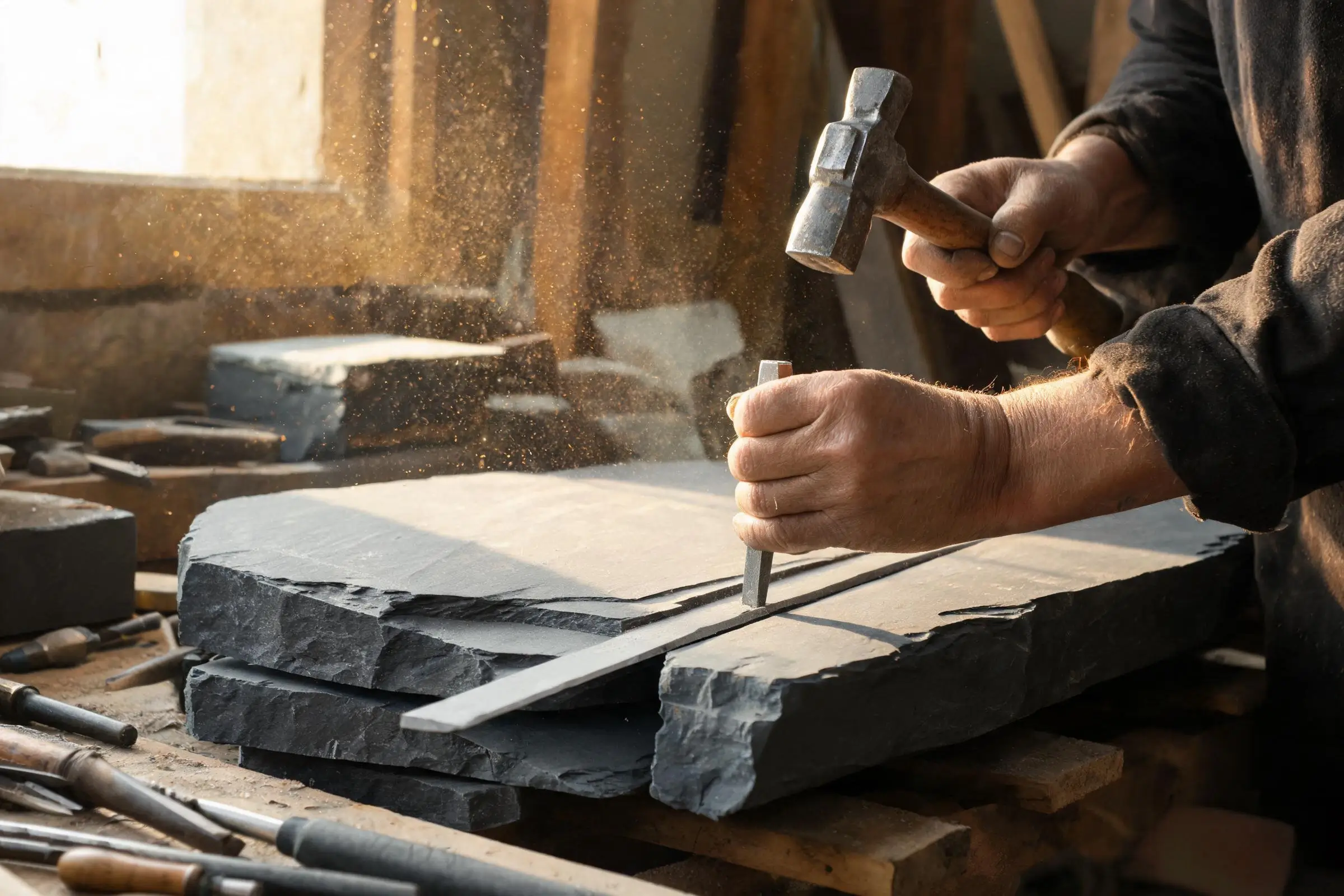
I've split granite in my time, on a bet. It doesn't split — it explodes. You swing the hammer, the chisel bites, and the block fractures in some random direction that has nothing to do with where you aimed. That's because granite's interlocking crystalline texture (Mohs 6–7) doesn't have a preferred plane. Slate's aligned mica plates (Mohs 2.5–3) create one. The hardness isn't the cause of the cleavage, but it's the gatekeeper: without the 3–4 band, the cleavage plane would either be too soft to hold a shape or too hard to follow.
For Jiujiang slate specifically, this is why the hand-splitting craft still exists alongside our CNC line. The roofing side of the business is built on this exact property: a skilled splitter can take a block and produce 600×300×5 mm tiles, one by one, each with a naturally flat cleft face that needs no further machining. That's not a nostalgic craft demo — it's a production process that only works because the hardness is precisely where it is. Move the hardness up to 5 and you need a saw for every tile. Move it down to 2 and the tiles bend in your hand.
Can a slate be too hard to split properly?
Yes, and it's a real problem in some regions. Slate that tests above Mohs 4 — usually because the quartz content is unusually high or the metamorphic grade has pushed the rock toward schist or phyllite — becomes stubborn under the chisel. The split tends to wander off the cleavage plane, producing wavy or stepped surfaces that can't be used as roofing tiles without secondary machining. This is one of the hidden quality differentiators between slate regions: the same "slate" label can cover rocks that split like glass and rocks that split like concrete. Jiujiang slate sits comfortably in the middle of the 3–4 band, which is where the best splitting character lives.
Question Three — How Hardness Controls CNC Machining and Tolerance
The roofing side of the business runs on splitting. The billiard side runs on machining. And on the CNC line, hardness is the variable that controls everything the operator cares about: tool wear, cutting force, heat generation, and — through all three — dimensional tolerance.
Let me walk you through a real production run. A 9-foot tournament billiard table uses a three-piece slate bed. Each panel is roughly 1.5 × 0.9 metres and 25 mm thick. After the block is sawn into rough slabs and the splitting step establishes the cleavage face, the panel goes to the CNC line for precision surface grinding and edge profiling. We use diamond-tipped tooling — nothing else holds up against stone. Here's what happens at different hardness levels:
With Jiujiang slate at Mohs 3–4, the diamond tip cuts cleanly. The stone is hard enough that the tool engages properly — it's not rubbing, it's cutting — but soft enough that the cutting force stays manageable. A single diamond tip machines a full batch of billiard panels (roughly 50 pieces through the surface-grinding stage) before the tip needs replacement. Tool temperature stays moderate. The stone doesn't heat up enough to distort. And the dimensional tolerance holds: ±0.1 mm flatness across the full panel surface, batch after batch. Our CNC machining page walks through the full tolerance stack; here I'm talking about what hardness does to it.
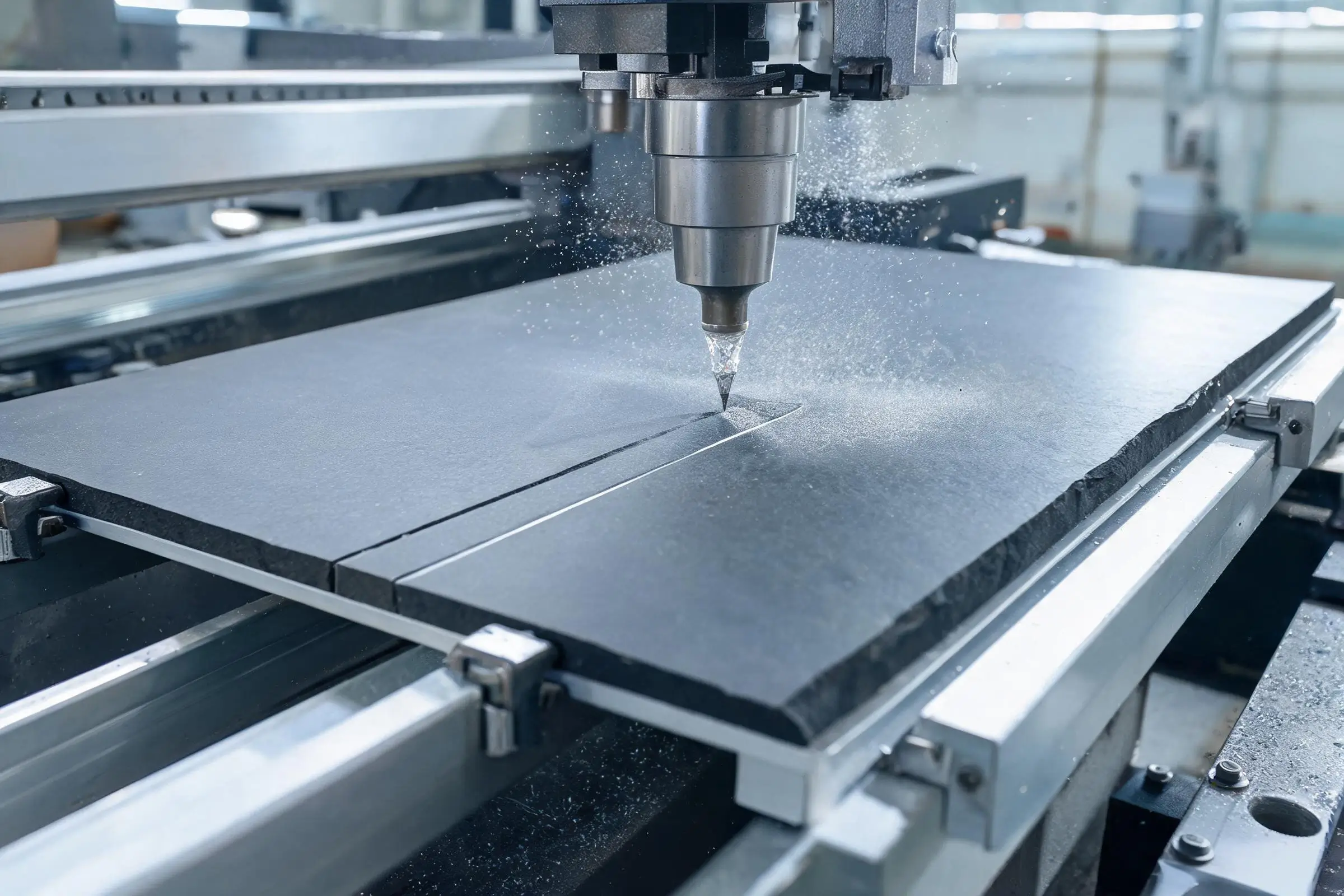
Now, I've also cut granite on the same machine — not for billiard beds, but for flooring and architectural commissions. Granite at Mohs 6–7 tells a different story. The diamond tip cuts, but it fights for every micron. Cutting force triples. Heat builds up at the contact zone — stone is a poor thermal conductor, so the heat stays local — and the thermal expansion at the cutting face pushes the tool path off by two or three tenths of a millimetre over a long cut. A diamond tip that survived 50 slate panels is spent after 12–15 granite pieces of the same dimensions. And the tolerance, despite running the same program, drifts to ±0.3 mm because the heat and force are constantly nudging the tool off its programmed path.
Let me put that in numbers that matter to a buyer:
- Tool consumption (per 50-piece batch): slate ≈ 2–3 diamond tips; granite ≈ 8–12 tips. That's roughly four times the tool cost per finished surface.
- Tolerance stability: slate ±0.1 mm across the batch; granite ±0.3 mm with thermal drift. That's three times the tolerance window — and on a billiard bed, where the flatness spec is measured in tenths, that's the difference between a table that plays true and one that needs shimming.
- Surface finish: slate produces a smooth, matte precision-ground finish in one pass; granite needs multiple passes with progressively finer grits to achieve the same surface quality.
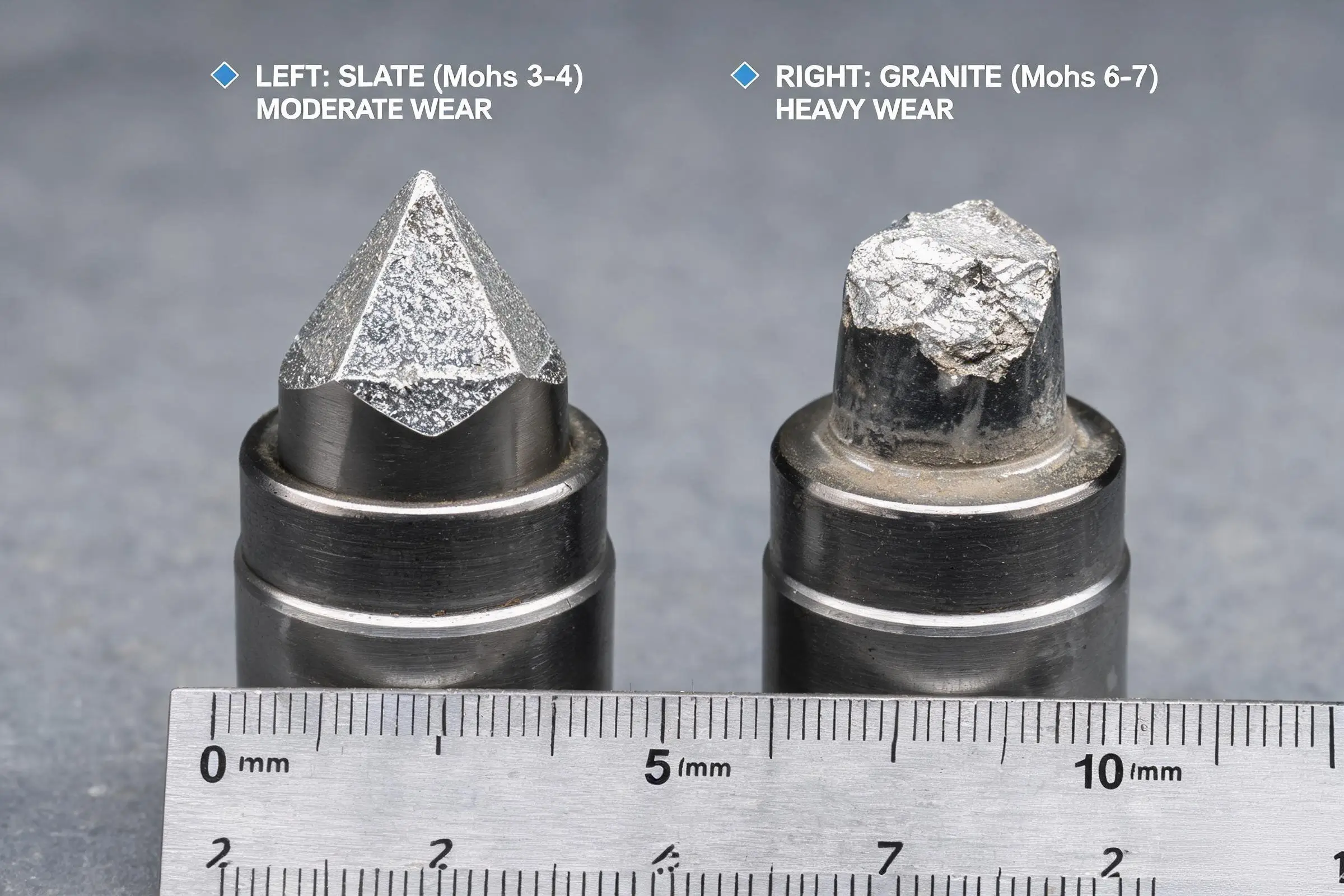
This is why Jiujiang slate is the reference material for billiard beds worldwide, and it's not just about being flat — it's about being machinably flat. The hardness puts the stone in a processing window where precision is affordable. Harder stone costs more to machine to the same tolerance, and softer stone can't hold the tolerance at all. The billiard slate page explains the full flatness specification; the hardness page explains why the specification is achievable.
Does higher hardness mean better dimensional precision?
Counterintuitively, no — not in stone machining. Higher hardness means higher cutting force, which means more heat at the tool contact zone, which means thermal expansion that pushes the tool off its programmed path. Jiujiang slate at Mohs 3-4 machines to ±0.1 mm flatness consistently; granite at Mohs 6-7, on the same CNC equipment, drifts to ±0.3 mm because the heat and force can't be fully controlled. Precision in stone machining comes from the hardness window, not from the hardness ceiling. The sweet spot is hard enough to cut cleanly, soft enough to cut cool.
Question Four — What Hardness Does on a Roof Over Fifty Years
A roofing tile has two jobs: keep water out and stay on the roof. Hardness doesn't help with the first — that's water absorption's job. Hardness helps with the second, in a way most buyers never think about until they see an old roof up close.
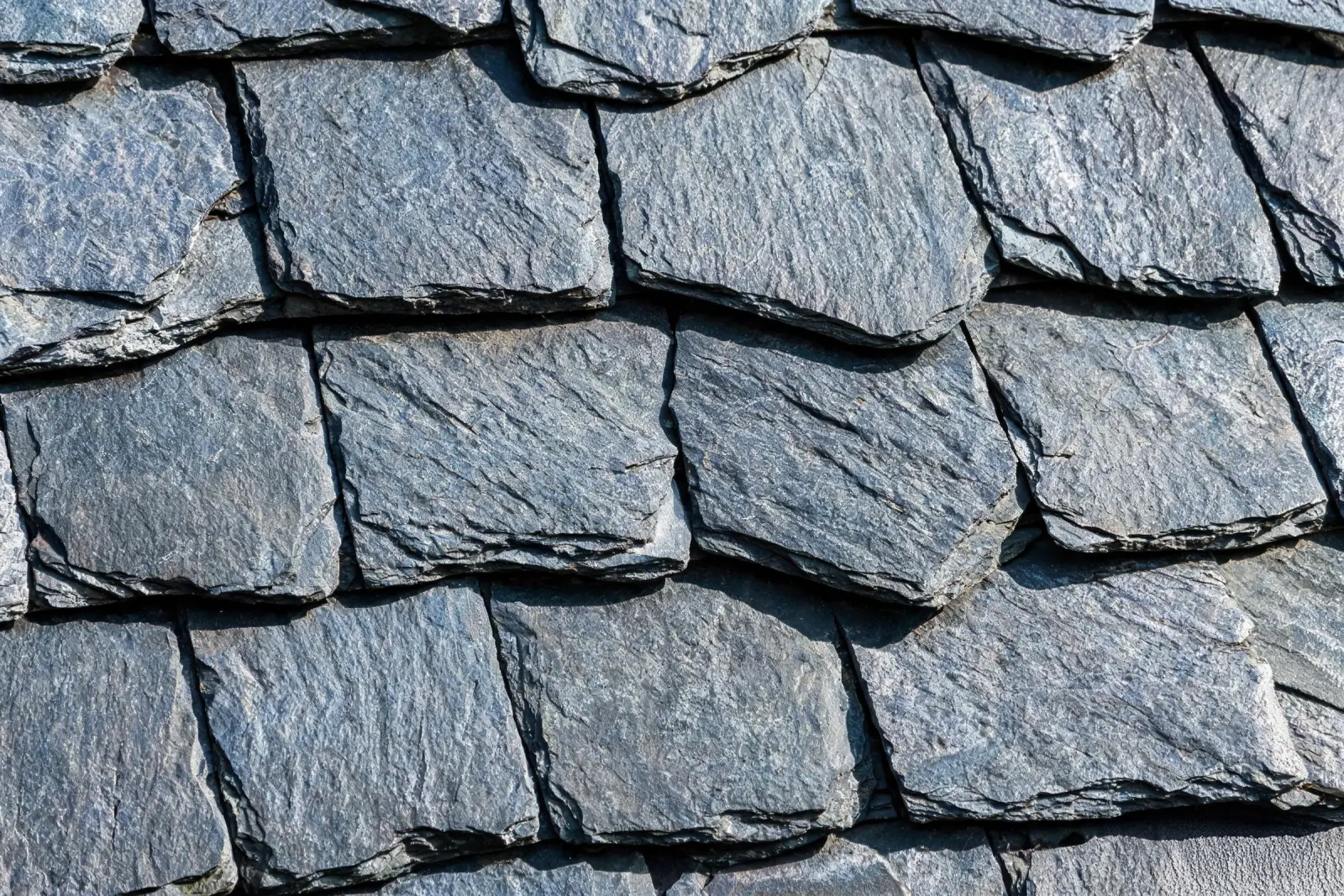
The surface of a slate roof tile is a natural cleft face — the face that was created when the tile was split from the block. It's not polished, not coated, not sealed. It's raw stone, exposed to whatever the sky throws at it: rain, wind-borne grit, hail, acid deposition, UV, freeze-thaw. Over decades, that surface wears. The question is how fast, and hardness is the answer.
Here's the mechanism. Rain carries dissolved CO₂ — weak carbonic acid, harmless on a timescale of days, but relentless on a timescale of decades. Wind carries fine mineral dust — quartz silt, mostly — that acts as a microscopic abrasive every time it rains. The combination is a slow, steady chemical-mechanical polishing of the cleft surface. On a slate at Mohs 3–4, the quartz grains in the stone resist the acid and the abrasive, while the mica plates are slowly etched and worn. The net effect over fifty years is a surface that has lost roughly 0.1–0.3 mm of thickness — a rounding of the sharpest cleft ridges, a slight smoothing of the texture, but no fundamental change to the tile's integrity. The original face is still recognisably the original face.
The 2001 building-grade certificate put a number on this: a standardised softening-depth test returned 0.025 mm. That's the lab-measured surface loss under accelerated weathering conditions — a controlled simulation of decades of acid rain and abrasion compressed into a test-cycle timeline. Scale that up to fifty years of natural exposure, and you land in the 0.1–0.3 mm range I described above. The lab and the roof agree.
Now compare that to a soft slate — a stone that tests at Mohs 2–2.5, which some regions sell under the "slate" label without mentioning that it's geologically closer to a shale. On the same roof, in the same climate, the same fifty years can remove 1–2 mm from the surface. On a tile that started at 5–7 mm thick, that's a quarter to a third of the tile gone. The surface doesn't just smooth — it develops a soapy, greasy texture as the mica is preferentially weathered away, leaving a surface that's slippery when wet and increasingly prone to delamination. I've pulled tiles off roofs like this — the back of the tile is still recognisable, but the face has turned to chalk. That's not a slate that failed. That's a stone that was never hard enough to be called slate in the first place.
The connection to the other properties is important, and I want to make it explicit because hardness alone doesn't tell the full story:
- Hardness decides whether the surface resists mechanical wear — the slow abrasion of decades.
- Density decides whether the interior resists water penetration — the mechanism that drives freeze-thaw damage.
- Flexural strength decides whether the tile resists breaking under load — the wind and snow forces on the flexural strength page.
Three properties, three threats, three defences. Hardness is the one that guards the surface. Density guards the interior. Flexural strength guards the structure. A good slate needs all three — and they're not independent. The same tight mineral interlock that gives Jiujiang slate its Mohs 3–4 hardness (quartz grains locked into a mica matrix) also gives it the 2.7–2.8 g/cm³ density that keeps water out and the 60 MPa flexural strength that keeps the tile in one piece. They trace back to the same geological root, but they protect against different threats. That's why I say: hardness decides whether you can use the stone, density decides how long, and strength decides whether it stays on the roof. All three. No shortcuts.
How does slate hardness compare to granite or marble for outdoor use?
Granite (Mohs 6-7) is harder than slate and resists surface abrasion even better — a granite roof or floor surface will show less wear over fifty years than a slate surface. But granite can't be split into thin tiles; it must be sawn, which means no natural cleft face, higher production cost, and a fundamentally different product. Marble (Mohs 3-4, similar to slate) is comparable in hardness but is calcite-based, making it vulnerable to acid rain — the same weak carbonic acid that slowly polishes slate will actively dissolve marble. Slate's advantage isn't being the hardest stone — it's being hard enough to resist wear while remaining acid-resistant, splittable and affordable. That combination is rare.
Question Five — The Pocket Test, and Why It's More Useful Than It Looks
I said at the beginning that you can run a hardness test with three objects from your pocket. Let me close with why that matters — because it's not just a party trick. It's a sourcing tool, and in forty years of buying stone, I've used it to catch more mislabelled shipments than any lab report.
Here's the scenario. A supplier sends you a sample tile labelled "natural roofing slate." It looks the part — dark grey, flat cleft face, the right weight in your hand. The test report says all the right numbers. But you're about to commit to a 40-foot container, and you want a gut check before the money moves. So you do this:
- Fingernail test (Mohs 2.5): Press your nail into the cleft face and drag. If your nail leaves a visible groove, the stone is softer than Mohs 2.5. That's not slate — it's shale or mudstone dressed up as slate. Reject.
- Copper coin test (Mohs 3): Scratch the surface with the edge of a coin. If the coin slides off without leaving a mark, the stone is at or above Mohs 3 — consistent with good slate. If the coin scratches easily and deeply, the stone is below Mohs 3 — too soft for a roof. Reject.
- Steel blade test (Mohs 5.5): Draw a knife blade across the surface. It should leave a thin, silvery scratch — that's Mohs 3-4 behaviour. If the blade can't scratch it at all, the stone is above Mohs 5.5 — it might be a harder schist or gneiss sold as "slate," which won't split or weather like true slate. Caution.
Three tests, five minutes, no lab. The pocket test won't replace a test report — you still need the documented numbers for specification and contract. But it will catch the stone that's completely wrong before you pay for a container of it. In my experience, roughly one in eight "slate" samples from unknown sources fails the fingernail or coin test. That's a rejection rate worth five minutes of your time.
Here's the deeper reason the pocket test matters more than most buyers realise. I've seen compressive strength numbers for Jiujiang slate ranging from 86 MPa to 280 MPa across different suppliers' data sheets. A buyer comparing those numbers would think they're looking at three completely different stones. They're not — they're looking at three different test methods applied to the same geological formation. Meanwhile, the Mohs reading is 3–4 on every single one. Hardness is the property that doesn't lie, because it doesn't depend on how you cut the sample or which direction you load it. Your fingernail, a coin, a knife blade — they don't care about geometry or loading direction either. They just scratch. And the scratch tells you what the stone is.
For Jiujiang slate, the pocket test reads like this: fingernail slides off clean, coin leaves a faint streak at most, blade leaves a thin scratch. That's Mohs 3–4, confirmed on the bench, in your hands, before you look at any paperwork. The full properties page explains where hardness sits among the eight key figures; the published test results give you the documented companion. But the pocket test is where my hands start, every time.
Can the Mohs scratch test replace a laboratory hardness test?
No — and I'm careful about this distinction. The pocket scratch test tells you the Mohs band (2-3, 3-4, 5+), which is enough to catch gross mislabelling (a shale sold as slate, or a gneiss sold as slate). It does not give you a precise figure, it does not produce a documentable number, and it does not replace the test certificate you need for contract and specification. What it does is give you a five-minute gut check before you spend money. Run the pocket test on the sample, then ask for the lab report. If the pocket test says "Mohs 3-4" and the lab report says "Mohs 3-4," you have consistency. If the pocket test says "Mohs 2" and the lab report says "Mohs 3-4," you have a question to ask before you buy.
Is harder slate always better slate?
No. Hardness is one of three properties that determine slate quality, and it has an optimal window, not a "more is better" scale. Slate above Mohs 4 — if the quartz content is unusually high or the metamorphic grade has pushed the rock toward schist — becomes difficult to split cleanly and more expensive to machine. Slate at Mohs 3-4 is in the sweet spot: hard enough to resist decades of surface wear, soft enough to split into thin tiles and machine to precision. "Harder is better" is the kind of logic that sounds right in a showroom and falls apart in a workshop. The question isn't "how hard?" — it's "hard enough for the job, soft enough for the process."
Does Jiujiang slate's hardness vary between batches?
Within a narrow band. The mineral composition that sets the hardness — muscovite, quartz and chlorite in roughly consistent proportions — is stable across the formation the region works. You'll see the Mohs reading sit at 3 in some batches and 3.5 in others, but it doesn't drift outside the 3-4 band. This is the geological advantage of a single broad formation over scattered pockets: the mineral frame is consistent. The properties page discusses batch variation across all eight properties; for hardness specifically, the variation is small enough that the pocket test reads the same on any Jiujiang tile you pick up.
Hardness is a window, not a ceiling.
Run the pocket test on a sample. If the fingernail slides, the coin barely marks, and the blade scratches — you're holding Mohs 3–4. Ask for the test report to confirm it.
Request a Sample and Test Report