
Jiujiang Slate Properties Explained: Eight Physical Numbers and What Each One Decides
Most property pages are lists. Density: such-and-such. Absorption: such-and-such. A list tells you what a stone is, but not what it will do — and the difference between those two things is where roofs and billiard tables are won or lost.
So this page works differently. Think of it as a materials class with eight specimens on the table. Each specimen is one physical property of Jiujiang slate — the metamorphic rock quarried around Lushan and Xingzi in Jiangxi that feeds both the roofing trade and the billiard trade. For each one, you get the number the lab produces, a translation into something your hands or your project can feel, and the practical consequence on a roof, on a table, or in a purchase decision. The same eight figures appear on every serious slate test report; knowing what they decide is what separates a buyer who reads a certificate from a buyer who just files it.
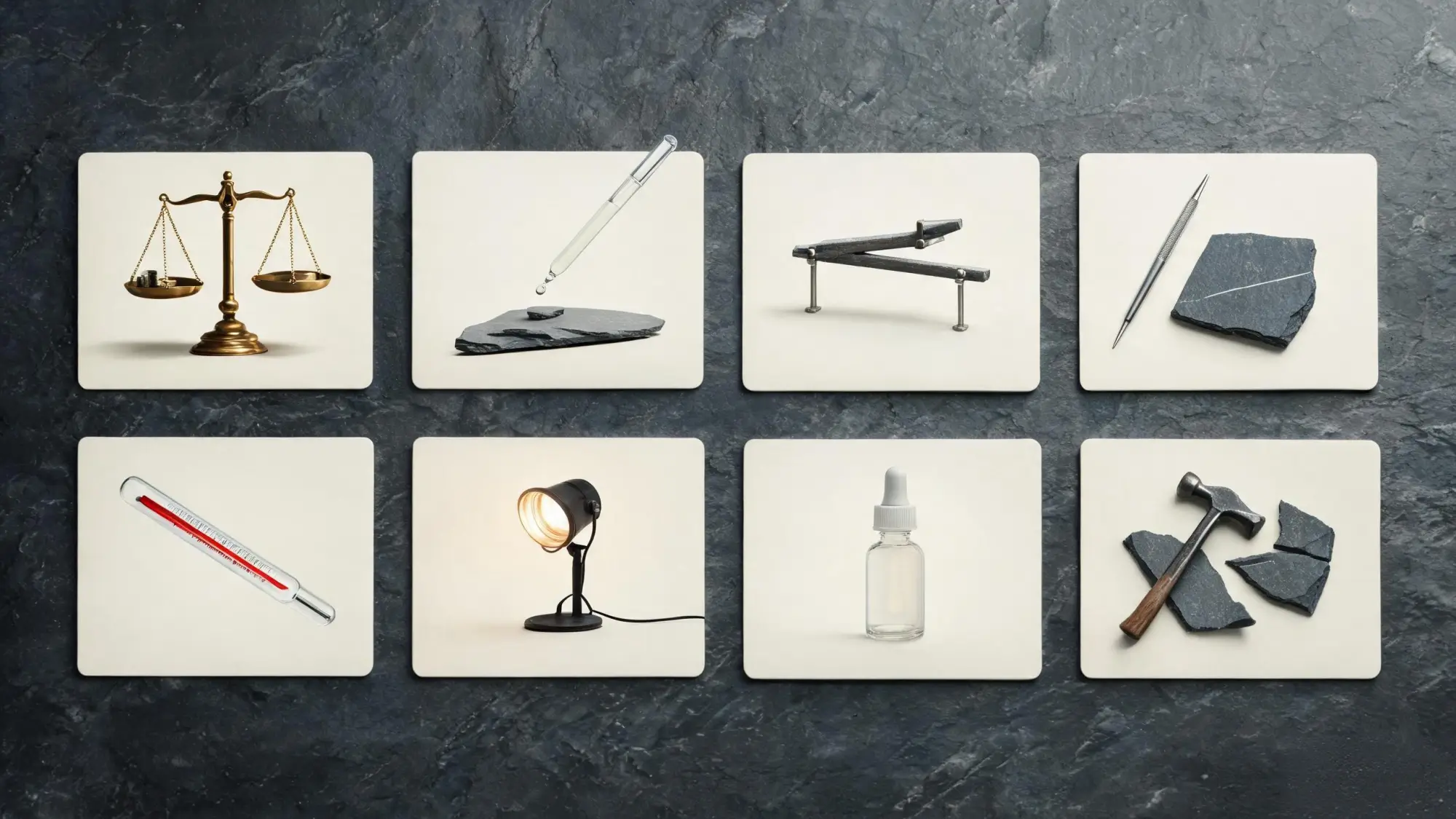
Quick answer — the eight figures on the dissection table. If you only have a minute, here is the whole sheet at a glance; the rest of the page is what each row means.
| What you measure | Jiujiang reading | What it decides |
|---|---|---|
| Mineral composition | SiO₂ ~66.5%, CaO <0.6%; muscovite, quartz, chlorite | Whether acid rain and polluted-city air have anything to feed on |
| Density | 2.7–2.8 g/cm³ (2,700–2,800 kg/m³) | Roof load per m², container maths, how "tight" the stone feels |
| Water absorption | ~0.2% by weight (EN method, 48 h soak) | Frost survival — the single number that decides a cold-climate roof |
| Flexural strength | ~60 MPa dry; still >45 MPa after 48 h soaked | Whether tiles survive walking, wind uplift and snow load |
| Hardness | Mohs 3–4 band | Wear under foot and weather; how the surface ages under touch |
| Thermal behaviour | Low single-digit ×10⁻⁶/K expansion; non-combustible (A1) | Whether panels stay flat through seasons; fire performance |
| Cleavage & workability | True slaty cleavage; split band 4 mm roof tile → 45 mm panel | Whether one rock can serve two trades at all |
| Consistency | One formation; batch traceable; 100% piece-by-piece inspection | Whether container №10 matches the sample you approved |
Specimen One — Mineral Composition: What the Stone Is Made Of
Every property on this page is downstream of one thing: what the rock actually contains. Jiujiang slate is a muscovite–quartz–chlorite schist — a hard, platy mica framework cemented by fine quartz — with silica (SiO₂) around 66.5% and, critically, calcium oxide (CaO) under 0.6%.
Why the CaO line matters more than it looks: the classic decay pathway for building stone in polluted city air runs through carbonate. Sulphur dioxide dissolves into rain, weak acid meets calcium carbonate, and the reaction product — gypsum — takes up more space than the mineral it replaces. The crystal growth pries the surface apart grain by grain. That pathway needs carbonate as fuel. At under 0.6% CaO, Jiujiang slate carries almost none: the pathway is largely closed before the first rain lands. The mica–quartz frame is the quiet reason this stone sits so comfortably in European coastal and industrial climates — a backstory the geology of the Lushan–Xingzi belt explains from the ground up.
One honest note from the trade: chemistry never certifies a slate on its own. A low CaO figure tells you the stone has no obvious slow poison; the strength and absorption figures below tell you how it performs now. Read them together, never separately.
Specimen Two — Density: 2.7–2.8 g/cm³, and Why Your Structural Engineer Cares
Density is where a materials person always starts, because so much hangs off it: water behaviour, frost behaviour, dimensional stability, even how a crate stacks. Jiujiang slate tests at 2.7–2.8 g/cm³ — 2,700–2,800 kg per cubic metre — which sits at the upper end of the natural slate range.
The translation the trade uses: at 7–9 mm thickness, a finished Jiujiang slate roof surface weighs about 19–24 kg per square metre. For a specifier, that number is the difference between a straight retrofit and a structural conversation. Slate is heavier than sheet metal, yes — but it comes in well under half of what concrete and clay tile systems ask a frame to carry, which is why natural slate goes onto suitable existing structures where heavier systems would need reinforcement. New build? The load is budgeted from day one.
Density also does quieter work. A tight matrix is a matrix with little connected pore space — the root of the next two specimens. And in the container, 2.7 t/m³ is the constant behind every loading plan: one cubic metre of this stone is 2.7 tonnes, which is why a 20-foot crate programme is calculated in square metres of tile, not vague "lots". The dedicated density page unpacks the arithmetic.
Is 2.7–2.8 g/cm³ heavy for slate, and what does it weigh per square metre?
It is at the upper end of the natural slate range — most roofing slates sit between 2.6 and 2.9 g/cm³. At the usual 7–9 mm roofing thickness that works out to roughly 19–24 kg per square metre of finished roof. As a comparison point, concrete and clay tile systems commonly ask a structure for two to three times that, so slate often passes where heavier coverings would need frame reinforcement. On an older building, have the structure checked once — but expect slate to be the light natural option, not the heavy one.
Specimen Three — Water Absorption: The 0.2% Figure That Decides Cold Climates
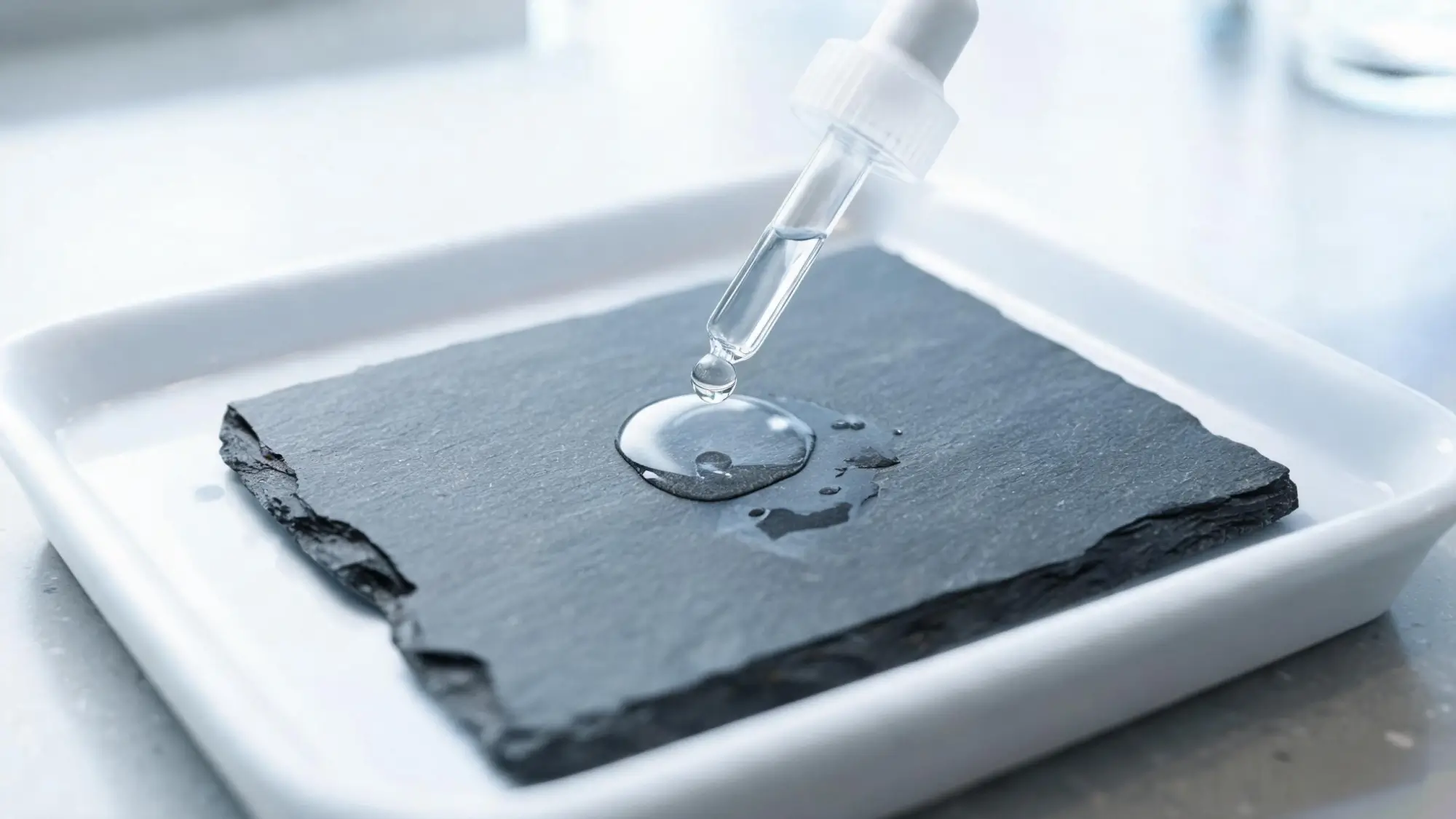
If you check one number before buying slate for a cold or coastal market, the trade's answer is always the same: water absorption. Jiujiang slate reports around 0.2% by weight under the EN soak method. The EN 12326 system classifies anything under 0.6% in the top class; Jiujiang slate clears that gate by a factor of three.
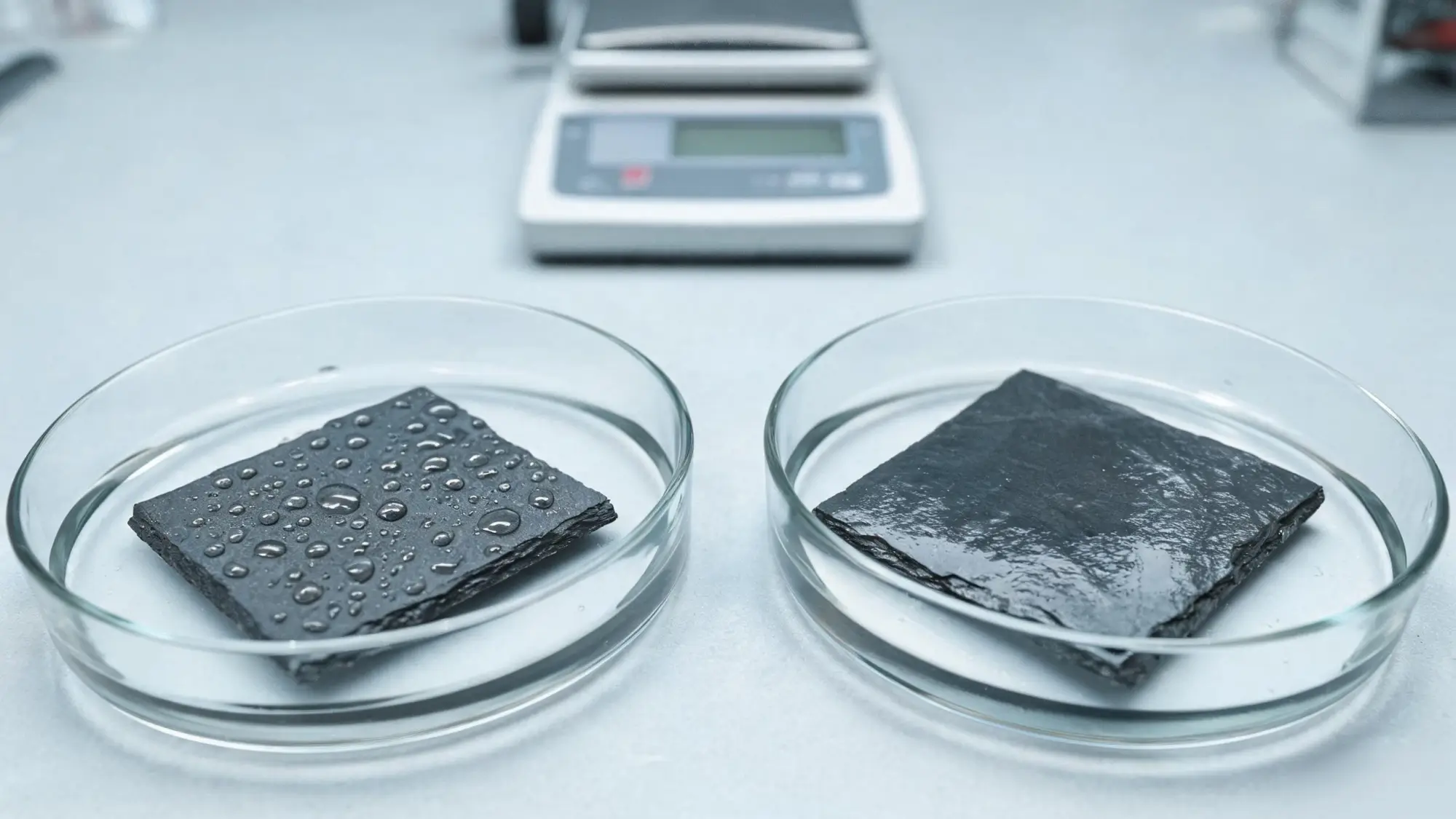
The mechanism is unforgiving, which is why the figure matters so much. Water that enters a stone freezes, expands about 9% in volume, and presses on the pore walls from inside. Repeat that a few hundred nights a winter and a porous slate begins to delaminate — tiles shed, courses disturb, and the failure always arrives in the worst month. A stone that barely drinks barely freezes. The 120-cycle laboratory freeze–thaw result on our published test data — zero weight loss, zero structural change — is the lab's way of saying what 0.2% means in practice.
For the billiard side, low absorption is the humidity defence: a panel that takes up almost no moisture from the air stays dimensionally quiet when the room's climate swings — one layer of the stability story that the flatness and dimensional stability page completes.
Why do some Jiujiang slate reports show 0.2% and others 0.1%?
Both figures are real measurements. Three things move the number slightly: the natural batch variation of any stone, the test method (the EN 48-hour soak and the ASTM procedure weigh differently prepared samples), and how the specimen was dried before the first weighing. Across our own reports the readings sit in the 0.1–0.2% band, and either way the stone is well inside the top EN class, which begins at anything under 0.6%. When comparing suppliers, the honest habit is to read the method line on the report — a number without its method is only half a number. Our own published figures are on the test results page with their methods attached.
Specimen Four — Flexural Strength: 60 MPa Dry, 45 Wet, One Dropped Nail
Flexural strength is the number a slate lives or dies by on the job site — literally, since most mid-life slate failures are bending failures: a roofer's misplaced boot, wind uplift clawing at an eaves tile, the long bending load of a heavy snow pack. Jiujiang slate tests at around 60 MPa dry, and — the part that matters more — still above 45 MPa after 48 hours fully soaked.
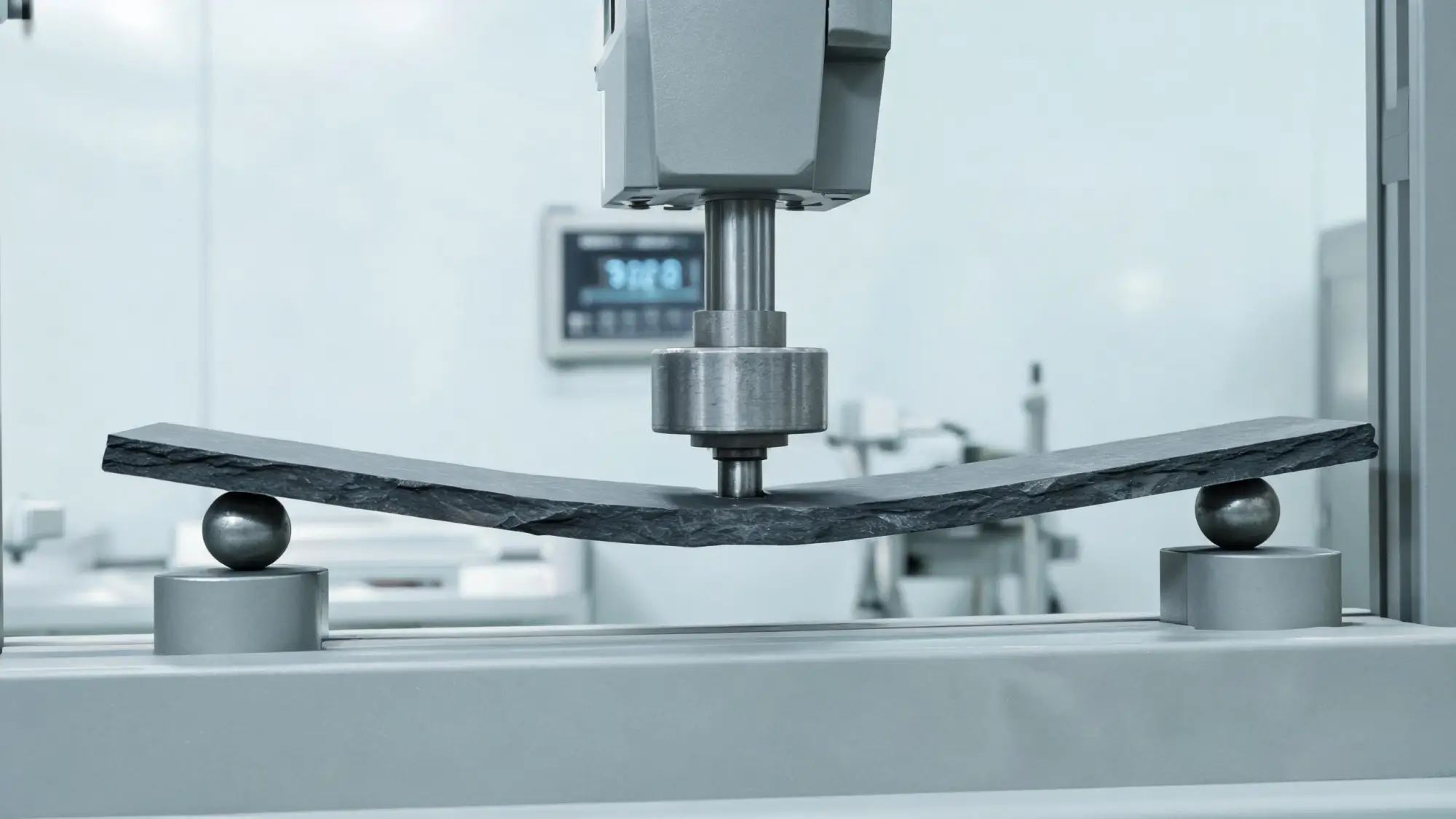
That wet figure is where weak slate is caught out. Water sitting in micro-pores wedges mineral grains apart, so every slate tests weaker soaked than dry — the question is by how much. A stone that holds better than three-quarters of its dry strength after two days underwater is a stone whose mineral frame is genuinely interlocked, not merely compacted. For the standards context — ASTM C406's S1 grade, EN 12326's class tables — the flexural strength page gives the full reading, and the roofing slate technical data sheet places the figure beside every other number a specifier needs.
The billiard trade reads the same specimen differently: there, bending performance is about a panel staying dead flat under its own weight across a 2.4-metre span, year after year. Strong, stiff, consistent — the strength figure is the quiet promise behind every table that leaves the region.
What flexural strength should roofing slate have at minimum?
The practical floor in the trade is 40 MPa dry with retention above 40 MPa after soaking; good slate tests in the 40–60 MPa band, and the best lots push past 60. Jiujiang slate reports around 60 MPa dry and above 45 MPa after a 48-hour soak, which puts it in the top band. One caution the trade always adds: the modulus formula squares the sample's thickness, so never compare the MPa of two slates tested at different thicknesses — a serious report always states the test setup. Buy against the standard class (EN 12326 or ASTM C406 S1) and against the wet figure, not against a single dry number on a flyer.
Specimen Five — Hardness: Mohs 3–4, and the Pocket Test Anyone Can Run
Hardness on the Mohs scale is resistance to scratching — how a surface stands up to abrasion, footfall, hail, and decades of weather rubbing at the cleft face. Jiujiang slate sits in the Mohs 3–4 band: harder than a fingernail, about even with a copper coin, clearly softer than a steel knife edge.
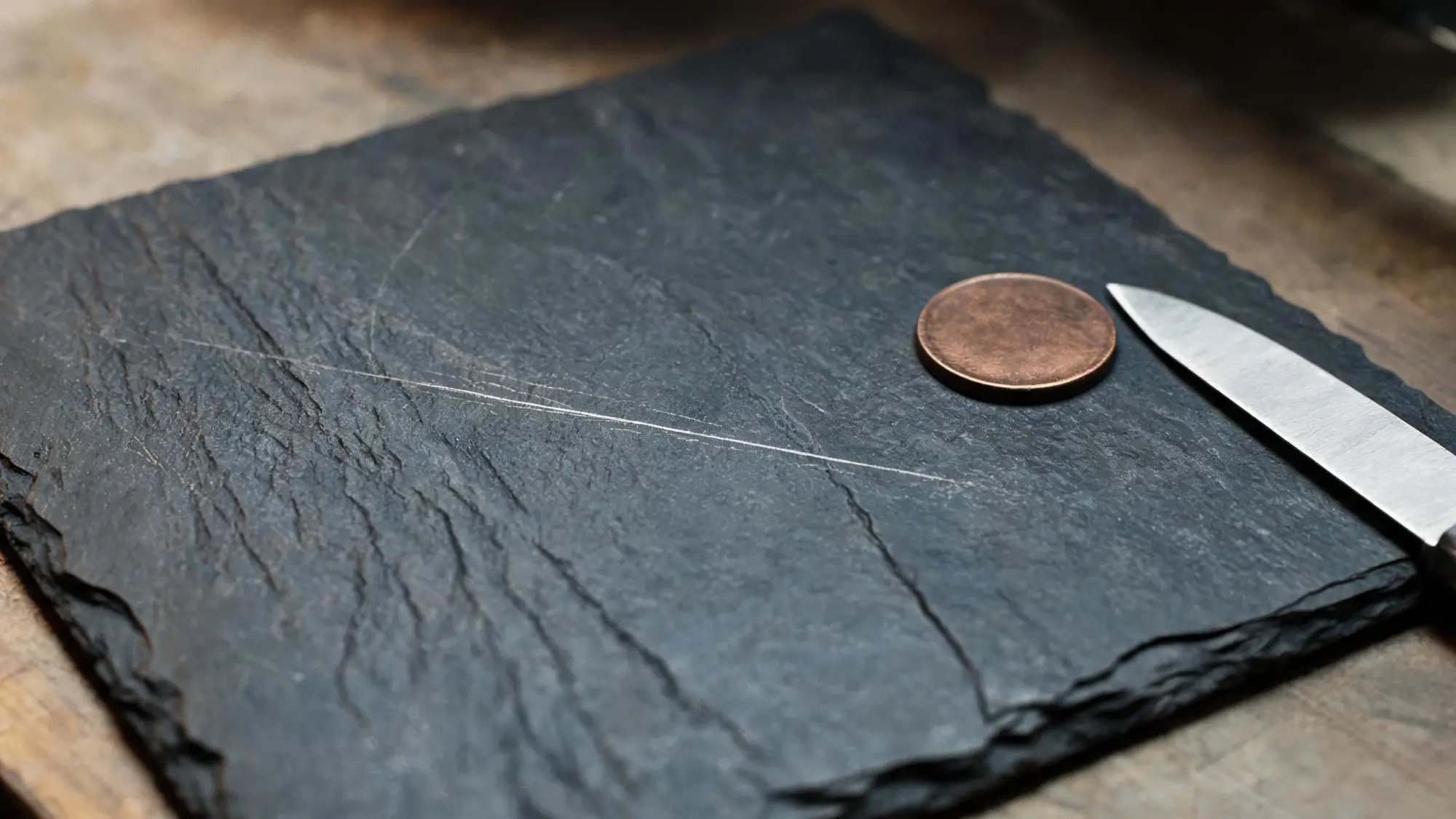
Mineralogists call it the pocket lab: fingernail runs about 2.5, a copper coin about 3, a pocket-knife blade about 5.5, and glass about 5.5. Scratch a sample tile with each in turn and the reading places itself. The mica-quartz balance in this slate lands deliberately between: hard enough that decades of rain-borne grit and foot traffic polish the surface rather than gouge it, soft enough that a slater can score and snap a tile on site and a fabricator can cut, edge and groove it without the tool wear that grinding granite demands. If you want the flip side of that balance — why slate offers the famous natural cleft face rather than a polished one — the smooth versus textured slate comparison is the honest answer: slate's charm is that its natural face is the product.
Can I test slate hardness myself without a laboratory?
Yes — that is the entire charm of the Mohs scale. Three everyday references bracket the range: a fingernail (about 2.5), a copper coin (about 3) and a steel pocket-knife blade (about 5.5). On a sample tile, try each against an inconspicuous spot. Jiujiang slate will resist the fingernail, contest the coin, and yield to the blade — placing it in the Mohs 3–4 band. It is a field check, not a certificate; for documentation, the hardness figure belongs with the rest of the report. But for a five-minute gut check on a sample before you even ask for paperwork, the pocket test is hard to beat.
Specimen Six — Thermal Behaviour: The Property Nobody Quotes Until a Panel Moves
Here is the specimen most property lists skip. Every material breathes with temperature, and in stone that breathing shows up as movement — movement that must be designed for or absorbed. Slate, as a stone, sits in the comfortable company of materials engineers already trust: its thermal expansion coefficient is low, in the single-digit range of millionths per kelvin — the same order of magnitude as glass and well below ordinary metals and plastics.
The trade translation is easier to feel than the exponent. Across a 2.4-metre billiard bed panel, a 10°C temperature change moves the stone's length by well under a fifth of a millimetre — comfortably inside the joint allowances a table's frame design already carries. On a roof, slate's thermal mass does the opposite, useful work: a dark slate surface in summer sun can run hot, and a stone that expands little and conducts heat away slowly simply does not build up the internal stress that cracks lesser coverings through repeated day-night cycling. Add the rating nobody advertises but every fire authority cares about: natural stone is non-combustible, class A1 — slate does not burn, does not spread flame, and gives off nothing in a fire. For roof specifications in wildfire-adjacent markets, that single word is worth a paragraph of sales copy.
How much does slate expand and contract with temperature?
On the order of single-digit millionths per kelvin — the same magnitude class as glass, and several times less than typical metals. Practical numbers: a 2.4-metre panel growing 10°C in temperature lengthens by roughly 0.1–0.2 millimetres, which is inside standard joint allowances; a metre of slate passing through a 40°C seasonal swing moves about a fifth of a millimetre in total. This is why billiard beds stay flat through unheated winters and summer showrooms, and why roofs in freeze-thaw and wildfire-adjacent markets specify stone: A1 non-combustibility and negligible thermal movement, in one material.
Specimen Seven — Cleavage and Workability: The Property Behind Two Industries
The cleavage plane is slate's signature — the metamorphic grain that lets a mason split a dense, hard stone into plates a few millimetres thin by hand and by machine, with faces so naturally flat that a roofing tile needs no surface machining at all. Cleavage quality is the gatekeeper property: it decides the thickness range a rock can honestly be worked to, from hand-split roofing tile at 4–8 mm up to solid billiard bed stock at 45 mm and beyond. Think of the thickness range as the instrument's register: a fine-grained, well-developed cleavage gives the rock its full range from thin treble to thick bass. A rock that splits cleanly only one way produces a much narrower instrument.
Workability follows from cleavage, and Jiujiang's is what allows one rock to serve two demanding trades. The roofing side needs plates that split thin and true, so the tile's natural face becomes the finished product — no grinding, no polishing, just the face 400 million years of metamorphism prepared. The billiard side needs the same rock to hold a machined flatness instead: on our CNC machining line, panels are cut, ground and finished to tolerances the table trade specifies — the precision story continues on its own page. The hand-splitting craft, and why it still can't simply be mechanised away, is told in the art of splitting slate by hand.
The third pillar of this specimen is consistency — the supply property that decides whether container №10 matches the sample you approved. Jiujiang's advantage is that the region works one broad formation, not scattered pockets: the mineral frame described in Specimen One holds batch after batch, quarry face after quarry face. In our factory that geology is backed with a policy the trade rarely sees: 100% piece-by-piece inspection — not batch sampling — with batch numbers that tie each crate back through the process to the block it came from. The full inspection walkthrough lives at 100% Inspection: How We Check Every Piece.
Do the properties vary between batches of Jiujiang slate?
Within a narrow, honest band — the way any natural stone varies. The key structural fact is that the region works one broad formation, so the mineral skeleton (muscovite-quartz-chlorite, low CaO) and the density band hold steady across quarries and batches. Within that band, a natural material still shows batch texture: colour tone drifts a shade, absorption readings slide between 0.1 and 0.2%, splitting character varies slightly with the bed. That is precisely why the working rules matter more than the geology: batch numbers on reports and crates, 100% piece-by-piece inspection rather than sampling, and sample approval tied to the production batch. Follow those three and batch variation becomes a non-issue.
The Properties as a System: Why One Rock Can Roof a House and Carry a Break Shot
Eight specimens on the table, and the honest conclusion is that none of them is remarkable alone. Density at the top of the range exists in several origins. So does low absorption, so does strength. What is uncommon is finding all eight in the same rock — and finding a formation large and uniform enough to deliver them together, batch after batch.
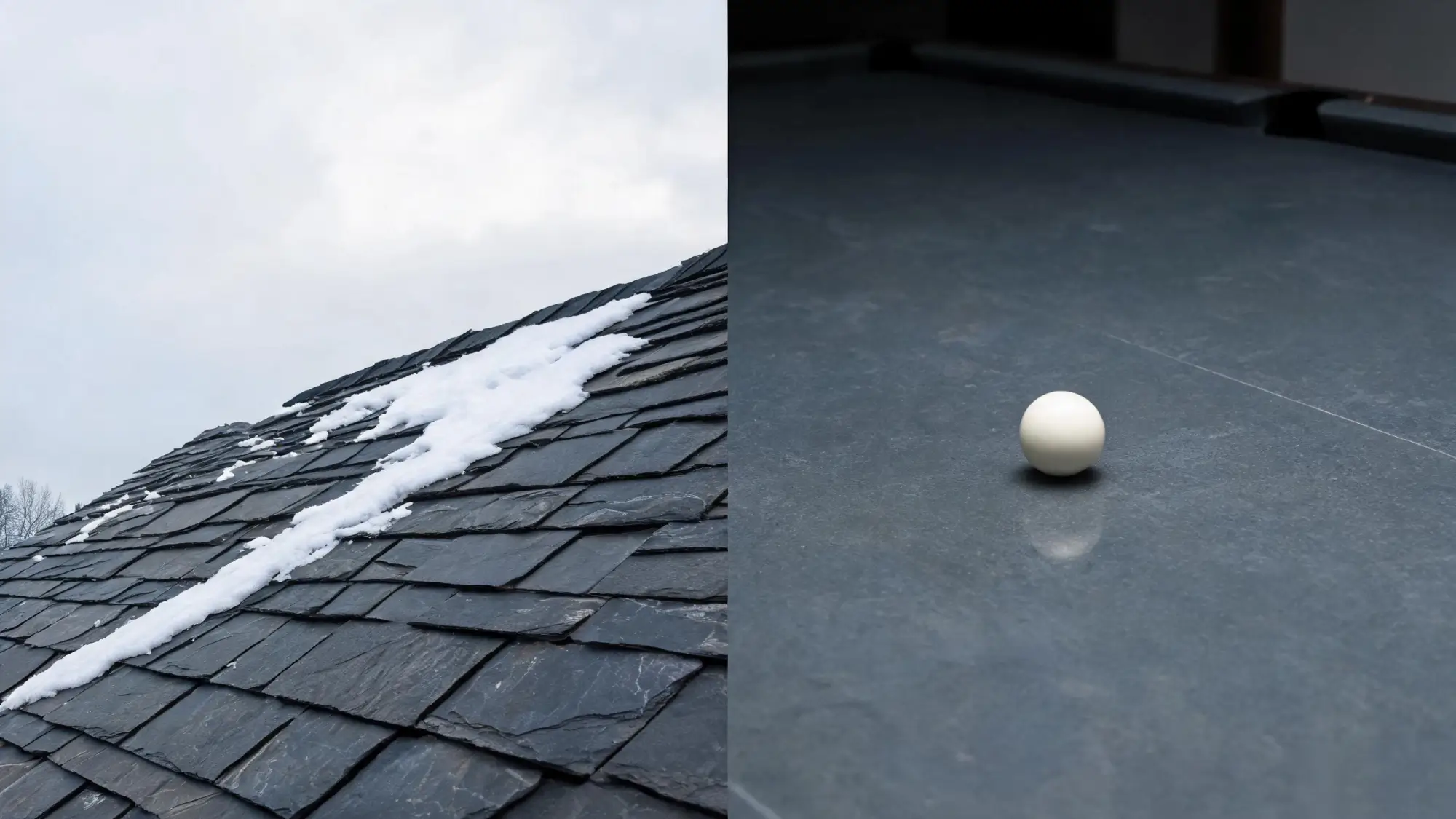
Trace the system and each property feeds the next. The mica-quartz skeleton (Specimen One) makes the rock dense (Two). Density closes the pores, so water barely enters (Three). Low water means frost has nothing to grip (the freeze-thaw half of Three), and the interlocked frame keeps its strength even soaked (Four). Hardness balanced against workability (Five) lets the same block be split thin by hand or ground flat by machine (Seven), and low thermal movement (Six) keeps both products dimensionally quiet through seasons. Consistency (Seven's supply half) is what turns a good stone into a dependable supply. A roofing buyer in Norway and a table builder in Texas are, in the end, reading two different requirements off the same eight lines.
That is also why this page insists on reading figures together. A supplier quoting one impressive number — usually absorption — while staying vague on the rest is showing you one specimen from a dissection tray. The stone you buy is all eight.
How to Read These Numbers on a Real Report
Everything on this page appears, in some form, on a standard slate certificate — EN 12326 in Europe, ASTM C406 in North America. Three reading habits keep you safe:
- Check the method before the number. EN and ASTM results for the same property are not directly interchangeable — different sample preparation, different weighing. A report that doesn't name its method is half a report. Our own figures sit on the Jiujiang Slate Test Results page with their methods attached.
- Read the wet strength, not just the dry. Dry strength flatters every slate. The figure after saturation is where weak stone is caught. Hold suppliers to the soaked number.
- Match the batch number. A certificate is only evidence if it names the batch your crates carry. No batch reference, no traceability — no matter how good the numbers look. The habit is developed further in What Makes Jiujiang Slate Different?, which turns these properties into a five-step verification checklist.
Related Reading
Want the full figure sheet for your project?
Ask for our current EN 12326 / ASTM C406 test report with batch numbers, and we'll pair it with a physical sample so you can weigh the density, run the pocket hardness test and check the wet strength claims against the stone in your hands.
Request the test report and a sample → | Browse roofing slate products