
Jiujiang Slate Resources and Quarry Reserves
Every so often an email arrives that skips the price talk entirely. The last one came from a roofing distributor weighing a long-term supply agreement. Two sentences of pleasantries, then this:
"We like the test data. We like the samples. But before we build a supply agreement on this stone, we need to understand the ground it comes from. How much slate does your region actually have left — and who decides how much comes out each year?"
It is the least romantic question in the natural slate trade, and the most serious one. Jiujiang slate quarry reserves — the recorded figures, the licence system that governs extraction, and the honest limits of what any supplier can promise — are the subject of this article. Treat it as a due-diligence file rather than a sales page. If you intend to spend the next twenty years specifying, distributing or fabricating with this stone, you should read the ground the way a lender reads a balance sheet.
That is the file in three lines: one of the largest documented slate belts in the country, thick-bedded, worked slowly under licence. The rest of this article shows where each line comes from — and where its limits are.
The Question Behind the Question
Roofing slate is sold on a promise that outlives the people who make it. A good slate roof serves for the better part of a century; a billiard bed can stay in a club for decades, then be re-faced or replaced with stone that must match the original. Nobody re-orders a roof in one go — they come back in eight years for an extension, in fifteen for a repair wing, in twenty-five to match a batch on a neighbouring building. Every one of those return visits assumes the region still produces the same stone.
So the reserve question is never really "how much is left in the ground?" It is: will the stone keep coming, in the same quality, for as long as my project needs it? That reframing matters, because the honest answer does not live in one big number. It lives in three separate layers: what geology put in the ground, what the licence system allows out of it, and what the supply chain holds in stock between the two. Most supplier websites skip the topic entirely — there is no flattering one-line answer. Fair enough. Here is the unglamorous mechanics instead.
What the Records Say
Start with the paperwork, cold. China tracks dimension slate — slate quarried to be cut and used as stone, rather than crushed for aggregate — as its own category in the national mineral-resource statistics. In those publicly available statistics, Jiangxi has long ranked at the top among provinces. That is the provincial frame. Drill down and the working quarries of this region sit in the Lushan–Xingzi slate belt, the stretch of foothill country between the mountain and Poyang Lake that stoneworking families have called home for generations. The record of working this stone goes back roughly a thousand years — inkstones, roofs, steles, bridges — which tells you the belt was never a one-decade discovery.
Then there are the local figures. Publicly available records for Heping — a single village inside the Hengtang processing belt — put its documented bluestone reserve at roughly 80 million cubic metres. Bluestone is the local name for the grey slate this region quarries. I quote that figure with a warning attached: a village-level number measures the scale of the belt, not what any one quarry is permitted to lift this year. Treat it as an order-of-magnitude signal — this is a belt where one village's paperwork runs to eight digits of cubic metres — and keep asking the sharper questions further down this page.
The third record is the shape of the deposit itself. The ore bodies here are bedded: layered, near-flat-lying banks of slate stacked one on another, metamorphosed out of ancient sediments — the long story is told in The Geology of Jiujiang Slate. The beds the quarries work through are commonly 30 to 150 metres thick. Set that against the thin seams many building-stone regions chase, and you can see why a bedded slate belt behaves more like a coalfield than a vein mine: you quarry it in benches, downward and outward, decade after decade.
What the Mountain Shows
Numbers are the file version. The standing-at-the-face version is harder to fake.
Walk to the edge of a working quarry in this belt and the first thing you notice is the staircase. Face after face of grey-blue rock, cut in steps — each step a bench, each bench a bed. When people picture a "slate reserve," they imagine a pit getting deeper. What you actually see is a hillside being opened like a book: the beds run along the face in long, level lines, and the quarry moves through them the way a reader moves through pages. Follow one dark band with your eye from one end of the face to the other and you are looking at metres of usable stone in a single layer — with more layers behind it, and under it.
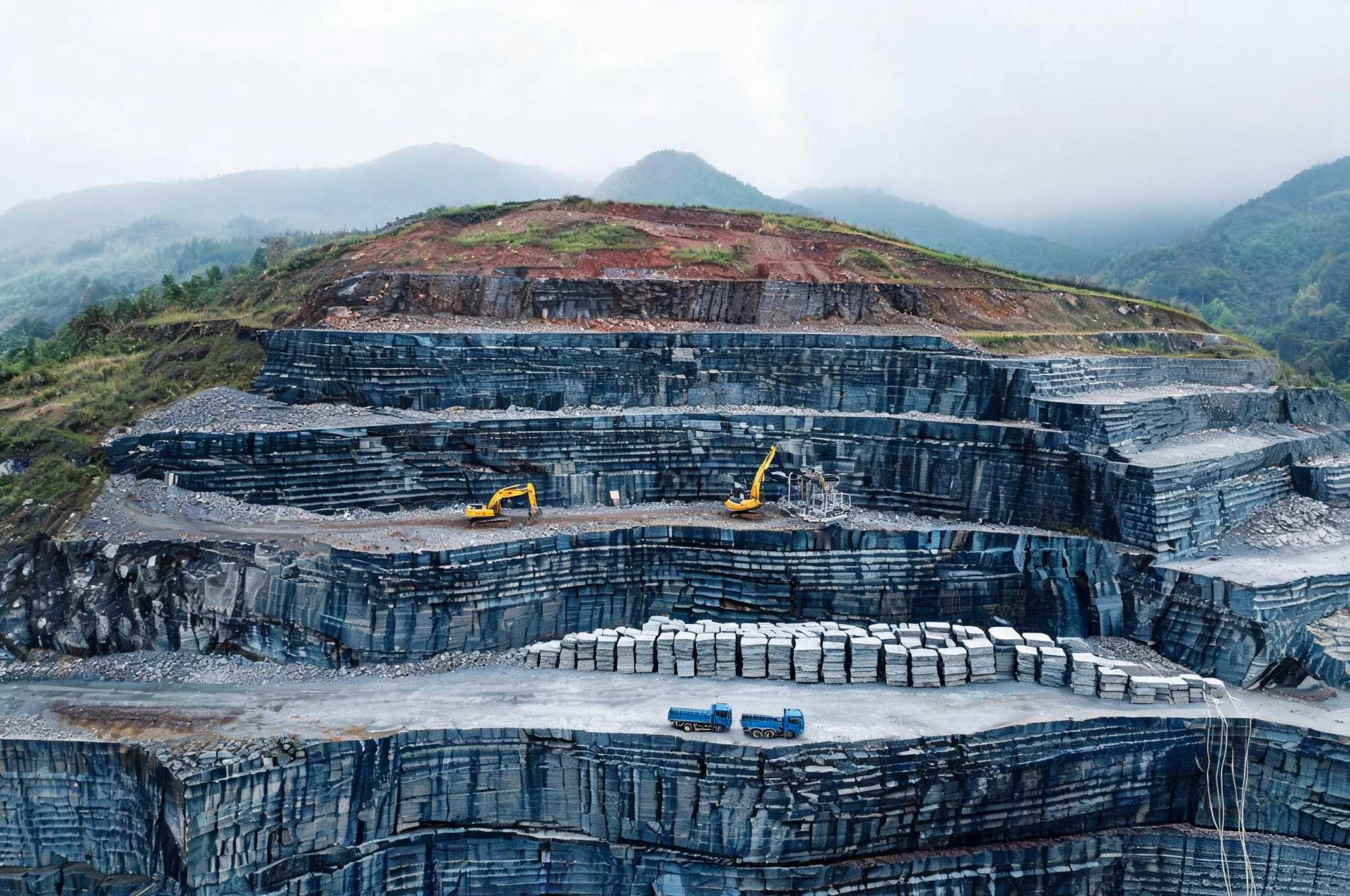
The second thing you can do at the face is read the thickness yourself. The recorded 30 to 150 metres is not an abstraction here; it is visible as stacked, parallel bands in the cross-section, splitting so predictably along the grain that a block comes off the face already hinting at the tiles inside it. This is the quiet advantage of a bedded deposit: uniformity. A vein that pinches and swells forces a quarry to chase quality. A thick, even bed delivers the same grain, the same density, the same splitting behaviour, bench after bench — which is exactly what a factory wants when it needs consistent test results and repeatable machining from its raw material.
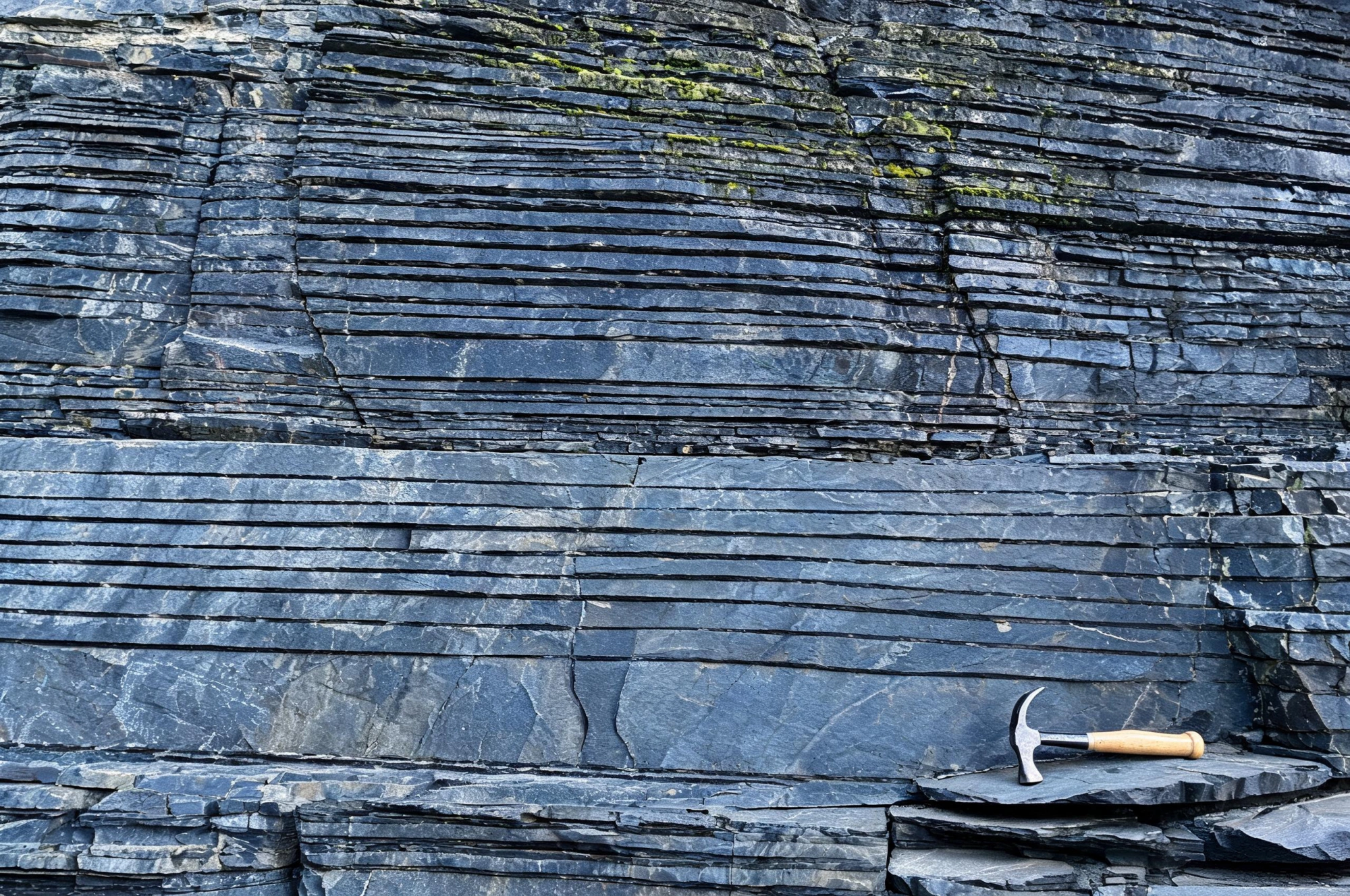
What you will not see at a well-run face is everything coming out of the ground. Extraction is selective: beds that split clean and test right are kept for roofing and billiard blanks; material that does not make the grade is left behind or routed to humbler uses. We have written elsewhere about the selection rules that turn blocks into finished slate; the quarry-side version is the same discipline pointed the other way. Selective extraction is why a managed face in this belt can look almost idle from the rim — and still load trucks every week.
Licences and Quotas: The Control System
Now the layer most foreign buyers do not know exists. In China, a working dimension-stone quarry operates under a mining licence: a defined boundary on the map, a defined term in years, and an annual extraction volume set under the licence and administered by the natural-resources authorities. The quarries supplying the Jiujiang belt work inside that frame. The gate of a licensed quarry posts its credentials — licence number, boundary, terms — where a visitor can stand and read them.
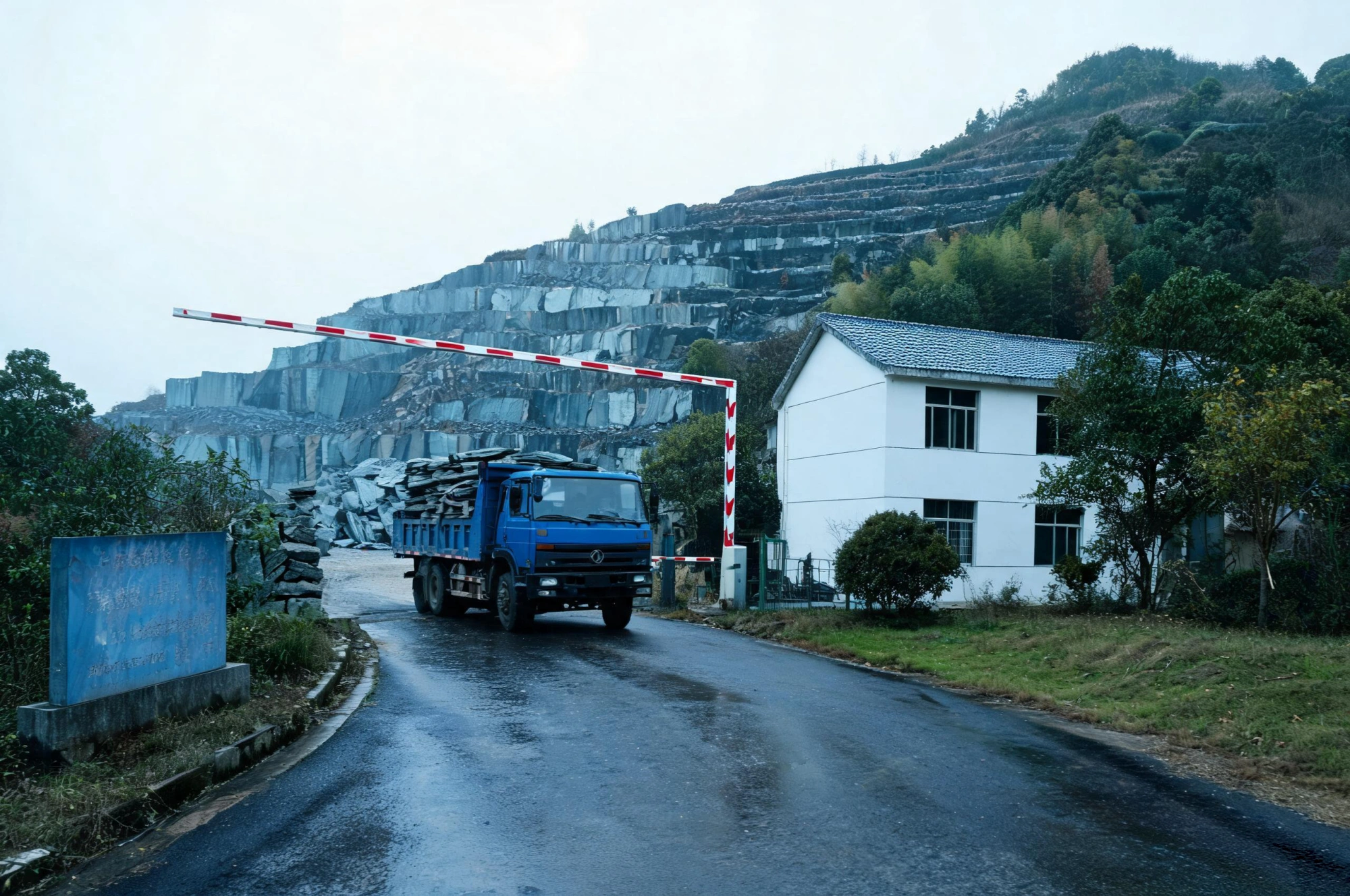
Buyers tend to hear "quota" as scarcity. Read it the other way round. A gold-rush quarry strips its best ground in a few years and closes; nobody plans for the far side of the boom. A quota-managed quarry is the opposite model: the state has a direct fiscal interest in the belt producing for decades, so volumes are set to keep the faces, the haul roads, the dust control and the restoration all sustainable. Slow extraction is not what a region in decline looks like. It is what a region being managed for longevity looks like.
There is a due-diligence dividend, too. Because the licence system is public and the volumes are on paper, a buyer's questions have verifiable answers. Which faces supply this factory? What are their licence terms? What is the permitted annual volume? Ask those in a meeting and you learn something no brochure contains — how your supplier handles a question they cannot answer with adjectives.
The Reserve You Can Touch: Stock, Arithmetic and Red Flags
Between the licence and your container sits the layer that actually ships: block stock. Drive the mountain road through Hengtang and you pass yard after yard of sawn blocks — rows of grey-blue stone stacked like loaves, seasoning in the open air between the quarries and the factories. This is the working reserve. A geological figure cannot fill a container; stock can. It is also the honest limit of any reserve claim: the number that governs your lead time is not how many million cubic metres the belt holds, but how many weeks of production the yards hold today.
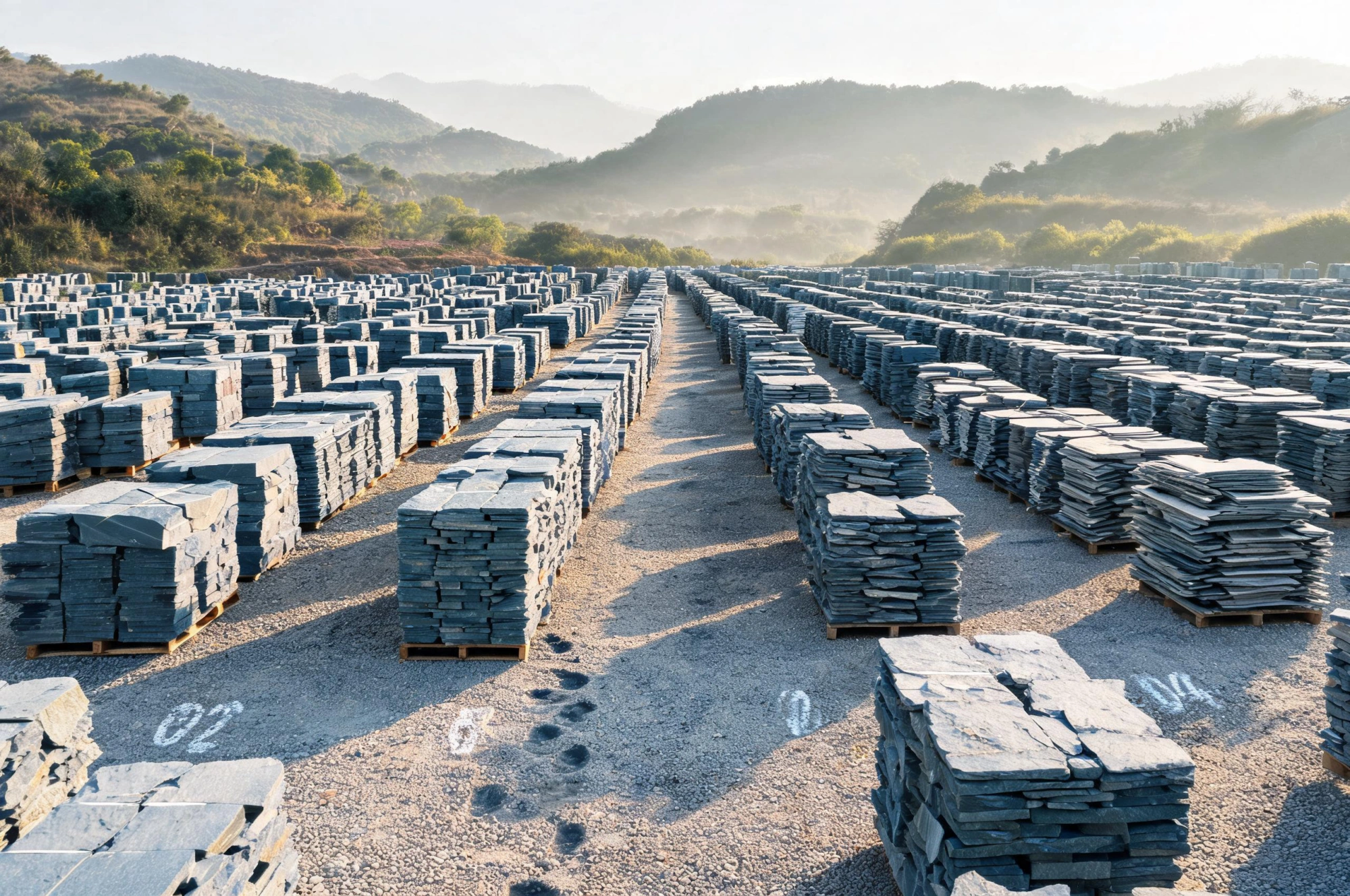
And now the arithmetic nobody likes to say out loud. No honest supplier will give you "years remaining" as a single number, because it is not one number. It is three: how much stone geology left in the ground, how much of it the licences permit out, and how much the belt chooses to cut in a given year — the last of which moves with the market. What you can do, and should do, is run the checks that separate a durable source from a fragile one. The table below is the five-question version. Bring it to any supplier in any slate region, not just ours.
| What to verify | What it tells you | Red flag if the answer is… |
|---|---|---|
| Quarry licence: boundary, term, permitted annual volume | Whether the stone has official, multi-year standing — not just goodwill | "Trust us" — no licence details offered |
| Which quarries supply the factory, and on what basis | Redundancy: one face stopping should never stop production | Blocks are bought spot, from whoever is cheapest that week |
| Block stock depth, at the factory or its yards | The buffer between your order date and your ship date | "We buy blocks when you place the order" |
| Test reports across different batches and years | Whether the beds hold their quality over time | One golden sample report, photocopied for a decade |
| A realistic quarry or factory visit arrangement | Whether transparency is a practice or a slogan | The quarry is always "temporarily closed to visitors" |
What This Means for a 100-Year Roof and a Lifetime Table
For roofing, reserve security is part of the product. A slate roof is specified to outlast its specifier, so the EN 12326 data describes the tile — water absorption, flexural strength, freeze-thaw — while the region's continuity describes the next thirty years: the re-orders, the extension that must match a ten-year-old batch, the repair order that arrives without warning. A distributor who builds a catalogue on a stone from a one-seam region is quietly betting the catalogue against the seam. A belt of bedded, licence-managed benches is a different bet entirely.
For billiard slate, the consistency argument is tighter still. Table beds are machined to close tolerances and re-ordered in singles and pairs years apart; the only way the second order behaves like the first is if it comes from the same kind of beds. Bedded deposits deliver that sameness by nature — which is one reason this region supports two industries on one stone, roofing and billiards, without stretching either thin. You can browse the finished ranges on our roofing slate pages, or start with the practical steps in how to source roofing slate from China.
What we will not do is promise you fifty years of anything — licences have terms, quarries have owners, and honesty ages better than hyperbole. What the evidence supports is this: a belt recorded at the top of the national statistics, beds thick enough to work in benches for generations, extraction licensed and capped by design, and a processing town that has held a thousand-year working tradition without exhausting the ground it stands on. For the step-by-step of turning that profile into an order, the full quarry walkthrough and our sourcing guides take it from here.
Frequently Asked Questions
How much slate does the Jiujiang region actually have left?
No single honest number covers a whole belt. The records that do exist point one way: national statistics rank Jiangxi at the top for dimension-slate reserves, and local figures for single villages in the Hengtang belt run to tens of millions of cubic metres of bluestone. But a regional total is not a delivery promise — geological reserves, licensed reserves and annual output are three different figures. For a purchase decision, ask for the quarry-level numbers, not the belt-level ones.
Is Jiujiang slate in danger of running out?
On the structural evidence, no. The ore bodies are bedded and thick — commonly 30 to 150 metres of usable stone — and the belt extends through the Lushan–Xingzi foothills rather than hanging on one seam. Extraction is licensed and capped by design, which is the opposite of the strip-and-run pattern that actually kills slate regions. The realistic risk to any single order is commercial, not geological: quarry ownership, licence terms and stock levels. Those you can check.
Who controls how much slate is quarried each year?
Each licensed quarry works inside a mining licence with a defined boundary and term, and an annual extraction volume administered under the licence by the natural-resources authorities. The licence terms are public documents — a buyer on a site visit can ask to see them at the gate, and should.
Does a large reserve number guarantee supply for my project?
No, and any supplier who says otherwise is selling you a statistic. The number that governs your delivery date is the factory's block stock and its standing relationships with licensed quarries. Reserve figures tell you the region has a future; stock levels and licences tell you whether your order has one. Check both.
How can I verify a supplier's reserve and supply claims before ordering?
Ask five things: the supplying quarries' licence details, which faces serve the factory and on what basis, current block stock depth, test reports spanning several batches and years, and a realistic site-visit arrangement. A supplier who answers all five without flinching is more valuable than any reserve statistic — and one who stalls at any of them is answering you anyway.
Related Reading
Ask the Reserve Questions Before You Place the Order
Licence-backed sourcing across the Lushan–Xingzi belt, working block stock in Hengtang, batch test data on file — we would rather answer your hardest supply-security question now than lose your trust later. Send us your checklist; we will send the paperwork, the stock photos and the samples.